
Queer

Really, queer.
Posted by
Buckethead
 on
| § 19
on
| § 19
on
| § 19

 April 2007
Really, queer.
on
| § 19
Subject: Tragedy vs Accident
Reverends Jesse Jackson and Al Sharpton, while visiting a primary school class. They suddenly found themselves in the middle of a discussion related to words and their meanings.
The teacher asked both men if they would like to lead the discussion of The word "tragedy".
So the illustrious Rev Jackson asks the class for an example of a "tragedy".
One little boy stood up and offered: "If my best friend, who lives on a farm, is playing in the field and a runaway tractor comes along and kills him, that would be a tragedy."
No," says the Great Jesse Jackson, "that would be an accident."
A little girl raised her hand: "If a school bus carrying 50 children drove over a cliff, killing everyone inside, that would be a tragedy."
I'm afraid not," explains the exalted Reverend Al. "That's what we would call a great loss." The room goes silent.
No other children would volunteer.
Reverend Al searches the room. "Isn't there someone here who can give me an example of a tragedy?"
Finally at the back of the room little Johnny raises his hand. In a stern voice he says: "If a plane carrying the Reverends Jackson and Sharpton was struck by a missile and blown to smithereens that would be a tragedy."
Fantastic!" exclaims Jackson and Sharpton, "That's right. And can you tell me why that would be a tragedy?"
Well," says little Johnny, "because it sure as hell wouldn't be a great loss, and it probably wouldn't be an accident either.
(h/t Kiwi)
 on
| § 0
on
| § 0

Just a note to remind the Ministry's loyal reader...dammit, readers...readers... that we are only three months away from Moon Conquest Day.
I hope everyone can take some time out and reflect on the stellar travellers who we have lost, commemorate America's first off-planet adventure, and celebrate telling the Russians to suck it. "It" being our collective wang which, given its interplanetary reach, is among the largest on our world.
And let's think about what symbol we can add to the flag to represent the moon. If states are stars, what can the moon be?
 on
| § 3
on
| § 3

...and once again, I find myself astounded by the institutionalized idiocy of the Transportation Security Administration.
Thanks to Richard Reid, for instance, I still get to experience the silly waste of time inherent in removing my shoes and running them through the scanning equipment. Thanks to the efforts of the 21 alleged terrorists in the UK during the summer of 2006, passenger screening personnel still get to inflict the silly waste of time inherent in depriving passengers of any liquid or gel not contained in a properly sized receptacle, or that receptacle itself not contained in the proper 1-quart see through bag. (See also this item on the Department of Homeland Security's designation of an entire state of matter as a national security risk)
A screener told me yesterday, with no small hint of pride, that, Yes! We still check all passengers' shoes! This, in sleepy little Myrtle Beach, SC, where many, though not most, of the flights are turbo-prop or 57 seat commuter jets with presumably low value as flying projectiles, and even lower value as targets for suicide bombings.
The experience reminded me of the many instances in which Bruce Schneier has had occasion to comment on the misguided nature of our government's reaction to events, including its apparent fetish for adding every new terrorist's trick to the permanent list of reasons for inconveniencing the traveling public, while adding no safety to the equation at all. Zero. I would direct the curious reader to this list of articles on Mr. Schneier's site for a thorough review of all that's wrong with the manner in which our bureaucratic overlords maintain their ridiculous pretense to be adding to our security. He's rightly called it "Security Theater", among other things.
At the time of this writing, the link just above produces a list of 244 such articles. They cover the failures of security, the knee-jerk TSA reactions to events, the useless political correctness and abuses of power inherent in current process, and the arguably unconstitutional restrictions on rights to redress for incorrect blacklisting or commentary about the process as you're having it inflicted on your person. Add to this the gaping productivity hole (estimated at $10 billion/year and up) left by the process, the passengers' costs for security (you didn't think the airlines were absorbing that, of course), and factor in a rational cost/benefit analysis (even under the assumption we wanted to guarantee that no person ever died except from natural causes) and it seems clear that security is not just irksome - it's poorly and stupidly implemented.
Luckily, it's not yet illegal to parody the process while away from airports.
(also posted at issuesblog.com)
on
| § 0
Call me anachronistic, but I use a real dictionary to look up words.
I like the internets as much as the next guy, but still prefer, more often than not, the look and feel of a solid dense bit of bookery in my hands. It means authority, and presence, and presents language in a more permanent and, I daresay, reassuring way than do bits and pixels.
Mostly. I just noticed that my dictionary is a relic of a bygone age. Not the age of print and type, but the age when terrorism had to do with Them, not Us.
I was looking for a word and happened upon a small picture in the margin that caught my eye: a tiny black and white photo of Manhattan, including the Twin Towers, associated with the definition of "skyline". About three inches down is another pic, a little larger, of just the towers and labeled "skyscraper". Also in the same corner of the page: skyjack. And sky marshall.
on
| § 7
From time to time (as often as our stomachs will allow us to manage it) we at the Ministry will look closely into the depths of human depravity both comical and twisted, and drag up whatever we find there for consideration. The general hope is that by bringing these stories into the light of day we can make them rarer. The usual effect is, instead, we end up sad and depressed about the future of the species.
So, onward!
Dateline: Washington, DC
The Washington Madam scandal has claimed its first victim: The State Department's senior diplomat in charge of USAID, which is devoted to stamping out sex trafficking, human exploitation, and AIDS, has resigned, having copped to using a perfectly innocent telephone service to hire nice Latin American women to come to his house and give him nice therapeutic "massages" in exchange for some untraceable cash money. Nice!!
Dateline: Crazytown
Newsflash: Michelle Malkin has finally completely lost her shit.
Dateline: The Congo and elsewhere
The New York Times has a heartwarmer on the rising use of child soldiers in the pointless conflicts of Africa, because they are loyal, pliable, and uncomplicated by higher philosophical thinking (plus they're easy to make more of). The article also notes that, in a cunning twist, the strongmen who hire them have at this point given up even the thinniest pretenses of a "cause," preferring to cut right to the basic raping, killing, and stealing as their main kinks.
... aaand that's enough for this week. I think I'm going to curl up in my bed under the covers for a while and wish real hard.
 on
| § 2
on
| § 2

Now that I've felt my ever less theoretical son kick me right in the hand (oh, how special!, interjects Mrs. Johno... he's been whaling on my cervix for weeks!), I have a public announcement to make:
I keep making beer, like a fool, for ever more theoretical consumption. At the moment, I have a nice floral and bitter pale ale, a spicy, strong and sweet Abbey, and a plain out freako-delicious Dunkel ready to go, and five gallons of porter curing besides. So, please.... kick my kegs. Run 'em out. I'll make more. Please help... drink all my booze, I'm begging out.
That is all.
on
| § 9
It's Friday Funtime Quizzery time. Over at Naked Villainy, we find a biblical quiz. I scared the Bejesus out of myself by getting a 100%, proving that despite two and half decades without cracking open the bible, my Lutheran Confirmation classes were ruthlessly effective. How well can you do, Heathen?
Wow! You are awesome! You are a true Biblical scholar, not just a hearer but a personal reader! The books, the characters, the events, the verses - you know it all! You are fantastic!
Ultimate Bible Quiz
Create MySpace Quizzes
on
| § 8
From a wonderful little website that I just discovered, this gem:
Guy 1: So my friend almost ran over a big family the other day but at the last moment a little boy popped up beside the car and I said 'dude you gotta make sure you get them all, or else that little boy is going to grow up and become Batman and come after you'
Guy 2: That's why they invented reverse, so that Batman won't get you.
Guy 1: They should just call it Batman. I'm just going to put the car in Batman and back into this spot.
Guy 2: Seems perfectly logical to me.
Yet another odd lexical twitch to add to my armamentarium, and confuse those near me.
on
| § 2
We’re moving into the home stretch here on Perfidy’s longest running series, alternative state slogans for alternate state people. Today, we focus on Texas, a state that has, historically, been foremost in the republic for arrogance and misplaced judgments of its own competence. Twice since independence Texas has not been part of the United States, a fact that is not well appreciated in light of Texans vehement protestations of patriotism. Anyway, on to the ridicule and fun-poking:
- I messed with Texas, and now I have a rash
- If it's good enough for Jesus, it's good enough for Texas
- Because Sometimes You Make Bad Choices
- Se Habla Ingles
- We Kill 'em So YOU Don't Have To
- 95% More Texasness Than The Next Leading State
- Crazy 'Bout Guns!
- Where everything's bigger, except the IQ's
- Mess with Texas, and Chuck Norris will roundhouse kick you to death
- All the oil, without all the burkhas
- 49 of 50 states agree, Texas Sucks
- Why?
- More episodes of Cops filmed on location here than anywhere
- Prone To Flooding
- We kill because we’re frightened little girls
- Have Fun Driving Through Us On Your Way To Nowhere!
- We gave you nuculer
- You Grill 'Em, We'll Kill 'Em
- If we secede again, you're all in deep crap.
- The Beefstick State
- I can see for miles and miles and miles and miles
- An execution a day keeps the prisons relatively empty
- The Manhandle State
- Swim to freedom!
- The unconditionally affirmative frontier
- Most, but by no means all, things are bigger in Texas
- Better Behave, or We'll Fry Your Ass
- Because You Can Never Have Enough Churches
- Come for the oppressive heat, stay for the flat dusty sameness
- Texas, Schmexas
- We Live to Annoy the Rest of the Country.
- Enjoy Leaving!
- More Mexico
- Friendship, Except When Betrayed or Approached By Strangers
- The Key To A Door You Don't Want To Open
- Yes, it is bigger. You'll have to step back though.
- Everything Is Brown Here
- Twice as loud, half as popular
- We put the "Ex" in "execution"!
- Texas: Your last, best defense against education.
- The Dumbo State
- Our state tree is the gallows.
- We Let America See Our Bush!
- The Great Horney Toad State
- That chili's not hot, you're just a pussy
- Don’t blame me, I voted Kinky
- Steers and Queers
- Y’all can go to hell. I’m goin to Texas. Damn, same thing.
- Tuck Fexas
- Welcome Wetbacks and Yankees!
- The Criminal's Lethal Injection Connection
- The Big Freakin' Hat State
- More Crime Than You'd Think
- Things look smaller in Texas
- Poker? I don’t even know her
- Texas: Come for the Adventure, Stay for your wrongful execution
- Birthplace of the meanest president in US History.
- Rodeo: a way for nominally straight Texans to dress in leather chaps and wrestle with animals
- Wetbacks R Us
- Of course we’re loners, who likes a loner?
- It’s like a whole other planet
- Gateway to Texas
- New Jersey thanks God they’re not us
- Our teenagers are the cutest! Did I say that out loud?
- Still proud of defeating Mexico
- Oil, leather, cows, mustaches… It’s not what you think
[wik] Bonus slogans!
- Okay then. LBJ was sort of an asshole.
- For the 100th time, they're 'palmetto bugs'
- We're just as God intended...although maybe not so much with the fire ants, killer bees, rattlesnakes, and little black scorpions
- 104 with 86% humidity makes you sweat? Fuckin' yankee sissy
- Hey we don't mind your freaky cult; it's the Feds
- Nation's leader in cows lost to flash floods
- All that AND tornados! What a'ya waitin' fer?
- It's really only this one guy who drives around with steer horns on his Cadillac - Earl Strickland - and he's from fucking Ohio.
- Gateway to...everywhere! I mean, fuck, look at the size of the place!
- The entire human population could fit squarely in Texas, but why the fuck would it want to?
- Bigger than alot of countries, especially pissant European ones
- Just say 'pardner' instead of 'dude' and you'll be OK
- Our strippers are 60% sassier than most other leading states
- Cornerstone of America's ludicrously-oversized-belt-buckle industry
- We have both political parties: Conservatives and Republicans
- Beers, steers, and, yes, queers
- Median strips? Sure, Tex - we put them there specifically so that you could just drive your SUV right the fuck over them.
on
| § 8
The more alert of our mostly sessile readership may have noted that astronomers have detected a new extrasolar planet. We've discovered hundreds of extrasolar planets, so why is this one so damned special? Well, let me tell you. It's earthlike. It's close. And it's in the habitable zone of its star.
Roadtrip!
Well, close in astronomical terms, and for some odd values of "earthlike." The new planet, Gliese 581c, is about half again as big, and five times as massive as Earth. The bigdomes are guessing that this would result in a surface gravity somewheres around twice that of Earth. Which would kill any fat, tall people on a colonization mission. It'd be worse than Oregon Trail. For more details on what life might be like on this planet, visit here, here, here, or here. And get in line behind this guy for tickets:
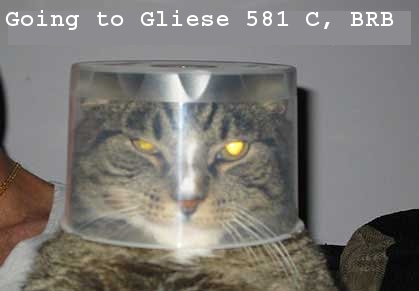
What might be most significant about this discovery is its implications for the Drake Equation – something we talked about in great depth just a little while ago. Pretty much as soon as we fired up that fancy new telescope, we discover an earthlike world, right on our doorstep. That has to be indicative of how common planets like ours are in the galaxy.
As we learn more about the big universe out there, more of the numbers in the Drake equation are looking to be large. The Drake equation can be divided into physical, life, and civilization factors. All of the physical factors are now almost certain to be large across the galaxy, so there’s no way to minimize your estimates of the number of ETs by saying that there aren’t going to be abodes for life as we know it. (Of course, they may be many other places amenable to life as we don't know it.)
As for life, there are two ways that we could get a firmer grasp on how to judge those numbers, and both are within, nearly, our grasp. Any evidence of life in our solar system would be a strong, but not definitive, clue that life is common in the galaxy. Europa and Mars are the prime candidates there. More research along the lines we are pursuing now may give us some answers. The other way is to increase our capacity to gain information on extrasolar planets, which we are also pursuing. If we get to the point where we can image these planets, it is certainly possible that we could detect chlorophyll or other biological evidence in their reflected light. Finding that would be strong evidence that life exists outside our solar system, and that it could be common as well.
That would mean that two thirds of the Drake Equation’s constituent elements would be heavily weighted toward high numbers. And that the chance of ET’s would be correspondingly higher as well.
[wik] The super nifty star map has not yet been updated to include our new vacation destination. However, you can look at it anyway by going to the to the scrolly thing right on the left side of the window, and scroll down about halfway, looking for "Gl 581." When you find it, click it, and you'll see the Gl 581 circled on the star map. Click on it, or in the window on the right to see the solar system, sadly absent little c. On the star map, if you click on the right arrow, and then the back arrow, you'll be in our sector. Neato!
A summary of the info taken from various websites, linked above:
Gliese 581c orbits a small, red star located 20.5 light years from Earth, in the direction of the constellation Libra. The star has 1/3 the size, and 1/50 the brightness of our sun.
Due to the dim smallness of Gliese 581, its habitable zone is correspondingly narrower than that of our sun. The planet, Gliese 581c (“c” for short) is within this zone, orbiting a mere 6 million miles out. That close orbit gives c a year lasting only 13 days. The presence of a large, Neptune-sized planet inside c’s orbit could mean that it is unlikely that c is tidally locked to the sun – having one side eternally facing the sun, as our moon does with Earth.
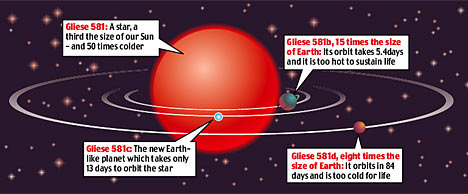
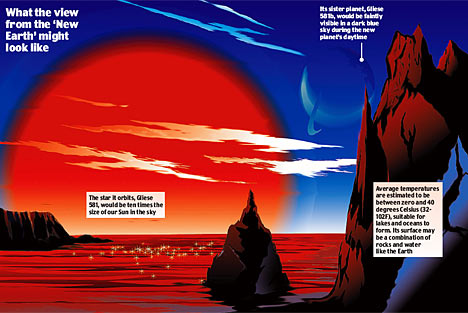
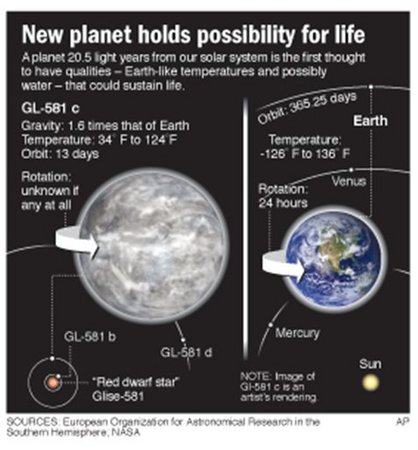
The planet itself is large, five times as massive as Earth and perhaps half again as large, or even bigger if it is made of ice and less dense than here. This would result in a surface gravity between 1.6 and more twice that of Earth. The temperature on c would be in the range of 0 to 40 degrees Celsius, or just what we have here. We have no idea what the composition of the planet is, guessing that it is a rocky world like Earth is not unreasonable. A big planet like this would have no difficulty holding down an atmosphere, and the presence of water is certainly a possibility as well.
Someone came up with this cheesy graphic, which despite its cheese gives you a good idea how big the sun would be from the surface of the planet.
This pic has some comparative stats for c and Earth:
And of course, Wikipedia has more info as well.
on
| § 12
I'm taking off tomorrow morning for another in a long series of annual gatherings of a group of my friends, at which much golf will be played and several other forms of hell may well be raised. In preparation for the trip, one of the participants, Rick, sent out a link to this video.
In our group's defense, I'm comfortable asserting that none of us will play anything near as badly as those on the film above. At least not during the first 18 holes of any given day. Oh, and the several incoherent misspellings you see in the video were there when I got it, just in case you were wondering.
on
| § 0
Dammit, David Halberstam died. He was one of the finest reporters - and finest writers - of his generation, and he will be missed.
(I imagine we can expect a story from Christopher Hitchens within the next day or two about how Halberstam was really a second-rate hack who slew children to collect their shoes.)
on
| § 2
Everyone can now stop using "inconvenient truth" - or its derivatives in any sort of writing, anywhere. If you feel tempted to do so in spite of my request, please read Orwell's "Politics and the English Language" and reconsider. Failing that, find an unabridged copy of Orwell's collected works and hit yourself repeatedly in the head with it.
on
| § 2
Who would have thought that making quality products would lead to world-wide domination? Apparently not GM, who just slipped into second place behind Toyota. When reached for comment, GM spokesmen replied, "They cheated."
The last American car I bought was a 1963 Cadillac, 20 years ago. Based on my experience with friends and relatives, I don't believe that I will buy any others in the near future - the sole exception being the potential purchase of a used pickup. The reason? They suck. Just 'cause they're made here (which, strictly speaking, they're aren't always) is not reason for me to subject myself to unreliable and poorly engineered vehicles.
[wik] Patton also posted on this very topic, but was too shy to post it at Perfidy. I will do him the favor of reproducing it here:
Hide the women and children! To the storm cellar, pronto! The Japs have sold 90,000 more cars than the, (quick - what’s a light-hearted pejorative for Detroit natives?) the Detroit guys!
…
Hey, wait a minute - so what? That little statistic is even less important than the dates and times at which the Dow Jones Industrials crossed each of the 1,000 point barriers, that is, “not at all”.
Given the fine mess that’s characterized GM these past few years, including poor results, billions of dollars in losses, junk bond ratings on its corporate debt, the jettisoning of the majority of its GMAC finance arm to Cerberus, the bankruptcy of Delphi, which it tried (and failed) to hive off as a separate, self-sustaining entity, and the battles with Jerry York, Kirk Kerkorian, and Tracinda, the fact that Toyota has passed them in sales is neither surprising nor particularly newsworthy.
They’re rather lucky to still be ahead of Ford, itself a company that is, as Monty Python might say “not at all well”.
Xenophobes and Detroit residents may mark this day as one that will live in infamy. More rational sorts will simply see it as the logical end to a progression that Toyota began, 20 years ago, when they started making cars better than General Motors was able or willing to do. Given that my last four vehicles have been made by Toyota, perhaps my objectivity isn’t perfect in this matter.
My post has the advantage of pithiness, but Patton got several more jokes in.
on
| § 11
Interesting title, from a story in yesterday's WSJ (subscription).
Short answer? "Yes, in some cases, if the company's really, really tiny."
Slightly longer answer? "Are you nuts?"
The article centers around the management practices in place at a company called Ternary Software Inc.
During a recent strategy meeting at Ternary Software Inc., a programmer criticized the chief executive's new incentive plan for employees. An hourlong discussion ensued, in which several participants, including the CEO, critiqued the proposal. Ultimately, all six participants agreed to handle incentives differently.That part was crucial: Ternary runs itself as a democracy, and every decision must be unanimous. Any of Ternary's 13 other employees could have challenged the incentive decision and forced it to be revisited.
...
The 19-person Exton, Pa., company has a policy-setting team of seven people, including two frontline workers elected by their peers. The team is linked to smaller groups through the company that ultimately give all employees a voice. The team meets to set policy for two hours once or twice a month.
The article's author cites instances of similar management practice, including Honest Tea Inc., of Bethesda, MD and Continuum Inc. from West Newton, MA. She also includes, for comparison, I guess, Google, which
...prides itself on an egalitarian culture that includes weekly updates from executives who field questions from employees.
As though that's somehow applicable.
The article goes on to include quotes from several b-school professors, including this from Ryan Quinn, a management professor at the University of Virginia's Darden School who says:
...these companies typically are willing to sacrifice some short-term profit to pursue innovation or other goals. Mr. Quinn says unorthodox practices can succeed at large and small companies, but says he has never seen a company like Ternary, that strives for unanimous agreement.
Note, he didn't say that this practice can succeed at large and small companies, just that unorthodox practices can. Like, for instance, having everyone wear a funny hat on alternating Fridays. So, overall, his response strikes me almost as a polite way of asking "Are you nuts?"
An additional bit of insight, from Harry Katz, dean of Cornell University's School of Industrial and Labor Relations, goes a bit further:
...[he] doubts a system like Ternary's could work on a large scale. In bigger companies, "there's an inevitable conflict of interest between managers and employees," Mr. Katz says.
The article also provides several other instructional views life within Ternary. Two excerpts:
Ternary's path to workplace democracy wasn't painless. The company, founded in 2001, first tried to draft a mission statement by consensus in 2004, when it had grown to more than a dozen employees. The meeting lasted two days and ended as participants too exhausted to continue arguing agreed in principle to run the company as a democracy. An attempt the next year to create a salary system by consensus was no better. But Mr. Robertson persevered, guided by two out-of-print books about a Dutch management technique called "sociocracy" or "dynamic governance." He has dubbed Ternary's system "holacracy" and has begun marketing it as a managing style.
I'll let the dripping irony in that passage speak for itself.
The meeting where the incentive scheme was discussed was typically busy. The team rejected Mr. Robertson's proposal to replace the profit-sharing program with an "ad hoc bonus system" based on performance, formulating a new plan that would keep the profit-sharing program and introduce monthly bonus incentives. The group also assigned the CEO new responsibility for spurring growth, gave the sales manager more authority to negotiate contracts, and decided to bill clients by the day, rather than by the hour.Technology chief Anthony Moquin, one of the founders of the company, said his gut reaction to the billing change was that it was simplistic. But he accepted it, saying, "We can try it and see how it works."
That's a common refrain at Ternary. Managers don't look for an ideal solution, merely a workable plan that looks like progress. Employees who don't like the results can seek a seat at the next strategy meeting or ask a member of the policy group to revisit the issue.
(emphasis mine)
Funny when you read it that way, it sounds like it should be a whole lot less interesting to the owners or managers of a company. In effect, it eliminates the value of any management role, including that of the CEO:
"It takes getting beyond your ego," says Mr. Robertson, who, as one of the founders of the company, has the CEO title but little typical CEO authority.
And it brings into question why you'd even have the title, let alone give it to someone.
The story goes on to explain how the company has benefited, in tough times, from having the flexibility to get all employees to agreement on issues like pay cuts. Quite uplifting, if you're exceptionally light and aren't running a for-profit business.
Left unsaid, in the story itself or the comments from the professors, a couple of things.
No offence to managers, employees, or Ternary Software, Inc. itself, but I'll be anxiously awaiting the future WSJ story about how Ternary grew and found the limits of what is essentially an intellectually lazy, confrontation-free, feel-good management style that doesn't strive for excellence, instead only for "a workable plan that looks like progress", and then jettisoned it as laughably unworkable.
Unfortunately, though I think you can already see where I'm going here, Ternary seems quite unlikely to ever grow too awful much, constrained as they are by a system that enforces crushing mediocrity, even in a small company like theirs.
As Professors Katz and Quinn intimated, unorthodox isn't bad, but there are a lot of things that can work in small companies which would be impossible at scale. Paying for everything on the owner's personal credit card is an excellent example. Keeping all your invoices and receipts in a shoebox is another. And, with all due respect to the admirable goal of "giving workers a voice", so is the practice of pretending they've each got something crucial and important to say about the company's direction, or that, in the event of failure, your fallback position is that "at least we all agreed on the strategy".
Sorry, but not all opinions matter equally, and without accountability for failure, there cannot be success in any non-trivial enterprise, including Ternary's. The time spent in search of universal approval of all decisions, and of making sure that every last person is happy and contented, is time wasted. And yes, this metaphor can be extended to the broader social and political realm, but I'll spare you that for now.
(all ellipsis above, mine)
(also posted at issuesblog.com)
on
| § 10
In a Huffington Post blog entry (via the last item in today's WSJ Best of the Web, after a bit of work, because BOTW referred to it, in error, I'm certain, as the "Puffington Host"), we find this dispatch from the cultural battleground, describing an encounter at the White House Correspondent's Dinner:
In his attempt to dismiss us, Mr. Rove turned to head toward his table, but as soon as he did so, Sheryl reached out to touch his arm. Karl swung around and spat, "Don't touch me." How hardened and removed from reality must a person be to refuse to be touched by Sheryl Crow? Unfazed, Sheryl abruptly responded, "You can't speak to us like that, you work for us." Karl then quipped, "I don't work for you, I work for the American people." To which Sheryl promptly reminded him, "We are the American people."
While I don't doubt for a second that Karl Rove is capable of random rudeness to songstresses and Hollywood types who make fake documentaries, I figured there had to be a better reason, and that James Taranto, of Opinion Journal, was too polite to tell the rest of the story. It turns out that there's an excellent chance Rove just doesn't know where Sheryl Crow's hand had recently been.
The answer was found in another entry at the Huffington Post site, Sheryl Crow's wisdom on how to help stop the ravages of our future global warming overlords. This excerpt summarizes both her deep, deep thinking on the matter and the reason for Rove's apprehension at her attempted laying on of hands:
I have spent the better part of this tour trying to come up with easy ways for us all to become a part of the solution to global warming.Although my ideas are in the earliest stages of development, they are, in my mind, worth investigating. One of my favorites is in the area of forest conservation which we heavily rely on for oxygen. I propose a limitation be put on how many squares of toilet paper can be used in any one sitting. Now, I don't want to rob any law-abiding American of his or her God-given rights, but I think we are an industrious enough people that we can make it work with only one square per restroom visit, except, of course, on those pesky occasions where 2 to 3 could be required. When presenting this idea to my younger brother, whose judgment I trust implicitly, he proposed taking it one step further. I believe his quote was, "how bout just washing the one square out."
See also (first four found via links from Huffington Post):
[wik] Possibly related, regarding Sheryl Crow: She’s well intended, and I don’t mean this with any disrespect, but she’s dumber than a road lizard.
on
| § 7
In honor of the International pixel-stained technopeasant day, many people are posting stuff for free on the internets. One of my favorite sf authors, Charles Stross, has posted his award-nominated novella "Missile Gap" in its entirety, over here. Missile Gap is deeply creepy, and... nevermind. I recommend it highly. Go read. Right now.
on
| § 3
So far, at least, as the day's only half over.
Context is almost unimportant for this one, but could be found, if you really wanted to and had a subscription, in today's Wall Street Journal, in an article entitled "After Big Wins in Las Vegas, An Investor's Luck Turns"
Speaking about city "councilwoman Lois Tarkanian, wife of former University of Nevada, Las Vegas, basketball coach Jerry Tarkanian", the story's protagonist, Billy T. Walters, said:
She's well intended, and I don't mean this with any disrespect, but she's dumber than a road lizard.
on
| § 1
FORT WORTH, TX—After a thorough review of the its operations, RadioShack CEO Julian Day could provide no real explanation for the analog-riddled company's staying power.
on
| § 0
We ought to also consider the possibility that disingenuousness is the most obsequious form of lying.
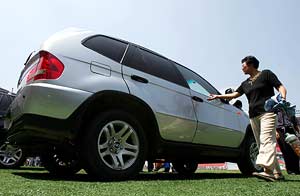
Found while catching up with my overload of simultaneously delivered Economist issues, a story entitled "Counterfeit cars in China", and subtitled "The sincerest form of flattery".
Of course, there have historically been regular instances of copyright, trade secret, and patent law violations in China. (Google search links, returning 1.3M, 287K, and 981K document hits, respectively). An argument can be made that such infringement is how third-world and emerging economies grow to become full players in the global market. That argument would ring true, however offensive the concept that "all you need to do to grow is to steal and learn".
COPYING in China goes far beyond fake DVDs, watches and handbags. “We can copy everything except your mother,” goes a saying in Shanghai. Soy sauce with fizzy water passed off as Pepsi, fake Cisco network routers (known as “Chisco's”) and mobile phones that look like the latest offerings from Nokia can all be easily found. So, too, can fake blood plasma.
Aside from the blood plasma (which I don't understand how one might fake), the rest of it is all old news. Counterfeiters of high-value manufactured goods should be restrained by to the barriers to entry, including "huge capital investment".
Of all the products to copy, however, a car is surely the most complicated. Cars consist of around 6,000 precisely manufactured components made from a range of different materials. For a car to be cheap, reliable and long-lasting, says conventional industry economics, these parts need to be put together in factories with huge volumes, lots of expensive machinery and many well-trained engineers.
Turns out that in China's case, that's not as true as might be hoped:
So it came as a surprise when counterfeit cars started to appear in China eight years ago. Early VW look-alikes were soon followed by the infamous Chery QQ. It appeared six months ahead of the car it copied, the Chevy Spark, because a Chinese firm somehow got hold of the blueprints.
All quite troubling, and it goes beyond the Chevy/Chery, affecting many other established manufacturers.
Yes, it's part of emerging economies' growth path, and yes, once they get to the point where they're creating more intellectual property than they're stealing, balance will be restored in many areas, including balance of trade, manufacturing costs, and living standards. But that doesn't happen overnight, and at some level, the imbalance causes pain in the trading system, yielding such things as (in the US) calls for trade protectionism.
Aside, however, from any arguments about whether, when, and how balance will be restored, it seems reasonable to expect some honor among thieves, no? Honor of the sort I'm considering would be that, if you're going to steal, at least don't lie about it, and if you're going to lie about it, at least put in the effort to make the lie plausible, if not believable.
What's triggered this mild outburst of mine on the subject? This:
Shuanghuan Automobile got into trouble for copying Audi's famous four-ring logo a few years ago. It then copied the design of Honda's CR-V, called it the SR-V and appears to have won the subsequent legal tussle. Last month the firm won an export licence, and it plans to start shipping another model, the CEO (pictured)—a sport-utility vehicle with a striking resemblance to the BMW X5—to Romania and Italy.
Copying DaimlerChrysler's small two-seater Smart car seems to have become especially popular. In January Shuanghuan launched an electric version, called the Dushi Mini. It followed in the tracks of Shandong Huoyun Electromobile, a firm that makes golf buggies, which launched its own version last year and announced plans to sell the car in Europe for less than half the price of the original.
After Daimler threatened to sue, the car was temporarily withdrawn. A spokesman for the Chinese firm said he had been surprised by the way his car resembled the original, explaining that the company had simply copied a toy car.
A toy car? Excuse me? Who's their spokesman, I wonder? Tommy Flanagan? Baghdad Bob?
Growing up to achieve a seat at the adult table in international trade would seem to preclude such blatant disingenuity. In the circumstances, the spokesman could have been expected to be at least a little sheepish after such an utterance.
(also posted at issuesblog.com)
on
| § 2
And some should be allowed to stand unchallenged.
Apropos this earlier item, I'd caution the participants to not be like this woman:
Woman registers a .47 on breath testerThu Apr 19, 1:41 PM ET (AP)
REDMOND, Wash. - A woman arrested following two car crashes last week registered a .47 blood-alcohol content on a breath test — nearly six times the legal intoxication threshold and possibly a state record.
Deana F. Jarrett, 54, was taken to Evergreen Hospital as a precaution following her arrest April 11, the Washington State Patrol said Wednesday. No one was injured in the accidents.
Jarrett blew the .47 on a portable breath tester after she collided with two other vehicles in quick succession, the patrol said. A check of all 356,000 breath tests administered since 1998 in Washington turned up only 35 above .40 — and none of those was higher than .45.
The legal intoxication threshold in Washington is .08.
Jarrett did not appear to have a listed phone number, and it was not clear if she had obtained a lawyer.
(excerpted in its short entirety, to avoid the corrosive effects of future link-rot)
It rather reminds me of a colleague from years ago, who once proudly held the "women's record" for blood alcohol level in Whitehall, OH, at .20%. I remember having read somewhere that .30% was lethal, but I'm not going to go and Google it, since, per the above, it must not be true.
on
| § 4
Bruce Schneier has an interesting bit up on Wired about how bad products drive out good in the security market. This is of course more broadly applicable. Worth reading.
on
| § 0
Should we need to invade Canada, we have at least one plan. Back in the interwar period, the United States maintained a series of color coded plans for wars with various potential enemies. Most well discussed of these was Plan Orange, which actually ended up being a big part of our actual war plans against Japan in the Second World War. Less well known is Plan Red, the plan for war with British Empire.
In the plan, the war was assumed to be continental. I imagine that this is because it was an Army plan rather than a Navy plan, and as such, it focused on "Crimson" which is Canada. The plan in its entirety can be found here, but the essentials are simple:
Step One, a joint Army/Navy assault on Halifax and the Maritime provinces to cut off Canada from reinforcements from Britain. Step Two, land assaults from New York and Vermont toward Montreal and Quebec City, with Quebec being the primary target. This would cut Eastern Canada off from the rest. Step Three, assaults from Niagara and Detroit into Ontario. Seizing these areas would deny the enemy their industrial facilities, staging areas for air attack, and secure control of the Great Lakes. Step Four, a thrust towards Winnipeg to cut the Trans-Canadian railway and communications between the far west and Eastern Canada. Finally, Step Five, an assault on Vancouver which would lead eventually to the occupation of British Columbia and deny Canada access to the Pacific.
This seems like a good plan, decisive strikes to disable communication, followed by occupation. Seeing as 90% of the Canadian population is within a three-day march of the American border, Canada is not exactly easy to defend. This plan, suitably updated to incorporate changes in the geo-political and military worlds, would likely have an even greater chance of success than it did in 1935. Alongside the phenomenal American military advancements over the last few decades, Canadian military strength has greatly diminished. Did you know that Canada once had the third largest Navy in the world? Canada's one real hope in '35 would have been to slow down an American offensive long enough for Britain to come to her aid. Now, Britain would find it nearly impossible to come to the aid of her former colony in the face of opposition from the US Navy.
The initial invasion would almost certainly be successful. But the idea of 33 million pissed off Canucks no longer across an international frontier is not exactly heartening.
on
| § 3
In all likelihood, this will be me, Princess Cat and Blackfive on the Friday before the Milblogger conference in a few weeks.

[wik] Princess Cat notes that we will likely have AWTM with us as well. We'll need a whole line of urinals!
on
| § 5
The United States has twice invaded Canada in the course of prosecuting wars against Great Britain. Despite this violent start to US-Canadian relations, on many occasions over the last two hundred years, people have proposed with varying degrees of seriousness that various bits of Canada be annexed to the United States. But for some people, that sort of piecemeal aggrandizement just isn’t enough.
For example, this website argues that there should be a complete merger of Canada and the United States. Given that Canada has only 10% of the population of its southern neighbor, they recommend that the Canadians adopt wholesale the political system and constitution of the United States. (And argue as well that the American Federal system will serve to preserve large measures of Canadian independence.
Among the benefits of such a merger would be the creation of, geographically, the largest country in human history. Most of the new territory is of course arctic wasteland, but it’s still land. The ten percent increase in population would narrow slightly the margin with China, which will be important in a couple decades when China goes imperialistic and attacks. Also, the added GNP will put us in a better position with regard to the EU. Dropping unnecessary border installations, customs, and redundant government installations will surely result in a savings for the taxpayer.
While this has absolutely no chance in Hell of ever happening, it is interesting to contemplate. (We’d have a better chance, I think, of picking up bits of Canada if Quebec ever decided to secede.) The most significant impact would be political, considering the close margins between Republicans and Democrats in the last few elections.
Consider: of the ten provinces, nine are big enough to become states, population wise. (Prince Edward Island only has 127,000 people – it would have to be rolled into New Brunswick or Newfoundland.) Of these provinces, now states, most would, thanks to their low populations, get the minimum three electoral votes. As we know, states with low populations get a disproportionate impact in the US Electoral College.
Bush won the 2004 election by five electoral votes. If Canada had been assimilated before the election, what would the result have been? Assuming that each province adopted the traditional winner-take all approach of most states, and that everyone who voted in the 2006 Canadian federal election for Liberal or NDP candidates voted for Kerry, this is what would have happened: Bush would have taken Alberta (6), Saskatchewan (3) and Manitoba (3), and lost by a whisker in British Columbia, for a total of 12 electoral votes. Kerry would have won in all the other small provinces, and gained BC (8) and Ontario (19), for a total of 36 electoral votes, throwing the election decidedly to Kerry no matter how Quebec voters went.
But, what if the provinces adopted the Maine method of determining their electoral votes? If so, then all the smaller provinces with three electoral votes would be unchanged, as would Alberta which went decidedly conservative. But, assume that Bush edges Kerry in BC, for a 5/3 split. And in Ontario, Bush would pick up six of the seventeen congressional districts for a 13/6 split. Both Kerry and Bush would likely pick up to districts apiece in Quebec, which gives us a total of 25 for Bush, 27 for Kerry. Bush would be up by three overall, and the last nine electoral votes would be in the hands of the Parti Quebecois.
The French would at last have their wish, control over America.
[wik] Ran into some other interesting sites in reading about the above: The Apportionment Paradox, Congressional Apportionment, and Thirty-Thousand.org.
on
| § 5
Tennessee was once nearly the state of Franklin before it all fell apart in a welter of acrimony, economic backwardness, Indian assault, and no doubt duels and whiskey. But the people regrouped, tried again, and successfully became Tennessee. For some fairly small values of "successful."
- Celebrating 50 Years Of Shitty Country Music
- We're Like Kentucky, But With Cities
- A unique fixer-upper opportunity
- The Darwin State
- The Educashun State
- The Parallelogram State
- Home of Most of Dolly Parton
- Daaaavey Crockett, King of the Wild Frontier
- The Forced Conscription State
- Got Cooter?
- We’re huge in Germany
- I Ride With Forrest
- Hooray For Dollywood
- At least we've got Elvis
- West West Virginia
- We’re bigger than France, and better smelling
- Almost Franklin
- We didn’t volunteer fer nuthin
- Don’t make me take off my Bible belt
- I love it when a plan comes together
- Home of Five Future Presidents
- Home of Al Gore, and therefore the Internet
- If you can read this motto, you may not be from Tennessee
- Follow Me To Tennessee, And Answer Me These Questions Three
- Gateway to Alabama
- I Hate Tennessee
- That’s Appalachian-American, you insensitive clod
- Fuck Walking Horses
- Tennessee is like a mullet: business in front, party in the back
- The Hillbilly State
- As Fertile as the Tennessee Valley
- Aim High: Agriculture and Commerce
- Don't go lookin for them damn melungeons
- The Hog and Hominy State
- Mother of Southwestern Motherfucking Statesmen
- The Butterbutt State
- Sounds Good to Me
[wik] There is a country-type band out of Ohio called Lost State of Franklin. They sound like a country version of Timbuk 3. It grows on you. You can listen to them here, click on "Clint Eastwood." This Clint Eastwood is nothing like the Gorillaz version.
on
| § 0
The new Ministry official motivational poster:
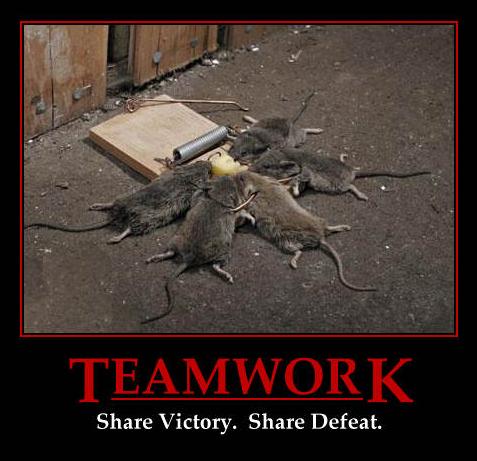
[wik] Thanks to Minister Patton's mysterious correspondent for sending us that.
on
| § 0
Chapter 11 proceedings seem to focus the corporate mind. Not always on anything that matters to business, however. Witness, below, excerpted from an email message I got from Delta Airlines today:
In a partnership with The Conservation Fund, we are the first U.S. airline to implement a voluntary carbon offset program — and we'd love to have you "onboard."
It's simple. Beginning
June 1, 2007 , you will be able to add a small donation to fund the planting of trees in sustainable managed forests around the globe when you book your ticket at delta.com. These trees will help off-set carbon emissions by absorbing carbon dioxide from the atmosphere and converting it to oxygen as part of their natural processes.We'll disburse 100 percent of your donation to "The Conservation Fund program" to plant trees and to support the organization's education and outreach efforts. Additionally, we'll make a donation to The Conservation Fund for every customer flying on a Delta mainline jet worldwide on Earth Day (April 22).
It's just part of our Force for Global Good initiative that strives to benefit the world we fly everyday. So go ahead and take a flight, and join us in uniting our customers and employees in support of environmental stewardship.
Note: this, from the company with the well-meaning customer service people who called to reschedule a flight I've got on tap for next week because their operations staff had changed things, leaving me a massive 7 minute connection time in Atlanta. Whoops. But at least they called.
Anyhow, a couple things occur to me right off the bat.
If they'd paid as much attention to their stockholders as they pretend to pay to the environment, their (former) stockholders wouldn't need to be such heavy users of Preparation H. Sure, the stock's at $0.16/share as I write this, but it's likely overvalued. Bankruptcy has a way of doing that.
Secondly, as I read that kind offer of theirs to join the "Force for Global Good", it sure looks like they're trying hard to do it with my money, and that it's not really them (other than on Earth Day™!) that will be doing the giving. If they want to give their own corporate money to a fool's boondoggle like carbon offsets, I'm fine with that. I'm not one of their stockholders, and am, in fact, a relatively steady customer of theirs. They've already proven, over the years, a callous disregard for the interests of their owners, and those owners are probably beyond surprise at this point. The customers, like me, being a bit more flexible in our ability to avoid having donations milched on our behalf, will see this as the useless public relations gum flapping that it is.
[wik] What good is corporate gum flapping without a press release?
on
| § 0
A little bird tells me that the Russkies are planning to build an undersea tunnel to the United States. No doubt this is some sort of paleo-commie plot. But it is an interesting, and hugely expensive one. The scheme is to build from the Easternmost tip of Siberia, to the little islands about halfway between there and Alaska, and then back into the water and over to Alaska. At over $10 billion, it will even cost more than Boston's big dig. The tunnel, which in its longest stretch will be underwater more than twice the distance of the chunnel, would carry rail, power, pipelines and road traffic. As cool as this is, theoretically, I can't really imagine that it would be terribly profitable, or useful. As a way to improve transportation to resource rich and largely empty Siberia, I would think that other schemes might give more payback. Saying you're connecting two continents that have been separated for 10,000 years sounds nifty. But what you're really doing is connecting the most desolate and uninhabited part of Russia with the most desolate and isolated part of the United States. If they build it, cool, but there isn't a lot of traffic piling up there, and sea transport is cheaper than rail anyway.
on
| § 0
Trawling through the vast wasteland of the internets, one finds mostly crap. To the point that Sturgeon's law seems wildly optimistic. Every now and again, though, your suffering is rewarded with unalloyed joy. This is one of those times. I found this over at AEBrain, and it is, without exception, the coolest use of Flash animation I have ever seen. (Though Homestar Runner comes close. And this is an addictive close third.)
[wik] I probably put more links in that paragraph above than I have in any in the last year. As a blogger, I should really consider linking more.
[alsø wik] Distracted by the linkiness, I forgot to say why that first link is so damn cool. Though if you clicked it, you'd know already. But I'm about to tell you, so wait a minute. The extrasolar system map is unlike most astronomical doodads you'll find, becasue it's not sol centric. Most star maps simply show what the stars look like from Earth. Which doesn't give you a good idea of how they are connected. A star map is like one of those goofy odd-perspective "the view of the world from New York" maps, that doesn't really provide any useful information. This map actually shows what stars are near each other. And, clicky on a star, and it will show if we have detected any planets in that solar system. Combine this thing with googlemaps and it would be awesome. If it had smooth scrolling between map sections, and a route planning mode with waypoints, it would be the most amazing thing in the world. Also, it would be cool if you could see more than one little bit at a time. Nevertheless, wow. Four thumbs up.
[alsø alsø wik] In light of my last post, I wonder how many of those planets in the nifty star map have ETs waiting to eat us. Most of the stars in that map are within the light cone of our radio broadcasts.
[wi nøt trei a høliday in Sweden this yër?] Broadcasting to a potentially unfriendly galaxy is probably not wise. On the other hand, a sufficiently advanced technology could detect us anyway.
on
| § 2
The blessed amazon fairy delivered another load of printed goodness at my doorstep. Typically, the amazon fairy brings me science fiction that is more or less throw-away, enjoyable to read but whose thinks pass in and then out of my brain leaving little lasting impression. Or history tracts that expand or deepen my knowledge of the past without notably changing my opinions of it. But this last deposit was a little different.
The book in the plain brown wrapper was "An Introduction to Planetary Defense, A Study of Modern Warfare Applied to Extra-Terrestrial Invasion." The careful and attentive reader of this website will quickly discern why this title got onto my wishlist. Of the four writers, I had only heard of the lead author, Travis S. Taylor, who had written a few science fiction novels for Baen Books. From the bios in those works, I knew that Dr. Taylor was a bit of a big brain, working for NASA and various defense department projects, including the Breakthrough Propulsion Physics program at NASA before its untimely demise. The name of the book and that last fact was enough for me to shell out the $35.
Was it worth it? On balance, I think definitely yes. There are problems with the book. Let’s get them out of the way first. The book is very poorly edited. There are typos, bad grammar, and poorly formed sentences throughout. That is irritating and distracts from the message the book is trying to get across. The book is poorly balanced, by which I mean that certain points will be attacked in great detail, and the next bit, seemingly of equal importance, will be glossed over. This creates a problem when the authors refer to something that was not adequately discussed further on, and my reaction is a resounding, “huh? Where’d that come from?” That’s the technical side.
On the idea side, I have far fewer problems, and where I do, it’s wishing that the authors had explored a topic a little more, or discussed something they didn’t. More on that (oh, much more. I’m going to go den Beste on their ass) later. Despite the flaws that are, I imagine, the result of what looks like self-publishing, this book is chock full of interesting, thought-provoking meaty stuff.
Why do I think so? Let me count the ways…
In thinking about aliens, two things have always bothered me, and I hoped that An Introduction would address them. The first of these problems is Fermi’s paradox, and the second is the remarkable optimism of SETI researchers. I was happy to see that this book addressed both of them, and in spades.
The Drake Equation
Before we discuss those two things, a brief discourse on the Drake Equation. The Drake Equation is not so much an equation as a means of quantifying ignorance, and adding up the probabilities of intelligent life arising in the galaxy. You start with the number of stars in the galaxy, and multiply that number by quite a few factors. The result is your own personal estimate, N, of how many ETs are out there.

N is the number of civilizations in the Milky way that have developed systems which produce electromagnetic emissions detectable from Earth. It is equal, then, to the rate of star formation times the probability that the star will have planets, times the number of habitable planets per star times the number of those planets that will develop life, times the number of those that will develop intelligent life, times the number of those intelligent species that will develop means of communication times (finally) the length of time those signals are detectable.
The first two numbers, we actually know something about. The rate of star formation is about 1.5 a year, and we are finding planets everywhere we look, so .9 for that. Number of habitable planets? For us in the Solar System, one definitely, and two maybes – Europa and Mars. Let’s say three. (It doesn’t matter if they’re not all habitable at the same time.) SETI researchers always use “1” for the number of habitable planets that develop life. How many develop intelligent life? Taylor suggests 2/3, fair enough. How many develop detectable civilizations? Taylor suggests a quarter. Run the numbers, and the Drake Equation yields an interesting result.
New, detectable ET civilizations are arising at a rate of one every three years.
Assume we’re off by an order of magnitude. That’s two civilizations per lifetime. A hundred thousand over the tenure of man’s existence on Earth. Half a billion extant in the galaxy right now.
Put in smaller numbers, and the results are still invariably stunning. Assume that only one in a hundred habitable planets develops life, and that only one in a hundred of those develops intelligent life. You still get an intelligent species arriving on the scene every thousand years. The galaxy is billions of years old. 150,000 extant in the Galaxy, right now.
Taylor and company also make some interesting additions to the Drake Equation. They take into account the size of the Milky Way, and calculate the galactic density of ETs. Using Taylor’s numbers, it is .064 ETs per square light year. Or, in a 1000 ly bubble centered on earth, there are 50,000 species. That’s intelligent, technological ETs. Even using my several orders of magnitude more conservative numbers, there are still 15 techno-ETs in local space. right now.
They also add two more factors to the Drake Equation: ft, the number of technological civilizations that go a-traveling, and v, the velocity at which those species can move about the galaxy. Here we get some even more interesting numbers. If we assume that all technological civilizations eventually travel, and that their velocity is a tenth the speed of light, then there are 200,000 travelers within range of Earth. Which means that there is a great likelihood of someone, sometime, visiting Earth. And maybe soon. Maybe next Tuesday. (Taylor provides all the math for this, btw.) You’ll have to read the book to see what his numbers suggest, you won’t believe me. (you can see a good chunk of the book here.)
The sheer number of stars in the galaxy, and the staggeringly long time it’s been around mean that whenever you plug a non-zero number into any element of the Drake Equation, you get lots of ETs, and an uncomfortable number in close proximity. Using my numbers but the same assumptions as Taylor, the likelihood of one of 60 nearby species paying a call on earth is about one visit every 166 years. Now there may be other factors that slow down the rate of visitation – varying galactic geography, randomness of placement, or even that there are even less species than we think. Another primary reason we’ll discuss next.
The chance of first contact is not so remote as we may believe.
The Fermi Paradox
Fermi’s Paradox comes from the question, “Where are they?” that Enrico Fermi asked back in the fifties after some back of the envelope calculations led him to consider that given a constant rate of expansion, it would only take millions of years for an intelligent species to spread throughout the Galaxy. And the Galaxy is billions of years old – if, at any time, an intelligent species had arisen, one might assume that they would have gotten here and, presumably, prevented us from existing in the first place.
This always seemed a fairly reasonable supposition, but it does fly in the face of the results of plugging even the most conservative numbers into the Drake Equation. Taylor and company put the eye on this dilemma and come up with a surprising conclusion. The Fermi Paradox is a crock.
Over the years, the SETI community has come up with several responses to the Fermi Paradox. We could be the first intelligent species. Or there could be any number of insurmountable obstacles to interstellar expansion: it’s too difficult, conceptually alien to other intelligences, or it’s not really a good idea and just not done. Or, it has been done and there is some sort of Prime Directive that restrains ET from screwing with us. Or ET is screwing with us and we don’t know it. Or we’ve simply been overlooked.
Now all of these things are reasonable. Taylor, however, contests the ground under Fermi’s feet. Fermi, in his calculations, used a simple population growth model. However, says Taylor, that isn’t really the best model for imagining intelligent species moving out into the big world. First, no species on Earth ever follows a simple exponential growth curve. Second, intelligent species will likely have different needs and goals, and thus will either defend niches or compete over them within a greater sentient galactic ecology.
Now this gets meaty.
“Nature here on Earth offers many examples where the struggle for existence between two similar species fighting over the same niche (food supply, space, etc.) occurs. Ultimately, one species wins out by causing the complete extinction of the other species. This phenomenon is known as the “principle of competitive exclusion” and was proposed by Darwin in 1859 in his Origin of Species.
“There are also cases on Earth where the “principle of competitive exclusion” is in direct contradiction with some well-known natural phenomenon. An example of one of these natural contradictions is called the “plankton paradox” and is focused on the variability of plankton organisms which all seem to occupy the same niche. All plankton algae use the same niche, which consists of solar energy and minerals dissolved in their native habitat waters. There are many plankton algae species, many more than the different types of mineral components in the water habitat of the plankton.”
Now this seems very interesting indeed to me. A direct analogy, which the authors do not explore – is that plankton are in effect in a space like environment where solar energy is the primary source of energy, and minerals of varying concentrations are available more or less for the taking within their environment. A spaceborne civilization using asteroids, comets, and solar energy to sustain itself and grow could be likened to plankton. One could imagine multiple intelligent races sharing this niche – with the vastness of space making contact fairly minimal. Of course, one might imagine that if plankton were a little more sophisticated, they might hate and attack other plankton that they did run into.
And that leads us to the next bit – a simple exponential growth law would not explain a species expanding into the galaxy and then running into competition. Other population growth laws – in fact, predator-prey models – might explain how well ETs do in the big galactic arena.
“Therefore, the simple Malthusian or exponential population growth as described previously is a drastic oversimplification. Perhaps Fermi’s Paradox is not as paradoxical as it seems. One could imagine that the galaxy is much like Earth with multiple species supporting and competing against each other over various niche resources. Perhaps the society that is a few million years older than us is not preying on us as often as expected because they are defending themselves from predators a few million years older than them. The possibilities are limitless. Let’s hope that we are living in a natural environment, as on Earth, where the coexistence of predator, prey, and other competing species is possible.”
A galactic meta-ecology, composed not of competing organisms as on Earth, but rather of competing intelligent species is possibly the answer to the Fermi Paradox. No species can expand willy-nilly, because of the presence of other species. Like early algae, the first species may have run wild, but ever more competent species will have, over time, engaged in competition. This competition will certainly engage the intelligence and resources of an alert species – which means that in the dark corners, new species will always be coming up to try their hand (or tentacle, flipper, pseudopod, or claw) in the big game.
The reason, therefore, that we haven’t been assimilated may be not that we are the first, or only intelligent life in the galaxy, but that other intelligent life is too busy staying alive to visit every star, or deal with every potential threat. Other species’ lifespans in the meta-ecology of the galaxy might be rather shorter than they would otherwise be, due to competition with other species. Possible aspects of this galactic meta-ecology are left unexamined in the book, which was frustrating to me, as it certainly bears directly on the main question the book is meant to answer. Still and all, a lot to think about, and we’ll be getting back to that in a minute.
Or maybe more than a minute. We will continue in part two.
on
| § 3
South Dakota, where some creepy guy once spent fourteen years carving presidents into a mountainside. South Dakota, where if there were still Buffalo, they'd roam. South Dakota...
- If Hell were a grim, wind-swept icy plain, well, then this would be Hell
- Under God and the Stony Gaze of Dead Presidents, the People Rule
- The Land of Land and Also Dirt
- Hello? Can anyone hear me? Hey! Over here!
- There’s no place like South Dakota, even South Dakota
- Closer Than North Dakota, unless of course, you’re Canadian. And you’re in Canada, as opposed to a Canadian visiting Texas. Doesn’t make much difference for Washington, since it’s West. Same for Maine. And all of New England…
- It’s better in South Dakota. Better than what, we’re not saying.
- At least we've got Rushmore
- Plenty of parking
- The North Dakota of the South
- The Original Mount Rushmore State
- Our capital has kind of a faggotty French sound, doesn’t it? Be honest
- 6,417 more square miles of nothin than puny North Dakota
- The other Sunshine State
- Seig Heil, South Dakota
- The Artesian State, nudge, nudge
- The unending blizzard state
- Bury my heart, and 299 other hearts, at Wounded Knee
- At least we’re not New Jersey. North Dakota is New Jersey.
- Gateway to the Badlands
- Just ‘cause there’s a “South” in our name doesn’t mean we’re southern
- Someone loves you in South Dakota. And he’s armed.
- Don’t trust those Hun North Dakoters
- Did you hear about North Dakota’s black guy?
- Really near North Dakota
- Come to South Dakota, we swear you’ll have a better time than the Sioux did
- South Dakota kicks so much ass, it might as well be Iowa
- Almost 7000 black people! We’re diverse!
on
| § 0
First it was the Irish, with their mining and their farming. Then it was the Slavs, those factory-dwelling scum. Then it was the Latinos with their ambition and willingness to spread mulch and cook your steak frites for little pay. Then it was the Indonesians with their endless garment factories. Then it was the Indians, who have apparently limitless capacity to take shit from irate helpline callers while producing flawless C++ code. And now it's the damn Chinese, taking the job of insane mass murderer away from the white, Christian American males to whom it is their birthright.
No. Seriously. Check this amazing shit out! Media whore Debbie Schlussel is an early frontrunner in the contest to say the least appropriate, most reprehensible thing possible about yesterday's shootings at Virginia Tech, and she's come up with a doozy. Wow!
So, the perpetrator of the Virginia Tech massacre is a Chinese national here on a student visa. And, today, this alien did “the job that Americans just won’t do.”
If you really want to be put off your lunch, kite over to her site and check out all the people who somehow agree that yesterday's tragedy is somehow an argument for tighter immigration laws (or evidence of a Great Yellow Conspiracy of unexplained provenance or purpose). Also go to her site if you somehow think I'm taking her out of context or misrepresenting the thrust of her argument. 'Cos I ain't.
Hat tip to Outside the Beltway
[wik]... and check up the to this post, which I found via qando. Just awesome!
**** UPDATE #3, 04/17/07: The shooter has now been identified as a South Korean national.****
**** UPDATE #2: The shooter has now been identified as a Chinese national here on a student visa. Lovely. Yet another reason to stop letting in so many foreign students.****
**** UPDATE: Shootings appear professional, says expert; VTU Alum on school's "Asian" Population; 2nd Amendment-Free Campus/VTU lobbied against students having guns on campus for personal protection ****
Here's what we know about the murderer of at least 32 students and maimer of at least 28 more at Virginia Tech, today:
- The murderer has been identified by law enforcement and media reports as "a young Asian male."
- The Virginia Tech campus has a very large Muslim community, many of which are from Pakistan (per terrorism investigator Bill Warner).
- Pakis are considered "Asian."
- There were 2 attacks at least half a mile apart.
- There have been at least two bomb threats to this campus in the last two weeks.
And dig her rebuttals to the comments:
Posted by: Old Atlantic [TypeKey Profile Page] at April 16, 2007 04:48 PM
Pakis are considered "Asian."
I believe the correct term is "Pakistani".
YOUR BELIEF SYSTEM IS FLAWED. EITHER TERM IS CORRECT. WHAT IS THIS--THE IMUS THOUGHT POLICE? DEBBIE SCHLUSSEL
on
| § 16
Twenty one people have been killed and at least another 21 injured at Virginia Tech. Details are scant, but apparently the shootings took place at two separate locations on the campus - in a residence hall and in an engineering building. I recognize that this is a minor note amidst a lot of much greater suffering, but reading the coverage available so far I imagine that Virginia Tech spokesman Larry Hincker is going to feel like a complete shit for saying this probably as the shootings were happening:
A bill that would have given college students and employees the right to carry handguns on campus died with nary a shot being fired in the General Assembly.
House Bill 1572 didn't get through the House Committee on Militia, Police and Public Safety. It died Monday in the subcommittee stage, the first of several hurdles bills must overcome before becoming laws.
The bill was proposed by Del. Todd Gilbert, R-Shenandoah County, on behalf of the Virginia Citizens Defense League. Gilbert was unavailable Monday and spokesman Gary Frink would not comment on the bill's defeat other than to say the issue was dead for this General Assembly session.
Virginia Tech spokesman Larry Hincker was happy to hear the bill was defeated. "I'm sure the university community is appreciative of the General Assembly's actions because this will help parents, students, faculty and visitors feel safe on our campus."
[wik] Update: Tuesday - In the comments, the Astronomicon informs us that the bill mentioned above died in committee back at the end of January, not yesterday as I had mistakenly assumed from the dateline on the article I linked. Thanks for the correction. Astro has a informative post about the bill, and goes into more detail than the article I found. It can be read here.
on
| § 3
I find, to my embarrassment, that I am utterly unable to top this. The Reg reports on a notional rule of engagement for autonomous killing machines. Boiled down, it's “Let machines target other machines, and let men target men.” But these quotes are priceless:
Many Reg readers will be familiar with the old-school Asimov Laws of Robotics, but these are clearly unsuitable for war robots – too restrictive. However, the new Canning Laws are certainly not a carte blanche for homicidal droids to obliterate fleshies without limit; au contraire.
It isn't really made clear how the ask-permission-to-kill-meatsacks rule could really be applied in these cases.
Which seems to suggest that a robot could decide, under Mr Canning's rules, to target a weapon system such as an AK47 for destruction on its own initiative, requiring no permission from a human. If the person holding it was thereby killed, that would be collateral damage and the killer droid would be in the clear. Effectively the robot is allowed to disarm enemies by prying their guns from their cold dead hands.
As clever as Mr. Canning is in trying to come up with these rules for our lethal robotic servants, in the end the three rules are going to add up to one thing: if it is human, kill it.
on
| § 0
Just read a fascinating article outlining the way that chlorophyll makes use of quantum processes in photosynthesis. It was known that photosynthesis converts the energy of the sun into sugar, and did it with remarkable efficiency. What wasn't known was exactly how this happened. But some big brains have delved into the matter, and this is what they've come up with:
Through photosynthesis, green plants and cyanobacteria are able to transfer sunlight energy to molecular reaction centers for conversion into chemical energy with nearly 100-percent efficiency. Speed is the key - the transfer of the solar energy takes place almost instantaneously so little energy is wasted as heat. How photosynthesis achieves this near instantaneous energy transfer is a long-standing mystery that may have finally been solved...
"We have obtained the first direct evidence that remarkably long-lived wavelike electronic quantum coherence plays an important part in energy transfer processes during photosynthesis," said Graham Fleming, the principal investigator for the study. “This wavelike characteristic can explain the extreme efficiency of the energy transfer because it enables the system to simultaneously sample all the potential energy pathways and choose the most efficient one.”
...Electronic spectroscopy measurements made on a femtosecond (millionths of a billionth of a second) time-scale showed these oscillations meeting and interfering constructively, forming wavelike motions of energy (superposition states) that can explore all potential energy pathways simultaneously and reversibly, meaning they can retreat from wrong pathways with no penalty. This finding contradicts the classical description of the photosynthetic energy transfer process as one in which excitation energy hops from light-capturing pigment molecules to reaction center molecules step-by-step down the molecular energy ladder.
"The classical hopping description of the energy transfer process is both inadequate and inaccurate," said Fleming. "It gives the wrong picture of how the process actually works, and misses a crucial aspect of the reason for the wonderful efficiency."
Now I'm no expert, but the bits I italicized in the quote above seem to be saying that every single damn molecule of chlorophyll in every cell of every plant on earth is a highly sophisticated (if single purpose) quantum computer. That's pretty damn amazing. And if that is the case, I am sure that if we poke around a little more, we might find other examples of this sort of thing. Like in mitochondria, or in neurons. Wow.
on
| § 12
South Carolina was among the foremost in fighting the oppression of the British, and later first to fight the Union to preserve its own. Perhaps this makes South Carolina an easy target. So be it.
- Birthplace of the Civil War
- If at first you don't secede: try, try again.
- That’s “secession” not “treason”
- Thank God Almighty the Atomic Bomb wasn’t invented in 1864
- The other white state.
- Rednecks and Peckerwoods, Unite!
- The Palmetto Bug State
- Like North Carolina, only Souther
- Try to forget the great evil in our past. We do.
- 50th in education, first in mobile home sales
- Home to the two worst Jacksons in American History
- Admit It, You Wish Lincoln Let Us Secede
- We fly the confederate battle flag ‘cause it matches our truck
- The Palmetto Dystopia
- That’s “heritage” not a history of brutal oppression and armed rebellion
- The Boiled Peanut State
- Oh, yeah -- like we're going to be concerned about an NAACP tourism boycott.
- We're "South of the Border"
- Remember The Civil War? We Didn't Actually Surrender
- Keystone of the South Atlantic Seaboard
- The Iodine State
- The Sand-lapper State
- Who Shall Separate Us? Stupid Question
- We owned more slaves than Caesar!
- Wealth gained from oppression spends like any other wealth
- Don’t let the sun set on your ass in our state, nigger
- Land of Two Mottoes
- We prefer to call it the “War of Northern Aggression”
- Ya don't think removin' that flag changes nothin', do ya, boy?
- Thank god for air conditioning and deet
- Southern pride and valor does not trump Northern industry and logistics
- We could have told the Japanese attacking a Union base by surprise was a very, very bad idea indeed.
- Come for the scrub pine and trailer shanties, stay for the barely repressed racism
- Freedom with Poverty, rather than Slavery with Luxury
- We know no caste or color
- The spirit of John Brown still lives
- Liberty and Union, One and Inseparable
[wik] I actually thought carefully before adding one of those slogans. So before you complain that I am some sort of insensitive monster, follow the link for the last four mottoes.
on
| § 1
Found in Friday's WSJ (4/13, subscription req'd):
The WSJ has a regular section of the paper dedicated to houses I wouldn't want, in places I wouldn't live, at prices I can't afford. They're always adjacent to full page advertisements from Coldwell Banker or some other house-hawker, so perhaps there's an editorial synergy at work.
The story right before the one about Snoop Dogg's home, for instance, detailed a $125 million listing for a 45,000 sq. ft. estate called "Fleur de Lys", being sold by a 46 year old divorcee you've never heard of, formerly married to a man you've never heard of, who started and sold a company you've never heard of. The last line of that listing editorial masterpiece was this:
Joyce Rey, head of Coldwell Banker's Previews division, and Robert Kass of Windermere Real Estate have the listing.
So I'm going out on a limb here, and assuming that each of the stories had its editorial birth in a call directly from a listing agent to Ben Casselman at the WSJ, or someone else who works in the pretend-editorial department for the "Weekend Journal" section.
With that lead-in, I'd like to highlight a portion of the otherwise garden variety article Mr. Casselman produced. It seems that Calvin Broadus, a/k/a Snoop Dogg (or would that more properly be "Snoop Dogg, a/k/a Calvin Broadus"?) has put a house on the market. Blah, blah, blah - sounds like a nice enough place, at something like a normal price for Southern California real estate these days.
As before, I presume the story came from the listing agent, though s/he was not named in the article. Here's the description they included in the article for Broadus, the seller:
The rapper, 35, has sold nearly 19 million albums in the U.S., according to Nielsen SoundScan, and has appeared in several films. (He's also known for popularizing the suffix "izzle.")
That, plus he was sentenced earlier this on weapon and drug charges for some earlier, and unimportant to this story, infraction.
Am I the only one who thinks it odd that (if as presumed) the listing agent who provided the story thought it was important to the story to enlighten us all that he is known for the suffix "izzle"? More important than the drug and weapons charges?
Yeah, I'm probably the only one.
[wik] I can just picture, 30 years from now, Calvin Broadus, talking to some kid somewhere, and saying "'izzle? Yeah, that was mine."
[alsø wik] I can picture some kid, 30 years from now, hearing something like that and laughing his ass off.
on
| § 0
I'm sure that the rest of the Ministers got theirs, but I must have missed the memo on the start of the Canadian seal-clubbing season. Dang.
Via an article in the April 4 2007 Economist (subscription required) entitled "On thin ice", I've learned that global warming has impacted Southern Canada's ability to provide fodder for the particpants in its seal-clubbing industry. Clearly, the government needs to do something to avoid disenfranchisement of the affected group.
THE activists have armed themselves with helicopters, video cameras and outrage. The hunters have their sharp hooks and blunt clubs, often combined into a single sinister-looking instrument of Norwegian design known as a hakapik. Canada's seal-hunting season officially began on April 2nd along with the usual row between those who denounce it as senseless cruelty and those who defend it as a traditional and necessary part of local livelihoods. Thanks to global warming, however, the argument might soon become redundant.
So it seems that the protesters are impaired in their ability to effectively protest. Global warming - Is there anything it can't do? Admittedly, not everyone can muster much sympathy for the perpetually outraged pretend-protectors of the cute little seals.
The problem?
This year there has been less of the usual footage of burly men bashing small furry skulls and of blood smeared across the ice floes. That is not because the hunters have become less aggressive, but because suitable seals have become scarcer. Thanks to an unusually warm winter, the ice is melting early in the southern Gulf of Saint Lawrence, where hunting began this week. The seal pups on which the hunt preys are reared on the ice until they are old enough to swim. So the premature thaw has drowned them—before the hunters had the chance to kill many.
Less seal-cranium-crushing= less for PETA, or whomever, to kvetch about. In a nod to realities of the matter, the Canadian government points out that seal hunting "brings income to struggling fishing communities", which I'd guess is a good thing.
Not surprisingly, the protesters don't care, and want to protest, regardless of any benefits to the communities in which the hunting occurs. However...
... campaigners against seal hunting are not wholly beyond reproach either. Few bother to make it clear that the killing of the youngest pups with fluffy white pelts has been banned for 20 years. They also make it sound as if the seals are endangered. In fact, the seal population has tripled since the 1970s.
In another bow to reality, and due to warm conditions in the South, the government has reduced the quota for seal hunters from 335,000 to only 270,000. The practical effect is to have shifted seal-hunting to the colder northern climes.
The sealers in those areas tend to hunt with rifles, and so do not provide such good fodder for media campaigns.
You'd think, reading it, that both the hunters and the complainers are equally wrong-footed by the weather, but that's not the case - the hunters can always head north. There's not enough outrage available up there for the complainers, however, and therefore I stand by my assertion that they're the ones most unfairly affected.
Oh, and yes, the new word learned is hakapik. Help me out here - the name of that tool isn't onomatopoeic, since it surely doesn't make a sound like its name. What's the description of a word which (in its English incarnation, at least) has a name that sounds as though it's describing what you can do with it?
[wik] Technically, if the protesters actually cared about the seals, wouldn't they try to save them from drowning, as well as from the evil hunters?
on
| § 0
Rhode Island was a notorious hold out during the period of the Constitutional convention, and has played an equally large role in the country's affairs in the two centuries since. As a result, this tiny state smaller than most large cities has a lot to answer for. Let us begin:
- The Little State that Couldn’t
- Pound for pound, the most corrupt state in the union
- Small? Yes, But We Know What To Do With It
- A kindler, gentler Massachusetts
- Yes, we know what a "peninsula" is
- Size ain't everything
- In Texas, we’d be lucky to be a county
- Plantations aren’t just for Mississippi
- We make Connecticut look huge
- No, We're Not Surrounded by Water
- We Don't Know Why It's Called "Island" Either
- The island state that really isn't an island
- Don't blink or you'll miss us.
- Welcome to Rhode Island... and… Leaving Rhode Island
- First to tell King George to kiss our ass
- The Anti-Alaska
- The Religious Toleration State, for some very odd values of “toleration”
- L’il Rhodie
- The Coffee Milk State
- You keep using that word “Providence” I don’t think it means what you think it means
- Look, the other side of the state!
- We've got lots to offer: crappy weather, smelly hippies, ... yeah, that's all
- Triple A Minor For The Kennedys
- We're Not Really An Island
- Have a free travel guide ... yes, we know ... its only one page
- Roodt Eylandt
- It’s cozy
- We're still not so sure about this whole constitution thing
- The only thing worse than our accent is the smell of our coastline
- Welcome! Oh, you're just heading to Boston ...
- How about a bowl of chowda with that?
- Running from Puritans since 1636
- The Little State that’s full of Absinthe Fiends
- Sshhh. You don’t have any Puritans with you?
- Freedom is just another word for nowhere else to go
- The Central Southern Gateway of New England
- We didn’t expect the Spanish Inquisition
- If battleships were proportional to state area, ours would be trawler-sized
- Nobody famous came from Rhode Island
- There’s a little bit of Texas in Rhode Island, but it’s trying to get out
- Hope. It’s all we got left
- Rhode Island, it’s the place for me, and not for thee
[wik] Bonus slogans:
- The 'taint of New England
- That's "vudeyelind" to the natives
on
| § 3
Ouch. Johno gets Mitt. Buckethead gets Joe. I get Hillary. One of these choices is not like the other two.
Why? Well, Mitt's a serious guy with a serious reputation among a fairly small subset of serious people who don't otherwise know too much about him, as Johno's undressing of him might indicate. He's not widely or well known, but Mitt has a vocal support group, and will do fine until the heat reaches room temperature in a national campaign. At that point, he's toast. Which is hard to do at room temperature, and don't ask me how long it took me to find that out.
Joe? He's famous for the same things that make him infamous, as Buckethead's clearheaded yet evenhanded rant exposes. There's a chance that he's a decent guy, underneath his hugely irkssome and noticeable but ultimately unimportant flaws. The fact that he can't seem to keep anyone's words from coming out of his cakehole, let alone his own, seems even more damning than the fact that he also has a history of not caring whose words he's using.
Easy targets, the both of them.

Not so, Hillary Clinton. Ms. Clinton is far more broadly known than either of the other two, and is still the frontrunner by a wide margin in the Democratic Party field. (See Mar 29 2007 Fox News/Opinion Dynamics poll). In that poll, Mitt Romney is tied for fourth place (at 6%) in the Republican ranks. He's tied with a guy who's not even sure he's running (Gingrich), a guy who, if he runs, would be a very interesting candidate and among the most (simultaneously) intelligent and arrogant candidates we've had to choose from in recent memory. Perhaps worse, Mitt's also trailing a guy in third place who wasn't even included in the poll until the March 29th issue, a man who has only recently entered the collective imagination for the presidency - Fred Thompson, at 9%. Fred's a guy who may still not run due to lack of energy, desire, or freedom from "indolent lymphoma". Worse yet for Fred's supporters, he's a guy who may even be too late to successfully run. And yet Mitt's still sniffing his exhaust. Like I said, easy pickings, both Mitt & Joe.
Hillary, on the other hand, at 36%, finds favor with more Democratic voters than those for Barack Obama and Al Gore combined. She may be one of the most polarizing figures in national politics since, well, since George W. Bush, but she's not someone who can be trivialized or taken lightly. And yet, that's my task here. Since this is stream of consciousness composition, I may find I've started and ended the trivialization with the picture above, one of many such candid photos that, if you pick the right frame from your choices, can make anyone look like they've got a ferret up their skirt. Pant-suit. Whatever.
Ms. Clinton is the other half of the most politically adept, yet managerially sloppy and morally "flexible", presidencies in my lifetime. I've often wondered whether she is, in raw intelligence, the smarter of the two, and a case can be made that perhaps she is. In the alternative, she's surely not far behind Mr. Clinton in intelligence. In political finesse, he has her beat by a country mile, but she'd surely have access to his gifts in that area during a national campaign. He owes her that, at a minimum, just for the dry-cleaning bills paid.
The political tactics that the Clintons, then and now, have been able to muster are brazen beyond belief. That's politics, however, and tells me more about what they're able to do to get her elected (anything required) than it does about their character (sketchy as all hell, just like all other politicians from either party). As a for instance, this, from HRC's Wikipedia page (provenance unknown, as always):
Former Bill Clinton fundraiser and ally David Geffen spoke out against Hillary Clinton in an interview with Maureen Dowd, stating that Clinton had no trouble lying and was overproduced and overscripted.[20] In response, the Clinton campaign attacked Geffen and the candidate that he is supporting for President, Barack Obama, charging that Geffen's comments reflected on Obama negatively and that Obama should return Geffen's money.
That's so Machiavellian that not only wouldn't I have reacted the way the Clintons did, I am incapable of having even considered it. If Barack Obama did anything other than laugh so hard he coughed up his lunch, I'd be hugely disappointed. But the story had the desired effect - deflection of tarnish on Bill Clinton's, and by extension, Hillary Clinton's, control of his network of allies.
Not that this is meant to be a post about him, but everything about Bill Clinton, the good and the bad, can be see as indicative of how Hillary will act as she moves her campaign forward. Sometimes the comparisons are parallels, but far more often, you'll find that they're opposites. When Bill Clinton was getting the snot kicked out of him by a rabid subset of the American body politic, it wasn't he who invented the term "Vast Right Wing Conspiracy" - it was Hillary. This, of course, was after he'd be catting about with the porcine intern, a fact about which Hillary couldn't plausibly have been ignorant. That sort of "Hey! Look over there!" defense isn't taught in grad school, as far as I know - it comes from a deep seated willingness to do whatever it takes to take and hold power. Bill was such a bad-ass smooth talker that he really didn't need to care about things like his reputation. If Joe Klein's faux-novelization of the 1992 presidential campaign, Primary Colors, is any indication, Hillary wasn't willing to rely on people forming their own impressions, unguided, of the Clintons, and had the same focus on the result, damn the impediments, even back then.
Her stewardship of the attempt at nationalized health care, in 1993, points to another polar opposite tendency between she and her husband. He was a consummate politician - a smooth talking pragmatist who, love him or hate him, had the gift of making many people listen to, if not agree with him. Hillary? Not so much. When the firestorm started after her foray into health care policy, Professor Martha Derthick (quoted in a 2006 George Will WaPo op-ed) wrote:
In many years of studying American social policy, I have never read an official document that seemed so suffused with coercion and political naiveté . . . with its drastic prescriptions for controlling the conduct of state governments, employers, drug manufacturers, doctors, hospitals and you and me.
Polar opposite of Bill? Yeah. Shrill? Pretty much.
Are her actions from the 1990s useful for predicting her likely trajectory in the 2008 Presidential campaign? Not completely. Some of the political wisdom of her husband has clearly sunk in since her initial campaign for her NY Senate seat. She's matured politically, and can, at times, seem positively statesmanlike. The risk remains, however, that she'll let out the shrildabeest. Two issues seem ripe for such a result.
First, she's called "off limits" any discussion of her relationship with Bill. I'm instinctively sympathetic to that request, not least because I'm no fan of reality TV, as I don't like to see people humiliated purely for entertainment purposes. According to James "The Lizard" Carville, in a December 2006 WaPo piece:
Despite all that, the subject of the marriage is too hot to handle. "It's uranium-242," said longtime Clinton adviser and friend James Carville, earlier this year. "You pick that stuff up and it'll blow up in your face . . . I'll talk about anything. But I ain't gettin' near anybody's marriage, especially the Clintons.' "
He's right. But the media and her opponents aren't likely so soft-hearted to leave this issue alone, and a real test of her ability to play on the big stage will be the manner in which she enforces her self-declared ban on this topic.
Another touchy spot is evident in the details of an LA Times article from Feb 18, 2007, entitled "GOP activists circling Clinton's campaign". In it, the actors discuss the tactics required to avoid a fate similar to that of John Kerry in the 2004 campaign:
Clinton has been publicly bracing for "Republican machine" attacks from the moment she launched her exploratory committee last month. Whether she can strike back quickly may prove crucial to winning over Democratic primary voters looking for assurance that she can survive a bruising general election and Swift-boat-style attacks.
"For Democrats, there's a strong sense this time around that they can't allow those same tactics to define Democratic candidates," said Democratic media consultant Jim Margolis.
If Ms. Clinton responds to "swift-boat style attacks" in the same was as Kerry did, she's toast. Swiftboating, you see, isn't slander or libel, as the LA Times and others who use the epithet would have you believe. As it applied in Kerry's case, assertions of fact were made by people close to him during his days in Vietnam, and he had a chance to respond. He largely failed to do so, and instead chose to whine about how unfair it all was. Swiftboating, then, is better defined as being put in a position where it's easier to whine than it is to rebut, respond, or explain the inconvenient facts because they're not rebuttable.
Partly because her opponents in this regard, such as StopHerNow, seem so unhinged, I don't think Ms. Clinton will be subject to the sort of factual expose and undressing Kerry begged for by his murky claims to heroism, and as a result, her best bet will be to respond only enough to such attacks that she can be seen to be responding, but not fully engaging, as it's beneath her. Claims that she's a rabid left-winger don't ring true. So what if, as StopHerNow says, she's left of her husband? He was really quite a centrist, believe it or not, and one could be to his left without being too awfully offensive. But as an apparent control freak, Hillary may not be able to stay above the fray, and that seems a risk she needs to mitigate.
One last slug in this already-overlong post, and perhaps the elephant in the room for Hillary, from that same December 2006 WaPo article entitled "The President in the Room", and an item that cements this as not just a Hillary campaign, but a Hillary and Bill campaign:
Yes, Bill can deliver political superstardom. He's a razor-sharp political strategist. He knows the institution of the presidency. His fundraising chops are unrivaled. All that is well and good -- perhaps too good, according to a September CNN poll, which showed his favorable rating higher than hers, 60 percent to 50 percent.
[wik] Other possible negatives? One word: "cankles" Two words: "pants suits"
on
| § 2
Old news, by now, but dredged back to my frontal lobe after having heard ESPN's Dan Patrick and Sports Illustrated's Rick Reilly talking on ESPN Radio today on the way back from lunch, and Reilly having said something to the effect that in five years, the winner of the 2007 Masters tournament, Zach Johnson, would be waiting tables at Olive Garden.
Apparently, Reilly has a habit of recycling his jokes:
(regarding Brett Wetterich, a rookie in last year's Ryder Cup matches) Rick Reilly, the celebrated American columnist, was more brutal. "You look at him and think, was he my waiter at Olive Garden last night? If he wasn't, he will be soon."
AUGUSTA, GA—World No. 1-ranked golfer Tiger Woods, after appearing to struggle through the weekend—playing with uncharacteristic inconsistency, bogeying twice in the final rounds, and breaking clubs—shocked the crowd at Augusta...
on
| § 0
At least so far, it's contained a few important items, many more less important items, a tiny bit of spam, and this kick in the teeth:
Florida President unsure of what to do with Ohio State
By VERN JACKSON
Gainesville Sun Staff Writer
April 4, 2007
GAINESVILLE – In the wake of Florida’s unprecedented dual championship victories over Ohio State, the University finds itself with a unique and somewhat perplexing problem.
What to do with Ohio State now that Florida owns it.
According to little known and never before used “Clause 121” of the NCAA charter, when a University defeats another member University for two consecutive national championship games by “convincing margins,” the defeated University becomes the sole property of the victor.
University of Florida President J. Bernard “Bernie” Machen readily admits that he was unaware of “Clause 121”, and is unsure of what to do with Ohio State. “They have, what is it, over 54,000 students? Plus, it’s in Columbus, Ohio. It is very inconvenient.”
The University of Florida Board of Trustees is holding an emergency meeting this Friday to deal with the unprecedented situation. According to sources on the Board, initial ideas include –
Sell It – The easiest move the Board might make is simply to sell Ohio State. However, due to the University’s size, and its location in the relatively depressed real estate market of central Ohio, it may be difficult to find a willing buyer. “We are looking into this option,” Machen says. “We have contacted the Solid Waste Authority of Central Ohio to see if they need more land.”
Keep It – This option has several difficulties, but may be the only one if Florida is unable to get a buyer for fair market value. Primary among the difficulties is the large student body population of Ohio State. However, sources on the Board did say since OSU’s student population is near Florida’s 50,000, there may be a situation where Ohio State students could be lent to Florida students on a semester by semester basis as personal valets.
Florida junior Kevin Young thinks the valet idea is just swell. “Everyone should have their own pet Buckeye,” said Young. “It would be like having your own personal fraternity pledge. I think the idea rocks!”
Were Florida to keep Ohio State, issues of whether to allow OSU to keep their current team name and mascot, as well as whether to allow them to continue to play in the Big Ten, would have to be resolved. Says Machen, “I think we could reach some sort agreement that would allow them to keep Brutus Buckeye and play in the Big 10. After all, what would we do – move them to the SEC? They would only get hurt. Since they are our wards now, we could never allow that.”
The prospect also exists that Florida would have dissolve Ohio State athletics. In that case, the issue of what to do with the student athletes is uncertain. Florida football coach Urban Meyer, when approached with the prospect of having to absorb Ohio State’s football team, paused for a moment and said, “I suppose they could be a scout team for our scout team. They really aren’t fast enough for anything else.”
Finally, there is one other idea University officials have floated, and that is simply to donate Ohio State to charity. “As I understand it, thousands of Hurricane Katrina refuges are still displaced. We could give OSU to the Katrina Relief Fund, and allow people to relocate there,” Machen said. “That could be the win-win situation everyone is looking for.”
As Kenny, my Melbourne-FL-based-Ohio-State-fan correspondent said at the end of the forwarded screed:
The Buckeye basketball team should have a good chance of making it back to the big dance next year...I saw they signed some good talent for 2008.. but what are the chances they'd get a re-match with Florida?? Not likely.....at this point I'd settle for a Buckeye Championship in Women's field hockey.
Such are the fruits (for the Buckeyes) of losing the big game, twice, I guess.
[wik] Also found, at the same site as was the t-shirt picture above, this snippet:
"I saw a sign at the game, OHIO STATE -- The New GEORGIA"
on
| § 0
We're moving into the home stretch in the Ministry series, "Alternate but less tasteful slogans for states we hate." On deck is Pennsylvania, a state which reached its zenith of importance in 1787 and has been on an ever-steeper downward trend since. On a personal note, I would like to express my deep and abiding hatred and contempt for all things Pennsylvania: from Pittsburgh and its sports franchises, to the arrogance of the Amish, to the bumpy, constraining and ever-under-repair roads with their less than courteous state troopers, and finally its sullen squareness. I sincerely wish that someone would decide to extend I-68 further west to connect with I-77, so that I would never have to drive through it again. But enough about me, let's rip on PA:
- Under Construction
- We'll huff, and we'll puff, and our cops will burn your house down
- Pennsylvania Speed Limit Still 65 mph
- Cook With Coal
- Founded in 1681 by wackos
- Not to be confused with Dracula's home
- The Oil, Ketchup, Coal, Steel, and Chocolate State
- Worth two beaver pelts a year in 1681; that's 57 cents in today's currency
- Pennsylvania. Nice.
- We're smoldering for YOU.
- Where only the girls are horsey
- Come see the charming, primitive Amish, who by comparison make the rest of Pennsylvania look advanced.
- If we can't be trusted with the Liberty Bell, what can we be trusted with?
- Training place of the secret Amish armies
- Beware the Giant Bell-Cracking Industrial Complex
- Three headed fish are tasty
- Keystonecopia
- Come For the Gritty Slums, Stay for the Abandoned Steel Mills
- With goats, all things are possible
- Where New Jersey Shits
- We've got the city of brotherly love! No, not that kind of love you pervert
- At least we’re not Utah. But we’re trying.
- The Peace through Invisible Lines State
- You want fries on that?
- Don’t hit the buggies. Amish are a violent people
- It was so bad in the eighties, Billy Joel wrote a song about us
- Gateway to Youngstown
- Our biggest accomplishment is to fit a five thousand mile long highway into a state only 283 miles wide
- Between the inbreeding and the radiation, a sportsman's paradise
- How about some Pierogies and Fanta?
- Shoofly pie is not made of flies
- TMI: It means something else here.
- Birthplace of the turnpike. That will be $82, please
- Recriminations aside, we’d love to have you visit
- Merge Right
- Our cops love C4
- It's still Nig-a-ria to us.
- How would you like a bullet with your Chianti?
- Poconos, for the best hot sheets motels east of the Mississippi
- Because we're so much better than Manhattan
- Scrapple, it’s not just a food, it’s a lifestyle
- Three Mile Island: It’s no Chernobyl!
- Free lube job with oil change
- Perfect Tensylvania
- Proud birthplace of Stephen Fucking Foster
- No, we don’t dress like the guy on the oatmeal canister.
- Secret Chocolate Rivers tended by murderous dwarves
- Keys aren't made of stone, asshole
- The nougatty center of a Maryland/New York muffin log
- Home of the Other Turnpike
- Diesel fuel makes asphalt last longer. Really.
- Someday, all of the Benjamin Franklin impersonators will fight all of the Mark Twain impersonators, flooding valleys and destroying whole towns in their wake, until nothing is left. That battle will take place in Carlisle, PA
on
| § 3
Joe Biden was born a poor black sharecropper in Scranton, PA. From an early age, little Joe made a name for himself by copying the work of others. This talent served him well until, in the 1988 presidential campaign, he was caught on tape repeating nearly verbatim a speech written by British Labor Party magnate Neil Kinnock. Along with some shenanigans from his law school days, wrapped up in a vicious little ad package by his Democratic opponent Michael Dukakis, Biden’s proclivity for plagiarism dropped him from the race.
In the intervening twenty years, Joe Biden has remained a long serving senator from an inconsequential state. He has slowly moved his way into the leadership of the Senate, and gained a reputation for loving the sound of his own voice. That Joe should be marked, even among other politicians for this quality is a stunning achievement. Like a professional hockey team saying, yeah, but that guy really likes to skate.
Joe Biden once took over twelve minutes to ask a question of Supreme Court nominee Alito. A five minute speech can last as long as a half hour – as Barrack Obama found to his dismay. He can take five minutes just to say hello. As Barrack Obama also discovered, Joe Biden will keep talking when a wiser man would stop. Biden, in describing his competitors, made this frighteningly stupid remark about Obama:
“I mean, you got the first mainstream African-American who is articulate and bright and clean and a nice-looking guy,” he said. “I mean, that’s a storybook, man.”
As many noted during the plagiarism flap two decades ago, it’s not so much that he said something that could be interpreted as racist, or that he gave a speech that was danger close to one given by a British politician. It’s the stupidity that it implies. Decades of political experience should, one would hope, instruct the candidate to avoid these mistakes. That it has not is worrisome at best.
About Joe Biden’s anti-Coolidgeness, columnist Richard Cohen had this to say:
“The only thing standing between Joe Biden and the presidency is his mouth. That, though, is no small matter. It is a Himalayan barrier, a Sahara of a handicap, a summer's day in Death Valley, a winter's night at the pole (either one) -- an endless list of metaphors intended to show you both the immensity of the problem and to illustrate it with the op-ed version of excess. This, alas, is Joe Biden…
The tragedy is that Biden, who is running for president, is a much better man and senator than these accounts would suggest. But his tendency, his compulsion, his manic-obsessive running of the mouth has become the functional equivalent of womanizing or some other character weakness that disqualifies a man for the presidency. It is his version of corruption, of alcoholism, of a fierce temper or vile views -- all the sorts of things that have crippled candidates in the past. It is, though, an innocent thing, as good-humored as the man and of no real policy consequence. It will merely stunt him politically.”
Not knowing when to shut up is a central indicator of foolishness, vanity, or cluelessness. Or all of these things. More than almost any of our 100 senators, Joe Biden does not know when to stop flapping his mouth.
Now it is early in the campaign, but I fear that like many other candidates doomed in the past to fall by the wayside, Joe Biden has no real reason to be President. This is not to say that the man is possessed of an overreaching ambition, not at all. Joe Biden is the long service bureaucratic placeholder who, after thirty years of service wants his GS-14 and reserved parking place. And like that retired in place civil servant, there is no good reason for that promotion save for seniority and a species of political inertia. In the words of the political satire, Happy Gilmore, “It’s Shooter’s turn.”
I have looked at Joe’s campaign website. There are any number of statements that can be interpreted with a generous eye as indicative of a coherent policy. But I’m not feeling generous. Joe Biden believes that there is a global economy, and that America has a role in it. Joe Biden believes that the United States, as the world’s most powerful nation, must take a leadership role in limiting or eliminating every factor that has made us the most powerful nation in the world.
There is a curious circularity to his policy positions as described on his website. For “Jobs” the key factors are energy policy and health care. For “Health Care” its jobs, econmy and using electronic records in hospitals. For “Energy” Joe Biden believes that energy policy is the center of both foreign and economic policy. Since all the oil is under where crazy people live, we should do without and invest in solar cars. And for “Climate Change” we should do without, invest in solar cars, and trade not emitting greenhouse gases.
Though energy is the center of our foreign policy, Joe Biden believes that NATO should impose a “No-Fly” zone over Darfur. He is particularly bold in calling for this even if the Sudanese don’t approve.
In short, what we the electorate have in Joe Biden is a time-serving motor mouth with a nice haircut. The next logical step in Joe Biden’s public service career is to move to the White House. However, Joe Biden has never held any sort of executive power beyond managing his Senatorial staff. Joe Biden has never exhibited any evidence of mastery of any complicated (even nuanced) policy matter. And most important to us, he has never demonstrated the ability or desire to ever shut the fuck up.
on
| § 0
However well intended, however laboriously justified, if you look closely enough, you'll often find that the results of grand government plans don't always match the rhetoric. Or worse, that the rhetoric was, well, bullshit.
Take, for instance, the recent goofy shift in the timing for switching back to Daylight Saving Time. From Brad Feld's blog, "Feld Thoughts", have a look at his initial take on the DST firedrill just recently encountered, if not endured, by Americans. Mr. Feld said:
I wrote a post on March 12th titled Daylight Savings Time is Stupid. A bunch of people agreed with me, but some didn’t, suggesting that (a) I was missing the point and it was more fun to have light at night than in the morning or (b) the “authorities” insisted that we’d get GDP gains, (c) there would be big energy savings helping save the world, and (d) restaurants and stores would make more money due to sunny night shopping. Oh – and I also learned DST = daylight saving time, not “savings.”
After the event, about which a manageable but still non-trivial amount of media ink was spilt warning us of the second coming of Y2K (and ignoring completely, or being so misinformed as not to have known, what a complete non-event that was in the real world), Mr. Feld checked in with one of his colleagues, "Ross the IT guy", for a real-life opinion on the matter.
A minute spent viewing "Comments on Daylight Saving Time from an IT Guy" provides clear, if not definitive, proof that it was all a waste of time. An excerpt highlighting variance between dreams and reality:
DST change (Daylight Savings Time) has made no difference in national energy consumption and probably cost us more than it saved in lost productivity.
Big shock, that. No net effect, based on several sources with which Ross, the IT guy, checked.
Since we are all home the same amount of time we're all pretty much using the same amount of energy.
It seems so obvious in retrospect that you'd think it would have been just as obvious in prospect.
There is, I should note, a dissenting comment on Feld's blog. It's backed by nothing, of course, and refers to "volumes of research on this area, it's not just politicians spouting off", but I remain unconvinced this was anything but a complete waste of time. The cost to update all the systems required to put the change into effect was a one-time cost, and won't be repeated through all future cycles from standard to daylight saving time. But the benefits, unlike the costs, seem ephemeral at best, and non-existent at worst, and I'll continue to believe that until it's credibly reported to be otherwise. I haven't seen any stories claiming savings, and have seen several, in addition to Mr Feld's, claiming the opposite.
It reminds me of another current hot-button issue, about which many folks clamor for immediate action without having scientifically, accurately, or definitively assessed the cost of inaction, or the benefits of action. Or, failing that as an impossibility, admitting that those same costs and benefits are about as quantifiable as the number of angels that can dance on the head of a pin.
But I'll spare you any further flogging of that particular horse, since I expect Minister Buckethead will soon be doing that job better than I can. Stay tuned.
on
| § 0
Found on Digg Spy, as the most intelligent comment on a story entitled "Tom Hanks signs on to Angels & Demons for Record Payout?".
Now, mind you, it came after a bunch of comments about how Angels & Demons was far superior to the Da Vinci Code. Which is absurd, as it's like comparing runny shit to smelly shit. Who knows which was actually worse? Who cares? They both (the books, not the types of shit) served a purpose, namely to be throw-away airport reading purchases, which is precisely how I came to read them both.
Anyway, the comment linked above, from Dumbledorito, reads, in its entirety:
A&D has a plot so linear you could put your eye out with it. Plus, it has an antimatter bomb (WTF?) and will probably piss off even more Catholics. The ending was more improbable than the Pope having been a former ping-pong champion, and lastly, if you're going to make a movie about the Illuminati, it should be based on the works of Robert Anton Wilson.Sorry to rant. I just didn't care for it. It was also another "scholar wet dream" film as the bookish nerd-professor gets the hot chick thanks to his esoteric knowledge of an obscure subject.
Yeah, like s/he said.
on
| § 4
It seems that the first annual Ministry Manatee Hunt and Barbecue, while a roaring success, was not quite roaringly successful enough. It seems that the total number of Manatees is on the rise, and some are even talking of removing the dread sea cow from the endangered list. Back in '91, the manatee census revealed that there were 1261 of the beasties skulking about in the waters of Florida. The most recent census tallies 2,812 of the critters. Which means that despite killing over 400 and donating the meat to soup kitchens and homeless shelters, we still have not been able to even reduce, let alone eliminate, the population of manatees. It seems that we will have to redouble our efforts, and institute a semi-annual Ministry Manatee Hunt and Barbecue.
[wik] We discovered that a dry rub barbecue works best with the well marbled manatee steaks. Add a nice hefeweizen, some corn on the cob, and you're in heaven.
[alsø wik] For GeekLethal, a pic of the perfect Manatee huntin' rifle, the Barrett M82:

[alsø alsø wik] For everyone else, this charming story about the M82.
on
| § 3
If you happened to pick up a copy of today's issue of USA Today, you could find a story entitled "Katrina claims stagger corps". You could find the same thing if, as happened to me, you saw it on a newswire, and thus didn't have to trouble yourself with purchasing the paper, with its sometimes-difficult-to-stomach format and voice. (n.b. - not it's opinion voice, but the clipped, short attention span voice they seem to choose for their stories, often resulting in news that, while it's neither more nor less accurate than anywhere else, didn't get the name "McNews" for nothing)
The story's key points are a bit breathtaking - New Orleans is seeking $77 billion in restitution and Louisiana's attorney general wants $200 billion.
New Orleans and Louisiana, swamped when the city's storm protections failed during Hurricane Katrina, demand the federal government pay a damage bill that is more than double the entire cost of the massive Gulf Coast rebuilding effort.So many claims have been filed against the U.S. Army Corps of Engineers that the agency needs at least another month even to tally the floor-to-ceiling stacks, spokesman Vic Harris says.
{...}
Those two alone are more than double the $110 billion Congress approved for Florida and the Gulf Coast after Katrina and two other hurricanes struck in 2005.
(ellipsis mine) Ouch.
The story, having specifically listed the amounts above sought by New Orleans and the state itself, goes on to elaborate:
New Orleans and Louisiana seek broad requests for costs after Katrina but don't list specific damages.
The great thing about suing for damages, from a defendant's point of view, is that the damages do have to be enumerated. In addition, any mitigation already provided will have to be taken into account, and surely the federal government's $110 billion so far approved must have contained some funds which have been applied against such damages.
There's also the sticky matter of shared responsibility. Particularly in the case of New Orleans, the actions taken and omitted by Mayor Nagin and his government in the aftermath of the hurricane would imply competence at some small fraction of anything the Corps might have exhibited. In any event, it's going to be a royal mess to sort out.
Luckily, there's an attorney involved, so don't you worry; this should all end up right as rain:
Homeowners could seek damages of an additional $200 billion or more, says Jerrold Parker, a lawyer whose firm is trying to organize a class-action suit against the corps."Just looking at the place, it's clear that there's tremendous damage," he says. "The fact is, everyone knew the protections were inadequate."
{...}
The corps must either pay or reject each of the claims. Those whose claims are rejected can take the agency to court. Parker says his firm represents more than 3,000 people who want to sue.
(ellipsis, again, mine) For the record, “Just looking at the place, it’s clear that there’s tremendous damage” doesn't count as "enumeration of damages". He also presumes, of course, that his 3,000 clients' claims and the contingent fees he hopes to glom from them are all in addition to the generous amounts sought by the various government agencies. This doesn't even pass the "red face test", let alone the "giggle test".
Left undiscussed in the story is the rationale by which the government and its agencies are liable for failing to provide absolute and flawless protection for flooding in, say, New Orleans.
A city that lies "5-10 feet below sea level". On the same page linked just left, you will see that...
The Army Corps of Engineers verifies that the New Orleans area has 325 miles of Congressionally authorized hurricane protection including: Westbank (66 miles); New Orleans to Venice, La. (87 miles); LaRose, La to Golden Meadow, La. (40 miles); Grande Isle, La. (7 miles); Lake Pontchartrain and vicinity (125 miles).
...but Mother Nature doesn't pay much attention to the Army Corps, let alone (just like the rest of us) to Congress.
Bad things happen to good cities. They also happen to New Orleans, which is not now, nor has it been in the past, a "good city". It's a truly unique city, and a very interesting one, but neither of those connotes goodness. While less, or at least differently, so than in the past, due to the effects of the hurricane, it's still a bit of a cesspool.
It's cops are notoriously and blatantly corrupt. They've had more than their fair share of murderers wearing the uniform, too. And, aside from the murder, that's just the cops - the elected politicians are no better. William Jefferson, he of the refrigerated cash, is a stellar example of this breed, but hardly the only one.
But it doesn't stop there. From the Autumn, 2005 issue of the City Journal:
The second job is less obvious. New Orleans’s immutable civic shame, before and after Katrina, is not racism, poverty, or inequality, but murder—a culture of murder so vicious and so pervasive that it terrorizes and numbs the whole city.In 2003, New Orleans’s murder rate was nearly eight times the national average—and since then, murder has increased. In 2002 and 2003, New Orleans had the highest per capita city homicide rate in the United States, with 59 people killed per year per 100,000 citizens—compared to New York City’s seven. New Orleans is a New York with nearly 5,000 murders a year—an unlivable place. The city’s economy has sputtered over the past generation partly because local and state officials have failed to do the most elementary job of government: to secure the personal safety of citizens.
And then there's the race card, described in the same article:
In the aftermath of the storm, hand-wringers wondered why they hadn’t noticed before that so many American blacks live in Third World conditions—supposedly only because they’re black. CNN’s Wolf Blitzer voiced white America’s knee-jerk best: “You simply get chills every time you see these poor individuals. . . . So many of these people, almost all of them that we see, are so poor, and they are so black,” he mused on the air.But Americans didn’t notice this before because it’s not true. Despite the president’s rhetoric, and despite those indelible images from the Superdome and the Convention Center, New Orleans is just as much a black success story as a black failure story.
Yes, New Orleans has a 28 percent poverty rate, and yes, New Orleans is 67 percent black. But nearly two-thirds of New Orleans’s blacks aren’t poor.
Yes, it’s true that nearly 25 percent of New Orleans’s families live on less than $15,000 a year, according to the 2000 Census. But 19 percent of New York’s families live on less than $15,000—and it’s much more expensive for poor people to live in New York, making them poorer.
New Orleans itself, its attorneys, and their clients, even more so than the state of Louisiana, appear to be trying to make their myriad problems those of all their fellow U.S. citizens. Simultaneously claiming poverty and race-based neglect from the federal government along with dismay at how wretched the city is now, ignoring that it's pretty much always been wretched, they're going for the gusto.
Or trying to.
It seems unlikely that, once the mess of layered claims, some bogus, some inflated, and some already addressed by insurance or other government single- double- or triple-handouts, is parsed, the extent of damage related to the breach of the levee system might be anywhere near crystal clear.
Add to that the absurdity of expecting guarantees from anyone, government or not, of protection against the weather, it becomes easier to hazard a guess as to what the outcome of this might be. I expect that the Army Corps, and by extension, all U.S. taxpayers, will be absolved of the imaginary financial responsibility that the plaintiffs in these cases are trying to foist off onto us.
(also posted at issuesblog.com)
on
| § 0


