Scientists Baffled

A peek into the world of scientists pulling unreplicable theories out of their collective ass.

Epstein Killed Cold Fusion

I am no longer in the habit of rendering witty, sharp, and on-target responses to rapidly changing world scene. A generous way of looking at this would characterize my thoughts as measured, wise, and deep. A less gracious estimation would be that ol' Buckethead over there is just old. 

So though there is a manifest and staggeringly deep well of evil that lies, stinking and shimmering in the heat of its own decay in the middle of our civic affairs, involving as it does the high, the mighty, and the innocent, I am not going to comment on any of that. Instead, I am going to notice one thing that while certainly less mind-blastingly vile than pretty much any random page of the vast trove of DOJ-released Epstein documents, is perhaps weirder:

regarding cold fusion. i killed pons years ago

So claimed Epstein to Al Seckel in 2009.

Ok, first of all let's just have a big, hearty wtf. WTF, over?

We've been edging toward the Unified Field Conspiracy Theory of Everything for quite a while now. Epstein, JFK, hidden technology, the Jews, the deep state, ubiquitous surveillance, Mossad assassinations (which means more Jews), aliens and UFOs, everything you can shake a stick at, plus the stick1plus the Mormons!. Things that were so far outside the Overton window as to be beyond the event horizon of reasonable discourse are now regular topics of discussion. This is all, for lack of a more punchy term, really fucking weird to the relatively normal person I once was.

So here we have two seemingly completely separate tentacles of the uber-conspiracy reaching around and fondling each other. Epstein, as the seeming nexus of all evil - and remember, in 2009 the world still seemed pretty normal - was not only connecting British royalty, billionaires, politicians, and scientists with underage girls, he was taking time out from his busy schedule to kill cold fusion research.

Ah, cold fusion. We even talked about that here at the Ministry back in the before times. There's long been stories floating around that there's something there, there - that set ups along the lines of Pons' original experiment generate energy, but not in an easily reproducible way. The Navy had played with it, some Israelis, a dude in France who while he might have gotten some results behaved in the cagy, secretive manner of a crank. No one ever made any real breakthroughs, but then no one ever put a lot of money into figuring it out.

Is it another instance of dark forces2really dark forces, in this case burying technology that would have improved our lives? At this point given the revelations not just in the Epstein files but elsewhere, you almost have to bet on the conspiracy being right given that just about every conspiracy short of the flat earth has been.

It's a fucked up world, kinfolk.

Posted by Buckethead Buckethead on   |   § 0

Science!

Some science-flavored links for your enjoyment:

So, we're all going to become gay cat ladies, then freeze to death in the new ice age because all the power was knocked out by a stupendous solar storm. Then, the ice weasels come.

Posted by Buckethead Buckethead on   |   § 0

Oh, ramp on the inside

Now this makes more sense than a barrel full of sensible stuff.  People have been arguing about how those crazy Egyptians built the pyramids for, literally, thousands of years.  Now some French dude thinks he's got it sussed out:

A radical new idea has recently been presented by Jean-Pierre Houdin, a French architect who has devoted the last seven years of his life to making detailed computer models of the Great Pyramid. Using start-of-the-art 3-D software developed by Dassault Systemes, combined with an initial suggestion of Henri Houdin, his engineer father, the architect has concluded that a ramp was indeed used to raise the blocks to the top, and that the ramp still exists--inside the pyramid!

The theory suggests that for the bottom third of the pyramid, the blocks were hauled up a straight, external ramp. This ramp was far shorter than the one needed to reach the top, and was made of limestone blocks, slightly smaller than those used to build the bottom third of the pyramid. As the bottom of the pyramid was being built via the external ramp, a second ramp was being built, inside the pyramid, on which the blocks for the top two-thirds of the pyramid would be hauled. The internal ramp, according to Houdin, begins at the bottom, is about 6 feet wide, and has a grade of approximately 7 percent. This ramp was put into use after the lower third of the pyramid was completed and the external ramp had served its purpose.

The design of the internal ramp was partially determined by the design of the interior of the pyramid. Hemienu knew all about the problems encountered by Pharaoh Sneferu, his and Khufu's father. Sneferu had considerable difficulty building a suitable pyramid for his burial, and ended up having to construct three at sites south of Giza! The first, at Meidum, may have had structural problems and was never used. His second, at Dashur--known as the Bent Pyramid because the slope of its sides changes midway up--developed cracks in the walls of its burial chamber. Huge cedar logs from Lebanon had to be wedged between the walls to keep the pyramid from collapsing inward, but it too was abandoned. There must have been a mad scramble to complete Sneferu's third and successful pyramid, the distinctively colored Red Pyramid at Dashur, before the aging ruler died.

Well, yeah.  And, he's got the evidence:

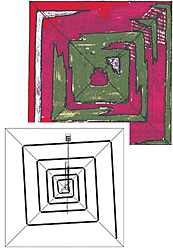
A microgravimetric survey done in the 80s revealed what looks like a blocky spiral on the inside of the pyramid.  Pretty cool.  Read the whole thing, here.

Posted by Buckethead Buckethead on   |   § 0

Linkalicious - science edition

Discovered Locklin on Science a little while ago, and I've been trolling through his archives. Found several gems - Spotting Vaporware, Nano Nonsense, The Airship: An Aesthetic Appreciation, The Atlantic: Tool of the Oligarchy, To Learn About the Future, Study the Past, How Hackers Ruin Everything With Computers, and finally, A Peregrination on the Nature of Money. That's a lot of links, but I commend all of them to you.

The Amish don't get Autism. This goes into the whole vaccination/autism thing, about which I am undecided. I probably lean towards vaccination.

Homeless Planets may be common. I thought homelessness never appeared in the media unless there was a Republican in the White House. Some catastrophists have speculated that Saturn and its moons were homeless, until captured by our Sun. It is interesting that several planets have almost identical axial tilts.

Comet collides with Sun during massive CME.

According to NASA’s SOHO, a bright comet, most likely from the Kreutz family of comets, which was discovered by amateur astronomer Sergey Shurpakov, slammed into the sun, but as it dove into it a coronal mass ejection blasted out. There is no correlation between the strike and the solar eruption; it was just a coincidence.

I guarantee it was not a coincidence. As the comet comes in from the outskirts of the Solar System, it will be moving into a differently charged regime. That is why comets have tails. This was an electrical connection between the comet and the sun, and this isn't the only time that this has happened. There's a whole bunch of EU comet articles here.

Comet theory of North American extinctions coming under fire. Shame, it was a cool theory.

Looks like there is a link between cosmic rays and cloud cover, modulated by solar activity. This, if true, would invalidate most of the AGW we've had shoved down our throats for the last decade or so.

Alfven and the electric universe.

In an ESA report last month the high-resolution of the Herschel space observatory produced another surprise, “The filaments are huge, stretching for tens of light years through space and Herschel has shown that newly-born stars are often found in the densest parts of them... Such filaments in interstellar clouds have been glimpsed before by other infrared satellites, but they have never been seen clearly enough to have their widths measured. Now, Herschel has shown that, regardless of the length or density of a filament, the width is always roughly the same. “This is a very big surprise,” says Doris Arzoumanian, Laboratoire AIM Paris-Saclay, CEA/IRFU, the lead author on the paper describing this work. Together with Philippe André from the same institute and other colleagues, she analyzed 90 filaments and found they were all about 0.3 light years across, or about 20,000 times the distance of Earth from the Sun. This consistency of the widths demands an explanation.”

So what is the favored conventional explanation? What else but “sonic booms” generated by "exploding stars!” But where are these exploding stars? And explosions should impose some degree of radial curvature on these filaments. But what we see is more like the tortuous paths of cloud-to-cloud lightning bolts. For that is what they are, in fact, on a cosmic scale.

The ‘father’ of plasma cosmology, Hannes Alfvén, wrote in 1986, “That parallel currents attract each other was known already at the times of Ampere. It is easy to understand that in a plasma, currents should have a tendency to collect to filaments. In 1934, it was explicitly stated by Bennett that this should lead to the formation of a pinch. The problem which led him to the discovery was that the magnetic storm producing medium (solar wind with present terminology) was not flowing out uniformly from the Sun. Hence, it was a problem in cosmic physics which led to the introduction of the pinch effect...

However, to most astrophysicists it is an unknown phenomenon. Indeed, important fields of research, e.g., the treatment of the state in interstellar regions, including the formation of stars, are still based on a neglect of Bennett's discovery more than half a century ago... present-day students in astrophysics hear nothing about it.” [Emphasis added]

The constant width over vast distances is due to the current flowing along the Birkeland filaments, each filament constituting a part of a larger electric circuit. And in a circuit the current must be the same in the whole filament although the current density can vary in the filament due to the electromagnetic pinch effect. Therefore the electromagnetic scavenging effect on matter from the molecular cloud, called Marklund convection, is constant along each current filament, which simply explains the consistency of widths of the filaments. The stars form as plasmoids in the Bennett-pinches, also known in plasma labs on Earth as Z-pinches.

Here's two sites which, regardless of whether you end up buying it or not, are just fun: Ancient Destructions and Saturnian Cosmology.

And, Bosnian pyramids.

And Zero Hedge dips into weird science: Earthquakes and Weird Atmospheric effects. Strange phenomena have been associated with earthquakes since the classical era, but seem to be largely dismissed nowadays.

Posted by Buckethead Buckethead on   |   § 1

Plasma Focus Fusion

Instapundit linked this item - Compact Fusion Experiment Demonstrates Confinement of 100 keV (Billion-Degree) Ions in Dense Plasma which is indeed cool news:

In a breakthrough in the effort to achieve controlled fusion energy, a research team at Lawrenceville PlasmaPhysics, Inc. (LPP) in Middlesex, NJ, announced that they have demonstrated the confinement of ions with energies in excess of 100 keV (the equivalent of a temperature of over 1 billion degrees C) in a dense plasma. They achieved this using a compact fusion device called a dense plasma focus (DPF), which fits into a small room and confines the plasma with powerful magnetic fields produced by the currents in the plasma itself. Reaching energies over 100 keV is important in achieving a long-sought goal of fusion research—to burn hydrogen-boron fuel. Hydrogen-boron, (also known by its technical abbreviation, pB11) is considered the ideal fusion fuel, since it produces energy in the form of charged particles that can be directly converted to electricity. This could dramatically cut the cost of electricity generation and eliminate all production of radioactive waste.

The dense plasma focus has been studied for over 40 years. However, LPP has been able to make great strides since its ―Focus-Fusion-1 experimental device started producing data in October, 2009, due to its unique, patented design. Most importantly, its electrodes, which produce the self-pinching action that concentrates the plasma and current, are much smaller than those of other DPF devices with similar peak currents. The electrode assembly is only 4 inches across and less than 6 inches in length.

The fusion energy yields achieved in these experiments are still far less than the energy used to run the machines. However, LPP hopes to make rapid progress in the coming year when the machine will be running with hydrogen–boron fuel for the first time.

They've made more progress in fusion in the last couple years than billion dollar efforts achieved in decades.  What may not be apparent at first sight, though, is that the lead researcher behind all this progress - Eric Lerner of Lawrenceville Plasma Physics - is the author of The Big Bang Never Happened, and his proposed ideas regarding plasma cosmology - quasars and the like.

Robert Bussard of Bussard Ramjet fame had another line of investigation that was similar in some respects - the Polywell - but funding ran out and then he died from multiple myeloma.  Research does continue though.

Posted by Buckethead Buckethead on   |   § 3

Stuff!

Gary Taubes, author of the life-changing (for me, at any rate) book Good Calories, Bad Calories now has a blog, and  a new book coming out this month - Why We Get Fat: And What to Do About It. That would make a nice late Christmas present.

Coming out two weeks before that, in fact, this next Tuesday, is Tim Ferriss' new one, The 4-Hour Body: An Uncommon Guide to Rapid Fat-Loss, Incredible Sex, and Becoming Superhuman. I enjoyed his first book, the 4-hour Workweek, which, while not exactly containing world-shattering new information is useful in providing in one place information and a perspective that would have taken vast effort to compile. It hasn't changed my life - but I hope it will in the new year. At least a little, anyway. I think the new one will be a useful companion piece to the information I've already assembled for the whole diet/exercise program I'm now following.

I'll post a review once I get it.

Posted by Buckethead Buckethead on   |   § 2

Smoking, it's all good.

The Hawaiian Libertarian drops a big post on the whole smoking is bad for you thing.

I don't know what would piss off Mrs. Buckethead more - me continuing to smoke, or continuing to smoke and justifying on the basis that the government is lying.

There's a few links in the article - ones that Aretae didn't include in his posts on the subject a while back.

I think I will switch to American Spirits or the like, though. I've been smoking cowboy killers for too long. I don't really want to go to the trouble of roll your own, and smoking organic would fit in (a bit, kind of) with my general trend toward healthier stuff.

[wik]: The other posts in the red pill series over at HL are all worth reading, if you haven't already. And you should have. Slacker.

Posted by Buckethead Buckethead on   |   § 1

Scientists Baffled

If you pay attention to science news, you may have noticed this sort of headline: "Scientists Shocked" or "Scientists Baffled." The teaser headline leads you to a heroic story of hero scientists heroically unjamming the gears of science.

What you may not have noticed is the pattern. Six or seven times out of ten, the scientist is an astronomer or cosmologist. And if you read even more closely, you'll find that the same sort of shocking results crop up at regular intervals. For example, every time a probe gets near a comet, we see a rash of reports of baffled scientists running around with their heads cut off, shocked at the results reported back by our robotic emissaries. Often, in the second paragraph, or perhaps the last, you'll see a comment along the lines of "It's back to the drawing board."

But two years later when the next probe arrives, the same confusion reigns.

Clearly, someone did not go back to the drawing board, and paradigms were not altered.

Aside from comets, one of the most common sources of bafflement is electromagnetism in space. Keep this in the back of you mind next time you scan the science news. Remember that hot gas is plasma. Plasma is electromagnetic. The easiest way on earth to generate high energy radiation - gamma, x-ray - is with plasma devices, entirely without the need for rapidly spinning gravitational sources. Finally, there's no such thing as magnetic field line reconnection - field lines are as real (though fully as useful) as lines of longitude or latitude. They can't reconnect.

Now read an article like this one. It's typical.

Here's a fun one about ball lightning, with a space connection.

In other science news, climate models are awesome. Borepatch weighed in on that one, too. And sunspots may have had something to do with the little ice age.

Posted by Buckethead Buckethead on   |   § 0

Science!

I've run across a few sciency links that caught my interest.

  • E.O. Wilson, famous scientist, inventor of sociobiology and proponent of the kin selection theory that attempted to explain the selflessness of ant workers has changed his tune.

    The researchers offer their own alternative theory, based on standard natural selection, but with a twist: After starting with a focus on a single founder, selection moves to the level of colony. From this perspective, a worker ant is something like a cell — part of a larger evolutionary unit, not a unit unto itself.

    “Our model proves that looking at a worker ant and asking why it is altruistic is the wrong level of analysis,” said Tarnita. “The important unit is the colony.”

    The researchers propose a theoretical narrative that begins with a primordial, solitary ant — perhaps something like the ancient Martialis heureka — that lived near a food source and developed genetic mutations that caused it to feed its offspring, rather than letting them fend for themselves. Called progressive provisioning, such nurture is widespread in insects.

    Another mutation could result in offspring that stayed near the nest, rather than leaving. They would “instinctively recognize that certain things need to be done, and do them,” said Nowak, describing real-world examples. “Put two normally solitary wasps together, and if one builds a hole, the other puts an egg in it. The other sees the egg, and feeds it.”

    That would be enough to form a small but real colony — and from there, eusociality could emerge from an accumulation of mutations that led to a hyper-specialization of tasks, limited reproduction to queens alone and favored the colony’s success above all else. Within this colony, a queen would be analogous to a human egg or sperm cell — a unit that embodies the whole. Worker self-sacrifice is no more nonsensical than that of a white blood cell.

    The researchers called this series of steps a “labyrinth,” one that isn’t easily navigated. Hence the rareness of eusociality, which is believed to have arisen just 10 to 20 times in history. But their theory explains everything that kin selection does, plus what it doesn’t.

    “There is no need whatsoever to invoke kin selection or inclusive fitness,” said Corina — not in eusociality, not in any cooperative behavior.

    Interesting in that kin relationships (while not unimportant) are subordinate to evolutionary changes that allow cooperative behavior.  The relevance to HBD, and evolutionary changes that may have altered human patterns of socialization over the past few millenia, will deserve some pondering.

  • I'm curious as to why this report gets mainstream coverage without a hint of disdain, when other plasma theorists are ridiculed.  It's the same thing.  But still, good that the researchers are using real experiments rather than computer models to try and figure something out.
  • The Younger Dryas was a period of intense cold almost 13,000 years ago.  Overall, there's been continuous warming since the end of the last ice age - the Younger Dryas period is a sharp, and rather long, exception to that trend.  Some have speculated that a (relatively small) cometary impact may have caused the cold.  This period also saw the extinction of megafauna in N. America, and the demise of the Clovis culture.

    In sedimentary deposits dating to the beginning of the YD, impact proponents have reported finding carbon spherules containing tiny nano-scale diamonds, which they thought to be created by shock metamorphism or chemical vapor deposition when the impactor struck.
    The nanodiamonds included lonsdaleite, an unusal form of diamond that has a hexagonal lattice rather than the usual cubic crystal lattice. Lonsdaleite is particularly interesting because it has been found inside meteorites and at known impact sites.

    But, another team of researchers has reported that they found no diamonds in YD boundary layer material.  Instead, they say, it's graphite.

    “Of all the evidence reported for a YD impact event, the presence of hexagonal diamond in YD boundary sediments represented the strongest evidence suggesting shock processing,” Daulton, who is also a member of WUSTL’s Center for Materials Innovation, says.
    However, a close examination of carbon spherules from the YD boundary using transmission electron microscopy by the Daulton team found no nanodiamonds. Instead, graphene- and graphene/graphane-oxide aggregates were found in all the specimens examined (including carbon spherules dated from before the YD to the present). Importantly, the researchers demonstrated that previous YD studies misidentified graphene/graphane-oxides as hexagonal diamond and likely misidentified graphene as cubic diamond.
    The YD impact hypothesis was in trouble already before this latest finding. Many other lines of evidence — including: fullerenes, extraterrestrial forms of helium, purported spikes in radioactivity and iridium, and claims of unique spikes in magnetic meteorite particles — had already been discredited. According to Pinter, “nanodiamonds were the last man standing.”
    “We should always have a skeptical attitude to new theories and test them thoroughly,” Scott says, “and if the evidence goes against them they should be abandoned.”

    Of course, that attitude is also required for existing theories. But nevermind. The fact that there is a YD boundary layer, and it's composed of a thick layer of carbon - well, that should be indicative of something bad going on, like perhaps lots of things burning. I'd be curious to hear what the YD impact proponents have to say about this.

  • The Burgess Shale is a fascinating bit of meaty science - and now, there is another.  The new fossil beds are only a few miles from the Burgess deposits, but scientists have already discovered eight taxa previously unknown to man.  Pretty cool.
Posted by Buckethead Buckethead on   |   § 0

Dark forces are aligning against us

Or cold ones, anyway.  This guy says that the 30-year Pacific Decadal Oscillation, La Nina, and the Antarctic Oscillation are all already in their cold phases, and that the North Atlantic Oscillation will be negative by December. This, combined with the recent extended solar minimum and the collapse of the thermosphere (record lows according to NASA) spells really cold weather on tap for this winter.  The southern hemisphere might already be feeling it, and the last two winters might be nothing on what's in store.

If he's right.  But I wouldn't stock up on suntan lotion.

Posted by Buckethead Buckethead on   |   § 1

It's science day!

In light of the last post, here's another useful thought on the reliability of consensus science:

In a Wired article published at the end of May, writer Erin Biba bemoans the fact that “science” is losing its credibility with the public. The plunge in the public’s belief in catastrophic climate change is her primary example. Biba wonders whether the loss of credibility might be due to the malfeasance unearthed by the leak of emails from the Climatic Research Unit at the University of East Anglia in the United Kingdom, but comes to the conclusion that malfeasance isn’t the cause of the public’s disaffection. No, people have turned against science simply because it lacks a good public relations outfit. Biba quotes Kelly Bush, head of a major PR firm, on the point: 

Biba says researchers need a campaign that inundates the public with the message of science: Assemble two groups of spokespeople, one made up of scientists and the other of celebrity ambassadors. Then deploy them to reach the public wherever they are, from online social networks to “The Today Show.” Researchers need to tell personal stories, tug at the heartstrings of people who don’t have PhD’s. And the celebrities can go on “Oprah” to describe how climate change is affecting them—and by extension, Oprah’s legions of viewers.

“They need to make people answer the questions, What’s in it for me? How does it affect my daily life? What can I do that will make a difference? Answering these questions is what’s going to start a conversation,” Bush says. “The messaging up to this point has been ‘Here are our findings. Read it and believe.’ The deniers are convincing people that the science is propaganda.”

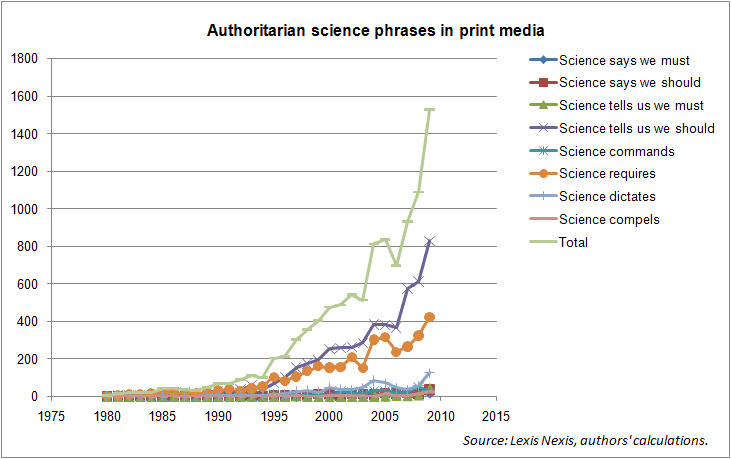
Well, then.  Science, back in a golden age before the politicization of research when scientists were men and women liked them that way, pronouncements from "science" were descriptive, not proscriptive.  "We found this to be true."  Not, "Do this or that."  The authors of this article decided to check up on things.  Looking at Lexis-Nexis, they searched for occurrences of phrases like, “science says we must,” “science says we should,” “science tells us we must,” “science tells us we should,” “science commands,” “science requires,” “science dictates,” and “science compels.”

And look what they found:

That's quite an increase in a mere quarter century.  As the authors note, over the same time period it looks a lot like Mann's hockey stick.  And perhaps for the same reason.

Posted by Buckethead Buckethead on   |   § 2

The Denialsphere?

While looking for some links for the last post, I ran across this interesting bit:

Much has been written of late about the nature of denialism. New Scientist a couple of issues back produced a special report on the subject, for example, and the New Humanist explores the idea of "unreasonable doubt."

There's plenty more out there. The most provocative I've come across (thanks to Joss Garman via DeSmog Blog's Brendan DeMelle) is a 2009 paper in the journal Studies in History and Philosophy of Modern Physics by Jeroen van Dongen of the Institute for History and Foundations of Science at Utrecht University in The Netherlands. His thesis is ideologically based denialism of science has a long pedigree, and he begins his paper with this quote from Albert Einstein:

This world is a strange madhouse. Currently, every coachman and every waiter is debating whether relativity theory is correct. Belief in this matter depends on political party affiliation.

The parallels between the political opposition to relatively in certain early 20th-century circles and today's pseudoskeptical approach to anthropogenic global warming are striking.

Indeed,the actions of many of Einstein's opponents resemble those of the thinkers now often referred to as, in perhaps an all too derisive manner, ''crackpots''. It thus appears that this phenomenon is at least as old as the existence of institutionalized science, which arbitrates authoritatively what is, and what is not, sound scientific practice and established truth; crackpots, with their own unshakable beliefs, in the end rather deny that authority than give up their ideas.It has long been clear that dismissing the anti-relativists' objections as those of an assortment of dimwits who simply did not get it, as physicists intuitively have tended to do, does not suffice.

"On Einstein's opponents, and other crackpots " is not a long paper, nor particularly dense. Check it out.

Just because a million people believe something to be true, doesn't mean it is. I refer you to Aretae's many posts on how sure you should be on things - but especially Logarithmically Right.  Another factor is that the specialization of science leads scientists in field A to accept as true without examination the consensus of field B without examining them.  And then use those conclusions in their own theorizing. Which are then used as inputs by the scientists in field B.  Positive feedback loop.  Cosmology and particle physics are particularly guilty of this.

And if James Hrynyshyn, communications consultant and freelance science journalist based in Western North Carolina, is especially vigilant in following things that link to his site, I suggest that he look at Aretae's post on climate, which is what I would have posted had he not written that first, and better.

[wik] Just to get snarky - follow the link.  Dude who wrote that is a little creepy looking.  The intense stare of the zealot.

Posted by Buckethead Buckethead on   |   § 0

This looks interesting

Via Boing Boing, a book on the maths I might want to read:

In problem solving, as in street fighting, rules are for fools: do whatever works--don't just stand there! Yet we often fear an unjustified leap even though it may land us on a correct result. Traditional mathematics teaching is largely about solving exactly stated problems exactly, yet life often hands us partly defined problems needing only moderately accurate solutions. This engaging book is an antidote to the rigor mortis brought on by too much mathematical rigor, teaching us how to guess answers without needing a proof or an exact calculation.

In Street-Fighting Mathematics, Sanjoy Mahajan builds, sharpens, and demonstrates tools for educated guessing and down-and-dirty, opportunistic problem solving across diverse fields of knowledge--from mathematics to management. Mahajan describes six tools: dimensional analysis, easy cases, lumping, picture proofs, successive approximation, and reasoning by analogy. Illustrating each tool with numerous examples, he carefully separates the tool--the general principle--from the particular application so that the reader can most easily grasp the tool itself to use on problems of particular interest.

From an MIT perfesser. Not something one normally associates with streetfighting, but hey, I'll play along.

Posted by Buckethead Buckethead on   |   § 1

First work out in like, decades

I started my super-slow workout program just now, and despite only doing five exercises for a little over a minute and a half each, I am convinced that this is serious exercise.  It's been about fifteen minutes since I stopped, and my muscles are still all a-trembly.  I lifted weights semi-regularly for a while back in my twenties.  I seem to remember that the weights were a bit bigger then.  But that's to be expected, that was almost twenty years ago, and now I am a decrepit old man.

I signed up for the gym in my office building, and I am now having buyer's remorse.  The machine I thought was a leg press when I looked at it from across the room is actually a leg extension machine.  And there's no seated row-type machine either.  I substituted a lat pull for the seated row today - next time, I'll use the free weights to do a proper one.  However, the weights are all dumbbells - there's no bars or stands.  Which sucks, because I can't replace the leg press with a squat if there's no bars or racks.  And what's really annoying is that I signed up through December because the pro-rated yearly membership was the best deal, by far - only $40 more than a month membership.

So, I used the leg extension machine.  I don't know if it would make more sense to keep using that - it does hit the quads, after all, or use the one bar I have at home without a rack.  Not safe, really, with no one to spot me.

Thoughts on super-slow based on my now vast-experience with the system: it kicked my ass.  The slow, controlled pace really gets you.  I remember doing multiple sets of ten that didn't burn like this did.  I was pretty good at guestimating the weight that would get me to failure in about a minute and a half - only slight adjustments will be necessary for next time.  All the upper body exercises (seated row lat pull, chest press, pull down, overhead press) hurt, and my muscles were like jelly after.  Which is, as I understand it, how it should be.  But the leg press extension hurt much more.  It hurt a lot.  It took a fair chunk of will power to get to ninety seconds, and I actually cheesed out a bit and didn't really go to failure.  I don't know why that exercise hurt that much more than the others.  Strange.  The explanation for that one is probably wherever my back fat went to.

Despite my disappointment with the lackluster facilities, I'm feeling pretty good about the whole thing.  Right now, my arms, back and chest feel pleasantly tingly and sore.  My thighs are recovering, though they still feel week.

I wonder if it might make more sense to price out a power rack and some decent free weights, and spend the money on that rather than on a renewal at this place.  I've got room in the garage, and seeing as I work at home, it shouldn't be hard to find the time.  And after six months or so, I think I'd be in the habit enough to trust myself to keep at it.

Posted by Buckethead Buckethead on   |   § 5

Weird Diet Effects

As some may be aware, two weeks ago I started a paleo diet with Aretae and some others.  So far, aside from some on the whole minimal slippage, I've kept the diet pretty well.  As happened last time I did a paleo diet, my energy level is significantly higher, and my general sense of well-being is improved.  I'm losing a little over a half pound a day, average, and  yesterday crossed a bit of personal milestone - I'm under 260 for the first time in somewhere around a decade.  (Yea, me.)

All cool, right?  But the funny thing is, the weight is not coming off in a uniform fashion.  One of the things that pushed me to start the diet again was that about a month ago, I scratched my back and felt a little more padding than I should have.  Holy backfat, Batman!  Not in gross quantity - I'm not orca fat by any stretch - but unpleasant.  Today, I scratched my back and it was gone.  Gone, as in completely and utterly not there.  My back feels toned and shit.

Which is odd, because earlier, I had been complaining that it felt like I was getting fatter in the gut, even though I know I'm losing weight at a pretty good clip.  I guess that perception is just because I'm losing the non-gut fat faster.

The human body is a strange and terrible thing.

[wik] at my current wasting rate, I should be down to my dating weight in just three months.  Though I understand that weight loss on this sort of diet often plateaus for a while before resuming.  I'll be able to wear a bathing suit just in time for first frost.  Awesome timing!

[alsø wik] Before:

[alsø alsø wik] After:

[wi nøt trei a høliday in Sweden this yër?] I think I'll look better without the mustache.

Posted by Buckethead Buckethead on   |   § 2

Science!

Some science links I've accumulated over the last few days, annotated.

  • Instapundit and many others linked this article from the Times, How Microbes Defend and Define Us.  (Including, since I started this post this morning, Aretae and Isegoria.) Fascinating bit - "In the mouth alone, Dr. Relman estimates, there are between 500 and 1,000 species. “It hasn’t reached a plateau yet: the more people you look at, the more species you get,” he said. The mouth in turn is divided up into smaller ecosystems, like the tongue, the gums, the teeth. Each tooth—and even each side of each tooth—has a different combination of species."  Those documentaries on the bugs that live on our skin always creeped me out.  But somehow, this is just remarkable.
  • The Death of Nemesis - in two versions.  There's a theory, fairly well established now, that something really, really bad happens every 27 million years or so.  One popular explanation for the extinctions has been Nemesis, a dark companion to the sun that periodically came in close and f*cked shit up.  But the new study shows that the very regularness of the periodicy argues against Nemesis, because we know that there have been close encounters with other stars, etc, over the last 500 million years.  No star could maintain that regularity over that time.
  • Higgs Boson, the God Particle, not discovered.  Rumors around the campfire were saying that the God Particle had been found.  Not so, say the Lords of the Tevatron.  I really doubt that it ever will be.
  • Black Holes apparently blow bubbles. A short one:

    A relatively small black hole has been spotted blowing bubbles with diameters of more than 300-1500 light years.

    Robert Soria of the University College London and colleagues pored over images and data from the European Southern Observatory and Chandra X-ray Observatory, zeroing in on an unusually large remnant from a supernova explosion. Its host galaxy appears in the Sculptor constellation of Earth's southern sky, around 12.7 million light years away.

    They discovered three hot spots in the x-ray emissions, all in a row, and identified the central one as the core of a black hole a few times larger than the sun. The two spots flanking the core are produced by jets colliding with interstellar gas.

    A nearby star feeds the black hole, giving it energy to shoot a flood of particles out each side at near the speed of light. These jets are much more powerful than expected for a black hole of this size, blowing bubbles that expand faster than the speed of sound. The finding suggests that more of the energy spent by a black hole goes into accelerating matter - rather than emitting x-rays - than previously supposed.

    I'd like to point out that gravity is an attractive force. Not likely to cause jets. Electromagnetism, on the other hand, is known to produce jets (plasma) and x-rays (in x-ray machines, for example) and accelerate particles (particle accelerators).

  • Giant Planets.  Cool article about the discoveries around Beta Pictoris, only 60 ly away.
Posted by Buckethead Buckethead on   |   § 0

Excermacize

On the recommendation of Aretae, I went and downloaded Body by Science.  Damn.  Another consensus wisdom bites the big one.  Doug McGuff and John Little show through the magic of science, that most of what you've been told about exercise is wrong.

The basic idea is that only by exercising to failure do you actually convince the body that it needs to be stronger.  They go into rather more detail than that - and convincing detail, backed by studies™ - but that's the essential take-away.  Constant low-energy exercise is just wasted time and energy because you do not fully test your muscles, and you are interfering with the body's efforts to heal after exercise. Also, you put yourself at risk for injury, and you are adding wear and tear that isn't necessary if your goal is increased strength or cardio-vascular fitness.  They go on to say that the distinction between aerobic and other types of exercise is bogus - if you build the infrastructure of greater strength, you are building cardio-vascular fitness.  Separating out cardio merely benefits one aspect of fitness, at the expense of others, and at the great waste of time and effort.

Ten minutes a week, five exercises.  That's a program that I can get behind, and the fact that the authors totally diss on running is a plus point in my book.  Looking back, I was at my strongest after a long summer breaking up concrete.  I think I became strong and fit because I was unconsciously following elements of this program that I never did in earlier exercise programs.  A lot of what I did, day to day, was relatively low intensity effort.  But every so often, I'd have to really exert myself all-out to do something - move a huge-ass chunk of concrete, whatever.  And according to the theories in Body by Science, it was probably that that made me strong.  I had never exerted myself all-out in the gym, and the results were always limited.

Cool.  I am going to add this to my my paleo diet.  I go into work a couple days a week, and there's a gym there, so that will be just perfect.

For those of you without a program and wanting to keep score, here's a short list of consensus views that I now think are largely bullshit:

  • Exercise physiology and methodology: exercise to exhaustion with five distinct exercises once a week is more effective in building strength and endurance than any number of hours running, weight lifting, biking or whatnot done in the traditional manner, and reinforces positively with the next item.
  • Diet and Nutrition: fat is good and carbs are bad - high consumption of carbohydrates relative to protein and fat is the direct cause of fat people and the associated metabolic syndrome diseases of diabetes, heart attacks, hypertension; and possibly acne in teenagers and who knows what else.  We aren't evolved to deal with carbs, full stop.  Paleo or something like it is therefore the answer.  Best book on this is Good Calories, Bad Calories, by Taubes.
  • Modern Cosmology: dark matter is clearly a fudge factor, and modern astrophysicists are clearly ignorant or flat out wrong on the behavior of electromagnetism and plasma.  Magnetic field lines do not and cannot "reconnect," this alone invalidates much of solar and astrophysics.
  • Democracy: in the small sense, I think that the explosion of bureaucracy is undermining what good we had here.  In the bigger sense, I'm convinced that the Formalist ideas are on the right track.  If it weren't for a few key problems, I'd be with Aretae on his anarchist pleasure island - my ideal state would be a small monarchy that implemented libertarian policies.
  • History: from the idea that the founding fathers were a bunch of whiny crybabies (a view I held long before Moldbug) I moved on.   I think that Velikovsky may have been right, or at least on to something - our understanding of history might be very different from what really happened - and if that's the case, then the geologists and paleontologists might be tragically wrong, too.  Thing is, the sciences take as gospel what other sciences say.  If the astrophysicists say it's been steady state for billions of years in the Solar System, the geologists will believe it, and that influences size of the idea space for their own theories.  They will automatically disregard any theory that conflicts with other theories.  So if the astrophysicists are wrong - which I firmly believe - then everything else can be wrong.  Not necessarily - but what have we ignored because of what we believe?
Posted by Buckethead Buckethead on   |   § 10