An Orbit of Eternal Grace

Science, mad or otherwise. Rockets and space travel, and maybe we can get off this sordid rock.

Sopwith Camels and 747s - The BFR's Military and Strategic Implications

Last month, Elon Musk gave us a new, revised version of the SpaceX development roadmap. Last year’s ITS is now a (slightly) smaller BFR. But small is a bad descriptor for what SpaceX calls  with perfect justice the Big Fucking Rocket.

Even a precis of the BFR is rather epic. 150 tons to low earth orbit. Fully reusable. Three times the payload of the previous biggest fucking rocket - the Saturn V, yet only a fraction of the cost per launch. Mars missions, lunar bases, point to point ballistic transport on Earth... and all by itself, the second stage is a low payload single stage to orbit craft. (Albeit with low payload compared to the full BFR stack.)

Awesome, in the original constituted entirely of awe sense.

There are a couple grains of salt we must gnaw upon though. First, Musk has a lamentable habit of overpromising. But as one wit noticed, if you convert human years to Mars-length Musk years, you can usually have a decent idea of what the actual timeline will be. Second, The BFR is largely - though not entirely - vaporware at this point.

Yet we have some mitigating reasons to be optimistic. SpaceX has mastered the basic technologies that will be used in the BFR. Most important, the reusable boosters and propulsive landing. SpaceX has made significant progress on the most important single piece of the new BFR, the Raptor engine. It works, and all that remains is the relatively straightforward development work to make it a production scale product.

Beyond the technical, SpaceX’s existing business is beginning to rake in the cash, and is poised to utterly dominate next year’s launch market. This year, they’ve already launched more rockets than any other company - or nation. The Falcon Heavy first launch is expected within a month. Though Musk might be late, he usually does deliver. And right now, he and SpaceX are on a big roll.

Sometime in the next five years or so, the first working BFR could launch. What does it all mean?

Is it a DC-3 or a 707?

Some have compared the BFR to the DC-3, or the Boing 707. These comparisons aren’t entirely misplaced - each of those forerunner aircraft had immense significance, opening up practical air travel in the propeller and jet ages respectively.

Cheap, reliable air travel requires at least one industry - the manufacture in bulk of cheap, reliable aircraft. Obviously though, that doesn’t exist in a vacuum. Those aircraft must be purchased by people who think they can use them to make a profit, or accomplish some purpose. Here’s where things get interesting.

First is the virtuous cycle. You make a DC-3, it’s popular. People buy them to move passengers, cargo, mail. Governments buy them to move troops, implements of war, or VIPs. Money flows into your coffers. You buy a pony, and use the rest to design and manufacture the DC-8, and then the 707. Eventually, you’ve got 747s that dwarf the payload, speed, and (inversely) the price per pound per mile of moving things you had when you started with your DC-3.

Second is the parallel development of civil and military aircraft. The long range civilian DC-3 used the same technologies as the long range military B-17. In fact, the Douglas Aircraft Company built both of them in WWII, even though the B-17 was a Boeing design. Advances on one side generally sooner or later made an appearance on the other. Jet engines designed for fighter planes evolved into engines for civilian jetliners. Often, civilian cargo designs were repurposed for military use in airlift or as tankers for in-flight refueling.

There is no such thing as a purely civilian advance in transportation technology.

A better transport is a better bomber. A more fuel efficient engine is a longer-range fighter. And so on...

***

Besides being an industry in and of itself, aircraft created entirely novel industries and made other things possible. Airmail, air freight - FedEx wouldn’t exist without inexpensive air travel, and neither would west coast major league baseball teams.

In this light, we can see that the BFR could easily have a similar effect. It becomes an industry in and of itself: the building of spaceships. It creates or facilitates industries - space freight, satellite launch, or others.

All good, right?

That's Not It, Though

But all of that misses the real point.

Right now, there are two types of rockets. Elon Musk’s, and everyone else’s. And the gap between the two is getting vastly bigger by the day.

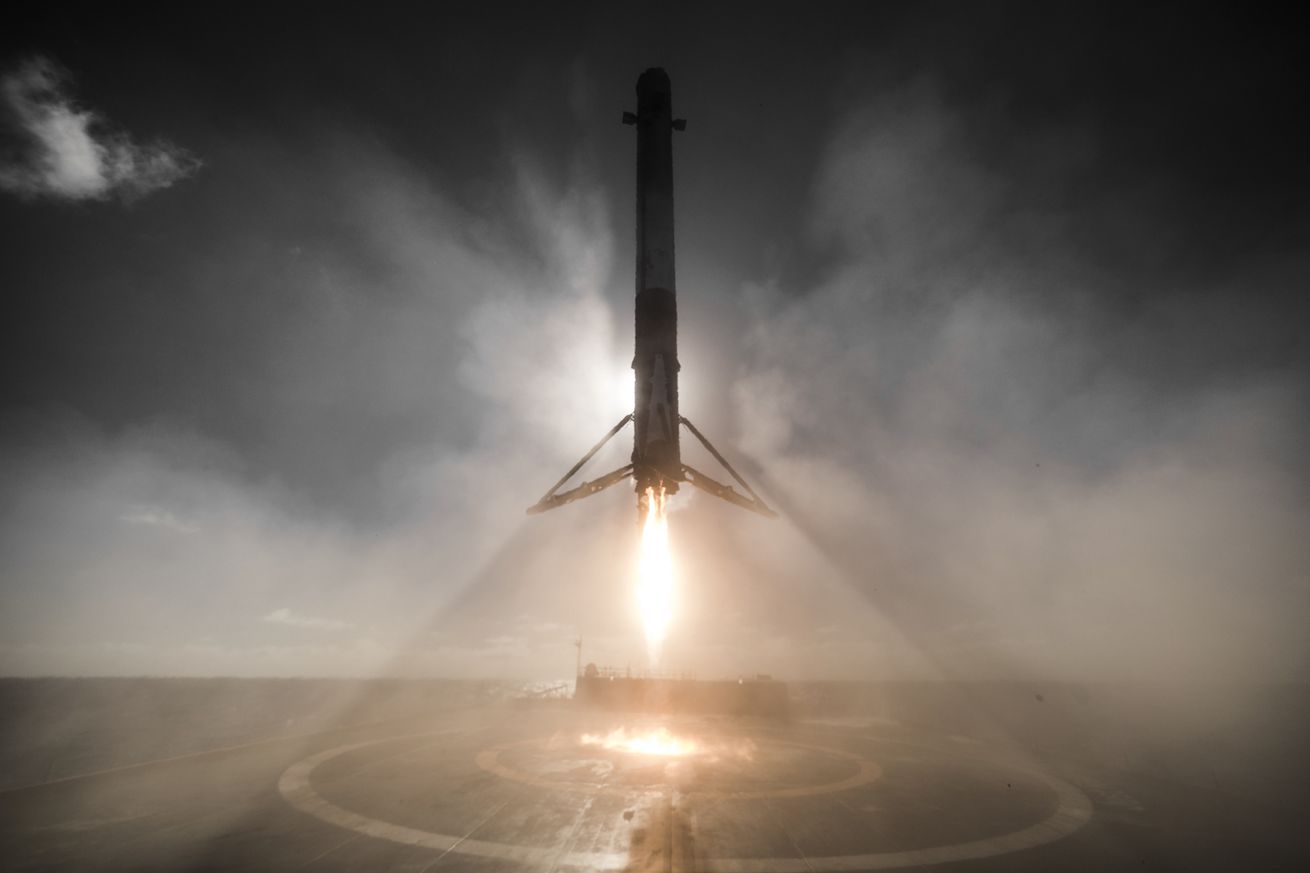
Space-X’s Falcon-9 as a mostly reusable rocket - if we’re making DC-3 analogies, we already have that one. The Falcon 9 is fully operational at this moment, and it allows SpaceX to dramatically undercut everyone else in the launch market. And they’ve barely begun reusing the things. Even new Falcon 9’s are cheaper. When SpaceX starts reusing rockets in bulk, when SpaceX starts flying the Falcon Heavy, and then re-flying the Falcon Heavy - this is a huge gap in performance, cost and capability. One that exists now or will by next Tuesday; and will widen even without considering any future development from SpaceX.

Only one other company is even in the planning stages for a rocket that could compete with SpaceX’s current vehicle, and that’s Blue Origin. They haven’t flown an orbital vehicle yet. The rocket that will power their competing spacecraft is still in development - though it has made its first successful burn. Now, they may achieve success, but they are years behind SpaceX.

The rest of the aerospace industry is literally decades behind, and shows little evidence of adapting to survive the new commercial space environment born in the current year. Arianespace, Boeing, Lockheed, the Russkis, the Chinese - all are continuing to build, and continuing to announce the design of new rockets that are exactly like the rockets the world has been building for the last half-century.

Prime example: ULA (Boeing and Lockheed) is developing the Vulcan rocket. From Wikipedia:

A later feature is planned to make the first stage partly reusable. ULA plans to develop the technology to allow the engines to detach from the vehicle after cutoff, descend through the atmosphere with a heat shield and parachute, and finally be captured by a helicopter in mid-air.

Yep this is going to be competitive with the Falcon 9, whose first stage is already fully reusable, especially since the first launch is scheduled for two years from now, and the whole helicopter-engine-grabbing feature will only arrive on later models.

Bonus example: NASA's SLS Rocket. From an Ars Technica article:

It is physically possible for NASA to make a launch date in 2019, but historically things can (and often do) go wrong in the assembly and testing of major launch systems. While it is possible to beat the odds or resolve problems quickly, there is no guarantee that will happen between now and a 2019 launch date.

Using technology that has been in existence since the 1970s, NASA might just manage to launch something three years from now, after over a decade of work.
Mad Scientist Musk Goes Back in Time

Let’s imagine a world. It’s something like 1914, and you’ve got a whole bunch of companies laboriously building wood and canvas airplanes with simple and low power engines. In a world that just a short while back didn’t have flying machines, they’re a marvel. It’s the most advanced technology of the age, and the designers’ smarts have become a byword for smarts itself.

And they’re useful. You can do aerial reconnaissance. You can fly a passenger or two or maybe a small cargo a distance of a couple hundred miles. The bolder thinkers have already imagined the uses to which more advanced airplanes might be put. A bigger plane, or a longer range plane; well, you could achieve wonders.

Then imagine that someone figures out how to make planes of similar capability. Only difference, instead of costing a million dollars a piece, they cost $250k. Huge impact, huge business advantage for that inventor and his company. He can quickly corner the market on aircraft manufacturing by undercutting his competitors and still making a huge profit. And new things become possible. At this price, you can afford to buy a whole bunch of planes and use them to carry high-value (but small) cargos around. Air mail is born.

Now, WWI isn’t much effected. There’s no new capabilities on offer - just a price advantage for the side that has our clever business man residing in it. Country A gets cheap, capable fighter planes. They can field more of them, perhaps. Be a little more reckless in their use, wring more advantage out of them. But all in all, more or less the same.

But further suppose that in his volcanic lair, this man is building something else. He’s building a Boeing 747. And it will cost only half again as much as the best of his competitors’ airplanes. But its performance is so much greater that really, its not even the same sort of thing.

“Amazing!” you say. And it would be.

What could you do with a Boeing 747 that you couldn’t with a Sopwith Camel?

***

In our imaginary world, Country X now has a modestly tame evil genius. He’s developing his 747, and in a couple years, the first one will fly. What might the statesmen and leaders of Country X imagine might be done with this technological marvel?

The evil genius thinks he’s going to fly to Antarctica, because it’s cool there, and he can claim all the land that isn’t inhabited by Scott’s ghost or penguins. So that’s one plan. He also allows that you could use the 747 for more pedestrian tasks like flying lots of people from city to city, or other just as dreadfully boring things.

But the Country X's proto-Army Air Corps generals might have a few thoughts.  

Instead of throwing a grenade over the side of your Sopwith Camel, bombing would be dropping 100+ tons of high explosives from a height no artillery, and no existing fighter can reach. Aerial reconnaissance is flying with impunity over any territory in the world, with a full crew of photographers and a photo lab, and advanced wireless telegraphy gear to communicate the intelligence back to the ground in real time.

The obvious things are extensions of what is already possible. But some clever Napoleon will realize that you can put a regiment of troops on one of these things, and have them anywhere in the world in less than a day. And since they only cost a little more than a Sopwith Camel, you can buy as many as you like and move whole armies. (Remember, WWI was caused in part by railway mobilization schedules.)

These are just the military implications. For Country X, they now have a capability that, though not new in the sense that aircraft have been in existence for a decade, is entirely new because it is so much more capable than anything previous.

And other businessmen might have some ideas about what uses a 747 could be put to. FedEx. Bulk air freight. Trancontinental passenger airlines. All of which are vastly profitable, and could not exist until the 747 comes into existence.

This is the BFR.

Not Just a Big Fucking Rocket

I’m arguing that the BFR is not just a Big Fucking Rocket.

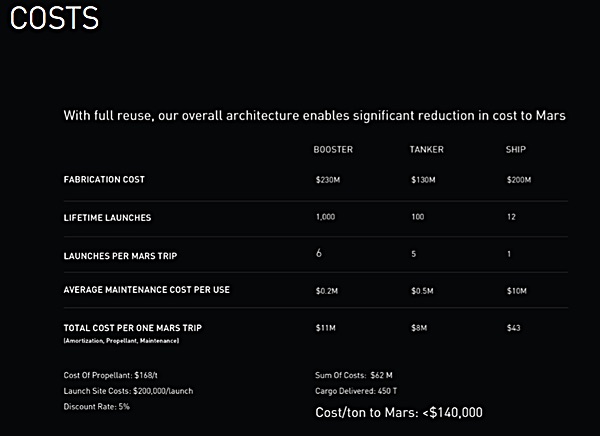
It has a greater payload capacity by far than any previous rocket. Its cost, per pound to orbit, will be cheaper than any other rocket. Its absolute cost to construct is in the same ballpark as a large jetliner. Its reusability, even if not at airline levels of turnaround, are beyond anything currently in existence.

A single BFR cargo launch is the equivalent of about seven Falcon 9 launches. Two BFR launches is therefore equivalent to matching the entire 2017 SpaceX manifest. Eight BFR launches is the entire world’s 2017 launch manifest. One BFR, going up every six weeks.
So let’s just assume that after the first prototype BFRs start flying in 2022-2023, production BFRs are coming off the line at about six a year starting in 2024. SpaceX spends 2024 testing their new birds, refining launch procedures and logistics, settling in and learning what it takes to make these things fly. By Christmas 2024, they’ve got it locked down, and they’re ramping up to one launch per week for each BFR. On New Year’s Day 2025, you have eight operating BFRs, each capable of one launch a week.

On Jan 7, 2025, Elon matched the entire world’s launch capacity for the entire year 2017. And he can do it again, every single week.

With a new BFR entering service every four weeks, by the end of the year SpaceX has a throughput to orbit two orders of magnitude greater than the entire world’s 2017 launch capacity. (And about a quarter of that number was thanks to the 2017 edition SpaceX.)

Today, airlines operate thousands of 747s and other aircraft - and the world’s militaries operate thousands of fighters and bombers. It will take some time, but soon we will have tens, and then hundreds of BFRs.

The BFR is the whole stack, but it might be helpful to distinguish the parts. The BFB is the booster, which will be standard for all launches. However, the BFS - the upper stage of the BFR - will come in several versions. Musk has already mentioned the tanker, cargo, and two kinds of passenger versions (one configured like an airliner, one for long-duration missions with cabins.) Without question, more variants are possible.

What the BFR Can Do

A big question is whether the market can expand to match this capacity. But that’s also a dumb question. Did airlines every have a problem finding people to ride their planes, or cargo to fill them? As the price comes down - and with BFR, it will be very much down, demand will increase. People, companies, institutions will all find that yes, they can use space transportation. Again, the most obvious use is for the things we already do - but can now do ten times faster or better.

Point to point transportation

Fedex will want to buy a dozen BFR-Cs and tell you that when it absolutely, positively, has to be there in four hours - it will be, even if the destination is on the other side of the world. UPS will want to buy another dozen - and at the very least, both companies will be booking space on the regular.

Point to point, on-Earth transport can be huge, provided that the cost and reliability are there. Southwest Airlines is  certainly going to want a number of BFRs, but they’ll be competing with Elon and SpaceX for that market. There is a market for expensive but very, very fast transport of people and things - 80 years of air travel has proven this beyond any question.

Satellites

The existing market for satellites is small because of two factors. Satellites are expensive, and launches are expensive. Lowering the second factor will cause a reduction in the former. If you can launch a satellite for the same price as shipping something to Australia on a 747, you don’t need to spend millions of dollars to ensure the same level of reliability.

Instead of one $100 million dollar satellite, you launch a hundred $100k satellites for the same level of service or better - and pocket 90% of the costs. SpaceX itself is already planning a constellation of thousands of satellites to provide low cost, high bandwidth internet globally. The very fact that you can launch just about anything means that just about anything will.

Universities will launch low cost research satellites. Small start up telecoms will launch hundreds of satellites. Big telecoms will launch thousands. The US military will launch more reconnaissance satellites. New weather sats. When cost per pound to orbit drops to air freight levels, everything we do in space now we can do on a broader, cheaper and better basis.

These denser networks of inexpensive sats will allow better communications, better data, more information about our world. Cheap orbital telescopes will give us a better picture of the larger universe.

New purposes

For all of our history as a space-faring species, most of the things we’ve put in orbit have had one of two purposes: watch things or talk to things. As outlined above, we’ll be doing a lot more of that. But then there’s all the things we’ve thought of but never did because the cost was just too damn much. Most of these involve people living in space.

One of the largest beneficiaries of BFR technology will be Bigelow aerospace. Right now, Bigelow is a William Penn who’s just been granted all the land in Pennsylvania. Unlike Penn, he has to wait for someone to invent the ships that will allow him to profit off of all that land. He’s a space real estate company in waiting.

Bigelow is already building and testing inflatable habs on the ISS. They’re working on a bigger model - the B330. Once inflated, the B330 has 1/3 the pressurized volume of the current ISS. It weighs a bit less than 25 tons, and its collapsed dimensions (near as I can figure*) are 2.5m in diameter and 5m long. That’s small enough that you could pack the BFR to its maximum payload weight with these things - take six into orbit, and boom, you’ve tripled the total available orbital real estate in one launch.

With 150 tons to low earth orbit and on-orbit refueling, building space stations is a trivial exercise - especially if you’re using expandable habs. Placing space stations wherever you want them isn’t much of an issue either. Haul them collapsed to where you want in the BFR, add water, instant space station. It took dozens of shuttle launches to build the ISS, and it cost well north of a $100 billion. One launch, you get something twice as spacious. (~$150 million per B330, plus connectors and whatnot, plus 40mil for launch. Call it one billion, ten fold decrease in price.)

Another option would be to launch the station into LEO. The BFR goes about its business. Construct a framework around your expandable habs and tack a motor on to the back. Now you’ve got a slowish but spacious and useful spaceship.

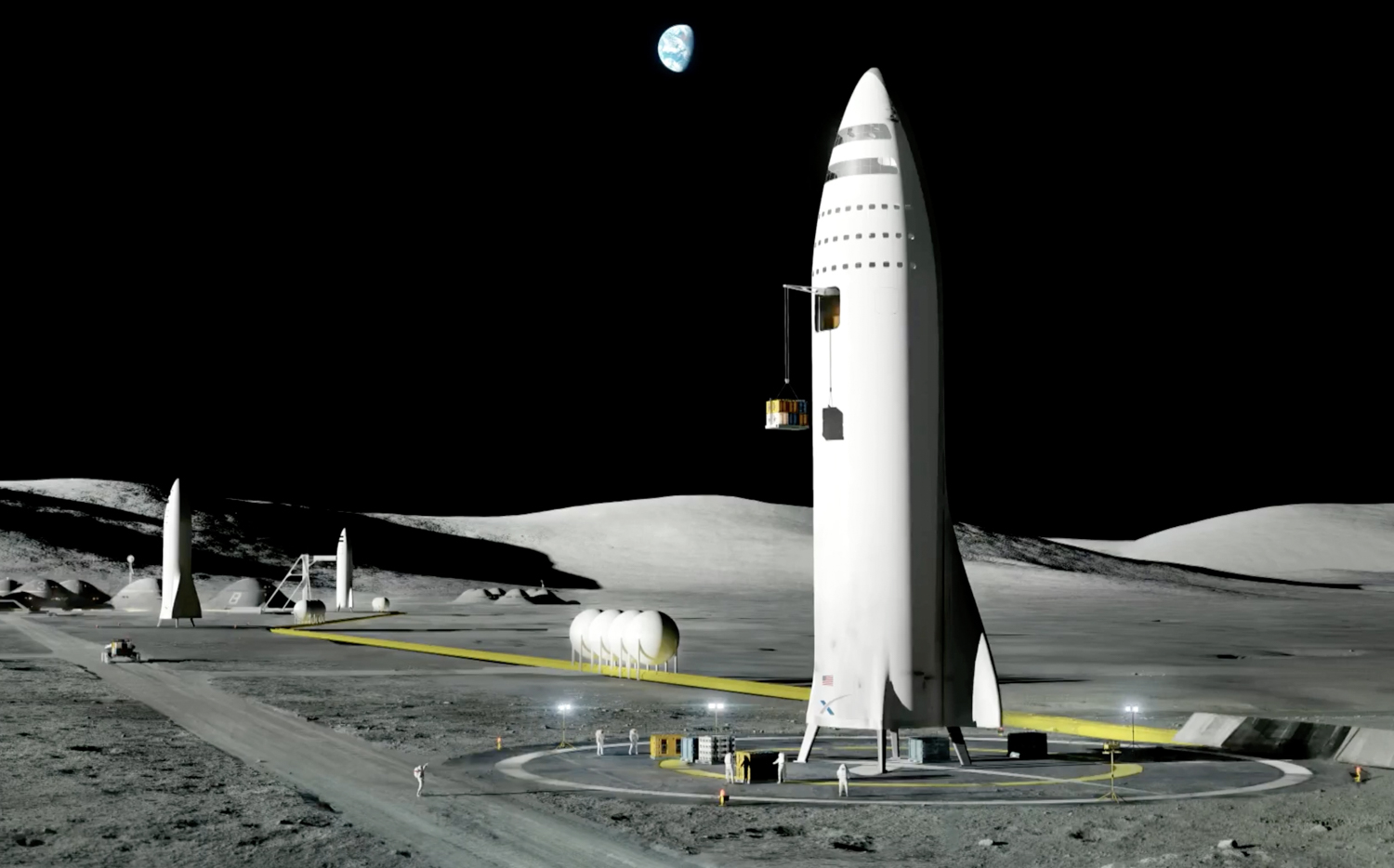
Building a moon base is barely more complicated, given that the BFS could land on the moon and return without refueling. Attach habs to asteroids. Land them on Mars. Float them on balloons in Venus’ upper atmosphere.

Further out into space we could do Elon’s little Mars trip, for starters. But think also how much better NASA’s deep space probes could be if they were 20 tons instead of half a ton, and got to their destination in months instead of years. Manned or unmanned asteroid sample return missions. Missions to Jupiter or Saturn are possible with the BFS, or with interplanetary ships that the BFR could easily loft into orbit.

Closer in, garbage scows to remove broken or dead satellites. Research facilities, hotels, amusement parks... The possibilities, truly, are endless.

Military uses

Just by making use of SpaceX-operated launches, the military and intelligence agencies would deploy better recon sats, better surveillance sats, higher bandwidth military communications networks. Better, more accurate GPS systems. All of this would parallel the commercial uses that companies world wide would likely jump on with both feet.

Military programs long thought impossible are now possible. The THOR weapon system could be put in place with as little as a dozen launches. Pin point, global, non-nuclear capability to destroy just about anything. Using a militarized B330, you’ve got instant military space stations for all sorts of needs.

If the US Air Force - or, ever more likely, a US Space Force - started buying and operating their own BFRs, even more possibilities open up. Just as FedEx and Southwest Airlines could get you or your packages to the antipodes in less than an hour, a military spacelift capability could put soldiers and equipment anywhere on the same timeframes.

The BFR has a cargo capacity slightly larger than the USAF C-5 Galaxy. It’s 13 hours from New York to the Middle East. If the BFR could actually do rapid turnaround, it could make that flight six times before the C-5 touched down. Which means that functionally, the BFR has six times the cargo capacity of the C-5.
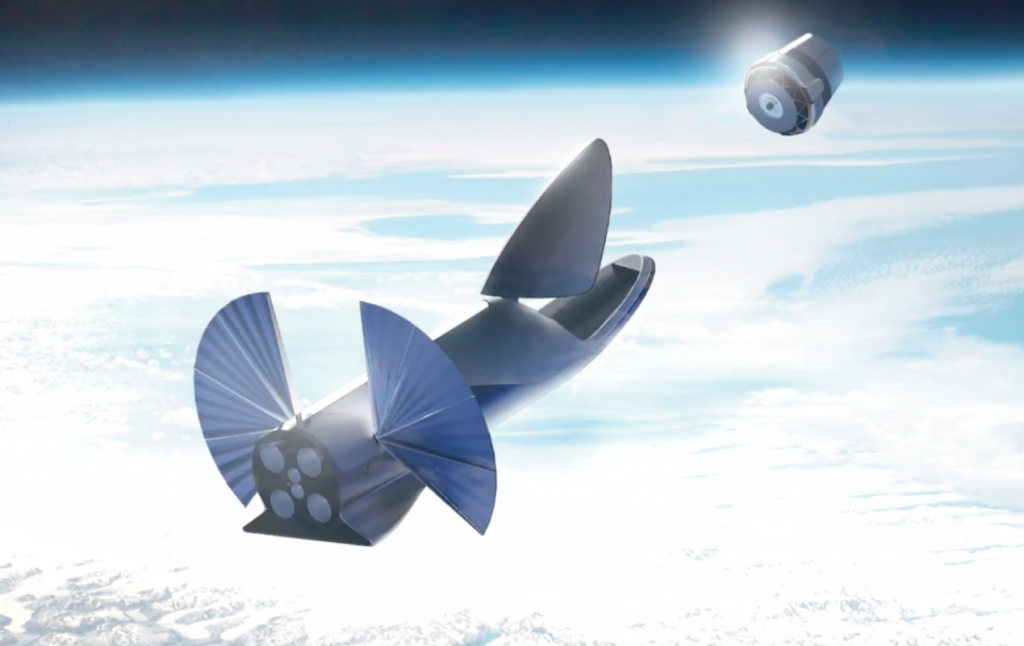
Once in orbit, the BFS is a capable platform, with fuel for a fair amount of orbital maneuvering. With the tanker assets that Musk is already planning, a refueled BFR upper stage would have a lot of delta-V. A military version of the BFS would be a powerful ASAT platform, an orbital bomber, or assault vehicle for deploying space-trained special forces to whatever target they needed to assault.

And just as easily as civilian bases could be assembled rapidly using the Bigelow B330, military stations could be built. While an orbital space station is necessarily vulnerable to attack, thanks to the fragility of the station and the harsh environment of space, the utility of a manned space base will probably be too great to pass up. The most likely use for a manned military station is as a orbital version of a forward air base. Space Force BFR upper stages could dock, refuel, rearm, switch crews, without having to waste precious fuel returning to the surface.

In time, though, new weapons would be developed, and deployed to space by the BFR. Dedicated, on-orbit fighters could be brought up by a BFR cargo mission, and be used for anti-satellite or anti-station missions. Assault landers, brought up by BFR and something like a small shuttle in design could drop a squad of commandos anywhere on the globe. Space based weaponry along the lines of the old Star Wars missile defense program could be tested.

What Does it All Mean?

All of this is literally just off the top of my head. Deeper thought would no doubt reveal even more uses. Most important though, there’s only two groups going to be operating the BFR in the near future - SpaceX and perhaps a small selection of other American Companies; and the US Government - specifically, the US Air or Space Force.

The US is going to have a short but significant window - a monopoly on cheap, bulk access to space. For a decade, maybe more, the United States will have sole possession of the only true spaceship. (And, maybe two if Bezos gets his New Glenn flying.) No other power will have anything comparable.

This is potentially more, destabilizing than the invention of the atomic bomb. Yet the only people who seem to be discussing the military uses and implications of the BFR seems to be Brian Wang at NextBigFuture and a couple people on Reddit.

The United States will have the 747, and everyone else will still be flying Sopwith Camels. We’d best figure out what to do.

Posted by Buckethead Buckethead on   |   § 0

Space Marines

I'd seen the rumors that Congress was discussing the creation of a United States Space Corps. And now it seems that the House of Representatives has actually included the proposal in the latest budget. The House Armed Services Committee added a provision for the US Space Corps and a new separate joint command: the US Space Command.

First off, all previous coverage on this subject has made crucial errors. By including images from the film Starship Troopers or Guardians of the Galaxy they have completely missed the boat. The correct image is the one at the top of this article. Failing that, the only other option would be:

A distant third would be this:

Now that we've got that out of the way, what are the merits of this proposal?

Space is big, as has been noted often. Now that we are finally poised to begin moving into space in a big way, it is a reasonable proposition that we should take steps to guarantee our security, space-wise. A US Space Corps could conceivably undertake to accomplish that. Mike Snead on The Space Review argues exactly that:

To use a term not now in fashion, the United States is a great power and must remain so to preserve the security and freedom of future generations of Americans. Millions of past Americans fought, often with great personal sacrifice, to enable the United States to forge its future on its own terms. Preserving America’s great power status is a key responsibility of Americans today.

A key attribute of a great power is the ability to project national power beyond its borders in its defense and to undertake national policies. Last century, “Earth-space”—the region of space around the Earth—became a region of vital national military and economic interest. The United States uses Earth-space for reconnaissance, intelligence, communications, geopositioning, and nuclear deterrence, and for the command and control of US forces actively engaged in defending the United States and our allies. As I have explained in several articles here, Earth-space will also become the primary source of energy for the United States as we unavoidably transition this century from fossil fuels to space solar power.

Reasonable Americans increasingly understand that the extension of active US military capabilities into Earth-space is essential to provide the ability to project American power for our nation’s security. It’s time for the United States to have a permanent human military presence in Earth-space—starting with a US Space Corps, followed soon by a US Space Guard and leading to a US Space Force.

That's the upside.

The downside is rather larger. In roughly descending order of imminent pragmatic concern:

  • It's opposed by the Air Force
  • The Army and Navy will likely also resist having their space assets absorbed
  • As will the civilian intelligence agencies like the NRO
  • The Air Force is not the proper model for a space force
  • It's too early
  • When we do create Space Marines, they'll be the US Space Corps Marine Corps, which is retarded and sounds like it was named by the Chinese.
  • Sooner or later, we'll have a space navy, so we should just go there and get it right the first time

Let's take a look at some of these points.

Bureacratic Crib Death

From the 80s to the present, we've had an Air Force Space Command. This is a component command subordinate to U.S. Strategic Command (USSTRATCOM). From 1985 until its 2002 merger with USSTRATCOM, USPACECOM existed as a Unified Combatant Command. Currently, US Space activities are managed by the Joint Functional Component Command for Space which is part of, again, USSTRATCOM.

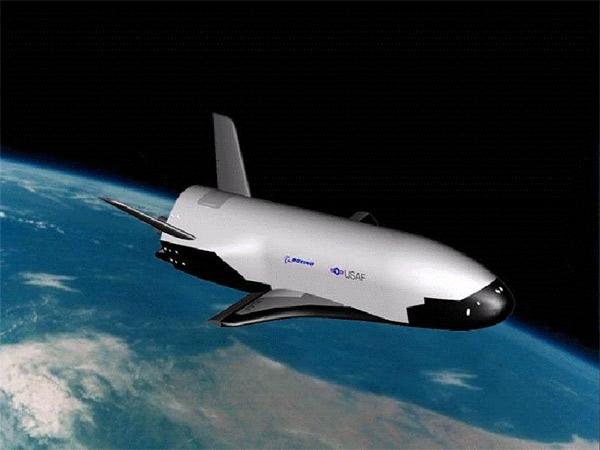
To the extent that any military (and more to the point, Air Force) program is ever well run, this jumble of awkward acronyms has mostly gotten the job done. Satellites didn't fall from the sky, space assets worked with ground assets with only moderate friction, and we have a robotic spaceplane that does sekrit missions for years at a time. (And will soon be launched by SpaceX.)

In other words, what we have is adequate for the job at present.

Given the resistance from other branches of the military, and the additional fact that this new force won’t ever have operational control of the National Reconnaissance Office’s satellites, what is the likelihood that this new Space Corps will actually control a significant fraction of our space, you know, forces?

Past history is not terribly encouraging. Bureaucratic infighting will leave one branch of the military without crucial assets it needs to accomplish its mission. Which one loses is more an indication of its skill and lethality at the infighting rather than its prowess in outfighting.

Back in the late 40s we spun off the Air Force from the Army. One of the unfortunate side effects of that birth was the all-helicopter Army Air Force. The new Air Force insisted that it have control over all fixed-wing aircraft because it was the Air Force, goddammit and therefore it should have control over all airplanes. The Air Force got its way, but that left the Army struggling to provide Close Air Support. Because it was no longer allowed to operate airplanes, the Army settled on helicopters. For some roles helicopters are well-suited, but the constant attempts by the Air Force to kill the A-10 are a perfect example of how the division of labor between the Army and the Air Force was poorly thought out, if at all.

Into the fifties, each of the branches of the US military (not counting the Marines) had their own nuclear deterrent. The Army had the rockets, the Air Force had the bombers and the Navy had the ballistic missile subs. Moderately sensible. But the Army lost again, and the missiles went to the Air Force. While the Navy has been able to resist the Air Force’s otherwise all-conquering bureaucratic acumen, what other branches - especially new ones - will be able to do the same?

And more to the point, what new inter-service rivalries can we imagine will arise with the creation of the Space Corps? Unlike the Navy and Marines who have a centuries long understanding of how to manage their respective roles, this will not be the case with the Air Force and the Space Corps, and this will be the primary bureaucratic battleground as the institutional Air Force struggles to hold on to assets, programs and funding.

There isn’t enough space activity to give the new Space Corps enough power to fight off the lethal and voracious Air Force joint task force budget and appropriations terminators. The Corps will likely flounder absent some Space Pearl Harbor.

Too Soon?

Look at it this way: how successful would the Air Force have been had it been created ten or twenty years earlier? In 1947, the US Army Air Corps had thousands of planes, thousands of airmen and mechanics, pilots and navigators. They’d just played a major part in winning the biggest war in history, and they’d been the means by which the first atomic bombs were delivered to their intended recipients.

In ’37, let alone ’27, the Army Air Corps was a tiny appendage of the Army, and its role in warfare was largely theoretical. Strategic bombing advocates were making absurd claims (that, absurdly, are still believed today) and the mechanics of CAS were still being worked out. But even here, there was the example of air combat in the First World War to draw on.

Right now, there are two military space vehicles. Two. (Yes, there are countless communications, surveillance and other satellites operated by the military. And all the ICBMs. But the X-37b is the only military space vehicle in any sense that makes sense. It could have guns, and possibly even crew.) Space weapons have never been used in anger. There are no Space Aces. Standing up a Space Corps is most akin to setting up a USAF in 1911, when the US Army had a few experimental aircraft and little else.

wright 1908 military flyer 

Space Fighters or Space Battleships

For the near future, space operations will be conceptually similar to air operations. Small crews, short duration missions. For the long term though, how long will this be the case? Distances between worlds are rather long. The model of getting in a plane and flying for a few hours just doesn’t fit.

There’s a reason why most science fiction has used a naval analog for warcraft in space. Even where space fighters are a thing, the model is not so much Air Force as Naval Aviation - squadrons of space fighters flying off space carriers. Long duration missions will require the traditions and methods of the Navy, not the Air Force. Soon enough, most space missions will necessarily be long-duration missions. That being the case, the sensible thing to do is to stand up a space navy and get it right from the start.

Assume that there is still a United States a hundred years from now, and that space travel is commonplace. (One of these speculations is crazy. But which one?) If there are American bases, outposts, and colonies on other planets then there will need to be an American Space fleet. Having a space fleet would mean that most of the nuclear deterrent that we’ve laboriously created will be moot - attack from space is cheaper, cleaner, and easier. Our strategic deterrent will *be* the space fleet.

In this scenario, its easy to imagine a suitable force structure, and their respective roles.

  1. Army: combat on the ground. Ground troops, fully capable, fixed-wing drone CAS, and artillery to include missiles and nukes.
  2. Navy: combat on, below, and above the seas. Subs (and missiles), surface combatants, and squadrons of drone fighters/bombers.
  3. Aerospace Force: combat above the earth, out to Earth orbit. What is now strategic bombers, air superiority missions, etc. But also space fighters launched from earth or orbital bases and designed to operate in near earth space.
  4. Space Navy: Combat in space. Cruisers of the void, battleships and the like. Capable of strikes to planetary surfaces as well as fighting opposing fleets.

And, having created a United States Space Navy, it wouldn’t be a stretch to go a bit further and create US Space Marines, which is the logical and desirable end for the United States, its military, and space travel.ew.) Space weapons have never been used in anger. There are no Space Aces. Standing up a Space Corps is most akin to setting up a USAF in 1911, when the US Army had a few experimental aircraft and little else.

Posted by Buckethead Buckethead on   |   § 0

FOBS: Fractional Orbital Bombardment System

Image
fobs

On March 15, 1962 - during the run up to the Cuban Missile Crisis, Soviet First Secretary Khruschev said,

We can launch missiles not only over the North Pole, but in the opposite direction, too. . . . Global rockets can fly from the oceans or other directions where warning facilities cannot be installed. Given global missiles, the warning system in general has lost its importance. Global missiles cannot be spotted in time to prepare any measures against them.

The Fractional Orbital Bombardment system was conceived by the Soviet Strategic Rocket Forces to exploit a backdoor vulnerability in the United States’ strategic defenses. As ballistic missiles began to eclipse nuclear-armed bombers in the 1950s, both sides deployed Ballistic Missile Early Warning nets. The first generation of American BMEW radars were deployed along the northern fringe of North America and Europe, intended to detect incoming Soviet missiles as they came over the pole and rose above the radar horizon. The Pentagon hoped to achieve at least a half-hour’s warning of a nuclear strike, to allow Strategic Air Command to launch its second-strike bombers and deciding where to target its own missile counter-strike.

Image
fobs map

But into the 1960s, the US was blind to attacks from the southern arc. FOBS was intended to exploit that blindness. By launching into a low polar orbit, the nuclear warhead could approach the US from any direction - and particular, directions not covered by the American early warning radar lines. The first warning the US would have a strike would have been the EMP effects of the weapons detonating over their targets.

Development of an orbital weapons system

The byzantine nature of the Soviet system led to the initiation of three programs to develop a FOBS.

FOBS 1

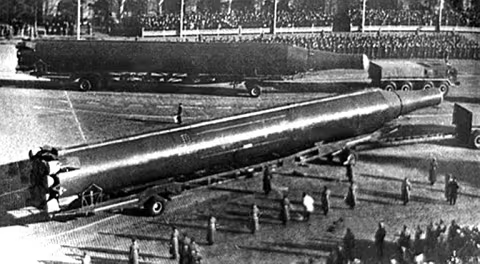
In 1962, Sergei Korolyov, the famed Soviet rocket scientist, began development of the GR-1 (Globalnaya Raketa -1 or Global Missile 1) - his last ballistic missile design. Development had ceased by 1964 without a single test launch. That didn't stop the Soviet Union from using the program as part of its extensive strategic deception efforts. The Soviets displayed the missile as an operational system during their annual Red Square parades in Moscow in the early 60s.

Image
fobs red square

FOBS 2

The Soviet's second FOBS effort came from General Designer Vladimir N. Chelomey at OKB-52. His plans initially envisioned two global missiles based on the UR-200 and UR-500 ICBMs. The latter could have lofted a 30 megaton warhead into Earth orbit. For reasons that aren't clear, the heavy lift option was discarded in favor of the lighter UR-200 missile. This all became moot, however, when Chelomey's patron Nikita Khruschev was overthrown in a coup in 1964 and Chelomey's attempts to keep the project going proved futile.

FOBS 3

The system that actually did become operational came from Designer Mikhail Kuzmich Yangel, based in Dnepropetrovsk, in the Ukraine. His R-36 (NATO designation SS-9) missile became the R-36-O or 8K69 in the FOBS context. Like the R-36, the R-36-O was a multistage missile fueled with storable hypergolic propellants. For deorbiting the warhead, the R-36-O added a third stage for which the Soviets used the designation of 'Orbital Payload' (OGCh).

There are conflicting reports on the size of the warhead. Some Russian sources claimed up to 20 megatons, though US intelligence reports suggest a yield in the 2.0 to 3.5 megaton range.

Image
FOBS on transporter

Deployment

Having won by process of elimination, Yangel’s FOBS was approved for deployment by the RVSN. From 1965 to 1968, a series of test launches from the Baikonur complex established the system’s readiness. The Soviet authorities decreed that the missile be redesigned as an ‘encapsulated’ launch system. This new packaging scheme saw the ICBM stacked and then installed in a hermetically sealed container and then emplaced in the silo for long duration standby operations. Just prior to sealing the container, the missile was fueled. For over seven years before refueling and overhauling, the missile would be ready for launch at five minutes notice.

Image
fobs

After the test program, the R-36-O / 8K69 was accepted into service in 1968 and remained in service until 1983. The Soviet Union built 18 operational FOBS silos at a site near Tyuratum, and stood up the first operational unit in 1969. Three FOBS battalions were part of the 98th Missile Brigade until 1974 when they were transferred to the Orenbugh Missile Army of the RVSN.

Employment

Were it actually used in a nuclear first strike, the missile’s flight profile had four phases: boost, orbital, braking and re-entry. Unlike a traditional ICBM, the FOBS missile had a much lower profile. A traditional ICBM rises on a steep trajectory and reaches an altitude of 1200 miles above the Earth before returning to Earth and its target. The FOBS would never ascend above 150 miles on its depressed trajectory and orbital insertion - and would not appear above the radar horizon of US early warning systems until almost at its final destination.

The 8K69 used its first and second stages to achieve orbit. At launch, the missile would head south toward the pole - a near polar orbit. The warhead, once past the south pole, flew north over the Southern Hemisphere, and eventually on track to hit targets in the central US. A slightly higher inclination launch could hit West Coast targets; a little lower would hit the East Coast.

As it approached the de-orbit entry point, the vehicle would pitch to orient for re-entry. The third stage rocket would fire for one minute, braking, changing the warhead’s trajectory from orbital to ballistic. And set the warhead on course for re-entry and its target. Given that it would be approaching from the south where the US had no early warning nets - time from detection to impact would be almost nil.

Degrading Utility

By the time the FOBS had been operationally deployed, the United Nations had passed the Outer Space Treaty which forbade the use of nuclear weapons in space. To the Soviets, this was a matter of semantics, and they promptly called their system a ‘fractional’ orbital bombardment system. Since the warhead never completed an orbit, it was thus in compliance with the letter of the international space treaties. (Of course, fully orbital weapons systems would require no additional development. Converting a FOBS to an OBS is simply a matter of not firing the retrorockets.)

FOBS faced a regime of degrading strategic utility soon after it was deployed. Over the course of the 1960s, the US expanded its BMEWS to a full circle around the continental US, limiting the value of attacking from the south. Further, the US deployed infrared early warning satellites that could detect launches over the Soviet Union. This rendered the surprise attack value of FOBS near useless.

While FOBS had near-unlimited range, the loss of the element of surprise relegated the system to an expensive collection of single-warhead missiles with low accuracy and only moderately powerful megatonnage. US Strategic planners believed that FOBS could be used as a pathfinder - attacking command and control centers rather than hardened silos and military targets. If the US lost the ability to coordinate a counter-strike, that could still be a significant advantage.

But what really killed FOBS was Soviet submarine designers. In the submarine-launched ballistic missile, Soviet planners had a vastly stealthier platform for launching a disarming first strike on the United States. SLBMs could be cheaper, more powerful and more accurate than any FOBS missile. And by the time of the SALT II negotiations in the late 70s, the FOBS program neared its end.

Posted by Buckethead Buckethead on   |   § 0

NASA's Wet Workshop Concept Revived

NanoRacks out of Houston, Texas is leading a group that proposes to use spent second stage fuel tanks from rockets built by United Launch Alliance as space station habitat modules.

Image
external tank station

Back in the seventies, NASA considered two methods for constructing what eventually became Skylab. The immense second stage of the Saturn rocket would provide commodious living space for astronauts - the question was how to go about it. The 'wet workshop' concept involved two Saturn IB launches one crewed, one not. Once in orbit, the crew of the second launch would install life support equipment in the upper stage's hydrogen tank. Over time, the idea of the 'dry workshop' won out. NASA fitted out the second stage on the ground and launched it ready to go.

So now, this new venture plans to use spent Centaur second stages. The idea is compelling: a human-habitable space station is an insulated pressure vessel, a cryogenic hydrogen fuel tank is an insulated pressure vessel. There ought to be some way to make that work. If NanoRacks and company can start making workable space stations out of otherwise thrown-away centaur second stages, that's awesome.

If they make it work, it will shine an even harsher light of condemnation on NASA, though. Consider the following facts:

  • The Atlas Centaur is about ten feet in diameter, and forty feet long. The majority of that volume would be taken up by the hydrogen fuel tank.
  • The Space Shuttle External Tank was 150 feet long and thirty feet in diameter. The hydrogen fuel tank alone was 100 feet long.
  • There were north of 130 flights of the space shuttle
  • In each case, the shuttle sacrificed payload capacity to make the tank reenter the atmosphere and burn up

A hundred or more refitted space shuttle external tanks would have a bit more interior living space than the ISS.

Image
etgop

Now, imagine 12 of those wheels stacked like tires.

Posted by Buckethead Buckethead on   |   § 0

Sharks got there first

I alluded to Newt Gingrich's moonbase plans earlier. I am not totally convinced of the shark's claims to have colonized space - I admit I have my doubts - but even absent a selachimorphic space empire the Newt's plan is problematic.

First and foremost, in the speech Newt hisownself used the term grandiose to describe the adventure. Not a good sign, really. A second relaunch of the JFK? A monolithic governmental exercise that pursues a politically chosen goal at all costs, consuming and destroying all other options as it progresses; a program that might (only if successful) result in something kind of amazing but which will leave a sterile policy wasteland where even cockroaches and lobbyists have trouble surviving? More, please.

We are just now recovering from the original sin of Apollo. NASA's finally shed itself of the ridiculous abomination that was the space shuttle, though I imagine most of the tens of thousands of people who worked on that program are still on the payroll. The 21st century re-imagining of the Apollo program - known collectively or in its parts as Orion, Constellation, Ares, EDS (sounds like a disease you'd be embarrassed to have), Altair and for all I know, "Oh shit we better think of something or we're fucked" - is on the ropes as well. NASA, through massive effort, the dedication of thousands of brilliant engineers and managers, and the application of hundreds of billions of taxpayer dollars has managed to achieve the impossible: get to the moon six times forty years ago, and make space travel seem as exciting as a local zoning planning board meeting.

There are now several enterprises looking to change that, mostly funded by tech-industry billionaires. Of these, Space-X has the most hardware in actual use. They've successfully flown a rocket large enough to put a capsule in orbit. That capsule is about this close to being man-rated, and could carry as many as six people into orbit. They've got plans for a heavy lift vehicle that builds off the success of existing rockets and there's no reason to imagine it wouldn't work. Elon Musk could be on the moon a decade before Newt, and for far less money. Significantly, far less of our money, since Senor Elon will be spending his own money to do it. And even if Space-X fails because a rocket falls on Musk's head, there are others - Paul Allen working with Scaled Composites, Bezos with Blue Origin, and more besides.

Please, please, please don't start another government space program. Because if you do, it will kill a private space industry that is just about off the ground. I want to go into space, and I trust Elon Musk more than I do Newt Gingrich. I said that so I can say this:

I think the most interesting thing about Newt's speech is that he thought that the moon could become the 51st state. A "Northwest Ordinance for Space" has been ridiculed by some, but I think that making fun of one of the great achievements of the Confederacy is mean-hearted and unwise. The Northwest Ordinance was probably one of the most successful government enterprises ever. By setting things up such that the colonists pushing back the frontier would come into the union on the same terms as the original colonies, now states - that more than anything assured the success of the American experiment.

If we are to avoid a repeat of the whole belters vs. flatlanders wars that we read about in science fiction, we'd need a Northwest Ordinance. Having a framework for communities in space to join on equal terms with their compatriots back home on Earth would be a good thing. And if people heading out knew that they would, in time, be on an equal political footing with those who stayed behind and that the rule of law would extend into space with them, we'd do more for space settlement than spending any amount of actual tax dollar money could ever do.

Posted by Buckethead Buckethead on   |   § 0

A Space Battle

Like the previous post, this was originally written back in 2004. I realize, eight years later, that I never finished it. Oops. Anyway, here it is, and maybe I'll finish it this week.

The primary tactical function of a battleship is to engage and destroy the enemy naval forces, which obviously supports the naval mission of protecting friendly shipping and ensuring control over the space.  The essence of space power will (like sea power) rest in the ability to dominate space.  You do that by denying use of it to the enemy.  And you do that by destroying his navy if it comes out of port.  But how will this happen, and what will future battles look like?

A lot depends on the political nature of the war in which the battle takes place, and the geography of the solar system.  (Interestingly, this will be constantly changing – as the planets, moons and asteroids orbit the sun, each at their own pace, the distances and relationships between them will change.  There will not be, as on earth, constant or permanent sea-lanes, straights, or territorial waters.  From month to month, minimum energy orbits between the planets will be in constantly different arrangements.  It will become easier to get to one place, and harder to get to others.  This will affect naval strategy.) Further, what will each power be trying to achieve or trying to protect?  Is the goal invasion and conquest, or merely to frustrate the goals of the enemy?

The greatest naval battles involving battleships were Trafalgar and Jutland.  In each case, the British were trying to frustrate the enemy.  That is to say, the British had no desire to follow up a naval victory with large-scale invasion.  However, the French in 1804 and the Germans in 1916 needed to defeat the British in order to achieve other desirable goals.  All the British need to do is to defeat the enemy fleet, and everything else follows.  Let’s assume that the Europans, long the dominant power in the outer solar system, are content with their control over trade routes in the Jovian system, and between Jupiter and the outer planets.  They are growing fat and rich on the trade that passes through their ports.  However, the Titanians, upstarts and growing powers in the Saturnine system, are deeply unhappy that the arrogant Europans get all the money and all the glory.  They want their own share of the trade with the populous inner system, and further want a piece of the growing pie that is comet harvesting in the Kuiper belt at the outer edge of the solar system.  (Which the sneaky Europans are poaching on.)

The Titanians have built a respectable space navy, with a core of Orion drive battleships, and a larger number of smaller conventional nuclear thermal drive commerce raiding corvettes and frigates.  As diplomacy falters, an unfortunate incident involving a Europan revenue cutter and a Titanian-flagged merchant solar sailship inbound to circum Mars provides the pretext for war.  Europan merchant vessels are spread throughout the system, carrying almost a third of all shipping.  Most of these are slow, automated solar sail freighters, but others span the spectrum of commercial ship design.  The Titanian navy deploys many of its commerce raiders downsystem to strangle the Europan economy.

The Europan main battle fleet is not currently circum-Jove, as it recently moved forward to the Trojan belt to overawe the piratical kingdoms located amongst the asteroids clustered 60 degrees ahead of Jupiter in its orbit.  What remains in Jupiter space is the smaller home fleet and a gaggle of small warships.

Due to the alignment of the planets (something that the Titanian high command was certainly paying attention to) there is a favorable transit from Saturn to Jupiter, as Jove is overtaking Saturn, being located in an inward and thus faster orbit.  The Titanian fleet is in an excellent position to quickly drop down on Jupiter, while the Europan fleet is nearly a quarter of the way around the sun and ahead of both Jupiter and Saturn.  It will be difficult for them to make it into battle in time.

The Europan home fleet can not refuse battle, because that would leave their moon open to attack.  But though the quality of their crews is unparalleled, the Titanian fleet slightly outnumbers the Europans.  Europan planners feel that it is a nearly even match.  But tactical considerations favor the Titanians.  As they will be decelerating into the Jupiter space, their heavy pusher plates will be facing toward the Europans.  This provides maximum protection to the Titanian battleships, and allows uninterrupted X-ray laser fire as the battle is joined.  Contrariwise, the Europans must perforce be accelerating towards the incoming fleet, and their pusher plates will generally be facing away.  Smart maneuvering will mitigate this somewhat, but the front of the ship remains the front of the ship.

The Europan Navy dispatches its corvettes and cutters outsystem, using a gravity whip maneuver that will disguise their eventual position.  They will coast up, powered down, and lie in wait for the enemy fleet.  Hopefully, they will inflict significant damage as the Titanians pass – but losses will be high as the ships reveal their positions by opening fire.  The Europans can be confident in the placement of these lurkers, because the location of the Titanian fleet is well known, and can only follow a narrow set of courses and still arrive at Jupiter.

The Titanian fleet powers on, occasionally launching a spread of sensor drones ahead in hopes of detecting enemy corvettes.  These drones are soon overtaken by the fleet as it accelerates towards battle.  The first combat occurs fifteen million miles out from Jupiter.  The furthest of the screen of corvettes avoids detection until within a quarter million miles of the fleet – less than the distance from the Earth to the Moon.  All of its X-ray laser missiles have been deployed, as have all of its sensors drones.  The resulting sensor net gives the ship a much better picture than the fast moving Titanian battlefleet.  All at once, the laser submunitions fire – each a small nuclear explosion pumping ten multi-gigawatt X-ray lasers.  Sixty lasers hit twelve targets, a spread determined by the sophisticated targeting computers on board the ESNS Gomer Pyle (the Europans have an odd sense of humor) and the instincts of her veteran gunners.  As much as possible, the gunners on the Pyle try to hit from the side, and avoid the thick refractory material of the pusher plate.  In this, they succeed somewhat – the more alert among the Titanian targets detected the Pyle in time to turn tail toward the enemy.  Nevertheless, the HRE Vindictiveness is completely disabled, and two others severely damaged.  Light damage on the remaining ships is soon made good.

For its trouble, the Pyle is quickly destroyed in a hail of laser and particle beam fire.  But the Europan command is pleased.

Over the next several hours, as the Titanian fleet slows as it backs into Jovian space, it endures several more attacks by lurking Europan cutters, corvettes and frigates.  One more battleship is destroyed, but the Titanians are now alert and wary, and destroy thirty Europan warships with long range massed laser fire.  Before the Europan home fleet can reach the Titanians, one more Titanian warship is hulled by a lucky long-range shot by a massdriver on the outer moon of Erinome.

Now the home fleet has completed its swing around Jupiter, adding his gravity to their already impressive acceleration.  The fleet is moving toward the enemy.  But now, the admiral of the fleet faces the most crucial question in a space battle – what speed and course?  His decision now will likely determine the course of the battle; because as good as his gunners and drone controllers are, if he does not put them in the right place, their skills will be useless.  His options are limited.  He must prevent the Titanians from bombarding Europa and her orbital factories, shipyards and habitats.  If the Titanians maintain their present course, they will do just that.  So he must either destroy or deflect them…

Posted by Buckethead Buckethead on   |   § 1

War in Space

This was originally posted back in 2004. We've since moved to a new hosting engine, and this has been kind of buried for a while. Thought I'd repost it in one convenient lump for your edification and enjoyment:

Steven den Beste has written a two part (so far) article on the possible outlines of combat in space. As is typical for the master of the USS Clueless, it is long and examines the topic in a thorough and logical manner. However, I find that his thinking diverges significantly from my own thoughts on the matter.

The first essay is a compressed history of naval combat here on Earth. The second part begins the discussion of what might happen in space. Clueless makes two central assumptions: 1) Stealth will be difficult if not impossible to achieve; and 2) that nuclear weapons will not be used. I’ll talk about the second one first.

[wik] and here is a description of a possible battle in space. You can read the comments - and many of them are quite interesting - here.

Fire Control Solution

Most of the interaction between technology and tactics centers on what might be termed a fire control solution. Another way to look at it is this: You want to kill one guy on a hill, in plain sight, three miles away. Shooting at him with a rifle will only bring him down by chance - rifles are not accurate at those ranges. You have three choices.

  1. Get more guys with rifles, and deluge that hilltop with bullets. Each bullet, considered individually, is inaccurate. But one of them will hit. An example of this is the Napoleonic era and earlier: firearms then were inaccurate in the extreme. Therefore, troops were massed in lines, to increase the volume of fire and achieve a satisfactory number of hits. The trade-off was that to get the volume of fire you wanted; you bunched your troops up and exposed them to the return fire of the enemy. So long as your enemy had the same type of weapons, this was acceptable.
  2. Run back to the lab, and invent a more accurate rifle, and drop him with a head shot. This happened in land warfare by the time of the American Civil War. Rifle accuracy increased, increasing the danger in exposing all your troops to enemy fire. Most generals were very slow to realize this, and some didn’t even into the First World War.
  3. Run back to the lab, and invent a more effective bullet. This has two potential paths: self-guiding, but otherwise more or less conventional bullets; or explosive bullets that lessen the need for accurate placement. An analogy for this is the ICBMs of the opposing superpowers in the Cold War. American missiles were equipped with ever more accurate guidance systems, allowing them to be placed directly on target. Soviet missiles never achieved that level of accuracy, but carried large warheads that made misses into hits.

How does this apply to space warfare? In space, there is no cover to hide behind and no foxholes to dig. If you are in plain sight (more on that later) you can, theoretically, be hit. However, space is very, very big. How do you hit and disable or destroy an enemy who is a quarter million miles away, and moving an order of magnitude faster than a bullet? You will have to use one of the methods outlined above, and that will shape battle tactics more than any other factor, save one: stealth.

Nuclear Weapons in Space

To go back to our earlier discussion of the death of the man on the hilltop, one way to ensure his demise was to use a bullet that rendered accuracy less important. What weapon that we now possess is better at this than a nuke? In the end, I don’t think nuclear weapons will be avoided in space warfare - there. utility will be too tempting to military planners. Considering the general hugeness of space, and the possibility that combat will take place over light seconds of distance, targeting becomes a real problem. When you look at the sun (well, glance. Didn’t your mother tell you not to stare at the sun?) you are seeing where it was over eight minutes ago. When you look at the moon, you are seeing where it was, one and a half seconds ago. The moon is a big target, and not moving very fast in relation to the earth. But a small spaceship, actively trying to jink and maneuver to avoid your righteous anger, is going to be a tough shot when even information conveyed at the speed of light is seconds out of date.

Nukes will surmount this problem to a large extent, by the stupendous explosions they create. It reduces the targeting problem by increasing the size of the kill zone. In the end, and because of the lack of bunnies and whales in space, nukes will definitely be used. (Use near the atmosphere of Earth might still be avoided, though.)

Stand-Off Weapons

A further use of nukes is in disposable X-Ray lasers. Imagine a small nuke. Put a cylinder of carefully designed rods around the nuke. Light off the nuke. What happens - hopefully - is that the nuclear explosion bombards the rods with highly energetic gamma rays. In the instant before being destroyed by the explosion, the gamma rays cause the spontaneous emission of X-ray photons in the lasing rods, creating several X-ray laser beams. Instead of an expanding sphere of radioactive death, you get a several lances of highly focused X-ray death. Initial research for these weapons was done back in the eighties for SDI. While those tests were inconclusive, something like this should be possible. A weapon of this nature would be rather amazingly powerful, and could be fired without giving away the precise location of the launching warship. (And, of course, it would function as a sensor drone until detonated.) Even if the X-ray lasers turn out to be impossible - stand-off weapons will likely form a large part of space tactics. There will be a spectrum of autonomous weapon systems, starting with pure missiles, shading into sensor drone/missiles, and into autonomous weapons platforms analogous to the X-45 we described here. The boundaries between the different types will be vague, and many types will be developed. But I don’t think that any crewed warship in a deep space battle will be without robotic surrogates. (Actually, I don’t think it will be long before that is true here on Earth.)

Other Weapons

Clueless’ other comments on possible space weapons are well founded and sensible. I especially liked his thoughts on the use of cannon in space, especially in light of the need to avoid heat - no large power plant would be necessary to fire a cannon. These are the weapons, along with nukes, that we will use to beat on each other as we take our squabbles into space.

Utility of Stealth Technology Reconsidered

Steven dismisses stealth technology, and invokes the Second Law of Thermodynamics to defend his assumption. However, there are several factors that I think he is missing. First, all space ships will need to radiate heat, making it possible for enemy sensors to detect them. However, the Second Law does not require my spaceship to radiate heat toward the enemy. If I am not mistaken, it should be possible to direct the radiation of heat toward a sector of the sky not infested by enemy sensors, thus reducing your IR signature. Also, much ingenuity could be invested in coatings, surfaces, insulators, heat exchangers and the like to pull heat from the surface of the ship, and place it elsewhere, out of the direct view of the enemy. And again, space is very, very big. To detect a ship that is trying to be cool, from tens, hundreds of thousands, or even millions of miles away, would require very sensitive IR gear indeed. I imagine that in some respects, fleet movements will be like modern submarine deployments, with heat replacing sound as the deadly giveaway. Non-essential power systems will be turned off until needed. And ships will be cold. They will coast like derelicts until battle is met.

Likewise, active sensor systems like radar will be used only sparingly. Lighting up a radar system powerful enough to detect stealthed objects at thousands of mile distances (remember the inverse-square law) will be like lighting up an enormous “shoot me” beacon. Conventional stealth technology does not render the airplanes invisible to radar. In effect, it makes them smaller and thus harder to detect. The same technologies (and their descendents) will still be used to render ships harder to detect.

Despite the troubling limitations of active sensors, there is hope. One possible work-around is the use of sensor drones. These would be deployed well in advance of battle, to allow maximum drift from the mother ship. The take from a sensor drone would be piped to the warship by tight beam laser communications to minimize the chance of detection. These could use active sensors without endangering a crewed warship. Also, data from passive sensors on a number of drones could be combined with that of the mother ship to form a much more powerful virtual sensor. Interferometry has been used for decades here on earth by astronomers, and there is no reason to suppose it won’t be used in space combat. (I would imagine that each sensor drone will also be a missile. There is no reason not to combine them. Not all missile/drones will have the complete sensor suite, but if you’re going to be talking to your missiles to guide them to target, you might as well benefit, intelligence-wise, while it’s still around.)

All ships will have their passive sensors working nonstop, trying to detect a warm blob, or a whisper of radio, or the occultation of a star. A warship’s powerful radar systems will only be engaged rarely, and only after the commander is certain that his location is already known. It is always possible to achieve strategic surprise � even when the enemy knows where you are. Tactical surprise requires more, or at least different, levels of cunning. With almost dormant, heavily stealthed ships, you could get fairly close to the enemy without detection. Of course, fairly close in space combat will likely end up being the distance from the earth to the moon.

In a little bit, I’ll continue with some thoughts on how the stuff I just talked about relates to space strategery and tactics.

Gravity Gauge

When we think about battles in space, it is useful to draw some parallels to earthly naval warfare. Just as there is a distinction between blue water and brown water navies, there will be a similar divide between warships designed to fight within the gravity well of a planet, and those intended to fight in the depths of interplanetary space. Warships designed to operate in close proximity to bases, and to deal with the rigors of maneuver in a steep gravity well will be very different from those required to make long journeys in flat space between the planets. We can think of the former as river gunboats, the latter as battleships.

Gunboats operating in orbital space around, say, Earth will have powerful, high thrust engines and limited facilities for life support. They will be based in orbital forts, or perhaps launched atop disposable launch vehicles like the Gemini or Apollo rockets of the sixties. The life of the crews of these warships will be more like that of an Air Force fighter pilot than that of a submariner - which I think will be the closest analog for long duration deep space warships.

Gunboats, operating in the constrained space around a planet, will engage at shorter distances than their deep space cousins. In most respects, their armament and sensors will be very like that of a modern jet fighter. In fact, they will probably look something like a modern fighter - as being able to enter the atmosphere (at least the upper reaches of it) will be a very useful thing. Aero-braking, skip-jumping along the top of the atmosphere, and similar tactics will all save fuel while increasing the range and maneuverability of the ship. And being able to land on Earth will be a happy alternative to dying in space in the event of damage to the ship.

Looking beyond the descendents of a marriage between the space shuttle and an F-15, other types of orbital gunboat can be imagined. Light sail ships, boosted by ground or space based lasers might also be developed. Heavier warships, analogous to coast guard cutters might linger in orbit for weeks at a time, before returning to base. If scramjets are ever perfected, then warships operating at the interface between space and the atmosphere might become common. All of these types would have some capacity to attack targets on the ground, and in fact some might be designed around that mission. Erwin Sanger, an Austrian designer in the forties, imagined a rocket-powered bomber that would skip along the top of the atmosphere.

In combat within the gravity well of a large planet, altitude will be the most important tactical consideration. Like the wind gauge for sail-powered warships, gravity gauge will be the dominant factor. Having the advantage of position will be crucial, in that a position higher up the gravity well translates to more options for maneuver. Also, shooting up the gravity well is inherently harder than shooting down. The first pilots of these warships will have to learn the somewhat paradoxical logic of orbital mechanics - slowing down speeds you up, and vice versa. For pilots used to the straightforward maneuvers within an atmosphere will have to adapt quickly.

Deep Space Design Tradeoffs

Deep space will offer vastly different challenges to warship designers. All of the propulsion systems that might be available in the near future have serious limitations. Two tradeoffs will determine the design of all warships. The first is mass/acceleration; the second is power/stealth. I noted in the first part the tradeoffs required by stealth. Most of the tradeoffs for mass and acceleration will push ship design in the same direction.

The major propulsion systems that could be constructed with current or very near future technology are chemical rockets, nuclear fission rockets, nuclear pulse drives, ion drives and solar sails. The first three are high thrust, short duration drives; while the last two are low thrust, long duration. With the exception of nuclear pulse, which I will discuss separately, all of these systems impose the same limitation on warship design: every ounce of mass will reduce the total acceleration the warship is capable of. Space types refer to this as delta-v, or change in velocity. It is a measure of the total change in velocity (speed plus direction) that the ship is capable of with a given drive and fuel supply. It doesn't matter whether your ship accelerates really fast and then coasts, or if it makes a long slow burn, since delta-v measures the total change. This makes it a useful comparison between ships even of vastly different design.

(While solar sails will have effectively infinite delta-v, because they use the solar wind for propulsion, solar sails will not be well suited for combat since the sails are so visible and so fragile. Warships will largely be confined to the other drives.)

Ship designers will always be striving to make the ship lighter. This will allow engines of a given capacity to achieve a higher delta-v. However, there are things that a warship must have in order to be effective. Weapons, armor, sensors and stealthing; crew, and food, water and life support for voyages lasting months or more; a storm cellar to protect the crew from solar flares; fuel or reaction mass; these are all things you will need to bring along. Rockets and ion drives are low energy, and this balance will place a premium on low mass weapons, small crews (and thus lessened life support requirements) and little or no armor.

Weapons that require vast power plants will be right out. (Both for mass and heat/stealth loss reasons.) Weapons that are themselves heavy will be right out. Missiles will not be very useful in long-range engagements, due to the fact that a rocket capable of propelling a warhead to a target tens of thousands of miles away in time to affect a battle will be almost as large as a small space ship. This would seem to put a premium on beam weapons. However, as we discussed in the previous part, and as Clueless mentioned, power plants capable of powering lasers, masers, and particle beam weapons will be heavy and produce lots of heat.

So, it may very well be that early spaceships will be armed with rapid-fire cannon and machineguns. With some effort, a high velocity, rapid-fire cannon could be developed for use in spaceships. Rate of fire would be important, as I discussed in the first part. The more rounds put in the general vicinity of the target will increase the chance of a hit. One of the most promising technologies is the Metalstorm system invented by the Australian O'Dwyer. This system stacks bullets in the barrel, and fires them electronically. By bundling several barrels together, it can achieve rates of fire approaching millions of rounds per minute. Gunners on warships would fire hundreds of rounds at a time, laying patterns that would (hopefully) intersect the course of the target. Variations might include sub-munitions, target seeking or sensor rounds, and explosive rounds. After firing all its rounds, individual Metalstorm units could be discarded, increasing available delta-v. Rapid-fire, self-contained, requiring effectively no external power, and disposable after use - Metalstorm cannon seem an ideal fit for spaceships.

As technology advances, smaller and more efficient power plants will allow warships to move toward beam weapons that will be more accurate than the cannon described above. Unless radically better drives are developed, missiles will remain the weapons of orbital gunboats, and not deep space navies. The mass penalty for missiles with adequate range will simply be too great. Warships of these types will be armed with cannon; and, if they can be developed, standoff x-ray lasers.

Deep space warships built around rockets or ion drives will tend toward small. Small is better for mass and stealth both. In all likelihood, they will be narrow, to provide a smaller radar and IR signature for enemies to detect. (That is, as long as the ship is pointing in the right direction.) They will be covered with stealth materials, and the rear of the ship will have complicated and fragile fractal heat radiators as well as the drive exhaust. Weapons will be concealed beneath the stealth covering. Life for the crew will be hard, living in cramped spaces for months at a time. I imagine it will be rather like a submarine.

Orion Drive

The exception to much of the mass considerations discussed above is the nuclear pulse, or Orion drive. This concept involves building a very large ship with a heavy base plate attached to the back of the ship by some very serious shock absorbers. Then, you light off a small nuke behind the ship. Repeat as necessary. This is an over-the-top propulsion scheme. With this, you could accelerate very large masses very quickly. Ships using an Orion drive would simply have to be big just to make the acceleration survivable. Since you need a big ship; adding armor, huge power plants, or anything else you want is not such a big deal. An Orion powered warship would be a huge hulking brute. It would not be subtle, and stealth would be a lost cause.

No other type of spaceship (based on current technology) could match the Orion for speed and payload. It will be in a class by itself until and unless someone invents fusion or antimatter drives. Meanwhile, the inherent limitations of the other propulsion types will limit the kinds of warships that can be built around them. (As will the existence of Orion powered warships.) And given the requirement for (large numbers of) nuclear devices for propulsion in an Orion, and the stupendous expense of putting that much mass in orbit will probably mean that only governments will ever have them.

Life for a crewman on an Orion warship will be easy, by comparison. The generous payloads of an Orion will make for more comfortable quarters, and better life support. Large amounts of armor will likely contribute to the peace of mind of the crew as well. Rotating crew quarters providing artificial gravity might even be possible. The speed of Orion will also mean shorter journeys - weeks instead of months between planets.

In the next part, we'll look at strategic considerations, and how these ships might be employed.

Strategery and Spaceship design

All of this brings us finally to considerations of strategy. What would these warships be used for? Warships are often thought of in terms of how they kill other warships. This is not completely unreasonable. However, in strategic terms, warships exist to exert control over the sea. Historically, this has taken two forms here on Earth: to either protect your own shipping (preserving your use of the seas) or denying the use of the seas for your enemy. More recently, sea power has been used to project military power inland. US carrier battle groups are able to inflict significant amounts of damage to inland targets, and are also able to provide cover for amphibious assaults. To achieve these missions, warships and navies must often defeat other navies, which is why we so often think solely of warships� abilities to kill other warships. But the underlying purposes of navies and warships will drive the development of ship design.

In a solar system that is inhabited by competing powers, these missions will have close analogs. Protect your own interplanetary shipping. Deny it to the enemy. Project military force onto enemy targets on planets, asteroids or moons. Provide cover for space-borne assault on enemy targets. Each of these missions will require different types of warships. We have discussed the different types of warships that could be built with the technology that we have now, or could reasonably develop in the near future. We have seen that they fall into two major categories. How will they be used?

The Orion drive will provide a (very expensive) platform for moving large amounts of men and materials quickly across interplanetary distances. Ships built around less effective drives will be cheaper but much less capable than the Orions. It seems unlikely that any private concern would, in the near future, have the resources or need to build Orion drive commercial ships. Most private, and non-military government transport will use rockets, ion drives or solar sails. Sails will be especially favored by private concerns because of the cheapness of operation - absolutely no fuel costs. Faster transportation for VIPs or urgent cargos will be provided by souped up, stripped down nuclear thermal rocket powered craft.

If a power wishes to impede the shipping of a rival, non-Orion warships will be the most cost-effective commerce raiders. These ships would operate like earthly submarines, and it would be well within their power to effectively attack enemy shipping, or engage in 'anti-submarine' warfare. Reconnaissance, intelligence gathering, lurking, stealthily inserting commandos - these are other missions that they might conduct. They could even serve as a sort of destroyer screen for a force of more capable ships. As escorts for friendly shipping, they would be useful in warding off the predations of enemy commerce raiders. But these light warships would be less well suited to the other missions that a space navy would be called upon to fight.

[wik] Side note: in talking about the relative usefulness of Orions and other warships, I am imagining a time when the solar system is somewhat well settled, and rival powers have emerged, and space warfare has had time to evolve. Initially, combat between the smaller classes of warships would be the leading edge - until the first Orion warship is built. I think that the first Orion would be like the British Dreadnought, taking naval warfare to an entirely different level, and possible igniting an arms race. The first interplanetary warships will be commercial or government ships originally designed for other purposes and retrofitted with weaponry. Indeed, ships like that will still be part of navies for a long time after the first purpose-built warships are laid down. But eventually, someone will become sufficiently frustrated with the limitations of conventional ships, and build that first Orion.

Battleship or Carrier?

Since we've been so free with analogies to naval warfare, let's throw out a few more. If the smaller class of warships, using conventional drives, are to be likened to submarines, what is the proper analogy for the Orion drive warships? The obvious choices are Aircraft Carriers and Battleships. Which one it ends up being depends a lot on weapons technology.

On earth, the battleship was surpassed by the carrier because of the advantages of aircraft. The best carrier without its dive-bombers, fighters, and torpedo planes would be a sitting duck for even an awkward, adolescent battleship. Why did aircraft have such advantages? Speed and range. Battleships were not only the largest of warships, they were the fastest and longest ranging. Aircraft trumped that by being able to fly above the water at speeds ten times or more faster than the fastest ship, and then drop bombs on the battleship with impunity from thousands of feet up.

Can we imagine an analogous vehicle in space? We have already seen that an Orion powered ship will be faster and have longer range than any smaller ship. While an Orion-powered ship could indeed carry fighter-equivalent spacecraft, dispersing your firepower into a bevy of smaller and slower ships does not seem to be as great an advantage as it was for wet navies. The same logic that drove the development of ever larger, ever more heavily armed battleships seems to apply to spaceships as well.

However, another consideration might yet result in Orion carriers rather than Orion battleships. The development of autonomous reconnaissance and (very soon) combat drones is well under way. There is no reason to believe that these developments will not be carried into space - in fact, all of our robotic space probes could be considered non-combat autonomous drones. The advantages of a non-crewed warship would be many: greater tolerance for acceleration, no need to waste mass on life support and a vulnerable but clever meatsack, and less concern if the drone is lost as opposed to a piloted warship. I don't think that the big warships will ever be unmanned, as the limitations placed on communications by the speed of light will require that humans be present at the battlefield. But that does not mean that drones will not be present on the battlefield. As I mentioned earlier, the line between weapon, sensor, and drone will grow vague. Each ship will be attended by a network of drones, feeding sensor data back to the mother ship; and if opportunity presents - deploying itself as a weapon. A big part of battle management will be the handling of these networks of drones. (I think that will be true here on earth in a very short time as well.) But these drones - be they weapons platforms akin to fighters, sensor drones, or x-ray lasers, will not make the Orion warship into a carrier. The primary focus will I think remain on the primary weaponry of the warship; if only because the autonomous drones of various types could never keep up with the mother ship. It does not pay to deploy millions of dollars of equipment that could be rapidly left behind by a fast-moving battle, and play absolutely no part in the battle itself.

So the Orions will be battleships, queens of space. The generous payloads of Orions will likely see them armed with powerful generators, lasers and masers, particle beam weapons, railguns and metalstorm cannon. Bundles of lasing rods like those used in the standoff X-ray lasers could be dropped overboard with propulsion nukes, literally gaining more bang for the buck. The powerful weaponry of an Orion battleship, powered by an onboard fission reactor, would likely out-range as well as out-power any smaller ship. (Just like with traditional battleships, which could shoot farther than any other.) Armor will be possible, making the battleship resistant to many of the weapons capable of being carried by smaller warships, and even to those mounted on orbital bases. (An Orion battleship is in effect a mobile base, considering its size.) Crew complement for an Orion Battleship might number in the hundreds - mostly for damage control, but also to manage all the weapons, sensors, drones and communications that would be required by such a vessel.

Next bit will cover what might happen in an actual space battle.

[alsø wik] Side note: The only reasonable variant on the basic battleship that seems likely is an assault version. It would perform the traditional naval missions of projection of force and covering assaults. This vessel would be used to rapidly transport space marines and the means to get them into whatever they're attacking: winged landing craft, zero-gravity assault boats, or whatever is required. This type of ship would also favor the types of weapons that could be used to bombard planetary surfaces. In time, as space navies build more Orions, variations in size and relative power might eventually be grouped into traditional categories such as frigates, cruisers and battleships. Or we might come up with altogether new names.

[alsø alsø wik] I think that in the long run, the traditions of the Navy will be more suited to space warfare than those of the Air Force. But since the Air Force is closer to space - they will likely get there first. And we’ll have generals in command of our space fleets. And that will suck.


Posted by Buckethead Buckethead on   |   § 4

That is a terrible lesson

XKCD is my hero. Today, more than ever:

Maybe the problem of stagnation in our space program over the last 40 years is not government mismanagement, lack of vision, underfunding, red tape or any of that. Maybe...

<whispers>

We just ran out of Nazis

Posted by Buckethead Buckethead on   |   § 0

Fifty Years!

We've just recently hit a lot of fifty year milestones in space history. I've been somewhat surprised that a fairly wide spectrum of the public commentary has been negative on the long term effects of Apollo. I've personally felt for a long time that NASA's entire existence from the late fifties until this very moment has been a hindrance to real progress in space exploration. And not merely despite its successes, but really largely because of them.

While I haven't been the only one saying this, it is gratifying to see that others are coming around. Rand Sindberg is the best example. (Oh, and not to suggest that this is a recent conversion for him - he's thought this way for a long, long time. But he puts it well.

Related, and also interesting is this piece from James Bennett.) I was born a month before we first walked on the moon. When I was a boy my son's age, we had a space station and the shuttle was on the horizon promising cheap access to space. Things seemed pretty cool, space-wise. Then we let the first US space station burn up, the shuttle turned into a hideously expensive, designed-by committee explodey thing, and the dream of space resolved into just that, a dream with no reality to it whatsoever.

So here I am, in my early forties. My son is eight, and we are again, maybe, seeing a rebirth of the dream of space. SpaceX has successfully flown the Falcon 9 and Dragon - which is, barring only some life support equipment, a vehicle capable of putting men in orbit for an less than a tenth the price of the shuttle. And they've announced that next year, they'll be test flying the Falcon Heavy - which will put 50 tons into orbit at a price of $100 million. Two launches to get the throw weight of an Apollo-era Saturn V, at less than a $1000 a pound.

This is big news. At those sorts of prices, much that wasn't feasible becomes, well, feasible. And better yet, there are others in the game. If SpaceX falls down, Rutan, Bezos, or someone else will likely be there to take up the slack. And everyone can fly to Bigelow's space hotels.

I've been reading a lot of economic doom and gloom (thanks, Zero Hedge!) lately, and the prognosis is, so far as I can see, pretty solidly doomy and gloomy. It feels like we've moved away from everything that once made us kick ass, and embraced everything lame. The list is long... But, even though we've lost huge chunks of the manufacturing sector, and most of our exports are raw materials, and we can't even deliver pizza in under a half hour any more - the one bright spot in the last few decades has been the computer industry. And what makes me happy right now is that the people who did the best at that, and made the biggest piles of money, are using that money to reinvent the space program on their own terms.

Maybe we'll have an Indian Summer before it all falls apart.

Posted by Buckethead Buckethead on   |   § 0

The next time will be dynamite. Huge. You'll see.

We've just recently hit a lot of fifty year milestones in space history. I've been somewhat surprised that a fairly wide spectrum of the public commentary has been negative on the long term effects of Apollo. I've personally felt for a long time that NASA's entire existence from the late fifties until this very moment has been a hindrance to real progress in space exploration. And not merely despite its successes, but really largely because of them. While I haven't been the only one saying this, it is gratifying to see that others are coming around. Rand Sindberg is the best example. (Oh, and not to suggest that this is a recent conversion for him - he's thought this way for a long, long time. But he puts it well. Related, and also interesting is this piece from James Bennett.)

I was born a month before we first walked on the moon. When I was a boy my son's age, we had a space station and the shuttle was on the horizon promising cheap access to space. Things seemed pretty cool, space-wise. Then we let the first US space station burn up, the shuttle turned into a hideously expensive, designed-by committee explodey thing, and the dream of space resolved into just that, a dream with no reality to it whatsoever.

So here I am, in my early forties. My son is eight, and we are again, maybe, seeing a rebirth of the dream of space. SpaceX has successfully flown the Falcon 9 and Dragon - which is, barring only some life support equipment, a vehicle capable of putting men in orbit for an less than a tenth the price of the shuttle. And they've announced that next year, they'll be test flying the Falcon Heavy - which will put 50 tons into orbit at a price of $100 million. Two launches to get the throw weight of an Apollo-era Saturn V, at less than a $1000 a pound. This is big news. At those sorts of prices, much that wasn't feasible becomes, well, feasible.

And better yet, there are others in the game. If SpaceX falls down, Rutan, Bezos, or someone else will likely be there to take up the slack. And everyone can fly to Bigelow's space hotels.

I've been reading a lot of economic doom and gloom (thanks, Zero Hedge!) lately, and the prognosis is, so far as I can see, pretty solidly doomy and gloomy. It feels like we've moved away from everything that once made us kick ass, and embraced everything lame. The list is long...

But, even though we've lost huge chunks of the manufacturing sector, and most of our exports are raw materials, and we can't even deliver pizza in under a half hour any more - the one bright spot in the last few decades has been the computer industry. And what makes me happy right now is that the people who did the best at that, and made the biggest piles of money, are using that money to reinvent the space program on their own terms.

Maybe we'll have an Indian Summer before it all falls apart.

Posted by Buckethead Buckethead on   |   § 0

Solar cycles and radioactive decay

Well, this is fascinating. It appears that solar flares have an effect on radioactive decay rates here on Earth:

On Dec 13, 2006, a solar flare sent a stream of particles and radiation toward Earth. Purdue nuclear engineer Jere Jenkins, while measuring the decay rate of manganese-54, a short-lived isotope used in medical diagnostics, noticed that the rate dropped slightly during the flare, a decrease that started about a day and a half before the flare.

Long-term observation of the decay rate of silicon-32 and radium-226 seemed to show a small seasonal variation. The decay rate was ever so slightly faster in winter than in summer.

If this apparent relationship between flares and decay rates proves true, it could lead to a method of predicting solar flares prior to their occurrence, which could help prevent damage to satellites and electric grids, as well as save the lives of astronauts in space.

All well and good - flare warnings would be of great benefit. But it seems to me that the article is missing something very important: if radioactive decay rates here on Earth are subject to variation based on electromagnetic activity from the Sun, what does that mean for all our radiometric dating techniques? The Carrington Event back in 1859 was orders of magnitude more powerful than the flare in '06. The Sun was quiescent for centuries in the Little Ice Age. What other changes in our electromagnetic environment have occurred in the past 50000 years? If they were strong enough, they could have a significant effect on the calculated age of archaeological finds.

Also, I remember being taught that radioactive decay was a constant.  Why was I lied to?  Or is this really that ground shaking a discovery?

In other Sun news,

Posted by Buckethead Buckethead on   |   § 1

My son wants to live on one of these

Boing Boing has a gallery up of artist's conceptions of space stations from back in the 70s.  I've seen most of these before, but it's always fun to look at pictures of space stations.  Always.

Sadly, I don't think that anything like that will ever be built, barring a truly vast change in our technological capabilities.  We can make space travel more affordable in the short term, to be sure - the current inefficiencies of NASA-style space travel are truly retarded.  Private space travel could bring costs down to (best case) the cost of air freight, as the fuel cost of a jaunt to orbit for a modest-sized vehicle are on par with a antipodal aircraft flight.  But that is a hard lower bound.

To get costs lower, you need new technology.  Nanotech diamond rocket engines burning exotic fuels, maybe.  Whole ships made entirely of ultralight diamondoid materials might get costs lower.  Real fusion torch drives, and a billion ecological impact statements might also do the trick.  A spacehook or elevator doing the indian rope trick would also significantly lower costs.

And costs need to get down to sea or rail freight levels, and they would need to be a thicker pipe.  Low cost, and large bulk lifting would be necessary to construct space stations.  Because, despite the availability of extraterrestrial materials in the belt and on the moon, you first need to lift an industrial complex into orbit to be able to process and move that material.  Colonies in space will need ecosystems, and the only known supply of livable ecosystem is at the bottom of an uncomfortably large gravity well.

The only way around that limitation that doesn't involve better earth to orbit technology is von Neumann machines, sending a small seed colony of self-replicating robots to the moon, or the belt, and having them construct the infrastructure that people could then travel to.  And is that really a good idea?

Posted by Buckethead Buckethead on   |   § 0

While I'm on a science kick

Aretae linked to this fascinating post by Falkenblog, on the dubiousness of Eddington's experimental proof of Einstein's theory of relativity.

I've gone down the rabbit hole on modern science - I am extremely dubious of anything outside the really hard sciences, the stuff that results in hardware.  What started with a big WTF on dark matter, has extended to lots more and relativity is one of them.  The fact that Eddington fudged his numbers is one more nail waiting for a coffin.

There's been some research, here and there, pointing in the direction of a rework of relativity in light of classical mechanics.  Three books that are on my list to read cover this idea:

  • Causality, Electromagnetic Induction, and Gravitation, Oleg D. Jefimenk:A strikingly new exploration of the fundamentals of Maxwell's electromagnetic theory and Newton's theory of gravitation. Starting from an analysis of the principles of causality, Jefimenko develops the argument that, contrary to the generally accepted view, time-varying electric and magnetic fields cannot cause each other; rather, the true, simultaneous source of both lies in time-varying charges and currents. These causal dependencies are expressed as solutions to Maxwell's equations in the form of retarded electric and magnetic field integrals, which turn out to be related to momentum conservation and result in an extension of conventional gravitational concepts. In particular, a second, "cogravitational" field (first predicted by Heavyside) is implied, relating to the gravitational field proper in a way similar to that in which the magnetic field relates to the electric field. This leads to a gravitational relationship in which the forces depend not only on the masses and separations of the interacting bodies but also on their velocities and accelerations. Generalizing Newtonian gravitation to time-varying systems gives a causal formulation that can reproduce many features commonly held to be unique to General Relativity, inviting one to wonder if the abandonment of Newton's theory in favor of GR might, perhaps, have been too hasty. Mathematically demanding, but great food for thought for anyone with an interest in the foundations of physics. Oleg Jefimenko is Professor of Physics at the University of West Virginia.
  • Newtonian Electrodynamics, Peter and Neal Graneau:A detailed technical account of how the 19th century electromagnetics developed by Coulomb, Ampère, Neumann, and Kirchoff explains and enables analysis of experiments with exploding wires, railguns, and arc dynamics that cannot be accounted for satisfactorily by the relativistic field theory of Maxwell, Lorentz, and Einstein.The authors suggest that in the rush to produce a unified description of physics, the solidly observation-based Newtonian electrodynamics was swept out of sight and written out of textbooks in an unduly hasty manner that has left gaping holes in the comprehension of such basic elements of electrical engineering as motors and generators.
  • Einstein Plus Two, Petr Beckman:
  • Presents Dr. Beckmann's theory that effects conventionally attributed to Einsteinian Relativity can be explained more simply. This theory, derived from electromagnetic principles, states that velocity with respect to the dominant local energy field, rather than veolcity with respect to the observer, is what matters. From this it is seen that the normal charge distribution law becomes inaccurate at high speeds which, in effect, is what the Lorentz transformations compensate for.

    Where Einstein is obliged to distort space and time, Beckmann leaves them as being what they always were and rearranges the charge configuration of moving objects. The result is a theory that satisfies the relativity principle, is equally compatible with all the experimental results cited as "proving" Relativity, and more powerful predictively in being able to derive the quantization of electron orbits, the Titius series of planetary spacings, and the Schrödinger equation.

    Delightfully thought-provoking, but not for the mathematically squeamish

(Descriptions of books from James Hogan, and recommended by him.) The common denominator is the idea that classical mechanics - Maxwell - can be used to explain relativistic phenomena without recourse to the bizarre side effects imposed by Einstein's relativity.  If Maxwell's equations, which seem pretty solid, and don't make your mind all twisty, can be used to explain more simply these things, then it seems to me that Occam's razor would insist that we drop Einstein into the dustbin of scientific history.

[wik] some more links I haven't had time to sort through:

Posted by Buckethead Buckethead on   |   § 4

Plasma Vortices and Spacequakes

This sort of thing fits right in with the Plasma Cosmology view.

Researchers using NASA’s fleet of five THEMIS spacecraft have discovered a form of space weather that packs the punch of an earthquake and plays a key role in sparking bright Northern Lights. They call it “the spacequake.”

...

“Magnetic reverberations have been detected at ground stations all around the globe, much like seismic detectors measure a large earthquake,” says THEMIS principal investigator Vassilis Angelopoulos of UCLA.

It’s an apt analogy because “the total energy in a spacequake can rival that of a magnitude 5 or 6 earthquake,” according to Evgeny Panov of the Space Research Institute in Austria. Panov is first author of a paper reporting the results in the April 2010 issue of Geophysical Research Letters (GRL).

In 2007, THEMIS discovered the precursors of spacequakes. The action begins in Earth’s magnetic tail, which is stretched out like a windsock by the million mph solar wind. Sometimes the tail can become so stretched and tension-filled, it snaps back like an over-torqued rubber band. Solar wind plasma trapped in the tail hurtles toward Earth. On more than one occasion, the five THEMIS spacecraft were in the line of fire when these “plasma jets” swept by. Clearly, the jets were going to hit Earth. But what would happen then? The fleet moved closer to the planet to find out.

“Now we know,” says THEMIS project scientist David Sibeck of the Goddard Space Flight Center. “Plasma jets trigger spacequakes.”

Spacequakes (vortices, 200px)

A THEMIS map of plasma flows during a spacequake. The axes are labeled in Earth radii, so each swirl is about the size of Earth.

“When plasma jets hit the inner magnetosphere, vortices with opposite sense of rotation appear and reappear on either side of the plasma jet,” explains Rumi Nakamura of the Space Research Institute in Austria, a co-author of the study. “We believe the vortices can generate substantial electrical currents in the near-Earth environment.”

Acting together, vortices and spacequakes could have a noticeable effect on Earth. The tails of vortices may funnel particles into Earth’s atmosphere, sparking auroras and making waves of ionization that disturb radio communications and GPS. By tugging on surface magnetic fields, spacequakes generate currents in the very ground we walk on. Ground current surges can have profound consequences, in extreme cases bringing down power grids over a wide area.

Lately I've been seeing more mention of electricity in space science news, which is to the good - but one possibility that the THEMIS scientists don't seem to be considering is that electrical forces are generating the magnetic fields.  You can't have one without the other - something that solar scientists and cosmologists, and in fact anyone who uses the phrase "magnetic lines reconnecting" fails to grasp.

Posted by Buckethead Buckethead on   |   § 0

Boltzmann Brains, OO's and Intergalactic Colonization Phase Changes

Where are they? The Fermi Paradox has lept out at me twice in as many days. First off, a post on the arXiv blog about some new research into the FP.

Their approach is to imagine that civilisations form at a certain rate, grow to fill a certain volume of space and then collapse and die. They even go as far as to suggest that civilisations have a characteristic life time, which limits how big they can become. In certain circumstances, however, when civilisations are close enough together in time and space, they can come into contact and when this happens the cross-fertilisation of ideas and cultures allows them both to flourish in a way that increases their combined lifespan. Bezsudnov and Snarskii point out that this process of spreading into space can be easily modelled using a cellular automaton. And they've gone ahead and created their own universe using a 10,000 x 10,000 cell automaton running over 320,000 steps. The parameters that govern the evolution of this universe are simple: the probability of a civilisation forming, the usual lifespan of such a civilisation and the extra bonus time civilisations get when they meet. The result gives a new insight into the Fermi Paradox. Bezsudnov and Snarskii say that for certain values of these parameters, the universe undergoes a phase change from one in which civilisations tend not to meet and spread into one in which the entire universe tends to become civilised as different groups meet and spread. Bezsudnov and Snarskii even derive an inequality that a universe must satisfy to become civilised. This, they say, is analogous to the famous Drake equation which attempts to quantify the number of other contactable civilisations in the universe right now.

So the question is, do we live in a world where intelligent species are too far apart to cross-pollinate, and survive; or one where they are, but it hasn't happened yet?  This is interesting, and is somewhat in line with my own thinking - though they are completely ignoring the possibility of BEMS and conflict, and supposing that intelligent entities in space are all bug-eyed Sagans who will get along famously.  I'm not saying they can't, but it isn't a sure thing.  Read Killing Star if you're uncertain about that one.  Pay special attention to the Central Park analogy. Interesting spin on the Fermi Paradox - but nothing really outre. Charles Stross, in his recent post Mediocrity (a sequel to the thrilling post Insufficient Data)

In general, there are two classes of solution to the Fermi paradox; ones that assume that we are unique special snowflakes in an empty cosmos, and those that postulate that intelligent species are common, but some kind of mechanism stops them from colonizing interstellar space. If we look at the second problem set, and broaden the focus ... well, intelligent species emerge as components of a biosphere bound to a particular planetary habitat. We humans are land-dwellers on Earth in the later high-oxygen period; conditions on earth even one billion years ago would have been rapidly fatal for an unprotected human, and even today, survival on 90% of our planet's surface area is contingent on the availability of cultural artefacts like boats (80% is water) or clothing (for protection in hostile climates). So the real question isn't, "can intelligent life colonize other star systems?" so much as "can intelligent life propagate itself, and its supporting biosphere and technosphere to run in alien environments? Which is a very different question. Call it the Ark Problem; if your name is Noah and you're going on a one-way trip to another world, how big an Ark do you need (and how many specimens per speciality, be they biological or technological)?

There is of course the not-answer to the Fermi Paradox - the simulation hypothesis - which argues that there are exactly as many intelligent species as the simulation designer decided to throw in the box with us, and no more. But then, it gets interesting.

It's that danged principle of mediocrity that's causing all these problems. It shows up in the Fermi Paradox, it turns up in the Simulation Argument, it turns up like a bent penny in all sorts of places — it's a big problem for the standard model of spacetime, once you start digging into the Boltzman Brains paradox (for a quick intro, look here or here). Indeed, it seems to me to be a corollary of the weak anthropic principle.

I'd never heard of the Boltzmann Brain paradox - I followed the links.  From the first:

The idea Don put forward is this: there’s us, the ordinary observers (OO’s) in the world, who have achieved a certain stature after billions of years of evolution in the universe, and are now capable of making quite refined (or so we think) observations of the universe. Andre Linde called OO’s “just honest folk like us.” We’ve made it as a species, man- and womankind, and we’re figuring ou the really deep things that are going on like the Big Bang, genetics, and all the rest. Then, though, there are the BB’s in the universe: Boltzmann Brains. Random fluctuations of the fabric of spacetime itself which, most of the time, are rather insignificant puffs which evaporate immediately. But sometimes they stick around. More rarely, they are complex. Sometimes (very very rarely) they are really quite as complex as us human types. (Actually, “very very rarely” does not quite convey just how rare we are talking now.) And sometimes these vacuum quantum fluctuations attain the status of actual observers in the world. But, the rarest of them all, the BB’s, are able to (however briefly) make actual observations in the universe which are, in fact, “not erroneous” as Don Page put it.

Over time - in a sufficiently long-lived universe - BB's should predominate.  (More so if, god forbid, they should learn how to reproduce.)

The thing is, when you start talking about very very…very rare things like Boltzmann Brains, you are talking about REALLY long times. Much longer than we’ve had on earth (and I mean 4.5 billion years) by many orders of magnitude. Numbers like 10 to the 60th years were being batted around like it was next week in this talk. By those times, all the stars and all the galaxies have gone out, and gone cold, and space has continued to expand exponentially and things are long past looking pretty bleak for the OO’s still around, who (we presume) need heat and light and at least a little energy of some sort to survive, even if we are talking about very slow machine intelligence (even slower than humans for example). So eventually, the mere fact that there is, at these long times, just oodles of space in the universe means that the BB’s become more and more common (even if they are rare) and eventually dominate the, uh, intellectual landscape of the universe. Of course this immediately raises all sorts of questions, such as mind/matter duality, the nature of reality and consciousness and multiple consciousnesses, perceived versus objective independent reality. Not to mention whether our “universe” is the only one.

And from Wikipedia, more on the Boltzmann Brain:

Boltzmann proposed that we and our observed low-entropy world are a random fluctuation in a higher-entropy universe. Even in a near-equilibrium state, there will be stochastic fluctuations in the level of entropy. The most common fluctuations will be relatively small, resulting in only small amounts of organization, while larger fluctuations and their resulting greater levels of organization will be comparatively more rare. Large fluctuations would be almost inconceivably rare, but this can be explained by the enormous size of the universe and by the idea that if we are the results of a fluctuation, there is a "selection bias": We observe this very unlikely universe because the unlikely conditions are necessary for us to be here, an expression of the anthropic principle. This leads to the Boltzmann brain concept: If our current level of organization, having many self-aware entities, is a result of a random fluctuation, it is much less likely than a level of organization which is only just able to create a single self-aware entity. For every universe with the level of organization we see, there should be an enormous number of lone Boltzmann brains floating around in unorganized environments. This refutes the observer argument above: the organization I see is vastly more than what is required to explain my consciousness, and therefore it is highly unlikely that I am the result of a stochastic fluctuation. The Boltzmann brain paradox is that it is more likely that a brain randomly forms out of the chaos with false memories of its life than that the universe around us would have billions of self-aware brains. The rationale behind this being paradoxical is that, out of chaos, it is more likely for one instance of a complex structure to arise than for many instances of that thing to arise. This ignores the possibility that the probability of a universe in which a brain pops into existence, without any prior mechanism driving towards its creation, may be dwarfed by the probability of a universe in which there are active mechanisms which lead to processes of development which (given a starting state that is unlikely but not as unlikely as the spontaneous appearance of a brain with no precursor) offer a reasonable probability of producing a species such as ourselves. In a universe of the latter kind, the scenarios in which a brain can arise are naturally prone to produce many such brains, so the large number of such brains is an incidental detail.

Fascinating. Weird to imagine that after the heat death of the universe, and trillions of years after the death of all OO's like us, Boltzmann Brains may still be there, observing.

Posted by Buckethead Buckethead on   |   § 0

Now everyone's gonna have orbital mind control lasers...

Wired reports that InterOrbital is offering personal satellite kits for the low, low price of $8000.

“$8,000? That’s just the price of a cool midlife crisis,” says Alex “Sandy” Antunes, who bought one of the kits for a project that will launch on one of earliest flights. “You could buy a motorcycle or you could launch a satellite. What would you rather do?”

The hexadecagon-shaped personal satellite, called TubeSat, weighs about 1.65 pounds and is a little larger than a rectangular Kleenex box. TubeSats will be placed in self-decaying orbits 192 miles above the earth’s surface. Once deployed, they can put out enough power to be picked up on the ground by a hand-held amateur radio receiver. After operating for a few months, TubeSat will re-enter the atmosphere and burn up.

“It is a pico satellite that can be a very low-cost space-based platform for experimentation or equipment testing,” says Randa Milliron, CEO and founder of Interorbital Systems.

That is pretty damn cool.

Just think what this will mean in the future, though.  If, ten years from now, you could launch a 10kg satellite for $2000 - think what kind of gear (made possible by another decade of the remorseless of Moore's Law) you could cram into a 22 pound satellite.  Christ, you could probably make a plausible hunter-killer sat that small.  Gun, targeting system, station-keeping; swarms, networking...

I am giddy with the thought of it.

Posted by Buckethead Buckethead on   |   § 0