An Orbit of Eternal Grace

Science, mad or otherwise. Rockets and space travel, and maybe we can get off this sordid rock.

Mars or bust

If the President announces that he wants to send a mission to Mars, I will be happy. However, there are many things that could taint that happiness. If the time frame is twenty years, it will mean that the announcement is a publicity stunt. There is no way that a twenty-year program will happen. It will just result in endless expense on paper studies and research programs, like we had with the space station; and likely end with an ill-conceived and poorly executed mission, like the space shuttle.

If the reorganization of NASA that is being hinted at is underwhelming, then I think that again, it is mere publicity. The lion's share of money that NASA has been given has been spent on two questionable ventures - the ISS and the Shuttle. NASA likes to point to these as its major accomplishments, but anyone who thinks even moderately long on the matter will realize that for billions of dollars of our money, we have gotten this:

  1. An inefficient and costly space transportation system that has resulted, so far, in the deaths of fourteen American astronauts.
  2. A space station that is inadequate for any conceivable useful purpose, and whose primary justification has always been that it is a destination for the shuttle.

The real successes, post Apollo, have been in the unmanned space exploration side of NASA: Pioneer, Voyager, Galileo, Pathfinder/Sojourner and many others. For a fraction of the cost, these missions have produced several orders of magnitude more scientific information than the manned space flight program, at a tiny fraction of the cost.

Many have used this fact to argue against manned space exploration, but this does not necessarily follow. Part of the problem is NASA, which has evolved into a typical government bureaucracy. The shuttle and the ISS look like committees designed them for the simple reason that committees did design them. Part of the problem is that NASA was never given a mandate for a follow up goal after the moon. NASA scientists and engineers had an impressive array of follow on missions in mind in the early seventies, but the Nixon and subsequent administrations squelched those dreams quickly, and much of the heart went out of NASA.

Given a proper goal and a short but realistic timeframe, NASA could do the job of getting us to Mars. However, we could easily run into the same problems as we did after Apollo, namely having achieved something truly incredible, only to find that in the process we did not create the means to repeat the feat, or even to use technologies for other purposes. Any grand scheme for Mars exploration would require that this be taken into account.

I have argued in this venue that NASA should be dismembered. On the eve of a possible Mars announcement, this is truer than ever. Significant reform for NASA means dismemberment. (You can see my thoughts about this here.) If we attempt to go to Mars the way we have traveled to Low Earth orbit, it is a guarantee of enormous expense and likely many deaths.

There is, however, some hope. Bush has talked about private space initiatives before. If, as part of his plan, he hopes to have private industry take over (or at least design the vehicles for) travel between Earth and the Mars mission assembly site, we have hope. If the plan includes testing equipment on the moon, and building an infrastructure that allows relatively cheap and reliable movement of people and supplies between earth orbit and the lunar surface, then there is hope.

In short, I would love for Mankind to set foot on Mars. I want an actual human being to get out of his lander, plant a flag on the surface, look upon his surroundings and wonder and say (if only to himself), “Holy shit, I’m on Mars!” This is something that no probe or robot can do, and it is something that we can all understand, and imagine that we are there too. It becomes something transcendent, in a way, that we all share. We can say that we went to Mars, and feel a part of it.

But for all the stupendous expense, I pray that we get something more out of it. I hope we get Pan Am spaceliners and Hiltons in orbit. LunarDisney, and vacations in space. Factories in space where pollution is just insulation. High tech research labs in orbit. Farside observatories that reach into the depths of space and time. I want the Mars mission to force the creation of private enterprise in space. Because I want to go, and the government will never make it cheap enough for me.

Posted by Buckethead Buckethead on   |   § 0

Martians must like Americans

Has anyone else noticed that only American Mars landers actually survive to transmit pictures back to Earth? The Russians landed the first probe on Mars back in '71, but it stopped transmitting 20 seconds after it landed. That one must have caught the Martians by surprise. They were more on the ball with other non-American probes.

Of course, even we can go too far - when we planned a landing near their south polar home, that lander had to go. Nevertheless, the success of our other probes is a clear indication that the Martians approve of our American way of life.

Posted by Buckethead Buckethead on   |   § 1

Mars is Boring

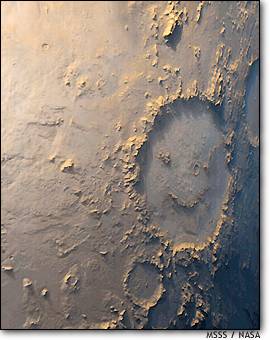
Don't believe me? Check out this picture.

Why are we doing this again?

Oh yeah -- because the universe contains many things we do not know, and we might as well learn a few of them while we're still here.

Seriously cool stuff.

Posted by Ross Ross on   |   § 2

X Prize closer to a winner

Bert Rutan's Scaled Composites are in the lead in the race for the X-Prize. This week, on the 100th anniversary of the Wright Brothers' first flight, Rutan's company staged the first flight of the SS1, (Space Ship 1). Although the flight was suborbital, two important conditions apply. 1) The SS1 is the first supersonic rocket-powered aircraft to be sent up by a private company rather than the Air Force, and 2) the SS1 is totally and cheaply reusable.

The X-Prize team predict that within a year, Rutan or one of two other teams will claim the prize, and the era of private space flight will begin. Sweet!!!!

Posted by Johno Johno on   |   § 0

The Gift that Keeps on Geeking

Geek Lethal, the lethalest geek of them all, is a saint and a man for all seasons.

His Christmas gift to me: Arthur S. Locke, et al., "Principles of Guided Missile Design" (Princeton, NJ: Van Nostrand & Co., 1956). Sweeeeeet. Now all I need is a backyard, an engineering degree, and money. Oh, and also a total disregard for my neighbors. Ever read Dad's Nuke?

I also recieved this weekend a pack of "Iraq's Most Wanted" playing cards. I opened the package, went to bed, and woke up the next morning to find that the Ace of Spades had turned up in the flop. Woo!!! Read 'em and weep, the dead man's hand again! And other Motorhead-related elations.

Truly this is a blessed fricken' season.

[wik] I have changed the link to the Guided Missile tutorial above, lest people get the mistaken impression that Mr. Lethal is some sort of nut. He's not. He's a very specific form of nut.

Posted by Johno Johno on   |   § 2

Captain Avitar, your ship is ready!

Via Geekpress, I see that NASA has produced a project of worth that is neither mock-worthy or eyerollingly useless and expensive. And no, I'm not talking about freeze-dried ice cream or powder-blue velcro-clasped jumpsuits.

Check it out: a working ion-propulsion engine! The prototype was produced at Glenn Research Center in Cleveland, a facility I toured repeatedly as a child. The engine is destined for use in the Prometheus Project, which is an ill-starred mission to Jupiter that will never happen in my lifetime as long as NASA is in charge. In the long term, NASA intends ion engines for use in any missions that can't rely on using planetary gravity wells as slingshots for long-distance propulsion, which is most of them. Good plan, hope it works.

At long last mankind will be ready when the Zentraedi, Gamilon, or Moties come for our women and mead. Can a giant ion railgun, huge transforming vehicles, and space cruisers that resemble Japanese WWII battleships really be far behind??

[wik] Special props to me for knowing how to spell Zentraedi without looking it up first. Not only am I in touch with my inner Geek, my Geek is in the drivers' seat, with a 20-sided keychain and a Macross decal on the window, doing Möbius donuts on your lawn.

Posted by Johno Johno on   |   § 2

China lays out Lunar plans

Space Daily is reporting that the Chinese have announced more details for its Lunar plans. Within the next three years, the Chinese will launch a Lunar orbiting probe, which is intended to produce three dimensional maps of the lunar surface, information on the composition of the Moon's surface, maps of lunar soil depth, and measurements of the environment between the Earth and the moon.

Beyond the lunar orbiter phase of the plan, the Chinese also hope to develop a automated lunar lander, possibly equipped with a pathfinder-style robotic rover, and eventually a sample return mission. All of this presumably leads to the possibility of a manned Chinese lunar mission, which has been a stated goal of the Chinese space program for some time.

Which means that Burt Rutan needs to get moving so that by the time the creaky apparatus of the Chinese Communist government lands on the moon, they'll find Americans already there, selling timeshare condos and opening amusement parks.

[wik] Do you realize how cool a lunar amusement park would be? Just think of the roller coasters you could build in 1/6th gravity. Also, in weak grasp of the Moon's pull, you could literally strap on wings and fly.

[alsø wik] I really hope that whatever successes the Chinese have in their space program, it does not result in some panicky space race reaction on the part of the American government. The best way to kick ChiCom ass is simply to let the unlimited creativity of the American economy to the job.

Posted by Buckethead Buckethead on   |   § 2

Powers Of Ten

Very cool Java applet demonstrating the wonders of the universe, from the very large, to the very small...hopefully you have installed Java! If so...

Powers Of Ten

Posted by Ross Ross on   |   § 0

NASA Gets with the times. Which times? 1966.

Gregg Easterbrook regains his footing after a disastrous couple weeks (ontology, rectocranial disease) with this post on NASA's latest genius plan: build a space plane!

NASA last wanted to build a space plane in the 1960s, and abandoned the project when ICBMs rendered negligible their strategic worth. It's well documented that podlike vehicles do better upon reentry than winged vehicles, and at this point the spaceplane is nothing but a decades-old dream. Furthermore, a space plane would do nothing to NASA's advantage-- it would still be expensive, dangerous, of limited use, and packed with Senate pork. From braindrizzles like this it's clear that NASA is not just useless, but actually harmful to the advance of engineering, science, and space exploration in the United States.

And these are the dudes in charge of space. /*covers face with hands

I would encourage anyone with a passing interest in space and space policy to pick up the most recent edition of the Atlantic, which features William Langeweische's killer cover story on the Columbia disaster and NASA's bumbling, fumbling, and institutional dead weight. Easterbrook covers the main point on Easterblogg so I won't belabor them here; I will only say that that X-Prize better be won, and soon.

Private Space Exploration Now!

[wik] Buckethead has kindly reminded me that he covered this NASA spaceplane garbage a while back.

[alsø wik] And don't forget to choose "That Buck Rogers Stuff" from the categories list at left for some of the darned-tootenist, bestest, pithiest, and altogether smartestest space bloviation anywhere!

Posted by Johno Johno on   |   § 3

More on nifty ways to kill little brown people

In the comments to Robert Prather's post China In Space (which he originally posted as a result of a comment I made on The Spoons Experience ain't the blogosphere grand?) Robert asked about space based kinetic energy weapons:

I saw a story last year about space-based missiles that used kinetic energy -- no warhead -- and hit the earth with all the destructive force of a nuclear weapon, minus the radiation.

Seeing as the post was a bit old, I decided to email him, but here's what I thought:

Robert,

The system you're looking for is THOR. It was featured in the novel Footfall, by Niven and Pournelle. Pornelle came up with the idea in the sixties, and advocated it when he became a member of the Citizen's Advisory Council on Space back in the early eighties. (The council included several sf writers, including Niven, Pournelle and Heinlein; as well as scientific and military types.) Here's a link to Jerry's description on his site, here's another article that references Pournelle and THOR, and here's a RAND corporation study, rather long and technical but juicy, nevertheless.

We've actually seen precursors of this concept in operation in Iraq - the concrete bomb is essentially the same concept, just airdropped instead of from space. With sufficient accuracy, and GPS gives us that, we don't always need explosives. When you have orbital weapons, the speed of reentry gives the weapon enormous power. However, it's not quite on the nuclear level. You'd need a very large projectile to approach Hiroshima grade impact events, or else accelerate the projectile to much higher speeds.

I was thinking some more about the militarization of space, and in one sense it has been militarized almost from the start - reconnaissance satellites are certainly performing a military function. But for the last forty years we've been frozen at the equivalent of 1914 for aircraft. What we're really thinking of is turning space systems from intelligence gathering and communications platforms into weapons platforms. While to the best of my knowledge we have never done it, it would be very easy to design a small manned, armed space capsule. We have invested substantial effort in developing unmanned ASAT weapons, they are still very limited in capability. With the advances in UAVs, this may change, but despite the weight penalties of carrying a pilot and his life support, the advantages of having intelligent direction are substantial.

When you think about potential Chinese moves into space, it becomes clear, I think that this is where it's going. For the Chinese to have any serious ASAT capability, which they would need to degrade our overall capabilities in any potential conflict, they would have to go with a space warship, however simple. Their technology would not enable them to develop the automated weaponry necessary. But, once they have made the space warship, their space capabilities could very well be greater than any collection of unmanned weapons platforms we have at the time. We would need manned space platforms to face the threat. (That assumes that they develop a reliable launch capability in addition to whatever space hardware they come up with.)

I posted a link to an article about the imminent arrival of serious battlefield lasers recently, and when you combine that concept with all the ideas for space to space and space to ground weaponry, you have some incredibly kick ass potential. We are already years if not decades ahead of any potential peer competitor militarily. Once this stuff comes on line, (and no one else is spending the money to develop it) we might be talking Nineteenth Century British v. Zulus or US Army v. Indians types of lethality differentials. Of course, just having the weapons doesn't guarantee victory - Custer left his Gatlings at base, and the British commander at Isandalwanda was a complete idiot. But with even moderately good military leadership, these weapons will give us enormous power. 

Posted by Buckethead Buckethead on   |   § 0

Divine Vessel in orbit

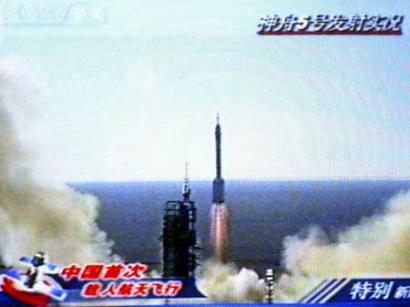
About an hour ago, the Chinese launched their first manned mission into space, with one Chinkonaut aboard. (Okay, that's the last time I'll use that. They made it into orbit, they deserve some props.) The Chinese government decided not to broadcast the launch live, but apparently all went well, and taikonaut Lt. Col. Yang Liwei, 38, is now circling the globe. He will return to Earth sometime tomorrow.

Chinks_in_space

The Washington Post has some good coverage, or just go to the drudge report and use one of his several links. I'll have more on this tomorrow. 

Posted by Buckethead Buckethead on   |   § 4

More on China's space plans

Here. Looks like nothing before the middle of the month.

[Update] Reports are conflicting, but it looks like the mission will be longer than the first missions of either the US or USSR. The yahoo article linked on Drudge is saying 14 orbits, which would be nearly a day in orbit. (Gagarin did, iirc, three orbits, and Glenn did one.)

Posted by Buckethead Buckethead on   |   § 0

Playing with the Big Boys

The ever-useful space.com is reporting that the consensus among those who watch these things is that the Chinese will launch their first manned space mission sometime in the next couple weeks. The article is well worth the read, as it examines some of the political and strategic considerations that many be prompted by a successful Chinese mission.

Many observers feel that the space flight program is merely a cloak for Chinese military development. Others feel that the mission is a prestige building exercise designed to reinforce the legitimacy of the Communist goeverment. Personally, I think it is both.

China is in many respects like Columbus, Ohio. Columbus is a decent sized city in a populous state. But it is alway overshadowed by Cleveland and Cincinnati. When I lived in Columbus in the nineties, there was constant talk of becoming a "major league" city. Much of this centered around efforts to acquire by any means necessary a pro baseball or football team. Of course, lying halfway between the Reds and the Bengals on one side, and the Indians and Browns on the other made this unlikely in the extreme. So, they got a Hockey team. But there were other efforts as well - all aimed at putting Columbus "on the map." When the number of people inside the Columbus city limits surpassed for the first time the number in Cleveland, Columbus cried, "We're the biggest city in Ohio!" Of course this completely ignored the fact that the Cleveland metro population is four times larger, and also that Cleveland has been less, well, assiduous in annexing neighboring communities.

China is convinced that does not get the respect that it deserves. So, this space mission is in some sense like Columbus' NHL team. But unlike Columbus, the Chinese have been making a strenuous effort over the last decade plus to modernize their armed forces. This space mission has obvious relevance to that effort. That China feels the need to pursue both of these ideas could be taken to indicate that China envisions for itself a grander role on the world stage.

And just remember the last time somebody had that set of ideas.

Posted by Buckethead Buckethead on   |   § 2

Environmentalist Wackos and Doommongers

In response to Johno's recent post:

I worked for several years for Citizen Action, an enviromental lobby group. Concern for the environment has always been something important for me, going back to the days when I was in the Boy Scouts and spent a considerable amount of time in actual nature as opposed to volvo station wagons with "Think globally act locally" bumperstickers.

CA and similar groups are the "sane" side of the environmental movement. While they eschew the violent or property damaging methods of Earth First and other wackos, their politics and beliefs are scarcely different.

My time at CA was a constant struggle - while I wanted to do something positive for the environment, do my part so to speak, the ideological fanaticism of the leadership and most of the other people working there was hard to deal with. At the time, I was significantly less conservative than I am today - and that experience was a major part of why I moved rightward.

At base, I cannot agree with people who think that technology is inherently evil, and that the world would be a better place if all but maybe a million environmentally conscious people were to depart it. Taken to its logical conclusions, the "sustainable development" ideology is a recipe for the death by starvation of billions.

Most environmentalists would of course stop short of advocating this path. But they are strangely tolerant of those who don't. The prejudices of the environmentalist and the antiglobalization crowd amount to a kind of condescension, where primitive peoples and nature are to be kept pristine, so that they may be properly appreciated by enlightened, blue-goretex-wearing ecotourists. Those primitive people are rarely consulted as to what their wishes actually are. (Usually, TV and a new wardrobe from a lot of the documentaries I've seen. Most people do not like poverty, even if it is a traditional lifestyle - that's why so many move to the cities.)

Technology could make things much better for the rest of the world, as could the economic liberty that makes advanced technology possible. A classic example is the golden rice, enriched with vitamin A that could prevent blindness in millions of children a year (it's all about the children, of course) even though it is an eevilll frankenfood. Kneejerk opposition to technological solutions, mystical environmental marxism, and constant doommongering are not a recipe for saving the whales, or anything else.

If we are going to preserve our natural wonders, and not go careening into self created disaster (at various times one or more of the following: new ice age, malthusian population collapse, utter depletion of natural resources, global warming, systemic collapse of the ecosystem, or just choking to death on pollution) we don't need more of the "woolly-headed crypto-Marxist claptrap that totally ignores reality in favor of impossible solutions."

Real solutions rely on an enlightened regard for self interest. If we refrain from screaming that the sky is falling, and point out that it is in everyone's best interest to avoid drowning in PCBs, we begin to make progress. (And using market based mechanisms for pollution control is a good start.) We are ever so much cleaner than we were even thirty years ago, and most new factories and what not are designed with environmental protection in mind. (The Cuyahoga River hasn't caught fire since before I was born! Go Cleveland!) In time, we'll have hydrogen cars, and maybe even clean fusion power (Cold Fusion Now!) or solar power satellites. The world will be cleaner, at least where sensible democratic people live.

But the worst polluters and environment rapers are totalitarian governments and poor nations. There is a clear connection between wealth and environmental awareness. People who have the luxury to think about a clean environment (rather than the next meal or whether they will be tortured by the local gestapo) will take steps to clean things up.

The trend is clear in the industrialized world - ever stricter standards and an increasingly park-like world outside the cities. We don't really need to worry much there. I don't think we are approaching ecological holocaust. We just need to calm down and stop firebombing apartment complexes and shouting "Free the Mink!"

Posted by Buckethead Buckethead on   |   § 2

But THIS is surprising

China... well ahead of the rest of the world.

(And I refuse to use the word "chinkonauts," though a certain sophomoric glee won't stop me from typing it here.)

As I read Neal Stephenson's "Quicksilver," I am reminded anew of the crazy shit men will do in quest for knowledge.

Posted by Johno Johno on   |   § 0

Two teams on the verge of claiming X-Prize

From Peter Diamandis, head of the X Prize Foundation:

"We expect to have a winner within the next nine to 12 months.''

Diamandis says that the two front runners are Burt Rutan's Scaled Composites effort, of which I have spoken previously, and John Carmack's (inventor of Doom and Quake) Armadillo Aerospace.

Lindbergh made his solo flight across the Atlantic in 1927 in pursuit of the $25,000 Orteig prize. He was not the first to fly across the Atlantic, not by a long shot. He was the first to fly solo, non-stop across the Atlantic.

According to the Space.com article, Diamandis said Lindbergh's flight "was a mind-shift breakthrough'' for the public. Within 18 months after that daring flight, the number of people boarding airlines rose from 5,700 a year to almost 200,000. Demonstrating that private companies can build and fly spacecraft can be a major step toward making human spaceflight as routine flying on an airliner is now."

Diamandis and many others hope that an X-Prize winner will light imaginations as Lindbergh's flight did, and lead the way to a new golden age of aerospace development.

Given the troubles that NASA has found, I can only say it can't happen soon enough.

Posted by Buckethead Buckethead on   |   § 0

NASA takes a giant step backwards

As China prepares to launch her first chinkonauts, and Europe launches a nifty new lunar probe, the United States is preparing to retro-60s style plan for American manned space flight. NASA is so, like, hip.

ABC is reporting on the push to design an orbital space plane to supplement the space shuttle. NASA is cleverly calling the designs "next generation shuttles" but the fact is, the Air Force had something very similar in mind when it was designing the X-20 Dynasoar back in the fifties.

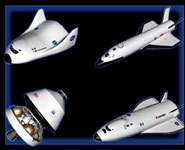
This image shows the four possible designs:

image

The vehicle on the upper left is functionally identical to the X-20, a lifting body glider. The one on the lower left is basically a reusable Apollo capsule. All four of these contenders would be launched atop a disposable launch vehicle like the Delta 4 or Atlas 5. The ABC piece quoted John Junkins, Professor of Aerospace Engineering at Texas A & M University:

"The Space Shuttle is 25-year-old technology that has not kept up... But it has done everything asked of it — carry people and carry huge amounts of cargo. No other space vehicle can do that. But it is time to separate the responsibilities."

So, to replace a twenty five year old technology, NASA is reaching back fifty years. We very nearly had a Orbital Space Plane in 1964, with a design going back to the late fifties. While I am not averse (certainly!) to NASA developing new space vehicles, trumpeting this as a next generation shuttle reveals the fundamental vacuum at the heart of a once great institution.

Posted by Buckethead Buckethead on   |   § 1

China ready to go to infinity and beyond

Space.com relates that Xinhua News Agency reported that China's Science and Technology Minister Xu Guanha stated that the preparations for the Middle Kingdom's first space launch were going smoothly. While no specific date has been set (and the communist government is notoriously tight lipped about such matters, talk around the campfire has settled on two possibilities: Oct 1, China's National Day and the anniversary of the founding of the state in '49, or later in the month. Obviously, weather, technical difficulties, solar radiation levels and acts of God (or acts of nature for you atheistic commie bastards) could interfere with the plan.

I hope that the mission goes well, not because I look forward to a lifetime of servitude to our new ant, I mean Chinese masters, but because hopefully this will light a fire under someone's ass here in the good 'ol U S of A. Either get serious about government funded space travel, or get the hell out of the way and let us do it.

Posted by Buckethead Buckethead on   |   § 2

Burn Rubber

Space.com is reporting that Burt Rutan and his team at Scaled Composites have successfully completed a full on test burn of a prototype hybrid rocket motor. (Another company has also tested a hybrid motor. Reportedly, Scaled Composites will decide which rocket to go with soon.)

Rutan has already conducted a series of tests of the White Knight mother ship that will carry the smaller SpaceShipOne to high altitude, where it will begin its independent flight into space. SpaceShipOne is designed to land like a glider, and it has undergone several gliding test flights.

The hybrid motors burn Nitrous Oxide (whippets) and hydroxy-terminated polybutadiene (HTPB) - otherwise known as rubber. While these are not the most energetic of all propellants (Liquid Hydrogen and Oxygen, used for the Shuttle main engines, are the most powerful) they have the advantage of being stable, easily stored and non reactive; and safer than almost all other potential rocket fuels.

It looks like Rutan is the most likely winner of the X-Prize, moving along at a rapid pace. I think it would be a rather amazing thing if they launch on Dec 17th, the 100th anniversary of the Wright Brother's first flight. It could happen.

Posted by Buckethead Buckethead on   |   § 1