This was originally posted back in 2004. We've since moved to a new hosting engine, and this has been kind of buried for a while. Thought I'd repost it in one convenient lump for your edification and enjoyment:
The first essay is a compressed history of naval combat here on Earth. The second part begins the discussion of what might happen in space. Clueless makes two central assumptions: 1) Stealth will be difficult if not impossible to achieve; and 2) that nuclear weapons will not be used. I’ll talk about the second one first.
Fire Control Solution
Most of the interaction between technology and tactics centers on what might be termed a fire control solution. Another way to look at it is this: You want to kill one guy on a hill, in plain sight, three miles away. Shooting at him with a rifle will only bring him down by chance - rifles are not accurate at those ranges. You have three choices.
- Get more guys with rifles, and deluge that hilltop with bullets. Each bullet, considered individually, is inaccurate. But one of them will hit. An example of this is the Napoleonic era and earlier: firearms then were inaccurate in the extreme. Therefore, troops were massed in lines, to increase the volume of fire and achieve a satisfactory number of hits. The trade-off was that to get the volume of fire you wanted; you bunched your troops up and exposed them to the return fire of the enemy. So long as your enemy had the same type of weapons, this was acceptable.
- Run back to the lab, and invent a more accurate rifle, and drop him with a head shot. This happened in land warfare by the time of the American Civil War. Rifle accuracy increased, increasing the danger in exposing all your troops to enemy fire. Most generals were very slow to realize this, and some didn’t even into the First World War.
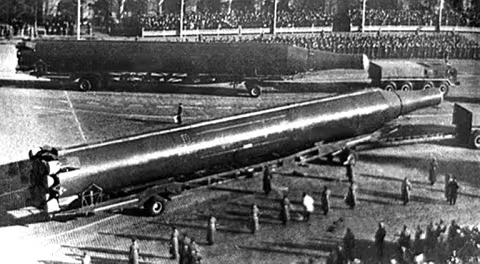
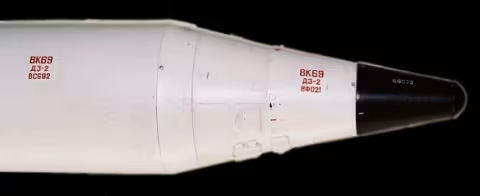
- Run back to the lab, and invent a more effective bullet. This has two potential paths: self-guiding, but otherwise more or less conventional bullets; or explosive bullets that lessen the need for accurate placement. An analogy for this is the ICBMs of the opposing superpowers in the Cold War. American missiles were equipped with ever more accurate guidance systems, allowing them to be placed directly on target. Soviet missiles never achieved that level of accuracy, but carried large warheads that made misses into hits.
How does this apply to space warfare? In space, there is no cover to hide behind and no foxholes to dig. If you are in plain sight (more on that later) you can, theoretically, be hit. However, space is very, very big. How do you hit and disable or destroy an enemy who is a quarter million miles away, and moving an order of magnitude faster than a bullet? You will have to use one of the methods outlined above, and that will shape battle tactics more than any other factor, save one: stealth.
Nuclear Weapons in Space
To go back to our earlier discussion of the death of the man on the hilltop, one way to ensure his demise was to use a bullet that rendered accuracy less important. What weapon that we now possess is better at this than a nuke? In the end, I don’t think nuclear weapons will be avoided in space warfare - there. utility will be too tempting to military planners. Considering the general hugeness of space, and the possibility that combat will take place over light seconds of distance, targeting becomes a real problem. When you look at the sun (well, glance. Didn’t your mother tell you not to stare at the sun?) you are seeing where it was over eight minutes ago. When you look at the moon, you are seeing where it was, one and a half seconds ago. The moon is a big target, and not moving very fast in relation to the earth. But a small spaceship, actively trying to jink and maneuver to avoid your righteous anger, is going to be a tough shot when even information conveyed at the speed of light is seconds out of date.
Nukes will surmount this problem to a large extent, by the stupendous explosions they create. It reduces the targeting problem by increasing the size of the kill zone. In the end, and because of the lack of bunnies and whales in space, nukes will definitely be used. (Use near the atmosphere of Earth might still be avoided, though.)
Stand-Off Weapons
A further use of nukes is in disposable X-Ray lasers. Imagine a small nuke. Put a cylinder of carefully designed rods around the nuke. Light off the nuke. What happens - hopefully - is that the nuclear explosion bombards the rods with highly energetic gamma rays. In the instant before being destroyed by the explosion, the gamma rays cause the spontaneous emission of X-ray photons in the lasing rods, creating several X-ray laser beams. Instead of an expanding sphere of radioactive death, you get a several lances of highly focused X-ray death. Initial research for these weapons was done back in the eighties for SDI. While those tests were inconclusive, something like this should be possible. A weapon of this nature would be rather amazingly powerful, and could be fired without giving away the precise location of the launching warship. (And, of course, it would function as a sensor drone until detonated.) Even if the X-ray lasers turn out to be impossible - stand-off weapons will likely form a large part of space tactics. There will be a spectrum of autonomous weapon systems, starting with pure missiles, shading into sensor drone/missiles, and into autonomous weapons platforms analogous to the X-45 we described here. The boundaries between the different types will be vague, and many types will be developed. But I don’t think that any crewed warship in a deep space battle will be without robotic surrogates. (Actually, I don’t think it will be long before that is true here on Earth.)
Other Weapons
Clueless’ other comments on possible space weapons are well founded and sensible. I especially liked his thoughts on the use of cannon in space, especially in light of the need to avoid heat - no large power plant would be necessary to fire a cannon. These are the weapons, along with nukes, that we will use to beat on each other as we take our squabbles into space.
Utility of Stealth Technology Reconsidered
Steven dismisses stealth technology, and invokes the Second Law of Thermodynamics to defend his assumption. However, there are several factors that I think he is missing. First, all space ships will need to radiate heat, making it possible for enemy sensors to detect them. However, the Second Law does not require my spaceship to radiate heat toward the enemy. If I am not mistaken, it should be possible to direct the radiation of heat toward a sector of the sky not infested by enemy sensors, thus reducing your IR signature. Also, much ingenuity could be invested in coatings, surfaces, insulators, heat exchangers and the like to pull heat from the surface of the ship, and place it elsewhere, out of the direct view of the enemy. And again, space is very, very big. To detect a ship that is trying to be cool, from tens, hundreds of thousands, or even millions of miles away, would require very sensitive IR gear indeed. I imagine that in some respects, fleet movements will be like modern submarine deployments, with heat replacing sound as the deadly giveaway. Non-essential power systems will be turned off until needed. And ships will be cold. They will coast like derelicts until battle is met.
Likewise, active sensor systems like radar will be used only sparingly. Lighting up a radar system powerful enough to detect stealthed objects at thousands of mile distances (remember the inverse-square law) will be like lighting up an enormous “shoot me” beacon. Conventional stealth technology does not render the airplanes invisible to radar. In effect, it makes them smaller and thus harder to detect. The same technologies (and their descendents) will still be used to render ships harder to detect.
Despite the troubling limitations of active sensors, there is hope. One possible work-around is the use of sensor drones. These would be deployed well in advance of battle, to allow maximum drift from the mother ship. The take from a sensor drone would be piped to the warship by tight beam laser communications to minimize the chance of detection. These could use active sensors without endangering a crewed warship. Also, data from passive sensors on a number of drones could be combined with that of the mother ship to form a much more powerful virtual sensor. Interferometry has been used for decades here on earth by astronomers, and there is no reason to suppose it won’t be used in space combat. (I would imagine that each sensor drone will also be a missile. There is no reason not to combine them. Not all missile/drones will have the complete sensor suite, but if you’re going to be talking to your missiles to guide them to target, you might as well benefit, intelligence-wise, while it’s still around.)
All ships will have their passive sensors working nonstop, trying to detect a warm blob, or a whisper of radio, or the occultation of a star. A warship’s powerful radar systems will only be engaged rarely, and only after the commander is certain that his location is already known. It is always possible to achieve strategic surprise � even when the enemy knows where you are. Tactical surprise requires more, or at least different, levels of cunning. With almost dormant, heavily stealthed ships, you could get fairly close to the enemy without detection. Of course, fairly close in space combat will likely end up being the distance from the earth to the moon.
In a little bit, I’ll continue with some thoughts on how the stuff I just talked about relates to space strategery and tactics.
When we think about battles in space, it is useful to draw some parallels to earthly naval warfare. Just as there is a distinction between blue water and brown water navies, there will be a similar divide between warships designed to fight within the gravity well of a planet, and those intended to fight in the depths of interplanetary space. Warships designed to operate in close proximity to bases, and to deal with the rigors of maneuver in a steep gravity well will be very different from those required to make long journeys in flat space between the planets. We can think of the former as river gunboats, the latter as battleships.
Gunboats operating in orbital space around, say, Earth will have powerful, high thrust engines and limited facilities for life support. They will be based in orbital forts, or perhaps launched atop disposable launch vehicles like the Gemini or Apollo rockets of the sixties. The life of the crews of these warships will be more like that of an Air Force fighter pilot than that of a submariner - which I think will be the closest analog for long duration deep space warships.
Gunboats, operating in the constrained space around a planet, will engage at shorter distances than their deep space cousins. In most respects, their armament and sensors will be very like that of a modern jet fighter. In fact, they will probably look something like a modern fighter - as being able to enter the atmosphere (at least the upper reaches of it) will be a very useful thing. Aero-braking, skip-jumping along the top of the atmosphere, and similar tactics will all save fuel while increasing the range and maneuverability of the ship. And being able to land on Earth will be a happy alternative to dying in space in the event of damage to the ship.
Looking beyond the descendents of a marriage between the space shuttle and an F-15, other types of orbital gunboat can be imagined. Light sail ships, boosted by ground or space based lasers might also be developed. Heavier warships, analogous to coast guard cutters might linger in orbit for weeks at a time, before returning to base. If scramjets are ever perfected, then warships operating at the interface between space and the atmosphere might become common. All of these types would have some capacity to attack targets on the ground, and in fact some might be designed around that mission. Erwin Sanger, an Austrian designer in the forties, imagined a rocket-powered bomber that would skip along the top of the atmosphere.
In combat within the gravity well of a large planet, altitude will be the most important tactical consideration. Like the wind gauge for sail-powered warships, gravity gauge will be the dominant factor. Having the advantage of position will be crucial, in that a position higher up the gravity well translates to more options for maneuver. Also, shooting up the gravity well is inherently harder than shooting down. The first pilots of these warships will have to learn the somewhat paradoxical logic of orbital mechanics - slowing down speeds you up, and vice versa. For pilots used to the straightforward maneuvers within an atmosphere will have to adapt quickly.
Deep Space Design Tradeoffs
Deep space will offer vastly different challenges to warship designers. All of the propulsion systems that might be available in the near future have serious limitations. Two tradeoffs will determine the design of all warships. The first is mass/acceleration; the second is power/stealth. I noted in the first part the tradeoffs required by stealth. Most of the tradeoffs for mass and acceleration will push ship design in the same direction.
The major propulsion systems that could be constructed with current or very near future technology are chemical rockets, nuclear fission rockets, nuclear pulse drives, ion drives and solar sails. The first three are high thrust, short duration drives; while the last two are low thrust, long duration. With the exception of nuclear pulse, which I will discuss separately, all of these systems impose the same limitation on warship design: every ounce of mass will reduce the total acceleration the warship is capable of. Space types refer to this as delta-v, or change in velocity. It is a measure of the total change in velocity (speed plus direction) that the ship is capable of with a given drive and fuel supply. It doesn't matter whether your ship accelerates really fast and then coasts, or if it makes a long slow burn, since delta-v measures the total change. This makes it a useful comparison between ships even of vastly different design.
(While solar sails will have effectively infinite delta-v, because they use the solar wind for propulsion, solar sails will not be well suited for combat since the sails are so visible and so fragile. Warships will largely be confined to the other drives.)
Ship designers will always be striving to make the ship lighter. This will allow engines of a given capacity to achieve a higher delta-v. However, there are things that a warship must have in order to be effective. Weapons, armor, sensors and stealthing; crew, and food, water and life support for voyages lasting months or more; a storm cellar to protect the crew from solar flares; fuel or reaction mass; these are all things you will need to bring along. Rockets and ion drives are low energy, and this balance will place a premium on low mass weapons, small crews (and thus lessened life support requirements) and little or no armor.
Weapons that require vast power plants will be right out. (Both for mass and heat/stealth loss reasons.) Weapons that are themselves heavy will be right out. Missiles will not be very useful in long-range engagements, due to the fact that a rocket capable of propelling a warhead to a target tens of thousands of miles away in time to affect a battle will be almost as large as a small space ship. This would seem to put a premium on beam weapons. However, as we discussed in the previous part, and as Clueless mentioned, power plants capable of powering lasers, masers, and particle beam weapons will be heavy and produce lots of heat.
So, it may very well be that early spaceships will be armed with rapid-fire cannon and machineguns. With some effort, a high velocity, rapid-fire cannon could be developed for use in spaceships. Rate of fire would be important, as I discussed in the first part. The more rounds put in the general vicinity of the target will increase the chance of a hit. One of the most promising technologies is the Metalstorm system invented by the Australian O'Dwyer. This system stacks bullets in the barrel, and fires them electronically. By bundling several barrels together, it can achieve rates of fire approaching millions of rounds per minute. Gunners on warships would fire hundreds of rounds at a time, laying patterns that would (hopefully) intersect the course of the target. Variations might include sub-munitions, target seeking or sensor rounds, and explosive rounds. After firing all its rounds, individual Metalstorm units could be discarded, increasing available delta-v. Rapid-fire, self-contained, requiring effectively no external power, and disposable after use - Metalstorm cannon seem an ideal fit for spaceships.
As technology advances, smaller and more efficient power plants will allow warships to move toward beam weapons that will be more accurate than the cannon described above. Unless radically better drives are developed, missiles will remain the weapons of orbital gunboats, and not deep space navies. The mass penalty for missiles with adequate range will simply be too great. Warships of these types will be armed with cannon; and, if they can be developed, standoff x-ray lasers.
Deep space warships built around rockets or ion drives will tend toward small. Small is better for mass and stealth both. In all likelihood, they will be narrow, to provide a smaller radar and IR signature for enemies to detect. (That is, as long as the ship is pointing in the right direction.) They will be covered with stealth materials, and the rear of the ship will have complicated and fragile fractal heat radiators as well as the drive exhaust. Weapons will be concealed beneath the stealth covering. Life for the crew will be hard, living in cramped spaces for months at a time. I imagine it will be rather like a submarine.
Orion Drive
The exception to much of the mass considerations discussed above is the nuclear pulse, or Orion drive. This concept involves building a very large ship with a heavy base plate attached to the back of the ship by some very serious shock absorbers. Then, you light off a small nuke behind the ship. Repeat as necessary. This is an over-the-top propulsion scheme. With this, you could accelerate very large masses very quickly. Ships using an Orion drive would simply have to be big just to make the acceleration survivable. Since you need a big ship; adding armor, huge power plants, or anything else you want is not such a big deal. An Orion powered warship would be a huge hulking brute. It would not be subtle, and stealth would be a lost cause.
No other type of spaceship (based on current technology) could match the Orion for speed and payload. It will be in a class by itself until and unless someone invents fusion or antimatter drives. Meanwhile, the inherent limitations of the other propulsion types will limit the kinds of warships that can be built around them. (As will the existence of Orion powered warships.) And given the requirement for (large numbers of) nuclear devices for propulsion in an Orion, and the stupendous expense of putting that much mass in orbit will probably mean that only governments will ever have them.
Life for a crewman on an Orion warship will be easy, by comparison. The generous payloads of an Orion will make for more comfortable quarters, and better life support. Large amounts of armor will likely contribute to the peace of mind of the crew as well. Rotating crew quarters providing artificial gravity might even be possible. The speed of Orion will also mean shorter journeys - weeks instead of months between planets.
In the next part, we'll look at strategic considerations, and how these ships might be employed.
Strategery and Spaceship design
All of this brings us finally to considerations of strategy. What would these warships be used for? Warships are often thought of in terms of how they kill other warships. This is not completely unreasonable. However, in strategic terms, warships exist to exert control over the sea. Historically, this has taken two forms here on Earth: to either protect your own shipping (preserving your use of the seas) or denying the use of the seas for your enemy. More recently, sea power has been used to project military power inland. US carrier battle groups are able to inflict significant amounts of damage to inland targets, and are also able to provide cover for amphibious assaults. To achieve these missions, warships and navies must often defeat other navies, which is why we so often think solely of warships� abilities to kill other warships. But the underlying purposes of navies and warships will drive the development of ship design.
In a solar system that is inhabited by competing powers, these missions will have close analogs. Protect your own interplanetary shipping. Deny it to the enemy. Project military force onto enemy targets on planets, asteroids or moons. Provide cover for space-borne assault on enemy targets. Each of these missions will require different types of warships. We have discussed the different types of warships that could be built with the technology that we have now, or could reasonably develop in the near future. We have seen that they fall into two major categories. How will they be used?
The Orion drive will provide a (very expensive) platform for moving large amounts of men and materials quickly across interplanetary distances. Ships built around less effective drives will be cheaper but much less capable than the Orions. It seems unlikely that any private concern would, in the near future, have the resources or need to build Orion drive commercial ships. Most private, and non-military government transport will use rockets, ion drives or solar sails. Sails will be especially favored by private concerns because of the cheapness of operation - absolutely no fuel costs. Faster transportation for VIPs or urgent cargos will be provided by souped up, stripped down nuclear thermal rocket powered craft.
If a power wishes to impede the shipping of a rival, non-Orion warships will be the most cost-effective commerce raiders. These ships would operate like earthly submarines, and it would be well within their power to effectively attack enemy shipping, or engage in 'anti-submarine' warfare. Reconnaissance, intelligence gathering, lurking, stealthily inserting commandos - these are other missions that they might conduct. They could even serve as a sort of destroyer screen for a force of more capable ships. As escorts for friendly shipping, they would be useful in warding off the predations of enemy commerce raiders. But these light warships would be less well suited to the other missions that a space navy would be called upon to fight.
[wik] Side note: in talking about the relative usefulness of Orions and other warships, I am imagining a time when the solar system is somewhat well settled, and rival powers have emerged, and space warfare has had time to evolve. Initially, combat between the smaller classes of warships would be the leading edge - until the first Orion warship is built. I think that the first Orion would be like the British Dreadnought, taking naval warfare to an entirely different level, and possible igniting an arms race. The first interplanetary warships will be commercial or government ships originally designed for other purposes and retrofitted with weaponry. Indeed, ships like that will still be part of navies for a long time after the first purpose-built warships are laid down. But eventually, someone will become sufficiently frustrated with the limitations of conventional ships, and build that first Orion.
Battleship or Carrier?
Since we've been so free with analogies to naval warfare, let's throw out a few more. If the smaller class of warships, using conventional drives, are to be likened to submarines, what is the proper analogy for the Orion drive warships? The obvious choices are Aircraft Carriers and Battleships. Which one it ends up being depends a lot on weapons technology.
On earth, the battleship was surpassed by the carrier because of the advantages of aircraft. The best carrier without its dive-bombers, fighters, and torpedo planes would be a sitting duck for even an awkward, adolescent battleship. Why did aircraft have such advantages? Speed and range. Battleships were not only the largest of warships, they were the fastest and longest ranging. Aircraft trumped that by being able to fly above the water at speeds ten times or more faster than the fastest ship, and then drop bombs on the battleship with impunity from thousands of feet up.
Can we imagine an analogous vehicle in space? We have already seen that an Orion powered ship will be faster and have longer range than any smaller ship. While an Orion-powered ship could indeed carry fighter-equivalent spacecraft, dispersing your firepower into a bevy of smaller and slower ships does not seem to be as great an advantage as it was for wet navies. The same logic that drove the development of ever larger, ever more heavily armed battleships seems to apply to spaceships as well.
However, another consideration might yet result in Orion carriers rather than Orion battleships. The development of autonomous reconnaissance and (very soon) combat drones is well under way. There is no reason to believe that these developments will not be carried into space - in fact, all of our robotic space probes could be considered non-combat autonomous drones. The advantages of a non-crewed warship would be many: greater tolerance for acceleration, no need to waste mass on life support and a vulnerable but clever meatsack, and less concern if the drone is lost as opposed to a piloted warship. I don't think that the big warships will ever be unmanned, as the limitations placed on communications by the speed of light will require that humans be present at the battlefield. But that does not mean that drones will not be present on the battlefield. As I mentioned earlier, the line between weapon, sensor, and drone will grow vague. Each ship will be attended by a network of drones, feeding sensor data back to the mother ship; and if opportunity presents - deploying itself as a weapon. A big part of battle management will be the handling of these networks of drones. (I think that will be true here on earth in a very short time as well.) But these drones - be they weapons platforms akin to fighters, sensor drones, or x-ray lasers, will not make the Orion warship into a carrier. The primary focus will I think remain on the primary weaponry of the warship; if only because the autonomous drones of various types could never keep up with the mother ship. It does not pay to deploy millions of dollars of equipment that could be rapidly left behind by a fast-moving battle, and play absolutely no part in the battle itself.
So the Orions will be battleships, queens of space. The generous payloads of Orions will likely see them armed with powerful generators, lasers and masers, particle beam weapons, railguns and metalstorm cannon. Bundles of lasing rods like those used in the standoff X-ray lasers could be dropped overboard with propulsion nukes, literally gaining more bang for the buck. The powerful weaponry of an Orion battleship, powered by an onboard fission reactor, would likely out-range as well as out-power any smaller ship. (Just like with traditional battleships, which could shoot farther than any other.) Armor will be possible, making the battleship resistant to many of the weapons capable of being carried by smaller warships, and even to those mounted on orbital bases. (An Orion battleship is in effect a mobile base, considering its size.) Crew complement for an Orion Battleship might number in the hundreds - mostly for damage control, but also to manage all the weapons, sensors, drones and communications that would be required by such a vessel.
Next bit will cover what might happen in an actual space battle.
[alsø wik] Side note: The only reasonable variant on the basic battleship that seems likely is an assault version. It would perform the traditional naval missions of projection of force and covering assaults. This vessel would be used to rapidly transport space marines and the means to get them into whatever they're attacking: winged landing craft, zero-gravity assault boats, or whatever is required. This type of ship would also favor the types of weapons that could be used to bombard planetary surfaces. In time, as space navies build more Orions, variations in size and relative power might eventually be grouped into traditional categories such as frigates, cruisers and battleships. Or we might come up with altogether new names.
[alsø alsø wik] I think that in the long run, the traditions of the Navy will be more suited to space warfare than those of the Air Force. But since the Air Force is closer to space - they will likely get there first. And we’ll have generals in command of our space fleets. And that will suck.






 on
| § 0
on
| § 0