

A New England in Crimea
The medieval 'New England': a forgotten Anglo-Saxon colony on the north-eastern Black Sea coast.
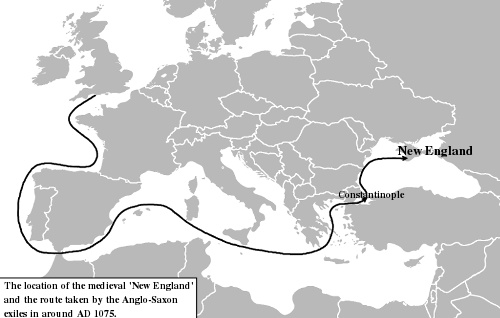
Although the name 'New England' is now firmly associated with the east coast of America, this is not the first place to be called that. In the medieval period there was another Nova Anglia, 'New England', and it lay far to the east of England, rather than to the west, in the area of the Crimean peninsula. The following post examines some of the evidence relating to this colony, which was said to have been established by Anglo-Saxon exiles after the Norman conquest of 1066 and seems to have survived at least as late as the thirteenth century.
According to these sources, what seems to have occurred is that, in the aftermath of the Norman Conquest of England in 1066, a group of English lords who hated William the Conqueror's rule but had lost all hope of overthrowing it decided to sell up their land and leave England forever. Led by an 'earl of Gloucester' named Sigurðr (Stanardus in the Chronicon Laudunensis), they set out with 350 ships—235 in the CL—for the Mediterranean via the Straits of Gibraltar. Once there, they voyaged around raiding and adventuring for a period, before learning that Constantinople was being besieged (either whilst they were in Sicily, according to the Edwardsaga, or in Sardinia, as the CL). Hearing this, they decided to set sail for Constantinople to assist the Byzantine emperor. When they reached there, they fought victoriously for the emperor and so earned his gratitude, with the result that they were offered a place of honour in his Varangian Guard.
...
Thus far the story, as outlined above, is clearly intriguing, and moreover largely supported by all of the available sources, both northern and Byzantine. However, perhaps the most remarkable and interesting part of the tale is found only in the Chronicon Laudunensis and the Edwardsaga, both of which may derive from a lost early twelfth century account, according to Fell. The Edwardsaga states that whilst some of the exiled Anglo-Saxons accepted the offer of joining the Varangian Guard, some members of the group asked instead for a place to settle and rule themselves:
[I]t seemed to earl Sigurd and the other chiefs that it was too small a career to grow old there in that fashion, that they had not a realm to rule over; and they begged the king to give them some towns or cities which they might own and their heirs after them. But the king thought he could not strip other men of their estates. And when they came to talk of this, king Kirjalax [Alexius I Comnenus] tells them that he knew of a land lying north in the sea, which had lain of old under the emperor of Micklegarth [Constantinople], but in after days the heathen had won it and abode in it. And when the Englishmen heard that they took a title from king Kirjalax that that land should be their own and their heirs after them if they could get it won under them from the heathen men free from tax and toll. The king granted them this. After that the Englishmen fared away out of Micklegarth and north into the sea, but some chiefs stayed behind in Micklegarth, and went into service there.
Earl Sigurd and his men came to this land and had many battles there, and got the land won, but drove away all the folk that abode there before. After that they took that land into possession and gave it a name, and called it England [Nova Anglia, 'New England', in the Chronicon Laudunensis]. To the towns that were in the land and to those which they built they gave the names of the towns in England. They called them both London and York, and by the names of other great towns in England. They would not have St. Paul's law, which passes current in Micklegarth, but sought bishops and other clergymen from Hungary. The land lies six days' and nights' sail across the sea in the east and north-east from Micklegarth; and there is the best of land there: and that folk has abode there ever since.In conclusion, the above points would seem to add some considerable weight to the case for the existence of a 'New England' on the northern and north-eastern coast of the Black Sea in the medieval period. Not only does it seem that the Byzantine Empire regained control of that portion of the Black Sea coast in this period, just as the Edwardsaga/Chronicon Laudunensis claim, but there also exists a quantity of medieval place-name evidence from this region that offers significant support for the establishment of English Varangian settlements there and a thirteenth-century account that appears to refer to the continued existence of a Christian people named the Saxi in this area, who occupied defended cities and were militarily sophisticated. In such circumstances, the most credible solution is surely that the medieval tales of a Nova Anglia, 'New England', in the area of the Crimean peninsula and north-eastern Black Sea coast do indeed have a basis in reality. This territory would appear to have been established by the late eleventh-century Anglo-Saxon exiles who had left England after the Norman Conquest and joined the Byzantine emperor's Varangian Guard, and their control of at least some land and cities here apparently persisted for several centuries, perhaps thus providing a regular supply of 'English Varangians' to the Byzantine Empire that helps to explain why the 'native tongue' of the Varangian Guard continued to be English as late as the mid-fourteenth century.
Sadly no information in the post on what happened to the Saxi - they were still around as late as the 1300s - but nothing on their ultimate fate.
Fascinating.
 on
| § 0
on
| § 0