An Orbit of Eternal Grace

Science, mad or otherwise. Rockets and space travel, and maybe we can get off this sordid rock.

The aliens are coming, hooray, hooray

The blessed amazon fairy delivered another load of printed goodness at my doorstep. Typically, the amazon fairy brings me science fiction that is more or less throw-away, enjoyable to read but whose thinks pass in and then out of my brain leaving little lasting impression. Or history tracts that expand or deepen my knowledge of the past without notably changing my opinions of it. But this last deposit was a little different.

The book in the plain brown wrapper was "An Introduction to Planetary Defense, A Study of Modern Warfare Applied to Extra-Terrestrial Invasion." The careful and attentive reader of this website will quickly discern why this title got onto my wishlist. Of the four writers, I had only heard of the lead author, Travis S. Taylor, who had written a few science fiction novels for Baen Books. From the bios in those works, I knew that Dr. Taylor was a bit of a big brain, working for NASA and various defense department projects, including the Breakthrough Propulsion Physics program at NASA before its untimely demise. The name of the book and that last fact was enough for me to shell out the $35.

Was it worth it? On balance, I think definitely yes. There are problems with the book. Let’s get them out of the way first. The book is very poorly edited. There are typos, bad grammar, and poorly formed sentences throughout. That is irritating and distracts from the message the book is trying to get across. The book is poorly balanced, by which I mean that certain points will be attacked in great detail, and the next bit, seemingly of equal importance, will be glossed over. This creates a problem when the authors refer to something that was not adequately discussed further on, and my reaction is a resounding, “huh? Where’d that come from?” That’s the technical side.

On the idea side, I have far fewer problems, and where I do, it’s wishing that the authors had explored a topic a little more, or discussed something they didn’t. More on that (oh, much more. I’m going to go den Beste on their ass) later. Despite the flaws that are, I imagine, the result of what looks like self-publishing, this book is chock full of interesting, thought-provoking meaty stuff.

Why do I think so? Let me count the ways…

In thinking about aliens, two things have always bothered me, and I hoped that An Introduction would address them. The first of these problems is Fermi’s paradox, and the second is the remarkable optimism of SETI researchers. I was happy to see that this book addressed both of them, and in spades.

The Drake Equation

Before we discuss those two things, a brief discourse on the Drake Equation. The Drake Equation is not so much an equation as a means of quantifying ignorance, and adding up the probabilities of intelligent life arising in the galaxy. You start with the number of stars in the galaxy, and multiply that number by quite a few factors. The result is your own personal estimate, N, of how many ETs are out there.

Drake Equation

N is the number of civilizations in the Milky way that have developed systems which produce electromagnetic emissions detectable from Earth. It is equal, then, to the rate of star formation times the probability that the star will have planets, times the number of habitable planets per star times the number of those planets that will develop life, times the number of those that will develop intelligent life, times the number of those intelligent species that will develop means of communication times (finally) the length of time those signals are detectable.

The first two numbers, we actually know something about. The rate of star formation is about 1.5 a year, and we are finding planets everywhere we look, so .9 for that. Number of habitable planets? For us in the Solar System, one definitely, and two maybes – Europa and Mars. Let’s say three. (It doesn’t matter if they’re not all habitable at the same time.) SETI researchers always use “1” for the number of habitable planets that develop life. How many develop intelligent life? Taylor suggests 2/3, fair enough. How many develop detectable civilizations? Taylor suggests a quarter. Run the numbers, and the Drake Equation yields an interesting result.

New, detectable ET civilizations are arising at a rate of one every three years.

Assume we’re off by an order of magnitude. That’s two civilizations per lifetime. A hundred thousand over the tenure of man’s existence on Earth. Half a billion extant in the galaxy right now.

Put in smaller numbers, and the results are still invariably stunning. Assume that only one in a hundred habitable planets develops life, and that only one in a hundred of those develops intelligent life. You still get an intelligent species arriving on the scene every thousand years. The galaxy is billions of years old. 150,000 extant in the Galaxy, right now.

Taylor and company also make some interesting additions to the Drake Equation. They take into account the size of the Milky Way, and calculate the galactic density of ETs. Using Taylor’s numbers, it is .064 ETs per square light year. Or, in a 1000 ly bubble centered on earth, there are 50,000 species. That’s intelligent, technological ETs. Even using my several orders of magnitude more conservative numbers, there are still 15 techno-ETs in local space. right now.

They also add two more factors to the Drake Equation: ft, the number of technological civilizations that go a-traveling, and v, the velocity at which those species can move about the galaxy. Here we get some even more interesting numbers. If we assume that all technological civilizations eventually travel, and that their velocity is a tenth the speed of light, then there are 200,000 travelers within range of Earth. Which means that there is a great likelihood of someone, sometime, visiting Earth. And maybe soon. Maybe next Tuesday. (Taylor provides all the math for this, btw.) You’ll have to read the book to see what his numbers suggest, you won’t believe me. (you can see a good chunk of the book here.)

The sheer number of stars in the galaxy, and the staggeringly long time it’s been around mean that whenever you plug a non-zero number into any element of the Drake Equation, you get lots of ETs, and an uncomfortable number in close proximity. Using my numbers but the same assumptions as Taylor, the likelihood of one of 60 nearby species paying a call on earth is about one visit every 166 years. Now there may be other factors that slow down the rate of visitation – varying galactic geography, randomness of placement, or even that there are even less species than we think. Another primary reason we’ll discuss next.

The chance of first contact is not so remote as we may believe.

The Fermi Paradox

Fermi’s Paradox comes from the question, “Where are they?” that Enrico Fermi asked back in the fifties after some back of the envelope calculations led him to consider that given a constant rate of expansion, it would only take millions of years for an intelligent species to spread throughout the Galaxy. And the Galaxy is billions of years old – if, at any time, an intelligent species had arisen, one might assume that they would have gotten here and, presumably, prevented us from existing in the first place.

This always seemed a fairly reasonable supposition, but it does fly in the face of the results of plugging even the most conservative numbers into the Drake Equation. Taylor and company put the eye on this dilemma and come up with a surprising conclusion. The Fermi Paradox is a crock.

Over the years, the SETI community has come up with several responses to the Fermi Paradox. We could be the first intelligent species. Or there could be any number of insurmountable obstacles to interstellar expansion: it’s too difficult, conceptually alien to other intelligences, or it’s not really a good idea and just not done. Or, it has been done and there is some sort of Prime Directive that restrains ET from screwing with us. Or ET is screwing with us and we don’t know it. Or we’ve simply been overlooked.

Now all of these things are reasonable. Taylor, however, contests the ground under Fermi’s feet. Fermi, in his calculations, used a simple population growth model. However, says Taylor, that isn’t really the best model for imagining intelligent species moving out into the big world. First, no species on Earth ever follows a simple exponential growth curve. Second, intelligent species will likely have different needs and goals, and thus will either defend niches or compete over them within a greater sentient galactic ecology.

Now this gets meaty.

“Nature here on Earth offers many examples where the struggle for existence between two similar species fighting over the same niche (food supply, space, etc.) occurs. Ultimately, one species wins out by causing the complete extinction of the other species. This phenomenon is known as the “principle of competitive exclusion” and was proposed by Darwin in 1859 in his Origin of Species.

“There are also cases on Earth where the “principle of competitive exclusion” is in direct contradiction with some well-known natural phenomenon. An example of one of these natural contradictions is called the “plankton paradox” and is focused on the variability of plankton organisms which all seem to occupy the same niche. All plankton algae use the same niche, which consists of solar energy and minerals dissolved in their native habitat waters. There are many plankton algae species, many more than the different types of mineral components in the water habitat of the plankton.”

Now this seems very interesting indeed to me. A direct analogy, which the authors do not explore – is that plankton are in effect in a space like environment where solar energy is the primary source of energy, and minerals of varying concentrations are available more or less for the taking within their environment. A spaceborne civilization using asteroids, comets, and solar energy to sustain itself and grow could be likened to plankton. One could imagine multiple intelligent races sharing this niche – with the vastness of space making contact fairly minimal. Of course, one might imagine that if plankton were a little more sophisticated, they might hate and attack other plankton that they did run into.

And that leads us to the next bit – a simple exponential growth law would not explain a species expanding into the galaxy and then running into competition. Other population growth laws – in fact, predator-prey models – might explain how well ETs do in the big galactic arena.

“Therefore, the simple Malthusian or exponential population growth as described previously is a drastic oversimplification. Perhaps Fermi’s Paradox is not as paradoxical as it seems. One could imagine that the galaxy is much like Earth with multiple species supporting and competing against each other over various niche resources. Perhaps the society that is a few million years older than us is not preying on us as often as expected because they are defending themselves from predators a few million years older than them. The possibilities are limitless. Let’s hope that we are living in a natural environment, as on Earth, where the coexistence of predator, prey, and other competing species is possible.”

A galactic meta-ecology, composed not of competing organisms as on Earth, but rather of competing intelligent species is possibly the answer to the Fermi Paradox. No species can expand willy-nilly, because of the presence of other species. Like early algae, the first species may have run wild, but ever more competent species will have, over time, engaged in competition. This competition will certainly engage the intelligence and resources of an alert species – which means that in the dark corners, new species will always be coming up to try their hand (or tentacle, flipper, pseudopod, or claw) in the big game.

The reason, therefore, that we haven’t been assimilated may be not that we are the first, or only intelligent life in the galaxy, but that other intelligent life is too busy staying alive to visit every star, or deal with every potential threat. Other species’ lifespans in the meta-ecology of the galaxy might be rather shorter than they would otherwise be, due to competition with other species. Possible aspects of this galactic meta-ecology are left unexamined in the book, which was frustrating to me, as it certainly bears directly on the main question the book is meant to answer. Still and all, a lot to think about, and we’ll be getting back to that in a minute.

Or maybe more than a minute. We will continue in part two.

Posted by Buckethead Buckethead on   |   § 3

Rockets are right

Rocket Jones totally breaks character and links to something relating to rockets instead of his usual diet of never-ending reviews of very, very bad movies. This one is an interesting one - on how economy of scale could make even disposable rockets reasonably affordable. Most of the skullsweat invested in lowering the per-pound-cost to orbit focuses on building reusable vehicles, or in some way using advanced technology to duck the inherent limits imposed by the rocket equation. (Or, the think up crazy shit like using atom bombs or Indian rope tricks.) This guy points out that if we just build rockets in job lots of thousands, they'll be cheaper. I find it hard to find any flaw in what he's saying, especially since our entire economy is based in large part on that very concept. The funding proposal he ends his article with is in line with my own thinking - the key point being that the chicken/egg dilemma is the real stumbling block in the development of affordable space travel. I've said before that a guaranteed government contract for ten launch vehicles of a given level of performance would result in advances pretty darn quick. His idea has the advantage of supporting effectively any launch technology - by aiming at launches, rather than vehicles. A cheap enough disposable rocket could meet the requirements as well as a more advanced reusable, and would be an easier technological target - and would, in the meantime, provide the launch market that everyone insists is there, waiting for launch costs to drop sufficiently. That alone, and certainly in addition to government launch contracts, would get the ball moving.

And all for less than the cost of a single shuttle launch...

Posted by Buckethead Buckethead on   |   § 1

Stairway to Heaven

A while back – too long, to be honest, I posted the first part of my interview with Brian Dunbar of the Liftport Company (where you can now buy a one ounce ticket to space) - those magnificent crazies who are attempting to build a Space Elevator. Part one just got us started, so without any sort of further ado, here is the balance of the interview:

Beyond the technical issues, some other questions:

What obstacles do you see in the way of building a space elevator, assuming a technical solution is available – what legal, bureaucratic and safety issues will have to be overcome before we see a beanstalk?

We'll need to assure ourselves and whatever government agencies that evolve to regulate us that the thing is safe for normal operation and that when it fails it does so in a safe and controlled manner.

There are legal and bureaucratic issues that encumber a launch operator. These are probably evolved to deal with an industry that pokes along with a low launch rate; the appropriate agencies are going to have to perk up and move faster or that will be a bottleneck.

If I invented a strong enough material this evening, how quickly could your company build a beanstalk?

If you do that you should contact us soonest. We can offer you a heckuva deal.

About twenty years. It's not just about the material - we need to evolve an organization, design the power delivery system, the lifters, the platform, run tests to make sure this all works in the Real World. The good news is that the further down this track we go the more work we're doing that back fills the effort so when the ribbon is done ..

Think of it this way. You're at work, waiting for a lengthy process to finish so you can get busy. You can just sit around playing Solitaire or you can be productive and get other stuff done in the meantime. We're doing other stuff right now.

Do you see some sort of threshold for large scale access to space (via rocket) or experience in space construction that needs to be crossed before we can consider constructing a beanstalk?

It would be nice if we had massive experience with construction and assembly in orbit. We do have MIR, ISS and the lessons learned there are valuable but the work there is somewhat odd in that it's not being done by 'construction' guys but by middle-aged PhDs. This isn't bad but what we (as a culture) need are a lot of young guys with experience in
orbit.

We don't have that. We'll have to hire the guys from NASA who have ISS experience and think hard about our choices.

But now - no threshold for heavy lift rockets - the initial seed ribbon can get there using the rockets we've got.

Your website has a countdown timer – with a date in 2018. How do you get that date?

You'll note this was changed after you emailed these questions to 2031.

We chose 2018 after running some numbers and making best guesses about the tasks that needed to be done.

We calculated 2031 after sitting down this summer with interns, business guys and some terrifically smart skeptics. State of the art was evaluated, tests were designed, assumptions questioned and we emerged with a road map and a date of 2031. Which pleased no one (I'll be OLD) but is, we think, a more realistic date.

The road map is (PDF file) at http://www.liftport.com/papers/SE_Roadmap_v1beta.pdf

How cheap do you think space access can get (price per pound to orbit) with a working space elevator? On the order of air freight?

Eventually the cost to get to orbit will drop to match the cost of air freight, but air freight for what year?

We're aiming for an initial cost of $400 per pound. This value may change depending on how expensive it really turns out to be to build the first space elevator. It's not going to become 'cheap' for a while, but that depends on so many factors that I'd won't venture a guess as to the amount.

I like to think that we're working to get the transaction cost equivalent to transporting cargo to Australia. Maybe an Australian Cargo Equivalent (ACE) unit can be devised for a given year ....

What would be the effects of a working beanstalk? I know that's a big question, but how do you think the beanstalk will change the world?

It will change everything. Two minutes after that no one will notice and 'change' will be the new status quo. A few years later you'll notice that movies made before 20xx set in the future have a comical quality to them - something like watching James Bond in Moonraker flying with a fleet of Shuttles and doing battle in orbit with space Marines wearing MMU rocket packs.

The effects will be to lower the transaction cost to space. Soon after that we'll see if stuff like solar power from space (SPS), making 'stuff' in orbit and colonies of people living off earth are as viable an idea we might hope they are.

In real-life and non-snarking terms lowering the cost to orbit and ramping up the throughput will affect the satellite industry and what we do in orbit. The industry is built around a low launch rate and high reliability. When it's dirt cheap to make satellites and they can be replaced quickly and easily you might see done to them what happened to IBM and DEC when microcomputers took the world by storm.

Were the founders of the company inspired by Clarke and Sheffield's novels, and how have science fictional portrayals of space elevators affected what you're doing?

Eh. Speaking only for myself I read the Clarke book in high school and I liked it well enough but just another book. When the opportunity presented itself to work with Michael I got here via an interest in CNT and nano-tech.

SF has had an impact on us all, certainly. I'm reasonably sure that the other guys at Liftport are SF readers from way back and reading imaginative literature as a young child will warp you (smile) in ways odd and strange.

Does LiftPort have any plans for developing other, variant forms of beanstalks in the future, such as rotovators, lunar beanstalks, rotating free space tethers, or the like? If LiftPort is successful in building a terrestrial beanstalk, do you plan on creating a solar system wide mass transportation system?

Any thinking along those lines is years off and so speculative as to be in the realm of fantasy. However ...

The first company to build a space elevator is going to discover that they are the de-facto experts in civil engineering outside of the atmosphere. This will present some interesting challenges to the companies growth and it's natural desire to grow and do better than the competition.

Probably best to say that if there are customers and we can build it, we'll bid on the project.

How rich do you think you'll get as a early employee of a space elevator company? (Be honest.)

This question gives me the most trouble. Being objective, if this all works and I'm still working for Liftport in twenty or thirty years then 'rich beyond the dreams of avarice' might be a good description. But it's really hard for me to imagine having that much wealth. What would I DO with it all?

If it happens then I imagine I'll deal with it.

Finally, my co blogger had a question – what do you plan on naming the first operational space elevator? And a request – please, please don't name it "BeanstalkOne" or SpaceElevatorOne." What kind of nomenclature can we expect from LiftPort?

We're a small company working on a project that is barely on the fringes of respect in some circles. We can't really be too frivolous - it will cost us cred.

On the other hand we can't be too dour and serious. There has to be a balance between 'gonzo' and 'staid corporate blah'.

One of our prototype lifters was named 'Squeek' - I've attached the artwork Nyein created for her. The monikers we gave the others escapes me for the moment but that's a good example.

Will it always be like that? I hope so; you have to keep your perspective.

That was a fantastic interview, and thanks to Brian Dunbar for taking the time to answer my perhaps overly long list of questions. There are many things going on right now, of which most people are unaware. Now, that is always true, of course, but one of the unique things about the time we find ourselves in is that in dark corners of hidden laboratories, very bright people are inventing things – as we speak – that have the potential to utterly transform our world. Not just one or two. Any number of developments in the realms of genetic engineering, computing, nanotechnology (or the confluence of any two – like the Remote Control Pigeons of Doom) could overnight transform not just our world, but our perceptions of it, ourselves, and our place in it.

Liftport, and Brian, are certainly of that caliber and potential. Brian says that two minutes after the first cable car goes up the magic rope trick, everyone will forget that things were different, and in that he’s right. But things will be different, more than we can imagine. Just yesterday, I was talking with a friend about life before cell phones, ten years ago. Life after space travel is as easy (or, given the nature of train travel in this country, easier) as hopping an Amtrak train will be what? Wonderful, unimaginable, horrific? What it will be, is bigger. A bigger world to play in, war in, think in. Our horizons will be expanded, even if most of us aren’t exactly aware how they got expanded.

I’d like to comment on a couple items that we discussed. In part one, I asked Brian if he thought that there is any similarity between the historical development of railroads and the future growth of space elevators. Brian responded,

blockquote > The railroad analogy is flawed, I believe, if you look at the American West in the 19th century. There the railroad companies gained wealth by owning sections of land adjacent to the tracks, and selling them at a profit. Towns were created by virtue of their being a railroad stop. This falls down with a space elevator - there isn’t any value in owning space next to the ribbon. It’s all about the anchor, GEO and the bitter end.

I think his last sentence is arguing with the ones before. The space elevator, should it be built, is not just a transportation system. It will be, in itself, real estate. Bigelow, with his funding of the orbital space prize and his own development of space habitats, realizes this as well. In orbit, it is very nearly true that there is no “there” there. We have to build our own. Real estate will be constructed habitat space. At the top of the beanstalk, there will be a space station, and whoever built it will own that land, and control who can rent it.

That may well prove to be a greater profit engine (as it was for the railroad barons) than the mere transportation of goods along the rails.

The other thing is from this half of the interview. Of all the rocky planets in our solar system, ours is the biggest, and therefore has the steepest gravity well. Building a beanstalk here is harder than anywhere else. I think there’s a decent chance that space elevator technologies might actually come into common use elsewhere before we actually get around to building a beanstalk on earth.

If we assume (and it’s even now a big assumption) that commercial activities like Rutan’s or Jeff Bezos’ will lower the cost of rocket travel to space significantly, then we can project that people will start heading into space in a big way. (Imagine lumbering and clumsy Conestoga wagons from before the railroads…) If we have a large presence in space, and start moving out to the moon, the near Earth asteroids, the belt and Mars, tether technology could provide a huge boost to our capabilities.

First, imagine that we could cut half of the rockets out of getting to the surface of the Moon by building a Lunar beanstalk. With only a sixth of the gravity of Earth, a lunar beanstalk would be within even current materials technology – requiring only the development of crawlers and such.

More likely, I think, is the use of rotating tethers as launch mechanisms. A free spinning orbital tether, spun up with solar power and maintaining its orbit with electromagnetic force, could launch payloads in a very cost effective manner. Dock your payload at the middle, lower it to the end of the cable, and wait for the right moment to let go. A flinger like that could be very useful.

More to the point, developing these tools would give us the experience to build a Earthly beanstalk so that we can ride to the stars in comfort and safety.

Thanks again to Brian, and Liftport, for giving us this exclusive interview.

Posted by Buckethead Buckethead on   |   § 4

Two great tastes that taste great together

A former Canadian defense minister is calling for governments around the world to release the alien technology that they've gathered, and use that knowledge to fight global warming. Well, hey, why not?

This story makes several implicit comments: 1) on the seriousness of the Canadian military efforts of the last few decades, 2) solving magical problems with magical solutions is appropriate, and 3) people assume that alien technology will be better just because it's alien.

Posted by Buckethead Buckethead on   |   § 1

Sneaky Martians

Hiding their air from us, apparently. New measurements and calculations from the orbiting Mars spy satellites indicate that Mars is losing about 20 grams of atmosphere a second. Which is not a whole hell of a lot. Even adding it all up over the course of billions of years, its still not a whole hell of a lot.

Extrapolating this measurement back over 3.5 billion years, they estimate that only a small fraction, 0.2 to 4 millibars, of carbon dioxide and a few centimeters of water could have been lost to solar winds during that timeframe.

Which means that either Mars never had the thicker, wetter atmosphere we think it did in the past, or else that atmosphere was not blown away atom by atom by the solar wind as we thought it did. Either way, something we though was so, weren't. If Mars did in fact have that thick atmosphere, it must be sequestered away somewhere in, around, or in the pockets of the planet. Which is a positive thought for all those budding junior scientists with their home terraforming kits. Martian air, perhaps hidden in underground reservoirs, or bound up in the crust or whatnot, would at least theoretically be amenable to be reintroduced into the atmosphere. Unless a third theory is true - that Mars' atmosphere was blown clear off the planet by a large meteor strike. So, to sum up, Mars doesn't have air, and is losing it slowly. It may or may not have air hidden. Mars may or may not have had a thick atmosphere in the past. Mars may or may not have been hit by an atmosphere-stealing asteroid. See how our knowledge grows?

[wik] I find it interesting, btw, that catastrophic explanations for what we see in the solar system are becoming more common.

Posted by Buckethead Buckethead on   |   § 1

Rockets are wrong

As impressive as they are to watch, rockets are a dangerous and in the end inefficient means of getting to orbit. Burning tons of liquefied oxygen and hydrogen and throwing away the rocket every time you want a satellite is not what your average beancounter would call sound economically. Imagine if, to fly from New York to Los Angeles, you built a brand new 747, flew it across the country, and jumped out over LAX for a parachute landing and let the plane crash into the Pacific. Getting a airline ticket would face a few more difficulties than just avoiding TSA’s watchlist.

This is a sound argument for reusable spaceships. But it is an even better argument for taking a step away from rockets altogether. Instead of rockets, why not have an elevator? Walk through the doors, take a seat, and ride into space with as much fireworks and commotion as getting on the express elevator in the Empire State Building. Building a physical structure that extends from the surface of the earth to orbit and beyond seems fantastical, but the idea actually has an extensive pedigree.

The idea for space elevators goes back to the misty dawn of the space age. Russian space theorist Konstantine Tsiolkovsky first proposed the idea of an orbital tower in his 1895 paper "Day-dreams of Heaven and Earth.”

On the tower, as one climbed higher and higher up it, gravity would decrease gradually; and if it were constructed on the Earth's equator and, therefore, rapidly rotated together with the earth, the gravitation would disappear not only because of the distance from the centre of the planet, but also from the centrifugal force that is increasing proportionately to that distance. The gravitational force drops ... but the centrifugal force operating in the reverse direction increases. On the earth the gravity is finally eliminated at the top of the tower, at an elevation of 5.5 radii of the Earth (36,000 km).

However, it was soon realized that no material could withstand the compressive stress of the weight of the tower. Half a century and more down the road, another Russian, Yuri Artsutanov, proposed what we now think of as the space elevator. Artsutanov suggested using a satellite in geostationary earth orbit (GEO) as a construction base, and extending a cable downward while simultaneously paying out a counterweight upwards to maintain the center of gravity in GEO. Artsutanov also described using a tapered tether to reduce the stress on the cable.

Over the last several decades, many people have examined the idea. Charles Sheffield and Arthur C. Clarke both used the idea as the central focus of their novels Fountains of Paradise and The Web Between the Worlds in the late seventies. And more thorough research has established many of the engineering requirements for a working space elevator. Most of these problems are solvable by a suitable application of engineering or politics – for example, building a working elevator car for the cable would be a straightforward, if difficult, application of the principles currently used in maglev trains.

But the biggest obstacle is the creation of a structural material for the elevator cable. Our strongest materials until recently fell short of the required tensile strength by a large margin. At a minimum, beanstalk cable material should have a tensile strength of 65 GPa (gigapascals, a measure of stress), and a density on the order of graphite. (Too much weight, and it doesn’t matter how strong the cable is.) The strongest steel is at about 5 GPa. Kevlar hits about the same, but is much lighter. We’re off by at least an order of magnitude. Quartz fibers and diamond filaments would reach up to the twenties. But then, in the nineties, came carbon nanotubes. Their theoretical tensile strength is in the range needed for a beanstalk.

But, the strongest actual observed GPa was only in the fifties, and the tensile strength of a cable would likely be less than that of its nanotube components. There are also difficulties with making bulk quatities of nanotubes and making them into suitable strands. Cost is also a factor, as nanotubes run about $25 a gram. But there is hope – carbon nanotubes have applications far beyond making space elevator cables, and someone, sometime, will for his own purposes invent a cable that is suitable for our beanstalk.

These developments in materials science put a working beanstalk in sight. And one company has formed to pursue the creation of a space elevator. I ran into Brian Dunbar of the Liftport Company in the comments section over at Murdoc Online, and asked him if he’d do an interview. He graciously agreed, and below, part one of our interview:

Brian, what is your role at the LiftPort Corporation?

I have two roles at Liftport.

Systems Administration - setup accounts, monitor disk usage, setup the web server

Gadfly - I flit about the Internet, looking for blogs, websites and forums that talk about space access, and specifically Liftport and the space elevator. If there are questions or misunderstandings, I correct them or point to a resource for better answers.

Why? Public support alone won't get us cheap access to space (CATS), but we won't get CATS without it. More specifically to Liftport we'll need a favorable legal and political climate to operate in. This is one way of doing that.

I'm not sure if there is a better way - would you trust us more if we ran commercials on TV? I wouldn't - and we don't have the funds for a massive traditional PR campaign so it's moot.

Could you give us a capsule description (for the sake of those readers who are not space enthusiasts) of what LiftPort is trying to do?

Build a space elevator system. Make money. Have fun.

To do that you need an organization that is going to be around for a few decades. This implies cash flow.

Our answer to that is to use the ancillary technology for a space elevator to build a series of businesses to provide short-term capital and long-term seriousness.

We're talking 'niche market' stuff here. Our robotics group is a good example; a lifter rolls up and down a ribbon to a balloon thousands of feet overhead. Going up it can carry fresh batteries or other consumables. Coming back it brings home the dead battery. This enables your load to have a much longer mission life, and it can power a higher energy device than a solar array could.

Potential uses are for wireless internet connectivity for areas where it's problematic to build towers or the towers have not been built yet, disaster recovery efforts, radio relay for the military.

So .. while it appears to be a two steps up one step back kinda deal this seems to be an optimal way to keep a private organization going while driving onto the main goal.

On your website, you always refer to your goal as a "space elevator." Is this a conscious decision to avoid the (Perfidy preferred) term "Beanstalk?"

Ya it is. 'Beanstalk' is a reference to 'Jack and the Beanstalk' of course and that story may not be known or internalized across the world. Space elevator .. everyone knows what an elevator is.

At this point the term 'space elevator' is more widely known than beanstalk. No one person set out to make this so it just happened.

Do you feel there is a strong analogy between the historical development of railroads and the future development of space elevators? Or does some other analogy present itself?

It's possible to use analogy while recognizing that space is different and analogies to previous eras don't really apply very well.

The railroad analogy is flawed, I believe, if you look at the American West in the 19th century. There the railroad companies gained wealth by owning sections of land adjacent to the tracks, and selling them at a profit. Towns were created by virtue of their being a railroad stop. This falls down with a space elevator - there isn't any value in owning
space next to the ribbon. It's all about the anchor, GEO and the bitter end.

The railroad as experienced in Europe might be a better analogy – there lines were constructed along existing communication links, improving the throughput between established locations. I'm dumbing that down for the sake of brevity of course.

It might be better to state that 'decreasing transaction cost on a transportation link always generates wealth' and leave it at that.

A few questions about technology:

What is the state of the art in materials technology, and how close are we to beanstalk grade materials?

I am no expert - it's not where I work and once you get beyond the most elementary description and math most of it is beyond me. The state of the art appears to be that it's possible to generate the material in the required strength in lengths of a few centimeters but beyond that, nothing. Yet.

Depending on who you talk to we're about a decade, or decade and half from 'space elevator' grade material. Or twenty years to never.

I am confident that the economic benefits of having such material would apply broadly across a number of disciplines - body armor, structural members, etc. So this should keep people beavering away at it.

What technologies need to be developed for a working beanstalk besides ribbon material?

We need a reliable vehicle or system that can traverse a variety of environments, without fail, at high speed. This isn't 'a' technology so much as engineering but neither is it a trivial exercise.

A power system for delivering energy from ground to the lifter needs to be devised. We're pretty sure that microwave aren't going to cut it (the rectenna would be huge) so that seems to leave a free-electron laser. You can't just go get one of these at Ace Hardware but they do exist as tested units in the lab. These need to gone over to see what efficiencies in manufacturing and operation could be had.

Organization. What does an organization that builds and operates a space elevator system (we certainly hope to have more than one in service) look like? We don't know. There have certainly been private operators of launch services but they've been geared around a low launch rate. Things are going to speed up and the org will have to be geared up to that fact.

The anchor. We think that the anchor is going to need to be mobile and capable of an average speed of 12 km/hour. This is faster than deep-sea oil platforms, and we'll move far more often than they're capable of doing. This implies some engineering of the concept.

What alternative uses for this technology is your company pursuing in the short term?

Currently we're standing up a CNT furnace in New Jersey - this will function as a new products integration lab for testing and (we hope) small scale manufacturing of CNT material.

Liftport Robotics to leverage the lifter work into a revenue stream (see above).

Liftport Media is stood up to exploit the media possibilities of the enterprise.

Traditionally, (in science fiction and elsewhere) a space elevator was portrayed as a cable. Why has LiftPort moved to a ribbon concept?

It's easier for the lifter to clamp onto a ribbon. Generally the answer 'cheaper and/or easier' will be valid for most of the choices we'll make.

How does LiftPort envision a beanstalk construction effort? Will it be built incrementally, or constructed in space and then deployed?

Yes.

The Plan calls for a seed ribbon to be built and lofted into orbit, in several loads. Once there we mate them together, then deploy the thing. Once it's down lifters ascend and add on more ribbon until we have 'enough' to support a few 20-ton climbers at a time.

Posted by Buckethead Buckethead on   |   § 7

Conversations with my son

I'm not one to make a habit of endless posts about the cuteness of my children. I mean, they are cute and all. I just don't want to belabor the point. But yesterday, the boy and I were in the car and had some interesting conversation.

the boy: There are good aliens, and bad aliens.
me: really?
the boy: Yes! And if the bad aliens come, we'll be in trouble.
me: I should think so.
the boy: But when the bad aliens come, the good aliens will come and fight them.
me: That's reassuring. What will we do when this happens?
the boy: Well, if our car breaks down and we get a flat tire, the good aliens will help us fix it
me: An Alien Auto Club?
the boy: Yes! That's true.

A little later, we drove by an accident scene, with four or five fire trucks, plus an assortment of police cars, ambulances and the like. Couldn't see what actually caused the ruckus. That led to this:

the boy: Can you sing the fire truck rescue song?
me: I don't know that one. How does it go?
the boy: [tuneless hum, then...] Why are you up on that house, anyway?

Always a good question. But then back to the aliens:

the boy: Where are the aliens, Daddy?
me: if there are aliens, they're probably on a planet around another star. Or in Hollywood.
the boy: They're on their way here.
me: Okay. When will they get here.
the boy: They'll get here tomorrow.
me: We should get ready then.
the boy: Yeah!

That led into a long rambling discussion about the difference between talking and non-talking, and good and bad aliens. He broke them down into the four possible combinations, and - I think - analyzed our proper reaction to the presence of each. But it's hard to tell.

Posted by Buckethead Buckethead on   |   § 6

Rutan speaks

Popular Mechanics has a short interview with Burt Rutan, the man who will build our space armada when the Giant Fighting Robots come. In the meantime, he is working on a commercial follow-on to the X-Prize-winning and cumbersomely-monikered SpaceShipOne, which he has graced with the inventive name, SpaceShipTwo. Branson will be buying a boatload of these for his Virgin Galactic spacelines in the near future, so go and check out what the future will hold for us in regard to the spaceships, and other neat stuff.

Posted by Buckethead Buckethead on   |   § 1

I'll have a side of lobster

Virgin Galactic unveiled a mockup of the interior of their upcoming sub-orbital craft, the SpaceShipTwo being designed as we speak by visioary aerospace genius but terrible nomenclator Burt Rutan. This is sweet. Eight people on a ballistic shot, several minutes of weightlessness for $200k. Test flights are scheduled to begin in the spring of 2008, with commercial flights beginning in 2009. What's that, ten years for a small company to go from drawing board to successful prototype to commercial full rate production? NASA should be hiring these people. And, Brickmuppet should be buying me dinner soon.

Posted by Buckethead Buckethead on   |   § 2

I'll have the prime rib

I meant to respond to this a while ago, but several factors have delayed my response. (For those who are interested, they are, in order: laziness, work, children, getting ip banned from my own domain, and preparing the Epic New Jersey Post.) But late is often better than never.

So, Ken over at Brickmuppet blog now believes that he'll be buying me dinner soon. We made a bet some time ago that commercial manned spacecraft would be orbiting the Earth before NASA pulled its collective head out of it's many-orificed nether regions. He has changed his tune thanks to the announcement last week that Bigelow Aerospace will be orbiting a full-size habitat before decades' end, and is working to ink three separate deals with Lockmart, Kistler and SpaceX to provide manrated launchers to move passengers to his new orbital hotel. (Do you think it'll have hourly rates?)

As Ken notes, this is big. It does in fact solve the chicken-egg problem of having a destination to which manned, commercial launchers can fly to. I would add that it is ironic that NASA's nearly complete ISS notably did not solve this problem. There is a space station in orbit as we speak, but it isn't a destination. Remember the hissy fit NASA threw when the Russkies were about to launch the first space tourist? They don't want grubby tourists stinking up their pristine space station. No matter how much they may be forced by higher powers to encourage private space, they are at heart against the development of commercial space endeavors.

By spreading out the love on the launch contracts, Bigelow is (hopefully) preventing a commercial launch monopoly. I really didn't consider that to be a problem, considering the sheer numbers of .com billionaires in the game, but still good news.

One of the biggest things that will fall out of space development of this kind is that it levels the playing field to a large degree. "God created man, but Colt made them equal." When space is no longer the domain of the super, or near-super powers, things will change to a very large degree, and quickly.
The national security implications of commercial space are enormous. The fantastic capabilities of the NRO's marvelous spy satellites are, in effect, a kludge, because we couldn't put observers in orbit. Two intelligence specialists in a Bigalow-style inflatable habitat in a low altitude polar orbit would have very nearly all the capabilities of a modern spy satellite.

Further, the iron laws of orbital mechanics mean that if you are in space, you have a signicant energy advantage over those still on the ground. The old rods from god concept takes on a new level of danger when anyone can send a payload up into orbit. It's a lot easier to put together something like that than a nuke. I'm not saying Al Quaida is going to do it, but other nations, using space technology developed here, could.

Another thing that occurred to me while reading Ken's post. Often, space enthusiasts have pointed to other transportation technologies in an effort to explain why space travel hasn't taken off in the way that they hoped. The Wright Brothers first flew in 1903, but it was decades before commercial aviation was big business, for example.

But what if we imagine that Great Britain, locked in a cold war with a newly formed Germany in the late nineteenth century, started an air race? Some German engineer makes an airplane on a government contract (since the German military planners realized that competing with the Royal Navy was nothing but foolhardiness), and it's clearly designed as a weapon. The British race to come up with one of their own. And so on, through the 1880s and 1890s, aviation is developed at great government expense. Airplanes are large, sophisticated devices requiring the most advanced machining and precision manufacture. Mechanical computers are devised to calculate the fluid dynamics needed to optimize the designs.

By the turn of the century, there is in both nations a thriving industry of airplane manufacturers making airplanes to government specifications. What is the future of aviation in this world? Aviation was brought into existence far in advance of it's "natural" time, and its development is forced down odd paths by the requirements of international rivalry and bureaucracy. How long before a commercial aviation industry can take off, when everyone knows that airplanes are huge bombers that can only be built with the resources of one of the great powers?

I think that's some of what happened in our past, with space. Technology was probably ready for reasonable commerical space development by at least 1980, but investors and high tech industry had been conditioned by the exigencies of the space race to feel that it was inherently out of their reach. Also, government agencies jealous of their perogatives both on the civilian and defense sides – actively prevented commercial development.

And Ken, I think I want Indian cuisine.

Posted by Buckethead Buckethead on   |   § 0

Beanstalk on a Blog

A while back, Murdoc had a post about the Liftport Group and its efforts to build a beanstalk. Liftport is researching the technologies that will be essential to the creation of a working geosynchronous elevator once materials science finally develops the requisitely strong materials for the beanstalk’s cable. With the invention of carbon nanotubes, it seems that the unobtanium is becoming, possibly, closer to being obtanium.

There was a spirited discussion in the comments to that post, enlivened by the appearance of one of the people working at Liftport, Brian Dunbar. I thought I had (as I seem to have a positive gift for) left the last comment, but surprisingly, a month later, Brian reappeared
and responded to my post. And it’s interesting stuff.

For your ease in reading, I have reproduced below the relevant earlier parts of the thread, so as to make it intelligible. It’s long, but interesting to see someone who is working for a company that is actually trying to build a beanstalk defending his idea on a blog. Sweet. Brian here was responding to some of the more critical commenters:

Fine - we need and encourage critics.

Note however that there are reasons why the old ideas remain ideas and not working systems. Too expensive, too impractical, not the right time, etc.

We think this could be a reasonable alternative. It is an idea worth exploring. If it doesn't work, then we'll know and can move on. If it does then we've got inexpensive access to space.

Which is the real prize, and why I work there. I don't care if CATS comes from laser launch, mass-produced Virgin Galactic SpaceShip2s or fricking magical swans. I do feel that the species needs a way to get to space that doesn't cost an arm and both legs - this is my contribution to that effort.

But the goal is, in the end, access to space.

posted by Brian - August 6, 2006 08:24 AM

The conversation moved to discussion of two-stage to orbit vehicles, and Dfens made the point that, “If it's a good idea that needs a technological jump before it's feasible, then I wait for that technology to improve and revisit my idea. That's the difference between science fiction and actual engineering.” Brian responded to that:

Point taken. Brief nutshell, here is what we're doing;

We think the only thing that requires a technological jump is the ribbon material. People are working on that, but not for space elevator applications. Practical CNT that an Edwards SE would require will be useful in hundreds of applications - enough so that there is a huge incentive to develop it. We might hope it would be sooner than later. Anything can happen to delay this option, so we accept that potential roadblock and move on.

We can't enter that arena and build an R+D effort to catch up with the established labs - no problem. We're not interested in the material so much as using it.

What we're doing is working on the other bits that will be required for a working space elevator. The lifters, for one, and an early result is the subject of this blog post. Politics and legal issues for another - and those two are essential to master for any project.

You're not wrong - but if things do work out then when the CNT does become available a small group of people will be - with some care and luck - in the right position to take advantage of the situation.

It may _not_ happen - the odds are long. But it just might.

posted by Brian - August 7, 2006 01:48 AM

This, I think, is one of the more interesting features of the Liftport project. The way technology moves now, you can actually more or less plan that someone will, in fact, invent what you need – so long as what you need is broadly useful. Finally, we get to the important part, where I comment. I said:

Me, I vote for fricking magical swans.

One thing that hasn't been mentioned - at least here - is that this isn't an either-or proposition. Whether it is a two stage to orbit (Dfens' quarter century old idea, or Rutan's next project, take your pick) a big dumb rocket, Orion nuclear pulse or indeed fricking magical swans, cheap access to space is a *prerequisite* for Brian's magical beanstalk. No matter how stupendously advanced the eventual material, no one has yet (that I'm aware of) come with an idea for a self-deploying beanstalk. We will have to get into space to build it. And that means getting beyond our primitive space technology.

Likely, there will be a great need for testing of the beanstalk concept elsewhere before anyone allows one to be built here on earth. Tethers, rotovators, maybe a lunar beanstalk would likely be necessary (for legal/ safety/ bureaucratic/ product liability reasons. People would want to see that a beanstalk works, and continues to work for a significant period of time before allowing a 100000km carbon nanotube whip to be placed over their heads.

For those reasons, cheap space access is even more necessary for a beanstalk. A beanstalk will be a like a railroad - people will have had to already gone ahead and prepared the way before it can be built. But once built, it will make going to space infinitely cheaper. First though, we've got to make it at least reasonably cheap.

All that aside, I am all for Brian and his comrades spending as much money as they can get their grubby hands on to do the research needed so that when the time comes we will have that beanstalk.

posted by buckethead - August 8, 2006 10:50 AM

I told you all of that, so I could tell you this. Brian responded to my comment:

And that means getting beyond our primitive space technology.

Maybe not.

In terms of material needed we can - we think - get the job done with six to eight Delta IV launches, plus on-orbit assembly.

The last is tricky - it's not like anyone has done this before ... unless you count ISS and MIR. We'll need a place for the assemblers to work and live. Again, it's a new application of somewhat established concepts. But it's been done before.

This is not to poo-poo the difficulty involved, merely to note that it's possible with technology we have now.

People would want to see that a beanstalk works, and continues to work for a significant period of time before allowing a 100000km carbon nanotube whip to be placed over their heads.

Wrong imagery. Any forces that would impart enough energy to play crack-the-whip will shred the material. The stuff is going to be strong, but that level of strong it ain't.

A break? Stuff that is below the break will come down. Stuff above goes up and might be controllable in it's altitude by moving the cars up and down.

The stuff coming down? It's light - kg's per kilometer. It's messy and there are (maybe) some long-term implications if we don't police up the stuff. And if the break is way up there and we have thousands of kilometers coming down? The bits that survive the shock of the breakup will burn on re-entry.

Which is not to make light of any of this - we've got studying to do before we can say with assurance 'yes we can do this' but some basic physics and engineering dictate that a whip hovering over our heads it's not going to be.

More seriously and of longer-term impact - we've got to live here too. We're working hard not to build something that could wrack the planet. Many eye-balls help - and I hope you and other bloggers like you will keep an eye on us and keep us honest.

Enron I don't want to be.

I think that six to eight launches seems optimistic – but that is besides the point. We’ll need a lot of experience in real space construction before this becomes feasible. More to the point, we’ll need a lot more experience with tethers and other long, stringy objects and how they behave in freefall conditions. As I recall, the one time that NASA attempted a tether experiment, the cable got rather tangled. Unspooling a cable the length of a beanstalk will pose significant engineering challenges all by itself. Don’t get me wrong – as any longtime reader of this blog will know, I am a huge space nut. I wrote a twenty page essay on space strategy, as a ferinstance.

Brian knocks me on my space whip imagery. And while I know, and he knows, that a break in a beanstalk would not result in a crack the whip scenario, you can be damn sure that luddites and other undesirables will use exactly that image. The fall of a beanstalk would nevertheless be a significant event, and could be a good deal more damaging than just having a plane or rocket fall on your head.

The real point is, I don’t think we’ll get a beanstalk before we’ve solved, at least to a great degree, the problem of cheap access to space. It gets to the whole bootstrap paradox with space exploration – once you’re there, things become easy. But to get there, things need to get easy.

The potential of the technologies that Brian’s company is researching right now are enormous, and extend far beyond use in a Earth beanstalk. Beanstalks on other worlds will make all that stuff currently trapped at the bottom of deep gravity wells accessible. Rotovators have the further possibility of reducing the cost of travel even between worlds – a network of spinning tethers in free space could play catch with payloads throughout the solar system – some like to pitch and some like to catch. No need for messy and mass-costly rockets, just load on the midlle of a flinger, and lower yourself to the tip, and let centrifugal force fling you toward your destination. A couple of course corrections, and then get caught by another flinger, crank down to the middle, and you’re there. If a beanstalk can be made compact enough to be carried aloft in six or eight Delta IV launches, we could without too much difficulty ship ready-made beanstalks to all the interesting parts of the solar system ahead of any large scale manned exploration missions.

That is the wonderful thing about thinking about space exploration – the possibilities are so entirely open.

Posted by Buckethead Buckethead on   |   § 1

It's only 41 light years

The roll of extra solar planets has reached north of 200 in just over a decade. The vast majority of the worlds we have detected circling other suns are Jupiter sized or better, and quite frequently orbiting very close to their primary – often completing a yearly circuit in a matter of days. The preponderance of large, close in worlds is of course an artifact of the means we use to find them – measuring the wobble in the movement of the star caused by the planet. Planets too small, or too far away cannot produce a big enough wobble for us to discern.

The proof that there are extra solar planets was wonderful news for those who hoped that the universe outside our own comfortable backwater might contain life. Even if the planets that we have found so far would be unsuitable for life as we know it, the fact that we were finding planets everywhere we were able to look seemed to indicate that somewhere, conditions would be right for another Earth.

Back in 2002, astronomers determined that there were several Jupiter sized worlds circling the star 55 Cancri, some 41 light years from here. The amazing thing was that all of these worlds were (compared to most of the planets detected previously) far away from the star. As best we can determine, there are four worlds around 55 Cancri. Three are large Gas Giants, and the fourth a solid object, composed of rock or perhaps ice and about the size of Neptune. Since this star is of the same approximate age and composition as our own sun, astronomers immediately said that this could be the home of an earthlike world.

A recent computer simulation has put that speculation on slightly firmer ground. The exercise took four candidate star systems, each with two or more worlds, and placed hypothetical moon sized objects around them for a 100 million simulated years. The simulation for 55 Cancri consistently yielded and Earth sized rocky world smack dab in the middle of the star’s habitable zone.

"Our models show a habitable planet, a planet with mass, temperature and water content similar to Earth's, could have formed," said Rory Barnes, a postdoctoral researcher at the University of Arizona…

"Our simulations typically produced one terrestrial planet in the habitable zone of 55 Cancri, with a typical mass of about half an Earth mass," said Sean Raymond, a postdoctoral researcher at the University of Colorado who worked on the project while a doctoral student at the University of Washington. "In many of the simulations, these planets accreted a decent amount of water-rich material from farther out in the disk." …

"In terms of the systems we looked at, 55 Cancri has the largest zone between giant planets in which terrestrial planets may form and remain on stable orbits," Raymond said. "So, I think the chance of other planets existing in the system is pretty good, but it's certainly not definitive at the moment."

Other modeling by Raymond has shown that only about 5 percent of the known giant-planet systems are likely to have Earth-like planets. But, he and others have said, there may well be many solar systems similar to our own, in which the giant planets are all on the outskirts, that simply can't be detected yet.

Next thing, clearly, is to build a honking big telescope that can find other planets visually. There have been proposals for a space telescope that would block the light of a star, allowing planets circling it to be detected directly. We need one of those, and then we can get on with the task of finding an alternate home in case the giant robots take over here on Earth.

Posted by Buckethead Buckethead on   |   § 3

Black hole, Meco. Meco, black hole

A recent survey intended to discover Black Holes has come up short. No where near the expected number was detected, leaving astrophysicists scratching their collective head. It is widely believed that the black hole is difficult to find by its very nature. An object so massive that light cannot escape its gravitational pull is of course going to be difficult to find. Space is black. Black holes are black. You do the math.

The conventional means to search for evidence of the black hole in space is to look for indirect evidence – x rays released by matter falling into the black hole before it reaches the event horizon. Falling down a gravity well that steep is an energetic event, the scientists reason. Supermassive black holes are thought to dominate the central regions of galaxies, and the x-ray output of black holes has been considered a primary constituent of the background hum of x-rays we detect in the universe.

A team of European and American researchers has spent two years probing the nether regions of the galaxies trying to find black holes. They investigated high energy xray emissions using the European Space Agency's orbiting International Gamma Ray Astrophysics Laboratory (Integral). Another high energy survey, and previous low energy surveys all reached the same conclusion – much fewer holes than expected.

This confuses the big domes. But the answer might not be that the black holes are further away, or more expertly hidden, or taking a long nap after consuming all the nearby gas and whatnot that might have created x-rays upon being eaten.

The answer might be that there are no black holes at all.

A different group of big domes was taking a gander at a quasar nine billion light years from earth. In laymans terms, nine billion light years is really goddamned far away. Happily, there was a galaxy in the way, which allowed the clever science monkeys to use the gravitational lens effect, in which the gravitational field of the intervening galaxy magnifies the light coming from the quasar. Further, as all the individual bits of the galaxy wander in front of the image of the quasar, it makes the light wobble. This wobbling allows the scientists to probe more deeply into the inner workings of the quasar.

Quasars are conventionally supposed to consist of a very large black hole consuming the matter around it and generating the extraordinary amounts of radiation that are the defining feature of the quasar. If these researchers are correct, that turns out not to be the case. Theory prohibits black holes from having magnetic fields. You wouldn’t be able to stick your refrigerator magnets to it. Even not counting the fact that they’d be immediately consumed by the gravitational field and converted instantly to x rays.

But this quasar, rejoicing in the name Q0957+561, shows evidence (detectable thanks to the wonderful gravitational lens effect) of some stupendous magnetic fields. Looking at the disc of material surrounding our friend Q0957+561, they noted a small hole in the middle, approximately four thousand times the distance from the earth to the sun, and evidence that that area had been swept clean by electromagnetic fields. The obvious conclusion, therefore, is that there ain’t no black holes.

The reason this is obvious (at least to these researchers) is that there are two competing, and mutually exclusive theories about large massive objects. One is that they are black holes. The other, lesser known theory, is that they are MECOs. MECO is egghead shorthand for Magnetospheric Eternally Collapsing Object. In brief, the theory holds that singularities can’t form, and when something really big starts collapsing, it gets very dense and very hot. At this point, subatomic particles start popping into and out of existence, pissing off everyone else and creating large amounts of energy. The radiation pressure from this craziness halts the collapse, and the object remains forever a ball of high energy plasma. Plasma, unlike black holes, is quite capable of maintaining magnetic fields.

While these objects are capable of creating large amounts of energy, they probably aren’t going to go about it in the same way. And that might account for the failure of the other astronomers to detect the job lots of black holes they expected. Perhaps the ones they think they are detecting are merely those MECOs that most closely resemble the profile of the theoretical black hole.

And remember kids, just say no to black holes.

Posted by Buckethead Buckethead on   |   § 2

Happy Moon Conquest Day!

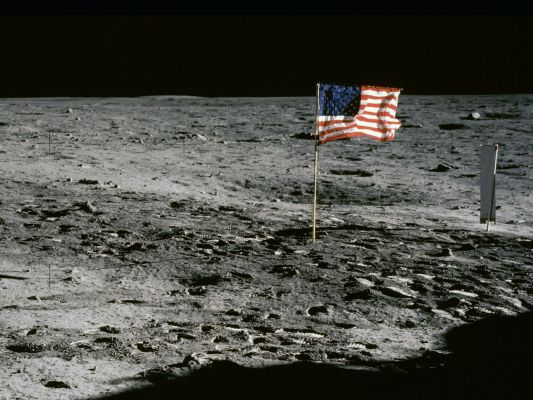
NASA's site commemorating the 30th anniversary of the Apollo landing read, "On July 20, 1969, the human race accomplished its single greatest technological achievement of all time when a human first set foot on another celestial body."

But the NASA text, and other sources, typically ignore one important and obvious detail: We CONQUERED it!

image

The British created a world spanning empire through the simple expedient of planting the Union Jack on soil inhabited by wogs who didn't know that flags meant ownership. Benighted natives woke to British officers telling them that they now lived in the British Empire. When they disputed this, the officers merely pointed at the flag and said, "See, there's the flag. England." And when they continued to disagree, there was always the Maxim gun. In keeping with this grand tradition of symbolic declaration strecthing back millenia (but without getting too into the semiotics of possession) our guy put our flag up there- so it's ours! Happily for the granola crunchy set, there were no Lunar aborigines that needed to be convinced more... strenuously.

Today is the 37th anniversary of that glorious event, when not just homo sap in general, but specifically God-fearing Amurricans left the cradle of Earth to begin the conquest of heaven. We sent men into space on a tower of fire, backed with nothing more than whiz-wheels, slide-rulers, and less computing power than my car's fuel injector. A relatively modest start, some might say - the Moon being low-hanging fruit, solar system wise - but it was a start nonetheless on the long road to interstellar domination. And someday, when Old Glory waves on 10,000 worlds and our mighty fleets cruise the galaxy, our fair descendants will look back at the Moon and Apollo as the start of it all. The only question is how they'll fit all those stars on the flag.

Huzzah! Huzzah! For the bonnie striped flag borne by a single moon!

Posted by GeekLethal GeekLethal on   |   § 3

You are here

This series of maps from the Atlas of the Universe will do nothing if not give you a little perspective on things. It reminds me of when I was a kid, and I'd start wrtiting my address, and just adding to it:

Me
315 Longview Rd.
Medina, Oh
United States
North America
Earth
Solar System
Orion Spur
Perseus Arm
Milky Way Galaxy
Local Supergroup
Universe

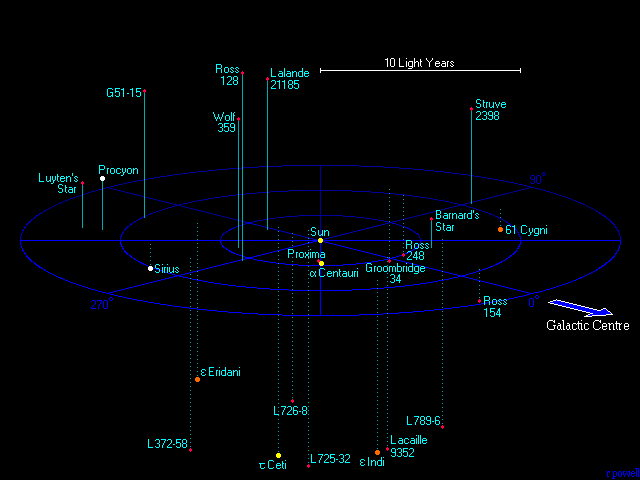
Here, for your convenience, is a map of the the local terrain:

You are here

[wik] Thanks to Geeklethal for pointing this out.

[alsø wik] You'll really want to click on the picture for a bigger, clearer version.

Posted by Buckethead Buckethead on   |   § 5

Ad Astra

Traveling to the moon is so last century. Mars is small dusty ball with little of interest. The rest of the Solar System is either very, very hot or very, very cold. Where is an enterprising space traveler to set his sights? The stars, of course. Interstellar travel is widely considered to be impossible, or at the very least prohibitively difficult. That hasn't stopped a group of scientists, engineers and dreamers from forming the Tau Zero Foundation, whose purpose is to lay the groundwork for practical starflight.

I'm all for that. The group is in its infancy, as yet. Yet having someone out there, pushing for the development of the technologies that could get us out of this rural backwater and into the big cities of the galaxy, is a good thing. Unless, of course, Greg Benford and Charles Pellegrino and not Carl Sagan are right about how dangerous the rest of the galaxy might be. And that really is the big thing. I am not saying that we shouldn't head out into the big galaxy - we should. Earth is the cradle of mankind, and we can't stay in the cradle forever. And if Earth is the cradle, the Solar System is the nursery. We don't know, yet, whether the universe outside the nursery is a barren desert, a civilised utopia, or a particularly savage part of the Bronx after sundown. Given the fecundity of life on earth, and the size of the galaxy, I think the barren desert is unlikely. There will be life, somewhere. Probably manywheres. If some of that life is sentient, the chances of a enlightened utopia is vanishingly small. Perhaps we, or some other race, might unify and be nice. All of them? At the same time? It only takes one to ruin the party, and someone is going to be nasty. When the outcome of an interstellar war could be species extinction, how many races will take a chance on being nice?

I don't think we will draw much attention to ourselves expanding into the solar system. Whatever technology we end up using to travel starward, we will likely need the resources of the solar system to accomplish the journey - massive solar power stations harvesting the energy of the sun to create antimatter, or perhaps something even more odd. When we head out, though - that's different. We will not only draw attention to ourselves, we will have proved that we have the capability of wreaking havoc on anyone in our neighborhood. A relativistic spaceship is indistinguishable from a relativistic bomber.

We're not there yet. But technology isn't just increasing. It isn't even accelerating. The rate of acceleration is increasing. We might be there quicker than even the most optimistic appraisals allow for, even not counting the singularity. It seems funny to talk of interstellar travel when we can barely get into orbit, but we went from not even being able to fly to walking on the moon in 66 years. Once we're in space, the expansion could be quite quick indeed.

Posted by Buckethead Buckethead on   |   § 5

It's Independence Day on the Moon, too

The Ministry would like everyone to have a happy, explosive filled, and thunderstorm-free Independence Day. If you are in Ohio, achieving this will be rather difficult, as the last two options are nigh on to unachievable thanks to the vagaries of weather and an Ohio's nanny-minded legislature. The only legal fireworks in my homestate are now, sadly, smoke bombs and sparklers. Sad. The day we celebrate our independence, we are not free to buy rockets and explosives to celebrate. A small lesson that we should take to heart is that independence and freedom are not the same. Perhaps we should institute a Liberty and Freedom day, to drive home the point.

In the meantime, though, celebrate America's independence as best you can, wherever you are. And next year, the Buckethead will remember to stop in somewhere truly freedom loving, like West Virginia or Pennsylvania, to buy lots of fireworks before getting to Ohio. In this way, he will bring joy to his many nieces and nephews, rather than ridicule and derision upon himself for not thinking of it.

image

Posted by Buckethead Buckethead on   |   § 7

Asteroid 2006-Mustafah

Meanwhile, other scientists fear the asteroids. NASA is attempting to come up with some sort of scheme to defend us against rogue asteroids with unstable, likely Islamic orbits. The French, in a preemptive move, have already surrendered to asteroid 2004 XP14, which will make a close approach to the earth next monday. NASA insists that it is a global problem, and that other nations should really get off their asses and help out.

Posted by Buckethead Buckethead on   |   § 10

SPF 5,000,000

Seth Shostak, SETI researcher and man-about-town, has a nice bit explaining why a sphere is such a inadequate shape for a homeworld. It is not exactly a new idea that we really ought to move off the planet and into the great void, but recently Stephen Hawking's comments have made the news. Hawking recommends new space colonies on the basis of the eggs in a basket rationale - that with life sequestered on just one world, we are vulnerable to a single point of failure - one asteroid, comet, disaster or alien invasion would put paid to the entire species. Fair enough, but Shostak argues that if we look at the tonnage to terrans ratio, the numbers are rather startling. For each of us, there is a trillion tons of earth. That's a lot of mostly inaccessible mantle and red hot magma for each of us. Moving into a more frothy or fractal living space would bring the ration down significantly. The asteroids have about the mass of the earth, but nearly all of it is easily accessible mass (assuming, of course, you have the capability to get to the asteroid belt. That mass could be readily converted to a living space ten thousand times that of earth - just assuming that you built domes on the surface of the rocks. If you actually cut them all up and made habitats out of them, the habitable volume could be millions bigger. Getting the ttt ration down to the order of a thousand or a hundred tons per person would be vastly more efficient. And therefore, we'd be better prepared to fight the giant fighting robots when they inevitably make their bid for domination.

Posted by Buckethead Buckethead on   |   § 0