
It's science day!

In light of the last post, here's another useful thought on the reliability of consensus science:
In a Wired article published at the end of May, writer Erin Biba bemoans the fact that “science” is losing its credibility with the public. The plunge in the public’s belief in catastrophic climate change is her primary example. Biba wonders whether the loss of credibility might be due to the malfeasance unearthed by the leak of emails from the Climatic Research Unit at the University of East Anglia in the United Kingdom, but comes to the conclusion that malfeasance isn’t the cause of the public’s disaffection. No, people have turned against science simply because it lacks a good public relations outfit. Biba quotes Kelly Bush, head of a major PR firm, on the point:
Biba says researchers need a campaign that inundates the public with the message of science: Assemble two groups of spokespeople, one made up of scientists and the other of celebrity ambassadors. Then deploy them to reach the public wherever they are, from online social networks to “The Today Show.” Researchers need to tell personal stories, tug at the heartstrings of people who don’t have PhD’s. And the celebrities can go on “Oprah” to describe how climate change is affecting them—and by extension, Oprah’s legions of viewers.
“They need to make people answer the questions, What’s in it for me? How does it affect my daily life? What can I do that will make a difference? Answering these questions is what’s going to start a conversation,” Bush says. “The messaging up to this point has been ‘Here are our findings. Read it and believe.’ The deniers are convincing people that the science is propaganda.”
Well, then. Science, back in a golden age before the politicization of research when scientists were men and women liked them that way, pronouncements from "science" were descriptive, not proscriptive. "We found this to be true." Not, "Do this or that." The authors of this article decided to check up on things. Looking at Lexis-Nexis, they searched for occurrences of phrases like, “science says we must,” “science says we should,” “science tells us we must,” “science tells us we should,” “science commands,” “science requires,” “science dictates,” and “science compels.”
And look what they found:
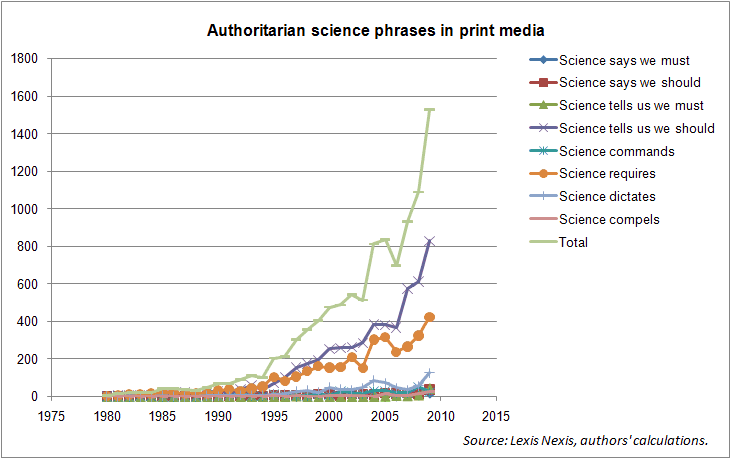
That's quite an increase in a mere quarter century. As the authors note, over the same time period it looks a lot like Mann's hockey stick. And perhaps for the same reason.
 on
| § 2
on
| § 2

§ 2 Comments
[ You're too late, comments are closed ]
Perhaps the public will start believing in science again if and when they start to see "scientists" who believe in science. The so-called "scientists" who speak for "science" in public these days clearly don't believe in the scientific method, or scientific rigor, or the intellectual skepticism required as the absolute baseline of a practicing scientist.
Witness CRU.
Truth is, people never stopped "believing in science". They stopped believing scientists.
It's the difference between thinking the local used car dealer is lying to you about the reliability of the jalopies on his lot, and thinking the dealer himself is a figment of your imagination.
I'd offer a pithy comment on…
I'd offer a pithy comment on the bemoaning of Erin Biba and her urine-sodden ilk, but I've already used my quota of rank obscenities for the day.
Perhaps tomorrow...