An Orbit of Eternal Grace

Science, mad or otherwise. Rockets and space travel, and maybe we can get off this sordid rock.

Science!

Some science links I've accumulated over the last few days, annotated.

  • Instapundit and many others linked this article from the Times, How Microbes Defend and Define Us.  (Including, since I started this post this morning, Aretae and Isegoria.) Fascinating bit - "In the mouth alone, Dr. Relman estimates, there are between 500 and 1,000 species. “It hasn’t reached a plateau yet: the more people you look at, the more species you get,” he said. The mouth in turn is divided up into smaller ecosystems, like the tongue, the gums, the teeth. Each tooth—and even each side of each tooth—has a different combination of species."  Those documentaries on the bugs that live on our skin always creeped me out.  But somehow, this is just remarkable.
  • The Death of Nemesis - in two versions.  There's a theory, fairly well established now, that something really, really bad happens every 27 million years or so.  One popular explanation for the extinctions has been Nemesis, a dark companion to the sun that periodically came in close and f*cked shit up.  But the new study shows that the very regularness of the periodicy argues against Nemesis, because we know that there have been close encounters with other stars, etc, over the last 500 million years.  No star could maintain that regularity over that time.
  • Higgs Boson, the God Particle, not discovered.  Rumors around the campfire were saying that the God Particle had been found.  Not so, say the Lords of the Tevatron.  I really doubt that it ever will be.
  • Black Holes apparently blow bubbles. A short one:

    A relatively small black hole has been spotted blowing bubbles with diameters of more than 300-1500 light years.

    Robert Soria of the University College London and colleagues pored over images and data from the European Southern Observatory and Chandra X-ray Observatory, zeroing in on an unusually large remnant from a supernova explosion. Its host galaxy appears in the Sculptor constellation of Earth's southern sky, around 12.7 million light years away.

    They discovered three hot spots in the x-ray emissions, all in a row, and identified the central one as the core of a black hole a few times larger than the sun. The two spots flanking the core are produced by jets colliding with interstellar gas.

    A nearby star feeds the black hole, giving it energy to shoot a flood of particles out each side at near the speed of light. These jets are much more powerful than expected for a black hole of this size, blowing bubbles that expand faster than the speed of sound. The finding suggests that more of the energy spent by a black hole goes into accelerating matter - rather than emitting x-rays - than previously supposed.

    I'd like to point out that gravity is an attractive force. Not likely to cause jets. Electromagnetism, on the other hand, is known to produce jets (plasma) and x-rays (in x-ray machines, for example) and accelerate particles (particle accelerators).

  • Giant Planets.  Cool article about the discoveries around Beta Pictoris, only 60 ly away.
Posted by Buckethead Buckethead on   |   § 0

Just Cool

ISS Astronauts, not having any real purpose in furthering our conquest of space, took some time off for photography.  Given their privileged vantage point, something like this was bound to come into view eventually.

And that is a pretty amazing something.

Kristian Birkeland, Norwegian physicist and discoverer of the electric currents that bear his name was the first to suggest an electrical explanation for the aurora.  He spent months in the far north, in the deep cold observing and measuring the aurora and divining their nature.  His theories were for decades ignored in favor of the theories of the English mathematician Sydney Chapman, finally being proven right after the advent of space travel.  Birkeland is something of a hero to the plasma cosmology types - he is an archetype for them - brilliant, nominated for the Nobel, dismissed for decades in favor of ideas that were later proved wrong.

The idea that electrical currents connect the various bodies of the Solar System is central to the plasma cosmologist's conception of the universe.  Birkeland was the first in the chain.  In the write-up for that picture, there's this:

This particular aurora is unique in the sense that it was spotted fairly far away from the South Pole over the southern Indian Ocean, likely as a result of a large ejection of energy that burst from the sun on May 24. The photographer is looking south toward Antarctica, though you can't see the southernmost continent in the photograph.

Interesting, no?  We admit that there are electrical phenomena throughout the solar system - Earth and Jupiter's magnetic fields, the braided electrical currents discovered trailing Venus in her orbit, the aurora - seen on many planets, sprites and elves seen above thunderstorms and shooting into space, the coronal mass ejections and numerous other phenomena on and around the sun and their proven effects on Earth - yet there is evidently great resistance to viewing these as a part of a larger, connected whole.  Gravity is all.

Posted by Buckethead Buckethead on   |   § 0

Dropping Quantum Gas

This article in wired describes the efforts of some scientists to grapple with perhaps the biggest problem in modern physics - the total disconnect between General Relativity and Quantum Mechanics.  Both are immensely successful theories - tested and confirmed to the limits of accuracy each within their respective domains.  Both provide useful theoretical predictions, and in the case of the latter, are the basis for literally the entirety of our modern technology.

Yet, they don't match up.  At all.  What these intrepid researchers are doing is dropping a Bose-Einstein condensate - a gas so cold that it acts as a single particle, and thus behaves with all the quantum strangeness we've come to know and love.  So far, they've just been doing proof-of-concept drops, to reassure themselves that the only thing acting on the condensate in the test capsule is gravity.  Soon, though, they hope to start poking at relativity.

What interested me, aside from the general peachy-keenness of the idea, was the implications in terms of the whole plasma cosmology idea.  The basic concept that Wal Thornhill, one of the plasma cosmology bigwigs, has outlined is this:

What is Gravity?

Sansbury argues that gravity is due to radially-orientated electrostatic dipoles inside the Earth's atomic nuclei, with the inner pole more positive and the outer pole more negative [36]. The force between any two aligned electrostatic dipoles varies inversely as the fourth power of the distance between them and the combined force of similarly aligned electro-static dipoles over a given surface is squared. The result is that the dipole-dipole force, which varies inversely as the fourth power between colinear dipoles, becomes the familiar inverse square force of gravity for extended bodies. The gravitational and inertial response o f matter can be seen to be due to an identical cause.

Sansbury struggled with a cause for the initial and sustained electrical polarisation within celestial bodies. The initial cause is due to the birth o f stars and planets (see later) in powerful plasma discharge events. Once established, gravity itself provides a weak radial atomic polarisation by drawing the heavy nucleus away from the centre of each atom toward the centre of a planetary body. The resulting radially-orientated dipoles form an electret in the non- conducting minerals of the planet. Surface charge on the planet contributes to the strength of the orientated-dipole electret. This global 'electret' may provide the radial electrostatic field required by Sansbury's model. The electrical model may explain the anomalous gravity readings taken down mineshafts, where Newton's constant, G, was measured to be 1.7 - 3.9% lower than in the laboratory [37]. Rather than invent a 'fifth force' or 'modified Newtonian dynamics' (MOND) [38] to complicate things, it seems we simply need to understand the electrical nature of matter and gravity.

There is another important effect of the orientated-dipole model of the interior of a planet to consider. At some depth where pressure ionisation becomes significant and conductivity increases, charge separation will occur as electrons drift up towards the electret inner boundary. Like charges repel and tend to offset the gravitational compression within celestial bodies. Therefore, changing the surface charge on a celestial body may have a significant orbital effect.

Antigravity?

Conducting metals will shield electric fields. However, the lack of movement of electrons in response to gravity explains why we cannot shield against gravity by simply standing on a metal sheet.
If gravity is an electric dipole force between subatomic particles, it is clear that the force 'daisy chains' its way through matter, regardless of whether it is conducting or non- conducting. Sansbury explains:

... electrostatic dipoles within all atomic nuclei are very small but all have a common orientation. Hence their effect on a conductive piece of metal is less to pull the free electrons in the metal to one side toward the center of the earth but to equally attract the similarly oriented electrostatic dipoles inside the nuclei and free electrons of the conductive piece of metal. '[40]

This offers a clue to the reported 'gravity shielding' effects of a spinning, super-conducting disc [41]. Electrons in a superconductor exhibit a 'connectedness', which means that their inertia is increased. Anything that interferes with the ability of the subatomic particles within the spinning disc to align their gravitationally induced dipoles with those of the Earth will exhibit antigravity effects.
Despite a number of experiments demonstrating anti-gravity effects, no-one has been able to convince scientists attached to the theory of general relativity that they have been able to modify gravity. This seems to be a case of turning a blind eye to unwelcome evidence. Support for antigravity implicitly undermines Einstein's theory [42].

'Instantaneous' Gravity

A significant fact, usually overlooked, is that Newton's law of gravity does not involve time. This raises problems for any conventional application of electromagnetic theory to the gravitational force between two bodies in space, since electromagnetic signals are restricted to the speed of light. Gravity must act instantly for the planets to orbit the Sun in a stable fashion. If the Earth were attracted to where the Sun appears in the sky, it would be orbiting a large empty space, because the Sun moves on in the 8.3 minutes it takes for sunlight to reach the Earth. If gravity operated at the speed of light, all planets would experience a torque that would sling them out of the solar system in a few thousand years. Clearly, that doesn't happen. This supports the view that the electric force operates at a near infinite speed on our cosmic scale, as it must inside the electron [43]. It is a significant simplification of all of the tortuous theorising that has gone into the nature of gravity and mass and I believe Einstein's postulates to be wrong [44]. Matter has no effect on empty space. Space is 3- dimensional - something our senses tell us. There is a universal clock, so time travel and variable aging is impossible - something that commonsense has always told us - but most important, the universe is connected and coherent.

If all that, or something like it is true, poking at the quantum behavior of elements in free fall could shed some light.  I'd be interested to see if differently charged condensates behaved differently - especially considering that since they're acting as a single particle, that dipole effect might not apply, or not in the same way.

Posted by Buckethead Buckethead on   |   § 0
Missed it by that much

I've mentioned a couple times that I think modern cosmology is a little addlepated.  Here is a classic example of why I think this:

IT'S the ultimate sleeper agent. An energy field lurking inactive since the big bang might now be causing the expansion of the universe to accelerate.

In the late 1990s, observations of supernovae revealed that the universe has started expanding faster and faster over the past few billion years. Einstein's equations of general relativity provide a mechanism for this phenomenon, in the form of the cosmological constant, also known as the inherent "dark energy" of space-time. If this constant has a small positive value, then it causes space-time to expand at an ever-increasing rate. However, theoretical calculations of the constant and the observed value are out of whack by about 120 orders of magnitude.

To overcome this daunting discrepancy, physicists have resorted to other explanations for the recent cosmic acceleration. One explanation is the idea that space-time is suffused with a field called quintessence. This field is scalar, meaning that at any given point in space-time it has a value, but no direction. Einstein's equations show that in the presence of a scalar field that changes very slowly, space-time will expand at an ever-increasing rate.

120 orders of magnitude is indeed a daunting discrepancy.  Like how they almost slipped that by you?  Now, if your predicted and observed values are in the ballpark - say, within a standard deviation - you might think you've got it nailed.  If your predictions are on the close order of your observed results, well, you might be on to something, but the theory might need some work.

If you're off by a factor of 1 000 000 000 000 000 000 000 000000 000 000 000 000 000 000 000 000 000 000 000 000 000 000 000 000 000 000 000 000 000 000 000 000 000 000 000 000 000 000 000.  There's another word for the relation between your predictions and the real world.  Nonewhatsofuckingever.  You're wrong, start over.  Don't try and wedgie your theory to overcome that sort of gap.  If you were aiming at a man-sized target at a range of fifty yards with that sort of accuracy you'd hit the fucking Andromeda galaxy, and I think I'm underestimating the effect of that many zeroes.

Seriously.

[wik] I hope that the journo who wrote that got the number wrong, or was picking his nose when all this was explained to him.  'Cause 120 orders of magnitude is huge.  Huge.

Posted by Buckethead Buckethead on   |   § 2

Scientists baffled

Over the last decade, our knowledge of comets has greatly increased - several probes sent out to meet these frostily glowing harbingers of doom have returned vast quantities of data.  But curiously, our understanding has not similarly increased.  Often, we read that scientists are saying that new data will require a back to the drawing board approach.  Yet what we get is stale retreads of the same old, same old.  When I was a boy, scientists were men, and would tear apart old theories and construct a new paradigm every morning before breakfast.  Not so much these days, it seems.

Here with the details is James Hogan, sf author.

I've posted about the Electric Universe ideas previously, here.  While I am fully aware of the dangers of heresy - not so much burning at the stake, but the near certainty of being wrong - I become more and more convinced that modern science has gotten a little off track.  The way research is funded almost guarantees that much study is devoted to adding ever more intricate filigree to existing theories - because those theories were proposed by the people who are now controlling grants and degrees.  A lot of our advances come not from young punks speaking truth to scientific power, but from established scientists with tenure commenting on another field altogether.  Alvarez, the physicist, and his dinosaur killer is merely the most famous episode.

Posted by Buckethead Buckethead on   |   § 0
Heretical shitburgers

2008 was a shitburger sandwich with a side of fries in many respects. Financially, it was a wash, and my work in the bowels of Customs and Border Protection was quite simply the worst work environment I have ever experienced. And I worked at a place where someone tried to kill me. Long hours of boredom and sociopathic coworkers were bookended by two hour commutes.

In a word, it completely fucking sucked.

But before our three remaining readers start dialing the suicide hotlines on my behalf, not all was crap on rye. For instance, there was the birth of my daughter Claire, which alone more than outweighed working for one of the tentacles of the Department of Homeland Security.

And all that free time at work gave me a lot of time to read. And my interminable commutes gave me a lot of time to ponder.

I wasn't really able to convert much of that to prolific blogging thanks to time constraints and the prejudices of the internet filters at DHS facilities. Which I hope to rectify, somewhat, in the near future.

Some of the fruits of my year of suffering are these:

I no longer believe that the entire community of astronomers, astrophysicists and cosmologists have the least fucking clue what is going on in the universe past where the air gets kinda thin.

I no longer have unlimited faith that democracy is the best system of government.

I think Velikovsky may have been right. Or at least on to something.

I drifted into these things sideways, really. While I am naturally a bit of a contrarian, (Okay, a really big contrarian. Shut up.) I have not made a habit of seeking out outre heretical thoughts just to make a spectacle of myself.

Since I was a kid, I have always read with amazement and delight all the breathless stories, describing all the remarkable, implausible theories modern science has come up with. Black holes, quasars, quantum strangeness. I ate it up and went back for seconds. And if it wasn't for beer, I might have actually been a physicist myself.

But in the nineties, I started getting a little dubious. Once, a friend of mine and I were attempting to explain the concept of Ockham's razor to a particularly dim and more than slightly drunk sorority chick. Why we thought that it was important that we should do so, and whether we thought it would do any good is beside the point. But in trying to find an example, we settled on gravity. We explained that mass attracts other bits of mass. You're sitting on a particularly large bit of mass. So it pulls you down. See? Simple. Can be explained by a few lines of equations, utterly predictable and nice.

But why is this explanation better than any others, she asked. Well, shit. Uh, imagine that there isn't any mystical force of gravity. Imagine that the only thing that is holding you in that chair is gravity trolls. Their job is to hold stuff down. There's trillions of them, and they, with infinite care, go around holding shit down. That's there job.

But I don't see them! Oh, we forgot to mention, they're invisible gravity trolls. You can't see or feel them. But trust us, they're holding you down right now.

Oh. But what about airplanes? she asked. Well, while the invisible gravity trolls are diligent, the curvy shapes of wings confuse them. They forget to hold them down. Helicopters work the same way. And, before you ask, hydrogen, helium and hot air make them drunk.

Why is there no gravity in space? Well, what do you think, invisible gravity trolls can breathe vacuum? How do satellites stay in orbit, then? Well, there's a long line of IGT's holding hands, and the last one is grabbing the satellite.

And so on. We spun out a massively baroque and ridiculous IGT theory of gravity. And then, we said that given the two theories that both explain the curious phenomenon of stuff not floating away, it's probably best to take the simpler one.

Anywho. Later on in that decade, we started hearing a lot about dark matter. And then more about dark energy. The universe, it seems, wasn't behaving right. The invisible gravity trolls were acting up - and a central bit was that galaxies were spinning as if there were much more mass than could be seen. So, invisible mass was proposed. Other problems arose, and dark energy explained these discrepancies.

It got to the point where cosmologists now insist, with their faces hanging out, that 96% of the universe is undetectable by pretty much any imaginable means. I started thinking, that smells like fudge, as in fudge factor. I started suspecting IGT's. But, not being a physicist, and not having anything better to put in in its place, I let it go.

Then I ran across Plasma Cosmology. The basic thought is that electromagnetism - a force which is 41 orders of magnitude stronger than gravity (that's 41 zeros) might just have something to do with how the universe fits together. For the same reason that a child's magnet can counteract the force of the inconceivably larger earth below it when it picks up a paper clip, electric and magnetic fields in space could have an effect on how stars, nebulas, and whatnot all behave.

They say, and I have come to believe, that substituting a gravity plus electromagnetic universe explains things better than a gravity only universe, and without resort to dark matter and dark energy - which had already seemed to me to be fudge factors more concerned with preserving theory than explaining what we actually see.

And that led in to a lot more stuff, which I plan on writing more about later.

But first, to get you started, read this introduction to plasma cosmology. It explains the basic idea in a readable way, and makes a good starting point.

Posted by Buckethead Buckethead on   |   § 3

It was the Gremlins

Today is the centenary of the Tunguska event, when something mysterious happened in remotest Siberia, leveling trees over hundreds of square miles, and leaving assorted caribou and bears and such dazed and befuddled.  People were slow to pay attention to this marvelous occurrence.  Perhaps we can forgive them, seeing as it happened so very far from fashionable and comfortable places, and anyway, just as we were getting ready to go, the whole damn World War thing started.  And after that was over, half the world turned commie, and screw that for breakfast, anyway.

So, the Tunguska event.  Something had a hate on for trees.  Comet, asteroid, methane gas, UFOs, or the mother of all lightning strikes.  (See some explanations here, at the fantastically thorough and accurate, all-encompassing and never to be sufficiently praised wikipedia.)

The impact (if it was indeed an impact) was on essentially the same latitude as St. Petersburg.  And several articles have pointed out that back in the sixties, the crack young staff of the Guiness World Records figured out that if the space thingy had been stick in traffic for four hours and forty seven minutes, then it would have been the capital of Imperial Russia and seat of the Tsars that would have been tatered, rather than some bog-soaked, mosquito infested corner of Siberian hell.

Think of the implications of that one.

Three years after the Russo-Japanese War, and the abortive 1905 uprisings.  But, before the rise of the Bolsheviks.  Losing St. Petersburg would have really gutted the centralized Russian Empire.  What effect would that have had on a) WWI, b) world Communism and c) the Moon Race?

Discuss.

Posted by Buckethead Buckethead on   |   § 7

Aliens are our brothers in Christ

The Vatican has announced that belief in extraterrestrials - even the smart, ravenous and highly lethal kind - does not contradict faith in God.  While I could make any number of snarky remarks about the relative uptodateness of Catholic thought, Galileo, Bruno, the Inquisition, etc., I will simply content myself with noting that Monty Python knew this was going to happen a quarter century ago, and depicted alens coexisting with messiahs in Life of Brian.

The Vatican astronomer noted that denying that there is no life anywhere else in the universe is putting limits on the (presumably unlimited) creativity of God.  Sadly, the article does not go into more interesting territory - I'd like to see what Vatican policy is regarding missionary efforts to aliens, and whether the holy mother Church feels that the anal probing greys have souls.  Cause, if they abduct me, I'm killing them sumsabitches.  But I don't want to commit a sin.

Posted by Buckethead Buckethead on   |   § 2

Ain't No Party Like A Communist Party

Cause the communist party in space

The fact that there are now enough Chinese astronauts to make a formal commie party in space is interesting, I guess. I mean, nothing wrong with that if those are your rules for doing things.

This bit was kinda creepy though. From Yang Liwei, first Chinese astronaut in space:

Like foreign astronauts having their beliefs, we believe in communism, which is also a spiritual power

I believe in the holy power of the workers owning the means of production, and I thank His Eminence the Party Chair every day I am chained to this machine turning out fake vomit and Silly Putty. Amen.

[wik] Eh, looks like the linked story is crapping out. Well, it was about Chicoms in space. Until it works again, enjoy this picture of a Cheese Doodle sculpture.

Posted by GeekLethal GeekLethal on   |   § 2

Happy Moon Conquest Day, 2007!

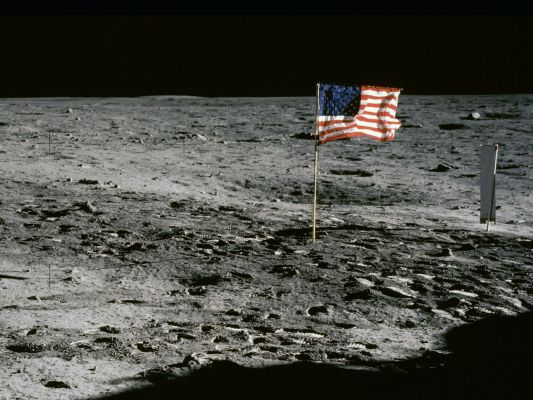
NASA's site commemorating the 30th anniversary of the Apollo landing read, "On July 20, 1969, the human race accomplished its single greatest technological achievement of all time when a human first set foot on another celestial body."

But the NASA text, and other sources, typically ignore one important and obvious detail:

We CONQUERED it!

image

The British created a world spanning empire through the simple expedient of planting the Union Jack on soil inhabited by wogs who didn't know that flags meant ownership. Benighted natives woke to British officers telling them that they now lived in the British Empire. When they disputed this, the officers merely pointed at the flag and said, "See, there's the flag. England." And when they continued to disagree, there was always the Maxim gun. In keeping with this grand tradition of symbolic declaration strecthing back millenia (but without getting too into the semiotics of possession) our guy put our flag up there- so it's ours! Happily for the granola crunchy set, there were no Lunar aborigines that needed to be convinced more... strenuously.

Today is the 38th anniversary of that glorious event, when not just homo sapiens in general, but specifically God-fearing Amurricans left the cradle of Earth to begin the conquest of heaven. We sent men into space on a tower of fire, backed with nothing more than whiz-wheels, slide-rulers, and less computing power than my car's fuel injector. A relatively modest start, some might say - the Moon being low-hanging fruit, solar system wise - but it was a start nonetheless on the long road to interstellar domination.

And someday, when Old Glory waves on 10,000 worlds and our mighty fleets cruise the galaxy, our fair descendants will look back at the Moon and Apollo as the start of it all. The only question is how they'll fit all those stars on the flag.

Huzzah! Huzzah! For the bonnie striped flag borne by a single moon!

Posted by GeekLethal GeekLethal on   |   § 1

The purity of essence of our precious category tags

Patton has accused me of being overly concerned about wasting a scarce natural resource. The category tag. In this, of course, he is completely wrong. Naturally, I could have argued that over-categorizing a post dilutes the utility of tags. And I would have been right. But that wasn't the point. I was attacking him on aesthetic grounds, and just to stick a stick in his eye.

Just to prove that I am not some sort of homo-tree-hugging-enviro-commie, this post, which really is about everything, is tagged with every category we have. And, when I have a free moment, I'll add some new categories, and add them to this post.

So there.

Posted by Buckethead Buckethead on   |   § 5

Riding Rockets, by Mike Mullane

Riding Rockets, Mike Mullane

I'm sure this book was all the rage on boyblogs when it first got published. Buckethead likes to tease me like he's from Planet Arrested Development, but I know he's not that bad. He's not an astronaut and lacks The Right Stuff. Being an astronaut either takes being a special kind of pig or else a really ginormous brain. Since we are neither, Buckethead and I will have to stay grounded on earth.

As for Mike Mullane, USAF Ret., he's got IT. The Right Stuff. The Goods. The cojones. That "cocky bastard something" gives him the gumption to walk up to Bo Derek on a beach and start basically hitting on her in front of her husband. Same again with putting his arm around Christie Brinkley at the Super Bowl. He's got the golden wings of an astronaut. The book is about his journey into space. THREE TIMES. That's three more times than the rest of us yahoos.

More than being an insider's take on becoming an astronaut or about NASA, I was fascinated by his perspective on the Challenger disaster and the lessons learned from it as an organization. While I would love to go to Mars and the Moon, I'm not sure how I will feel about being vaporized in space. Nor do I feel like I'd survive the space vomit syndrome that's common up there. When I was a kid, I'd throw up in the car after about 10 minutes, before my pop could even get onto the PA Turnpike. (We lived right next to an exit.) I doubt I'd pass the Vomit Comet or the 15-minute enema. (And that duration was **VOLUNTARY**)

This guy isn't some saintly man going up against The Big Organization in some David and Goliath story. Even though he's completely arrogant, he retains his humility enough to tell you that he went to see a shrink and buckled while fighting the organization and it's mercurial and cryptic managers. I could never work for guys like Young. I'm too chatty and their stony silence and inability to look you in the eye would bug the crap out of me. I must not want to go into space that badly. But I do like to blow things up and things that go boom.

One day, I will be in Florida to watch a rocket launch. I'm going to make one of my old skating buddies fulfill his promise of letting me watch a launch from his house in Cocoa Beach. He and his wife are both NASA rocket engineers. It's their life's work. How lucky they are to be a part of greatness.

If you're a guy, DON'T READ THIS BOOK. You'll find out how much of a man you ain't. (Ross, being Canadian, isn't even a contender.)

Posted by Mapgirl Mapgirl on   |   § 5

Friendly Reminder

Just a note to remind the Ministry's loyal reader...dammit, readers...readers... that we are only three months away from Moon Conquest Day.

I hope everyone can take some time out and reflect on the stellar travellers who we have lost, commemorate America's first off-planet adventure, and celebrate telling the Russians to suck it. "It" being our collective wang which, given its interplanetary reach, is among the largest on our world.

And let's think about what symbol we can add to the flag to represent the moon. If states are stars, what can the moon be?

Posted by GeekLethal GeekLethal on   |   § 3

C or Bust!

The more alert of our mostly sessile readership may have noted that astronomers have detected a new extrasolar planet. We've discovered hundreds of extrasolar planets, so why is this one so damned special? Well, let me tell you. It's earthlike. It's close. And it's in the habitable zone of its star.

Roadtrip!

Well, close in astronomical terms, and for some odd values of "earthlike." The new planet, Gliese 581c, is about half again as big, and five times as massive as Earth. The bigdomes are guessing that this would result in a surface gravity somewheres around twice that of Earth. Which would kill any fat, tall people on a colonization mission. It'd be worse than Oregon Trail. For more details on what life might be like on this planet, visit here, here, here, or here. And get in line behind this guy for tickets:

image

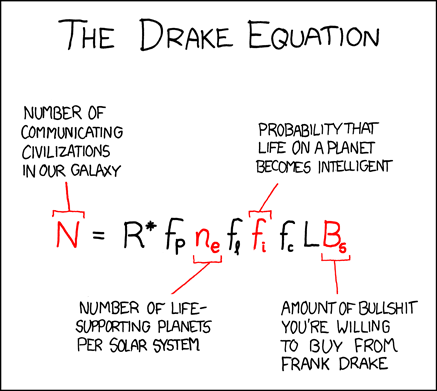
What might be most significant about this discovery is its implications for the Drake Equation – something we talked about in great depth just a little while ago. Pretty much as soon as we fired up that fancy new telescope, we discover an earthlike world, right on our doorstep. That has to be indicative of how common planets like ours are in the galaxy.

As we learn more about the big universe out there, more of the numbers in the Drake equation are looking to be large. The Drake equation can be divided into physical, life, and civilization factors. All of the physical factors are now almost certain to be large across the galaxy, so there’s no way to minimize your estimates of the number of ETs by saying that there aren’t going to be abodes for life as we know it. (Of course, they may be many other places amenable to life as we don't know it.)

As for life, there are two ways that we could get a firmer grasp on how to judge those numbers, and both are within, nearly, our grasp. Any evidence of life in our solar system would be a strong, but not definitive, clue that life is common in the galaxy. Europa and Mars are the prime candidates there. More research along the lines we are pursuing now may give us some answers. The other way is to increase our capacity to gain information on extrasolar planets, which we are also pursuing. If we get to the point where we can image these planets, it is certainly possible that we could detect chlorophyll or other biological evidence in their reflected light. Finding that would be strong evidence that life exists outside our solar system, and that it could be common as well.

That would mean that two thirds of the Drake Equation’s constituent elements would be heavily weighted toward high numbers. And that the chance of ET’s would be correspondingly higher as well.

[wik] The super nifty star map has not yet been updated to include our new vacation destination. However, you can look at it anyway by going to the to the scrolly thing right on the left side of the window, and scroll down about halfway, looking for "Gl 581." When you find it, click it, and you'll see the Gl 581 circled on the star map. Click on it, or in the window on the right to see the solar system, sadly absent little c. On the star map, if you click on the right arrow, and then the back arrow, you'll be in our sector. Neato!

A summary of the info taken from various websites, linked above:

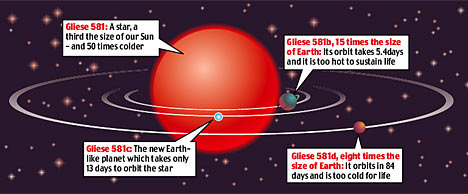
Gliese 581c orbits a small, red star located 20.5 light years from Earth, in the direction of the constellation Libra. The star has 1/3 the size, and 1/50 the brightness of our sun.

Due to the dim smallness of Gliese 581, its habitable zone is correspondingly narrower than that of our sun. The planet, Gliese 581c (“c” for short) is within this zone, orbiting a mere 6 million miles out. That close orbit gives c a year lasting only 13 days. The presence of a large, Neptune-sized planet inside c’s orbit could mean that it is unlikely that c is tidally locked to the sun – having one side eternally facing the sun, as our moon does with Earth.

image

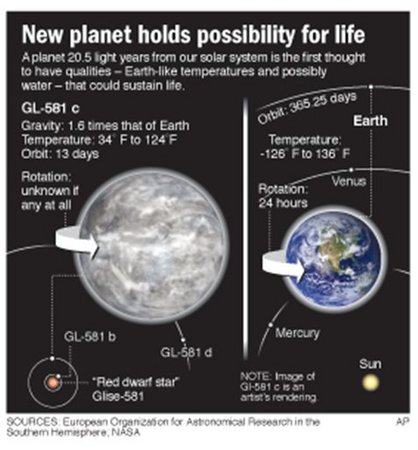
The planet itself is large, five times as massive as Earth and perhaps half again as large, or even bigger if it is made of ice and less dense than here. This would result in a surface gravity between 1.6 and more twice that of Earth. The temperature on c would be in the range of 0 to 40 degrees Celsius, or just what we have here. We have no idea what the composition of the planet is, guessing that it is a rocky world like Earth is not unreasonable. A big planet like this would have no difficulty holding down an atmosphere, and the presence of water is certainly a possibility as well.

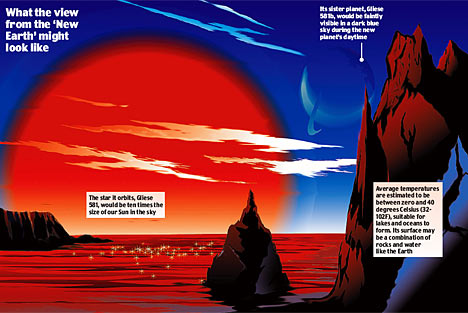
Someone came up with this cheesy graphic, which despite its cheese gives you a good idea how big the sun would be from the surface of the planet.

image

This pic has some comparative stats for c and Earth:

image

And of course, Wikipedia has more info as well.

Posted by Buckethead Buckethead on   |   § 12

Sweet, and by sweet I mean kick ass

Trawling through the vast wasteland of the internets, one finds mostly crap. To the point that Sturgeon's law seems wildly optimistic. Every now and again, though, your suffering is rewarded with unalloyed joy. This is one of those times. I found this over at AEBrain, and it is, without exception, the coolest use of Flash animation I have ever seen. (Though Homestar Runner comes close. And this is an addictive close third.)

[wik] I probably put more links in that paragraph above than I have in any in the last year. As a blogger, I should really consider linking more.

[alsø wik] Distracted by the linkiness, I forgot to say why that first link is so damn cool. Though if you clicked it, you'd know already. But I'm about to tell you, so wait a minute. The extrasolar system map is unlike most astronomical doodads you'll find, becasue it's not sol centric. Most star maps simply show what the stars look like from Earth. Which doesn't give you a good idea of how they are connected. A star map is like one of those goofy odd-perspective "the view of the world from New York" maps, that doesn't really provide any useful information. This map actually shows what stars are near each other. And, clicky on a star, and it will show if we have detected any planets in that solar system. Combine this thing with googlemaps and it would be awesome. If it had smooth scrolling between map sections, and a route planning mode with waypoints, it would be the most amazing thing in the world. Also, it would be cool if you could see more than one little bit at a time. Nevertheless, wow. Four thumbs up.

[alsø alsø wik] In light of my last post, I wonder how many of those planets in the nifty star map have ETs waiting to eat us. Most of the stars in that map are within the light cone of our radio broadcasts.

[wi nøt trei a høliday in Sweden this yër?] Broadcasting to a potentially unfriendly galaxy is probably not wise. On the other hand, a sufficiently advanced technology could detect us anyway.

Posted by Buckethead Buckethead on   |   § 2