July 2010

Dark forces are aligning against us

Or cold ones, anyway.  This guy says that the 30-year Pacific Decadal Oscillation, La Nina, and the Antarctic Oscillation are all already in their cold phases, and that the North Atlantic Oscillation will be negative by December. This, combined with the recent extended solar minimum and the collapse of the thermosphere (record lows according to NASA) spells really cold weather on tap for this winter.  The southern hemisphere might already be feeling it, and the last two winters might be nothing on what's in store.

If he's right.  But I wouldn't stock up on suntan lotion.

Posted by Buckethead Buckethead on   |   § 1

For those of you who, unlike me, are in need of reading material

Cool Tools has compiled a list of the 100 greatest magazine articles.  With links!  You can apparently also suggest new ones and vote articles up or down.  The current top five are:

Apparently, they are very good at picking articles, but not so good at counting.  Several of these look to be well worth the effort of reading.  I think I'll check out First Wave at Omaha Beach, and a couple Hunter S. Thompson pieces.

Posted by Buckethead Buckethead on   |   § 0

It's science day!

In light of the last post, here's another useful thought on the reliability of consensus science:

In a Wired article published at the end of May, writer Erin Biba bemoans the fact that “science” is losing its credibility with the public. The plunge in the public’s belief in catastrophic climate change is her primary example. Biba wonders whether the loss of credibility might be due to the malfeasance unearthed by the leak of emails from the Climatic Research Unit at the University of East Anglia in the United Kingdom, but comes to the conclusion that malfeasance isn’t the cause of the public’s disaffection. No, people have turned against science simply because it lacks a good public relations outfit. Biba quotes Kelly Bush, head of a major PR firm, on the point: 

Biba says researchers need a campaign that inundates the public with the message of science: Assemble two groups of spokespeople, one made up of scientists and the other of celebrity ambassadors. Then deploy them to reach the public wherever they are, from online social networks to “The Today Show.” Researchers need to tell personal stories, tug at the heartstrings of people who don’t have PhD’s. And the celebrities can go on “Oprah” to describe how climate change is affecting them—and by extension, Oprah’s legions of viewers.

“They need to make people answer the questions, What’s in it for me? How does it affect my daily life? What can I do that will make a difference? Answering these questions is what’s going to start a conversation,” Bush says. “The messaging up to this point has been ‘Here are our findings. Read it and believe.’ The deniers are convincing people that the science is propaganda.”

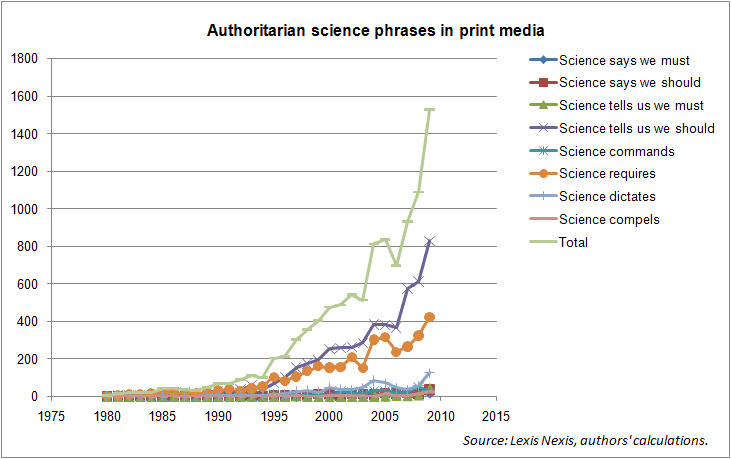
Well, then.  Science, back in a golden age before the politicization of research when scientists were men and women liked them that way, pronouncements from "science" were descriptive, not proscriptive.  "We found this to be true."  Not, "Do this or that."  The authors of this article decided to check up on things.  Looking at Lexis-Nexis, they searched for occurrences of phrases like, “science says we must,” “science says we should,” “science tells us we must,” “science tells us we should,” “science commands,” “science requires,” “science dictates,” and “science compels.”

And look what they found:

That's quite an increase in a mere quarter century.  As the authors note, over the same time period it looks a lot like Mann's hockey stick.  And perhaps for the same reason.

Posted by Buckethead Buckethead on   |   § 2

The Denialsphere?

While looking for some links for the last post, I ran across this interesting bit:

Much has been written of late about the nature of denialism. New Scientist a couple of issues back produced a special report on the subject, for example, and the New Humanist explores the idea of "unreasonable doubt."

There's plenty more out there. The most provocative I've come across (thanks to Joss Garman via DeSmog Blog's Brendan DeMelle) is a 2009 paper in the journal Studies in History and Philosophy of Modern Physics by Jeroen van Dongen of the Institute for History and Foundations of Science at Utrecht University in The Netherlands. His thesis is ideologically based denialism of science has a long pedigree, and he begins his paper with this quote from Albert Einstein:

This world is a strange madhouse. Currently, every coachman and every waiter is debating whether relativity theory is correct. Belief in this matter depends on political party affiliation.

The parallels between the political opposition to relatively in certain early 20th-century circles and today's pseudoskeptical approach to anthropogenic global warming are striking.

Indeed,the actions of many of Einstein's opponents resemble those of the thinkers now often referred to as, in perhaps an all too derisive manner, ''crackpots''. It thus appears that this phenomenon is at least as old as the existence of institutionalized science, which arbitrates authoritatively what is, and what is not, sound scientific practice and established truth; crackpots, with their own unshakable beliefs, in the end rather deny that authority than give up their ideas.It has long been clear that dismissing the anti-relativists' objections as those of an assortment of dimwits who simply did not get it, as physicists intuitively have tended to do, does not suffice.

"On Einstein's opponents, and other crackpots " is not a long paper, nor particularly dense. Check it out.

Just because a million people believe something to be true, doesn't mean it is. I refer you to Aretae's many posts on how sure you should be on things - but especially Logarithmically Right.  Another factor is that the specialization of science leads scientists in field A to accept as true without examination the consensus of field B without examining them.  And then use those conclusions in their own theorizing. Which are then used as inputs by the scientists in field B.  Positive feedback loop.  Cosmology and particle physics are particularly guilty of this.

And if James Hrynyshyn, communications consultant and freelance science journalist based in Western North Carolina, is especially vigilant in following things that link to his site, I suggest that he look at Aretae's post on climate, which is what I would have posted had he not written that first, and better.

[wik] Just to get snarky - follow the link.  Dude who wrote that is a little creepy looking.  The intense stare of the zealot.

Posted by Buckethead Buckethead on   |   § 0

While I'm on a science kick

Aretae linked to this fascinating post by Falkenblog, on the dubiousness of Eddington's experimental proof of Einstein's theory of relativity.

I've gone down the rabbit hole on modern science - I am extremely dubious of anything outside the really hard sciences, the stuff that results in hardware.  What started with a big WTF on dark matter, has extended to lots more and relativity is one of them.  The fact that Eddington fudged his numbers is one more nail waiting for a coffin.

There's been some research, here and there, pointing in the direction of a rework of relativity in light of classical mechanics.  Three books that are on my list to read cover this idea:

  • Causality, Electromagnetic Induction, and Gravitation, Oleg D. Jefimenk:A strikingly new exploration of the fundamentals of Maxwell's electromagnetic theory and Newton's theory of gravitation. Starting from an analysis of the principles of causality, Jefimenko develops the argument that, contrary to the generally accepted view, time-varying electric and magnetic fields cannot cause each other; rather, the true, simultaneous source of both lies in time-varying charges and currents. These causal dependencies are expressed as solutions to Maxwell's equations in the form of retarded electric and magnetic field integrals, which turn out to be related to momentum conservation and result in an extension of conventional gravitational concepts. In particular, a second, "cogravitational" field (first predicted by Heavyside) is implied, relating to the gravitational field proper in a way similar to that in which the magnetic field relates to the electric field. This leads to a gravitational relationship in which the forces depend not only on the masses and separations of the interacting bodies but also on their velocities and accelerations. Generalizing Newtonian gravitation to time-varying systems gives a causal formulation that can reproduce many features commonly held to be unique to General Relativity, inviting one to wonder if the abandonment of Newton's theory in favor of GR might, perhaps, have been too hasty. Mathematically demanding, but great food for thought for anyone with an interest in the foundations of physics. Oleg Jefimenko is Professor of Physics at the University of West Virginia.
  • Newtonian Electrodynamics, Peter and Neal Graneau:A detailed technical account of how the 19th century electromagnetics developed by Coulomb, Ampère, Neumann, and Kirchoff explains and enables analysis of experiments with exploding wires, railguns, and arc dynamics that cannot be accounted for satisfactorily by the relativistic field theory of Maxwell, Lorentz, and Einstein.The authors suggest that in the rush to produce a unified description of physics, the solidly observation-based Newtonian electrodynamics was swept out of sight and written out of textbooks in an unduly hasty manner that has left gaping holes in the comprehension of such basic elements of electrical engineering as motors and generators.
  • Einstein Plus Two, Petr Beckman:
  • Presents Dr. Beckmann's theory that effects conventionally attributed to Einsteinian Relativity can be explained more simply. This theory, derived from electromagnetic principles, states that velocity with respect to the dominant local energy field, rather than veolcity with respect to the observer, is what matters. From this it is seen that the normal charge distribution law becomes inaccurate at high speeds which, in effect, is what the Lorentz transformations compensate for.

    Where Einstein is obliged to distort space and time, Beckmann leaves them as being what they always were and rearranges the charge configuration of moving objects. The result is a theory that satisfies the relativity principle, is equally compatible with all the experimental results cited as "proving" Relativity, and more powerful predictively in being able to derive the quantization of electron orbits, the Titius series of planetary spacings, and the Schrödinger equation.

    Delightfully thought-provoking, but not for the mathematically squeamish

(Descriptions of books from James Hogan, and recommended by him.) The common denominator is the idea that classical mechanics - Maxwell - can be used to explain relativistic phenomena without recourse to the bizarre side effects imposed by Einstein's relativity.  If Maxwell's equations, which seem pretty solid, and don't make your mind all twisty, can be used to explain more simply these things, then it seems to me that Occam's razor would insist that we drop Einstein into the dustbin of scientific history.

[wik] some more links I haven't had time to sort through:

Posted by Buckethead Buckethead on   |   § 4

Plasma Vortices and Spacequakes

This sort of thing fits right in with the Plasma Cosmology view.

Researchers using NASA’s fleet of five THEMIS spacecraft have discovered a form of space weather that packs the punch of an earthquake and plays a key role in sparking bright Northern Lights. They call it “the spacequake.”

...

“Magnetic reverberations have been detected at ground stations all around the globe, much like seismic detectors measure a large earthquake,” says THEMIS principal investigator Vassilis Angelopoulos of UCLA.

It’s an apt analogy because “the total energy in a spacequake can rival that of a magnitude 5 or 6 earthquake,” according to Evgeny Panov of the Space Research Institute in Austria. Panov is first author of a paper reporting the results in the April 2010 issue of Geophysical Research Letters (GRL).

In 2007, THEMIS discovered the precursors of spacequakes. The action begins in Earth’s magnetic tail, which is stretched out like a windsock by the million mph solar wind. Sometimes the tail can become so stretched and tension-filled, it snaps back like an over-torqued rubber band. Solar wind plasma trapped in the tail hurtles toward Earth. On more than one occasion, the five THEMIS spacecraft were in the line of fire when these “plasma jets” swept by. Clearly, the jets were going to hit Earth. But what would happen then? The fleet moved closer to the planet to find out.

“Now we know,” says THEMIS project scientist David Sibeck of the Goddard Space Flight Center. “Plasma jets trigger spacequakes.”

Spacequakes (vortices, 200px)

A THEMIS map of plasma flows during a spacequake. The axes are labeled in Earth radii, so each swirl is about the size of Earth.

“When plasma jets hit the inner magnetosphere, vortices with opposite sense of rotation appear and reappear on either side of the plasma jet,” explains Rumi Nakamura of the Space Research Institute in Austria, a co-author of the study. “We believe the vortices can generate substantial electrical currents in the near-Earth environment.”

Acting together, vortices and spacequakes could have a noticeable effect on Earth. The tails of vortices may funnel particles into Earth’s atmosphere, sparking auroras and making waves of ionization that disturb radio communications and GPS. By tugging on surface magnetic fields, spacequakes generate currents in the very ground we walk on. Ground current surges can have profound consequences, in extreme cases bringing down power grids over a wide area.

Lately I've been seeing more mention of electricity in space science news, which is to the good - but one possibility that the THEMIS scientists don't seem to be considering is that electrical forces are generating the magnetic fields.  You can't have one without the other - something that solar scientists and cosmologists, and in fact anyone who uses the phrase "magnetic lines reconnecting" fails to grasp.

Posted by Buckethead Buckethead on   |   § 0

Boltzmann Brains, OO's and Intergalactic Colonization Phase Changes

Where are they? The Fermi Paradox has lept out at me twice in as many days. First off, a post on the arXiv blog about some new research into the FP.

Their approach is to imagine that civilisations form at a certain rate, grow to fill a certain volume of space and then collapse and die. They even go as far as to suggest that civilisations have a characteristic life time, which limits how big they can become. In certain circumstances, however, when civilisations are close enough together in time and space, they can come into contact and when this happens the cross-fertilisation of ideas and cultures allows them both to flourish in a way that increases their combined lifespan. Bezsudnov and Snarskii point out that this process of spreading into space can be easily modelled using a cellular automaton. And they've gone ahead and created their own universe using a 10,000 x 10,000 cell automaton running over 320,000 steps. The parameters that govern the evolution of this universe are simple: the probability of a civilisation forming, the usual lifespan of such a civilisation and the extra bonus time civilisations get when they meet. The result gives a new insight into the Fermi Paradox. Bezsudnov and Snarskii say that for certain values of these parameters, the universe undergoes a phase change from one in which civilisations tend not to meet and spread into one in which the entire universe tends to become civilised as different groups meet and spread. Bezsudnov and Snarskii even derive an inequality that a universe must satisfy to become civilised. This, they say, is analogous to the famous Drake equation which attempts to quantify the number of other contactable civilisations in the universe right now.

So the question is, do we live in a world where intelligent species are too far apart to cross-pollinate, and survive; or one where they are, but it hasn't happened yet?  This is interesting, and is somewhat in line with my own thinking - though they are completely ignoring the possibility of BEMS and conflict, and supposing that intelligent entities in space are all bug-eyed Sagans who will get along famously.  I'm not saying they can't, but it isn't a sure thing.  Read Killing Star if you're uncertain about that one.  Pay special attention to the Central Park analogy. Interesting spin on the Fermi Paradox - but nothing really outre. Charles Stross, in his recent post Mediocrity (a sequel to the thrilling post Insufficient Data)

In general, there are two classes of solution to the Fermi paradox; ones that assume that we are unique special snowflakes in an empty cosmos, and those that postulate that intelligent species are common, but some kind of mechanism stops them from colonizing interstellar space. If we look at the second problem set, and broaden the focus ... well, intelligent species emerge as components of a biosphere bound to a particular planetary habitat. We humans are land-dwellers on Earth in the later high-oxygen period; conditions on earth even one billion years ago would have been rapidly fatal for an unprotected human, and even today, survival on 90% of our planet's surface area is contingent on the availability of cultural artefacts like boats (80% is water) or clothing (for protection in hostile climates). So the real question isn't, "can intelligent life colonize other star systems?" so much as "can intelligent life propagate itself, and its supporting biosphere and technosphere to run in alien environments? Which is a very different question. Call it the Ark Problem; if your name is Noah and you're going on a one-way trip to another world, how big an Ark do you need (and how many specimens per speciality, be they biological or technological)?

There is of course the not-answer to the Fermi Paradox - the simulation hypothesis - which argues that there are exactly as many intelligent species as the simulation designer decided to throw in the box with us, and no more. But then, it gets interesting.

It's that danged principle of mediocrity that's causing all these problems. It shows up in the Fermi Paradox, it turns up in the Simulation Argument, it turns up like a bent penny in all sorts of places — it's a big problem for the standard model of spacetime, once you start digging into the Boltzman Brains paradox (for a quick intro, look here or here). Indeed, it seems to me to be a corollary of the weak anthropic principle.

I'd never heard of the Boltzmann Brain paradox - I followed the links.  From the first:

The idea Don put forward is this: there’s us, the ordinary observers (OO’s) in the world, who have achieved a certain stature after billions of years of evolution in the universe, and are now capable of making quite refined (or so we think) observations of the universe. Andre Linde called OO’s “just honest folk like us.” We’ve made it as a species, man- and womankind, and we’re figuring ou the really deep things that are going on like the Big Bang, genetics, and all the rest. Then, though, there are the BB’s in the universe: Boltzmann Brains. Random fluctuations of the fabric of spacetime itself which, most of the time, are rather insignificant puffs which evaporate immediately. But sometimes they stick around. More rarely, they are complex. Sometimes (very very rarely) they are really quite as complex as us human types. (Actually, “very very rarely” does not quite convey just how rare we are talking now.) And sometimes these vacuum quantum fluctuations attain the status of actual observers in the world. But, the rarest of them all, the BB’s, are able to (however briefly) make actual observations in the universe which are, in fact, “not erroneous” as Don Page put it.

Over time - in a sufficiently long-lived universe - BB's should predominate.  (More so if, god forbid, they should learn how to reproduce.)

The thing is, when you start talking about very very…very rare things like Boltzmann Brains, you are talking about REALLY long times. Much longer than we’ve had on earth (and I mean 4.5 billion years) by many orders of magnitude. Numbers like 10 to the 60th years were being batted around like it was next week in this talk. By those times, all the stars and all the galaxies have gone out, and gone cold, and space has continued to expand exponentially and things are long past looking pretty bleak for the OO’s still around, who (we presume) need heat and light and at least a little energy of some sort to survive, even if we are talking about very slow machine intelligence (even slower than humans for example). So eventually, the mere fact that there is, at these long times, just oodles of space in the universe means that the BB’s become more and more common (even if they are rare) and eventually dominate the, uh, intellectual landscape of the universe. Of course this immediately raises all sorts of questions, such as mind/matter duality, the nature of reality and consciousness and multiple consciousnesses, perceived versus objective independent reality. Not to mention whether our “universe” is the only one.

And from Wikipedia, more on the Boltzmann Brain:

Boltzmann proposed that we and our observed low-entropy world are a random fluctuation in a higher-entropy universe. Even in a near-equilibrium state, there will be stochastic fluctuations in the level of entropy. The most common fluctuations will be relatively small, resulting in only small amounts of organization, while larger fluctuations and their resulting greater levels of organization will be comparatively more rare. Large fluctuations would be almost inconceivably rare, but this can be explained by the enormous size of the universe and by the idea that if we are the results of a fluctuation, there is a "selection bias": We observe this very unlikely universe because the unlikely conditions are necessary for us to be here, an expression of the anthropic principle. This leads to the Boltzmann brain concept: If our current level of organization, having many self-aware entities, is a result of a random fluctuation, it is much less likely than a level of organization which is only just able to create a single self-aware entity. For every universe with the level of organization we see, there should be an enormous number of lone Boltzmann brains floating around in unorganized environments. This refutes the observer argument above: the organization I see is vastly more than what is required to explain my consciousness, and therefore it is highly unlikely that I am the result of a stochastic fluctuation. The Boltzmann brain paradox is that it is more likely that a brain randomly forms out of the chaos with false memories of its life than that the universe around us would have billions of self-aware brains. The rationale behind this being paradoxical is that, out of chaos, it is more likely for one instance of a complex structure to arise than for many instances of that thing to arise. This ignores the possibility that the probability of a universe in which a brain pops into existence, without any prior mechanism driving towards its creation, may be dwarfed by the probability of a universe in which there are active mechanisms which lead to processes of development which (given a starting state that is unlikely but not as unlikely as the spontaneous appearance of a brain with no precursor) offer a reasonable probability of producing a species such as ourselves. In a universe of the latter kind, the scenarios in which a brain can arise are naturally prone to produce many such brains, so the large number of such brains is an incidental detail.

Fascinating. Weird to imagine that after the heat death of the universe, and trillions of years after the death of all OO's like us, Boltzmann Brains may still be there, observing.

Posted by Buckethead Buckethead on   |   § 0

Raw Milk = Gun in Your Face

One can imagine many threats that might require the use of armed force to contain.  A crazed gunman.  Terrorist plotters with bombs.  Criminals about their evil business.  What you normally wouldn't include on that list is hippy organic dairy farmers catering to those with a hankering for raw milk.

But you wouldn't be the federal government, would you?

With no warning one weekday morning, investigators entered an organic grocery with a search warrant and ordered the hemp-clad workers to put down their buckets of mashed coconut cream and to step away from the nuts.

Then, guns drawn, four officers fanned out across Rawesome Foods in Venice. Skirting past the arugula and peering under crates of zucchini, they found the raid's target inside a walk-in refrigerator: unmarked jugs of raw milk.

"I still can't believe they took our yogurt," said Rawesome volunteer Sea J. Jones, a few days after the raid. "There's a medical marijuana shop a couple miles away, and they're raiding us because we're selling raw dairy products?"

The government, of course, insists that it is acting to protect consumers and ensure a level playing field.

"This is not about restricting the public's rights," said Nicole Neeser, program manager for dairy, meat and poultry inspection at the Minnesota Department of Agriculture. "This is about making sure people are safe."

If it's not about restricting people's rights, then why are people's rights being, ah, restricted?  The raw food movement has been growing, but apparently only one particular type of raw food is being singled out for armed raids.  Can we guess the reason?

But raw milk in particular has drawn a lot of regulatory scrutiny, largely because the politically powerful dairy industry has pressed the government to act.

That's all from this LA Times article.  This article offers more details.

When the 20 agents arrived bearing a search warrant at her Ventura County farmhouse door at 7 a.m. on a Wednesday a couple weeks back, Sharon Palmer didn't know what to say. This was the third time she was being raided in 18 months, and she had thought she was on her way to resolving the problem over labeling of her goat cheese that prompted the other two raids. (In addition to producing goat's milk, she raises cattle, pigs, and chickens, and makes the meat available via a CSA.)

But her 12-year-old daughter, Jasmine, wasn't the least bit tongue-tied. "She started back-talking to them," recalls Palmer. "She said, 'If you take my computer again, I can't do my homework.' This would be the third computer we will have lost. I still haven't gotten the computers back that they took in the previous two raids."

The tactics of the war on drugs meets rent seeking industry lobbyists.  Radley Balko has documented ad nauseum (often literally) the abuses that local and federal law enforcement inflict on us daily.  150 Swat raids every 24 hours, on average.  The average joe thinks, well, they're all drug dealers and criminals.  Except when highly trained expert law enforcement personnel get the wrong address, or guy, and while they're there, they shoot the dog.  Using these tactics to enforce a milk cartel that already makes us all pay more for milk seems yet wronger.

If any sufficiently connected lobby or influence group can get the right laws passed, they have highly aggressive and none-to-smart police to enforce them, and who don't seem particularly concerned about their fellow-citizen's rights.  Frankly, it's a miracle that the dozens of raids these articles have talked about haven't resulted in injuries or puppycide.

Posted by Buckethead Buckethead on   |   § 1

Luck v. Providence

This, I found interesting:

Providence is the idea that God has blessed this country.  That its wealth, power and position in the world was due to God.  Providence is not a reward, because it’s a gift, but it isn’t luck either, which is random (unless you believe in the Lady that should not be named and she is a lady and like many ladies she favors the ones that abuse her).

...If it is only luck, not only do you not appreciate what you have, but you feel guilt for having something you do not deserve.

This is exactly what the world and our leaders, and the people who envy Americans, meant for the people in this country to feel because it is easy to take everything from a person that feels guilty about all the things he has that he does not deserve.

A guilty person does not protest when the government taxes the life out of him, because he does not deserve better.  He does not fight back about injustice, because his life really is an injustice from his perspective.  It isn’t fair that he has more.

It is certain that the idea of providence, or Providence, has entirely dropped out of our common discourse.  Like many things that have disappeared, perhaps it shouldn't have.

Posted by Buckethead Buckethead on   |   § 0

Not Polite

I think I might like to buy this.

The website of the artiste.  The fire-breathing sasquatch is also cool.

Posted by Buckethead Buckethead on   |   § 0

This looks interesting

Via Boing Boing, a book on the maths I might want to read:

In problem solving, as in street fighting, rules are for fools: do whatever works--don't just stand there! Yet we often fear an unjustified leap even though it may land us on a correct result. Traditional mathematics teaching is largely about solving exactly stated problems exactly, yet life often hands us partly defined problems needing only moderately accurate solutions. This engaging book is an antidote to the rigor mortis brought on by too much mathematical rigor, teaching us how to guess answers without needing a proof or an exact calculation.

In Street-Fighting Mathematics, Sanjoy Mahajan builds, sharpens, and demonstrates tools for educated guessing and down-and-dirty, opportunistic problem solving across diverse fields of knowledge--from mathematics to management. Mahajan describes six tools: dimensional analysis, easy cases, lumping, picture proofs, successive approximation, and reasoning by analogy. Illustrating each tool with numerous examples, he carefully separates the tool--the general principle--from the particular application so that the reader can most easily grasp the tool itself to use on problems of particular interest.

From an MIT perfesser. Not something one normally associates with streetfighting, but hey, I'll play along.

Posted by Buckethead Buckethead on   |   § 1

Hey

I'm in Ohio for a couple weeks. If any of our vast readership is interested in getting together for beers and conversation, use the contact page to drop me a line.

Posted by Buckethead Buckethead on   |   § 0

Now everyone's gonna have orbital mind control lasers...

Wired reports that InterOrbital is offering personal satellite kits for the low, low price of $8000.

“$8,000? That’s just the price of a cool midlife crisis,” says Alex “Sandy” Antunes, who bought one of the kits for a project that will launch on one of earliest flights. “You could buy a motorcycle or you could launch a satellite. What would you rather do?”

The hexadecagon-shaped personal satellite, called TubeSat, weighs about 1.65 pounds and is a little larger than a rectangular Kleenex box. TubeSats will be placed in self-decaying orbits 192 miles above the earth’s surface. Once deployed, they can put out enough power to be picked up on the ground by a hand-held amateur radio receiver. After operating for a few months, TubeSat will re-enter the atmosphere and burn up.

“It is a pico satellite that can be a very low-cost space-based platform for experimentation or equipment testing,” says Randa Milliron, CEO and founder of Interorbital Systems.

That is pretty damn cool.

Just think what this will mean in the future, though.  If, ten years from now, you could launch a 10kg satellite for $2000 - think what kind of gear (made possible by another decade of the remorseless of Moore's Law) you could cram into a 22 pound satellite.  Christ, you could probably make a plausible hunter-killer sat that small.  Gun, targeting system, station-keeping; swarms, networking...

I am giddy with the thought of it.

Posted by Buckethead Buckethead on   |   § 0

Quotable

This is actually from a few days back:

Humans are very tactical. This is altogether fitting. Not every tactic is strategic but all strategy is tactical. Strategy is always an accumulation of tactics. Tactics are concrete. The strategy that connects them is less so. Moment by moment, every life is tactical. However, in the same flow from moment to moment, life is not necessarily strategic. A focus on tactics is natural and a focus on strategy is somewhat unnatural. This drags the mind strongly to the concreteness of tactics and away from the diffuseness of strategy. Tactical thinking tends to reduce strategy to a parliament of hammers and every situation to a nail.

From the Committee of Public Safety.  The whole post is excellent, and kind of a distillation of a series of posts he's been doing strategy.  He's gone into the the distinctions between magic bullet and attritional styles of strategy, linear v. parallel, and so on.  All well worth your time and very insightful.  What I particularly liked about this one is that it takes the tactical/strategic dichotomy out of its normal realm of military considerations, and makes you look at it from a new perspective.  Plus, its alternate history thinking, which I am congenitally incapable of resisting.

Posted by Buckethead Buckethead on   |   § 0

First work out in like, decades

I started my super-slow workout program just now, and despite only doing five exercises for a little over a minute and a half each, I am convinced that this is serious exercise.  It's been about fifteen minutes since I stopped, and my muscles are still all a-trembly.  I lifted weights semi-regularly for a while back in my twenties.  I seem to remember that the weights were a bit bigger then.  But that's to be expected, that was almost twenty years ago, and now I am a decrepit old man.

I signed up for the gym in my office building, and I am now having buyer's remorse.  The machine I thought was a leg press when I looked at it from across the room is actually a leg extension machine.  And there's no seated row-type machine either.  I substituted a lat pull for the seated row today - next time, I'll use the free weights to do a proper one.  However, the weights are all dumbbells - there's no bars or stands.  Which sucks, because I can't replace the leg press with a squat if there's no bars or racks.  And what's really annoying is that I signed up through December because the pro-rated yearly membership was the best deal, by far - only $40 more than a month membership.

So, I used the leg extension machine.  I don't know if it would make more sense to keep using that - it does hit the quads, after all, or use the one bar I have at home without a rack.  Not safe, really, with no one to spot me.

Thoughts on super-slow based on my now vast-experience with the system: it kicked my ass.  The slow, controlled pace really gets you.  I remember doing multiple sets of ten that didn't burn like this did.  I was pretty good at guestimating the weight that would get me to failure in about a minute and a half - only slight adjustments will be necessary for next time.  All the upper body exercises (seated row lat pull, chest press, pull down, overhead press) hurt, and my muscles were like jelly after.  Which is, as I understand it, how it should be.  But the leg press extension hurt much more.  It hurt a lot.  It took a fair chunk of will power to get to ninety seconds, and I actually cheesed out a bit and didn't really go to failure.  I don't know why that exercise hurt that much more than the others.  Strange.  The explanation for that one is probably wherever my back fat went to.

Despite my disappointment with the lackluster facilities, I'm feeling pretty good about the whole thing.  Right now, my arms, back and chest feel pleasantly tingly and sore.  My thighs are recovering, though they still feel week.

I wonder if it might make more sense to price out a power rack and some decent free weights, and spend the money on that rather than on a renewal at this place.  I've got room in the garage, and seeing as I work at home, it shouldn't be hard to find the time.  And after six months or so, I think I'd be in the habit enough to trust myself to keep at it.

Posted by Buckethead Buckethead on   |   § 5

Weird Diet Effects

As some may be aware, two weeks ago I started a paleo diet with Aretae and some others.  So far, aside from some on the whole minimal slippage, I've kept the diet pretty well.  As happened last time I did a paleo diet, my energy level is significantly higher, and my general sense of well-being is improved.  I'm losing a little over a half pound a day, average, and  yesterday crossed a bit of personal milestone - I'm under 260 for the first time in somewhere around a decade.  (Yea, me.)

All cool, right?  But the funny thing is, the weight is not coming off in a uniform fashion.  One of the things that pushed me to start the diet again was that about a month ago, I scratched my back and felt a little more padding than I should have.  Holy backfat, Batman!  Not in gross quantity - I'm not orca fat by any stretch - but unpleasant.  Today, I scratched my back and it was gone.  Gone, as in completely and utterly not there.  My back feels toned and shit.

Which is odd, because earlier, I had been complaining that it felt like I was getting fatter in the gut, even though I know I'm losing weight at a pretty good clip.  I guess that perception is just because I'm losing the non-gut fat faster.

The human body is a strange and terrible thing.

[wik] at my current wasting rate, I should be down to my dating weight in just three months.  Though I understand that weight loss on this sort of diet often plateaus for a while before resuming.  I'll be able to wear a bathing suit just in time for first frost.  Awesome timing!

[alsø wik] Before:

[alsø alsø wik] After:

[wi nøt trei a høliday in Sweden this yër?] I think I'll look better without the mustache.

Posted by Buckethead Buckethead on   |   § 2

Mohammed et Charlemagne

I downloaded this the other day, and I've just been enthralled.  It's really surprising - even when we no better, having read our Gibbon, we still imagine that Europe went from full-on Roman Empire glory straight into deepest Dark Age, without going through any sort of awkward in-between phase.  Pirenne's Mohammed et Charlegmagne is a perfect corrective for this - straightforward prose, well balanced scope, telling details and a good narrative organization.

The Germans, pushed into the Empire by the arrival of Attila of Hun fame, did not want to destroy the empire.  They wanted to use it for their own benefit.  The successor kingdoms set up - the Vandals in North Africa, the Visigoths in Spain, the Ostrogoths in Italy, a grab bag of smaller tribes in Gaul - were all integrated into a post-Roman system that was still largely Roman.  What's remarkable is how Roman, and how prosperous, these states remained.  Urban culture survived the Barbarian invasions, remained tied to the Emperors in Constantinople, and trade - in the form of Syrian and Jewish merchants - was still being conducted in volume.

We know - though I haven't gotten to that part in the book yet - that in the dark ages, the money economy collapsed utterly, western Europe was largely isolated from the rest of the world, and literacy took a powder.  But it certainly wasn't the Vandals and Goths that did it.

The version I downloaded is just images of the pages - not OCR'd - but I'll put up some quotes over the next few days.  Fascinating stuff, and relevant as well to the ongoing discussions here, and in Aretae and Foseti-land.

[wik] Link to book.  Free download, though you should consider flying to Belgium and giving money to his heirs.

Posted by Buckethead Buckethead on   |   § 2

Book Reports

I've been reading some of the books I got with my amazon gift card (thanks, Dad!) and here's a bit of an (brief) update:

  • Read the 10,000 year explosion.  I enjoyed this, but when I was done, I wished that these guys had written Michael Hart's Understanding Human History.  The book was very well written, engaging - but except for the section on the intelligence of the Ashkenazi Jews, totally ducked the issues of differing levels of intelligence in different populations.  UHH went after these topics, but the book lacked detail and, frankly, good writing.  A mash up would have been fascinating.  Still, very interesting stuff - I knew that the lactose tolerance gene had originated fairly late, only a few thousand years back - but the scale of recent evolution was way beyond what I had previously thought.  This sort of book really floats my boat.  The evolution of our species is fascinating, and their take on how we might have gotten Neanderthal genes (and only the best ones, at that) and how and how fast beneficial genes spread was enlightening.
  • I read Stross' Fuller Memorandum, the third book in the Laundry series.  Short answer: buy it.  If you have any connection to IT, you'll love them.
  • Of the other books, I haven't finished any yet.  I'm actively but slowly reading de Soto's Mystery of Capital, de Mesquito's Governing for Prosperity and Vox Day's The Return of the Great Depression.  Reading the three of these concurrently is interesting, there are a lot of connections between the three.  de Soto's book is clear and well presented, but its repetitiveness is a bit annoying.  Still, lots of good stuff.
  • I wish I hadn't started all three of those, because I really want to read Grand Strategy of the Byzantine Empire by Luttwak.  But I don't want to have too many unread books laying around.

[wik] Update: I downloaded Pirenne's Mohammed et Charlemagne, and now I'pm totally sucked in.  I don't think I'll be reading anything else until I'm done with this.

Posted by Buckethead Buckethead on   |   § 6

Buckethead want

The interior of this structure is awesome.

[Architects] Olson Sundberg Kundig Allen says, "The Brain is a 14,280 cubic-foot cinematic laboratory where the client, a filmmaker, can work out ideas. Physically, that neighborhood birthplace of invention, the garage, provides the conceptual model. The form is essentially a cast-in-place concrete box, intended to be a strong yet neutral background that provides complete flexibility to adapt the space at will. Inserted into the box along the north wall is a steel mezzanine. All interior structures are made using raw, hot-rolled steel sheets."

3-31-brain2.jpg

The exterior, not so much. But if the exterior looked more like this:

File:Bull Stone House.jpg

(Image from here.)

It'd be a lot nicer. You can kind of imagine what the structure would look like if you combine in your head this image with the second one from above:

(Image from here.)

If this were a little bigger, and a little cleaner - just replace that big door with giant windows.  Now that would be an office to get up for in the morning.

[wik] Hat tip, The SteamPunk Home.  Images of the Brain taken from Apartment Therapy.

[alsø wik] The apartment therapy links are long dead, as is the site where I got the barn image. But the Brain is still available here. There's more internal images there, worth a look.

Posted by Buckethead Buckethead on   |   § 0

Double plus bonus thoughts

In light of my last post, it makes me wonder, again, how history might have unfolded without Islamic conquests. The continuity of Classical civilization, without the interruption of the Dark Ages; the Eastern Roman Empire not reduced to a nub and finally destroyed by the Turks; North Africa, Egypt, Syria and Lebanon, Anatolia - all would have been Christian, and speaking Greek or Latin. Persia likely would have eventually become Christianized, rather than converted to Islam. The Crusades never would have happened, for sure, but without having to claw back up from next to nothing, Europe would have been further along by the turn of the millenium.

The European discovery of the New World, and their exploration efforts in general might have been delayed by centuries, since Christians would have controlled access to the Red and Black Seas, and thus trade with the Orient.

Very different, indeed.

Posted by Buckethead Buckethead on   |   § 2

So, the Vandals weren't actually, you know, Vandals?

It is commonly thought that the barbarian Germanic tribes (ancestors of later barbarian French and Germans) invaded the west Roman Empire, extinguished the light of culture and learned urban life and brought about the dark ages so impressively imagined in this work.  Further, it is also thought that Islam, in conquering large swaths of the east Roman Empire and North Africa, did not have the same effect; rather, they preserved the learning of the Classical world, saving it up until it could be translated into Latin by industrious scholars in the late middle ages in Cordoba.

Thinking about this, it seems strange.  Why would the Arabs, renowned through later ages for their contempt for learning, have preserved the corpus of Greek and Latin literature?  The muslim armies bursting out of Arabia in the seventh century were no where near as civilized as the partially Romanized Germans.

And thinking more, in my reading about Belisarius and Justinian in the period right before the Islamic breakout, the German successor kingdoms in the west - Italy and North Africa - were, while not exactly up to par with Augustan Rome, not uncivilized.  The cities were still there, still trading, Latin was still being spoken and the ruling classes learned it and aped the manners of their Roman predecessors.

Well, this guy thinks that the Islamic - Arab expansion in the seventh century was the real cause of the Dark Ages:

Henri Pirenne’s posthumously-published Mohammed et Charlemagne (1938) presented to the academic world the results of a lifetime of research and study. His conclusions were stunning. The accepted narrative of western civilization, he maintained, was erroneous in a fundamental way. Classical civilization, the literate and urban culture of Greece and Rome, did not die as a result of the “Barbarian” Invasions of the fifth century. On the contrary, the great cities of the west, of Gaul, of Italy, of Spain and of North Africa, continued to flourish as before, this time under Germanic kings. These monarchs enthusiastically adopted the Latin language as well as Christianity, and regarded themselves as functionaries of the Roman Emperor — who by now however sat in Constantinople. Literature, as well as the arts and sciences, Pirenne found, continued to flourish in the western provinces until the middle of the seventh century. At that point, however, everything fell apart. Now, quite suddenly, a darkness — complete and total — descends. Gold coinage disappears and the great cities go into terminal decline. Within a generation, Europe is in the middle of a Dark Age. The light of classical civilization is utterly and completely extinguished.

What, Pirenne mused, could have caused such a total and dramatic disintegration? The conclusion he reached was almost as dramatic as the civilizational collapse he described. It was, to use Pirenne’s own phrase, explainable in one word: Mohammed. It can have been no coincidence, argued Pirenne, that all the luxury items of Near Eastern origin, which were commonplace in western Europe until the early seventh century, suddenly disappear in the middle of that same century — just at the moment Islam spread throughout the Middle East and North Africa. Islamic war and piracy must have closed the Mediterranean to all trade and strangled the economy of western Europe. Since the great cities of the west were dependant for their existence upon the luxury items imported from the east, these soon began to die. With the cities went the wealth of the kings, whose tax revenues disappeared: Local strongmen, or barons, seized power in the provinces. The Middle Ages had begun.

It was thus Islam, and not the German barbarians, who had caused the Dark Age of Europe.

Interesting.  John O'Neill, who wrote that post at Gates of Vienna, has written a book about the subject, Holy Warriors: Islam and the Demise of Classical Civilization. Downloadable, and at a reduced price of only $10.

He continues,

...the Byzantine Empire, which Glick [whose book O'Neill is savaging, - ed] asserts suffered little or no economic dislocation. Before commenting on the seventh century, we should note that the sixth century, just before the rise of Islam, was an epoch of unparalleled splendour for Byzantium: Justinian reasserted Imperial control over Italy and North Africa, and both he and his successors presided over a prosperous and opulent civilization. Great monuments, both civil and ecclesiastical were raised, and science and the arts flourished. This was the situation that pertained as far as the reign of Heraclius, in whose time Byzantium first came into conflict with Islam. Cyril Mango is one of the world’s foremost authorities on Byzantine history, a topic which he has covered in several volumes and numerous articles. Here’s what he says about the Empire in the seventh century, from the reign of Heraclius onwards:

“One can hardly overestimate the catastrophic break that occurred in the seventh century. Anyone who reads the narrative of events will not fail to be struck by the calamities that befell the Empire, starting with the Persian invasion at the very beginning of the century and going on to the Arab expansion some thirty years later — a series of reverses that deprived the Empire of some of its most prosperous provinces, namely, Syria, Palestine, Egypt and, later, North Africa — and so reduced it to less than half its former size both in area and in population. But a reading of the narrative sources gives only a faint idea of the profound transformation that accompanied these events. … It marked for the Byzantine lands the end of a way of life — the urban civilization of Antiquity — and the beginning of a very different and distinctly medieval world.”(Cyril Mango,Byzantium, the Empire of New Rome, p. 4) Mango remarked on the virtual abandonment of the Byzantine cities after the mid-seventh century, and the archaeology of these settlements usually reveals “a dramatic rupture in the seventh century, sometimes in the form of virtual abandonment.”(Ibid. p. 8) With the cities and with the papyrus supply from Egypt went the intellectual class, who after the seventh century were reduced to a “small clique.”(Ibid. p. 9) The evidence, as Mango sees it, is unmistakable: the “catastrophe” (as he names it) of the seventh century, “is the central event of Byzantine history.”(Ibid.)

Constantinople herself, the mighty million-strong capital of the East, was reduced, by the middle of the eighth century, to a veritable ruin. Mango quotes a document of the period which evokes a picture of “abandonment and ruination. Time and again we are told that various monuments — statues, palaces, baths — had once existed but were destroyed. What is more, the remaining monuments, many of which must have dated from the fourth and fifth centuries, were no longer understood for what they were. They had acquired a magical and generally ominous connotation.”(Ibid. p. 80)

So great was the destruction that even bronze coinage, the everyday lubricant of commercial life, disappeared. According to Mango, “In sites that have been systematically excavated, such as Athens, Corinth, Sardis and others, it has been ascertained that bronze coinage, the small change used for everyday transactions, was plentiful throughout the sixth century and (depending on local circumstances) until some time in the seventh, after which it almost disappeared, then showed a slight increase in the ninth, and did not become abundant again until the latter part of the tenth.”

We know that the loss of the Syria and Egypt were a huge blow to the Byzantines. (Who, of course, didn't call themselves Byzantines - they were Romanoi.) Eliminating the Germanic kingdoms in North Africa and Spain would have done no less harm to the economies of the west. And we know that later, the Arab states to the south and east of the Med were a huge barrier to trade - the entire European exploration effort was largely an attempt to bypass that blockage. Arab pirates and fleets in the Med were a constant threat to European trade in the Middle Ages and beyond. Why should we imagine that it was any different a few hundred years earlier?

O'Niell goes on to discuss evidence of the prosperity and wealth of Visigothic Spain:

And so it goes on. One dark inference and assertion based on unsubstantiated sources after another. Take for example his comments on mining and metallurgy under the Visigoths:

“The economic regressiveness of Visigothic Spain is well illustrated by the failure of the Goths to carry on the vast mining enterprise begun by the Romans, who removed from Iberian pits a wide variety of metals, including silver, gold, iron, lead, copper, tin, and cinnabar, from which mercury is made. The relative insignificance of mining in Visigothic Spain is attested to by the winnowing of the full account given by Pliny to the meager details supplied by Isidore of Seville, who omits any mention, for example, of iron deposits in Cantabria. The most important Roman mines have lost their Latin names, generally yielding to Arabic ones -- as in Almadén and Aljustrel -- probably an indication of their quiescence during the Visigothic period and their revival by the Muslims. The Goths may have allowed their nomadic foraging instinct to direct their utilization of metal resources. In some areas mined by the Romans they probably scavenged for residual products of abandoned shafts that remained unworked, and metal for new coinage seems largely to have been provided by booty captured from enemies or from older coins fleeced from taxpayers.”

Read that again carefully: The only evidence he has that mining declined under the Visigoths is the “meagre details supplied by Isidore of Seville” and the fact that the most important Roman-age mines in Spain are now known by Arabic names. This hardly constitutes convincing evidence upon which to make such a sweeping statement; and it stands in stark contrast to the vast wealth, in gold, silver and precious stones, that the Arabs themselves claimed to have carried off from Spain.

Sounds interesting. O'Niel has guest posted at Gates previously - and I had checked out his book, but it seems to me that it was $20 before. At ten, I think I might pick it up, or else find a copy of Pirenne.

[wik] You can download a copy of Pirenne's Muhammed and Charlemagne here at scribd.

Posted by Buckethead Buckethead on   |   § 3

Troy, like many other cool things, is in Finland

I've acquired a fair number of heretical and contrarian beliefs. I think I'll let this one slide, for now. Still, it's an interesting theory. An Italian Nuclear Engineer has assembled evidence that the Trojan War happened not in the Mediterranean, but in the Baltic.

Compelling evidence that the events of Homer's Iliad and Odyssey took place in the Baltic and not the Mediterranean

• Reveals how a climate change forced the migration of a people and their myth to ancient Greece

• Identifies the true geographic sites of Troy and Ithaca in the Baltic Sea and Calypso's Isle in the North Atlantic Ocean

For years scholars have debated the incongruities in Homer's Iliad and Odyssey, given that his descriptions are at odds with the geography of the areas he purportedly describes. Inspired by Plutarch's remark that Calypso's Isle was only five days sailing from Britain, Felice Vinci convincingly argues that Homer's epic tales originated not in the Mediterranean, but in the northern Baltic Sea.

Using meticulous geographical analysis, Vinci shows that many Homeric places, such as Troy and Ithaca, can still be identified in the geographic landscape of the Baltic. He explains how the dense, foggy weather described by Ulysses befits northern not Mediterranean climes, and how battles lasting through the night would easily have been possible in the long days of the Baltic summer. Vinci's meteorological analysis reveals how a decline of the "climatic optimum" caused the blond seafarers to migrate south to warmer climates, where they rebuilt their original world in the Mediterranean. Through many generations the memory of the heroic age and the feats performed by their ancestors in their lost homeland was preserved and handed down to the following ages, only later to be codified by Homer in the Iliad and the Odyssey.

Felice Vinci offers a key to open many doors that allow us to consider the age-old question of the Indo-European diaspora and the origin of the Greek civilization from a new perspective.

This other article has some more thoughts:

There is a well-known statement that “Homer is not a geographer”. This is due to one simple problem: when Homer describes a location, this often does not conform to reality. For example, Strabo wondered why in the Odyssey the island of Pharos, situated just outside of the Egyptian city of Alexandria, was said to lie a day’s sail from Egypt. In reality, it wouldn’t take five minutes. Places like Rhodes were never described as an island by Homer, though you would think he would describe it as such. The location of Homer’s Ithaca does not conform to reality either. Dulichium, the long island, has never been identified, for where it is supposed to be, there is nothing. Professor John Chadwick thus concluded: “there is a complete lack of contact between Mycenaean geography as now known from the tablets and from archaeology on the one hand, and Homer’s accounts on the other.”

Most observers have hence claimed that Homer never visited the locations, made the landscape up, etc. But some recognise that if Troy was not Hissarlik , Homer’s Pharos may not have been near Alexandria… and that would mean that the entire Iliad and Odyssey may not have occurred in those locations in and around the Mediterranean Sea that have become associated with them at all. So if not there, the question remains: where?

One important clue comes from Plutarch, who wrote that the island of Ogygia, mentioned in the Odyssey, was situated “five days sail from Britain, towards the west.” Indeed, such a location would make sense of Homer’s description of the site: a large number of seabirds is said to fly around Calypso’s Cave on Ogygia and the North Sea and its islands are far better known for their large number of seabirds than the rather tranquil coasts of the Mediterranean Sea. Elsewhere, Homer refers to the wild or singing swan, which is found in Siberia and Scandinavia, whereas Mediterranean countries only know the silent swan. Furthermore, the movement of the tides is often evoked by the bard, in both literal and figurative senses; but the tides are notoriously undramatic in the Mediterranean Sea, but all the more impressive along the shores of the North Sea.

This would place Homer’s epic in northern Europe, which may seem startling at first, but not to such well-respected authorities as Stuart Piggott: “The nobility of the [Homeric] hexameters should not deceive us into thinking that the Iliad and the Odyssey are other than the poems of a largely barbarian Bronze Age or Early Iron Age Europe.”

So Europe, but where in Europe? For Felice Vinci in “The Baltic Origins of Homer’s Epic Tales”, the answer is the Baltic States, along the coastlines of Denmark, Sweden, Norway, Finland, Poland, etc. As to the location of Ogygia, for Vinci it should be identified with the Faroe Islands, specifically the island Kalsoy.

Kalsoy

Vinci is not the first to argue for a Scandinavian setting. It was also offered by the Swedish historian Martin P. Nilsson. Others, such as Bertrand Russell, stated that the Mycenaean civilisation originated with fair-haired northern invaders of Greece. One obvious question is why a Northern European story would become the backbone of the Mycenaean – Greek – civilisation in Southern Europe. For Vinci, the answer is simple: when the climate began to change and grow colder, these people were forced to migrate south. One tribe, the Achaeans, reached the Peloponnese and founded the Mycenaean civilisation. The migrants had brought their legends with them, but the geography of the north did not transpose on the south, hence the discrepancy.

So where precisely does Vinci locate these battles? The Iliad is placed along the Gulf of Finland and the Odyssey in and around Denmark. Troy itself is Toija in Finland; Thebes is Täby in Sweden; the Peloponnese was Zeeland, in Denmark. Vinci’s argumentation is linguistic, showing similarities in place-names, but hence suffers from a potentially fatal flaw, as most of these names cannot be traced back to before ca. 800 AD. This means that a gap of two to three millennia exists; as mentioned by Vinci himself, these people left their homeland in 1000 BC, so how can we be certain where was what, as there was no continuous tradition present?

Still, it is clear that there is some connection between north and south Europe, for there was trade between these Baltic states and Mycenea, as revealed by the large quantity of Baltic amber that was found in the most ancient Mycenaean tombs in Greece.

That Ogygia is clearly not situated in the Mediterranean Sea, seems clear. Its vegetation does not conform to the Mediterranean climate. And in Homer’s epics, there are frequent references to fog, even snow, and of how the sun does not seem to set but instead lingers just beyond the horizon, a phenomenon that is typical for summer in the northern regions. In the Odyssey, we read: “Here we can perceive neither where darkness is nor where dawn is/ nor where the Sun shining on men goes down underground / nor where it rises.”

Furthermore, the sea is never described as being bright, but grey and misty. The characters wear tunics and “thick, heavy cloaks” which they never remove, not even during banquets. The sun or its warmth are seldom mentioned in the book, yet are what would immediately come to mind in a Mediterranean setting. Indeed, there is nothing in this geographical description that hints at a Mediterranean setting; even if Homer was not a geographer, he should at least have known what a typical Mediterranean landscape looked like – as he is believed to have lived there. Instead, it seems he lived elsewhere…

Though Vinci may be right, Piggott is most definitely right: the Achaean warriors used chariots to move across the battlefield, a method of fighting that was unknown in Greece. But similar chariot fighting was described by Julius Caesar when he invaded Britain; what he witnessed, seemed taken word by word from Homer’s accounts. Furthermore, the “great walls” of Troy (never said to be made out of stone) could be identical with the palisades around various megalithic tumuli and Celtic settings. The sweet wine the warriors drink may seem typically Mediterranean at first, but we now know that wine was grown in northern Europe, but that honey was added… making the wine indeed sweet; such an addition was not required for Mediterranean wines, and once again, it seems Homer’s heroes were thus fighting elsewhere. Finally, in Homer’s account, everyone drinks from bronze chalices, which is typical of Celtic customs – and largely absent from Mediterranean cultures.

There's more at the link.  It seems somewhat plausible - we know that the ancestors of the Greeks came into Greece from the north - they could have brought their tales with them.  At the end of the bronze age, there was a lot of migrations, cities destroyed across Egypt, Anatolia, Mesopotamia, some of that certainly included the proto-Greeks who took over from the Mycenaeans.  I don't know what evidence there is of bronze age ships in the Baltic - but this sort of literary detective work is what ended up in the discovery of L'ans aux Meadows in Newfoundland, all from clues in the Eddas.  Might have to read some more on this one.

Posted by Buckethead Buckethead on   |   § 0

If we'd built Orion, it would have been more

Interesting little animation:

<sadly, a flash animation>

Looks like we nuked the ever-loving fuck out of Nevada. What'd they ever do to us?

[wik] I don't think we've ever had a more appropriate use of the category icon for "Cry Havoc" here on perfidy.

[alsø wik] hat tip to A.E. Brain

[alsø alsø wik] The Ministry of Future Perfidy remembers this animation from its distant vantage point in the unimaginably far future year of 2025. This YouTube video is something like it:

Posted by Buckethead Buckethead on   |   § 0

Well, damn

What I was attempting, distractedly, to do in my last post Devin has accomplished in a much more thorough-going fashion. He's laid out a sensible taxonomy of government types, into which all our governments can be squished. He also hits on an excellent way of phrasing the distinction I was arguing with Aretae about - legitimist v. lawless. A monarch is typically, though not always, going to be a legitimist regime; and will be behaving far differently than, say, Mao.

Having that taken care of, the remaining tasks are to figure out - hopefully in a detailed way, how the elite selection mechanism relates to the other things we are about. Economic growth, individual rights and liberties, justice, defense and, in general, quality of life.

I'd start right now, but it's past my bed time.

Posted by Buckethead Buckethead on   |   § 2

Science!

Some science links I've accumulated over the last few days, annotated.

  • Instapundit and many others linked this article from the Times, How Microbes Defend and Define Us.  (Including, since I started this post this morning, Aretae and Isegoria.) Fascinating bit - "In the mouth alone, Dr. Relman estimates, there are between 500 and 1,000 species. “It hasn’t reached a plateau yet: the more people you look at, the more species you get,” he said. The mouth in turn is divided up into smaller ecosystems, like the tongue, the gums, the teeth. Each tooth—and even each side of each tooth—has a different combination of species."  Those documentaries on the bugs that live on our skin always creeped me out.  But somehow, this is just remarkable.
  • The Death of Nemesis - in two versions.  There's a theory, fairly well established now, that something really, really bad happens every 27 million years or so.  One popular explanation for the extinctions has been Nemesis, a dark companion to the sun that periodically came in close and f*cked shit up.  But the new study shows that the very regularness of the periodicy argues against Nemesis, because we know that there have been close encounters with other stars, etc, over the last 500 million years.  No star could maintain that regularity over that time.
  • Higgs Boson, the God Particle, not discovered.  Rumors around the campfire were saying that the God Particle had been found.  Not so, say the Lords of the Tevatron.  I really doubt that it ever will be.
  • Black Holes apparently blow bubbles. A short one:

    A relatively small black hole has been spotted blowing bubbles with diameters of more than 300-1500 light years.

    Robert Soria of the University College London and colleagues pored over images and data from the European Southern Observatory and Chandra X-ray Observatory, zeroing in on an unusually large remnant from a supernova explosion. Its host galaxy appears in the Sculptor constellation of Earth's southern sky, around 12.7 million light years away.

    They discovered three hot spots in the x-ray emissions, all in a row, and identified the central one as the core of a black hole a few times larger than the sun. The two spots flanking the core are produced by jets colliding with interstellar gas.

    A nearby star feeds the black hole, giving it energy to shoot a flood of particles out each side at near the speed of light. These jets are much more powerful than expected for a black hole of this size, blowing bubbles that expand faster than the speed of sound. The finding suggests that more of the energy spent by a black hole goes into accelerating matter - rather than emitting x-rays - than previously supposed.

    I'd like to point out that gravity is an attractive force. Not likely to cause jets. Electromagnetism, on the other hand, is known to produce jets (plasma) and x-rays (in x-ray machines, for example) and accelerate particles (particle accelerators).

  • Giant Planets.  Cool article about the discoveries around Beta Pictoris, only 60 ly away.
Posted by Buckethead Buckethead on   |   § 0

Where have all the good countries gone?

In a lot of the discussions in this little corner of the internets - Aretae, Foseti, Devin, Isegoria, Borepatch, me - we seem to get occasionally stuck in our arguments over terminology.  Aretae, in Democracy - A Curse? and in the comments lumps together personages like Louis XIV and Lenin.  Me, I think there's a world of difference between the two.  From his anarcho-libertarian pov, he isn't resolving the distance between the two.

I see a monarch, an authoritarian on one hand; and a totalitarian on the other.  The two types of leader produce different types of outcomes.

So, why don't we identify nations and times where we thought things were working?  We can all agree that Soviet Russia, Maoist China, Hitler's Germany were all trainwrecks, for obvious reasons.  Aretae has pointed to the Swiss Confederation as a successful (and over a long period, too) nation emitting lots of magical problem-solving growth.  The formalists have pointed to Hong Kong and Singapore.  Other nations that have been mentioned, too - 18th C England, slightly earlier in Holland, 19th C America.

What are we forgetting?  The Hanseatic League?  Argentina before Peron?  Chile after Pinochet?

If we can point to a place and time that had a happy thing going, we can maybe suss out what factors were contributing to the success at that time in that place.  Then, we can compare them.

If we can come up with a list in the comments, maybe we could break, and do a little googling, and come back with some thoughts on each.  Or better, research one that is not to our inclination - Aretae should do Singapore, and I should do low government Holland, and so on.  What say you?

Posted by Buckethead Buckethead on   |   § 6

Dad Life

Johno peeks his head from his burrow and sends us this:

Posted by Buckethead Buckethead on   |   § 0

Uniquely insulting

No easy way to excerpt, so I'll just quote the whole damn thing:

Let me start by saying I have no problem with LeBron James leaving Cleveland for a bigger city, for a team with more talent, for more money, or for any other reason to his liking. It’s his talent. His body. He’s free to market his skills as he pleases. But like just about everyone else outside of Miami, I thought his decision to schedule a 1-hour prime time special on ESPN to make the announcement was tacky and gratuitous. (And shame on ESPN for playing along.)

So I don’t blame Cleveland for hating him.

When LaBron and the Heat visit Cleveland for the first time next season, the game will almost certainly be nationally televised. Cleveland fans could go ahead and boo and hiss when James takes the floor as expected. But that would really be no different than the reaction of every other city who lost a hometown hero to a bigger market. As these things go, what James did to Cleveland was uniquely insulting. So when James comes back to town, Cleveland needs to come up with an appropriately unique collective middle finger to let James know just how his home city feels about him. It needs to be special.

Here’s my idea: Make him play before an empty arena.

Go ahead and buy your tickets to that game. Sell the place out. In fact, for this idea to work you may need to sell the game out way ahead of time. There’s no sense in punishing the Cavs organization for all of this. If you want, have a city pep rally or two the afternoon before the game to let current Cavs players know it’s nothing personal.

But come game time, don’t step foot in the arena. Do go downtown. Patronize the local bars and restaurants. Watch the game from a sports bar. Do some shopping. But keep your tickets in your pocket. Set a goal: See if Cleveland can set an all-time record for lowest attendance at an NBA game. Put so few people in the stands that LeBron’s first dribble actually casts an echo through Quicken Loans Arena. And on national TV to boot.

Any crowd can boo. This would show some civic commitment. It would take some coordination. Some advance planning. It would demonstrate a lingering anger still potent enough to compel an entire stadium of fans to eat the price of a couple tickets. And if it works, it would be a pretty awesome spectacle to behold.

Even better: There’s a pretty good chance that the first Miami/Cleveland game in Cleveland will be on . . . ESPN.

As a native of Cleveland, I was horrified. Well, not really. But Radley has the right of it - the way James went about this was just classless. Or, to put it another way, exactly how you'd expect a player in the NBA to behave. At least we still have the rest of the team, which isn't always the case.

Posted by Buckethead Buckethead on   |   § 1

Throttle wide open, brakes not engaged

Sounds like a great album title.  What it is, is the conclusions of a study on the recent accusations of sudden acceleration syndrome against Toyota.

The findings are consistent with a 1989 government-sponsored study that blamed similar driver mistakes for a rash of sudden-acceleration reports involving Audi 5000 sedans.

You think?  I'm surprised anyone took this seriously at all.

Posted by Buckethead Buckethead on   |   § 0

955 posts. No, 1848. No, ~1915.

When Aretae blew through a grand of posts, I was of course curious as to how many posts I've written.  The answer was less than obvious.  I could tell immediately that since the migration to WordPress in 2007, I'd written 142.  (Counting this one, that is 144 now.)  But we've migrated through three CMS platforms in the seven plus years that this blog has been around.  The earliest Blogger posts were rolled into Expression Engine in 2004, so they should be in that count.  But I couldn't get into the EE control panel, so I had no idea how many posts I wrote up to 2007 and the second migration.

With a timely assist from Patton, I was able to use another way to get into a crippled version of the cpanel, and saw that I had written 811 posts.  So, 955.  Wait a minute, though - in seven years of blogging I hadn't even matched what Aretae has written in a year?  That can't be right.  It turns out, for some reason lost to time, there are two Buckethead users in the old system.  So, the number jumps to 1848.  More respectable - considering that I've not blogged at all for months, if not years at a time.

Then it occurred to me that most of the posts written as "The Ministry" were actually written by me.  Assuming 75% of those are mine on the old system, and the seven since we moved to WordPress, that makes about 1915.  I probably broke a 1000 posts sometime in 2005, I'm guessing.  I'm averaging about a post a day, these days, so I should clear the double-M, two thousand sometime in the early part of October.  Post 229 should be it, or close enough.

Posted by Buckethead Buckethead on   |   § 1

Sad News

Author James P. Hogan died yesterday.  What little details there are, can be seen here.

Hogan's novels have given me a great deal of reading pleasure over the years, which is praise enough.  I'd say that The Proteus Operation is one of the best WWII alternate history novels out there.   Though the Proteus Operation was my favorite of his novels, one I've reread more than once; the book that hit me the most was Kicking the Sacred Cow: Heresy and Impermissible Thoughts in Science.  Perhaps odd for someone whose claim to fame was science fiction.  That book started me on my current heretical path, largely through the chapters on cosmology, relativity and catastrophism.  Even if I didn't agree with everything in it, he made a strong case for real skepticism - it's easy to be skeptical of the weird ideas, the crackpots; it's much harder to be skeptical of what everyone believes.  There aren't many books that really change the way you think, but for me, that was one of them.  And if I'm burned at the stake, it will have been his fault.

He will be missed.

Posted by Buckethead Buckethead on   |   § 0

Consistent and Believable

The History Channel is not without its critics

I think the worst offender here is the History Channel and all their programs on the so-called "World War II".

Let's start with the bad guys. Battalions of stormtroopers dressed in all black, check. Secret police, check.
Determination to brutally kill everyone who doesn't look like them, check. Leader with a tiny villain mustache and a tendency to go into apoplectic rage when he doesn't get his way, check. All this from a country that was ordinary, believable, and dare I say it sometimes even sympathetic in previous seasons.

I wouldn't even mind the lack of originality if they weren't so heavy-handed about it. Apparently we're supposed to believe that in the middle of the war the Germans attacked their allies the Russians, starting an unwinnable conflict on two fronts, just to show how sneaky and untrustworthy they could be? And that they diverted all their resources to use in making ever bigger and scarier death camps, even in the middle of a huge war? Real people just aren't that evil. And that's not even counting the part where as soon as the plot requires it, they instantly forget about all the racism nonsense and become best buddies with the definitely non-Aryan Japanese.

Not that the good guys are much better. Their leader, Churchill, appeared in a grand total of one episode before, where he was a bumbling general who suffered an embarrassing defeat to the Ottomans of all people in the Battle of Gallipoli. Now, all of a sudden, he's not only Prime Minister, he's not only a brilliant military commander, he's not only the greatest orator of the twentieth century who can convince the British to keep going against all odds, he's also a natural wit who is able to pull out hilarious one-liners practically on demand. I know he's supposed to be the hero, but it's not realistic unless you keep the guy at least vaguely human.

The whole thing, here.

Posted by Buckethead Buckethead on   |   § 3

Abrams v. Dragon

We had a few great comments on the previous post.  After I posted that, I spent the majority of the next two days in an interminable, useless exercise that was euphemistically referred to as "training."  So I had lots of time to think, and one of the things I was thinking about was a goblin invasion of the United States.

Nadporučík Lukáš actually hit the first thing that occurred to me.  Fuel Air Explosives are the next best thing to a pony nuke, and can be delivered from well outside of bowshot.  To say the least.  Air power and artillery are going to be the biggest tools in our pocket.  Isegoria chipped in with some insightful analysis - especially the point about mechanized infantry.  Goblin swords are not going to cut open Abrams tanks (or at least, not fast enough) to do the trick, and meanwhile the heavier weapons mounted on Bradleys, Strykers, even Humvees are powerful enough to kill Goblins as I described them.  And mechanized infantry and armor units are going to be significantly more mobile - both in the field, and on the roads and rails.

Now, even with the advantages pointed out, the goblin armies are going to be like Japan in the first part of WWII.  They're going to run wild because I doubt even the most paranoid members of the Pentagon's planning apparat have seriously laid in plans for a goblin invasion straight into the middle of the country.  When I was first imagining this, I was picturing the gate as a kind of shimmering aurora that ran east west from roughly Oregon through the midwest, up through Ohio across Pennsylvania and out into the Atlantic somewhere south of NYC.  And the Goblins pour out of this in uncounted hordes - because that's what goblins do.

A huge fraction of our ground forces are deployed overseas, and useless in the near term.  Most of our military bases are not located close to the veil - they're in the south or southwest.  The Air Force could deploy in strength immediately, and Naval and Marine Aviation could chip in as well.  But there's nothing but lightly armed civilians through most of that area, and in the east, mostly unarmed civilians.  How long before guard units are called up, divisions moved by rail and road up from the south?  It'd be a while - and even longer before we could get anything back from overseas.  And really, this would probably be a global phenomenon - will all the forces be able to disengage immediately?

I think they could conquer a large amount of territory before we could launch an effective response.  There'd be millions of refugees fleeing south on all the major roads, and north into Canada.  Millions more Americans wouldn't be fast enough, and would probably be killed, raped, and then eaten.

Once we get moving, the advantages Isegoria pointed out would come into play.  But a lot of the fighting would not be in open terrain - forests, woods, urban terrain do not generally allow 500 meters for restful plinking.  It's door to door, and dense undergrowth.  This will limit, to a degree, the advantages of infantry firepower. In house to house combat, I think a full suit of bullet proof armor, a magically sharp sword and a determined attitude will count for a lot.

Still, I think that Isegoria is right.  Modern American technology is going to win the day in that scenario.  Our logistics - rail and roads - will allow us to move forces outside the immediate combat zone far faster than they could imagine.  Paratroopers, vertical envelopment.  Tanks and IFVs.  Artillery, MLRS, down to mortars.  GPS guided bombs, FAE, napalm, daisy cutters, and when all else fails, strafing runs from A10s and their very, very large gun.  Spectre gunships, fer chrissakes.  Air superiority and artillery, logistics and mobility would all trump a moderate immunity to bullets.

So, what would the goblins need to even the odds a bit?  If we were writing a story, we wouldn't want the US Army to stomp right back to the veil in a week, and then go straight off and free magical worlds for democracy.  That's a horror story, not an adventure.

My first thought was the other standby of fantasy, the dragon.  If the goblins can have bulletproof magic armor, then I think that we can reasonably presume that a dragon is going to be at least as formidable as an Abrams tank.  With monomolecular claws, airmobility, and plasma bolt breath.  Now, the dragon probably wouldn't be as fast as a helicopter, but it would be much harder to kill.  If it's plasma breath can cook a tank, then the goblins have a force multiplier.  Would this even the odds?  Not by itself, unless there are a fuckload of dragons.  So let's assume that each regiment of goblins has a dragon.  The dragon can offer:

  • CAS - its plasma cannon mouth will cook unprotected infantry easily, and a well-aimed shot will light up a tank - especially from above.  While there aren't as many dragons as tanks, the dragons will be harder to kill.
  • Limited air superiority - the dragon might not be as fast as human aircraft, but it is maneuverable and very heavily armed.  It could knock helicopters down with its claws, and planes with a dose of plasma.  This would pretty much remove the spectre gunship and apache threat, and pose serious harm to anything flying relatively low.  It would not help against stand-off weapons and bombardment from altitude.
  • Tactical mobility - it could carry thirty or forty goblins at a time - dragonborne troops.

Look at this as if you were a cthulhoid malevolent intelligence planning the invasion of Earth - what creatures of legend, or what types of magic, would be required to even the odds?

Posted by Buckethead Buckethead on   |   § 3

Goblin Storm Rising

What would happen if we were faced with an alien menace immune to bullets?  Or at least, largely immune to bullets?  How would the tactics of our beloved armed forces have to change?

Today, the Amazon fairy brought the lastest of Charles Stross' Laundry books, The Fuller Memorandum.  For those who haven't, the previous two installments - Atrocity Archives and the Jennifer Morgue - are great fun, a hash-up of the great spy novels and Lovecraftian horror.  And the protagonist is a UNIX guru.

It occurred to me that another fun match up would be Tom Clancy and Lovecraftian Horror.  There was a movie that came out a couple years back, involved dragons going up against modern technology - duels between Apache gunships and dragons; M1A2 tanks and dragons, parked cars and buildings against dragons.  (The dragons won.)  The movie overall sucked all ass, but some of the imagery was cool.

Most fictional accounts (and all factual ones, so far as I am aware) involving mythical creatures tend to deal with the typical quest architecture - single hero or small group of heroes against said mythical creatures.  Usually, using the same weapons as our medieval forebears, rather than the best modern science and engineering have to offer.  Personally, if I was going up against a troll, I'd rather have a Barrett .50 than a rusty longsword.

So, what if a mystical veil appears (or re-appears...) - a gate between our world, and other places where there are dragons, goblins, dwarves, and whatnot.  And what if they all have magical weaponry and armor.  And they invade in force - huge numbers, hundreds of divisions?  What then?

Let's lay out the ground rules - magic is, on the whole, subtle.  No fireballs.  But it can be used to enhance the properties of otherwise normal physical objects.  So, the magical steel breastplate is significantly more bulletproof than the garden-variety conquistador relic.  Say, more bulletproof than the best body armor issued to our own soldiers.  This armor will deflect anything shy of a .50 bullet, giving the ugly nasty a bruise but not otherwise hindering his attempts to gut you with his magic sword - which, similarly, is magicked up to preternatural sharpness.  The magic sword is equivalent to the sf descriptions of a monomolecular blade - cuts through just about anything, given time.  Magic bows and arrows are super accurate, have longer range, etc.

So, a fully geared up goblin warrior is armored over most of his body, but certainly the head and torso.  Regular small-arms fire is functionally useless - only a shot to the face or multiple wounds to the extremities will stop him.  At range, he's got a bow and a quiver of arrows.  These are at least as accurate as the English longbow, but with a tendency to result in head shots.  And, once they get close, they've got super-sharp can openers that will cut right through any body armor.  They've got no artillery to speak of.  They depend on mass assaults in the medieval style to close and gut their opponents who are typically other goblins, armed similarly.  (The Scots, locked in eternal combat with their mortal enemies, the Scots.)

So, invading on a broad front through the middle of the US, they find almost no resistance at first -  no army there.  But we get our collective asses in gear, call up the guard, bring troops back from Kerplackistan, and engage.

Our typical tactics involve dispersed formations and small caliber weapons.  The only way an M16 armed US soldier is going to kill a goblin is with a head shot.  Artillery will work on them - but only more or less direct hits, as their armor will protect them from shrapnel well into what we'd normally consider the 100% kill zone.

Would we be able to kill enough - put enough hits on target before they close and chop us to gibbets?  I don't think so.  What tactical changes would we have to make to deal with this threat?

I invite your suggestions in the comments.

Posted by Buckethead Buckethead on   |   § 9

You mean Americans still have jobs?

Andy Grove discusses how start-ups will not necessarily be a jobs engine for the American economy:

You could say, as many do, that shipping jobs overseas is no big deal because the high-value work -- and much of the profits -- remain in the U.S. That may well be so. But what kind of a society are we going to have if it consists of highly paid people doing high-value-added work -- and masses of unemployed?

Since the early days of Silicon Valley, the money invested in companies has increased dramatically, only to produce fewer jobs. Simply put, the U.S. has become wildly inefficient at creating American tech jobs. We may be less aware of this growing inefficiency, however, because our history of creating jobs over the past few decades has been spectacular -- masking our greater and greater spending to create each position.

...There’s more at stake than exported jobs. With some technologies, both scaling and innovation take place overseas. Such is the case with advanced batteries. It has taken years and many false starts, but finally we are about to witness mass- produced electric cars and trucks. They all rely on lithium-ion batteries. What microprocessors are to computing, batteries are to electric vehicles. Unlike with microprocessors, the U.S. share of lithium-ion battery production is tiny.

That’s a problem. A new industry needs an effective ecosystem in which technology knowhow accumulates, experience builds on experience, and close relationships develop between supplier and customer. The U.S. lost its lead in batteries 30 years ago when it stopped making consumer-electronics devices. Whoever made batteries then gained the exposure and relationships needed to learn to supply batteries for the more demanding laptop PC market, and after that, for the even more demanding automobile market. U.S. companies didn’t participate in the first phase and consequently weren’t in the running for all that followed. I doubt they will ever catch up.

As they say, read the whole thing.

Posted by Buckethead Buckethead on   |   § 3

Quote of the day

This might actually be quote of the month, come to think of it, but it's early yet.

Honesty may be the best policy, but it's important to remember that apparently, by elimination, dishonesty is the second-best policy.
- George Carlin

Posted by Patton Patton on   |   § 2

Excermacize

On the recommendation of Aretae, I went and downloaded Body by Science.  Damn.  Another consensus wisdom bites the big one.  Doug McGuff and John Little show through the magic of science, that most of what you've been told about exercise is wrong.

The basic idea is that only by exercising to failure do you actually convince the body that it needs to be stronger.  They go into rather more detail than that - and convincing detail, backed by studies™ - but that's the essential take-away.  Constant low-energy exercise is just wasted time and energy because you do not fully test your muscles, and you are interfering with the body's efforts to heal after exercise. Also, you put yourself at risk for injury, and you are adding wear and tear that isn't necessary if your goal is increased strength or cardio-vascular fitness.  They go on to say that the distinction between aerobic and other types of exercise is bogus - if you build the infrastructure of greater strength, you are building cardio-vascular fitness.  Separating out cardio merely benefits one aspect of fitness, at the expense of others, and at the great waste of time and effort.

Ten minutes a week, five exercises.  That's a program that I can get behind, and the fact that the authors totally diss on running is a plus point in my book.  Looking back, I was at my strongest after a long summer breaking up concrete.  I think I became strong and fit because I was unconsciously following elements of this program that I never did in earlier exercise programs.  A lot of what I did, day to day, was relatively low intensity effort.  But every so often, I'd have to really exert myself all-out to do something - move a huge-ass chunk of concrete, whatever.  And according to the theories in Body by Science, it was probably that that made me strong.  I had never exerted myself all-out in the gym, and the results were always limited.

Cool.  I am going to add this to my my paleo diet.  I go into work a couple days a week, and there's a gym there, so that will be just perfect.

For those of you without a program and wanting to keep score, here's a short list of consensus views that I now think are largely bullshit:

  • Exercise physiology and methodology: exercise to exhaustion with five distinct exercises once a week is more effective in building strength and endurance than any number of hours running, weight lifting, biking or whatnot done in the traditional manner, and reinforces positively with the next item.
  • Diet and Nutrition: fat is good and carbs are bad - high consumption of carbohydrates relative to protein and fat is the direct cause of fat people and the associated metabolic syndrome diseases of diabetes, heart attacks, hypertension; and possibly acne in teenagers and who knows what else.  We aren't evolved to deal with carbs, full stop.  Paleo or something like it is therefore the answer.  Best book on this is Good Calories, Bad Calories, by Taubes.
  • Modern Cosmology: dark matter is clearly a fudge factor, and modern astrophysicists are clearly ignorant or flat out wrong on the behavior of electromagnetism and plasma.  Magnetic field lines do not and cannot "reconnect," this alone invalidates much of solar and astrophysics.
  • Democracy: in the small sense, I think that the explosion of bureaucracy is undermining what good we had here.  In the bigger sense, I'm convinced that the Formalist ideas are on the right track.  If it weren't for a few key problems, I'd be with Aretae on his anarchist pleasure island - my ideal state would be a small monarchy that implemented libertarian policies.
  • History: from the idea that the founding fathers were a bunch of whiny crybabies (a view I held long before Moldbug) I moved on.   I think that Velikovsky may have been right, or at least on to something - our understanding of history might be very different from what really happened - and if that's the case, then the geologists and paleontologists might be tragically wrong, too.  Thing is, the sciences take as gospel what other sciences say.  If the astrophysicists say it's been steady state for billions of years in the Solar System, the geologists will believe it, and that influences size of the idea space for their own theories.  They will automatically disregard any theory that conflicts with other theories.  So if the astrophysicists are wrong - which I firmly believe - then everything else can be wrong.  Not necessarily - but what have we ignored because of what we believe?
Posted by Buckethead Buckethead on   |   § 10

Bad tidings

Looking a lot like 1932?

Ambrose Evans-Pritchard thinks so.

Roughly a million Americans have dropped out of the jobs market altogether over the past two months. That is the only reason why the headline unemployment rate is not exploding to a post-war high.
Let us be honest. The US is still trapped in depression a full 18 months into zero interest rates, quantitative easing (QE), and fiscal stimulus that has pushed the budget deficit above 10pc of GDP.
The share of the US working-age population with jobs in June actually fell from 58.7pc to 58.5pc. This is the real stress indicator. The ratio was 63pc three years ago. Eight million jobs have been lost.
The average time needed to find a job has risen to a record 35.2 weeks. Nothing like this has been seen before in the post-war era. Jeff Weninger, of Harris Private Bank, said this compares with a peak of 21.2 weeks in the Volcker recession of the early 1980s.

Then there's the devaluation:

It is obvious what that policy should be for Europe, America, and Japan. If budgets are to shrink in an orderly fashion over several years – as they must, to avoid sovereign debt spirals – then central banks will have to cushion the blow keeping monetary policy ultra-loose for as long it takes.
The Fed is already eyeing the printing press again. "It's appropriate to think about what we would do under a deflationary scenario," said Dennis Lockhart for the Atlanta Fed. His colleague Kevin Warsh said the pros and cons of purchasing more bonds should be subject to "strict scrutiny", a comment I took as confirmation that the Fed Board is arguing internally about QE2.

Posted by Buckethead Buckethead on   |   § 1

No shit, sherlock

My wife and I are working on a secrit project, one which involves downloading a vast amount of public domain texts from a variety of sources. One of the sources we are using to guide our choices of which books to download is the list compiled by Harold Bloom at the end of his book, The Western Canon, the Book and School of the Ages. Mrs. Buckethead, in interpreting some of the vaguer entries in the list (like, Robert Burns, Poems) has had recourse to looking over the interwebs for guidance on what Mr. Bloom meant when he said, "Poems." Universally, she has found comments criticizing Bloom's list. For being Eurocentric. That's like complaining that African-American History month is afrocentric. Did they read the title? Sheesh.

But, while trolling around being completist on the works of Ambrose Bierce, I found this:

Apparently, this is Johnny Depp's directorial debut, and the story for the song - Unloveable by Babybird - is from Bierce's classic story, "An Occurrence at Owl Creek Bridge." If you haven't read it, you should. This story blew me away when I first read it at 13, and just did again.

Posted by Buckethead Buckethead on   |   § 0

Be sane. Your bizarre deaths would make me look crazy.

Aretae started up a Google group for the purpose of monkeybrain solidarity in maintaining a paleo-style diet.  I'm not actually starting the diet until Monday, due to patriotic obligations, but the group has already yielded one great quote, used in the title.

If anyone is interested in joining, go over here for the details.  If you don't know what a paleo diet is, well, google is your friend.  But in the meantime, you can see Aretae's post.  I first got interested in this when I read Gary Taubes' excellent book, Good Calories, Bad Calories.  The essential idea is that we are not evolutionarily prepared for the massive ingestion of refined carbohydrates.  The presence of these in the body disturbs the fat metabolism, causing energy to be sequestered in the body as fat, rather than used as fuel.  By restricting carbohydrate intake - moving toward protein and fat, you restore the balance, and all the fat will seep into your bloodstream as energy.

I did the diet last fall, with good results.  I lost ten pounds in little over a month, with absolutely no hunger.  And I cheated a bit even.  What killed the diet was the onset of Thanksgiving - and I didn't jump back on the wagon after.  But while I was on it, I felt better, had higher energy levels, was less sleepy at work.  I'm looking forward to getting going again.

Two great resources on paleo diet are these blogs - Free the Animal, and PaNu.  Also of interest is this article from the November, 1935 issue of Harpers.  That article alone pretty much disproves (in a Karl Popper sense) most of what we've been told about nutrition for the last four decades.

Posted by Buckethead Buckethead on   |   § 1

The Onion goes Formalist

Over the last week or so, the Onion has been dredging up some articles from its sordid past.  Several of them have a distinctly Moldbuggian tone:

  • The first one starts out actually on a more Libertarian track, but it's just a precursor.  New Poll Finds 86 Percent Of Americans Don't Want To Have A Country Anymore:

    "I already belong to a health club, a church, and the Kiwanis Club," Tammy Golden of Los Angeles wrote. "I'm a member of the Von's Grocery Super Savers, which gets me a discount on certain groceries. These are all well-managed organizations with real benefits. None of them send me a confusing bill once a year and make me work it out myself, then throw me in jail if I get it wrong."

    "I think we've come far enough as a nation that we don't need to have one anymore," Wheldon wrote. "It's not like we're Somalia, where the warlords run everything, or Russia, where it's all organized crime. We've had over 200 years of being Americans. I don't think we still need the United States of America to show us how to do it."

  • American People Ruled Unfit to Govern - wherein the Supreme Court decides that "the American people will no longer retain the power to choose their own federal, state and local officials or vote on matters of concern to the public."  A prime Moldbug concept, that the Supreme Court holds sovereignty.
  • And finally, Exiled American King Triumphantly Returns To Washington - Rather explicitly anti-democratic:

    "Huzzah!" said Diane Sowell of State College, PA. "At long last, we are rid of that corrupt, antiquated system of government known as democracy, a system that has done nothing but maintain the status quo of political inequality, economic stagnation, and social injustice. Our good king will change all that."

    Chris Matthews, host of MSNBC's Hardball, applauded the king's return but questioned some of his policies. "As much as I support welfare reform," Matthews said, "replacing it with a nationwide network of debtor's prisons, as His Majesty plans, strikes me as a little extreme. Still, it can't be much worse than what we've had."

Posted by Buckethead Buckethead on   |   § 0

A&A for iPad

The iPad can be a nearly perfect game tool. Computers corrected some of the grievous flaws of the tabletop wargames - insane tedium in setup, overly (if sometimes necessarily) complex rules, and difficulty in modeling the fog of war. But they also took away the physicality of the games - of being able to walk around the game. The touch aspect of the iPad brings back some of the physicality of the games, while the computer handles minutia. Although what would really be awesome would be an entire tabletop running the iOS...

As the proud owner of an iPad, I've been waiting for someone to come up with a good Axis and Allies game. It looks like my wait may soon be over. Here's a demo of a new game called wwTouch, which looks to fit the bill.

Axis and Allies is the perfect middle ground. Complex enough to be interesting, but not so complex as to be unwieldy. Streamlined rules, moderately easy (compared to say, Panzer Leader) set up and clever design of the board and pieces. And still, a physical game, but one whose rules you could easily keep in your head - which allows you to actually act like a general in that you can have an intuitive idea of how things should turn out, and act accordingly. If the matter of the game and how the pieces interact is too complex, you can't internalize your knowledge of the game quickly enough - which means that unless you have hundreds of hours to devote to the game, you're not going to really enjoy it, or learn from it. Personally, I don't have hundreds of hours to devote to anything anymore, let alone wargaming.

As much as I love civ, with its city and empire building, it lacks any incorporation of strategy in the combat mode. It's all a matter of mass and gaming the idiosyncrasies of the combat system. Axis and Allies comes the closest of any game I've played to balancing the economic and strategic aspects well - though I'd dearly love someone to invent a game that really combined the two.

This post was inspired by something Instapundit linked to - an article by Jonathan Last in the WSJ about a new game called Making History II, made with the connivance of historian Niall Ferguson.

[...]where players choose a country and, beginning in 1933, guide it—diplomatically, economically and militarily—through the great conflagration. The new version boasts many intriguing features, not the least interesting of which is the involvement of historian Niall Ferguson.

Prof. Ferguson, author of "The War of the World," says that he spent a lot of time playing World War II games over the years. But he often found these games lacking.

"What drove me crazy was the way economic resources were so arbitrarily allocated to countries," he explains. "Rather in the same way that Monopoly is economically unrealistic (there ought to be a central bank with the power to vary short-term interest rates) all these early strategy games would greatly exaggerate the resources of countries like Japan and Italy, and underestimate the vast wealth of the U.S. so one had a completely false impression of the odds against the Axis."

So Mr. Ferguson worked with the developers at Muzzy Lane to realistically map material resources and economic frameworks. As such, Making History II may be the apogee of a breed which has been quietly beloved of boys and men for half a century: the war-strategy game. While computers have added a level of mathematical sophistication to the genre, the older, hands-on war-strategy games retain an elegant charm.

Sounds interesting, but the game is Windows only, can't download it, and the Amazon reviews say the early version is buggy.  I think I'll wait.  The article also notes that Prof. Ferguson is also a big A&A fan - another point in his favor. I may have to load up my old version of A&A Iron Blitz on the windows virtual machine...

Posted by Buckethead Buckethead on   |   § 7