Deranged Scribblings

All things regarding writing.

That novel I mentioned?

Well, I set up a site for it to live on. Go and see The Veil War, where you can read the first 2000 words. I've got almost 30000 in the bag, and a couple weeks worth of vacation before Thanksgiving scheduled to add more, so there will definitely be more coming soon.

Read.  And tell your friends.

Posted by Buckethead Buckethead on   |   § 0

The mechanics

As I mentioned just a bit ago, I am writing an actual novel. So, I'll like be a novelist and stuff. Sweet.

The actual writing of the novel has been surprisingly pain free, given that I'd been putting it off for almost a quarter century. Once I started typing, it came out at nearly a 1000 words an hour, which is a pretty respectable rate. What has bothered me though, is the lack of decent writing tools that actually do what I want them to do.

As of late last night I seem to have solved at least one aspect of my problem - the need to be able to seamlessly move devices without having to worry about whether I'm working on the most current version. I downloaded iA Writer for both the iPad and Mac, which uses Dropbox for sync.  Dropbox, btw, totally rocks.

I'd been aiming for a stripped down writing interface - I don't want to deal with formatting. I don't want to deal with most things aside from typing. I didn't want to use a full-featured word processor. As a technical writer, I fully appreciate the capabilities offered by this sort of tool, but have become increasingly disenchanted with them except for the very final stages of creating a finished document. I find that I do most of my actual writing for work with WordPad. So OpenOffice, Word, Pages - all out. There's too much in there to distract from actually writing.

Happily, there have been many apps released that purport to be the perfect tool in this space. Unhappily, most of them are wrong in this assertion. The closest was Byword, which has an elegant, non-eye-straining page for typing. It does the full screen, block-out-all-distractions thing. It does typewriter focus, so your cursor doesn't always end up at the bottom of the screen.

Yet - it uses three different formats for saving files, each with different capabilities. When you fire up the app, if you hadn't closed your documents from the last session, it will open them in new, untitled files. So if you start typing, Bam! you've got a new version whether you wanted to or not. And it didn't have a companion iPad app, so syncing presented issues.

iA Writer was going for a buck on the iPad, so I had a what the hell moment and bought it. I quickly discovered that it is the best text editor I have yet used on the pad, and I've used a lot of them. Advantages: extra bar on the virtual keyboard with left and right arrow, left and right word (jump a word instead of a space) and common punctuation like quotes, dashes and parentheses. Clean typography - it's very easy to read. (I only wish I could make the text a little smaller, so a little more could fit on the screen.) Word counts. Dropbox sync. Email as body or attachment. Very nice, I thought.

So, I sprung for the $10 Mac App. It doesn't look as good as Byword, but doesn't behave oddly. Syncs perfectly with the iPad app. The big type doesn’t look as bad on a 24" monitor. Happy, happy, joy, joy.

I can now write on the computer, get up and grab the iPad and keep going.  I find it amusing that after 30 years of software evolution; and enhancements in infrastructure, networking and computer power; the very best writing app that I've found mimics almost perfectly the functions and behavior of a typewriter from 1950.

That's part of the problem. The other part is organization of background material. For my novel, I have tons of background notes to keep everything straight. Lists of characters major and minor, notes on the locations, notes on the various entities and their capabilities, notes on things that the characters don't and likely won't ever know but which certainly effect how the story goes. Putting all this in, say, one long word file would work in the sense that all the information would be stored on my computer.

But it wouldn't be easy to access. If I were careful, and did everything up with headings, I could use the document map sidebar to be able to easily see any one part of it. But often, I want to look at more than one part of my notes. I always want the cast of characters visible, so I can reference that, and usually one or more other things that are relevant to what I'm typing. Word falls down there unless I want more than one document, which kind of defeats the purpose.

And I haven't found anything significantly better. Right now I'm using Ulysses, which basically organizes text files into bundles, with a navigator at the side. I got it cheap, and it works, but there is no good way to really organize the files. I'd almost be better having small text files in a folder hierarchy - but only almost. Its saving grace is that I can view two (and no more than two) of the individual files. So I can have my cast of characters and one other thing visible.

I've tried Scrivener, which is a little better, but not much, and I don't want to pony up $50 just to see if it works a little better than Ulysses.  (Though they just upgraded to version 2.1...)  I'm tempted to see if I can make Yojimbo work - which I've used to keep track of clippings and receipts and the like. If I did make individual text files and dropped them into Yojimbo collections, that might conceivably work. And, as a bonus, all the textual material would not be in proprietary formats.

What I really want is this, which I first wrote about over five years ago. A visual way of navigating files. If any coders out there would like to help me build this, I'd be more than willing to share the profits.

Aside from that gaping wound in my workflow, other bits have fallen into place. Sigil is a nice little app that creates ePubs pretty easily - and allows you to edit them if you discover some last second thing that needs changing. TextWrangler is a nice power editing tool useful taking .txt files and making bulk changes and has a good search function. Finally, Pages makes nice pdfs if you're into that sort of thing.

Posted by Buckethead Buckethead on   |   § 0

Abrams v. Dragon

We had a few great comments on the previous post.  After I posted that, I spent the majority of the next two days in an interminable, useless exercise that was euphemistically referred to as "training."  So I had lots of time to think, and one of the things I was thinking about was a goblin invasion of the United States.

Nadporučík Lukáš actually hit the first thing that occurred to me.  Fuel Air Explosives are the next best thing to a pony nuke, and can be delivered from well outside of bowshot.  To say the least.  Air power and artillery are going to be the biggest tools in our pocket.  Isegoria chipped in with some insightful analysis - especially the point about mechanized infantry.  Goblin swords are not going to cut open Abrams tanks (or at least, not fast enough) to do the trick, and meanwhile the heavier weapons mounted on Bradleys, Strykers, even Humvees are powerful enough to kill Goblins as I described them.  And mechanized infantry and armor units are going to be significantly more mobile - both in the field, and on the roads and rails.

Now, even with the advantages pointed out, the goblin armies are going to be like Japan in the first part of WWII.  They're going to run wild because I doubt even the most paranoid members of the Pentagon's planning apparat have seriously laid in plans for a goblin invasion straight into the middle of the country.  When I was first imagining this, I was picturing the gate as a kind of shimmering aurora that ran east west from roughly Oregon through the midwest, up through Ohio across Pennsylvania and out into the Atlantic somewhere south of NYC.  And the Goblins pour out of this in uncounted hordes - because that's what goblins do.

A huge fraction of our ground forces are deployed overseas, and useless in the near term.  Most of our military bases are not located close to the veil - they're in the south or southwest.  The Air Force could deploy in strength immediately, and Naval and Marine Aviation could chip in as well.  But there's nothing but lightly armed civilians through most of that area, and in the east, mostly unarmed civilians.  How long before guard units are called up, divisions moved by rail and road up from the south?  It'd be a while - and even longer before we could get anything back from overseas.  And really, this would probably be a global phenomenon - will all the forces be able to disengage immediately?

I think they could conquer a large amount of territory before we could launch an effective response.  There'd be millions of refugees fleeing south on all the major roads, and north into Canada.  Millions more Americans wouldn't be fast enough, and would probably be killed, raped, and then eaten.

Once we get moving, the advantages Isegoria pointed out would come into play.  But a lot of the fighting would not be in open terrain - forests, woods, urban terrain do not generally allow 500 meters for restful plinking.  It's door to door, and dense undergrowth.  This will limit, to a degree, the advantages of infantry firepower. In house to house combat, I think a full suit of bullet proof armor, a magically sharp sword and a determined attitude will count for a lot.

Still, I think that Isegoria is right.  Modern American technology is going to win the day in that scenario.  Our logistics - rail and roads - will allow us to move forces outside the immediate combat zone far faster than they could imagine.  Paratroopers, vertical envelopment.  Tanks and IFVs.  Artillery, MLRS, down to mortars.  GPS guided bombs, FAE, napalm, daisy cutters, and when all else fails, strafing runs from A10s and their very, very large gun.  Spectre gunships, fer chrissakes.  Air superiority and artillery, logistics and mobility would all trump a moderate immunity to bullets.

So, what would the goblins need to even the odds a bit?  If we were writing a story, we wouldn't want the US Army to stomp right back to the veil in a week, and then go straight off and free magical worlds for democracy.  That's a horror story, not an adventure.

My first thought was the other standby of fantasy, the dragon.  If the goblins can have bulletproof magic armor, then I think that we can reasonably presume that a dragon is going to be at least as formidable as an Abrams tank.  With monomolecular claws, airmobility, and plasma bolt breath.  Now, the dragon probably wouldn't be as fast as a helicopter, but it would be much harder to kill.  If it's plasma breath can cook a tank, then the goblins have a force multiplier.  Would this even the odds?  Not by itself, unless there are a fuckload of dragons.  So let's assume that each regiment of goblins has a dragon.  The dragon can offer:

  • CAS - its plasma cannon mouth will cook unprotected infantry easily, and a well-aimed shot will light up a tank - especially from above.  While there aren't as many dragons as tanks, the dragons will be harder to kill.
  • Limited air superiority - the dragon might not be as fast as human aircraft, but it is maneuverable and very heavily armed.  It could knock helicopters down with its claws, and planes with a dose of plasma.  This would pretty much remove the spectre gunship and apache threat, and pose serious harm to anything flying relatively low.  It would not help against stand-off weapons and bombardment from altitude.
  • Tactical mobility - it could carry thirty or forty goblins at a time - dragonborne troops.

Look at this as if you were a cthulhoid malevolent intelligence planning the invasion of Earth - what creatures of legend, or what types of magic, would be required to even the odds?

Posted by Buckethead Buckethead on   |   § 3

The SF Precursors of Moldbug

I think in some ways I was primed to accept Moldbug before ever I heard of him.  Not by my growing conviction that Conservatism in philosophy and practice was seriously flawed, not by the obvious dysfunctions of our republic, and of other governments around the world.  But by science fiction.  Frank Herbert, Neal Stephenson, John Brunner, Robert Heinlein - some of my favorite sf authors - all had in their stories things that cracked the door that Moldbug later kicked open.

Stephenson is the obvious one.  In Snow Crash and Diamond Age, he describes a society descended from, but very different from our own.  In Moldbuggian terms, the USG collapses - and the result is not quite a reset.  There is a remnant USG, the Feds, who are still exhibiting all the dysfunction we've come to love, but unable to inflict it on everyone else.  Everywhere else, the quasi-national franchise state has taken over.  These entities are soveriegn nations competing for customers, and have adopted a bewildering variety of governmental structures.  Mr. Lee's Greater Hong Kong was the best of these, a free-wheeling nation state run by Mr. Lee and whose citizenship was available for a fee.

Moving this world further into the future, the Diamond Age imagined a world where nanotechnology has become a commonplace.  At the pinacle of prosperity and power in this new age are the Neo-Victorians, who live on islands constructed by advanced technology off the coast near large cities.  Like most of the sovereign states in the books, citizenship is voluntary - but there is no indication that the Victorians practice any sort of democracy.  They have a queen, and the aristocracy are referred to as "Equity-Lords," a term that I would later find particularly apt in light of Moldbug's neo-cameralist ideas.

Stephenson, across the decades of future encompassed in these two books (from contextual clues, Lord Alexander Chung-Sik Finkle-McGraw is probably about my age) portrays a world unfolding more or less as Moldbug might have imagined - the collapse of Democracy, the growth of thousands of micro-states, a return to classical international law.  What struck me particularly about the New Atlantis of the Neo-Victorians was that the basis of their prosperity was described as being cultural - a culture that rejected most of the political theory of the past two or three centuries.  They were reactionaries, they lived in a society of their own creation designed to correct the flaws of the 20th Century West.  They wrapped themselves in manners and propriety, yet they retained the essential liberty of the Anglo-Saxon tradition.

When I finally read Moldbug a decade after I first read Diamond Age, this was the image that kept popping up in my mind, and probably contributed greatly to its plausibility for me.

Frank Herbert is best known for the Dune series, and for fathering a son who is actively ruining his father's legacy.  As interesting, fully-realized, well-written and just fabulous as Dune is, there is another book that not many have read.  Herbert's Dosadi Experiment is in many ways more interesting than Dune.  Rather than exploring the border between religion and politics, it explores politics more or less straight on.

Since not many people have read Dosadi, here's a primer. In Dosadi, interstellar travel is possible through the efforts of the Caleban, intelligent stars who can teleport you from planet to planet.  The ConSentiency is the interstellar government of a largely peaceful multi-species society.  One of the key elements of this government is the Bureau of Sabotage:

...sometime in the far future, government becomes terrifyingly efficient. Red tape no longer exists: laws are conceived of, passed, funded, and executed within hours, rather than months. The bureaucratic machinery becomes a juggernaut, rolling over human concerns and welfare with terrible speed, jerking the universe of sentients one way, then another, threatening to destroy everything in a fit of spastic reactions. In short, the speed of government goes beyond sentient control.

...BuSab began as a terrorist organization whose sole purpose was to frustrate the workings of government in order to give sentients a chance to reflect upon changes and deal with them. Having saved sentiency from its government, BuSab was officially recognized as a necessary check on the power of government.  First a corps, then a bureau, BuSab gained legally recognized powers to interfere in the workings of any world, of any species, of any government or corporation, answerable only to themselves.

Crucial to the progress of the story are the Gowachin, a frog-like species with an interesting legal system:

The Gowachin regard their legal practices as the strongest evidence that they are civilized. Gowachin law is based upon the notion of a healthy disrespect for all laws; the purpose of this notion is to avoid the stultifying accretion of a body of laws and precedents that bind Gowachin mechanically. In a Gowachin trial, everything is on trial: every participant, including the judges; every law; even the foundational precept of Gowachin law. Legal ideas from other systems are turned on their head: someone pronounced "innocent" (guilty in other terms) by the court is torn to pieces by angry spectators; judges may have bias ("if I can decide for my side, I will"), though not prejudice ("I will decide for my side, regardless"); defendant and plaintiff are chosen at trial by the side bringing the complaint choosing one role or the other; torture is permitted; and all procedural rules may be violated, but only by finding conflict within procedural rules (an example of Nomic).

Gowachin law is illustrative of a dominant theme in Herbert's books set in this universe: that governments, law, and bureaucracy (collectively, society's tools for regulating itself) are dangerous when allowed to escape human (sapient) control. In both novels, the Bureau of Sabotage (BuSab) plays a major role. An official bureau, its mandate is to slow the workings of government(s) to ensure that the machinery of governance never overpowers those subject to its power. Historically, BuSab was created when government had become terrifyingly efficient, with laws conceived, mandated, and funded within hours, thus subjecting sapients to an overpowering bureaucratic juggernaut.

Gowachin legal practices are to law and the courts what BuSab is to government bureaucracy: a governor on an engine, preventing a static pronouncement on the state of things (real or intended) from ever over-ruling sentient judgement or discreation at the contingent moment. Inasmuch as only sapience or full consciousness is capable of dealing with a dynamic universe, no procedural set judicial algorithm can ever supersede or effectively protect sapience.

This aspect of the novels is echoed in Dune Messiah, when the Emperor, Paul, rejects a request from a subject world for a constitution. Ostensibly, the purpose is to provide basic guarantees for the people; in reality, it's an attempt to check the Emperor's power with legal limits. Paul justifies his decision by arguing, in his official pronouncement, that constitutions are dead things, limited and limiting to what can be currently conceived as a threat from which the people require protection, ultimately enfeebling them by depriving them of the essential human challenge to deal with an ever-changing universe.

(Both of those quotes are from Wikipedia.)  The main character of the story is Jorj X. McKie, a Sabateur Extraordinaire and the only Human admitted to the Goawachin Bar as a legum.  The center of the story is the planet Dosadi, an experiment conducted with the connivance of one of the Calaban.  Humans and Gowachin are sequestered on the planet Dosadi, a poisonous desert whose only inhabitable area is one river valley.  In this valley is Chu, a city of 89 million humans and Gowachin.  They cannot leave, and every form of poisonous and intoxicating substance known to either species is available.  Many forms of government have been tried on Dosadi - as the story begins, it is a dictatorship.  But one thing that the Dosadi are not allowed to remove is the DemoPol, which is something of a combination of opinion poll, propaganda device, and election tool.  On Dosadi, it is recognized that the DemoPol is one of the chief means of their oppression.

The Dosadi Experiment is monstrously cruel - hundreds of millions of sentient beings forced to lived in horrible conditions over generations, and forbidden any solution that would improve their lot.  It is a cruel society, necessarily; violent and callous.  To maintain a civilization under these conditions is almost impossible, but those most capable of survival under these conditions are very competent indeed.

I imagine that Moldbug would say that Dosadi is an exaggeration of things we see in our society - not so cruel, not on the edge of Malthusian collapse - but similar in its callousness, crime, and most importantly the inability to change what we recognize to be broken.  I remember feeling how odd to entertain the notion that something with "demos" in it could be bad - democracy is the ultimate good, as I had been taught.  If you haven't read the book, do so immediately.

Heinlein has been much more discussed in the context of politics - especially Starship Troopers.  I think that Farnham's Freehold and Moon is a Harsh Mistress are both more accurate representations of Heinlein's actual politics.  Certainly more so than the typical idea that the state in Troopers is fascist, which is obviously false to anyone who has read the book.  Heinlein talked a lot about authority and responsibility, and how they need to be properly aligned for there to be a functional society.  The key bit is that only veterans may participate in the government - people who have demonstrated that they have at least the potential to put society's needs ahead of their own are the only ones allowed near the levers of power.  Others, the taxpayers, are granted all the civil rights we expect save only the franchise.  They are free, but are subjects.

Mistress, on the other hand, introduced me to anarchism and libertarianism in the persons of Prof. de la Paz and Mannie.  But Heinlein did put a royalist in the mix, Stuart Rene "Stu" LaJoie.  I think that reading and enjoying this book was the extent of my serious belief in libertarianism.  Not that I have not (and continue to have) a deep sympathy with many libertarian ideas about many things.  I just don't think it can exist in the pure form.  Heinlein in general was skeptical of democracy, and I think that a lot of that seeped in deep, only to bubble up later.

Finally, John Brunner's Shockwave Rider.  Not a dystopian novel, by any means, but the United States of this world has definitely fallen down in a lot of ways.  A coarsened culture, callousness, violence and crime, corruption in government - what we see now, turned up a few notches.  In many ways, this was a precursor to the cyberpunk genre - computer worms, the hacker hero, bleak environment, corporate and gov't thuggery.  Notably, the book was the first to include the idea of the self-replicating computer virus, and also the Delphi Pool, which bears a passing resemblance to DARPA's Policy Analysis Market.

The politics of Brunner's book verge toward the socialist, but yet with a healthy dose of libertarianism.  While I think his solution is more than a bit utopian; like Snow Crash, his portrayal of a democratic government overwhelmed by organized crime, and the social decay created by too rapidly changing technology is vivid, and powerful.  Shockwave Rider didn't effect me so much with its politics, directly, but by the idea that wisdom is not the same as intelligence.  You hear that a lot of course, but this book showed it.  Rationality and logic and science are only tools, powerful tools to be sure; but if you have a society that is not founded on wisdom you get atomization, grief, violence and cruelty.  Brunner might not agree with this - but I think that the idea that you have to live for something outside yourself is more of an argument for monarchy than a democracy - people link themselves more naturally to people than abstracts.

Posted by Buckethead Buckethead on   |   § 0

Books that are important to Buckethead

When I asked for good books to read, Aretae, Foseti and Isegoria all gave me links to “Books that Influenced Me” posts. I guess I’m a little behind the curve on this one, but here’s my list of books that played a part in making me the sicko that I am today.

  • Heinlein; The Bible - My earliest reading started with Heinlein. My mom read an article in the local paper about good books for kids. It mentioned Heinlein, and specifically Red Planet and Have Spacesuit, Will Travel. Set the course of my reading for most of the next 35 years. Heinlein’s Juveniles had a profound impact on my thinking - the value and danger of recklessness; the importance of thinking, the martial virtues and competence. It created a huge chunk of my worldview. I later went on to read nearly every thing Heinlein wrote. The other early influence is the Bible, King James Version. I’ve never been particularly religious, but the language of the KJV is second only to Shakespeare. I used to read Ecclesiastes: “I have seen all the works that are done under the sun; and, behold, all is vanity and vexation of spirit.” This prepared me well for High School.
  • Robert Pirsig, Zen and the Art of Motorcycle Maintenance; Robert Anton Wilson, Illuminatus / Schroedinger’s Cat - Shortly after High School, and after leaving college for a major in beer and other intoxicants, I was a bit at sea. Pirsig’s book blew my mind - the idea that some random dude on a motorcycle was challenging the entire edifice of western philosophy was just awesome. Later readings made me appreciate the care with which he drew his analogies. This book was the start of my heretical thinking, as opposed to my earlier reflexive contrarianism. Robert Anton Wilson’s books also blew my mind. Or maybe it was the drugs. Still and all, the big pull from these books was how important perception is to reality - that your worldview can control what you see, and that things that don’t fit really are invisible to most people.
  • Eric Drexler, Engines of Creation - Amazing book. Convinced me, before I had heard the word Singularity that it was bound to happen. Also made me realize that most sf writers are frighteningly conservative in their extrapolations.  Nanotechnology, AI and biotech will change the world beyond imagining, and any sf that doesn't wrestle with this is not the true sf.
  • Shakespeare - I was trapped in a crappy apartment with no money, not much of a job, and a copy of the complete work I picked up for $13 at an antique store. I didn’t read the whole thing, but I read most of it, and read it slowly. Christ, what a writer. No one compares. No one.
  • John Brunner, Shockwave Rider; Neal Stephenson, Diamond Age / Snow Crash - John Brunner and Neal Stephenson are in some ways my favorite sf writers - they not only cram their books with great techojoy, they create vivid societies that result from the technological changes. These books changed the way I looked at technology and its implications.
  • Paul Johnson, Birth of the Modern / Intellectuals / Modern Times - Many academic historians give Johnson the cold shoulder. But at least one Academic Historian, my dad, loves him and introduced me. I’d been reading history by the truckload since I left high school, but most of my reading was centered on 1600 and before. Modern Times was the history I should have learned in high school - it is a wonderful tonic for the recieved notions of our recent past. These three books put me on a more conservative path to understanding the world, away from the unfocused quasi-liberalism I had absorbed from my surroundings. Unlike Foseti and Moldbug, I never went through a larval libertarian phase before embracing reaction.  Over time, I developed an appreciation of the flaws of Conservatism, and as soon as I found Moldbug ten years later, went straight to the darkness.
  • Jared Diamond, Guns, Germs and Steel - fascinating book. I now think that he went way overboard on the geographical determinism - race and IQ have a huge part to play that Diamond discounts utterly. Still, brilliant work.
  • V.D. Hanson, The Soul of Battle - really got me going on classical history for starters, but this book, (and Carnage and Culture, too) is a direct opposite to Diamond. Hanson argues that culture is vastly more important than geography. I noticed also that the “West” while having a constant tradition of freedom and individualism was only occasionally democratic. This was the beginning of my questioning why we associate the former with the latter.
  • The Writings of Mencius Moldbug - when I first happened upon Moldbug, it was like coming home. I’d built up, over the previous decade, an understanding of the world that had no explanation. Moldbug gave me a philosophical structure that explained things I had already noticed, and thought about. Still feeling the effects of this one. For one, I still resist giving up the faith of my youth, in the inherent goodness of American republicanism.
  • The Catastrophists - I hit this one about the same time that I found Moldbug. I read a book by the sf author James Hogan, Kicking the Sacred Chao which details that author’s scientific heresies. Among them was another look at Velikovsky and Catastrophism. I’d read Velikovsky in high school - my local library had his stuff on the shelves - but I read it like science fiction. Hogan convinced me that at the very least, Velikovsky had been the victim of a colossal hit job by mainstream science and Carl Sagan in particular. Since I already knew Sagan was an asshole, that seemed plausible. I started looking into it more, and have concluded that at least some version of the Catastrophist outline is likely, and that the Plasma Cosmology view of astrophysics is almost certainly true. Complete revolution in my scientific and political worldviews in three years!  Electric Sky by Don Scott and Electric Universe by Talbot and Thornhill are the two most accessible.
  • Neal Strauss, The Game - I’d read and enjoyed the evolutionary psychology books for years, but here it was put into practice. Strauss is a wonderful writer, and this is an inherently fascinating topic.
Posted by Buckethead Buckethead on   |   § 0

Top Five Science Fiction Novels

Back in aught four, I attempted to compose a top five list of my favorite science fiction novels. In this, I failed utterly - being unable to get the list down anywhere near the target of five books. As I said then, my list is large, it contains multitudes.

In the intervening six years, I've read a couple more sf novels. One or two. Three at the outside. Some of them deserve a place on the list, and in retrospect, some deserve a kick to the curb.  Hard to imagine, but in 2004, I hadn't discovered Charles Stross, Karl Schroeder, or Peter Watts!  They remain excellent novels, just not on my plus-sized top five list.

You can look at the original list over here.  Of these, I think that Pattern Recognition is out. Likewise Asimov's Pebble in the Sky and Schismatrix. Pastwatch was a late addition, and gets the boot - though it is still one of my favorite alt-history novels, and so does Bring the Jubilee and Lest Darkness Fall. Man in the High Castle will stand in for all alt-history novels because as fun as they are, they are rarely staggering works of genius when it comes to the writing and ideas.

I tried to think about removing some of the books from authors that have more than one title in the list.  I can't.  So that leaves us with:

The Moon is a Harsh Mistress, by Robert Heinlein
Starship Troopers, by Robert Heinlein
Player of Games, by Iain Banks
The Stars My Destination, by Alfred Bester
Mote in God’s Eye, by Larry Niven and Jerry Pournelle
The Dosadi Experiment, by Frank Herbert
Dune, by Frank Herbert
A Fire Upon the Deep, by Vernor Vinge
A Deepness in the Sky, by Vernor Vinge
Ender’s Game, by Orson Scott Card
Diamond Age, by Neil Stephenson
Cryptonomicon, by Neil Stephenson
Snow Crash, by Neal Stephenson
Sundiver, by David Brin
Startide Rising, by David Brin
American Gods, by Neil Gaiman
Good Omens, by Neil Gaiman and Terry Pratchett
Mother of Storms, by John Barnes
Killing Star, by Charles Pellegrino and George Zebroski
Doorways in the Sand, by Roger Zelazny
The Greks Bring Gifts, by Murray Leinster
The City and the Stars, by Arthur C. Clark
Canticle for Liebowitz, by Walter Miller
Hyperion Series, by Dan Simmons
The Earth Abides, by George R. Stuart
Shockwave Rider, by John Brunner
Voice of the Whirlwind, by Walter Jon Williams
The Man In The High Castle, by Philip K. Dick
Norstrilia, by Cordwainer Smith
The Lensman Series, by E.E. “Doc” Smith
Cities in Flight, by James Blish
Tactics of Mistake, by Gordon R. Dickson

And here's my nominations for newly opened spots on the list:

Singularity Sky, by Charles Stross
Accelerando, by Charles Stross
Atrocity Archives, by Charles Stross
Ilium/Olympos, by Dan Simmons
Blindsight, by Peter Watts
Permanence, by Karl Schroeder
Anathem, by Neal Stephenson

Posted by Buckethead Buckethead on   |   § 3

The Amazon Fairy

Is on his way to Festung Buckethead and when he gets here, he'll be bringing in his purple velvet bag:

  • The Sun Kings: The Unexpected Tragedy of Richard Carrington and the Tale of How Modern Astronomy Began, by Stuart Clark
  • The Grand Strategy of the Byzantine Empire, by Edward Luttwak
  • Governing for Prosperity, by Bruce Bueno de Mesquita
  • The Rational Optimist: How Prosperity Evolves, by Matt Ridley
  • The Mystery of Capital, by Hernando de Soto
  • The 10,000 Year Explosion: How Civilization Accelerated Human Evolution, by Gregory Cochran and Henry Harpending


And while I was at it, I also pre-ordered:

  • A Rainbow of Blood: The Union in Peril An Alternate History, by Peter G. Tsouras
  • The Fuller Memorandum (A Laundry Files Novel), by Charles Stross


Rainbow of Blood is a sequel to Britannia's Fist, an alternate history novel where the United States and Britain go to war in the middle of the Civil War - over the British connivance with the Confederates in building armored commerce raiders.  It's somewhat like Harry Harrison's Stars and Stripes series, which also had the US and Britain at war, but over the earlier Trent Affair.  Solid historical speculation, and not bad fiction.  Tsouras has edited numerous volumes of alt-history essays, most of which are pretty good.

Charles Stross is one of my favorite sf authors right now.  I just order anything he publishes.  In this case, this is volume three of a really fun series where Cthulhoid monsters meet bureaucracy in the person of a UNIX geek.

Oh, and I got this, in honor of GeekLethal:

Thanks to everyone who offered suggestions, and thanks Dad for being an enabler for my addiction.

Posted by Buckethead Buckethead on   |   § 2

anywaz so the fed desouls womenz form an early age via numerous methods

Found this on Foseti.  It's like reading Joyce's Ulysses, but without the comforting assurance of generations of fey English majors that what you are reading is indeed a classic of western literature, no matter how little sense it's making to you as you read.

Start here, if anywhere.  And here's a sort of concordance/glossary that may help you understand what you are reading.  Or may not.  I don't know if I do, but it's fun trying to imagine that I do.  There does seem to be something behind the mangled spelling and odd terminology.  Whether that something is good, I don't know.  I hope he's not typing this in software that has spell-checking, because otherwise the red squigglies would blind him.

From "i luvs you allls  o ye of little faith"

to all the spinsters with cats
who teh fed tricked into spinsterhood/serving debt lxolllozlzl
to all the fanboys in ther single mom’s basements
whose dads they never knew because the fed tookawy fatehrhood lzozlzl
to all the broken familes
who were split up by the need to make two salaries to feed the kids
to all aging necon womenz celeberating secretive tapings of butthex without teh girlths conthent lzozllzlzozlzl they tircked you too
to all the spinster chix again i am sorry they sdesouled you
in asscokcing sessins drugged you up on prozac
told you to abort your kids no wonder your’re d[pressed and all fucjked up no lozlzlzlzling here
my heart goes out to you while tucker max & goldman sax laugh zlzolzlzl
too all the aborted fetushes we ask for forgiveness we deserve not and to all those tricked into aborting the gift of life lzozllzllzl we forgive u too and pray for teh fethuses, but not in school as prayer is illegal in school lozlzllzlz

[wik] One of GBFM's favorite word is butthex.  But it's not pronounced butt-hex.  You are asked to imagine that Barney Frank is saying it - something more like but-thex.

[alsø wik] Not really germane, but considering what I just linked, who the fuck cares?  GBFM uses a the pure quill variant of the Hemingway Black WordPress theme that once powered perfidy before we cleaned house and moved to this new, Buckethead-designed theme.

[alsø wik] I don't think we've ever had a more appropriate use of the 'deranged scribblings' category here on perfidy.

[wi nøt trei a høliday in Sweden this yër?] I just noticed that there is a post at GBFM entitled, 'how the federal reserve system created the PUA community lzozlzlzloozlzllzll!! they DO NO wan t the men to read mises or hayek or jefferson or the us constitution lzozlzlzlz they want to keep the men in the fiat masters’ cave — the fiat butthex matrix — “gaming” and fighting over the table scraps of all the desoulaed, haggaard, std-ridden, vicious, gold-digging, cold, defeminized, prozac-addled womenz the fiat masters buttthexed and deosuled in college during teh primae nocate ceremeonies, instead of manning up and fighting for their dvine irght to something far greater — an honorable, virtuous wife. lzozllzllzllzozzlz' - I believe I'll save that one for lunch tomorrow.

Posted by Buckethead Buckethead on   |   § 3

Evil is as evil does

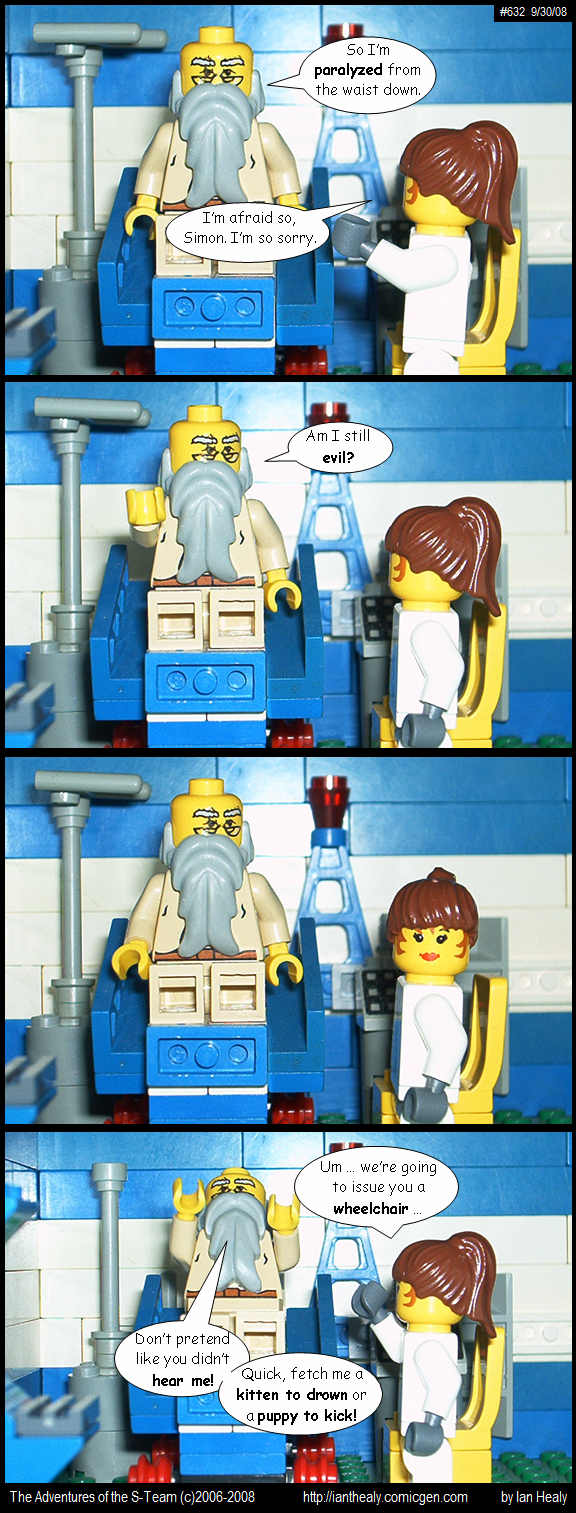
I meant to share this one earlier. Yes, I'm pimping my strip here but this one is pretty perfidious in its nature.

Read the entire strip from infancy to present day right here. The Adventures of the S-Team...bringing teh funnay every weekday for like two and a half years 'nshit!

Posted by EDog EDog on   |   § 0

How we're going to get f*cked

Well, not EVERYONE, exactly...just those of us who intend to make our living through our creativity.

There's a Bill sneaking its way through the government, called the "Orphan Works Bill," and it's absolutely worthy of Germany ca. 1935 (which, if you think about it, wasn't ALL that different than America ca. 2008). I'm parroting the email I received from my local writers' organization.

There's a reason why Google, Getty, Disney, et al are interested in seeing this bill pass:

http://www.youtube. com/watch? v=CqBZd0cP5Yc

PASS IT ON

The Orphan Works Bill promotes theft of creative work, pure and simple. This bill, currently under consideration in Congress, will deny you the right of immediate ownership over the product of your own creativity, and therefore makes it increasingly difficult to make money--much less a living--from it.

Copyright law, as it is now, acknowledges that the work you create is legally yours--your own property--as soon as you create it.

The Orphaned Works Bill will deny that right of ownership. It requires that the creator of any work must pay to register that work before it can be legally deemed the property of the creator. It means you have to register with a private company to have it copyrighted. That means your work can be "orphaned" as soon as it's created, especially since such companies don't exist right now.

Should someone copy your work and leave off your name, it becomes "orphaned" especially when the copied work is copied again and again. These days, this happens all too easily. That repeated copying makes it difficult to discover who created the work in the first place--even for the "diligent" copier.

In addition, it pits million- and billion-dollar companies that want easy access to creative work against artists who can hardly make ends meet from their own work as it is. Why? Because it puts the burden of proof on the creator of the work, rather than the copier.

Worse, it seriously erodes the property rights of citizens of the U.S. as outlined in Section 1 of the 14th Amendment to our Constitution.

Write your senator and congressperson now. Find your state representative: https://forms. house.gov/ wyr/welcome. shtml Feel free to forward this e-mail.

"The three great rights are so bound together as to be essentially one right. To give a man his life, but deny him his liberty, is to take from him all that makes his life worth living. To give him his liberty, but take from him the property which is the fruit and badge of his liberty, is to still leave him a slave."

- George Sutherland, Associate Justice of the United States Supreme Court, 1921.

Posted by EDog EDog on   |   § 1

Vote Early, Vote Often

Just in case you thought this might be a politically-oriented post, don't worry. I'll leave that to Ministers better suited for all things governmental. This is mostly a self-serving post to let you all know I am a semi-finalist in the Amazon Breakthrough Novel Award with my as-yet-unpublished novel Deep Six. You can go read an excerpt here and write a review of it. To make it to the finalists round (100 out of the existing 500 novels will move on), I'll need plenty of positive reviews. To sweeten the pot, there are prizes for reviewers. And remember, if you can't say anything nice, lie.

We now return you to your regularly-scheduled Evil.

Posted by EDog EDog on   |   § 3

50047

That's the word count I stopped at for the night. And I got those down in 25 days of hardcore writing effort. That's a pretty good pace - one might even say blistering if one was a connoisseur of all things wordiness.

Anyway, I just wanted to toot my horn here and say that I rock.

You can read my so-called deranged scribblings here.

Posted by EDog EDog on   |   § 1

Rossed!

If I'm mostly absent over the next month, here's why. But don't worry, come December I'm sure to be back to my normal, prolifically irritating self.

Posted by EDog EDog on   |   § 0

From the "Dig Ian" file...


I'm going to be a guest on Turnbaby Talks this coming Sunday evening at 6 PM Mountain (8 PM Eastern). We'll talk about NaNoWriMo, The Milkman, my webcomic, and whatever else I've got going on (It, of course). Please tune in and call in so I don't have to hem and haw the entire time. If you can't listen live, the show will be archived for your future listening pleasure.

Posted by EDog EDog on   |   § 0

Minister of Big Words and Stuff

*tap tap* Is this thing on?

Greetings and salutations, Faithful Readers! Or breathings and salivations as the case may be (if you're an asthmatic zombie).

I am Minister EDog, and this is my first Perfidious Post about All Things Dark, Evil, and Twisted (those things in particular cause the riding up of certain kinds of underwear). To celebrate this momentous event, I feel it my duty to do what I've done for a couple years now via email to other ministers - that of pointing you towards some of the oddities I've discovered in this magical digital world we've created. And barring that, just show you some Pretty Weird Shit. Being as my nickname is EDog, I thought I'd fire off some cannons of canine-ical canon. And if you're still reading after that fusillade, then we'll get along just fine.

Unlike certain other Ministers here, I am a carnivore, and cheerfully indulge in All Things Meat, whether seared, broiled, boiled, fried, braised, baked, spoken to in anger, or given a dirty look. I'll admit that one of my favorite breakfast foods is the Gas Station Hot Dog, a taste I developed back in The Day when I managed a 7-Eleven. Now you don't have to go to a gas station any more to experience that wonderfully creative flavor of not-quite-grade-A-meat product. You can get it delivered right to your door!

Many are those of us who have canine companions. I myself have a lovely Australian Cattle Dog with a penchant for breaking out of the house through screens when frightened by approaching storms. Yes, I know. Dog logic. But here we cook and clean for our dogs - at least, some of us do - and take care of nearly their every need except one. Sure, you've probably neutered your male dog, because you've seen the Public Service Announcements. But if you haven't because, say, you intend to breed the animal, you have to deal with certain, ah, libidinous instincts. Someone has finally come up with a solution for the problem of the horndog.

And last but not least, if your dog is still of a mind to sow his wild oats, don't pray for crop failure. Instead, learn to help him practice safe sexual recreation with a time-tested method with approximately a 98% rate of effectiveness.

I know you're out there...I can hear you breathing.

Posted by EDog EDog on   |   § 4

Watch the skies, cover your ass

I completely forgot to mention, but the other day Ministry Crony and future Hugo winner EDog has a published novel now available for sale. The story in question is The Milkman, which Ian was kind enough to let me read a while back. It is fun, weird and strangely comforting. It's gonzo science fiction in an era that doesn't look overly kindly at gonzo, or science fiction. It tries to answer one of the burning questions of our time: "What’s the deal with aliens and anal probes?" And succeeds in finding an answer. Swordfights, bikers, spaceships and some embarrassing bodily functions. What more could you ask for?

Buy the damn book already, you won't regret it. You can get your greasy mits on a copy here (author's preference) or here or here.

Posted by Buckethead Buckethead on   |   § 1

The purity of essence of our precious category tags

Patton has accused me of being overly concerned about wasting a scarce natural resource. The category tag. In this, of course, he is completely wrong. Naturally, I could have argued that over-categorizing a post dilutes the utility of tags. And I would have been right. But that wasn't the point. I was attacking him on aesthetic grounds, and just to stick a stick in his eye.

Just to prove that I am not some sort of homo-tree-hugging-enviro-commie, this post, which really is about everything, is tagged with every category we have. And, when I have a free moment, I'll add some new categories, and add them to this post.

So there.

Posted by Buckethead Buckethead on   |   § 5

Pere Ubu: Why I Hate Women (CD, Smog Veil: September 2006)

It gradually dawns on you that the drive from Vermont to Cleveland probably shouldn't have been attempted at night, especially given the circumstances. Tarry highway coffee can't beat back the buzzing behind your eyes and the vile taste of exhaustion rising at the back of your throat. The last time you looked in the mirror, the bruises around your neck had blossomed from faint red suggestions of violence into splendid purple and blue memorials of the last hour you'll ever spend in that town. You need a shave and a transfusion probably wouldn't hurt either.

You reach down to press in the cigarette lighter, and as you look away from the road the edge of your eye catches sight of the furry... thing... driving the white panel truck as it blows past you on the right. What the hell?

Later, pitching the dead end of the same cigarette out the window, you swear the trees furring the black hills to the north suddenly resolve themselves into a gigantic man-shaped figure rising out of the woods against an inky Berkshire sky and striding off to the west. A second later, you pass a tractor-trailer. When you are able to look back north, there is nothing there but trees and sky.

As the exhaustion creeps deeper into your chest, you drift in and out of awareness, the center line a punctuated commentary on the tedium of driving through upstate New York. You climb that line hand over hand, every mile one mile closer to Cleveland. The radio cuts in and out, a jittery melange of classic rock, bad country, and paranoid ranting about God, UFOs and government conspiracies.

It is some time before you realize that the whirring you hear is the car's front wheels grasping blindly at mud. You open your eyes. It is some time before you realize that you aren't driving any more, and that you probably shouldn't try to move in case it makes the pain hurt worse. It is some time before you realize there had been someone in the car with you, and you don't remember where they came from. You wonder what could be making that thrashing sound in the brush down below you.

The night is getting colder, and over the occasional whoosh of passing cars on the highway above, the radio is playing again, a curious mixture of agitated rock, stealthy nightmares, and electronic squealing that echoes the buzzing behind your eyes. There's a theremin playing like a demented steel guitar, and the singer's disembodied nasal voice hovers just above you like a wisp of fog, intoning cryptically about lost luggage, two slices of white bread sealed in a ziploc bag, and bars where the beer don't walk on him. He's got a job for life. In your head -- in my head is a white room where all the good things go. A man with a bag walks in, drops it on the floor and he goes. Goodbye, goodbye, goodbye.

I gotta get out of this place else I swear my head will crack - crack!
I gotta get out of this place else I swear my head will crack
What will you do for me?
Johnny Two-Toes says to Betty Groove

I wait for the dawn but I fear the dawn will not come back
What will you do for me?
What will you do?

There's something that's closin down on me feels like a hand grabbed round my throat
What will you do for me?
Johnny Two-Toes says to Betty Groove
What will you do?

I gotta get outa this town for I swear this town will be the death of me
What will you do for me?
Johnny Two-Toes says
What will you do for me?

Sleep finally overcomes and the night is split by the red pulsations of emergency vehicles. The activity comes nearer, and the man and the electronic buzzing sing together just for you, with the infinite love of a father for his helpless newborn child,

My eyes are growin tentacles for to grab you
My eyes are growin hand grenades for to have you
My eyes are growin tentacles for to grab you
I live in a house without any windows

My hands are growin spectacles for to grab you
My hands are growin half the night for to have you
My hands are growin spectacles for to grab you
My hands are growin spectacles...
I live in a house without any windows
I got a 40 watt bulb to light up my life.

As the music grows to a stormy climax and abruptly fades into the busy sounds of an upstate New York freeway night, it gradually dawns on you that Cleveland is going to have to wait a while.

Posted by Johno Johno on   |   § 0