January 2006

Rocket Racing One Step Closer

Peter Diamandis - the saint-like personage responsible for both the X-Prize and the vast inflation of the hopes of space geeks everywhere - looks like he is within reach of forming an honest to God rocket racing league. Combining the best aspects of current day NASCAR racing and the golden age of aircraft racing, the Rocket Racing League's competitors will fly modified versions of XCOR Aerospace's EZ-Rocket design over complex three dimensional courses, combining gliding with strategically-timed rocket burns to achieve the best time.

F-16 pilots Robert “Bobaloo” Rickard and Don “Dagger” Grantham paid their $100,000 deposit to the league yesterday, to become the first of what the League hopes will be ten teams in the 2007 inaugural season. The hundred grand will go to the expected million-dollar-plus cost of their Mark-1 X-Racer. Operating costs for the rocket and the race team will easily be on the order of a million dollars a year. But hey, they're racing rockets.

I will certainly be glued to the tv when this all comes together. And if it leads to the development of better rocket technology, well that'll just be pure gravy.

Posted by Buckethead Buckethead on   |   § 1

A new low

Once, in a brighter age, I was a movie afficianado. I saw everything. I loved good movies, and I loved bad movies. The badder, the better in many cases. (Evil Dead, They Live for example.) Today they announced the Oscar nominees. I have seen 1 (one) movie nominated for major awards. That's it. Okay, two if you count the Best Animated Film category as a major award. Ten years ago, I would have seen all but maybe one of the movies up for the big ones, and most of the movies up for the technical awards. This year, it's the exact inverse.

The one movie I've seen is "Walk the Line," the Johnny Cash biopic. And, of course, the Wallace and Grommit Curse of the Wererabbit flick. And "March of the Penguins," nominated for best documentary. Aside from those, I saw "Batman Begins," "War of the Worlds," "Harry Potter and the Goblet of Fire," "Star Wars: Episode III Revenge of the Sith," which were nominated for assorted technical awards.

The real reason for this cinematic apathy is not a a decling interest on my part in movies. Or even the widely rumored decline in the quality of films produced. The reason I don't see movies is about three feet tall and named John Christian. Three year olds don't behave well in movie theaters. And the prospect of paying out the yin yang for a sitter just to watch a movie I may or may not like is simply inconceivable.

The only time Mrs. Buckethead and I actually go see real movies in actual movie theaters is at the big holidays, when we have family (read: free babysitters) to watch our spawn. The very limited opportunities for movie watching has had a drastic effect on how we choose which movies to watch. Generally speaking, we only watch movies that we can be sure ahead of time that we will really enjoy. And among that small group, we are likely to pick the movie that woould be the most impressive on the big screen - in order to maximise our movie experience. In other words, we'll watch Harry Potter and the Goblet of Fire twice before going to see something like "Syriana" or "Good Night, and Good Luck." Not to pick on Mr. Clooney, but if he wants to see us watching his movies, he really ought to star in a big budget special effects extravaganza with lots of explosions.

As John has gotten older, his impact on our movie watching has only increased. For the first couple years of his life, we could watch more or less anything on video. He was simply unaware of what was happening on screen. This eased the process of accomodation - we were able to wean ourselves off the movie crack gradually. But after watching "Christmas Vacation" and having John ask, "Where's the Kitty?" we realized that even that option had been closed off. And since John is a night owl like Mrs. Buckethead and myself, the only way I'll ever watch my Sin City DVD is if I get up at five in the morning and watch it before I go to work. Which isn't really an option at all.

Seeing as we have another spawn cooking right now (she'll be done sometime around the end of March) it will be at least another five years before I can watch movies again. If we have another kid, that day will be pushed back to sometime after 2012. Hopefully by that time they'll be able to beam movies directly into my nob.

Posted by Buckethead Buckethead on   |   § 7

I Love You Too, Man, Mr. President

I know it's surely in poor taste, but this ifilm video clip from the Late Late Show allegedly showing the President deep in his (fictional) cups (which he hasn't done in years, Mr. TIA/Carnivore/Sekrit NSA Person) made me laugh so hard some pee almost came out. My nose. Some slowed-down-type video footage is all it is, and yet here I am wiping what I hope are tears out of my eyes.

Many thanks to new unfogged coblogger apostropher.

Posted by Johno Johno on   |   § 0

Some like to pitch and some like to catch

Rand over there at Transterrestrial Musings has had some good stuff recently. One that caught my eye was the post I just linked, regarding the use of rotating tethers to fling payloads and passengers from Earth orbit to the moon. There's a lot of good commentary in the, uh, comments - so read it all.

This is, I think, a very good idea. It's practically all upside. A 100km tether would be able to fling a payload to the moon, and then use the Earth's own magnetic field to recharge so that it can launch the next payload. Essentially, we can get one fourth of the momentum needed for a lunar round trip for absolutely nothing. Okay, for the amortized cost of building and launching the tether.

But there is more to it than that. Before learning how to make large, 100km tethers, we would need to practice on baby tethers. However, they would not be merely experimental artifacts with no practical use. Smaller tethers would serve an immediate need in allowing payloads to be shifted to higher orbits. And the skills learned in building and operating these tethers are obviously directly applicable to constructing larger ones.

Larger tethers have multiple uses. A rotovator could dip into the upper atmosphere and grab a vehicle like Rutan's SpaceShipOne, reducing the cost to get off the earth. A tether in lunar orbit could catch incoming payloads from the Earth, or coming up from the Lunar surface. While Lunar tethers could not use magnetic fields to recharge (the Moon has a very weak magnetic field) one of the niftiest properties of a rotating tether is that it can serve as a momentum bank, like a flywheel. A ship inbound from Earth will have momentum, which is transferred to the tether when it is caught and lowered to the center. That linear momentum is stored in the spinning tether as angular momentum. Sometime later, that ship or another could use that energy to launch itself back toward the earth. Naturally, there'd be some losses. But it would mean an end to spending energy to launch each ship individually. Just do it once, and use that energy over and over. A high traffic rate between the Earth and moon would only improve matters, making it easier to balance the load.

The real advantage would lie in having a system of rotating tethers, located around the solar system. Tethers to catch relatively low-powered suborbital launch vehicles coming up from Earth and pass them up to orbit. Inter-orbit tethers to fling payloads back and forth. Larger tethers to fling ships to and from the earth, and even further afield. And practice building rotating tethers is in the end practice building space elevators.

There are some problems, most notably the issue of guidance and "catching" incoming payloads. Launching, by comparison, is easy. But like most technical problems, there will certainly be a technical solution. The only way to get to the point where that matters, though, is to go ahead and start building tethers - and given NASA's current state, that isn't terribly likely.

Posted by Buckethead Buckethead on   |   § 0

Hamas off to a rational start

Having won the Palestinian elections in a landslide, Hamas immediately put forward a sensible and forward-looking plan to establish amicable relations with Israel and bring peace to that troubled region, and prosperity to its beleaguered citizens.

The first point of its comprehensive one-point plan is so simple and profound that it is truly astounding that no one in fifty years had ever hit upon it. Israel must change its flag. I mean, sure, those two blue bars on the Israeli flag are clearly indicative of the zionists desire to create a greater Israel from the Nile to the Euphrates. We all saw it, didn't we? We just didn't want to say anything, embarrassed as we all were after that Holocaust thing that didn't really happen, but which would still have been a good idea if someone had only done it.

Yeah. Change the flag. All will be well.

I think we can anticipate an endless series of well thought out and reasonable policy proposals from Hamas. Now that they're the head of an almost state, they'll certainly have to be more polite. Maybe instead of killing Jews, they'll just suggest in polite diplomatic language that the situation will be greatly improved if most or all of the Jews would somehow cease living. Maybe the Iranians could help out with that.

[wik] Loyal reader #0003, NDR, notes in the comments that claims such as these have a long history. He recommends this Daniel Pipes article, and having read it, I do as well. However, before I read it, a funny thing happened. I am so conditioned as to assume that NDR is disagreeing with me. So before actually reading the article he linked, I did a panic check on my source. The only other places linking that article were places like NewsMax. Egads! Had I unintentionally linked to the Israeli equivalent of NewsMax? I broadened my search, and discovered that the Jerusalem Post had also mentioned the incident, here. As I read, I realized that the Pipes article was referring to the long history of Arab claims. Not some sort of fantastical notion of Israelis claiming that the Arabs claimed that the flag stood for Greater Israel, or whatever it was that ran through my noggin.

My only excuse is that it is unseasonably warm, and the air conditioning at work has only two settings: warm and hot. And it is only set to warm for three days in October. The rest of the year is mostly unbearable, especially when it is sunny outside. Today, according to the cheap thermometer I keep in my office, it is 86 degrees and no air movement whatsoever.

My brain is melting, that's my story and I'm sticking to it.

Posted by Buckethead Buckethead on   |   § 3

No News is Good News (Global Warming Edition)

I couldn't help but notice that the EPA's pages on Global Warming haven't been updated since 2000. In fact, it's downright difficult to find a policy page or information page anywhere that gives the Bush adminstration's position on these issues. If you read the US government's pages, you'd come to the conclusion that little has changed in the last five years or so.

This is more "we just don't know" bullshit. I am struck by how similar this all is to debates over smoking. For today's youth it's hard to believe (and even silly) that twenty years ago the health effects of smoking were very much a matter of debate. Back then it didn't seem like smoking was good for you, but the hard-and-fast science on just how and why just never really seemed to emerge. We know now that a highly successful campaign by tobacco companies to distort the science coupled with tobacco-driven politics conspired to deprive the public of key information they should have been told, giving the industry a few more years of profitability at the cost of hundreds of thousands of lives.

That's just par-for-the-course for corporations in general. A vanishingly small number of companies will try to do the right thing, when the profitable thing is so appealing. We need regulation to protect ourselves against harmful actions conducted in self-interest by private and corporate entities; their cost and decision equations simply do not take into account the greater good. Unless forced to, they never will.

Six years have gone by and the EPA's position on climate change is identical -- we just don't know. What's written on those pages is very much the state of the art in GOP positioning on this issue. Proclaim as loudly as possible that there are too many unknowns to make a decision, and further study is necessary.

The climate science community has shifted from arguments about whether global warming is taking place to the clear and present danger of the tipping point, something long postulated in the literature. What they're trying to figure out is, is warming occurring so rapidly that we are approaching a point beyond which we will be unable to repair the damage, should we decide to do so?

This Administration's position on climate change is to do nothing and say nothing. Based on recent news reports it appears that the administration has engaged in an active policy of suppression to inhibit the release of any scientific data or conclusions that might support serious action vis-a-vis global warming. Only by suppressing official domestic science has this administration been able to delay the engagement of the public on this issue.

Ask yourself -- are you comfortable with the idea of Tom Delay, Bob Ney, Jack Abramoff, Randy Cunningham, Ralph Reed (and their pay-to-play, bought and pair for ilk) setting US policy on the environment? Because they already have. Responsible, honest leadership is needed -- leadership that doesn't simply "stay the course" no matter what inconvenient facts present themselves.

I've described the election of Bush in 2004 as a disaster -- a turning point from which devastating consequences in the future will result. In five short years he has created a financial disaster in the federal government it seems almost impossible to repair. Taxation policies have inarguably yielded great benefit for the wealthiest, but none of the promised effects have materialized -- indeed, average wages are down relative to inflation. Bush has destroyed the credibility of the US in the international community with his "tough guy" policies and utter lack of candor. You can argue that you believe he's done what needed to be done, but the rest of the world doesn't see it that way. He has squandered the reputation of the US military, pointlessly exposing to the rest of the world precisely what the US military can and cannot do, and how long it can sustain itself. He has engendered a culture of corruption in Washington that sets new records for dysfunction.

I can't help but think that the center and left in this country are fighting so many low-level battles that we're simply losing sight of what's really important. Global warming and climate change is important. We need to study the hell out of it and figure out the best path forward. Separation of powers is important. "It's not constitutional" is the only thing standing between freedom this country's citizens enjoy and a history replete with examples of dictatorial and executive control.

The task at hand: Discover some absolutes. Find a list of ten issues and develop simple decision points for them. Hell, find three issues just to get started.

Posted by Ross Ross on   |   § 0

Actual Facts

It is sobering to realize that almost everything is one direction or another from Kansas City.

Posted by Buckethead Buckethead on   |   § 0

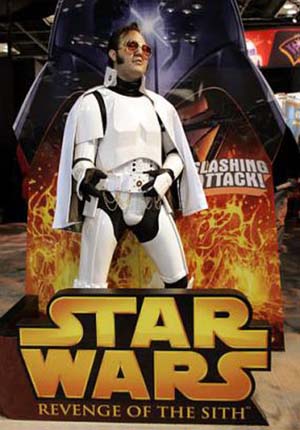
At least he wasn't wearing Leia's Gold Bikini

From the diseased mind of confessed Star Wars geek and Ministry Crony Phil we find the bizarre intersection of two divergent forms of obsession.

Behold, "Stormtrooper Elvis:"

Stormtrooper Elvis

"A little less conversation, a little more action."

Does he sing Blue Suede Shoes with that tinny little radio voice all the Stormtroopers have? Does the Empire supply him with free quaaludes and peanut butter and banana sandwiches? A costume like that would make it much more difficult to expire sitting on the throne, wouldn't it? Yeesh.

[wik] You can see the entire parade of hopeless wannabes, with entirely free bonus snarky commentary starting here.

Posted by Buckethead Buckethead on   |   § 1

Election Fetish

I was inspired to jot off most of the following in response to a comment over at Murdoc's place. It didn't have awhole lot to do with Murdoc's post, but the issue had been bouncing slowly through my skulljelly.

Hamas won, decisively, an election in Palestine. A lot of people have gotten their panties in a twist over it. This is perhaps to be expected, and really, we ought to rename our chattering classes the "panty-twisting classes." But it was also to be expected in the sense that after forty years of ardent radicalization of the Palestinians on the part of Yassir Arafat, that once a Fatah leader attempted to move even a little toward moderation someone one else would step in as the "real terrorist party" and quickly win the admiration of the people. It didn't help that aside from a new reputation for fecklessness in attacking the Jews, Fatah had a long standing reputation for bumbling, corruption, venality and treachery.

Hamas is of course a perfect fit for the "Real Terrorist Party," seeing as they are in fact real terrorists. The Palestinians know that Hamas will quite literally stop at nothing to kill Jews. And the Palestinians have been trained from birth to salivate at the sound of exploding Jews. Action, reaction.

There is a tendency in the West to fetishize elections. Many of us believe that in some magical way, receiving the lustration of a democratic election somehow makes the winner righteous, or at least sanctioned by a higher authority. That someone expresses the will of the people, and is annointed by the sacred oil of electoral victory is held to be an important thing. That this is beside the point should be too obvious to have to point out, but many very bad people have embodied the will of their people, and have used that mandate to wreak great evil on their neighbors or even the people whose will they embody.

Elections are an effect, not a cause of Democracy. Holding elections does not mystically transmute a grabastic collection of nihilistic refugees into a democratic nation requiring the respect and due deference of the civilized world. Even if it is an honest, rigorous and fair election.

As NDR pointed out in the comments to Johno's recent post, there is a long tradition of demagogues and worse exploiting the weaknesses of a democratic state. The Greeks invented democracy, and were therefore the first to allow it to devolve into tyrrany. The only defense against that is an educated and morally courageous citizenry - a citizenry that (at least for the most part) votes for what is right, not for what is expedient. Or worse, follows the dictates of base emotions at the instigation of the evil.

I don't know if Godwin's Law applies in this case, but Hitler won an election, too. Which is not to say that Hamas is like Hitler. Although it is. The thing is, "The People" in all its profound glory and unlimited sovereignty, can be profoundly and tragically wrong. As the Palestinians are today. We can understand why this came to pass - and I think that's fairly clear - but that doesn't mean that we have to accept the outcome. A leadership committed to genocide and hatred is not legitimate even if they come to power in a way that we ourselves use. It is not the form of the election that makes us what we are. (Or the British, Germans, Japanese, Indians, or whoever.) We have elections because we are free people living in a moderately just soceity.

The Soviets used to have elections to put a veneer of legitimacy on their tyranny. Elections in Palestine is just the means by which Hamas takes over the reins of power from an insufficiently violent and hateful Hamas. The Palestinians have not, I think, ever exhibited any of the qualities necessary for a real democracy to succeed. Electing Hamas shows that they value Hatred and Fear more than anything else.

Posted by Buckethead Buckethead on   |   § 4

You take the high road... I'll take the low road.

There's an old joke I used to hear in the music bidness, one you'd pull out when bitching about artist managers, A&R, (especially) booking agents, concert promoters, radio promo guys, anyone really.

And since it's Friday, my inbound commute this morning took 135 very cold and standy minutes, and I'm feeling petty, I whip it out once again for your... enjoyment...? That's not the word I want.

Q: Is it possible to get pregnant via anal intercourse?
A: Of course! Where do you think lobbyists come from!?

[wik] Be sure to watch Ed Helms' piece on searching for the taint in Washington on the Daily Show. It's a real... shocker.

Posted by Johno Johno on   |   § 0

We're Getting The Band Back Together!

According to the Washington Post, notorious burnout, drug casualty, and musical genius Sylvester Stewart might be rejoining the great original lineup of The Family Stone to perform at this year's Grammys.

I'll believe it when I see it, but I will damn well sure be watching!!

Posted by Johno Johno on   |   § 2

A New Democracy Blooms

I don't have much to add to all the professional and amateur punditry surrounding Hamas' win in this week's elections in Palestine, except to say that George Bush was right, and I was wrong. Democracy is the future of Middle East!

It's a pity, though, that "democracy" and "freedom, liberty, and Enlightenment values" don't mean the same thing like Bush's cabal seem to wish they did.

Posted by Johno Johno on   |   § 6

Aerial Battleships

I emailed this out to a few people, and was roundly ignored. Perhaps I shouldn't have sent it Friday afternoon at 5:00. In any event, I was thinking some more about this idea in my first eight hour meeting this morning:

Here's a alternate history teaser for you. I was reading a book by James Hogan called Kicking the Sacred Cow, a fascinating look at scientific theories not accepted by the mainstream, yet short (for various reasons) of full-on crackpotism. One of the things he discussed in his book was alternate theories of relativity. Without getting into too great detail, one aspect of this is that some physicists are coming to believe that Einstein's general relativity might have gone too far in trying to explain the speed of light and other conundrums. What they propose is that unlike in Einstein's theory, there is a peferred reference frame, and that that reference frame is determined by the ambient gravitational field. Further, once you accept this, you can derive many physical constants directly from Maxwell's electromagnetic equations that can only be assumed in General Relativity. Even further, it may be that gravity itself is a side effect of electromagnetism. (It may be that that peferred reference frame is in fact equivalent to the idea of the ether, and the reason why the Michaelson Morley experiment failed to detect it was the same for the same reason that it would be difficult to measure the air speed of an airplane from inside the cockpit.)

All very interesting, and worth a read. But what got me is the thought that if this is all true, powerful electromagnetic fields operated in the right way might have an effect on gravity. Which could be really cool for all of us if someone figures it out. And there's that Russian dude who claimed that he could do it himself. But what if someone like Michael Faraday - widely considered the most brilliant experimental scientist of his or any day, and inventor of the dynamo (on which all subsequent electrical technology is based) had a brainwave and built himself a giant electromagnet and figured out how to cancel out the effects of gravity back in 1825?

Suppose he spent the next ten years getting all the kinks worked out. And at the end of the day, he had a funky device that you could mount in a ship, and it would make that ship fly. By 1840 or so, people are building flying ships. Let's assume that ships can be made more or less arbitrarily heavy, thanks to the antigravity. Either another version of the device, or even something as prosaic as propellers, would push these literal airships through the atmosphere. Speeds would therefore be limited to something on the order of the steamships of the day - but they could go up thousands of feet in the air, and cruise for long distances. Essentially, the new aerial ships would have the same range, speed and carrying capacity as the wetter sort of steamships, but able to fly at altitudes of up to several thousand feet.

Further assume that the production of the device is difficult, but within the capabilities of any moderately industrialized nation of the time, limited perhaps by the need for some rare and expensive element. There might be some variation in the ability of different nations or companies or inventors to produce faster or bigger ships, but all will be more or less in the same ballpark, performance-wise.

What would be the effect of this technology on the wars and politics of the last half of the nineteenth century? These new airships would, unlike modern aircraft, have all the advantages of water-bound ships - range, cargo capacity, armaments and armor, etc., but able to travel at will over the whole globe.

Among the big shows scheduled for the 1860s include the American Civil War and the Austro-Prussian War. 1871 would see the Franco-Prussian War and German unification. The 1880s saw the great powers occupied in an undignified scramble for brown people's land. And all that would lead up to the really, really big show of WWI.

Some thoughts: the South would be unable to produce many of these ships, but it would certainly have some. Gen. Stonewall Jackson leading an airborne division? The German Reichsluftmarine wouldn't be as hemmed in by British control of the passages out of the North Sea. Tsarist Russia would no longer be hampered by lack of warm water ports. Switzerland would no longer be landlocked. Railroads would no longer be the only way to marshal troops quickly and transport them to the front. This last is important, given that the greatest effort and thought was put into plans for marshalling troops and equipment for transportation by rail. Much of the diplomatic screwups that led to the First World War were dictated by mobilization and rail schedules.

Air battleships would not be fragile structures of aluminum, easily blown to bits by AA guns. These battleships would in be in essence, real battleships like the HMS Dreadnaught or the USS Iowa given the ability to fly. Of course, in the time of the Civil War, it would be flying CSS Virginia and USS Monitor. But that's the nature of the beast. Naval air ships would carry the largest cannon available, and be capable of intense bombardment of targets on the ground. Cargo ships could hold hundreds of men and their equipment and travel hundreds or even thousands of miles at 20-30mph.

In short, the advantages of naval conflict - mobility, firepower and carrying capacity - would be carried over to land warfare, long limited by the speed of march and the carrying capacity of the individual infantryman.

What do you think might happen?

Posted by Buckethead Buckethead on   |   § 2

Balkanada Addendum

As I was daydreaming during my second eight hour meeting this morning, it occurred to me that there is at least one other factor that would be significant in any breakup and possible assimilation of Canadian territory. I'm not sure of the specifics, but it is my understanding that Canada, while fully independent in terms of conducting its affairs both foriegn and domestic, it is still technically part of the British Empire. The Queen is still, after all, on the front of their monopoly money. I wonder what, if anything, Great Britain would have to say about the U.S. gobbling up several ex-Canadian provinces.

Posted by Buckethead Buckethead on   |   § 0

Big time, just around the corner

My wife's band, Dead Men's Hollow, is going from success to success. Tomorrow, they are playing a free concert on the Millenium Stage at the prestigious Kennedy Center for the Performing Arts (right by the Watergate Hotel in our nation's capital.) And today, I learn that they have been nominated for no less than six Washington Area Music Awards from the Washington Area Music Association.

DMH is up for the following Wammies:

  • Bluegrass Group
  • Bluegrass Recording (for their CD "Forever True")
  • New Artist of the Year
  • Album of the Year (for "Forever True")
  • Debut Recording of the Year (for "Forever True")
  • Best Recording Design (for Marcy Cochran, who designed the art for "Forever True")

You can hear their music by following the link above and clicking on "Music." They've got some free downloads, just for you.

I can't say how proud I am. Despite many obstacles, and even harassment, they are moving up in the world at a steady and relentless pace. Their music gets better everyday, so listen now and you'll be able to say, "I knew them before they kicked the Dixie Chicks clear out of country music."

Posted by Buckethead Buckethead on   |   § 4

Habby Birthday, Mr. Blackfive

I have been informed, by a reliable source, that it is Blackfive's birthday. I was informed by this reliable source early this morning, and I could have scooped the entire interweb on this important story had I not spent the first six hours of my work day in twenty hours of meetings. Nevertheless, go wish him a happy birthday in a way that means most to bloggers - visit his site, then (if you don't already have one) create a new blog and link him twenty or thirty times.

Then, link me twenty or thirty times for giving you the idea.

I recently had the pleasure of meeting Blackfive, and enjoying with him and two lovely ladies some excellent Malaysian food and about four hundred dollars worth of beer. Blackfive is a standup guy, and I am honored to have met him. So really, go over and say happy birthday.

Posted by Buckethead Buckethead on   |   § 3

Actual Facts

A fossil is an extinct animal. The older it is, the more extinct it is.

Posted by Buckethead Buckethead on   |   § 0

Balkanada

The whole Canada thing has gotten me thinking. While support for independence in Quebec seems be holding steady, or even declining, the potential for a breakup of Canada is still real, if somewhat remote. But what would actually happen if Canada did break up?

The first puzzle is what the remainder of Canada would do in the event of a decisive vote for sovereignty in Quebec. There seems to have been some preparation for this eventuality, and I doubt many in British Canada would really object much to the idea of Quebec going its own way. The situation would be nothing like that of the southern states seceding in 1861 – there would certainly be no civil war to force Quebec to remain part of Canada. The likely result, at least in the near term, would be an amicable divorce, in its nature very like the split between the Czech Republic and Slovakia.

The Quebecois and the rest of the Canadians would divvy up the marital assets – military bases, government facilities, and the like. They would agree to things like free movement of citizens, trade reciprocity, and access to the St. Lawrence seaway for the western parts of Canada. The opinion of the United States would have to be considered – especially in regard to that last item, seeing as how such a large portion of US trade uses the St. Lawrence seaway as well – it is the only access to the sea for the entire US Great Lakes region, including Chicago, Detroit and Cleveland. But so long as this was guaranteed, I don't think the US would really twitch at the idea of the Quebeckers going their own way.

The repercussions of an independent Quebec might move well beyond their own independence. I can imagine that once the idea of Canada is broken, others who might not have considered secession might find it, well, thinkable. The obvious candidates in this case would be Alberta, Saskatchewan and British Columbia. We are told that Canadians in the west have long felt shafted by the elites in the east, whose policies have either taken, or threatened to take, the wealth of the west to be given to the economically disadvantaged in Quebec and the Maritimes, whose economies are not as vibrant, or as well blessed with natural resources.

Alberta, especially – the Texas of the north – might be the first to follow Quebec into secession. There have been movements for secession there in the past, though not particularly large or successful. Unlike Quebec, however, with Alberta and the plains provinces, the probability of one or more of these newly independent nations turning around and petitioning the US for statehood would be significant. And that would raise big questions in the US, which has not admitted a new state to the Union in almost a half century, and the only real parallels would be with Texas and California, more than a hundred and fifty years in the past. More on that in a minute.

Meanwhile, assume that the unraveling of Canada continues, and gathers momentum. Quebec started the ball rolling, and Alberta gives it a good kick soon after. In quick succession, Saskatchewan and British Columbia also declare independence. The Central government in Ottawa has lost its biggest problem, which is nice. But it has also lost two of its most prosperous provinces, which means that it will be far less able to make transfer payments to the economically stagnant Maritime Provinces. Further, it is now geographically separate from them, with Quebec awkwardly positioned betwixt the two parts of the rump Canada. What will the Maritimes think at this point? Continuing support from Ottawa might seem to be less and less assured. Perhaps they, too, would consider independence, followed by a petition for statehood.

The advantages for certain provinces in statehood are in some cases fairly clear. As Bob and Doug McKenzie put it in the Daily Hoser:

Top Ten Affects if Canada and the United States merged into one nation:

  1. We'd be a kick ass nation with some kick ass beer!
  2. The Blue Jays would finally belong in the American League
  3. Red white and blue flag shaped like a maple leaf
  4. All politicians would henceforth be known as Hosers!
  5. One word: Americanada
  6. New rodeo attraction: bear back riding.
  7. Change of spelling from "about" to "aboot"
  8. Quebec forced to take Detroit if it wants to cecede.
  9. Condos line Hudson Bay
  10. The Mackenzie brothers can join Sonny Bono in Congress!!!

Beyond those benefits, the western provinces have, arguably, more in common with American citizens just across the border than they do with Canadians in Ontario. Likewise, the population of the Maritimes has a lot of affinity for New England. Being a part of America means getting all the benefits of being American. (And, of course, the downsides.) They would be able to participate directly in the formation of American policy with representatives in Washington. They would benefit from social programs that for all the whining, are not that different from those in pre-balkanized Canada – and that would be an important point for the Maritime Provinces.

In short – being part of Canada might seem a bad deal in the middle of a collapse, but going it entirely alone might seem a bit risky, hence the flip to America.

But how would the Americans react to all this?

If one Canadian province petitioned for statehood, the argument might be different than if many did. Just think about the various considerations and calculations that will be taking place in the minds of congressman, senators, state leaders and pundits:

Partisan types will be wondering how the citizens of a new state will vote. Most of the provinces under consideration would be, by American standards, very low in population. New Brunswick, Newfoundland and Labrador, and Prince Edward Island are all sub-South Dakota in size. PEI is tiny – actually only a fourth the population of our current least populous state, Wyoming. Nova Scotia is about a million people, which puts it in the range of a Rhode Island. Saskatchewan and Manitoba likewise. Alberta, at over three million, is equivalent to Connecticut. BC is the largest at over four million, equivalent to South Carolina. The smallest provinces would only have a single Congressman. Those with a million people would get two. Alberta would get as many as five, BC perhaps six. The overall effect would be small. But in the Senate, things would be different, as each of these new states would get the same two as everyone else.

And who would get those congressmen and senators, and who would benefit in the electoral college? The plains provinces are almost entirely conservative. Alberta is entirely conservative. It can be assumed that most of those votes would go to the Republicans. The Maritimes vote predominantly Liberal and NDP, and it can be assumed that most of those votes would go to the Democrats. That's three red states and four blue states – if each province comes in as its own state. British Columbia would be a battleground state. In the last election, it voted in 17 conservatives, and 19 from the libs and the NDP. But the peculiarities of the Canadian election system mean that as far as percentages go, it's not so close: 55% Libs and NDP, 37% Conservative.

If all the provinces came in, partisan bickering could probably be overcome since over the spread of all of these provinces; it's more or less a wash right-left wise. But if only Alberta, Saskatchewan and Manitoba wanted to join, the Democrats would howl at the near certain addition of six Republican senators. Small states (and their representatives) would likewise howl at the further dilution of their already small influence in the Senate.

The influence of these new states on Presidential elections would also be debated. Our electoral college gives a lot of influence to small states in the race for the Presidency. And if Prince Edward Island became a state, 137,000 people would wield three electoral votes, a 1:46,000 ratio compared to 1:616,000 ratio for Californians. Again, the relative balance of conservatives and liberals across all the provinces would likely reduce most complaints – something like the way free and slave states were admitted to the Union before the Civil War.

What other issues would there be? The advantages to the US of having access to Alberta's oil reserves would be clear, though environmentalists might oppose admission on those grounds. (Or support it, so they could influence it.) Expansion would likely be viewed as a good thing in principle by most Americans, especially as Canadians are for the most part very like us. Integration of ex-Canadian military forces into the American armed services would likely not be anywhere near as big a problem as it was for the Germans absorbing the East Germans. The cultural affinities of Canadians to America would likely lead to a smooth process overall. The great latitude the Constitution provides to the states in how they order their business would certainly help as well.

A little research on the web revealed the basic process of borg-like assimilation of new territories:

  1. A territory petitions Congress.
  2. The dependent area drafts a constitution with a republican form of government.
  3. Congress must approve statehood by a simple majority.
  4. The President must sign the bill.

It doesn't matter if the territory was already US territory or an independent nation as was California and Texas. So long as the state government is republican in nature, the details don't seem to matter much.

If Quebec left and the rest of Canada decided that they could still be Canada without them, this would all be moot. I think the key would be Alberta. If even one more province decided to give the stinkfinger to Ottawa, it would start a domino effect leading to the United States absorbing most of Canada outside Ontario. The only province that seems to have a reasonable shot at making it on its own as an independent nation is British Columbia. The rest are too poor, or too landlocked to be completely viable states, hence the anschluss with the U.S.

[wik] Posts like this are what happens when I leave my book at the office before getting on the Metro for the ride home.

Posted by Buckethead Buckethead on   |   § 5

O Canada!

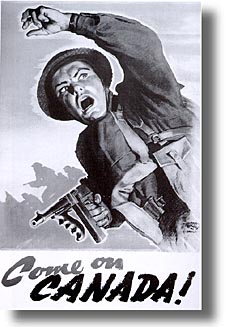
I officially declare this Canada day on the Ministry. In the spirit of this official celebration of the lives, achievements and peculiarities of our neighbors to the north, herewith, some linkage:

  • Canada now has a conservative government. Right wing wacko, neocon and Albertan Steve Harper is now the Grand Poohbah of Canuckistan. This is great news on several levels. First, a wacky neocon is control of another real country. Second, that country is Canada, which needs a dose of wacky neocon adventurism to overcome its recent reputation as a effeminized moral weaklings. Third, the leader of a real country is named "Steve." That great name has had a checkered history when its been the moniker for a head of state. King Stephen of England managed to plunge the country into bloody civil war in only a few months. And that's pretty much the beginning and the end of the story of Steves in power. I think one US President's middle name was Stephen, but I can't verify that.
  • Austin Bay has a fine essay on the decline of the once mighty (pound for pound) Canadian military.
  • Mark Steyn on the Election in Canada and its result. Has anyone really noticed that Mark Steyn is the living embodiment of the idea of the Anglosphere?
  • Reuters, somewhat predictably, predicts that the new conservative leader will have a tough row to hoe.
  • Beer!
  • Pardon my English has noted that Michael Moore's Jesusland map needs updating.
  • A couple more thoughts on the end of Canada.
  • A couple more thoughts on Canada's gun problem, or rather problem with the lack of guns.
  • Some insightful commentary on what it all means, Canada-wise.
  • For those who aren't ready to believe that Canada is, in fact, an independent nation despite several attempted invasions - here's the classic Onion parody, "Perky "Canada" Has Own Government, Laws" - you have to scroll down a bit, it's the fourth item. For some unknown reason, I can't find it on the Onion site.
  • And lastly, CANADIAN WORLD DOMINATION!

image

[wik] Our resident Canadian, Ross, is cordially invited to comment on the momentous events underway in his frozen homeland.

[alsø wik] Murdoc has a round-up of blog commentary, of which my favorites are Joe Katzman at WoC (no surprise) and this seemingly counterintuitive bit from Frank Warner that makes more sense if you think about it for a second. Murdoc also dared to use the "H" word.

[alsø alsø wik] I should also mention that the Austin Bay piece, well, I stole that from Blackfive.

[wi nøt trei a høliday in Sweden this yër?] Joe also links to this nifty graphic.

Posted by Buckethead Buckethead on   |   § 3

Effing Redistributionists

Interesting commentary from the Christian Science Monitor about the "Triumph of the Redistributionist Left." While disheartening for me - especially considering that I will not get the nice Christmas presents from Social Security that the older generations will, all aside from philosophical considerations - the guy has a point:

It's about something much deeper; namely, that the era of big government is far from over. Trends are decidedly in favor of that quintessential leftist goal: massive redistribution of wealth.

Republicans' capture of both Congress and the White House was, understandably, a demoralizing blow to the left. But the latter can take solace that "Republican" is no longer synonymous with spending restraint, free markets, and other ideals of the political right.

While the left did not get its way on tax cuts, this may be only a temporary defeat: Freewheeling spending has made future tax cuts politically a lot harder.

During the first five years of President Bush's presidency, nondefense discretionary spending (i.e., spending decided on an annual basis) rose 27.9 percent, far more than the 1.9 percent growth during President Clinton's first five years...

Discretionary spending is dwarfed by mandatory spending - spending that cannot be changed without changing the laws. Shifting demographics combined with an inability to change those laws virtually ensures that, through programs such as Social Security and Medicare, America's workers will be forced to redistribute a larger and larger portion of their income to other Americans in the coming decades.

...Certain trends have been favoring the left for the past several decades. In the early 1960s, transfer payments (entitlements and welfare) constituted less than a third of the federal government's budget. Now they constitute almost 60 percent of the budget, or about $1.4 trillion per year. Measured according to this, the US government's main function now is redistribution: taking money from one segment of the population and giving it to another segment. In a few decades, transfer payments are expected to make up more than 75 percent of federal government spending.

That's not a pretty picture.

Posted by Buckethead Buckethead on   |   § 4

How blogs change politics

Mark Steyn, in a recent article about the Alito nomination, quotes Michael Barone on the differing effects of the left and right blogosphere on American politics:

The left blogosphere has moved the Democrats off to the left, and the right blogosphere has undermined the credibility of the Republicans' adversaries in Old Media. Both changes help Bush and the Republicans.

This does not seem entirely implausible. We have all seen the effect of the right blogosphere in memogate, the spread of the Swift Boat Veteran's message, the fall of Sen. Frist, and many others. The left blogosphere has not really seemed to have any big coups like those of the right, but certainly they have been a powerful force in reinforcing the left's base - keeping them motivated and, more importantly, giving money. Dean's campaign was a classic example of this, as was the campaign of abortive Ohio Congressman and Iraq war veteran Paul Hackett.

It will be interesting to see how the blogosphere - both sides - affect the next election cycle.

Posted by Buckethead Buckethead on   |   § 0

Metalstorm Back in the News

UPI is reporting that Australian company Metalstorm will be demonstrating a new weapons system for the US Military in Singapore next month.

The author of the article is not exactly hip to the intricacies of military technology.

Next month a new high-explosive munition will be fired in Singapore and then tested again by the U.S. Army, heralding what may be a sea change in weaponry: a gun that can fire 240,000 rounds per minute.

That's compared to 60 rounds per minute in a standard military machine gun.

While 240,000 rounds a minute is in fact a lot, his figure for regular machine guns is off by an order of magnitude. Just think back to the last war movie you saw - were the machine guns firing one round a second?

*bang*

*bang*

*bang*

*bang*

Not likely. Nevertheless, this is good news. A metalstorm system could be very useful as an automated point defense system to protect our troops from incoming mortar fire. Hooked to a radar system, once an incoming mortar is detected, the metalstorm pod would quickly rotate toward the incoming and fire as many as a hundred rounds in a fraction of a second. Modern military radar systems are quite good, but the limitation has been in the speed of defensive firing systems. If the rate of fire is 600 rounds a minute (ballpark for a typical machine gun) you may - may - get off a few rounds in the seconds before the mortar hits. Odds are, you'll miss.

The beauty of the metalstorm system is that it does not depend on mechanical processes to fire and reload bullets one at a time. No matter how refined that process becomes (and in the case of electric gatling guns, that is very refined indeed) the mechanics of the process limit the maximum rate of fire. Metalstorm has no moving parts. Bullets are fired electronically, and to get around the problem of loading new bullets, they are simply stacked in the barrel. Each barrel could have ten bullets. Get a bundle of barrels 10x10, and you have a thousand rounds. And they can all be fired in very, very rapid succession. Whole pods of barrels could be replaced as a unit, for easy reloading.

With the electronic firing system, bullets can be fired in patterns, or at any desired rate of fire. Lighting up just the top layer of bullets would create a wall of lead - a hundred bullets fired in a fraction of second. And this - combined with an accurate fire-finder radar, would stand a very good chance of hitting an incoming mortar round.

Metalstorm has lots more ideas for its technology beyond mortar defense. They're currently testing a grenade launcher system that could be mounted under an assault rifle in the same way standard grenade launchers can be mounted under the M-16. They've proposed four barreled handguns with a 24 round capacity. These nifty items could fire four rounds simultaneously - before recoil kicks in, for greater accuracy. Air defense, gun pods for uavs, even for use with sub-lethal ammunition - the possibilities are nearly endless.

All they need to do is figure out a way to explode IEDs with them, and we won't have to spend a quarter billion dollars on the F/A/R/C/E 22.

With electronic firing

Posted by Buckethead Buckethead on   |   § 4

Cruel and Perfidious Canucks

In reference to Bram's comment on my previous post, Upheaval in the Great White North regarding the Liberal efforts to disarm Canadians leading to a less than interesting Canadian Civil War:

It's being reported that despite the lack of guns in the hands of honest Canadian citizens, the ability of Canadians to commit violence and rapine on their compatriots has not lessened. In fact, it has increased. Canada's rate of violent crime is now twice that of the United States - 963 per 100,000 compared to the States' peacable 475. Sexual assault is also twice the US level. Overall crime rates are half again that of the US. Looking on the sunny side, if you are injured in the course of a violent assault (a likely outcome, all things considered) you won't have to pay for treatment! Isn't that great? Of course, you may have to wait awhile...

Posted by Buckethead Buckethead on   |   § 2

Upheaval in the Great White North

After over a decade in power, it seems as if Canada's liberal government is heading toward defeat. Trailing by a substantial margin behind Harper's conservatives, Martin's liberals are unlikely to retain control. Who exactly will have control remains to be seen, as the same polls indicate that it is uncertain whether the conservatives will actually attain a majority.

Columnist Mark Steyn has this appreciation of the situation:

By my math, the Tories are currently about 25 seats short of a majority, and the race does seem to be tightening as "undecideds" come home to their kleptocrat nanny. The Liberal vote seems to be holding up in the Maritimes and possibly in BC as well. The scarification strategy works - though, unlike 2004, it won't work well enough. And, as I wrote below, in Quebec antipathy to the Martinite Grits is so strong you can only scare folks from the Tories to the Bloc and vice-versa. Furthermore, while the bleeding of the Liberal vote to the Tories can be staunched, the desertion by a proportion of the left to the NDP looks less responsive to the scary stuff. So, even if everything else turned out swell, I reckon the Liberals are still looking at a significant loss of seats. If they were by some chance to wind up as the biggest single party, the Governor-General would invite Mr Martin to form his second (and even smaller) minority government.

Bloc Quebecois will get all of its votes from Quebec. The conservatives are stong in the west, and the liberal base is Ontario. However, the loberal vote will be split between the Liberal party and the NDP, which means that the Tories will have the most votes in Ontario. The Maritimes will likely be split evenly.

So what does it all mean? First, the likelihood of Martin keeping his job is slim. The conservatives will likely have to form a minority government, but even a "weak minority government unable to operate without the support of secessionist obstructionists" is better (in my opinion) than a scandal ridden administration that is reflexively anti-American. I'm sure Ross is less happy, but hey, we can always invade.

I'm curious as to where the Canadian sucessionist movement is. They appear to be at least for the moment happy with playing kingmaker in Canadian politics - but regional parties are typically the bane of democratic soceities. Either they will decide on their own to go back to trying to pull out of Canada, or the rest of the nation will get sufficiently pissed as to invite them to leave. The apparently permanent split of the Canadian left seems to leave the door open for continued growth of the Conservatives - something that will likely be fueled by the increasing oil wealth of the west. From what I have read, that part of British Canada that isn't Ontario has often been frustrated by the self-centeredness of the center.

The dark and disaster-hungry part of my soul really wants to see Canada break up. Naturally, I am aware that political instability is not a good thing, and having it on our northern border is even less a good thing. We're already reverse hemorrhaging on the south - an influx of Canadian political refugees is not something we should be asking for.

Nevertheless, just think of the spectacle - Quebec votes for independence, which would force the rest of Canada to contemplate the existential question of what is Canada, exactly, and do we need Quebec in it. Deciding that it does could lead to conflict. Deciding it doesn't could lead to rapid devolution on the model of Yugoslavia. Once the first one goes, there is far less justification for insisting that other parts remain part of the metropole. A rapidly balkanizing Canada would, at least, give Canadians the satisfaction that the Americans would finely being paying attention to them, but the end result would be hard to predict.

Some have speculated that parts of Canada would petition for statehood, Alberta being the most frequently mentioned. Quebec would certainly attempt to pursue an independent course – though problems with an Anglophone minority could prove troublesome. Other parts might decide to follow Quebec's example – British Columbia could go that way. Canada's maritime provinces would be poor candidates for independence, as they are very dependent on transfer payments from the Federal government for their economic livelihood. Ontario's ability to maintain those payments would be minimized at best with the loss of Alberta and the west – perhaps the Maritimes would shop around for a new federal government to subsidize them.

And beyond the secession of provinces from the Federal government, parts of provinces could retro-secede, leading to a patchwork of small independent states, a rump of British Canada with outposts across the northern tier of America, an angry and economically isolated Quebec, and new American states.

So long as no one gets killed, it would be fascinating to watch. And I'm curious to see how we'd design a flag with 57 stars.

Posted by Buckethead Buckethead on   |   § 3

Actual Facts

Though the most common first name in the world is Muhammad and the most common last name is Chang, there are only two Muhammad Changs. Curiously, both live in Utah and are Mormons.

Posted by Buckethead Buckethead on   |   § 0

I Bet You They Won't Play This Song On The Radio

Alert fans of my writing (all six of you) may recall that back in November, I reviewed an EP by the New England-based quintet The Beatings titled If Not Now, Then When?.

The band are now set to release their second full-length, Holding On To Hand Grenades, later in January, and everything I said about the advance single is true once again. In that piece, I wrote:

It is not damning with faint praise to say that the Beatings remind me of Mission of Burma; only rarely can a band pursue Burma's post-punk ideal of brittle soundscapes replete with feedback, scratchy guitars, and dry vocals and have it sound any good. Usually such bands just sound like they're ripping off Burma with a little Pixies on the side. But the Beatings have managed the rare trick of appropriating some of the astringent, hyperintelligent sound invented by Mission of Burma but making it sound human, intimate, and alive in a way that Burma never could.

But the Beatings aren't a tribute band. Although they do wear their influences on their sleeves (touches of Radiohead, Pixies, Sonic Youth, and giant helpings of Husker Du is what I'm hearing), this is to be expected for a relatively young band working in a close-knit genre looming with giants. It is really, really hard to find your own voice and write original songs (I should know... I've been trying (and failing) for fifteen years), but four(ish) short years into their career, The Beatings sound most like... themselves.

If greater success eludes The Beatings with the release of Hand Grenades then there is no justice in the world. On Hand Grenade the band combine the spiky astringecy of their biggest influences with a deft melodic sense that makes their best songs refreshingly sweet and tart at the same time. Every song on the album is better than those on their previous EP, suggesting that they are growing quickly as songwriters and arrangers.

Like many of the recent generation of indie rock bands, The Beatings thrive on tension. The Pixies' signature loud-soft dynamic makes up a large part of their DNA, but they add new dimensions to this by-now routine strategy by adding Sonic Youth-style sheets of noise and by using three singers, one male with a brittle monotone that can burst into melodic (almost-)screaming, one male with a high and thin voice, and an occasional contribution from bassist Erin Dalbec who (in the best Kim Deal/Kim Gordon tradition) acts as a burst of sunshine over the grey-blue musical landscapes.

Guitarists Tony Skalicki and E.R. interweave their turbulent guitar lines over powerful drumming from Dennis Grabowski. All bassist Dalbec has to do with so much going on is add drive and punch to Grabowski's drumming; that she is able to add harmonic interest is just icing on the cake. The muscular sound drives the fast songs and keeps the slow ones moving along, and the band create gorgeous textures to go with the turbulent rhythms. I don't think I've ever heard a band before who could sound like Public Image Ltd. and Galaxie 500 at the same time, but I'm glad to have had the chance.

Highlights on Holding On To Hand Grenades include the stately and noisy "Upstate Flashbacks," the driving hookiness of "Feel Good Ending," the chilly resignation of "Stockholm Syndrome Revisited," and the cute little weird vignettes like "Oh Shit, My Phaser's Jammed" and the acoustic "Harry's Wild Ride." The album does peter out a bit toward the end, stumbling with "Pennsyltuckey" and "Villains," which simply go on too long, and "False Positive," which mainly suffers for sounding like a couple songs sequenced before it. Still, out of sixteen songs a maximum of three or four could be considered as filler - an impressive ratio by any standard.

It's not as if Boston's punk tradition needed saving, and it's not as if The Beatings need their talent affirmed by comparison with the greats of that scene, but it's true: if ever the world needed an heir to Mission of Burma, Galaxie 500, The Pixies and so on, The Beatings are it, and on their own terms. Holding On To Hand Grenades is an impressively self-assured statement of purpose that should be the Beatings' entry to the World of Bigger And Better Things.

This album is available from cdbaby.com.

Posted by Johno Johno on   |   § 0

It might just be more interesting to live in Texas

As previously covered hither and yon, politics here in the Lone Star State are "fixin" to "git" interesting. Kinky Friedman's still engaged in a run for the Governor's mansion, and though he's not yet acquired the necessary signatures to get on the ballot, my Spidey Sense tells me that he will. Heck, I might even go to his Houston organizing meeting this afternoon to see if I can help. In any event, if he makes it on the ballot, he'll have my vote, for a lot of reasons not worth boring you about, along with one that is: Based on the constitutional definition of the office, the governor in Texas can't do much harm, and can occasionally do some good. Like the man says, "How hard could it be?"

Friday's installment from Kinky Central arrived via email, and it seemed incumbent on me to pass it along, even to non-Texans, as it could be a the best use of 12 minutes of your Sunday evening:

imageimage

Dear Kinky supporters,

Please tune in this Sunday evening, Jan. 22nd, to CBS’ “60 Minutes” at 6:00 p.m. CST (check your local listings). Kinky’s interview with veteran journalist Morley Safer will air, along with footage of Kinky on the campaign trail and our mega-fundraiser at Willie Nelson’s private ranch and golf course.

We hope you’ll be watching. And telling your friends to watch. And telling your friends to tell their friends to watch … you know the drill!

Happy viewing!

Team Kinky

I wouldn't presume to suggest contributions to his cause, but there is some cool swag available at his website, and I used it as one of my sources for Christmas gifts for my Dad, a huge fan of the Kinkster.

Speaking of Dad, his response to Kinky's note was that he might not tune in to see the show, out of no disaffection for Mr. Friedman, but instead because

For some reason, "60 Minutes" always puts me in mind of a hairy reasoner.

So please act accordingly, as your mileage may vary.

Posted by Patton Patton on   |   § 0

It is good to love the French

Al Bundy may well have been on to something when he said, "It is good to hate the French," and indeed it is easy and often pleasureable to do so. But it is important to compartmentalize. I do get riled at French government, French foreign policy, and French collective opinions. But the French themselves, and the wonderful bon-vivant culture they have created.... now, those are wonderful things.

For Christmas, I was the beneficiary of an extraordinarily generous gift, a gift certificate to Formaggio Kitchen, a store over in Cambridge who are serious about food. Dead serious.

Yesterday I ventured over there, and aside from a small bottle of 20 year old balsamic vinegar (which is the culinary equivalent of a fine Cuban cigar) and a few impossible to find odds and ends like grey Normandy sea salt, preserved lemons, and black sesame seeds, I picked up dinner for tonight. To wit: a very nice and somewhat pricey Burgundy, a hunk of aged goat's milk cheese from the same region, a hunk of Trois Laits, which is a soft and stinky three-milk cheese also from the same region, and a quarter loaf of pain Poilâne, the signature bread from the most famous baker in France.

Formaggio Kitchen aren't messing around. The cheeses I bought were purchased green from the source, and aged to perfection in a stone cellar purpose-built for that in the basement of the Cambridge store. The bread was baked Wednesday morning and flown via Federal Express to Boston. Lionel Poilâne himself claims that his signature pain Poilâne, a large round three-build sourdough loaf made with 85% extraction flour which he calls a miche, is best eaten about three day after baking, so I'm in business.

Tonight I will sit in my little kitchen in Salem, Massachusetts, and I will eat bread, cheese and wine from Burgundy and Paris nearly as fresh as if I were there. It is modern times, and it is good to love the French.

[wik] N.B. I did try a slice of pain Poilâne last night, and I see what all the hoopla is about. Holy crap. And I, I have the recipe.

Posted by Johno Johno on   |   § 3

The Same Thing That Makes You Laugh, Can Make You Cry

Between 1968 and 1973, Sly and the Family Stone had an amazing run. Between their instantly legendary performance at Woodstock and their last hit album in 1973, the band would release three classic records: 1969's Stand!, a party record full of hope and vitriol that is for my money the best album of the 1960s or '70s; 1971's There's A Riot Goin' On, a claustrophobic and paranoid funk workout that jettisoned the upbeat veneer that had lightened Stand!; and 1973's Fresh, full of more conventional grooves but lyrics just as outspoken as the previous two albums.

The Family Stone's signature blend of rock, funk and soul has become a fundamental ingredient of modern hip-hop, R&B and neo-soul, and the legacy of Sly Stone (whose real name is Sylvester Stewart) as a musical innovator remains undimmed. The Family Stone was also the first fully integrated band to hit the big time, an innovation that has not endured quite as well. Unfortunately, with this titanic string of successes came a spiraling drug problem that seemed to sap Stewart's mojo. Although he continued to turn out mediocre-to-decent albums, by 1976 his career was undeniably petering out. Since then Stewart has been reclusive, occasionally turning up to record a (usually perplexing) track here and there.

Considering that The Family Stone remain an important if relatively under-celebrated force in popular music, and considering that the band's leader is apparently no longer able to make new music, Sony's recent idea almost makes sense.

The company owns all the master tapes to the great Sly & The Family Stone albums. On their own these tapes are just sitting in a climate controlled room sucking up rent and not producing income. But if Sony were to lend those tapes out to a wide variety of chart-topping artists - The Roots, Maroon 5, John Legend, will.i.am of the Black Eyed Peas, Chuck D, Big Boi of Outkast, Buddy Guy, and so on, to do with them what they please, Sony has a chance to hit that beautiful spot where a cheaply produced album will successfully market to multiple audiences and sell like crackberry hotcakes.

This is an excellent way to make easy money, especially now that the recording industry as a whole has run like Wile E. Coyote off a cliff and is only moving forward thanks to momentum. If the whole label-distributor-retailer physical-product sales scheme is to survive a little longer, it is high time to grab the easy cash wherever it can be found.

So that is exactly what Sony did: lent the tapes out to a number of artists with the understanding that each artist take an original song in its final form and use it to create a new piece of music. Do they creatively lift portions of a song and radically incorporate them into a new track? Do they remix the original substantially, adding their own creations here and there? Or do they just let the original tape roll and overdub a wanky guitar solo or new vocal wherever it fits?

No matter what the strategy, the final result should ideally be a cross between hybrid and homage, a live-action mashup of the old and new. And given the high quality of the originals, artists need to really deliver the goods if their own contributions are going to measure up. Sony even got Sylvester Stewart to give his approval to the enterprise, so this album is coming out as a Sly & The Family Stone recording complete with Sly Stone's own thumbs-up.

The result, titled Different Strokes by Different Folks, is a creatively bankrupt collection of mostly terrible vandalisms of some of the best songs by Sly & The Family Stone. But make no mistake. Despite the billing, this is not a Sly and the Family Stone recording. Instead, it is an awful and embarrassing collection of sort-of covers by some of the biggest names in music.

The worst offenders fall into two categories; those who don't seem to even understand what worked about the songs they are "covering," and those who have nothing new to add, meaning their contributions are at best extraneous and distracting.

Two examples sum up the first group. Will.i.am of the Black Eyed Peas shoehorns the fuzzy driving stomp of "Dance To The Music" into a boring, plodding and nearly undanceable Black Eyed Peas-style "funk" track. The song's throbbing groove is replaced with a lurching two-note riff that sucks all the fun out of the original tune's vocals.

Worse yet, Nappy Roots and Martin Luther manage to miss the entire point of "Don't Call Me Nigger, Whitey." Whereas the original provocatively explored the dilemmas inherent in American racial politics and pleaded for a solution, the new version jettisons all that in favor of a verse of stock thug/hustler rhymes complete with Glocks and rocks and 'doing what you got to do', a verse about how white kids call each other "nigger," and a verse-long complaint about how black kids today are too materialistic and listen to too much gangsta rap like, presumably, the first verse of the song.

In the second category, Stephen Tyler and Robert Randolph tackle "I Want To Take You Higher" by basically singing and playing along with the complete original master track. Apart from a few seconds of gospel-style introductory music, the entire track is practically intact except that about half of Sly Stone's vocal lines are cut out to make room for Tyler's. The result is perfectly unimpressive; I did the same thing in my bedroom when I was sixteen with a four-track and a Pink Floyd album. But like most things I did alone in my bedroom at sixteen, I never felt the results worthy of public scrutiny.

Devin Lima's version of "If You Want Me To Stay" dresses up the original with new percussion and skritchy guitar that neither adds to nor detracts from the song, but his vocal is a close impression of Sly Stone's original - sometimes so close that I can only tell some of his contributions apart from the portions of Stone's that remain because I have heard the original hundreds of times. While an interesting exercise in impersonation, it is also totally pointless.

The missteps abound. Moby turns "Love City" into a Moby song, too techno for day-spas and too limp for clubs. Buddy Guy and John Mayer (John Mayer?!? When the hell did this walking haircut get street cred??) make space in "You Can Make It If You Try" for some wanky solos that really contribute nothing to the original. John Legend and Joss Stone prove by negative example the value of restraint on a remixed and over-sung version of "Family Affair" that interpolates a few seconds of the Family Stone's "Loose Booty." John Legend and Joss Stone are phenomenally talented newcomers. Unfortunately, as with Stone's appearance with Melissa Etheridge at the 2005 Grammys, all they prove is how far they have to go before they can stand shoulder to shoulder with their idols.

The most disappointing thing is how many people involved in this project should know better. Why did Isaac Hayes and Chuck D agree to participate? Their updated version of "Sing A Simple Song" with D'Angelo basically amounts to Chuck D rapping over the original track about how great a song it is, D'Angelo singing a line or two, and Isaac Hayes literally saying a word here or there. The final result sounds merely rushed and stitched together. So, Chuck... the original was that good? Then why not shut the hell up and let me hear it uninterrupted?

Not everything is so dire. A few interesting choices partially redeem some participants. The Roots, for example, submerge "Star" in their own track in a way that seems more like homage and less like cannibalism, and Maroon 5 (of all people) radically re-conceive "Everyday People" as a techno-guitar workout. This experiment doesn't quite work, but it at least is much bolder than most of the limp and uninspired dreck included elsewhere.

The best cut is probably the last, where DJ Reset does a mashup of Janet Jackson's "Rhythm Nation 1814" with the Family Stone's "Thank You (Falettinme Be Mice Elf Agin)" to surprisingly good effect. Jackson used a sample of "Thank You" as the basis of the original "Rhythm Nation," so although this pairing is obvious, it also works perfectly well.

All in all, Different Strokes by Different Folks does one thing: the album makes me desperate to listen to the original Sly and the Family Stone songs free of all the extra crap and doodazzery smeared on top. I urge all interested souls to pass this compilation by and invest a little money in the original albums. Stand! should be in absolutely everyone's record collection, and There's A Riot Goin' On and Fresh, as well as the Greatest Hits album that sums up everything pre-Stand!, are not far behind.

Different Strokes By Different Folks is a total stinkbomb, a waste of time and money that reflects well on practically no one involved and makes the iconic music of Sly and the Family Stone seem lesser by association. It is too much to expect that Sony Music Group and its employees will ever feel shame over releasing this cheap and cheesy little low profile cash-in at a whopping $18.98 retail, much less billing it as a Sly & The Family Stone album, but at least I can dream that some day when their shortsightedness, avarice, and allergy to creative business practices put them out of work, they come to regret a few of their mistakes.

Posted by Johno Johno on   |   § 3

In Which Johno Discovers Smog Based Life

It's amazing how a seemingly elegant story can become astonishingly complex the closer you look at it. Take, for example, Darwinian evolution. Darwin's original notion of the place where life on Earth began was a gentle "warm pond," a conceptual predecessor to the "primordial soup" that most of us probably learned about in high school.

In the middle of the 20th century it was more commonly believed that life began, whether in a pond or not, in the fairly harsh environment of a noxious atmosphere composed of ammonia, methane, ethane, and other gases (oxygen only came later, a product largely of plant-based photosynthesis). The famous experiment from the 1950s where scientists created amino acids by running lighting through a flask full of these gases was the watershed moment in this line of thinking.

More recent research confounds this thesis in turn, arguing that organic compounds -- especially RNA, the probable evolutionary precursor to DNA -- dissolve readily under such conditions, and therefore would have a hard time surviving such an environment.

The current thinking is that the early evolution of life on earth was many-pronged, possibly resulting in numerous forms of life (e.g. protein life, RNA life, even rudimentary life based on clay crystals) that were eventually outcompeted by DNA-based life, viruses, and certain possible forms of RNA-based life that may yet survive. Yet more radical theories argue that the early chemical precursors to Earth life may have formed on Mars billions of years ago, when that planet's chemistry and climate were more favorable to the formation of RNA-like compounds, and then came to earth by accident after meteor strikes knocked some of Mars out into space.

The point, before I bore all my readers into submission, is that history is always far, far more complicated than it at first seems. The simple classroom narrative almost always covers up all the interesting complexities and for this can end up being almost wrong.

This goes for music history too. Every so often, new recordings emerge into popular view that change the dominant narrative of pop music as we know it. Just last year Rhino released One Kiss Can Lead To Another: Girl Group Sounds Lost And Found, a tour de force compilation of 120 girl-group recordings from the 1960s that acts as sort of a companion piece to that label's four-disc Nuggets set, which collected American garage rock from roughly the same period.

Together these two box sets amount to a drastic revision of the usual quickie history of Rock and Roll in which rock and roll hit a dead patch after the Elvis joined the Army and didn't get interesting again until the Beatles wave broke over North America, and didn't get good for Americans until the Summer of Love. Judging from songs collected on these two Rhino sets, that history is not only wrong but monstrously unfair to a huge number of artists working between 1959 and 1968 who have had the misfortune to fall on the wrong side of tightly controlled Oldies Radio playlists.

One lesson to take away from both my tiresome little homilies is that what we think we know, what survives to make up our worlds, has as much to do with accident as with design (whether "intelligent" or not). So why did I just expend 500-odd words on jibber-jabber about DNA and Rhino Records? Because of a new compilation called Godfathers of L.A. Punk: Today Its Time To Wake Up Again America!!!, out now on Siamese Dogs records.

The usual narrative of punk rock goes something like this: The Stooges begat The Ramones begat the Sex Pistols who begat Everyone Else, world without end, Amen. This is a neat little chapbook of a history that, while elegant, completely fails to explain what the Dead Boys and Rocket From The Tombs were doing in Cleveland in '74, how the Saints came from Australia, or why when the Sex Pistols went to California for the first time, there were punk bands ready and waiting to open the show for them.

It turns out that -- surprise! -- there's more to the story.

Siamese Dogs Records is the brainchild of one Philippe Mogane, a French photographer who, in the 1970s, found himself in Los Angeles with a bagful of high-end cameras and a serious jones for the Detroit-bred musical stylings of one James N. Osterberg, better known as Iggy Pop, and his band The Stooges. Mogane found himself in fact living in the same tatty building as The Stooges, and in time became sort of a go-between among the warring Stooge factions. The photos he took of the group were published in Europe, resulting in renewed interest in the group there.

At the same time, Mogane became interested in the local bands that were following in The Stooges' footsteps, and with Stooges guitarist James Williamson founded Siamese Dogs records to promote these groups. Their first releases were a couple archival singles by the Stooges, "I Got a Right" and "Gimme Some Skin."

By the time 1978 rolled around, the punk sound was on the breeze and Siamese Dogs was riding the first wave of Los Angeles punk, releasing music by (as Mogane styles them) "the Godfather of LA Glam Punk," The Max Lazer Band, "The Godfathers of LA Hard Punk," The Weasels, and "the Godfathers of LA Punk," The Controllers, among others. Mogane now feels the world is finally ready for the music he recorded nearly thirty years ago, and has revived the Siamese Dogs imprint to release Godfathers of LA Punk.

One thing for sure is that the bands recorded by Siamese Dogs are clear ancestors of many great California legends. Godfathers captures something about Southern California, a feeling that would eventually play out in recordings by dozens of bands we know well. For example, The Controllers and The Weasels point the way straight to The Germs, Black Flag, The Weirdos, Suicidal Tendencies, Bay Area bands like Flipper and The Dead Kennedys and even Jane's Addiction. And though it is surely heresy to say so, you can hear in the glam of The Max Lazer Band a little bit of the strut and swagger that influenced the metal scene that spawned Guns 'n' Roses. In these latter cases, it's not so much a sound as a vibe, a creeping Californianess that colored each nascent scene and ties together bands as diverse as The Doors, X, the Red Hot Chili Peppers, and Suicidal Tendencies.

But all this historical importance is of interest only to snotty record collectors who own Stiff Little Fingers LPs on vinyl and can name from memory the birth-names of all the Ramones, CJ included. Without decent music, no disc like Godfathers of LA Punk will be anything more than a curiosity, a mildly interesting document of a time just as well forgotten. Luckily, that is not the case. Instead,Godfathers of LA Punk is very worthwhile listening for any serious punk collector. Besides its historical value, there is just too much music here of surpassing quality to pass up.

To begin with, the Stooges tracks, "I Got A Right" and "Gimme Some Skin (both alternates from the Raw Power sessions) are practically worth the price of admission on their own. But beyond the long shadow of Iggy is a surprisingly diverse collection that probably has something to please punk fans of every stripe.

My personal favorites are The Weasels and The Controllers, who in particular anticipate merchants of gratuitous outrage like The Circle Jerks and The Dead Kennedys and the hard-boiled tales of X. The Weasels' biggest hit, "Beat Her With A Rake," is a song about a guy who beats his girlfriend to death for giving head to another guy again in public. Objectively, there is absolutely nothing redeeming about a song whose message line is "beat her with a rake and make her pay for her mistake." Indeed, it's only sorta-funny in the way that appeals to world-weary eighteen year olds. Nonetheless, over a trashy and muscular punk riff that is years ahead of their time, The Weasels sell "Beat Her With A Rake" and another domestic abuse single (this one with a Nazi twist!) called "I'm The Commander" to the hilt, reveling in their brazen crassness.

Similarly, The Controllers' melodic proto-hardcore stomp "Do The Uganda" is about wanting to "get VD and be real mean, I wanna be black and look like Idi Amin," only to conclude that "You can't leave Uganda, yeah the joke's on you!"

Mean-spirited joke songs like these seem indigenous to California's punk scene. It would be a surprise if a young Jello Biafra hadn't come across these records up in his Bay Area home.

With such classically tasteless offerings as these on hand, it is no wonder that Philippe Mogane himself emailed me in response to my request for a review copy of this album, warning me that "it might be too staggering for your proper, nice and orderly mind." Well, fair enough. But I've heard songs like "Beat Her With A Rake" before, going all they way back to The Leaves' and Hendrix' versions of "Hey Joe," Jim Morrison's half-silly spoken word rants about killing his parents, and even John Lee Hooker's lovingly detailed torture-murder fantasy "Bad Like Jesse James." And if I can enjoy Snoop singing about how he "don't love these ho's" or the Meatmen singing about how crippled children suck, then I can surely get a thrilling transgressive frission out of the absolute awful, terrible wrongness of a chorus that goes, "beat her with a rake and make her pay for her mistake."

Beyond the manic (but today fairly orthodox-sounding) punk of The Weasels and The Controllers, Godfathers is a gratifyingly diverse set. The Max Lazer Band enriches glam rock with saxophones and a punk edge, and if "Street Queen" isn't quite as ferocious as some of the other offerings here, it still glitters, writhes, and bites hard.

More interesting still are the arty, jagged noise experiments of Nu Americans and the Attitude, both of whom even employ - gasp! - keyboards! The Attitude's cover of "Hound Dog," featuring some hot piano from Little Richard, is a nicely sacrilegious good time, and Nu Americans' bizarre "Listen To Your Heart" sounds like some unholy mix of The Slits, Devo and Captain Beefheart. That is, except for one thing: Devo and The Slits had yet to release their first records. (Indeed, this is just one of the many ways in which the bands on Godfathers of LA Punk were ahead of their time. Iggy Pop may have showed everyone the way as far back as '73, but even in 1978, the day of punk had yet to arrive.)

Together the Attitude and Nu Americans remind me of a one-shot video I have of a band called the Steel Tips, who opened for the Dead Boys at CBGB in '77. The Steel Tips mixed Zappa with The MC5 and added some atonal riffing on top, in what I presume was an effort to sound like no other band ever. Having now heard The Nu Americans and The Attitude, I now suspect that bands like this were incredibly common in 1978 and have now been all but forgotten. And although I'm not personally in love with that sound, your mileage may certainly vary.

If a French photographer had never shacked up with the Stooges in a grimy Los Angeles loft, the bands on Godfathers of LA Punk might never have been committed to wax. And if said French photographer hadn't decided that it was time for America to hear these sounds again, they would be lost forever but for faint memories in the minds of Los Angeles' oldest bartenders and punk progenitors.

Godfathers of LA Punk isn't necessarily the alpha and omega of Los Angeles punk rock, but it is definitely of interest to any and all fans of the genre. More importantly, it helps shed some light on the murky beginnings of one of punk's most important scenes. Punk was the one of the last great gasps in rock and roll's evolution before its long, slow decline toward the millennium, and we owe it to future generations of truth seekers to give them the straight story. I'm sure that what Philippe Mogane has done in reissuing these songs could be done (has it been done?) in Houston, in Cleveland, in Chicago, and every little jerkwater burg in between. And even if all the music so rediscovered is not worth saving, it would be nice to make that decision consciously rather than let happenstance and obscurity swallow dreck and diamonds alike.

One final note: Godfathers of LA Punk contains the answer to a question I didn't even know needed asking: what's the deal with Pauly Shore? Readers of a certain age will remember that in his MTV days, Pauly Shore would frequently refer to himself in the third person as "the wea-sel," with just that singsongy skip in the middle: "wea-sel." Well guess what? I think I know what Pauly Shore was listening to before he hit the big time, because The Weasels introduce themselves in the live version of "Beat Her With A Rake" as, you guessed it, "The Wea-sels." You learn something new every day.

Posted by Johno Johno on   |   § 0

Actual Facts

Penguins kill sharks by torpedoing up into the shark's stomach from underneath, causing the shark to explode.

Posted by Buckethead Buckethead on   |   § 3

Ted's Excellent Belated Novel

Like me, Ted has signed on for the ProNaNoWriMo program, the Procrastinator's National Novel Writing Month. He's got two chunks of his magnum opus up over at Rocket Jones, here and here. Worth a read, and you can help pick out a title and win large cash prizes.

[wik] And I'll have more of my story up real soon now.

Posted by Buckethead Buckethead on   |   § 0

Probabalistic Systems

Mark over at Kaedrin Weblog has a had a run of good. His last few posts concern probabalistic systems and emergent order, as represented by Amazon, Google, and Ben Franklin. Go check it out.

Posted by Buckethead Buckethead on   |   § 0

"Chuck Norris Doesn't Sleep. He Waits."

A thousand and one (or so) free Chuck Norris fun facts here. The Top 30 Norris facts at the originating site are here.

Were the "submit" thingy working, my contribution might be:

"Chuck Norris doesn't need you to submit facts about him. Your women-folk already know everything about him they need to."

Posted by GeekLethal GeekLethal on   |   § 1

Random Acts

The following is a review that originally appeared on blogcritics.org. Not that that's interesting or anything; everything I write for them turns up here eventually. But this time it's special and stuff. You see, I came across the CD reviewed herein thanks to a another review I wrote a while back of the latest album by Poncho Sanchez. Apparently people read what I write, because I got an email from a guy in Yonkers asking if I'd care to review his CD; he liked what I'd said about Poncho. Turns out, he's pretty good too.

Flute is a scary instrument; jazz flute doubly so. Too often flute players fall back on either candy sweetness or the tired breath tricks that Ian Anderson has been doing with Jethro Tull for more than thirty years now. The instrument suffers as well by its overuse in Muzak and tepid soft rock, to the point where people reflexively assign flute music to the "eww" file. For my part, all the great jazz flute players who push my buttons (and that's not many, owing to my own ignorance) are experimenters who use the flute as a tool to explore the outer limits rather than just play some good old straight music.

All this goes triple for Latin jazz flute, where the light tone of the instrument can get buried underneath an avalanche of percussion. It's a neat trick, then, that Yonkers, NY native Carlos Jimenez has pulled off. As a young Latin jazz flutist, he has made an album that leaves the flute front and center, counterbalanced by a rhythm section that for all their propulsion and weight still leave plenty of room for the flute on top. Moreover, Jimenez is a straight-ahead player interested in exploring groove and melody rather than orbiting Neptune on a descending-modal whole tone run. And even though the words "tasteful flute" generally make me want to run screaming for my Slayer albums, he has made a very promising debut album, titled Arriving.

Jimenez' tone is light and airy, about as far from the round caramel sweetness of classical flute as it's possible to get, and he has developed a voice as a soloist that makes the most of this lightness. He sometimes leaves phrases open ended, building up questioning statements for bars at a time before tying them together again. Although he is young (and plays young), his ideas have enough meat on them to promise a lot of room for him to develop as a player.

His band backs him up in style with great comping and tight rhythms that balance the Latin and jazz sides of their sound nicely. Bassist Geoff Brennan in particular skips across the beat with a feel that digs in like Stanley Clarke but bounces like a salsa band. The percussion line of Hilton Ruiz (piano), Guillermo Jimenez (timbales), Aryam Vazquez (congas) and Adam Weber (drum kit) keep Brennan tied to earth with knotty and dense rhythms that smolder and spark. In particular, Ruiz' solos and tartly dissonant comping fill in harmonic and rhythmic details beautifully, and the occasional backbeat fill from Weber sometimes send things in a welcome bebop direction.

Arriving is a collection of originals by Jimenez (plus Miles Davis' "So What"), most of which are open-ended head charts that devote most of their space to soloing (I'm not even sure if a couple of Jimenez' compositions even have heads or not). While this suggests that Jimenez' writing has a lot of growing up to do, it doesn't actually detract from the album as a whole. With a rhythm section as tight and alert as his, Jimenez can carry tunes on solos that, though sometimes limited, are expressive enough to retain interest.

Standout tracks include the opening "Tomando Cafe," "Natalie's Cha Cha Cha" and "Arriving," which percolate with sparkling rhythms and probing solos from Jimenez, Ruiz, and guest player Bobby Porcelli (alto sax) on "Arriving." Elsewhere, as on "Tunnel of Flowers" and "My Allison," Jimenez and crew give over to prettiness that goes on too long to really hold interest.

The greatest compliment I can give is that I have Arriving on an IPod playlist with a number of heavy hitters in Latin and Latin hybrid music - The Spanish Harlem Orchestra, Mandrill, Jimmy Bosch, Poncho Sanchez, Mongo Santamaria, and so on - and the best selections from Arriving always send me rushing back to the "now playing" screen to remind myself who's making this good noise.

Although not perfect, Arriving is a strong debut from a young player.

Posted by Johno Johno on   |   § 4

John Kerry the Lesser

I don't hate Tom Daschle. Really. And never mind what I said before, that was just rhetoric and hyperventilating. I don't hate the guy. Especially seeing as he lost.

I do, however, harbor a profound and comprehensive disgust for the ex Senator of one of the flat states. And now, he is contemplating a run at the presidency. This prospect fills me with joy, knowing that soon I will be able to witness his final humiliation.

Senators don't win Presidential elections. The trend is for governors, though Senators have always had a tough row to hoe. JFK was an exception, and Tom Daschle is about as far from Jack Kennedy as you can possibly be and still be human. Over the last forty years, generally speaking Democrats don't win elections. And the ones they did win, they had help. Carter would never have made it but for Watergate, and Clinton wouldn't have made it but for the sawed-off, flappy-eared madman from Texas.

Not that he'd get that far. Unless the Democrats throw up an even less impressive band of statesmidgets than they have for the last few elections, there is no way that Daschle will stand out in the crowd. He is a colorless, droning white policy wonk from the midwest. His grating nasal tones combined with monotonous yet self-righteous delivery will alienate most of the nation. He'd be John Kerry without the charmless Boston accent and distinguished military career. And what electoral prize will his presence on the ticket (maybe) secure? Nebraska.

Tom says,

"I have received a lot of encouragement."

Good luck, Tom, because you'll need it.

Posted by Buckethead Buckethead on   |   § 0

WordPerfect Reborn slightly less limp

Like many people who use computers, I was once a habitual Microsoft basher. Complaining endlessly of the faults and manifest stupidities of Windows and Office seemed at the time a perfect way to waste an afternoon. The foibles of word processors and other office applications are important to me in my work, because I am of necessity a "power use." - my day to day work requires me to make more than typical use of the capabilities of a word processor.

Then, a new position at a new agency forced me to use WordPerfect. I feel, to this day, that that version of WordPerfect is the most gawd-awful, user-hostile, clumsy and thumb-fingered abomination a major software company has ever foisted on a gullible public. At every turn, WP foiled my every intention with obscure commands, unwieldy interfaces, and random behavior. Nothing in WP was easy. Making a template took days of my time and years off my life from repressed aggravation. I learned - and quickly - to hate WP with a blue passion.

A coworker who had long ago swallowed whatever vestiges of pride remained to him, defended WP. The only coherent points he could make were that a) It's not Microsoft, and b) It's got this nifty reveal codes feature. As for the first argument, I am not about to willingly stab myself eighty times in the chest just to avoid the use of a Microsoft product. If the serfs at Redmond can manage to make a usable product that does not leave me wanting to don a sackcloth tuxedo and rub ashes in my hair, well by damn I'll use it. Corel couldn't manage that trick, so eff them sideways.

As for the second argument, I found this to be the most stunning example of well, not circular reasoning - more of a kind of retarded death spiral reasoning. Reveal codes is, indeed, an essential feature for using WP. The reason why it is essential is that the software is incapable of managing markup by itself. Now, imagine that you are a software gnome. You job is to grab the words from the writer as they fly off the keyboard. Not too difficult, right? Oh, wait, he backspaced! Well, throw those letters away. You are qualified to be Notepad.

Now imagine that you are Wordpad. Occasionally, you are asked to mark certain parts of the typing as being "10 point" or "Times New Roman" or "Bold." Again, not too terribly difficult. If they overlap, fine. Sometimes, you will be asked to remove the markup. Great job, Mr. Gnome.

The gnome who got promoted to be WP is apparently so confused by all the other nifty stuff he's been asked to do, that he can't handle simple things like formatting codes. If you italicise something it marks it, in a manner similar to HTML. But if you de-italicise it, rather than remove the first set of codes, it just puts "de-italicise" markers around the italicised text. Make more than a few changes, and the whole thing becomes very screwy, very quickly - especially if any sort of even mildly complicated formatting is in use.

All these nested markers mean that changing one of them can make the whole document different. Which is why the "reveal codes" function was so very, very, important. You had to be able to see the codes in order to fix the mess that the software itself created. Feggh.

The reason I bring this up is that the new version of WordPerfect has been released. Among its many features are:

In addition to PDF import, Corel WordPerfect Office X3 offers features including, a new email client, a fresh new user interface, new online resources, enhanced multilingual character support and the ability to easily eliminate hidden metadata. These new capabilities are complemented by the suite's RealTime Preview, context-sensitive toolbars, and task-oriented wizards. [emphasis mine]

Do you think that that might have anything to do with the problem I described? For their sake, I hope so, because unless they fixed that problem, the software will still be crap no matter how many other changes they made.

Posted by Buckethead Buckethead on   |   § 0

I Vant To Suck Your Vote

Loyal Reader EDog sends along a story about an actual, real vampire who is running for governor of Minnesota.

Check out the testes on this guy:

"Politics is a cut-throat business," said Jonathan "The Impaler" Sharkey, who said he plans to announce his bid for governor Friday on the ticket of the Vampyres, Witches and Pagans Party.

. . . . .

"I'm a Satanist who doesn't hate Jesus," Sharkey told Reuters. "I just hate God the Father."

However, he claims to respect all religions and if elected, will post "everything from the Ten Commandments to the Wicca Reed" in government buildings.

Sharkey also pledged to execute convicted murders and child molesters personally by impaling them on a wooden pole outside the state capitol.

Sharkey told the Minneapolis Star Tribune that he's a vampire "just like you see in the movies and TV."

"I sink my fangs into the neck of my donor ... and drink their blood," he said, adding that his donor is his wife, Julie.

Well, we are a representative democracy, and Vampir folk as a voting block are under-represented, so... why not? At least he's upfront about his skimming off the top.

I wonder if he'll let Minnesotans pay their state income taxes in pints of A-negative?

Posted by Johno Johno on   |   § 4

Six Strings and a Box Of Wood

The era of forward-thinking acoustic folk music never quite seems to arrive. Name a decade, name a year, and there are always a handful of fantastic musicians bubbling under, never quite obscure but never quite breaking through to popular success.

Of course, this make sense. No matter how fast an acoustic guitarist's hands, no matter how subtle their tonal shadings, they are automatically relegated to the second rank of artists as far as popular success goes. Look at Picasso's charcoals. They are breathtaking in their power, full of energy and vigor and darkness and light, and the best of them are fully the equal of his greatest achievements as a painter in my humble and perfectly uninformed opinion. If the attractions are more subtle for the lack of color, I at least find them no less profound.

And so it goes with acoustic guitarists. Not to take anything away from Edward Van Halen, but every sixteen year old guitar novice soon learns that it really is easier to sound awesome on the guitar if you crank up the volume to 11 and slap on some echo. That's great and fine - there is no moral dimension to rocking out - but it is a much more demanding thing to blow minds if it's just you, your fingers, and six strings on a hollow box of wood. The musical statements are just as compelling (and undoubtedly more so in many, many cases), but there are just not as many people willing to extend their ears a little and listen.

I once stood outside the Iron Horse Music Hall in Northampton, Massachusetts for forty-five minutes in the cold, transfixed by the late acoustic guitar master Michael Hedges. I was early to see whoever was playing the late show, I didn't have a ticket for Hedges, and the place was sold out. So I stood outside in the snow, watching in awe as Michael Hedges scattered flurries of notes all over the room, as he half-danced along with the music he made, as he spun heroic tales all on his own with two hands, six strings, and an electronic echo box. As a guitarist, as a music fan, as a person not particularly open to the attractions of poetry (much less new-agey guitar music) I was flabbergasted at the spectacle. The fundamental laws of my universe changed a little on that snowy New England night.

The new compilation Imaginational Anthem on Near Mint Records is a lovely collection of acoustic guitar performances both old and new. The oldest recordings date from the mid-1960s, the newest were recorded last year, and it's nearly impossible to tell without reading the liner notes which is which. Taken together, the songs on Imaginational Anthem are a stunning digest of the past forty years in solo acoustic guitar music. The best of them changed my universe a little once again.

The title of the album is borrowed from a nifty little tune written by Phil Ochs' cousin Max which appears here twice, in a 1969 and a 2004 version. Fittingly, Ochs wrote the tune as a tribute to the godfather of modern acoustic guitar music, Michael Fahey, who also appears on Imaginational Anthem with a perfect little jewelbox of a performance of "O Holy Night."

Although he is represented only by this one rarely heard cut, Fahey's spirit looms large over the entire collection. As the foremost formal innovator of acoustic guitar music in the 1950s and 1960s, Fahey set the tone for an entire half century of musicians with his wide-ranging genre excursions, unorthodox tunings, and use of non-western scales and styles. As a teacher, he nurtured legends like Leo Kottke. As head of Takoma Records, he released albums by a number of great guitarists who otherwise probably would have gone unheard on record. (A number of Takoma releases have been reissued in the past ten years or so. Intrepid souls would do well to check them out.)

For having nearly every note on it made with six strings and a hollow box of wood, Imaginational Anthem is a refreshingly diverse collection. Fahey's "O Holy Night" is a neat and orthodox reading of the Christmas carol, albeit a lovely one with proper voice leading and perfect technique. On the other end of the spectrum are Gyan Riley and his father, renowned minimalist composer Terry Riley, who offer up "La Cigale (the Locust)," a contemplative piano and guitar duet that is as unfocused, conversational, and random-sounding as "O Holy Night" is perfectly mannered.

The rest of the album falls between these extremes. Brad Barr (guitarist for the Rhode Island jam band The Slip) delivers an amazing tune called "Bouba's Bounce," a stunning display of technique and musicianship that lacks structure but hangs together as a piece nonetheless thanks to Barr's ability. As with Fahey's, Barr's performance lives and dies by the expression he brings to his playing, and even if I wasn't already aware of his considerable talents I'd know from "Bouba's Bounce" that Barr is a player of uncommon sensitivity.

I could also listen all day long to standouts like Jack Rose's "White Mule III," a muscular modal workout blending folk and flamenco techniques played on a guitar equipped with drone strings, and "Night After Sidewalk" by Kaki King.

A word about King. She is a bartender at the New York rock venue The Mercury Lounge, and is one of only two women to appear on this compilation. She is a guitarist blessed with a terrifying amount of technique and interpretive ability, and "Night After Sidewalk" is a gorgeous and quiet piece of still beauty which is for me easily the best track included here: a Picasso charcoal for sure. King is also young, and her presence and skill (and that of the similarly youthful Brad Barr) is excellent news for the future of this music.

There are only a couple tracks here that don't quite please my ears like the rest. Harry Taussig's "Dorian Sonata," recorded in 1965 is, in fact, in the Dorian mode, but the piece doesn't have enough motion or melodic interest to keep my attention. (Probably my ears are too used to this kind of selection, having heard dozens of similar pieces in the forty years since this one was penned.) Depending on my mood, I find myself either mildly interested or mildly irritated by Riley and Riley's "La Cigale." I feel the same about much of Terry Riley's canon, so your mileage my vary. And whether or not "Imaginational Anthem" itself (in either version) appeals to me also depends on my mood. Although more structured than Barr's "Bouba's Bounce," the intricate melodies sound in turn exciting or aimless, and the gestures it makes seem less remarkable in light of the other, newer, innovative music included here. Perhaps this too is an encouraging sign for the future.

Imaginational Anthem isn't for everyone, but it is awfully good. Bringing together some of the finest acoustic recordings from the last half century, it makes a strong case that the genre is alive, well, and even thriving. Near Mint records plan to release more albums of this same ilk in the future, and I wish them the best of luck.

(Reprinted from blogcritics.org)

Posted by Johno Johno on   |   § 0

Johno's Fun With Beer #6

Brew #7

For this beer, I was lucky enough to have access to the strain of yeast used by a famous Belgian-style brewery in Cooperstown, NY. In fact, this brew is a more-or-less clone of their signature ale. It is intended to be a Belgian Strong Ale, and as such is absolutely packed with fermentables - about 8 to 8 1/2 pounds of sugar in the batch as opposed to the usual 5-ish. The suggested 70 degree fermentation temperature is a challenge in my apartment, but I hope that by wrapping the bucket in a blanket, I can keep it nice and warm enough. Perhaps it's lunacy to think I can make a Belgian ale in the cold of a New England winter, but dammit! I wanna!

Both hops are straight from the source. The guy I get my supplies from has a friend in the Czech Republic who buys the local hops and ships them direct to the USA. Thus, they are as fresh as they can get. I need to exploit this connection while it lasts, as really good Styrian Goldings are hard to come by, and absolutely delicious.

As for naming this batch: Last week was the third birthday of Trogdor The Burninator. Make a more different S.

Trogdor The Burninator "Consummate V" Belgian Strongbad Ale

9.9 lbs Munton & Fisons extra light liquid malt extract (3 cans)
8 oz light Belgian candi sugar
2 oz Styrian Goldings leaf hops, 4% alpha acids, bittering
1 oz Saaz leaf hops, 3% alpha acids, flavoring
8 oz aromatic malt
8 oz crystal malt, 60L
2.5 oz chocolate malt
2 oz honey malt
1 Whirlfloc Irish moss extract tablet (clarifying agent)
EasYeast Cooperstown Belgian Ale liquid yeast

Steeped grains for 1 hour at 160 degrees +/- 10 in 1 gallon tap water.

Broght 3 gallons filtered tap water to boil. Added steeping water, LME, candi sugar, and Styrian Goldings hops. At 42 minute mark, added the Saaz hops. At the 45 minute mark, added the Whirlfloc tablet.

Cooled wort in ice bath. Added 2 gallons chilled water to fermenting bucket. Oops... a little too much. Ended up with about 5.5 gallons of wort, which is a little dangerous since I'm making a Belgian-style that will ferment vigorously, producing lots of foam and attended gases. I really, really don't want to blow the top off my bucket. Headroom is paramount!

It took hours and hours to get the wort to a good pitching temperature (73 degrees). This is because I'm an idiot.

Instead of an airlock, which only lets a trickle of air out at at time and would therefore lead to a beer explosion, I used a blowoff tube to vent this batch, made from the 3/8'' plastic tubing from my siphon setup and a short length of 1/4'' brass pipe, with the end of the tube submerged in a bucket of water. This turned out to be pointless, as the seal between the brass pipe and the grommet in the lid of my bucket was imperfect, allowing gases to escape around it. This is really not that big a deal, as the outward pressure of the fermentation will keep the bad things on the outside. I will just need to put an airlock on there once things slow down a bit.

[wik] So far so good. A very vigorous fermentation and a batch temperature of 70-73 degrees. Yay! Now all I have to do is get my porter out of my other fermenting bucket before it's time to rack this stuff to secondary. Hrm......

[alsø wik] A word about the yeast I used this time: EasYeast is a one-man company, a microbiologist from the University of New Hampshire who ranches brewing yeast on the side. He markets the strains locally in pitchable amounts (meaning you can just dump them as-is into your wort), and also sells small amounts of sterilized wort for those of us too lazy to make starter worts for our other, inferior brands of liquid yeast cultures (I'm looking at YOU, Wyeast).

[alsø alsø wik] HOLY CRAP!! Good Beer!! As of May, it's a delicious, malty, bracing, crisp, delicious Belgian Strong style with a nice backdrop of Saaz and a foreground of spicy esters. It's well-balanced, complex, and deceptively easy-drinking. Ohhhh, I kick ass.

[wi nøt trei a høliday in Sweden this yër?] As of October, the last six pack of this stuff is really nice! Fading, mellower, but taking on lovely pear flavors. I bet I could get a good year out of this. Outstanding.

Posted by Johno Johno on   |   § 0

All About The Benjamins

Today would be the 300th birfday of America's greatest founding father, natural philospher, aphorist, and pussy-hound, Benjamin Franklin.

Click the link for a list of festivities nationwide. Tonight I will be attending a lecture by a local (Boston-area) historian on the continuing influence of Franklin's inventions and ideas. There will also be wine and cheese; the Johno is most pleased.

Best of all, if you are so inclined you may hoist a Poor Richard's Ale in honor of the man himself. Moreover, you may also brew some yourself- a PDF recipe is contained in the foregoing link. As the man said, "beer is proof that God loves us and wants us to be happy."

Posted by Johno Johno on   |   § 0

I... Wanna Rock And Roll 'til Matlock

Paul Stanley of KISS recently underwent Hip replacement surgery.

Best wishes to him on his recovery. I was going to recommend that now he has a titanium joint he should probably hang up the Les Paul, but I have reconsidered. When I was a little kid KISS seemed like superheroes. I mean, there they were on Sesame Street (Sesame Street!!) with their smoke and leather and studs and fire and that drum kit that flew down from the rafters, and I was too young to understand that the scary guy with the evil shoes and the bass shaped like an axe was really an oversexed rabbi-school dropout and comic book fan named Chaim Witz who would go on to have awkward interviews with brittle NPR hosts.

But if KISS have all their collective joints replaced with titanium upgrades, why, the sky's the limit! The KISS Army would have a new calling and purpose, rushing to the aid of their invincible leaders whenever trouble threatened! Evildoers and bluenoses, beware! For KISS and their minions are on the move!!!

...at least until 4:45, when it's time for the early bird turkey dinner special down at the Country Kitchen.

h/t to Llamabutchers.

Posted by Johno Johno on   |   § 0