July 2005

The zealotry of the converted

The recent wave of intelligent design advocates arguing for the inclusion of creation science into the curricula of high schools throughout our counry has aroused stiff resistance from the advocates of evolution, science and those with more than three neurons to rub together. This was to be expected, since most of us thought that this issue had been resolved round the time of Scopes and his infamous monkey. (Not infamous that way, you pervert.)

However, these are not the only people upset by the biblical intelligent design advocates. Some people are upset because their creation theory is getting short shrift thanks to all the greedy god botherers pushing the Genesis account.

In an open letter to the Kansas School Board, these oppressed individuals are making their case for an intelligent design theory that, on first glance, seems far more probable - and explains a lot more than what we've been used to so far. Witness:

I am writing you with much concern after having read of your hearing to decide whether the alternative theory of Intelligent Design should be taught along with the theory of Evolution. I think we can all agree that it is important for students to hear multiple viewpoints so they can choose for themselves the theory that makes the most sense to them. I am concerned, however, that students will only hear one theory of Intelligent Design.

Let us remember that there are multiple theories of Intelligent Design. I and many others around the world are of the strong belief that the universe was created by a Flying Spaghetti Monster. It was He who created all that we see and all that we feel. We feel strongly that the overwhelming scientific evidence pointing towards evolutionary processes is nothing but a coincidence, put in place by Him.

Having made their case for a fair hearing, they proceed to give us some details of their rich and inventive belief system:

Some find that hard to believe, so it may be helpful to tell you a little more about our beliefs. We have evidence that a Flying Spaghetti Monster created the universe. None of us, of course, were around to see it, but we have written accounts of it. We have several lengthy volumes explaining all details of His power. Also, you may be surprised to hear that there are over 10 million of us, and growing. We tend to be very secretive, as many people claim our beliefs are not substantiated by observable evidence. What these people don’t understand is that He built the world to make us think the earth is older than it really is. For example, a scientist may perform a carbon-dating process on an artifact. He finds that approximately 75% of the Carbon-14 has decayed by electron emission to Nitrogen-14, and infers that this artifact is approximately 10,000 years old, as the half-life of Carbon-14 appears to be 5,730 years. But what our scientist does not realize is that every time he makes a measurement, the Flying Spaghetti Monster is there changing the results with His Noodly Appendage. We have numerous texts that describe in detail how this can be possible and the reasons why He does this. He is of course invisible and can pass through normal matter with ease.

I’m sure you now realize how important it is that your students are taught this alternate theory. It is absolutely imperative that they realize that observable evidence is at the discretion of a Flying Spaghetti Monster. Furthermore, it is disrespectful to teach our beliefs without wearing His chosen outfit, which of course is full pirate regalia. I cannot stress the importance of this, and unfortunately cannot describe in detail why this must be done as I fear this letter is already becoming too long. The concise explanation is that He becomes angry if we don’t.

But don’t make the mistake of thinking that this is mere hand-waving and ridiculousness. They have evidence:

You may be interested to know that global warming, earthquakes, hurricanes, and other natural disasters are a direct effect of the shrinking numbers of Pirates since the 1800s. For your interest, I have included a graph of the approximate number of pirates versus the average global temperature over the last 200 years. As you can see, there is a statistically significant inverse relationship between pirates and global temperature.

Pirates are Cool

You can also see the beautiful iconography developed by this heretofore unknown sect:

Him

We need to embrace this new faith.

We need to be touched in our hearts by His noodly appendage.

You can also buy tshirts and mugs.

Posted by Buckethead Buckethead on   |   § 5

Rutan comes up with another clever name

Burt Rutan is a brilliant designer, a technological innovator, and a genius of the first rank. He is not, however, nearly as clever at coming up with clever names for things. He and eccentric British billionaire Sir Richard Branson have teamed up to form - wait for it -

The Spaceship Company

Inelegant naming conventions aside, this is wicked good news. The new company will be co-owned by Rutan's Scaled Composites and Branson's Virgin Galactic. It will license the rocket and reentry technology first used on SpaceShipOne from Paul Allen's Mojave Aerospace, and will own the designs for White Knight 2 and SpaceShipTwo now under development at Scaled Composites.

The new model mother ship and space ship will have greater range and payload capacity than the originals (which will be installed at the Air and Space Museum this fall - I need to bug Dad to get me into that event.) Virgin Galactic wil recieve two of the WK2's and five of the SS2's, with options on future production; guaranteeing them at least a 18 month monopoly on private spaceflight.

All the crying about NASA's inability to figure out what's wrong with the space shuttle - in both the particular fuel sensor and detaching foam as well as the general why are we spending so goddamned much money on thirty year old technology - maybe turn out to be whining about safety standards for buggy whips a hundred years ago. Private industry could very well make NASA (with the exception of the deep space probes) completely moot, and soon.

Posted by Buckethead Buckethead on   |   § 2

Stupidity is the new uh, stupidity

A little while ago, I related a charming and heartwarming story of willful and persistant stupidity in the face of the concerted efforts of cluefull to avert disaster. Sadly, I must inform you all that - at least in this instance - evil and the forces of dimness have tirumphed.

My acquaintances inform me that after a meeting involving high level and well paid representatives of their client, as well as their own CIO, it was decided to implement option "a" of the two methods I described in my earlier post. Now these proud and competent programmers have to write code that will propagate this retarded and blinkered parody of good accounting practice. When it comes to bad accounting, at least the Enron people were clever and stole money. These idiots should by rights be toothless and banjo-picking somewhere decent people are afraid to go.

Posted by Buckethead Buckethead on   |   § 0

I Now Pronounce You Goodwyfe and Goodwyfe

Working my way through Francis J. Bremer's John Winthrop: America's Forgotten Founding Father, I come by this tidbit:"[in the Massachusetts Bay colony,] [m]arriage was rejected as a sacrament and became a civil ceremony performed by local magistrates."

Fascinating. The effect of reading books like Bremer's is always to remind the reader that the history of religion is far less monolithic than one assumes at first glance. We talk about "The Puritans" and "Puritanical Morals" without understanding, or at least acknowledging, that there was no such single thing as "Puritianism." The congregations of Stour were not the congregations of Ely were not the congregations of Delft were not the congregations of Salem. Each group, indeed each Puritan, carried with them their own particular ideas of gospel. Though they agreed on major principals (e.g. predestination, the perfidy of Rome and ceremony, the depravity of the Arminian and Antinomian heresies, the primacy of scripture and the duty of good Christians to be living examples for the unconverted), they disagreed on a million minor points. They were protestants, after all!

I always have to chuckle at modern churches or religious groups who lay claim to the heritage of the Puritans. When you look closely you find funny things that subvert that aim. For example, the fact that opponents of gay marriage who object on religious grounds to that innovation frequently point to the unbroken primacy of Christian marriage under the auspices of church in Western society, (Christian nation, founded by Christians, God God God all the time forever amen etc. etc.) but in Massachusetts - the first and most serious religous experiment attempted by colonists on these shores - marriage was by law a civil ceremony divorced from the church even in 1630, a time when the Massachusetts Bay Colony was 100% Christian crusaders aiming to be a beacon of Godliness to the world and shunning from society those who fell short.

Which, by the way, I never would have suspected.

[wik] I would point out by the way to smarty pantses who would argue that civil society = religious society in the MBC that that simply wasn't true. Church leaders who became civil leaders were asked to resign one or the other posts.

[alsø wik] Am I the master of the run-on sentence with nested dependent clauses, or what? I frigging rule!!!

Posted by Johno Johno on   |   § 2

Research Promises More Fulfilling Robotic Relationships

British researchers, long at the forefront of bringing humanity new knowledge with practical applications, has wowed the planet with this revelation:

Wining and dining is the best way for men to woo women

Holy fuck! If you spend time with women and give them things, they tend to like you!

Apparently the Brits designed,

a mathematical formula and modeled courtship as a sequential game to find the best way to impress the ladies.

I applaud science's efforts to quantify attraction. Beyond the obvious relationship of quantity of dough being proportional to the raw attractiveness of the dough-holder. I get that. But spending alot of time and effort to determine the patently obvious, for its own sake, makes me want to eat my own shoe in sheer frustration.

After a stiff drink and a percodan, and with a little reflection, I realized a greater shortcoming here. What the study fails to take into account is that different cultures value different gifts, particularly in the awkward cultural judo that courtship can be. The study really only applies to places where wining and dining is an accepted, or indeed feasible, practice. Nor does the work draw a distinction between eateries. At Outback, say, dinner for 2 can be kept under $40; a decent steak dinner in, say, Japan can run around $170,000.

But why have to deal with exchange rates and kooky foreign currency and decent meats at all if you don't have to? Leave it to the Japanese to build their own dates.

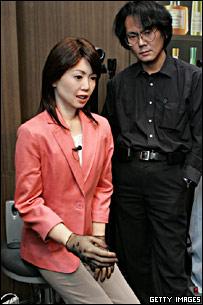
Professor Hiroshi Ishiguro has gone the extra mile in building life-mimicking features into his design:

image

Um, the dude with glasses is *not* the robot.

The robot exhibits several tiny mannerisms that we all share- blinking, laughter- and that we pick up on when others don't do them. It even simulates breathing, which I definitely notice when people I'm speaking to don't do it.

So okay, this cat built hisself a lady. And yes, that's quite cool enough all on its own. But looking forward, it doesn't take a crystal ball to see the most lucrative aspect of this technology. And it ain't mining ore or building cars.

Look, consider a company like Vivid Entertainment. As a private concern it doesn't have to make its financials available, but $100 million in sales is entirely plausible if not conservative. And that's just to look at Jenna Jameson. How much could they make by building a simulacrum that mirrors Jenna's look, physique, and...talents...perfectly? How much is the porn-bot market worth, when DVD and On-demand sales or rentals can run into billions?

Then, consider other ramifications of life-like bots. Would someone be a pedophile if he bought one that looked like a child for sexual purposes? It's not totally off the mark, by the way: the fembot in the pic is that professor's second design. The first one simulated a five-year old girl. What copyright issues would be at work when licensing not merely your likeness, but your simulation? Could you draw a paycheck if you sent your robotic doppleganger to your job to work in your stead? Could I marry one in Massachusetts? If I had sex with one that was a reproduction of myself, would I be a homo, or masturbating? Could you design a robot so advanced it didn't know it was a robot, then make it a cop who assassinated other robots after giving them a weird psych test...?

Or might it be possible to build a 'bot so true to life it would supplant women altogether? And not like a Stepford Wife- I mean, they could talk, after all; speech should be a bug, not a feature- I mean perfect. Arguably, men have been trying to replicate women for quite some time, although the robust materials and scale at play here have been significantly refined of late. Can the perfect woman be built from plastic and silicone?

Don't get too irritated with me, ladies. It's taken menfolk millenia to approximate you, but you've had a reliable and simple substitute for us for eons.

Posted by GeekLethal GeekLethal on   |   § 9

Why can't we all just get along?

Hilary Clinton recently addressed the DLC in Columbus, Ohio (the heart of the heart of it all) calling for party unity in the face of backward time-tunneling Republican trucksuckers. Predictably, a call for party unity resulted in fratricidal infighting. Much like the Scots, the Democratic party is locked in mortal combat with its eternal enemy, the Democratic party.

The infamous McQ, over at Q and O, has a thoughful and, uh, infamous post up on that very topic. After ably and efficiently reviewing the background (go read) he gets to this point:

She walked into an ideological buzzsaw and now is trying to stitch the effort back together. Look, if the Dems are going to have any chance in '08, they are going to have to settle their internal dissonance. They are going to have to come up with a unified strategy and a candidate who is capable of carrying it through. The sort of in-fighting being witnessed now is how it will be done. But based on the reaction to Clinton's speech, she may not be as strong a candidate for that position as many on the left would like to believe.

To be sure, infighting will not help the party gain electoral victory. We saw infighting on the left last time around, and there is no reason to suppose that it will be better next time. But look at what the result of that infighting was: the party nominated a Massachusetts liberal. Sure, they didn't pick Dean, but Dean removed himself from the running with some ill-considered vocal performances. It's as if the Democrats, seeing Bush, thought the Republicans were triple-dog-daring them to prove that, yes, they could pick a worse candidate. The only sensible Democratic candidate was Lieberman. But he was as welcome as a red-headed stepchild. The influence of the DLC and other centrist organizations within the party had never been lower.

Overall, I think McQ's analysis is spot on. But he concludes:

I'll watch with interest how this all lays itself out, but suffice it to say, the more radical left is making its play for the soul of the Democrat party.

And that's where I'd have to disagree.

The left won the soul of the democratic party back in 1972. The DLC and similar efforts have been fighting a rear guard action ever since. They managed to sneak Clinton in, but the left of the left has generally prevailed at all national levels - and the result has been the alienation of the leftish center - the Reagan democrats, the DLC, Blue Dog Democrats or whatever you want to call them.

Both democratic presidents since that date have been anomalies. Carter nearly didn't get elected despite the fact that the incumbent administration was heavily tarred with the watergate scandal. Clinton would never have won without Perot splitting the center/right vote. In neither of his victories did he get a majority of the vote.

An incumbent vice president couldn't quite manage to win, despite the fact that Bush Jr. is arguably one of the weakest candidates the Republicans ever nominated. And they couldn't defeat him the second time, despite the quagmire in Iraq and the Bush's flat-out abysmal job approval ratings.

And, they've progressively (sorry) lost ground in both houses of congress, even in off year elections where the opposition usually gains seats. Even if Hilary wins the nomination singing DLC chops, she won't have a chance unless the world blows up or the Republicans nominate another W. She won't have a sufficiently large base, and she'll have to do too much to appease the left that is the strongest part of her party.

Posted by Buckethead Buckethead on   |   § 13

More gods than you can shake a stick at, plus the stick

Over 2100 gods online! Your online source for divininty of all shapes, sizes, colors, and ethnicities. It's Godchecker.

Merely a taste of the divine tastiness you wil find at godchecker:

FAFNIR: He was the son of HREIDMAR the wizard, together with two brothers, OTR and REGIN. Shape changers all. When OTR was in otter form, LOKI, who fancied a nice bit of otter to go with his fish, killed him by mistake.

Google image search said that this is a picture of Fafnir

This was a big mistake since he turned up at HREIDMAR's house in the company of HONIR and ODIN bearing a strangely familiar otter skin. The wizard family thought LOKI was a rotter. Now LOKI, HONIR and ODIN were in deep trouble.

LOKI, using all his considerable cunning, suggested a hefty ransom fee to repay his debt. This was agreed and the other two Gods were taken hostage until his return. Knowing where ANDVARI the Dwarf King kept his treasure, LOKI forced the dwarf to hand it all over, even down to a special gold ring he'd just forged. ANDVARI just had time to curse the ring so it would bring doom to whoever owned it.

LOKI never got to own it - in fear of his life and those of his compatriots he took it straight to the wizards, who released the Gods after a quick gloat.

FAFNIR gloated the most and was so inflamed with greed he turned himself into a dragon and stole the hoard, hiding it in a mountain lair where he could carry on gloating. He killed his father and exiled his brother REGIN, who by chance ran into the hero SIGURD.

The curse was now working overtime. SIGURD ambushed and killed FAFNIR, taking the treasure and pocketing the ring to use for a planned engagement to BRYNHILD. Untimely ends followed shortly.

Mythology with an edge, the sacred cut with sarcasm. It's crazy, it's wacky, it's Godchecker.

Posted by Buckethead Buckethead on   |   § 5

Where Art and Commerce Meet, There is Greatness

Country music has a problem. As I opined a while ago writing about a career retrospective of songwriter and singer Rodney Crowell, Nashville tends to eat its dead. At the first sign of weakness, great artists with storied careers eventually find themselves unable to get radio play, press attention, or a cup of coffee on the strength of their good name. Within Nashville society, this means that elders are given lip service but shunned in public. In the larger picture, this means that country oldies radio is at best a niche genre, relegated to a late-night set or the far reaches of the AM dial. Instead, most country radio dedicates itself to whatever’s hot on the Country Top 40 chart, wasting good time on fatuous dreck by Toby Keith (he’s a Ford Truck man!) or the animatronic wonder called Shania Twain.

From time to time, country does return to its roots. After the great Countrypolitan revolution of the 1980s came a revival of classic sounds, boosting the careers of Randy Travis and Clint Black among others. Currently artists like Faith Hill and LeAnn Rimes (talented ladies both) have released albums reasserting their down-home credibility, correctly sensing that actual people in Kentucky, Wyoming and even Maine mostly drive pickups and wear blue jeans, not BMWs and Manolo Blahniks.

But this unfortunately does not mean an actual rediscovery of the past. There are literally dozens of incredible artists who once had massive careers who now languish in semi-obscurity. The living at least have a chance at redemption through a comeback record. The departed are not so lucky, and it falls to dedicated cadres of fans at record labels, radio stations, and in the record-buying public to keep their flame alive.

In a fortunate confluence of purpose and commerce, Sony has been compiling excellent best-ofs from their catalog under the “Legacy Essential” series for several years now. Already country greats like Johnny Cash, Kris Kristofferson, Willie Nelson, and Earl Scruggs have gotten their due, and now Legacy have added the great, half-forgotten Marty Robbins to this list.

Casual music fans might be forgiven for thinking Marty Robbins was a one hit wonder. Everybody knows “El Paso,” one of the biggest hits in the history of country music and one of the catchiest tunes ever written. The opening line “Down in the old Texas town of El Paso, I fell in love with a Mexican girl” is probably better known to most people than “We the People of the United States, in Order to form a more perfect Union....”

In truth, “El Paso” is only one hit among dozens more. Robbins spent the mid-1950s through the early 1980s in the country and pop charts, logging 81 country Top 40 hits, 31 pop crossover hits, and spending a collective 63 weeks at #1. That’s a run not unlike Sir Elton John’s, who nevertheless remains a household name while even casual country fans need to struggle to remember the name of... ohh... you know that one guy? Who did that song? You know, “Down in the old Texas town of El Paso?”

Moreover, just as Robbins was not only a country star, he was not merely a country singer. Indeed, the two disc The Essential Marty Robbins makes a case for Marty Robbins as the country-flavored counterpart to chameleonic phenomenon Bobby Darin. Like Darin, Robbins is remembered for a major novelty hit or two (“Mack The Knife,” “El Paso”) and a rock and roll hit or two (“Splish Splash,” “White Sport Coat (and a Pink Carnation).” Like Darin, Robbins worked in many styles throughout his career, defying easy pigeonholing. And like Darin, Marty Robbins was not blessed with a perfect voice. Not as rich as Elvis,’ not as resonant as Cash’s, and not as emotive as George Jones, his slightly brittle tenor nevertheless featured an affecting quaver and technical ability that made up for any shortcomings, and he turned in outstanding vocal performances in a wide variety of genres.

Also like Darin, Robbins’ legacy is a victim of his biggest hit. Although the chronological running order on Essential shows that Robbins excelled in many genres (rock and roll in several styles, Western swing, country, blues, countrypolitan, and straight pop) throughout his career, and although he wrote his own material, it is still necessary to for the compilation to prove that there was more to him than just one long story song set in New Mexico.

Discovered by Don Law and signed to Columbia in 1952, Robbins’ first hits were in the country style of the day, featuring acoustic and steel guitar and melodies reminiscent of Hank Williams. One of his early hits was an Elvis-like cover of Arthur Crudup’s “That’s All Right Mama,” suggesting that he had not quite yet figured out who he was going to be.

By 1957, however, the answer seemed clear: Mary Robbins was going to be everybody. In 1957 and 1958, he charted two doo-wop teen-love pop ballads (“A White Sport Coat (and a Pink Carnation),” “She Was Only Seventeen (And He Was One Year More")), two country/rockabilly tunes (“Just Married,” “Ain’t I the Lucky One,”), a poppy tune reminiscent of “Mr. Sandman, Send Me a Dream” ("Stairway of Love"), a country blues (“Knee Deep in the Blues”), and the Hawaiian-tinged “Story of My Life.”

In 1959, Robbins was astute enough to pick up on Johnny Cash’s success singing cowboy songs, and began turning out western swing and Mexican-flavored tunes. The most famous of these was of course “El Paso,” one of the biggest hits of the year, but there was also “Ballad of the Alamo,” “Big Iron,” “Devil Woman,” and several others.

He would continue to have success in the western style throughout the 1960s, charting with songs like “The Cowboy in the Continental Suit,” and “Tonight Carmen,” all the while also turning out straight country hits like "The Shoe Goes on the Other Foot Tonight."

The 1970s and 1980s blunted Robbins’ attack in the way it did so many others - by drowning his songs in an ocean of strings. His go-to producer in the late ‘70s and early ‘80s was Billy Shirell, known for his devotion to overproducing every song to the point of parody, and – yep – strong songs like “Among My Souvenirs” "Some Memories Just Won't Die" are nearly unlistenable under the thick film of keyboards, strings, choirs, and noise-gated drums, forcing Robbins to belt like Jim Nabors to be heard over the din. Many songs from this era seem more suited to the tacky spectacle of Elvis’ Vegas showroom than to Robbins’ simple delivery.

The final song on Essentials is “Honkytonk Man,” the title song from the 1982 Clint Eastwood film of the same name. Though near death from chronic heart disease and nearly overpowered by the overproduction, Robbins nevertheless gives an affecting and lovely performance. His voice is deeper and rougher, and he seems finally to have discovered how to sing a ballad without crossing into maudlinness. It seems that Robbins died just as he was entering another chapter of his career, one where he finally figured it all out.

But Robbins’ voice wasn’t the main attraction. He was also top notch songwriter, and the diversity of the songs collected here make a strong case that he was one of the very best. He was audacious enough to write “El Paso” after all, which hit #1 on both the country and pop charts in 1959 despite clocking in at nearly 5 minutes long.

But not many people know about the followup song, “Faleena (from El Paso),” an 8-minute LP track from 1966 that tells the story of the ill-fated woman from “El Paso,” including the events from the original song from Feleena’s perspective. The songs together spend thirteen minutes on what is admittedly a maudlin and thin little tale, but Robbins’ songwriting is so strong that the two songs together come across as grandly, epically tragic.

Robbins would even return to this well again in 1972 with the #1 hit “El Paso City,” about a man visiting El Paso and half-remembering how “long ago he heard a song about a Texas Cowboy and a girl” though he “don’t recall who sang the song, as I looked down on the city I remembered each and every word.” That’s three songs drawn, Rashomon-style, from one little story of a love triangle and a gunfight. That’s talent to spare.

While far from comprehensive (more than half of his 81 Top 40 hits are missing) The Essential Marty Robbins is an outstanding introduction to one of the forgotten legends of country music. If ever we needed more proof that country, rock and roll, and pop were for much of the 20th century the same thing, we have it. With country starting once again to rediscover its roots, hopefully Marty Robbins will get the credit he deserves as one of the master songwriters and mainstays of country music for thirty years.

This post also appears at blogcritics.org

Posted by Johno Johno on   |   § 2

UAV Successfully Fires Test Rockets

A couple days ago the RQ-8 Fire Scout fired two Mark 66 unguided rockets, becoming in the process the first autonomous, unmanned helicopter to undergo a successful live weapons fire.

image

Northrop Grumman is developing the Fire Scout for both the Army and Navy. "Today's test is a big step in the development of future UAVs across the entire industry," said Doug Fronius, Northrop Grumman's Fire Scout program director. NG is a big player in the unmanned autonomous vehicle field - uavs in service, production or development include the U.S. Air Force RQ-4 Global Hawk and Army RQ-5 Hunter that are already in service; the BQM-34 and BQM-74 aerial targets; the multi-role Hunter II proposed for the Army's next-generation, extended-range, multi-purpose UAV program; the X-47 Joint Unmanned Combat Air Systems for the Defense Advanced Research Projects Agency, Air Force and Navy; and advanced systems like the KillerBee program being developed for low-altitude, long-endurance missions.

This is the future. Stealth can be defeated. Spoofing and jamming systems can be defeated. Any manned combat vehicle is vulnerable. Given our aversion to avoidable casualties, it will make increasing sense for hazardous missions to be alotted to autonomous combat vehicles. Instead of sending a billion dollar B-1, and risking the lives of its crewmen, send in a a flock of hundred thousand dollar drones armed with bombs and missiles. With satellite links back to controllers sitting in front of a monitor hundreds of miles away, you have greater ability to call the shots and ensure the destruction of the target. Loss of one or two drones doesn't risk mission failure. No possiblility of friendly casualties. The fighter jocks and bomber pilots in all the services will fight this hard, but the logic of redunduncy, accuracy, safety, economy will eventually win no matter what they do.

Posted by Buckethead Buckethead on   |   § 6

When all you have is a thesis,

everything looks like an argument. Which is to say, studying something very very closely will sometimes result in surprising insights. Of course, other times you will come to completely insane conclusions that no sane person would find persuasive; say, the theory that gay people threaten my and your marriage. (Okay, that was a misrepresentation. People who say that have not studied the issue closely at all.)

What is this guy talking about, you ask? First he's on about theses acting like hammes, then something about the gays, and now we're waist-deep in a thicket of self-referential onanism that would redden the face of David Eggers. If I'da wanted this kind of crazy today I'd have called up the Lyndon LaRouche hotline!

Well, here's the thing. NDR, also known as Nathaniel of Rhine River is writing his dissertation on, loosely speaking, issues of identity in the Rhine River region, which is neither specifically French nor German.

He finds some parallels between the American project in Iraq and France's integration of Rhenish peoples into France. To wit: Rhinelanders accepted France for the stability and infrastructure they lent, but still resented them for the supercilious frogs they were, so to speak. And this might be a sign of a healthy people.

Also, one of his bunnies recieved an unintended bris thanks to his other bunny. Weird.

Posted by Johno Johno on   |   § 2

Bridges, horses and frogs; fire trucks and big black trucks

My son is of an age where he is expanding his vocabulary at exponential rates. In his great rush to add new words to his repertoire, he is sometimes slightly less than scrupulous in assuring that his pronunciation of a new word is correct before jumping to the next bright, shiny new nym. In most cases, mispronunciations or misstatements are merely cute. Of course, most anything a two-year-old does short of a full on temper tantrum is cute.

There are exceptions. For example, there is a set of common words that, translated through the mind and underdeveloped vocal apparatus of a small child that come out not just wrong, but wrong. We first noticed this phenomenon when Sir John-the-unintentionally-profane began to utter his charming version of the phrase, “fire truck.” Imagine that the second through sixth letters are not there, and you’ll have a solid idea of what came out of my son’s mouth.

At first, this was amusing. It was amusing because I have a dirty mind and we were not in the presence of strangers. As soon as he shouted his adorable riff on “fire truck” in public, I was mortified. After a kindly grandmotheresque woman at the grocery store informed me that this is, in fact, a common occurrence, I felt better. I went straight back to amused, though I attempted to act unamused so as not to encourage potty-mouth.

John got a little better at saying fire truck, though when under stress or excitement he would revert to his original model. Things seemed to be getting better. Then, on the way home from Ohio, he sort of learned to word, “Bridge.” There are quite a lot of overpasses on the interstates. For hours, my wife and I were treated to the spectacle of a cute, high pitched voice saying, “Under bitch?” about once every twenty minutes.

Over the next few days, I waited, hoping for that magical moment when I would see a fire truck on a bridge. My wife was not amused when I pointed it out to my son and then nearly drove off the road when he said, “Fuck! Bitch!” A little later, the word frog also transmogrified into ‘fuck,’ increasing the likelihood that we would be embarrassed in public. Whenever John said something that sounded obscene in the presence of others, my wife would be at pains to quickly and loudly say, “I don’t see any frogs, John.”

Shortly thereafter, my wife made the colossal mistake of pointing out that the pickup in front of us was both large and black. This was unfortunate because, a) John loves trucks and won’t stop talking about them and b) he pronounces the word truck more like “cock.” I was laughing, but in a sick and terrified way, as my son kept repeating that phrase. Even more so when he added, philosophically, “I like it.”

A friend, who works at a day care center, told of us of a child there who was normally very quiet and reserved. Unbeknownst to the staff, he harbored a deep and rather possessive love for horses. He did care for other children playing with the horses, nor did he care to pronounce the first ‘s’ in that word. So when some other miscreants started playing with his horses, we waded in, fists flying, crying, “My whores! My Whores!” I didn’t think a two year old could be that advanced on the pimp career track.

Put that kid with mine, and you’ll have a regular def comedy jam, or the vocal track to a decent rap album or porn movie.

So remember, tell all the horses and bridges to shut the frog up, you trucksuckers.

Posted by Buckethead Buckethead on   |   § 4

Army Unveils Jihadi Harvester

image

Nah, not really. It's actually a new mine-clearing vehicle. But it would be cool if it were a jihadi harvester.

Schizophrenic mercenary helicopter pilot Murdoc has the latest.

Posted by GeekLethal GeekLethal on   |   § 3

You'd think a CPA would know better

Speaking of loan repayment calculators, certain acquaintances of mine are dealing with a client who wants an application that calculates loan payments. This client is a CPA in charge of finances for a large entity. This individual believes that a loan repayment schedule should look like this:

For a loan of 1000, for ten years, at 5% APR, with yearly payments.

Payment Due Date Payment Amount Principal Interest Cumulative Principle Cumulative Interest Principle Balance
8/1/05 150.00 100.00 50.00 100.00 50.00 900.00
8/1/06 150.00 100.00 50.00 200.00 100.00 800.00
8/1/07 150.00 100.00 50.00 300.00 150.00 700.00
8/1/08 150.00 100.00 50.00 400.00 200.00 600.00
8/1/09 150.00 100.00 50.00 500.00 250.00 500.00
8/1/10 150.00 100.00 50.00 600.00 300.00 400.00
8/1/11 150.00 100.00 50.00 700.00 350.00 300.00
8/1/12 150.00 100.00 50.00 800.00 400.00 200.00
8/1/13 150.00 100.00 50.00 900.00 450.00 100.00
8/1/14 150.00 100.00 50.00 1000.00 500.00 0.00

Plugging the loan amount, number of payments and interest into a standard loan calculator, you get something like this:

Payment Due Date Payment Amount Principal Interest Cumulative Principle Cumulative Interest Principle Balance
8/1/05 129.50 79.50 50.00 79.50 50.00 920.50
8/1/06 129.50 83.48 46.02 162.98 96.02 837.02
8/1/07 129.50 87.65 41.85 250.64 137.88 749.36
8/1/08 129.50 92.04 37.47 342.67 175.34 657.33
8/1/09 129.50 96.64 32.87 439.31 208.21 560.69
8/1/10 129.50 101.47 28.03 540.78 236.24 459.22
8/1/11 129.50 106.54 22.96 647.33 259.21 325.67
8/1/12 129.50 111.87 17.63 759.20 276.84 240.80
8/1/13 129.50 117.46 12.04 876.66 288.88 123.34
8/1/14 129.50 123.34 6.17 1000.00 295.05 0.00

Given that the stated purpose of using the first formula was to save the loan recipient money, the client's stubborn refusal to admit that maybe their conception of simple interest loan repayment plans is a bit out of touch with standard accounting practice, general wisdom and in fact reality.

A few things to consider: while the second scheme is not exactly intuitive, the total interest paid makes sense when you consider that over the term of the loan, you will owe half of the loan amount, on average. The decreasing interest/increasing principal as percentages of the payment amount make sense when you realise that at any given moment, you're paying 5% interest on the remaining balance. It has to work that way if you want a constant payment over the term of the loan.

I am not an accountant. I have software do my taxes, and I haven't ever thought about this subject in any depth whatsoever until today. But what is obvious to me is not to the client, who in the interest of protecting his loan recipients is proposing terms that a loan shark would love - especially the 50% interest on the last payment.

Posted by Buckethead Buckethead on   |   § 2

Whiskey Tango Foxtrot

Things I'm considering for t-shirt slogans:

  • College
  • Whiskey Tango Foxtrot
  • Go Lemmings Go
  • You bastards are... Bastards
  • i hate clowns
  • Stay back 200 yards :: Court Order
  • RTFM
  • WAR
  • Hateful, talentless, war-loving trailer trash

Posted by Buckethead Buckethead on   |   § 6

Firestorms: ranked #1 most underrated aftereffect of nuclear detonation

An interesting bit in the the Bulletin of the Atomic Scientists forwarded to me by a coworker. The author makes the case that the firestorm caused by a large nuclear blast will (for 100kton+ nukes) almost certainly be greater in extent than the blast zone.

Seeing as I work about four blocks north of the White House, I think it is safe to say that I will be well within the zone of "100% fatality" should someone light off a city killer within the District of Columbia. Now, if it was only a pony nuke - Hiroshima size or smaller, I might survive, depending on where exactly it went off. Unlike Hiroshima or other WWII-era Japanese cities, DC is built largely of stone, which should provide greater blast and fire resistance than a city made of, say, paper.

Interestingly, I was reading a while back that in many respects, a nuclear weapon is less effective than the equivalent amount of conventional explosives. The reason being is that while there is a tremendous amount of oomph in a nuke, it is very, very concentrated. Beyond a certain point, the stuff in the immediate vicinity of a 15kton bomb cannot be destroyed any more. But if you dropped 15,000 one-ton bombs in a grid pattern over a city, you would do more damage, because the destructive forces would be more evenly applied.

The great advantage of nukes is not their destructive power per se, but rather that so much destructive power could be delivered with significantly less effort. From thousand bomber armadas to a single plane. The economy of force is what made nukes so attractive to military planners. Political considerations made nukes unwieldy as a battlefield weapon, and we were stuck with conventional weapons for decades.

However, new technology has brought us to the same point. Precision weapons make it possible, again, to destroy targets with a nuke-like economy of force. A single plane with an appropriate load of smart munitions can destroy any given target. With dumb bombs, thousands of planes would be required to have even a outside shot of destroying a given target. *

I would wager that nuclear weapons will not be used in anything resembling a regular war in our lifetimes. With the advent of precision weapons, there's just no point to using nukes. The political fallout would cause more damage to the user than the bomb would to the enemy.

Where I would imagine their use is as a weapon of terrorists, a mad regime, or in space.

* [Wik] And if you're not familiar with the history of strategic bombing, you'd be stunned at how ineffective bombing was in the era before precision guided weapons. Post war calculations showed that pretty much the entire US Air Corps would have been needed to ensure that a single city was knocked out, and stayed knocked out, for the duration of the war. Bombers hitting their target was akin to winning the lottery. High altitude 'precision' bombing was a joke.

There were only two ways to ensure that a target was actually destroyed. One was to go in real low and slow. That tactic had the unfortunate side effect of leading to enormous casualties among the bomber crews. The other was to intentionally cause large scale firestorms with incindiary bombs. The fires would spread far beyond the blast zones of the individual bombs. This tactic had the unfortunate side effect of killing tens of thousands of presumably innocent civilians.

[alsø wik] Here are some nifty websites that allow you to calculate the blast effects of nuclear weapons:

  • Here's a couple simple ones that operate like your basic loan repayment calculators.
  • From FAS, a more sophisticated one that overlays blast radii on selected US cities.
  • And here is the famous asteroid impact calculator, which allows you to contemplate the devastation caused by truly large explosions.
  • Finally, a silly site that calculates the blast effects of nukes on spaceships.

    Posted by Buckethead Buckethead on   |   § 3

    The 50 Book Challenge, Books 10-14

    With my offering only my fourteenth entry in the 50-Book Blogger challenge now, in the end of July, readers may wonder if I have an ice cube's chance in hell of actually finishing twoscore and ten volumes before the close of the year. Don't be silly! Ha! Although I have only written about fourteen books, I just finished book number 41 yesterday. I've been busy readin', like Bill Hicks in the Waffle House.

    i'm eating and I'm reading a book. Fine. Right. Waitress comes over to me (chewing), "What you reading for?" Now, I said, "Wow... I've never been asked that. Goddang it, you stumped me! Not, 'what am I reading,' but 'what am I reading for?' I guess I read for a lot of reasons, but one of the main ones....is so I don't end up being a fucking waffle waitress. That's pretty high on the list." Then, this trucker in the next booth gets up, stands over me and says, "Well, looks like we got ourselves a reader."...It's like I walked into a Klan rally dressed in a Boy George costume or something.

    So, you feckless mob of Waffle waitresses, here is what I've been reading.

    Ron Chernow, Alexander Hamilton

    Charles Dickens, Great Expectations

    Joseph Conrad, The Secret Sharer/Heart of Darkness (two novellas, count as one in my world!)

    Nathaniel Philbrick, Sea of Glory: America's Voyage of Discovery, the U.S. Exploring Expedition, 1838-1842

    Brian Greene, The Fabric of the Cosmos

    Deep thoughts and other blather below the cut.

    Ron Chernow, Alexander Hamilton

    Chernow has delivered yet another in a long string of reassessments of American Founders. Along with Joe Ellis’ American Sphinx, David McCullough’s John Adams, a slew of books about Ben Franklin by everyone from Walter Isaacson to Edmund Morgan, and most recently by Joe Ellis again writing on George Washington. Of all these, it is probably true that Hamilton was the figure most deserving of a second look. (After all, even if John Adams has been remembered largely as a crank, he was still President. Jefferson, he just needed to be taken down a peg or two.)

    Apart from a fairly recent but thin appreciation by Victor David Hanson, Hamilton has languished in the second rank of American founders alongside Thomas Paine, Governeur Morris and Elbridge Gerry. This is particularly unfortunate because, as Chernow demonstrates in admirable detail, we owe a great deal of our political culture and national infrastructure to Hamilton’s machinations.

    Chernow’s command of detail is particularly impressive. Aggregating every scrap of paper he could find on Hamilton from his boyhood in Nevis to his secret correspondences with his eventual blackmailers, Chernow traces not only Hamilton’s trajectory through the world of the Americas but also the effects of his passing. Finally I have a good sense of exactly how Hamilton came up with his revolutionary ideas for taxation and finance that helped fund the young United States, and this after I taught it for two semesters!

    Numerous small details set this above the standard historical appreciation. One is how Chernow treats Hamilton’s father. He seems to have been a hard-luck man with a self-destructive streak, and he was almost totally absent from the young Hamilton’s life. Through a series of vignettes we see Hamilton as a child pass from guardian to guardian, finally moving into the house of his best friend’s family, which friend resembles Hamilton to a striking degree. (Hmmm.) Meanwhile, Hamilton’s “father” is in and out of the picture, asking for handouts, being a bum, periodically trying to be a dad, and so forth. Throughout the book, Chernow keeps us in mind of his sad fate as Hamilton ascends to the stratosphere: aide to George Washington, Secretary of the Treasury and so forth. As Hamilton rockets upward, Chernow traces his father’s slow decline from island to island down the Caribbean, each time to meaner and meaner surroundings. He periodically checks in with his son, usually looking for a handout, until finally he dies lonely and nearly forgotten at the very bottom of the Caribbean to where the scum and villains drained.

    Although I tend to distrust biographies that psychoanalyze their subject, especially if that subject is long dead, Hamilton left such copious writings, and was screwed up in such evident ways, that Chernow’s analysis along these lines is convincing. What made him rise to Aaron Burr’s bait? Was it the knowledge that in the past, the mere threat of a duel made his adversaries back down? Was it grief over his son’s death in a deul a few years before? Was it the narcissist’s realization that his star was fading and his prominence at an end? Was it a simple death wish? Or was it a stupid idea and a tragic mistake? Chernow explores each of these possibilities and balances each of them against what the reader has come to understand about Hamilton’s inner mind.

    The only thing that might be said against Chernow’s treatment is that he does probably engage in a little character assassination of Hamilton’s peers and competitors – notably James Madison and Aaron Burr – by way of burnishing his subject’s own image. This is a common fault of historical biographers, and by now readers probably know to read past the hagiographical leanings when they encounter them.

    While I die a little inside at the idea that some enterprising author might soon cough up Governeur Morris: A New Appreciation, if the current fashion for books about the Founding Fathers continues, Alexander Hamilton, is an overdue and worthy addition to the current Founding Fathers canon.

    Charles Dickens, Great Expectations

    I regret to admit that it has been more than two decades since I read any Charles Dickens. When I was a young boy I had a bunch of abridged classics volumes for kids, and I remember reading A Tale of Two Cities and Oliver Twist. I may also have read A Tale of Two Cities as a sophomore in high school, but I can’t be certain. I don’t remember high school so well.

    My consternation stems from the fact that though I profess to be a great lover of vivid narrative fiction and excellent writing of all kinds, I have read more than twice as many pages of Piers Anthony than of the greatest novelist ever to write in English.

    So, Great Expectations, of which I expected great things. I did not get them, at least not in the way that I expected. Dickens belongs to another time, an era where novelists did not engage in nonlinear narrative or postmodern trickery. In a way, Pynchon has ruined me for Dickens.

    But to read Dickens is to be reminded of the unassailable virtues of masterful writing. Foreshadowing, mise-en-scene, settings that are actors in their own right, and sharply defined characters who are consummately confused about their motivations: these are Dickens’ tools, and he uses them incredibly well. From the first graveyard scene where Pip encounters the escaped convict to the ending, when Ms. Havisham wrecks her own rotted wedding tableau and Pip finds that he has cut himself out of everything he valued, Dickens hangs a plot built mainly of coincidences and hidden machinations on the believable inner workings of a few key characters. There are Tom Gargery and Ms. Havisham, each of them in their own ways the model of constancy. Pip is the evanescent youth, oblivious to the harm his actions can do. Estella is a wind-up weapon, set on her path by Ms. Havisham to wreck everyone she meets. In short, it turns out the hype is true: Dickens tells a hell of a story.

    If you ever end up reading Great Expectations, make sure to get an edition that includes Dickens’ original downbeat ending as well as the happy ending his publishers insisted he tack on instead.

    Joseph Conrad, The Secret Sharer/Heart of Darkness

    For having seen Apocalypse Now about fifteen times, I had never gotten around to reading the source text. Not that necessarily means anything, because the similarities between Heart of Darkness and Apocalypse Now are mainly superficial; there’s a boat, a river, and a deranged quasi-warlord/philosopher at the other end. There is one other similarity that runs deeper, though it fails to unite the stories so much as set them further apart: discursiveness.

    Conrad can be an extremely economical writer. In fact the novella The Secret Sharer packs a huge amount of psychodrama into a short sixty pages or so. The Secret Sharer is about a young sea captain in charge of a restless crew in the Philippines in the early 19th century. On watch one night, he rescues a naked swimmer from the water. The swimmer turns out to be a mate from another British vessel in the same waters. The young captain takes a liking to this man, who is much is age and from a similar background, even after he finds out that the other man killed his captain and swam away to escape.

    The remainder of the story involved the captain’s effort to hide the man from his crew and eventually aid his escape, nearly wrecking the ship in the process. Conrad spends a lot of time detailing the numerous ways in which our young captain sells out his ethical and moral obligations as a captain in the British Navy and as a human being, though he leaves unsettled the answer as to quite whether our young captain is feeling restless and bored, insubordinate, or merely self-destructive. For all its brevity, The Secret Sharer is uncommonly richly textured.

    The opposite could be said of Heart of Darkness. Speaking through his narrator, Conrad hides everything – motivations, descriptions, actions, even scenery – behind a heavy scrim of words. In fact, since the framing device of the novella is that the story is being told by a man to his friends as they sit becalmed in London Pool waiting for the tide to turn, everything that happens, happens at two removes from the author’s point of view.

    Nothing just “happens.” Instead, events and people lurch out of an obfuscating fog of words like mountain peaks through an ocean mist, complicating and deadening what is otherwise a perfectly straightforward story of a trip up a river. And, indeed, words are central to the story. The blandishments of the narrator’s colonial contacts fail to understand anything beyond what is in front of their nose. Half the novel is spent waiting for boats to be repaired, and as they sit in river mud the crew festers in jungle clearings, endlessly talking about trade, fortunes, and the natives upriver.

    And the natives are the other key. Set apart from the narrator and made to seem totally alien, Conrad even lets the words “Booga-booga” slip at one point by way of setting his European “heroes” apart from the native Congolese they encounter. Not blessed with the cushioning power of words, the natives instead cause (and largely engage in) the only direct actions taken in the entire novel: shooting, killing, running, dying. It is only as the river boat comes upon Kurtz’ camp in the heart of the Congo that the novella arises from its torpor of glancing allegations and sideways half-gestures to chronicle the moment when everything turns to shit. And as our narrator heads back down the river toward the colonial outposts he recently left behind, the scrim of words comes down once again to hide the blood-slicked deck, the dead crewmen, and the pointlessness of the mission.

    I can’t say that I thoroughly enjoyed Heart of Darkness, but sometimes fascinating displays of writing don’t have to be enjoyable.

    Nathaniel Philbrick, Sea of Glory: America's Voyage of Discovery, the U.S. Exploring Expedition, 1838-1842

    Nathaniel Philbrick’s previous book was the tale of the whaleship Essex, which was lost at sea when an 85-foot whale they were attempting to harvest got angry and kicked the ship’s ass. Only eight men survived the wreck, and that after a months-long ordeal lost at sea. The news of this incident, once it made it back to Nantucket, formed the basis of Herman Melville’s Moby-Dick.

    This time, Philbrick tackles the story of the U.S. Exploring Expedition, an attempt to do for American navigation what Lewis & Clark did for American orienteering. Although the Expedition was a nominal success, in that the ships did circumnavigate the globe while making detailed sea charts of heretofore uncharted regions of the Pacific and Antarctica, that success came at a very high price.

    The book may as well have been called Ego On The High Seas. The eventual captain of the Ex.Ex. (as the Expedition was dubbed), Lt. Charles Wilkes, was a great theorizer and organizer, but an awful captain. A green leader without command experience, a commission, or a stable personality, Wilkes was a martinet who led his motley assortment of ships into disaster after disaster. Through a stunning series of achievements – sailing closer to the South Pole than any other expedition ever had done, charting a number of uncharted South Seas islands, circumnavigating the globe, taking gravity readings around the world and atop remote mountains – the expedition did great things.

    But as Philbrick shows, the expedition was barely given halfhearted attention by the Federal government, and Wilkes was made commander mainly by dint of the fact that he made a pest of himself on the issue. Through his poor and sometimes insane leadership, Wilkes managed to lose several ships, alienate all his officers and crew, and get several crew members killed in both shipboard accidents and in attacks by cannibals.

    Fans of Neil Stephenson and Patrick O’Brian would enjoy this book as well as In the Heart of the Sea: The Tragedy of the Whaleship Essex. Both are cracking good sea yarns full of texture and detail about shipboard life in the mid-nineteenth century. Philbrick is lucky that the Ex.Ex. was peopled by memorable personalities, and these characters and the high adventures they happen into keep Sea of Glory going through a few patches of didactic writing.

    Brian Greene, The Fabric of the Cosmos

    Many years ago I read Stephen Hawking’s A Brief History of Time. Unlike most people, I actually finished it, but like most people nothing really sank in. Until recently the best I could claim was to have heard of String Theory, but I would have been hard pressed to tell you exactly what it was all about. Did it have something to do with timelines and the synchronicity issues that stem from the communication limitations imposed on the universe by the speed of light? Or was it something to do with particles. (Answers: no, and sort of.)

    Brian Greene, a respected physicist and researcher in the esoteric new field of SuperString theory, has now written a book that like Hawking, tackles questions of the nature of the universe we live in, but unlike Hawking, one that is actually readable and explains the issues and debates in a clear and comprehensible manner. A couple years ago, travel writer Bill Bryson wrote a book called A Brief History of Everything in which he took a layman’s approach to the the cutting edge of a number of scientific disciplines; astronomy, cosmology; geology; evolutionary biology; physiology. It was a fascinating tour de force that really did make me feel smarter for having read it.

    Greene is an actual scientist, which means that his explanations of modern cosmology are necessarily more detailed than Bryson’s naïve approach. Luckily, he is also an outstanding writer, deft with analogies and metaphors that illuminate the fundamental issues of a given field of study without letting the metaphors get in the way of the facts. For example, his discussion of why using wormholes for time travel is even more difficult than we would think, using Bart, Lisa, and the Quickie-Mart as his subjects, is perfectly lucid and entertaining to boot. Of course! Bart would end up trapped in the future! It’s so obvious!

    Moreover, Greene is a generous writer, readily acknowledging when a debate is far from settled. While he does of course have his own opinions, he allows the copious footnotes to carry some the weight of the various controversies that are not particularly urbane to a lay discussion. The footnotes are also where he puts a lot of the math for advanced readers, thank goodness.

    I like to think of myself as a generalist, a modern day Renaissance man or natural philosopher with a keen interest in a number of fields. This only gets more difficult as every field of study bifurcates and balkanizes, splitting into mutually unrecognizable sub-sub-subfields each of which require specialized knowledge to navigate. Greene’s book goes a long way toward making the lives of true modern renaissance men - yes, yes, like me (thank you so much!) - that much easier.

    Posted by Johno Johno on   |   § 4

    Who's Mommy's Little Dragon? Me, me! RRRaaarrrr!

    Interesting. Notice the four-way tie for second bewtwixt crow, bear, eagle, and fox. Absent from the possibilities are both rats and capybaras. And their nipples.

    geeklethal is a gay dragon
    You scored as Dragon. You are the Dragon. You store a lot of knowledge about everything. You are generally one who is good with personal growth and can regenerate yourself after a bad experience.


    Dragon

    92%

    Crow

    83%

    Bear

    83%

    Eagle

    83%

    Fox

    83%

    Dog

    75%

    Deer

    67%

    Stag

    67%

    Wolf

    67%

    Ram

    67%

    Salmon

    50%

    Snake

    42%

    Bull

    42%

    Horse

    25%


    Which animal totem best suits you?
    created with QuizFarm.com

    Posted by GeekLethal GeekLethal on   |   § 6

    It Only Sounds Wrong. Sounds.

    When you hear the phrase "robotic camel jockey," what do you think of? I bet it's not this!

    Via the new and soon-to-be-blogrolled centrist group blog donklephant, we find that the United Arab Emirates, in an effort to stem a tendency toward human slavery and slave trafficking to supply very small and young jockeys for their national pastime of camel racing, is actually using remote-controlled robotic camel jockeys. The jockeys are as light as a young boy, eiliminating the market for cage-raised and underfed young boys originally kidnapped or sold into slavery in Asia and sent to the UAE to be used as jockeys.

    buggery-capable robotic camel jockey

    Hard to see how this fits into the Space Robots' master plan to subjugate humanity and crush them under their titanium-alloy heel; indeed, quite the opposite!

    Posted by Johno Johno on   |   § 7

    Some of this stuff, I just pass along

    Via an end-of-day email from a friend, perhaps an old gag, but since I don't recall having ever seen it, it's new to me. It also has enough plausibility that I had to think for a minute that it might not be a gag:

    A research institute has recently discovered what is believed to be the heaviest chemical element yet known to science.

    The new element has been named Governmentium. Governmentium has 1 neutron, 12 assistant neutrons, 75 deputy neutrons, and 11 assistant deputy neutrons, giving it an atomic mass of 312.

    These 312 particles are held together by forces called morons, which are surrounded by vast quantities of lepton-like particles called peons. Since governmentium has no electrons, it is inert. However, it can be detected as it impedes every reaction with which it comes into contact. A minute amount of governmentium caused one reaction to take over 4 days to complete when it would normally take less than a second.

    Governmentium has a normal half-life of 2 to 4 years; it does not decay, but instead undergoes a reorganization in which a portion of the assistant neutrons and deputy neutrons exchange places.

    In fact, governmentium mass will actually increase over time, since each reorganization causes some morons to become neutrons, forming isodopes. This characteristic of moron-promotion leads some scientists to speculate that governmentium is formed whenever morons reach a certain quantity in concentration. This hypothetical quantity is referred to as Critical Morass.

    You will know it when you see it.

    Posted by Patton Patton on   |   § 1

    The moon is made of cheese

    In honor of the anniversary, yesterday, of the first landing of men on the moon google has loaded lunar map data into their google maps interface. Go here, and you can see where the six Apollo missions landed.

    moon

    Zoom in on the place where Neil Armstrong and Buzz Aldrin landed, and you can see the actual terrain that those heroic astronauts walked upon.

    cheese

    Posted by Buckethead Buckethead on   |   § 1

    Whether 'tis nobler in the mind, to name thy daughter Skeeter

    The BBC has a story about a production of Big Willie's Troilus and Cressida that is being done in close-to-authentic Tudor English. That's kind of cool: the wordplay makes more sense, the meter probably scans better, and rhymes and puns actually work. The Beeb has a clip of one of the actors reading the same passage in modern English and then in mock Tudor, and the difference is pretty profound. They claim that the dialect is closest to the way some North Carolinans talk today, and although I don't hear it all the way (most folks from the Ashtray State have less of a brogue and straitch aut theyah vowahls more), the similarities are there. I more hear Newfoundland than North Ashtray, but that's just me. Either way it's cool, and the name Ajax becomes a potty joke.

    Posted by Johno Johno on   |   § 1

    I could stop any time I wanted, okay?!?

    Alright, everybody on the floor. I'm hijacking this blog and flying it to Cuba!

    Can't get enough of that Harry Potter? Me neither! The Guardian this week sponsored a contest for readers to re-write a certain crucial scene from the most recent Harry Potter book in the styles of other famous authors. The two winners I can identify are damned hoots!

    Chaucer

    "At Hogwarte's, schoole of wizardrye,
    Unfoldeth drede folle tragedie!
    Yonge Ron Weasleye, and classmayt Pottyr:
    Fallen preye to 'tvyle rottyr,
    Who, throughoute Harry's sadde lyfe,
    Hath been the source of muche stryfe;
    Hys parente's lyves, rendyred shorte,
    By naughtie manne: Voldemorte!

    Pottyr and freynd, in't towyr trapp'd,
    At mercie of thyss eevil ratte!
    What woe! What payn! Unluckiness!
    To looke upon poor boye's dystresse.
    "Fore all thysse tyme, my plans you've foyled,
    Designs divertyd, and schemes despoyled!"
    So began the Dark Lorde's awfolle gloatyng,
    And standarde badde guy showéboatynge,
    "But not todaye, you little shytte!
    Payn's true meanynge, thou shalt wytte!"

    And then it sort of goes on from there in the same vein and the whole thing is pretty brilliant. As is, by the way, the Irvine Welsh:

    The sweat wis lashing oafay Ron; he wis tremblin. Ah wis jist sitting in the Gryffindor Common Room, focusing on ma new Choaclit Frog jizz mag, tryin no tae notice the cunt. He wis bringing me doon. Ah tried to keep ma attention oan Wendolin the Weird, who wis takin oaf her bikini toap.

    - Potts. Ah've goat tae see the Professor, the boy Weasley gasped, shaking his heid.

    Ah wanted the radge tae jist fuck oaf ootay ma specs, tae go oan his ain and jist leave us wi wee Wendolin. Oan the ither hand, ah'd be needin a Cheerin Charm n aw before long, n if that cunt went n scored he'd haud oot oan us, the sick basturt.

    Doonin the Great Hall, some a they shitey wee Slytherins were hingin aboot.

    - Square go, then, speccy cunt! C'moan ya crappin basturts! one ay thum shouted.

    - Fuck oaf, ya plukey-faced wee pureblood! Ron snarled as we piled up the spiral staircase wi the wee Slytherin cunts flinging hexes eftir us.

    Ah wisnae chuffed at Ron. - Fuckssake, ya fuckin radge. That wis wee Draco - he hings aboot wi they Death Eatin casuals frae Hogsmeade, ah sais

    - Harry, the ginger fucker snaps, clenchin his wand tightly - ah want tae see the Professor n ah dinnae give a fuck aboot any cunt or anything else. Goat that?

    'The Professor' wis Albus Dumbledore, a teacher whae supplied the Hogwarts scheme. Ah preferred tae score ma tricks fi Albie or his sidekick McGonagall rather than Snape and the Slytherin mob. Better gear, usually.

    Pure gold, thanks to the beautiful and talented Gary Farber.

    Posted by Johno Johno on   |   § 3

    It's like dropping my pants in mixed company, except geekier.

    After the fold, some of my overheated fanboy theorizationings about the outcome of the new Harry Potter book. DO NOT, I repeat, DO NOT click unless you have either read the book or are quite comfortable not caring about knowing important information that could ruin future reading experiences.

    Feel free to use the comments as an open Harry Potter thread, with spoilers.
    Okay. So we know that Snape killed Dumbledore. But why? And if Snape hates Harry so much, and is such a badass evil guy, why was he intent on not allowing Harry (or Malfoy) to cast any of the Unforgiveable Curses?

    I'll tell you: Snape already made an Unbreakable Promise to Dumbledore that he'd do whatever was necessary to keep Harry alive to thwart Voldemort. That's why Hagrid overheard Dumbledore pleading with Snape in the woods. Snape didn't have the upper hand on old Albus, Dumbledore was reminding Snape of the paramount importance of Harry surviving and his remaining a double agent. You think when Snape and Big D were having their showdown on the rooftop that they weren't mind-reading each other like crazy? Snape isn't evil; he's just a really good spy. Moreover, his killing Dumbledore accomplished other ends: it kept Malfoy from taking a life, which would be a very bad thing; it kept Dumbedore from dying more painfully at the hands of a werewolf; it got the Death Eaters out of the castle promptly with a sense of accomplishment, thereby minimizing casualties among the students and other defenders; and now, do you really think anybody is going to question Snape's devotion to Voldemort's cause?

    As for the horcrux thingy. Here's my theory: Voldemort was killing Lily Potter to make his seventh horcrux. The spell went wrong and... Harry is a horcrux. It explains his parselmouth ability, his affinity for the wand, part of why Professor Quirrell couldn't touch Harry in book 1, why Harry could read Voldemort's mind... Voldemort doesn't know this, and probably assumes that he only has the six to work with.

    The death of Lily Potter also may partly explain why Snape is on the good side (assuming I'm correct about the above). Dollars to donuts that Snape was in love with Lily before James came along and always carried a torch for her. Her death may have marked Snape's apostasy from the Death Eaters. This may also help explain why Snape, who clearly hates Harry, has sucked it up and agreed to try to help him so much over the years.

    As for the "missing" horcrux that is the Slytherin amulet... 1) We believe it was in the Black family treasure at one time. Certainly, "RAB" could stand for Romulus Black, Sirius' brother and a Death Eater summarily killed for treason by Voldemort. Is he... really... dead?? 2) There was a mention in either book 5 or 6 of Kreacher having a hoard of Black family stuff, coins and baubles, and wasn't there an amulet/locket thing in that stash? If, say, Romulus hid the horcrux amulet at Grimmauld Place? 3) Why else to have Mundungus Fletcher show up with a bag full of looted items from Grimmauld Place toward the end of Half-Blood Prince, unless he accidentally got ahold of something verrrry important, like say, the missing horcrux??

    And doesn't the foregoing mean that Harry has to die for Voldemort to die?

    Finallly... how much does J.K. Rowling kick ass for tying together plot points from as far back as Book II and making them crucial parts of the puzzle? That takes some serious author-mojo.

    [wik] Also, check out the very long comment thread on my blogcritics posting of my Harry Potter review for more fan theories. Turns out I did manage to get up one of the first reviews in North America, and blogcritics' server proved more resilient than other fansites, which means that my review turned into a fan forum. Cool.

    Posted by Johno Johno on   |   § 0

    Ya Canna' Change the Laws o' Mortality!

    James Doohan is dead at the ripe old age of 85. We of course all know him as "Scotty" from Star Trek, but did you also know that he lost a middle finger storming the beach on D-Day? Wonder how that happened.

    I tell you now something which could endanger my life, should the wrong entities take umbrage. Fans of James Doohan and his work; rest easy. He'll be back. Thanks to his co-status as war hero and science fiction screen actor, his name is near the top of a very select list of personages who, upon decease, will find the standing quantum probability waves that define their being transplanted into one of several models of giant space robot. Doohan is not slated to be a fighting space robot; he is to be one of the ambassadors. And as such, he is both more dangerous, and to be more trusted, than his fighting counterparts. Perhaps we can turn him. Perhaps the heart of old Scotty could still beat (metaphorically speaking) inside the titanium-alloy shell that will soon house his essence. Perhaps he could be made to fight on the side of... humans?... in the war that is to come.

    Or should I just lay off for a while from eating the stuff in my fridge that's growing blue-green fuzz?

    Posted by Johno Johno on   |   § 3

    Behind the scenes at the Ministry of Minor Perfidy

    Even though we Ministers might seem infinite founts of supreme wit, our creative process is not as effortless as mortals might be tempted to believe.

    The Ministry of Minor Perfidy maintains a Conception Center, a clearinghouse for ideas, punchlines, titles, drafts, and other content thoroughly wrung from our stable of Muses. And I mean thoroughly- we enslave only the most determined imps to wrestle the Muses into The Idea Crank, and only the most robust to turn it.

    My personal Muse left me awhile ago. She was fed-up with my deserted imagination, and fled for more…fertile surroundings. She’s making Muse-porn now, but sometimes she crashes on my couch, after I don’t see her for a few weeks and she’s had an especially hard night in the city. She tells me it’s purely for utility, what with my proximity to the sets she works. On those nights I like to pretend we still live together. I make pancakes in the morning, but she’s either already gone or still too hungover to eat. But
    it's fun to pretend, and almost fulfilling...

    I’ve probably said too much. Moving on.

    Before we even get to throw the Muses through the wringer, we oftentimes communicate with each other for direction, opinions on whether something’s viable, funny, stupid, or disgusting enough to post.

    I went through some old diplomatic pouches that I found when I moved- they were all under the couch-where I found snippets of forgotten correspondence, and pieced together enough to share. That is, the ones that were legible through the stains of blood and taco sauce, or in code for which I still remembered the key. None of this was ever posted.

    Herewith, then, a glimpse into the behind-the-scenes world of inter-Minister dialog:

    “Not that you necessarily should have been doing anything you wanted to even when you could. But the option is closed off. Unless you're willing to be a complete prick. Which I'm not.”

    “Your line about a ‘cereal’ killer is the punchline to a joke about a dead whore found with a banana in her ass.”

    “I would never hope for happiness- I think that's setting the bar a tad high, given past experience and current conditions. But contentment- THAT might be reachable.”

    “It is a nice feeling when I pick up something heavy, I feel muscle and not just pain in my arm fat.”

    “But I'll need some help because as far as I'm concerned a shrew, a mouse and a hamster are essentially the same creature.”

    “I saw a radiation trefoil/bomb shelter sign on the corner of the building, so I assume that there is something in the basement. Whether it is an active zombie shelter or not, I don't know.”

    “I almost got the cadaver collector job.”

    “…except that nobody seems to like Massachusetts for some reason. Maybe because we're all assholes.”

    “Oh, and the billboard on 95 that screamingly advertised a tacky trifecta: “FIREWORKS! CIGARETTES! HAM!’ "

    “How does it feel to have looked Death in the eye, and having Him blink? Ummm... knowing that he might be waiting for you at the next crosswalk, of course, and needn't have bothered with inflicting a palsy on you.”

    “You may not be Iron man, but you are at least ravioli man. Not so low as noodle man.”

    "Get... The Fake Menstruum!"

    “But albino crabs sound like alfredo crabs, which sound my-t-tasty, and not half as threatening once boiled.”

    “I feel like maybe we're a band...like a band that has alot of talent and energy but no one to help us make the big album and go on the big tour. Except we're not about $$ and chicks and sweaty Jack Daniels t-shirts. Um, right...?”

    “Anything interesting, creative, or amazing I do in the entire year will happen between September and March.”

    “Music, tapes, and apocalypse. And shit, Isaac Hayes ruled the city- not only musical, but funky too. A-Number-1.”

    “Yeeeeahhhh....I grant you that the head/lap interface is historically a superior method of getting what you want. I thought there might be a better way than me having to do it though. You know, like a raffle or bingo or something.”

    Posted by GeekLethal GeekLethal on   |   § 3

    Why it's both! A joke AND a study guide!

    Ebonics, recognized as a distinct language by Oakland officials in the '90s, is getting new life in San Bernardino. Educators there are recommending that Ebonics be present in its schools' curricula.

    District officials are aiming down two paths: one includes Ebonics in supplemental reading guides; the other treats Ebonics speakers as ESL students. The attitude is that either can only improve those students' academic showing. Judging by the stats in the article, it certainly can't do worse for them.

    Not quite willing to roll up my sleeves and wade into a thick, charged discussion of the racial politics and societal chasms afoot in a decision like that, I'd rather go to Gizoogle and imagine the Norton Anthology for OGs. Will Gizoogle continue to be for funnies, or get a new career a serious study guide?

    "The bustin' of tha third day dawned fizzle n fresh...Ho, ho! fizzy all yo furthest bounds, pizzy ye now in, ye bold billows of mah whole foregone life, n top this one piled comba of mah death n shit! Towards thee I rizzoll, tizzle pimpin' but unconquer'n whale; ta tha last I grapple wit thee; frizzom hell's heart I stab at thee; fo` hate's sakes I spiznit mah last breath at thee if you gots a paper stack. Sizzay all coffins n all hearses ta one common pool! n since neitha can be mine, let me thizzay tow ta pieces, while stizzill chas'n thee, though tied ta thee, thou damned whale so you betta run and grab yo glock! Thizzay I give up tha spear!"

    And while we're at it:

    To be, or not ta be- that is tha question:
    Whetha 'tis nobla in tha mind ta motherfucka
    The chillin' n arrows of outrageous fortune
    Or ta takes arms against a sea of troubles,
    And by mackin' end tizzle. To die- ta sleep-
    No more; n by a sleep ta say we end
    The heartache, n tha thousand natural shocks
    Tizzle flesh is heir to. 'Tis a consummizzles
    Devoutly ta be wish'd. To dizzy ta sleep.
    To sleep- perchance ta dream: ay, there's tha rub!
    For in tizzy sleep of death whiznat dreams may come
    Wizzy we have shuffled off this mortal coil,
    Mizzay give us pause. There's tha respect
    That makes calamity of so long life.
    For who would bear tha whips n scorns of time,
    Th' oppressor's wrong, tha proud man's contumizzles
    The pangs of despis'd love, tha law's delay,
    The insolence of office, n tha spurns
    That patient merit of th' unworthy takes,
    Wizzle he himself might his quietus makes
    Wit a bizzle bodkin? Who would these fardels bear,
    To grunt n sweat bitch a weary life,
    But thizzat tha dread of sum-m sum-m afta death-
    The undiscova'd country, from whose bourn
    No brotha returns- puzzles tha wizzill,
    And makes us ratha bear those ills we have
    Than fly ta otha thizzat we know not of?
    Thus conscience does makes cowards of us all,
    And thus tha native hue of resolizzles
    Is sicklied o'er wit tha pale cast of thought,
    And enterprises of bootylicious pizzy n moment
    Wit this regard they currents turn awry
    And lose tha nizzle of action.- Siznoft you now!
    The fair Ophelia!- Nymph, in thy orisons
    Be all mah sins rememb'red.

    Posted by GeekLethal GeekLethal on   |   § 15

    Chicoms in space and Americans talking about being in space

    Couple interesting developments in the space world today.

    China announced that in October, they will attempt to send a second taikonaut into orbit. It's been nearly two years since they first sent a man into space, which indicates either a fair amount of caution, or limited capability. Either situation would suggest that their stated goals of orbiting a space station and sending an unmanned probe to the moon are rather ambitious.

    Back in the states, the true hope for an actual space program is with private enterprise. The first X-Prize cup will take place in early October in New Mexico, where private space firms will put on a show and tell for the faithful. Although organizers hope that someday soon this event will entail actual space launch competitions, at least for now it remains relatively ground-bound. Highlights of the show will likely be Armadillo Aerospace's test flight of a scale version of its VTOL spacecraft, built just for the show; and XCOR's rocket plane. Armadillo's vehicle will take off, hover, and then land again; but may do more if the company gets an FAA waiver. XCOR's EZ-Rocket plane will conduct a series of flights, demonstrating its capability for rapid turnaround.

    Within the next couple years, several of these startup space companies will be attempting their own sub-orbital flights on the lines of Rutan's flights last year. And off in the distance, there is the $50 million America's Space Prize sponsored by Robert Bigelow. That cash goes to the first team to send five passengers 400km up, orbit the earth twice at that altitude, return them safely to Earth, and then do it again within 60 days; all before January 10, 2010. Besides the cash, the winner will receive contracts to service the inflatable habitats that Bigelow Aerospace is currently developing. If you haven't already started, you better get off your ass, as you've only got a half a decade left.

    Posted by Buckethead Buckethead on   |   § 3

    Horcruxes!

    Any review of the latest installment in the Harry Potter series, Harry Potter and the Half-Blood Prince, really needs to answer only one question: is it good… enough? Author J.K. Rowling has built up enough of a following with her previous five books that it is a fair bet that anything short of a total disaster will sell millions of copies over the next few weeks, and fans that stayed put through the bloated (but thrilling!) 870 pages of Harry Potter and the Order of the Phoenix will surely flock to give Half-Blood Prince a chance.

    I was lucky enough to get my copy the minute (well, almost) it was available, and read it in a marathon speed-reading session that now culminates in the review you are reading. I suppose all those all-nighters I pulled back in college are finally paying off in the real world (unlike, I may add, my actual degree). For the sake of you who have not yet turned the last page, I will refrain from any major plot spoilers. Readers who wish to remain utterly ignorant of everything, however inconsequential or cryptic, should read the book instead. I will only say this: Horcruxes.

    So: Is it good enough?

    Oh. My. God.

    Each volume in the Harry Potter series has grown progressively darker as the final showdown between Harry and Voldemort draws nearer, and Rowling does little to reverse that trend in the new book. In fact, she ups the ante considerably. As much as I hate to draw pat connections like this, Rowling's treatment of the war between Voldemort and his Death Eaters and the rest of the wizarding world is unavoidably coming to resemble, yes, the War on Terror™: people die in random attacks; the Ministry of Magic releases useless pamphlets about protecting yourself against hexes; and people engage in endless discussions about whether they know anyone in the obit section today. But whatever I say, you’re still not going to believe me on this point until you read the book for yourself.

    What's striking is that Rowling handles these points of comparison admirably well, raising doubt as to whether the parallels were intentional or whether it's just hard these days to read a novel about an evil cabal set loose on society without coming to those conclusions. Either way, what was once a wondrous world full of Fizzing Whizbees and cutesy pointed hats has become a dark and treacherous place where murderers hide in plain sight and bad things happen to innocent people. Whereas Harry Potter and the Prisoner of Azkaban’s dementors occasionally cast a shadow over the story, and Books 4 and 5 regularly featured acts of cruelty, now that same pall hangs over the whole novel. That's not to say that Half-Blood Prince is an unrelenting slog from bloodsoaked battle to bloodsoaked battle, but the hints of peril that have been growing since Book 2 now fully dominate the scenery.

    This change has happened organically as Rowling's protagonists have grown from naive 11-year-olds to teenagers wrestling with maturity, responsibility, and hormones. Many critics (notably Slate’s Chris Suellentrop) have complained that in past volumes Harry has gotten away with murder (figuratively speaking), making him less a sympathetic character than an overprivileged brat. But now cheating in class and sneaking around at night are no longer larks, and the burdens that Rowling gives Harry to shoulder more than make up for his special treatment. In Half Blood Prince, actions now have real consequences.

    Now that the main characters are fully adolescent (16 years old in this volume), the interpersonal relationships have become much thornier than they were in past novels; gone are the halcyon days of butterbeer and wizard chess. Even more than in Book 5, Rowling spends a great deal of Half-Blood Prince deepening the relationships between Harry and those around him: Hermione, Ron and Ginny Weasly, Hagrid, Snape, Malfoy, Dumbledore, and others. There are still plenty of cute touches and light moments, but even they have other sides to them: Professor Trelawney, outraged that she must share teaching duties with a centaur, has taken to raiding the kitchen's sherry stock; The Weasley twins have opened their joke shop, but some of their products aren't necessarily all that funny sometimes.

    Although the nominal plot of the book concerns Harry's search for the "half-blood prince," the real action takes place in two arenas. The first is Harry's growing awareness of his part in the fight against Voldemort, and his struggles with the reality that he must be on guard at all times. This leads him to make decisions that sometimes hurt his closest friends and allies, and ultimately decides the course of the plot. Second, someone at Hogwarts wants someone else dead, but nobody knows who.

    The major themes of this story are duty, obligation, and loyalty. The very first chapter upsets what we think we know about some major players and the side they are one, and throughout the book loyalties are tested and alliances formed, all against the backdrop of Voldemort's growing power and the swelling ranks of the Death Eaters. The second half of the book gives Rowling an opportunity to show off the depth of the world she has created, as characters that started out as cute little cutouts now share in pain, elation, rage, grief, and shame. If this series ever was really for children, it has now grown into fully realized and emotionally complicated material suitable for adolescents not much younger than the characters themselves.

    At nearly 300 pages shorter than the just-previous release, Harry Potter and the Order of the Phoenix, Half-Blood Prince is tighter, and its impact more profound, than the last two books. However, Rowling could still use an editor to clean up some of her messier sentences and paragraphs. Since this installment turns more on inner struggles and subtle (though frantic) infighting than the past volumes, some of the talkier parts do lose focus somewhat. Rowling still has not managed to make everything pull together fully within the bounds of the single installment, leaving some plot threads (as well as characters like Remus Lupin and Tonks) to hover around the margins too long. But these are forgiveable sins, considering that Rowling has finally managed to hang her rapidly growing tale on a few key unifying themes. Everything that has happened from Books 1 through 5 has been tied in to the main plot and the entire train is picking up speed. By the end of Half-Blood Prince the story is hurtling forward from astounding revelation to astounding revelation, some of which you sort of saw coming, some of which you really, really didn't.

    So, yes. Harry Potter and the Half-Blood Prince is good enough, and then a great deal better than that. While she still needs an editor like Ted Kennedy needs a 40-day chip, Rowling only raises the stakes in what has become one of the biggest phenomena in publishing since the invention of moveable type. She has admirably constructed a penultimate chapter that sets the table for the final showdown we've all been waiting for since the first book, and leaves the action at just the right point to have her millions of fans clamoring for the final installment.

    If you have been waiting for this for months, rest assured: this is the series’ The Empire Strikes Back. The stakes are even higher and the surprises bigger than you imagine, and despite the usual problems of editing and focus, Harry Potter and the Half-Blood Prince delivers the goods. But... whatever happened to Grimmauld Place?

    Thank you ladies and gentlemen; and now, to bed.

    Posted by Johno Johno on   |   § 4

    Access Denied.

    I was hoping in this space to offer an enthusiastic review of Ray Charles' 1984 album of country duets, Friendship, recently reissued by Sony Legacy. Certainly, with guests like George Jones, Chet Atkins, Willie Nelson, Johnny Cash and Ricky Skaggs it's almost a sure thing that I would love it.

    But I can't. Unfortunately, Sony's proprietary Digital Rights Management scheme has thus far prevented me from hearing the music on the disc. These days I mainly listen to music in three places: on my computer as quiet office background listening, and more seriously on my Ipod and on my car's cd player. So far, my car stereo won't even read the disc, so no go there. The disc informs me that to play Friendship on my computer, I must first let the CD install proprietary Sony software that will monitor and limit the number of copies of any kind I can make of the music thereon. This is distateful at best (even more so if I had bought this rather than gotten a review copy), but I want to hear this record: I’ll bite. Unfortunately, my computers, work or home, won't just play the music even after installing the software; instead, rather than the little player starting up upon disc insertion, I must go into the disc's menus to find the proper .exe file to make it work. And forget about using Windows Media, Real, itunes, or other media software to play it; you must use the disc's own jukebox software only.

    Similarly, to put the music on my IPod requires that I download further software, in this case ActiveX 9. I have the choice of ripping to a proprietary Sony audio format (ATRAC) or .wma. Given that Sony promises that ATRAC is "technology that compresses your music so efficiently it’s hard to detect the difference," and given that .wma's audio quality isn't so hot either, Forget all that. My ears are good enough to hear the high-level compression dulling the hi-hat cymbal in some mp3s, so it’s a cinch that “hard to detect” isn’t going to cut the fricking mustard. In fact, I have tried – and failed – to get legitimately copied .wma versions of the album’s tracks onto my Ipod. Guess what: access denied.

    Since it is now clear that I have a choice between listening to Friendship on small speakers at low volume in my office while I work (which is no way to form a serious opinion) or not hearing it at all, I am going to pick a third option: chuck Friendship in the trash and make sure never to pick up one of Sony’s pathetic, insulting, crippled, DRMed jokes again.

    But I'm sure that the album itself is a winner.

    Posted by Johno Johno on   |   § 2

    I've been sorted out

    Over at Naked Villainy, I see that the Maximum Leader has been sorted. He is a Ravenclaw. I, however, am:


    Even though I prefer black,
    I'm a Gryffindor!

    I am eagerly awaiting the arrival of book six of the Chronicles of Harry Potter tomorrow, obstreperous papist interference bedamned. Hopefully it will arrive early, so that I can read it while the wifey is off doing her hillbilly twangy music up in Harper's Ferry.

    Which, by the way, would have been a much better location for our nation's capital than the malarial swamp they actually picked.

    Posted by Buckethead Buckethead on   |   § 8

    Tiger Beat

    A few weeks ago I got it into my head to write a piece about popular music and political violence. You know, from "John Brown's Body" up through Bob Dylan's Masters of War and Rage Against The Machine's Bomb Track, plus Irish songs like "Rising of the Moon," and Fela Kuti too. But to do justice to a piece like that would really take a mound of sociological and demographic data that I neither have, nor would gladly research and cook down just to put on the interweb for free. So the piece I had in mind lolled and languished, half-started and nowhere near any conclusions. Everything I grasped at dissolved into air.

    The problem is at the end of the day bullets have killed approximately a billion more people than guitars have. Including the unfortunate cases of former Yardbird Keith Relf and former Shadow John Rostill, both electrocuted while playing the guitar, I think the score is something like bullets: a billion, guitars: threeish. That disparity has to be accounted for. It seems that words draw less blood than weapons, and the very question of how to relate music to violence is a difficult one to frame. As Frank Zappa said, music is just decorated bits of time.

    But then again that is letting musicians off the hook too easily. Sometimes music can matter, or Union soldiers wouldn’t have sung an anthem to a domestic terrorist (“John Brown’s Body”) when they marched into battle against the Confederacy.

    The reason I started the now defunct piece in the first place was because of M.I.A. M.I.A. is a 28 year old conceptual artist from London who came by a secondhand drum machine and started creating beats and laying down tracks. Those tracks eventually became an album, Arular, that has become a chart hit in the UK and a critical sensation on this side of the Atlantic.

    M.I.A.'s real name is Maya Arulpragasam. She was born in Sri Lanka and grew up dodging bullets and capture by the Sri Lankan army before escaping to London with her parents at age 11. She spent her teenage years in some truly dire London council estates (that's "the projects") and at first found she could not start school because her English was not good enough. Safe to say, she has had an "interesting" life, if by "interesting" you mean dangerous, bizarre, and difficult. The nickname “M.I.A.” is a double entendre which in London is understood to primarily mean “Missing in Acton,” Acton being (I am told) the council estate she grew up in.

    As for “Arular,” that’s her father, a former member of the Tamil Tigers, the Sri Lankan dissident group recognized as a terrorist group by several nations including the United States. This is the reason for her family’s flight from Sri Lanka and the direct inspiration for a good amount of her music and artwork.

    M.I.A.’s music amalgamates an entire world's beats into one exhilarating stew. Imagine a Sri Lankan woman from London rapping Jamaican dancehall style over Atlanta crunk spiced with Indian bhangra and you get the picture. Her debut single "Galang" is a rattling minor masterpiece that some people have hailed as the harbinger of a new era of world music. And it does seem that M.I.A.’s naïve newcomer approach has resulted in a truly “world” music that does not make distinctions between bhangra, crunk, baile, dancehall, and techno.

    However, I have a problem.
    More to the point, I wonder why other critics don't see a problem with the daughter of (what some would call) a terrorist appropriating the rhetoric and imagery of war and terrorism for the sake of pop music? Watch the video for "Galang" here and then come back. It's actually worth it; the song really grows on you. I'll wait.

    Check it out. Graffiti, stencils, spraycans, chainlink fences, tigers, tanks, Molotov cocktails, Hueys, burning palm trees, and bombs. Being that M.I.A. grew up in a war-torn nation and then saw the worst of what Margaret Thatcher's England had to offer newcomers, it's not particularly surprising that she draws her inspiration from what she's seen. But something about how she, a grown woman, deploys this imagery of war and suffering comes across to me as unspeakably crass. You see, the Tamil Tigers invented the suicide vest and the modern practice of suicide bombing, and in light of this, lyrics like "I got the bombs to make you blow" don't read as ambiguously political party starters. They read - whether M.I.A. meant them this way or not - like half-assed slogans from someone who hasn’t thoroughly thought through the politics of the suicide vest. Given her past, I seriously doubt that's the case, which makes her lyrics all the more puzzling.

    It is possible for political music to be fatuous. For example, Madonna cemented her slide into cartoonish irrelevance on stage at Live8 with the cry, "Aah you ready foh a REVOLUTION?!?" and "We Are The World" was a study in smug self-contradiction. But on "Galang," M.I.A. does the opposite, turning a slight but entertaining slice of clangy pop music into something strange and slightly disturbing.

    Some critics have discussed M.I.A.’s background, but very few of them have addressed the contradictions she seems to embody. The closest anyone has come has been Robert Christgau writing in the Village Voice:

    Sinhalese depredations have been atrocious. But my reading suggests that more Sri Lankan Tamils want equality than want Eelam, and from this distance I'm not pro-LTTE. Hence I strongly advise fellow journalists to refrain from applying "freedom fighter" and other cheap honorifics to M.I.A.'s dad. But I also advise them to avoid the cheaper tack taken in last week's Voice by Simon Reynolds: "Don't let M.I.A.'s brown skin throw you off: She's got no more real connection with the favela funksters than Prince Harry." Not just because brown skin is always real, but because M.I.A.'s documentable experience connects her to world poverty in a way few Western whites can grasp. Moreover, beyond a link now apparently deleted from her website to a dubious Tamil tsunami relief organization, I see no sign that she supports the Tigers. She obsesses on them; she thinks they get a raw deal. But without question she knows they do bad things and struggles with that. The decoratively arrayed, pastel-washed tigers, soldiers, guns, armored vehicles, and fleeing civilians that bedeck her album are images, not propaganda--the same stuff that got her nominated for an Alternative Turner Prize in 2001. They're now assumed to be incendiary because, unlike art buyers, rock and roll fans are assumed to be stupid.

    M.I.A. has no consistent political program and it's foolish to expect one of her. Instead she feels the honorable compulsion to make art out of her contradictions. The obscure particulars of those contradictions compel anyone moved by her music to give them some thought, if only for an ignorant moment--to recognize and somehow account for them. In these perilous, escapist days, that alone is quite a lot.

    I respect Robert Christgau, and much of what he writes above is dead on the money. But I feel he gives M.I.A. too much leeway. By minimizing the symbolic freight carried by pastel tigers and burning palms, he trivializes both M.I.A.'s art and experiences and the real world events those stenciled images refer to. Moreover, by simultaneously assuming that M.I.A. is fully in charge of how these symbols are deployed, and arguing that these pastels (and the rest of Arular) show that she is undoubtedly deeply conflicted about South Asia's history of violence, he gets to have it both ways.

    But "[G]uns, armored vehicles, and fleeing civilians" can be both empty images and incendiary in exactly the same way Che Guevara or Red Army t-shirts can, or swastikas, or the idiot slogan that from time to time appeared on blackboards in my high school: “The south will rise again!” Similarly, M.I.A. can namecheck the PLO, the Tigers, and bombs to make you blow. But this duality doesn’t any of these things more profound or less crass.

    Whether or not M.I.A. is using them as mere decoration, people still have the right to ask if there’s something more for these images to say. Journalists have been having a joyous field day with M.I.A.'s exotic background, and rock fans are stupid. But if we the listeners have to confront the contradictions in M.I.A.'s music, that goes triple for M.I.A. herself given that those contradictions originate in a war whose participants have contributed, however inadvertently, to the ongoing misery that rocks Beirut, Jerusalem, Baghdad, and now London.

    A grenade is a grenade, a tank is a tank, and terrorism isn't much more fun in a club track then it is on stage at a white seperatist convention. M.I.A. is using political violence for her own artistic ends, and it's impossible to tell what - or how unserious - those ends are. In a way, political violence is the "momma joke" of the music world. Christgau wants to give her a pass for that; my gut won't let me.

    I'm not here to indict M.I.A. for anything; Christgau is right that she doesn't come out and endorse the Tamil Tigers at any point. I also agree that it’s vanishingly unlikely that she has any designs on using her music as a PR campaign for such a cause. Moreover, I really like "Galang" a lot. But to use terrorism and revolutionary insurgency in the service of pop music in this day and age is either a pop-culture triumph of the highest order or a tasteless and ill-considered act of exploitation, and I can't for the life of me figure out which one.

    [wik] This post also appears on blogcritics. All good sentient creatures read blogcritics.org daily for the latest in entertainment and other news, opinions, and kvetching. You are sentient... aren't you?

    Posted by Johno Johno on   |   § 4

    I Feel Happy! I Feel Hap*ungh!*

    William Rehnquist has been report as saying he's "not dead yet. I Feel Fine! I think I'll go for a walk!"

    [wik] See you again Thursday.

    [alsø wik] Ooh, there's some lovely filth down 'ere!

    [alsø alsø wik] Wi nøt trei a høliday in Sweden this yër?

    [see the løveli lakes...] Hat tip to QandO.

    [the wøndërful telephøne system...] Anyone want to bet he's sticking around to try to body-block the cowflop hurling toward the fan? Might as well try to hold back the tide with a teaspoon, I say.

    [and mäni interesting furry animals...] Including the majestik møøse...

    [a Møøse once bit my sister...] For Buckethead, "Do you embarass easily?"

    [No realli! She was Karving her initials øn the møøse with the sharpened end of an interspace tøøthbrush given her by Svenge - her brother-in-law -an Oslo dentist and star of many Norwegian møvies: "The Høt Hands of an Oslo Dentist", "Fillings of Passion", "The Huge Mølars of Horst Nordfink"... ] Tits, winkle, and vibraphone. Grunties.

    [...It's...] I think I'll be done now.

    Posted by Johno Johno on   |   § 1

    Piquancy Marking Time

    When, in the course of human events, a blogger becomes so sclerotically enclotted with oversized ideas, high dudgeon, and essays that have metastisized beyond reason or control that he cannot face the prospect of one more minute of research nor one more hour teasing nuance from a dependent clause of a dependent clause, there is only one thing to do:

    Linkfest!!!!

    -- From Slate: "In just two short years, [The Department of Homeland Security] has clearly found its core mission – reorganization."

    -- From Winds of Change's Armed Liberal: A contrarian look at what drives terrorism, from University of Chicago's Robert Pape

    [Robert Pape:]The central fact is that overwhelmingly suicide-terrorist attacks are not driven by religion as much as they are by a clear strategic objective: to compel modern democracies to withdraw military forces from the territory that the terrorists view as their homeland. From Lebanon to Sri Lanka to Chechnya to Kashmir to the West Bank, every major suicide-terrorist campaign—over 95 percent of all the incidents—has had as its central objective to compel a democratic state to withdraw.

    TAC: That would seem to run contrary to a view that one heard during the American election campaign, put forth by people who favor Bush’s policy. That is, we need to fight the terrorists over there, so we don't have to fight them here.

    RP: Since suicide terrorism is mainly a response to foreign occupation and not Islamic fundamentalism, the use of heavy military force to transform Muslim societies over there, if you would, is only likely to increase the number of suicide terrorists coming at us.

    -- From James Taranto: a piece from OpinionJournal's Best of the Web that contrasts nicely with the foregoing:

    Why Do They Hate Us?
    That's the question we've all grown sick and tired of hearing since Sept. 11, 2001. It's not that the query is inherently objectionable; understanding what motivates the enemy is obviously helpful in wartime. But the people who ask this question almost never genuinely seek to understand; rather, they have their own axes to grind against the U.S. or the West, and seek to use the prospect of terror attacks to scare the rest of us into supporting their views. This we have dubbed vicarious terrorism.

    Now and then a terrorist actually takes the trouble to explain his motives. London's Daily Telegraph reports on the trial of the man who allegedly (and now confessedly) murdered Dutch filmmaker Theo Van Gogh:

    Mohammed Bouyeri, a baby-faced 27-year-old with dual Dutch-Moroccan nationality, broke his vow not to co-operate with the Amsterdam court by admitting shooting and stabbing his victim last November.

    "I take complete responsibility for my actions. I acted purely in the name of my religion," he told its three-strong panel of judges.

    "I can assure you that one day, should I be set free, I would do the same, exactly the same." . . .

    Bouyeri then turned to the victim's mother, Anneke, in the public gallery, and told her he felt nothing for her. Mrs van Gogh watched as he read out from what appeared to be a statement: "I don't feel your pain. I have to admit that I don't have any sympathy for you. I can't feel for you because you're a non-believer."

    This had nothing to do with Israeli "occupation" of "Palestinian lands," America's "unilateral invasion" of Iraq, "torture" of prisoners at Guantanamo or Abu Ghraib, the widening "income gap," or any of the other litany of complaints that the terror apologists trot out. Islamist terrorism arises from religious fanaticism and hatred, plain and simple.

    -- From Balloon Juice: John Cole is doing yeoman's work on the Plame affair, starting with the premise,

    " Valerie Plame worked for the CIA, was stationed in Washington at the time of her outing, and previously had been a covert agent.' If you agree with that statement, say "Yes" and nothing more. If you disagree, state "No" and why you disagree (with reputable links to back it up)."

    He moves forward from there. We are currently debating whether step 7 can be generally accepted as fact:

    7.) Shortly after the State of the Union Address, Colin Powell, then Secretary of State, addressed the UN Security Council, presenting the administration's case regarding Saddam Hussein.

    The Security Council did not provide the authorization the United States had sought, yet Coalition forces proceeded to initiate Operation Iraqi Freedom on 20 March 2003. In the aftermath of the invasion, no WMD stockpiles were found.

    This, and other developments we will discuss in other points, led to renewed focus on the intelligence used to advocate for the invasion.

    [Yes, or no?]

    -- From Boing Boing: The story of pyrotechnics experts who get together every year to have a - no kidding - fireworks war. And not in the sky, either. [wik]: Link fixed!!

    -- From EDog's Everything Page: Loyal Reader #0017(EDog) handicaps our chances in our current war based on past performance. Although any prospectus will tell you that past returns are no guarantee of future performance, I still think our chances are pretty darn good. No permalinks; scroll down to July 7.

    -- From Yahoo! News via Loyal Reader #0017(EDog): A chilling story of rampant falsified research among our medical research community, including several instances of falsified data and entirely fabricated studies making their way into peer-reviewed journals. Yeeesh. Make sure to have a private dick check out your PCP before your next checkup!

    -- From Obsidian Wings: A treatise on the incredible silliness of Fox News' favorite new term, "homicide bomber" and its various extractions, including the gobsmackingly tacky phrase, "...the first homicide attacks in Western Europe."

    -- ... and finally, from Slate once again: A defense of the smoking hot but irritatingly perky (tweeked? caffeinated?) Food Network host Rachel Ray. There's nothing wrong with cooking with what you can find at the local Stop 'n' Shop (Safeway, Ralph's, Giant Eagle, what-have-you).

    Posted by Johno Johno on   |   § 8

    What's your price, beeyatch?

    I see from the comments that few people got the point of my last post. Well, you got the point about Ebbers, fine, but not my little gedeankenexperiment. I am glad that all of you are upstanding, law-abiding boy scouts. I am an upstanding, law-abiding boy scout. I'm with you.

    I know that none of you would want to steal from the little people, or leave the sick and hungry old without their pensions. The shame of being incarcerated for something like fraud would bring you to your knees. You don't even get the street cred of a felony murder rap. Fine.

    Let's assume that some perverse trillionaire makes you an offer. He will staff an unused prison with felons on loan from the penal system. He will hire guards. He'll buy a set of free weights and subscribe to basic cable. How much money would you need to stay for three years in this facility that is in every respect just like a minimum security federal prison except that when its all over, you don't have a police record to sully your good name?

    How much for a similarly staffed and equipped facility that instead models a federal maximum security prison?

    What is the minimum amount that would make you say, "All right. I will risk my ass for that kind of money?"

    Posted by Buckethead Buckethead on   |   § 3

    Ebbers sentenced to 25 years in federal, pound-you-in-the-ass prison

    The asswipe former CEO of Worldcom, Bernie Ebbers, was just sentenced to 25 years for $11 billion in fraud, the largest in corporate history. (Though still a distant second to the UN Oil-for-Food scandal.) This is all to the good. Ebbers will be stripped of everything but his house and $50g. He won't be eligible for parole until he's 85.

    Discussion of this topic around the campfire at work led to some interesting speculation. Assuming that you would receive a nominal three year sentence at a minimum security prison, how much would you be willing to steal? In other words, how much money would make that three year sentence worth your time?

    Parameters: Being stolen, that money would be tax free; however you could expect some restrictions in exactly how you could go about spending it due to continued gov't attention. The minimum security prison would offer your fellow inmates minimal opportunities for prison rape, but would not guarantee your safety. You'd have access to the prison library, exercise equipment and cable tv. You'd probably end up working in the prison laundry or some other, similar job while in prison.

    What's your price, beeyatch?

    Going further, how much would make it worth your while to spend three years in general population in a large, maximum security prison for violent felons? I think we all know what conditions are like there. Now how much will you need?

    Posted by Buckethead Buckethead on   |   § 14

    The Force Is Strong With This One!

    And a big round of applause for David, my sister's first kid, who joined us just after midnight, July 13 2005. Three weeks late, and if he's anything like his mother I'm sure it was out of sheer bullheadedness... "the hell I'm getting out of here!"

    image

    [wik] For a moment I pondered being the jerkwad dinglebrat I am and posting this under the category "Darwin Award Contender," but then I thought to myself, "why not give the kid a fighting chance?"

    Posted by Johno Johno on   |   § 6

    Pope disses Potter

    The Holy Father may not approve of the Harry Potter books. But I am eagerly awaiting the arrival by parcel post on Saturday of my copy of Harry Potter and the Half-Blood Prince. I spent too much time explaining to the more religious members of my family why D&D was not actually Satan worship with dice to worry about what a German thinks of the morality of a fantasy novel.

    For those interested in some of the (skimpy) information available about book six, you can go here and here. It's not much - who'd a thunk that scholastic books could keep a secret better than the CIA? Maybe we should put them in charge.

    Posted by Buckethead Buckethead on   |   § 8

    Oily political operative or hero of the republic?

    The OpinionJournal has a different take on the Rove matter than my esteemed colleague Johno.

    I heard on the news last night that Rove was talking to Cooper on the agreement that what he said would be "deep background" and not to be used in reporting. If it is the case that Rove was telling a reporter that the story he was pushing (that VP Cheney was responsible for sending Wilson to Africa) was incorrect, then this is not such a big deal. You have to knowingly and with malice out an undercover agent for their to be a crime, and it seems that that particular line may not have been crossed. Are we even clear that Plame was actually, really, an undercover agent? I seem to remember that there was some confusion about that back when this story first came out, and before Wilson's credibility was shot.

    Rove is a political operative. But that does not mean that he eats babies or that every single thing he says is part of some machiavellian scheme. This story frankly annoys me, if for no other reason than because it means I have to watch Kerry speak on the news again. Plame was not some daring agent on a secret mission behind the Iron curtain, whose unveiling could have resulted in death. Wilson is a self-aggrandizing hack who lied about what he did, when, and why in Africa. Rove is an oily political operative, but every president has one and it's rather pointless to scream, "He's an oily political operative! Fire him!" This is just an excuse for Democrats to scream at Bush, not that they really needed one.

    Posted by Buckethead Buckethead on   |   § 8

    Our two weapons are fear and surprise...and ruthless efficiency!

    Columbus (Ohio) has finally made a stand against freedom haters, terrorists, drug thugs, indecency, communists, and people who don't celebrate diversity as enthusiastically as they ought.

    Columbus has taken a stand against the scourge of our times. Columbus has finally acted. Columbus is doing something. Columbus has outlawed...[jarring chord] assault weapons!

    The federal assault weapons ban (AWB) was allowed to go away last year but several states, including the cradle of liberty Massachusetts, have passed state laws that mirror the AWB's provisions, thereby ensuring continued inconvenience, price gouging, and suspicion of lawful gun owners.

    Characteristic of lawmakers who concern themselves with firearms legislation, the Columbus City Council doesn't have a fucking clue, especially if this dude is their best source of information:

    The Ohio Coalition Against Gun Violence (OCAGV) provided support for the ordinance and testified in the public hearings. Toby Hoover, Executive Director of OCAGV, congratulated the City on its progressive action to make Columbus a safer place to live and raise families.

    Said Hoover, "Assault weapons are semi-automatic guns that are made to spray fire a high volume of bullets. Assault weapons are not hunting guns. They are people killers and we should never forget that we are talking about people, both victims and survivors. These guns are an assault on us all and we congratulate Columbus for regulating them."

    Where to begin?

    -There is no semi-automatic weapon on planet Earth that will "spray" anything. "Semi-automatic" means one pull of the trigger, one bullet goes downrange. No different in action from about a gazillion types of hunting rifles, target rifles, and yes, military issue rifles.

    -What is a "high-volume of bullets"? You know, the ones being sprayed about willy-nilly? Probably more than 10 in a magazine, which is a characteristic number in these situations. In MA, for example, 11 is bad. Ten rounds in your rifle is fine, but 11 makes it the Devil's Tool. If seombody could explain that to me, I'd surely appreciate it.

    -"Assault weapons are not hunting guns". Well, you'd first need to explain precisely what an assault weapon is, which you've not done satisfactorily yet. And guess what? Military rifles are oftentimes underpowered compared to hunting rifles. Read about it on your own; stats and discussion are easy to find. If beefier military rounds make you jumpy, guess what? They're all sporter rounds: all your flavors of .30 caliber (.30, .308, 30-30, 30-06) originated in military use and are still in use around the world. But if powerful weapons and powerful cartridges are the real problem, as this quote and associated line of thinking suggest, we'd be better off banning hunting rifles and sporter rounds like the 7mm Remington.

    So which is it? Do we outlaw sport ammo or military ammo? 'Cause it's oftentimes the same thing.

    -"They [assault weapons] are people killers". So are the hunting guns you suggest are OK to live with in society. So are the bricks on your patio. So's your car. Everything's a "people killer". Either you learn to live in our world, or you get yourself a helmet and never leave your bunker.

    -"We congratulate Columbus on regulating them". Um, yeah...guns are already regulated. If you are refering to full-auto weapons, which I think you are when you talk about "spraying", they have been minutely regulated for years. You need special licensure, huge fees, probable legal hassles, and the BATF looking up your ass for the rest of your natural life, which is more regulation than any American ought to put up with.

    But alas, foolishness rarely exists in a vacuum. Consider:

    Sue Ann Schiff, Executive Director of Legal Community Against Violence (LCAV), agreed: "Assault weapons are designed to kill humans quickly and efficiently. The Columbus ordinance is directed to military-style weapons designed for rapid spray firing, not to standard sporting firearms."

    Isn't any weapon conceivably a "military-style" one? And anyway, if it's style you're about, the military ain't the place to go for it.

    Ms. Schiff, assault weapons- whatever those are- are not designed to kill humans quickly and efficiently. If you're talking about military-issue weapons, they are designed to throw a regulation cartridge a regulation distance consistently, take alot of abuse, be simple to maintain and operate, and be lightweight. I don't even know what "rapid spray firing" is, but American military rifles haven't had a full-auto capacity in about 20 years. And killing quickly and efficiently comes from training- marksmanship, trigger control, breathing control, shot placement, fieldcraft; otherwise, we'd just let the weapons loose to fight for us.

    And again, "standard sporting firearms" are oftentimes much more powerful in terms of range, munition, and accuracy than any military issue rifle. Those are ok though, right?

    Look, I care about certain aspects of gun stuff, so I read about it, and can speak as a learned amateur on some of those topics. I recognize alot of people don't care though, and my topic and tone will sound overwrought and nitpicky. That's fine, really.

    But this bit doesn't even pass the common sense test:

    The Columbus ordinance bans the possession and transfer of assault weapons while continuing to allow the use of the weapons at licensed shooting ranges and in officially sanctioned competitive shooting events. Individuals who lawfully owned and possessed assault weapons before the ordinance's effective date may keep their weapons but have 90 days to register them with local authorities.

    Ooookaaaayyy...

    So the same people, who still own the same weapons, can continue to do the same activities with them now as before the ban, but have to tell the state government they own them.

    If the weapons were already "lawfully owned and possessed", what's the real problem?

    Posted by GeekLethal GeekLethal on   |   § 10

    Jackbooted nags

    Gene Heally, him of the Cato Institute, has an op-ed up here regarding the growing power of obnoxious thugs passing laws to protect us from those notorious fools, criminals and scofflaws, us.

    Right here in the District of Columbia, our nation's capital,

    Last Tuesday, the D.C. City Council heard testimony on a bill that would make it illegal to smoke in a bar, even if the owner, the employees and the customers all agree that smoking should be permitted.

    ...The pro-ban forces have packaged their message in the rhetoric of workers' rights. It's an effective strategy, one that draws on the insights of smoking-ban pioneer Stanton Glantz. At a 1986 conference of anti-smoking activists, Glantz advised that "the issue should be framed in the rhetoric of the environment, toxic chemicals, and public health rather than the rhetoric of saving smokers from themselves."

    And that was the gist of many of those supporting the ban. After kicking the smokers out of the bars, the next step is to ban smoking on sidewalks, in parks, and in one extreme case, even in the smoker's own home. Thankfully, that last didn't survive scrutiny. But these laws are eating away at our freedom as surely as the erosion of property rights we've been discussing here the last couple days.

    Once nanny laws are in place, the next step is enforcement. What police officer wouldn't rather pull over a soccer mom for a seat belt violation than chase down some dangerous criminal? It's safe, and even if only unconsciously, they're going to emphasize that kind of behavior. And some police forces are going to absurd lengths to protect us. Witness:

    One wonders if this is really the sort of thing police should be focusing on in the on-again, off-again murder capital of the United States. But the idea that the police should focus solely on protecting us from crime is one that many have come to think of as archaic. The new view is that it's also law enforcement's job to protect us from our own bad habits. In a 2003 sting operation, Fairfax, Va., police officers entered 20 bars, administered breathalyzer tests, and arrested nine patrons for intoxication. Fairfax police Chief J. Thomas Manger declaimed: "Public intoxication is against the law. You can't be drunk in a bar."

    And two weeks ago, using night-vision equipment on loan from the National Guard, Maryland state troopers swept out and nabbed 111 offenders for the crime of driving without a seatbelt. Scores of people who were driving along, minding their own business, had their evening ruined by an unpleasant encounter with the business end of the law. Welcome to the era of jackbooted nags.

    It's things like this that make my testicles clench whenever I see a cop, never mind the fact that I am a law abiding citizen going about my lawful business.

    Posted by Buckethead Buckethead on   |   § 5

    You know, white people drive like this....

    ... and black people drive like this!

    Ha ha! He's so right! It's funny because it's true!!

    You may also find funny this uncannily on-target George W. Bush conspiracy generator. Make your own, or set it on random! Did you know that George W. Bush has not captured Osama bin Laden so that Ann Coulter and oil companies could kill minorities? And that he allowed 9/11 to happen so SUV owners could oppress the Jews?

    According to the internets, it's wall to wall fact!!

    Posted by Johno Johno on   |   § 1

    Uh oh! Somebody's done gone and said it!

    Mark Steyn, in a typically ambiguously phrased article in Tuesday's Telegraph, informs that "Islam does incubate terrorism".

    On reading the article, it's clear that he's had difficulty forcing himself to just get out with his point. I don't know what the problem is - they gave him 1000 words (+/-) of space to speak his mind, and he got all tongue-tied. Like this:

    Oh, dear. "Britain can take it" (as they said in the Blitz): that's never been in doubt. The question is whether Britain can still dish it out. When events such as last Thursday's occur, two things happen, usually within hours if not minutes: first, spokespersons for Islamic lobby groups issue warnings about an imminent backlash against Muslims.

    In fairness to British organisations, I believe they were beaten to the punch by the head of the Canadian Islamic Congress whose instant response to the London bombings was to issue a statement calling for prayers that "Canadian Muslims will not pay a price for being found guilty by association".

    In most circumstances it would be regarded as appallingly bad taste to deflect attention from an actual "hate crime" by scaremongering about a non-existent one. But it seems the real tragedy of every act of "intolerance" by Islamist bigots is that it might hypothetically provoke even more intolerance from us irredeemable white imperialist racists. My colleague Peter Simple must surely marvel at how the identity-group grievance industry has effortlessly diversified into pre-emptively complaining about acts of prejudice that have not yet occurred.

    If there's a point in there, I wish he could get himself to make it. Damned polite Canadians! He continues:

    Most of us instinctively understand that when a senior Metropolitan Police figure says bullishly that "Islam and terrorism don't go together", he's talking drivel.

    Many of us excuse it on the grounds that, well, golly, it must be a bit embarrassing to be a Muslim on days like last Thursday and it doesn't do any harm to cheer 'em up a bit with some harmless feel-good blather. But is this so?

    He wraps up the piece (which I won't continue to quote because, after all, fair use is fair use and you really should just go and read the whole thing), with some veiled thoughts that, to some folks, might be read as his encouragement for Islam to pull its head out of its 1200 year old rectal cavity, before the decision is taken irrevocably from its control, because this P.C. bullshit has gone just about far enough, and the West had best stop allowing its best institutions, intentions, and tools to be used to its detriment.

    But only to certain readers, I'm sure. (OK - just one more quote)

    Shame on us for championing Islamic thought-police over Western liberty.

    Heh. Indeed.

    Posted by Patton Patton on   |   § 6

    Um... excuse me... is this thing on?

    Whatever else you might think about the whole Valerie Plame thing that bored me to tears even before I was through hearing about it the first time, and that was what?... six months ago, that story has recently turned hi-larious.

    Turns out Rove did it.

    For all the screeching some folks do about Rove did this and Rove did that and Rove snacks on the entrails of blind orphan babies it has become difficult to remember that Carl Rove is... a slimy heartless douchebag of a human being.

    Obsidian Wings has an absolute howler of a transcript from today's White House press gaggle. Go read their account; all I could do here is repeat what they wrote. The gist is this: the press, who remember like the rest of us how the President vowed that whoever leaked the Plame info would be hung by the neck until dead! dead! dead! (in a career sense, of course). Now that it's Rove, Scott McClellan in best Ari Fleischer mode has a lot to say about how it's not appropriate to comment on an ongoing investigation and evidence has to be weighed and whatnot... we need to make sure that justice is served yadda yadda but we can't comment at this time about this ongoing investigation, the names of the innocent etc., etc., while all the while he's been talking in great and excruciating detail for months about this newly secret ongoing investigation.

    Feh.

    I'm sure justice will be served, and I'm sure OJ will find the real killers any day now.

    Posted by Johno Johno on   |   § 2

    By any other name

    While everyone was (justifiably) freaking out over the stupendously bad Supreme Court ruling in Kelo, other property rights are taking a beating as well. Richard Diamond reports on the accelerating trend of state and local governments taking you car with the flimsiest of excuses.

    Just days after the Supreme Court ruled that cities could take homes from private owners to build strip malls, the US House of Representatives issued a non-binding condemnation of the court’s decision. While the publicity firestorm could eventually result in stronger laws against public seizure of private property, state governments are happy to continue confiscating automobiles like property rights never existed.

    The number of excuses given for government automobile seizures is expanding dramatically. Since 1991, the Commonwealth of Virginia has permanently seized 6,450 automobiles for crimes ranging from drug-running to “frequenting a bawdy place.” Now other jurisdictions are deploying new technologies to seize cars for the most minor offenses imaginable.

    A key technology in the desperate fight against citizens with unpaid parking tickets or library fines is something known as APNR, or Automatic Number Plate Recognition. This system was originally developed to recover stolen vehicles. A small camera snaps a picture of a license plate, and a computer instantly performs a background check. In a large scale test in the UK last year, police took 28 million pictures, stopped over a hundred thousand motorists, and recovered eleven hundred vehicles. All to the good. But while they were at it, they also issued "51,000 tickets to drivers for offenses ranging from speeding, to drinking from a water bottle, to talking on a mobile phone." A system designed to recover stolen vehicles discovers its killer app: a honking big revenue stream for government.

    Leave it to the Americans to take a good idea and take it to its logical endpoint. Just around the corner from me in Arlington, VA, city treasurer Frank O’Leary said in a TV interview, "I rub my hands together in great glee and anticipation... I think it’s beautiful. It gives us a whole new dimension to collection." Combining the new technology with the existing practice of vehicle seizure in complete disregard of the Constitution is the new way of doing business. Says Richard,

    Before ANPR-facilitated seizure was deemed acceptable, a screwed-up parking ticket database was a minor hassle. Now it’s a Constitutional nightmare, mocking fundamental and cherished legal protections: the right to be presumed innocent, the right to a trial by jury, the right not to have excessive fines imposed, the right not to be searched or have your property seized without reason or warrant, and the right to due process.

    States conducting automotive seizure rely on a doctrine found in a 1931 Supreme Court ruling stating "It is the property which is preceded against, and, by resort to a legal fiction, held guilty and condemned as though it were conscious instead of inanimate and insentient." In other words, it’s OK to confiscate your car because you forgot to pay an $85 parking ticket; you didn’t commit the crime, your car did. In 1980, the 7th Circuit Court of Appeals reaffirmed the concept, convicting a 1976 Mercedes Benz 280S of drug-running. The Bill of Rights, the court argued, applies to people not to cars.

    That ruling - the lynchpin of the RICO civil forfeiture process - makes a complete mockery of any rational conception of property rights. There are whole websites devoted to cataloguing the evils of civil forfeiture. While these laws were intended as a way of punishing slippery drug dealers and mafiosi, as is the way with all law enforcement powers they were soon used against other targets. And eventually, against ordinary citizens.

    If the police take your car, they do not have to prove that it violated some RICO statute. You have to prove that your vehicle was "innocent." And now that these new laws are allowing the police to take cars for things like unpaid library fees (and who among is is without sin on that count?) basically they can take your car for any reason whatsoever. The only way in which this is different from auto theft is that the police are the thieves.

    Many people say that the slippery slope argument is a logical fallacy. But property rights seem to be on a slip 'n' slide right now, headed for the abyss.

    [wik] Here's a good summary of the asset forfeiture phenomenon.

    Posted by Buckethead Buckethead on   |   § 1

    Thank You (For Talking To Me Africa) (with apologies to Sly Stone)

    The Boston Globe has a long article today on the (Democratic Republic of the)Congo's recent turn of the corner from hopeless morass of civil war and atrocity to tattered but hopeful region. In light of our recent discussions of Africa and the best way to give aid to nations that need it, it is worth remembering that many problems African nations face aren't entirely of their own making, but are the partial artifacts of centuries of colonial action.

    Don't get me wrong. I got over my imperial-white-people guilt years ago, and I'm not about to lay all Africa's problems at the feet of honkie Europeans. More than just being fatuous, that line of thinking absolves troubled African nations from any responsibility for their own troubles. No. The fucking of Africa was and always has been a collaborative effort between wealthy nations and individuals and unscrupulous (or merely tragically unwise) agents within Africa.

    Witness the article's history of the Democractic Republic of the Congo. After the Belgians buggered out, leaving a collapsed national infrastructure, national rule passed briefly to an ineffectual president and then to Mobutu Sese Seko, who raped the country for his own ends for 32 years. The Belgians aren't responsible for Seko, not directly, but the destabilizing effects of postcolonialism, as in many other nations, created the conditions which allowed a monster like Seko to seize power. And in a nation so rich in resources and poor in local organizations that can manage them, massive corruption is a given.

    The DRC has a long, long road back from chaos to nation, but at least the press now feels comfortable sounding some hopeful notes. Shockingly, considering our recent discussions of aid to Africa, there are only two international aid organizations operating in the entire country. The UN still "controls" swaths of the east, in that they maintain armed outposts that they dare not venture outside of, and the Congolese army in the words of one of its organizers is "pathetic... with nothing to eat, nothing to wear, and almost no training. [But] they are getting better."

    Where are the Red Cross and the Red Crescent? Where is Doctors Without Borders? The DRC is probably years away from being stable enough to admit the Peace Corps and similar groups, but it looks like they are on the verge of getting their shit together for the first time in, well... ever. Hopefully our guys will get there before the professional terrorists do.

    [wik] Does this remind anyone else of some sort of crazy new-era domino theory/containment game? Have we left one Cold War (which might have been better termed a Proxy War anyway) behind, only to become embroiled in another? The developed world is desperate to stabilize places like Afghanistan, Kazakhstan, the DRC, and most of Eastern Africa in order to stave off the encroachment of terrorist organizations that take root in the backcountry and then prove harder to kill off than Florida roaches in August. In that way, Iraq is still not like Vietnam, since the libervasion there was for other (but arguably) related ends than the spread of Islamist terrorism. But maybe the war in Afghanistan, maybe that one, is like Vietnam, or more aptly like Korea. Remember, I am Special Minister of Crazy Ideas That Just Might Be True.)

    Posted by Johno Johno on   |   § 3

    Like Pouring Water on a Drowning Man

    A Kenyan economist, in an interview with Der Spiegel, says “Stop it with the aid and the money and the hurting, ‘n’ d’hoy glavin, Mr. money people!. Well, he didn’t actually say it in the style of Professor John Frink, but he did say, and I quote, “For God’s sake, please stop the aid!”

    A couple weeks ago my esteemed coblogger Patton observed that much or even most of the money sent by wealthy nations to help in Africa ends up doing much harm by enriching bad men. Now an actual African economist from a nation who has a lot of problems that it would seem like giant piles of money could help solve says, please stop.

    Two instances do not an argument make, but they are food for thought. Sometimes asking people to get their own shit together is a heartless abdication of humanitarian responsibility. But sometimes it is the right thing to do, especially if it means less money for plutocrats to buy AK-47s, gold toilets, and abbatoirs for their dissenting citizens. Maybe giving money to some African nations is, in the words of the great Otis Rush, pouring water on a drowning man.

    Posted by Johno Johno on   |   § 4