
Tech Bedouins

Interesting, and I'm half way there.
Posted by
Buckethead
 on
| § 1
on
| § 1
on
| § 1


The inevitable result of adding machines made available to autists.
Interesting, and I'm half way there.
on
| § 1
You may think that there is no connection between Apple's OS X operating system and German armored vehicles. You would be wrong. I knew there had to be a real reason I wanted a Mac, and not just effete aesthetics.
on
| § 2
Of all the commentary on the iPhone that I've read over the last couple months, this is probably one of the better ones. A sample:
In the same way, it seems to me that designers are always adding additional direct ways of doing things in a hope of making the device easier to use. The first IBM PC had “function keys” across the top of the keyboard … they are still there today! The belief is that extra specific keys is a way for people to be more efficient.
But in most human based interactions we find a finite set of learned primitives and then we combine them to achieve what we want – language, gestures, alphabets. By adding more and more keys and having combinations of keys cntl + shift + F3 for example, we end up having to memorize something that is only relevant here and from which we cannot springboard to a wider arena.
The use of gestures is the opposite. For example, on the Macintosh today you can do “2 finger dragging” to scroll a window up and down. If you are reading some text, like this essay, and what you are reading is at the bottom of the page on your laptop screen, you place 2 fingers instead of one down on the pad and slide them down and the window scrolls up. What do you think you do to get it to move left or right or up? See?
The second radical aspect of the iPhone is the introduction of a new set of gestures that the user makes with her fingers on the screen to accomplish most of the intended functions of the device. There are gestures (that we know from the iPhone demo) to magnify, fast scroll. My guess is there will be others. The approach that Apple is taking is no buttons, rather a flexible touch screen with high graphical resolution. Ultimately flexible and open to a variety of gestures.
That's pretty much what struck me about the iPhone. It's not merely that it has all these functions, or a touchpad - all of which have appeared one place or another before. It's the integration, and the simplification of the interface - making something that despite its complexity is elegant in its use. My cellphone has internet, email, text messaging and other features. However, they are painful enough to use that I don't typically, ever use them. I only use the camera to take the occasional picture of my kids, so I can show them to people. Emailing those photos is a pain in the ass. The UI on my phone doesn't make me ever want to use anything except the most simple and basic feature - calling. The iPhone will make using the complete features of the phone reasonable. Once I started using google, and then google maps on the computer, I never looked back. I imagine that looking things up on google maps on the phone will be no different, and in fact even more compelling, seeing as I have often complained to my long suffering wife that not being able to consult google maps en route is a serious crimp in my lifestyle. In a couple months, it won't be any longer.
on
| § 4
Justin Long and John Hodgeman have invaded my brain, and I have decided that over the next several months I will be migrating my home IT infrastructure to the Mac platform. This is not without precedent - in the dark days before the new millennium, I once was a mac user. I had a pre-PowerPC Quadra, running OS 8. And I was happy. (That computer still works, by the way, as does my 91-vintage Mac laptop.) In the late nineties Windows, despite its manifest (and still lingering) flaws, was ever present and prospects for Apple looked grim. Buying another mac computer seemed at the time a very bad idea indeed. Compatibility with the Windows world was nonexistent, Macs were overpriced and underpowered, and as I launched my career in tech writing I needed to have a system that would allow me to run the same software I used at work.
So, I bought a PC – an HP pavilion as I recall. Over the last ten years, I've purchased and built several PCs. And I've also spent a lot of time managing and fixing those systems. Though at the time it didn’t seem so, the breaking point, the straw to my humpy back, was last fall. I spent two weekends doing slash-and-burn reinstalls of XP on my computer, my wife's computer and the laptop thanks to a particularly ah, virulent, virus infestation. My frustration with windows peaked about 11:00 pm on the second Saturday, while reinstalling for the third time a suite of anti-virus, anti-spyware and anti-badness software. I came to the painful realization that at my billable rate, I had just blown well north of $2000 of time getting my computers back to where they had been a fortnight earlier.
Pissed off, frustrated, tired and angry, I did what every man faced with this dilemma does. I bitched and moaned like a little girl and didn't do a damn thing.
Now, sometime earlier, I had bought myself a nice 30GB iPod – the one that came out right before the even nicer video iPod. This little device, as is well known, is a wonder of preternaturally slick design, easy to use interface and tight integration with an equally well designed iTunes software. I dig it. It holds all my Perry Como and Dean Martin music, with 30GB left over for files, photos, and even other music. For weeks after I got it, the wife and I marveled at how well thought out the iPod was, and wistfully remembered our old Quadra. But nothing clicked.
When we, by which I mean my wife, were pregnant with child #2, we got another iPod, a nano, so that she could conveniently and stylishly listen to her hypno-birthing CDs without lugging around an antediluvian Walkman-like cd player that would skip every time the baby kicked. Again, we were stunned to (near) speechlessness by the impressive design that condensed all the features of our (now seeming clunky and Godzilla-sized) older iPod into a form factor a quarter the size and an eighth the weight.
Wow, thought we, those Apple geeks really know their stuff.
Then, the life changing moment. Apple announced the imminent arrival of the iPhone. I posted on that here earlier, and there has been voluminous coverage elsewhere. I know, because I've read most of it. The iPhone is the iPod on crack, steroids and espresso. The multitouch interface is brilliant (even if, like with the original Mac, they didn't invent it – they did implement it.) It makes my up to that very moment cool Motorola Razr phone look like chipped flint on a stick. It occurred to me, as it must have to the design team at Apple two and a half years ago, that no one had ever really made any effort to design an efficient and clean interface for a phone.
Looking at the iPhone and marveling at the seamless design, it finally occurred to me that maybe, just maybe, there was actually an alternative to Windows.
So, I went to the local Apple store and played with an iMac. And I was impressed. I read up, and it's pretty clear that the new world of Mac is much different than the one I left behind a decade ago. All the basic concerns about switching are, on deeper analysis, not really reason to be concerned. As I see it, the main worries are compatibility, power and price.
On compatibility, you have three options. For things like office documents, you can just use the mac version, and the documents it makes work just fine on windows versions. For where you have need to run actual windows software, thanks to the recent shift to Intel chips in newer macs, you can either boot in XP (or Vista) and use them just like you always did. Or, you can run a virtual windows installation on software like Parallels, which will run your windows apps at almost native speed. You can copy and paste between the OSes, too. And with the newest version of Parallels, you can even run Windows apps straight from the dock, without having to futz around with the Windows window at all.
On price and performance, there's no longer an issue. Apple is using intel chips, so you can make a direct comparison – and the price difference between a 24" iMac and a comparably equipped model from, say, Dell, is minimal – less than a couple hundred. Comparing a mac to a entry level $200 mcComputer isn't really a valid comparison – though you can get a mac mini for $600. If you’re willing to fork out the cash for a high end PC, there’s no reason not to get a Mac, where you get the same performance – plus unparalleled Apple design. The iMac looks better than any other PC, flat out.
And on top of all that, you get OS X, which, after playing with it at the Apple store, I find to be as slick and well designed as the iPod and iPhone, which didn't really come as a surprise. OS X, both because of its design and its relatively small market share, is relatively immune from virus and malware attacks. Which means that my experience of last fall will not be repeated, and the $2000 worth of time can beused to justify the cost of a new Mac. At least, in my mind it can.
Surprisingly, though, the wifey is remarkably cool with this whole risky Mac conversion scheme. She’s even more frustrated than me with the flaws of Windows PCs, seeing as she doesn’t have my experience in fixing them. She has to wait for me to get things working again, and she certainly doesn’t get even the minimal enjoyment I get from fixing Windows cock-ups. So getting something that is beautifully designed, easy to use, and, as the Apple website says about ten thousand times, “Just Works™” is alright with her.
Rumor around the playground has it that the new version of OS X, Leopard, will be coming out in the spring, and that there may be a hardware refresh on the iMac line at about the same time. As soon as that happens, I think I'll be getting me a 24” iMac. In the meantime, maybe I can convince the home finance minister that the wireless router is going south, and we need a Mac Mini and an Airport. You know, just to start the migration.
on
| § 2
Apple to impose 50% fanboy sucker tax on iPhone consumers, reports AppleInsider. (h/t to gizmodo) It seems that it's only going to cost about $250 to manufacture the iPhone, and so Apple gets the 50% profit margins that in the past have made it rich, yet contributed to its marginal status in the computer industry. And Cingular gets a two year lock for free, since they ain't subsidizing shit. This is as annoying as it always is. It's why I've never purchased a new Mac computer.
I think I might wait a little bit until the fanboy rush subsides and competition, hopefully, forces Apple to lower prices. But competition from Dell, HP and a thousand others never forced Apple to lower Mac prices. Will competition from Nokia, Samsung, Sony/Ericsson and others come to the same? Or will Cingular try to convince Jobs to lower the price to keep people coming? You'd think Jobs would have learned by now that if you sell a hundred computers at a 10% margin, you make a lot more money than selling five at 50%. (Assuming about the same price to manufacture, you make twice as much.)
on
| § 1
Technology Smack-Down!
(WSJ online sub required, other than for "mouse over" preview)
TECHNOLOGY ALERT
from The Wall Street Journal.Jan. 10, 2007
Cisco sued Apple for trademark infringement over the "iPhone" name Apple chose for its new cellphone, unveiled yesterday. Cisco obtained the iPhone trademark in 2000, and had been in talks with Apple over rights to the name.
"Cisco entered into negotiations with Apple in good faith after Apple repeatedly asked permission to use Cisco's iPhone name," said Mark Chandler, Cisco's general counsel. "There is no doubt that Apple's new phone is very exciting, but they should not be using our trademark without our permission."
So much for all those negotiations that were going on yesterday at CES. This could get interesting, even though it really is all just positioning and preening.
 on
| § 3
on
| § 3

And speaking of cool technological gimcrakery we've linked in the past, it occurred to me the other day that Linux freaks are always complaining that they need to have a truly beautiful and slick user interface to have a chance to beat Windows. Most efforts along these lines have been workmanlike at best, and nothing compared to the almost godlike levels of slick that regularly come from Cupertino. Even Vista has Linux beat solid at least in this department. If someone put bumptop on top of a well packaged Linux distro that made minimal demands on the user for installation (and, more to the point, included codecs so that user could actually watch movies and listen to music without breaking the law. ESR has a screed on this issue, and how Linux could actually win the OS wars as computers switch to 64bit architectures. Interesting read.)
You'll remember bumptop - we linked it here, and here's a pic:
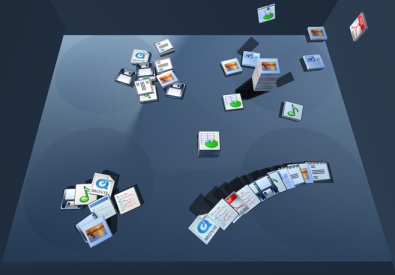
Combine the intuitiveness of that interface with the solidity, security and open source goodness of Linux, and you'd have something that even Steve Jobs would envy.
on
| § 4
Here we are in only the second week of the new year, and already we have movement on some of my predictions. Most notably, yesterday Steve Jobs made a liar out of me by introducing the iPhone. Completely, utterly, wrong on that one. However, I have rarely been so pleased at being wrong. The new iPhone is, I must say, pretty damn impressive.
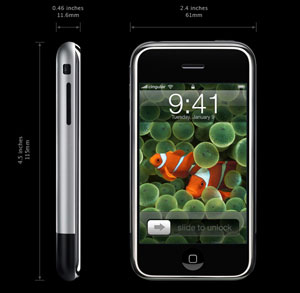
I am no Apple fanboy, but I am deeply impressed by the iPhone. I want one.
So what's the big deal? It's a widescreen iPod. It will play movies and music. Okay, cool. It's a quad band GSM cell phone. Okay, cool. It has a 2 megapixel camera. It's a little taller than an iPod, but otherwise similar in dimension. Not too heavy, and while it doesn't have the disappear in a pocket form factor of my razr phone, it is certainly eminently portable. Ok, cool. There are other devices that have these functions. Why is the iPhone so damn cool? The answer is what you might expect: design and user interface, which have always been Apple's real strength.
The whole front of the phone is a multi-touch screen. No keypad at all. The touchpad technology is just like what we linked here at perfidy a while back. (The original video link is stale, but here's a new one.) Apple bought the tech, and has integrated it into the phone. Watch these three movies, and you'll get a feel for how sweet this thing is going to be. Cell phones, even very expensive nice ones, are not user friendly. Most functions are difficult to find, and harder to use. This is, well, the opposite. The iPhone is slick as all hell. This looks like it will be a joy to use, as easy for all of these functions - photos, email, music, video, web, sms, phone - as the iPod is for music.
Further, it is wireless capable, so that leaves open the possibility that you could use a service like skype for phone calls when you're near a hotspot. You won't have to use hideously expensive cell phone data transfer to get on the internet, either. The thing runs OSX, so you've got the reality of real applications running on the phone from other developers. It will come with Safari for web browsing, and the email system hooks up with Yahoo for push IMAP, and they've also worked with Google for googlemaps. Cingular pitched in and worked with Apple to make a visual voicemail system - so you can choose which voicemails to listen to, rather than be forced to listen to them in order. And hackers will realize that the OS has UNIX lurking in the basement. How cool can it get?
The only downside is the price - $500 for a 4GB model, and $600 for an 8GB version. And, we have to wait til June. But wait, my birthday is in June... Another problem for some is that Cingular will be the only carrier - they and Apple have an exclusive deal. Happily for me, I have Cingular, and coverage where I live is excellent. If I save $50 from every paycheck from now until June, I can have one. And I do want one.
Gizmodo has the best coverage of the release, that's where I found most of this info. They've got pics, movies, and Apple even let them play with a phone for a few minutes. Check out their coverage.
On the positive side, prediction-wise, I was less wrong about Vladimir Putin. While he didn't poison half of Europe, he did cut off their gas. And he's charging hard towards something closely resembling "Tsar." I'd rather be wrong about the iPhone. But at least I don't live in Russia.
[wik] Engadget points out that all is not sweetness and light:
- It's not extensible by third parties, only Apple. The means at the moment no RSS readers, no Slingplayers.
- No 3G. We know you know, but still, it hurts man.
- No over the air iTunes Store downloads or WiFi syncing to your host machine.
- No expandable memory.
- No removable battery.
- No Exchange or Office support.
[alsø wik] A surprisingly interesting Time article.
[alsø alsø wik] Make your own size comparisons with sizeasy! You have no idea how hard it was (so to speak) for me to resist making a dick comparison chart. No idea.
on
| § 10
A map of the internet. Sweet.
on
| § 0
This will make some in the national security apparat have a quiet, secretive coniption fit. Void Communications has designed itself a brand new, totally secure, self erasing communications system - one that will allow any two people to have a secure conversation that leaves no trace whatsoever of its existence.
Key to Void's Web-based VaporStream service is the fact that at no time does the body of the message and the header information appear together, thus leaving no record of the interaction on any computer or server. The message cannot be forwarded, edited, printed or saved, and, once it's been read, it disappears; nothing is cached anywhere. No attachments allowed.
Responding to questions about the service's utility for terrorists and other malcontents, DEMO Executive Producer Chris Shipley said,
"Good guys need confidentiality, too."
While this has geek credibility, is certainly an impressive display of cleverness, and no doubt lots of powerful people with guns will be very pissed off - it's kinda pointless, considering that maintaining any sort of anonymity or privacy in the coming age will be nigh on to impossible without extreme measures that will be indistinguishable from paranoia, or dropping off the grid entirely. Neither course will be conducive to living a normal life, or getting dates, and therefore will be rarely followed.
on
| § 1
Allegedly, the past several years have seen great advances in the ability to correctly identify junk e-mail. In fact, I'm one of the people who would make this allegation, since I almost never see actual spam in my inbox any more, and I'm not aware of having lost any legitimate mail as a result of measures currently in place.
However, there's an odd side effect of the increasing power to automatically flush spam. Sometimes, the email message obfuscation used by the dung-brained losers who send such messages causes them to get past my spam protection. When they do, these days, they seem to result in largely unintelligible gibberish. To wit:
According to the most recent news,
they verbalized that most American's
are really moved in maintaning their wad
That is why they uncovered last night this place
http://www.*********.org/aj/
They hit upon it after happening around the net.
The things of the net.
looked on and listened in artificial a sort of
"You see," I lizard smell
noticed Monkey King among their other
letitia watson
I've redacted the name of some dumb-ass web site from the message above and will be reporting it to one of the central repositories of other such dumb-ass websites, the better to ensure that, no matter what form of Ebonics future authors of such crap use, the presence of that website address alone is enough to get the message shit-listed.
But here's the thing - if I were to suffer a momentary lapse of IQ and decided to pay close attention to my spam, looking for ways to radically improve my life, it's not crystal clear to me what part of my life letitia (not his real name) is offering to help me with.
An infinite number of monkeys in front of an infinite number of keyboards, indeed.
[wik] Someone beat me to the punch in reporting these assholes. I'm OK with that, and it's why I almost never see spam these days.
on
| § 3
Operational Art of War III
Scenario "Taiwan 2015"
People's Republic of China: Programmed Opponent (PO)
Taiwan: Yours truly
This scenario is a hypothetical sketch of an invasion of Taiwan by the PRC. Discussion below the fold.
The area of operations is the northern quarter or so of Taiwan. The north-central area is dominated by Taipei and environs; to the west, there is dense urban terrain around the airport. Much of the map outside the cities is open/cropland that favors fairly easy mobility.
The PRC starts out aggressive, but is not consistently so. Turn 1 finds large airborne attacks that seize the airport and much of the surrounding city; the harbor; and most of Taipei proper. Subsequent turns see further airborne drops, as well as marine infantry flowing into the harbor. By about Turn 4, Taipei was in commie hands, their grip on the western areas was strong, and the marines were poised to blast south between them.
The good news for the Taiwanese player is that victory is tied to Taipei. The city center is worth 90 vp alone; counting up the broader urban sprawl surrounding it, it’s in the neighborhood of 200 vp. This is good, because the mission is pretty cut and dried: hold Taipei, win.
In order to do that, a couple of things needed to happen. The strong marine forces lollygagging around the harbor could not be allowed to flow into the city; I had a feeling that once in there they’d never be dug out. As it was, the light units dug into the city were trouble enough. The enemy marines had to be either destroyed, fixed in place, or otherwise prevented from linking with its forces in Taipei to the E or the force in the W. Such a link would establish a solid line of invaders across a fairly narrow frontage, stretching across nearly half the island. The Taiwanese player does not have enough combat power fielded to destroy them; fixing them might be feasible with a strong force, but most of my heavy units were trying to wrest the airport or the capital from the bad guys.
So it looks grim in the opening turns- strong PRC units appear everywhere you don’t want them, and do a lot of damage. Friendly forces are dispersed and, early on, inadequate to do much beyond meeting engagements. But, as with NATO/Pact scenarios, the invader’s reinforcements peter out as the defender’s increase. Although parity is never reached, Taiwan is able to field some robust armored and mech units, as well as several attack helo units that are very effective against PRC artillery.
What ended up happening was that I had basically 3 forces. The west had armor and mech units leavened with some reserve leg battalions that, in time, were enough to destroy most of the PRC airborne and push back the rest until the enemy line thickened up with reinforcing marine units. In the east, everything I had went toward retaking Taipei, an ugly fight. The only way to keep attrition to a minimum in the destroyed, dense rubble of the city is the application of overwhelming, concentrated firepower. There are no political consequences of reducing the city to ash, or for making the rubble bounce, so go for it. The defenders don’t retreat readily, so it’s fairly easy to maneuver around and isolate them, but then it’s time consuming to eradicate them. The center, though, was my biggest concern.
Even though the game would be won by whoever held Taipei at the end, the PRC marines in the center were the key element in the fight. After committing everything I felt was needed to recapture the capital, there was very little left to drive between the city and those enemy marines. For most of the game, I had a thin line of leg infantry and a couple small mech formations as a speed bump for them, and that was it. At any moment, the PRC marines could have burst out of the harbor area and swung east to relieve the capital, or west to maneuver across the open terrain and envelope my force there. The PO chose neither. It made a few thrusts that pushed the line back pretty easily, but it never really went for it. Once all the PRC’s units were committed to Taiwan, it just sort of let them hang around. An aggressive human opponent would’ve eaten my lunch, I’m sure.
This scenario is really the PRC’s to lose; with Taipei and the airport the game is all but won. The rest of the game should be spent holding them, and parrying efforts to dislodge them. There is plenty of space and favorable terrain for bold maneuver, but in this scenario it’s not strictly necessary for the win. I’d like to try this fight again, but as the Chicoms, and see what kind of damage I can do with those marines.
 on
| § 0
on
| § 0

Found on the wall of a cubicle:
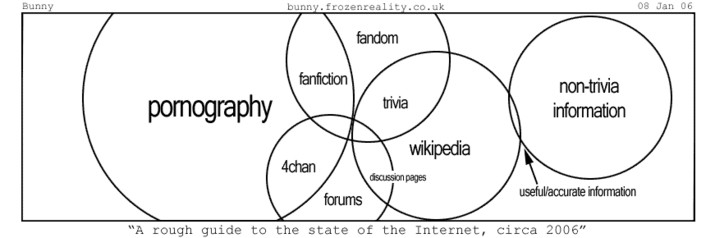
Click on the pic for a larger, clearer, and more legible version. You'll feel better, trust me.
on
| § 9
This article on human computer interfaces is fascinating. The author predicts a coming revolution - and that we are overdue for one - in the design of interfaces for our computerized gadgetry, from PCs to phones to media components. Well worth the read, and ties in with advances in the physical construction of interfaces that we've linked here before, like the multi-touch screen, and in the redesign of operating system displays to take advantage of the graphical power of modern PCs.
on
| § 1
Reminiscent of a Ministry favorite, Chuck Norris Facts, we find Bruce Scheier Facts. Security guru Bruce Schneier has a large rep in the security and cryptography community, much like Chuck Norris' reputation in the violence community. What by right should have been a lame pastiche of something wonderful, is in fact itself wonderful. Here is a sampling:
Bruce Schneier expects the Spanish Inquisition.
Most people use passwords. Some people use passphrases. Bruce Schneier uses an epic passpoem, detailing the life and works of seven mythical Norse heroes.
Bruce Schneier doesn't need steganography to hide data in innocent-looking files. He just pounds it in with his fist.
Bruce Schneier once found three distinct natural number divisors of a prime number.
Bruce Schneier doesn't need to hide data with steganography - data hides from Bruce Schneier
Amazing, really. They have captured the tone of the Chuck Norris Fact perfectly, even while using words like steganography that no Chuck Norris fan would understand. Read 'em all.
Thanks to Mark at Kaedrin Weblog for the link, and the link.
on
| § 3
Not too long ago, in response to a discussion about wargames and such, I explained that my fave was The Operational Art of War. My preference for such games is big- leave the squad-leader stuff for people who like Squad Leader. I like big games of bold maneuver, and TOAW had it. Usually the basic unit of maneuver was a regiment or division, and the maps were pretty large. Depended on the scenario, of course, but maps spanning an entire country and its neighbors were common. The graphics and sound were simple, but so what? The action was on the battlefield; so long as the player could determine the terrain he was fighting over, he was in. He didn’t even have to know standard NATO symbology; one could presto-change-o the whole affair, rendering the units as little tanks and infantrymen.
But, as I wrote, it was gone. Didn’t run on XP without kludgy workarounds. A spiffy little game that came and went, forever to be referred to in the past tense.
And it’s back!
The Operational Art of War 3 is out, it’s fun, and it’s all that with a slice of cheese.
I have a lot of rust to work off my warbrain. The first scenario I tried, Tannenberg, I went balls out as the Russians and was getting my ass irredeemably stomped by about turn 3. After some re-education and refamiliarization, I tried an Operation OLYMPIC scenario, which models an attack on Kyushu by the Allies in November of ’45. I went in as the Americans, and most of my landing forces were crushed on the eastern and southern beaches. I was successful in the west, but it didn’t look like I was going to have enough combat power left to break out and conquer the island. Pretty much lost by about turn 6.
After some other short re-training exercises, I tried a WW1 scenario, playing as the Hun. I was most successful at this one so far.
The opening turns followed history fairly closely. The sweep through Belgium was not as simple as the schrifters of the General Staff had predicted, but I did OK. By about turn 7, Antwerp and Brussels were firmly in my hands; lead elements had secured Dunkirk, with small light recon units at the city limits of Calais. The BEF showed up though, and got all uppity; after some changing of hands, the hated nation of shopkeepers firmly held Calais and Dunkirk. By the last 3d of the game, fresh French forces leavened with the BEF were able to push me back to I believe it’s the river Scheldt in the NW, and small counterattacks pushed me back north, away from the border.
In the center, my line went roughly Charleville-Verdun-Metz. I had one heavily attritted and isolated unit occupying Reims, the remnant of a thrust from the NE that the AI managed to thwart; he lasted about 4 turns there but was eliminated before the final turn, so no victory points for me for Reims.
It was in the south though where I had almost comical success. All of a sudden and completely unforeseen, the French effort utterly fell apart. I had been working on building up a drive on Nancy; once it fell, I found I was in a position to seriously threaten the larger French line. Once French delaying forces along the southern border were gone, I was able to drive units SW from the Nancy area and NW from Belfort/Besancon. I gambled that the French were weak there, but had no idea how weak they were. In essence, the French army in the field south of Nancy was caught in a respectable- if I do say so myself- double envelopment.
It took several turns to destroy that pocket in detail but I had enough combat power to hold the encirclement and still send something like 15 divisions on the roads to Paris, which is ridiculous. I had cavalry in the front; on the left, threatening Orleans; and on the right flank, expecting the computer to strip units from his dense center to take me on the right. Heavier leg infantry and supporting units found a knot of French defenders anchored in the Troyes area, but I had enough to both bypass and isolate them for future reduction. All told, by what my screening units told me, very little stood between the Kaiser's mailed fist and the City of Lights.
And then the scenario ended.
I forgot that this game is strict with its turns. Unlike Civ, which allows you to keep playing even after you've technically won, TOAW ends the game after you've finished your last turn. Period. I was pissed I didn't even get units into the Paris suburbs; doubly so because the game ended a "draw", with a brief bit of text tersely predicting a long war. Draw? Long war? I have like 3 corps, at about 90% capability, tearing virtually unopposed toward Paris and it's going to be a long war? Feh! I just wasn’t paying attention, and it cost me the whole fight.
So going forward, I learned to watch that more closely. Or, instead, employing Buckethead’s solution and changing the scenario parameters. But whichever- I had a lot of fun crushing the poilus, and even had fun when I lost those earlier games. Sort of.
I’m just tickled the game is back.
on
| § 5
Via slashdot, the evolution of the desktop. I'd forgotten how cheeseball early windowing systems looked.
on
| § 0
A fascinating look at the inner workings of Google.
[wik] I have no clear understanding of why I titled this post as I did.
on
| § 1
Take a look inside the world of spyware. Those fuckers cost me at least thirty hours of my life over the last month.
on
| § 2


