April 2004

We're all C- students

Today in Slate, an argument against individual investment Social Security accounts.

The short version:

Average yearly return of US stock market over last 20 years: 12%
Average yearly return on holdings of individual holders of Vanguard 401(k) accounts: 4%

In general, institutional investors and trustee investors do a good job, Joe and Jane blow do a terrible job. Of course, this has far greater implications than just it maybe being a good idea to keep the Blows from meddling in their SocSec porfolios, but that's the hot button issue of the the day, so I'm gonna lean on that button 'til Buckethead squawks.

Posted by Johno Johno on   |   § 14

"Friday the 13th, Detroit: Jason vs. Glock"

Just like in a horror movie.

The woman is walking from her parked car to her home after work. She drops something and, as she's stooped to pick it up, sees the bad guy charging her from the treeline.

She gets into her house, but can't bolt the door before he's upon her. Muttering obscenities and a chilling monologue, he shoves powerfully against the door. She ends up on her butt, on her own kitchen floor...just seconds before she'd been just walking toward her house, and suddenly she's in mortal danger...then he's in the house, nearly upon her...she sees the gun in his hand....she thinks of her teen daughter, also in the house...terrified, adrenalin racing, she sees his eyes...

Then she pulls her 9mm from her waist and puts 3 rounds in his fucking head.

Real life, not a horror movie. The incident took place in Detroit, and the lady in question said it was like "Friday the 13th...except it was Tuesday." Police determined that she had actually fired 6 rounds, but the autopsy showed (probably a very brief autopsy) that cause of death was multiple gunshots to the mellon.

Now, any person who can go from her everyday mundane pattern to immediate mortal danger, be off balance, ambushed, needing just a little more urging to head into panic, yet have it together enough to put 3 rounds in the bad guy's head is fabulous. Just fabulous. That's the difference training can make, as opposed to just packing to feel safer.

Opponents of Michigan's new concealed-carry statute "predicted a large increase in self-defense-type shootings". I'm not sure why that's a bad thing; would those CCW opponents be happier, and feel safer, if this lady and her daughter were dead and this convicted fellon was still marauding about with his unregistered weapon?

She has admitted she has conflicted feelings over all of this. She knows she did the right thing by defending herself and her daughter, but is not thrilled she had to kill someone. Personally, I'd rather be alive and feel bad about killing the bad guy than be dead.

Posted by GeekLethal GeekLethal on   |   § 0

Double plus whitening

Norbizness (who I have not linked in some time, to my shame) has a hilarious post up - rap lyrics translated into middle-management speak. Example:

"Law enforcement officials seem intent on confiscating my current narcotic harvest."

"Please pass me the amplification device, so that I may extend my present line of discourse. The alliance of particular Californian neighborhoods is a portent of imperilment."

Fun, fun, fun

Posted by Buckethead Buckethead on   |   § 7

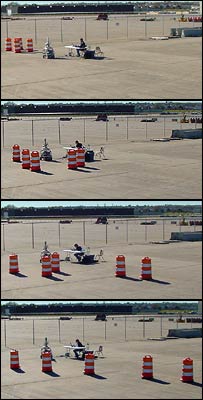
They control the horizontal. They control the vertical. Now they control the highways.

The University of Nebraska is working on perfecting the most devious and insidious use for robots yet. More invasive yet coddling than the robotic refrigerator, more inconvenient than the Sirius Cybernetics Nutri-Matic, and clearly a harbinger of a coming world where humans are nothing more than meatsacks to be shunted from place to place according to the whim of some malevolent Cray with a Playstation mind.

Reports already suggest our children are more tolerant of authority than their elders, yet mistrustful of politicians and actual individual figures thereof. What better surrogate than the electronic partners they have been weaned on? And what better way to take control than to automate the very sources of inconvenience, delay, and implacable authority, objects that already inspire feelings of helplessness, resignation, and inevitability?

What is this new menace?

What form have they taken?

Why should you arm your automobile with an aluminium bat, a reenforced bumper, and a law-enforcement brakes and steering package?

image

That's right. Those orange barrels are moving on their own. Weep for the children of tomorrow, for their future is as bleak as an Ohio winter.

Posted by Johno Johno on   |   § 0

Let's party like it's 1789

Crazy maverick senator Zell Miller has said, with his face hanging out, that we should no longer directly elect our senators. The esteemed Georgia senator thinks that the founding Dads had it straight the first time, and that senators should be appointed by the legislatures of the several states.

Now, those of you who are devoted readers of this webthingy will know that I am all about originalism, the genius of the founding fathers and our comparative unwisdom, and in thinking that almost every political development since about 1800 was generally for the worse. However, I must beg to differ with Democrat in Name Only (DINO) Miller.

Because of the curse of gerrymandering, the vast majority of seats in the People's House, the House of Representatives, are elected by "safe" districts. There is, thanks to careful (not to say maniacal) line drawing, absolutely no chance that these seats will ever face a competive election, even when an incumbent steps down. The only interesting competition you'd see is in the primaries for the dominant party.

Contrariwise, the shark like operatives for both parties have not yet devised a method for gerrymandering whole states. Senate elections are (aside from Presidential elections) the only place where our votes can truly make any sort of difference in who represents us in Washington. Of course, this is completely at odds with the intent of the founders. They envisioned the Senate being the calm, wise, reserved debating soceity that would restrain the whims of the democratic mob in the House. Instead, we have the mob in the Senate, and party hacks from safe districts in the House.

Zell's proposal would remove the one democratic part of the Congress. And we can't really afford that. I would agree to his plan only if we passed an amendment that somehow removed the problem of gerrymandering. (I have no idea how you might accomplish that, but if you have ideas, please use the comments.)

[wik] Rich Lowry has more on this up at the National Review Online.

Posted by Buckethead Buckethead on   |   § 7

Hmmm...Steel or Fiberglass?

Haaretz and The Telegraph are discussing the lack of heavy armor in Iraq and connecting that lack to high casualties in April. That situation will only continue, because I just read in my newsletter that the 1st Cavalry Division, which is completing its deployment to Iraq and is for all intents and purposes an armored division, left most of its armor in Texas.

FORSCOM commander General Larry Ellis (under whom I served when he was Colonel Ellis, in his final weeks leading the 1st BDE, 3rd ID and who is a fucking super stud) points out that the improved humvees in service now are the best available solution to the situation. Until either more Strykers become available or an entirely new vehicle designed and fielded, this is it. A different option is to go back to the future: another Army officer says he has 700 old M113s that were prepositioned in Kuwait and have been gathering dust. Why not use them as battle taxis instead of soft humvees, he asks?

Problem is that humvees were never intended for frontline battlefield usage. They were designed to replace the venerable jeep as a mechanized mule, not to operate in the real fight. But in these counter-insurgency operations, where the bad guys are everywhere and nowhere, there are no rear areas where humvees can operate safely. The tactical question might be whether this or that upgraded humvee can do the job, but the larger question should be, what vehicle do we need that can act as ambulance, police cruiser, tactical command post, and general purpose people mover while providing enough occupant protection and vehicle survivability in an environment of 360 degree hostility? And while we're bullshitting, it needs to be light enough for easy air transport and cheap enough to buy a zillion of them. Have something on my desk for Monday.

I was a support guy and worked on commanders' staffs in two different Bde HHCs and one Bn HHC. I drove M577s, the command post carrier version of the original '113. You'll notice that you have to crouch in a '113. On '577s, you'll see how tall the vehicle is- the interior was tall enough to stand up in, and the walls had steel shelving crammed with radios, COMSEC gear, maps, batteries, personal weapons, sledgehammers, shovels, food, shit-tickets (aka victory paper aka toilet paper), comic books, porn, and everything else too heavy or...uh, sensitive... to carry around.

The M113 family is very noisy and very slow. Both the '113 and moreso the '577 (due to the generator and cradle next to the driver's hatch; clearly visible in the pic) severely restrict the driver's field of vision. Not only do the tracks damage roads, but roads also damage track! Wear and tear and continual use on hard surface can increase the likelihood of throwing the track, literally, where the whole damned thing pops right off the road wheels. I don't know how prevalent this problem is in Iraq, since there are numerous '113-family vehicles in the field already, but I'm not sure adding 700 more to the end of the supply chain would be a good thing. Furthermore, stock models are not armored beyond the steel they're made of. They'll stop small arms- probably- but I'm not optimistic about heavy crew-served machine guns (say 12.7 mm+) or RPGs. Even if the steel stops the heavy round or rocket, it would likely spall the interior. I understand that actual '113s, as opposed to '577s, have some sort of an anti-spall kit for interior surfaces and bolt-on armor kits for the hull, but I don't know how available that gear is. Even with after-market add-ons though, an RPG will still likely ruin your day; if an IED blows a drive sprocket, you're in deep doo-doo.

BUT- is all that better than tooling around downrange in the fiberglass and canvas convertible that is the humvee? Probably!

At least until we get some Halderman-ian armored infantry fielded.

Posted by GeekLethal GeekLethal on   |   § 3

Hamtramck-abad

Practitioners of the religion of peace have once again managed to piss off alot of people.

Last week the Hamtramck, MI City Council gave "initial approval" to allowing city mosques to broadcast calls to prayer over loudspeakers in a decision sure to piss off both infidels in general as well as muslims who might want to sleep in that day.

Not surprisingly, the council completely caved to muslim demands with a unanimous vote of support. Don't want to offend anyone, don't you know. Well, except for people who don't want to hear it, which is the rest of the city. Final approval was expected at last night's meeting.

Leaders of the city's muslims claimed that infringing on their right to make a goddamned racket through loudspeakers was actually infringing on their right to practice their religion, going on to claim that it was in their tradition to do so. I'm no more an expert on Islam than the next kaafir but as best I understand it, Islam did pretty well for itself through the 13 centuries that passed BEFORE electric amplification. And don't try and tell me that none of Hamtramck's umma has a damned watch to tell him when he's supposed to get down to some Mecca-facing.

We know though that the legal issues in question- noise ordinances, rights of religion- are only the mechanism muslim leaders are using to proselytise. Masud Khan, head of the Al-Islah Islamic Center, initiated this whole loudspeaker business. Pleased with the council vote, and after the requisite Allah-thanking, he added,

"Hamtramck is going to be a pioneer city for the whole United States."

Posted by GeekLethal GeekLethal on   |   § 9

Call it the "McClellan Doctrine"

Without presuming to make any assumptions or accusations about the courage of the Bulgarian people and their armed forces, the following quote, from an MSNBC article about the renewed fighting in Fallujah-- including artillery-- struck me funny.

Bulgarian President Georgi Parvanov demanded Tuesday that Bulgaria’s 450 troops be moved to safety away from the holy city of Kerbala after his convoy was fired on when he visited them Sunday.

Posted by Johno Johno on   |   § 4

Let's build some life!

This really long scientific article talks about some eggheads making DNA blocks or something, and then putting them together to create life. I was too lazy to read more than the first paragraph, (which I have excerpted below) but I am sure that this technology will in no way effect my day to day life, or the moral or technological underpinnings of it.

Evolution is a wellspring of creativity; 3.6 billion years of mutation and competition have endowed living things with an impressive range of useful skills. But there is still plenty of room for improvement. Certain microbes can digest the explosive and carcinogenic chemical TNT, for example--but wouldn't it be handy if they glowed as they did so, highlighting the location of buried land mines or contaminated soil? ...nature apparently has not deemed such a thing fit enough to survive in the wild.

Posted by Buckethead Buckethead on   |   § 0

Cold Fusion: not quite so lamebrained an idea

Technology Review is reporting that the Department of Energy has decided, on the basis of recent research, to look into cold fusion once more. Fifteen years after Pons and Fleischmann were greeted with awe and then ridicule, some are beginning to take it seriously again.

Read the article for the details, but the gist of it is this: some of the confusion over other experimenters not being able to reproduce the results lay in the concentration of heavy Hydrogen in the Palladium cells. If there are more Deuterium atoms than Palladium atoms, then you get extra heat. With lowered amounts, you get spotty to no results. Further, new experiments show that fusion byproducts (such as Helium-4) are appearing in amounts appropriate to the level of heat generated. No one really knows how all this is happening, but:

He [Peter Hagelstein, associate professor of electrical engineering and computer science at MIT, who chaired the tenth International Conference on Cold Fusion in Cambridge last August] suspects the difficulty lies with "a very powerful approximation" at the root of 70 years of nuclear physics—that all nuclear interactions occur between two particles in a vacuum. He thinks that assumption breaks down in cold fusion, where the interacting particles are tightly packed in a metal lattice. His idea is that the deuterium nuclei exchange vibrational energy, or "phonons," with the surrounding palladium atoms. That exchange could enhance nuclear interactions that would otherwise be vanishingly small, so that the reactions can occur at the rates implied by cold fusion experiments. Hagelstein's theory is still in development, but is reaching a point where he can start making testable predictions—a vital step toward making cold fusion a credible science. "In time, hopefully, we'll get more of the puzzle figured out," he says.

We see effects like this in chemistry - where the presence of one compound acts as a catalyst for the chemical reactions of two or more other compounds. Is it so unreasonable that there could be catalysts at the subatomic level as well? Who knows, we might get the fusion powered DeLorean after all...

Posted by Buckethead Buckethead on   |   § 0

Do Dead Androids Dream of Electric Banking?

Weird Franco-psycho writer Emmanuele Carrere has penned a biography on weird California-psycho writer Philip K. Dick, I Am Alive and You are Dead.

A recent Economist had a brief review of the book, which is not yet released. That review spent alot of its brief space describing Dick's drug use and abuse; presumably Carrere spends alot of time on that as well, as the "review" didn't offer much substantive critique of other content.

One fun fact the review mentioned was the love affair Hollywood has with Dick's work (an affair that will continue through the immediate future) has generated upwards of $700 million, yet not as much $$ flows back to the Dick estate as one might hope.

I'm not a big fan of biography, but I might have a peek at this one just for the union of weird spirits in Carrere and Dick.

Posted by GeekLethal GeekLethal on   |   § 11

Why Hide The Fallen?

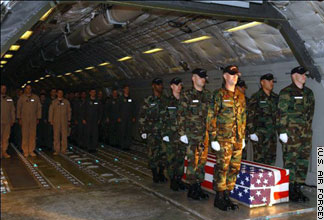
I was dismayed last week when a Defense Department contractor was fired for publishing pictures of coffins containing slain soldiers on their way home from Iraq. An undersecretary of Defense argued "we don't want the remains of our service members who have made the ultimate sacrifice to be the subject of any kind of attention that is unwarranted or undignified." While I can understand the DoD's will to secrecy and the policy it generated, it ultimately does very little good. Sometimes risking undignified treatment is the price of freedom.

In the current climate of half-truths and obscurity that President Bush and his advisors seem to prefer, even long-standing policies like this get caught up in the larger tide of similar gestures seemingly designed to deny the American people information that they might actually want to have. I'm not blaming Bush-- this isn't his policy-- but it just doesn't help him, either.

I am personally glad the photos were published. War is an abstraction to us, and images of the fallen make it decidedly less so. Like the images of September 11 (or March 11), and like the hideous photos brought home from prior wars (a Spanish partisan falling, his carbine flung away from his body, his head exploding, the screaming Vietnamese girl, burned by Napalm), they translate the current libervasion of Iraq into human terms far removed from the best-case calculus of the President's advisors or the redfaced screaming of the BusHitler crowd.

Wars look ever more like video games, and ever since WWII, the USA has been able to absorb the cost of committment without undue strain. This changes how we see things. During WWI, the USA itself felt the impact of the fighting abroad. Rationing, huge casualty lists, and the sinking of civilian ships brought the fact of war into everyone's consciousness. Ditto WWII, where the stakes for the USA were higher still. But now that war is less of an effort for the country, and conducted on a smaller scale far away (and for increasingly complicated reasons and goals), it becomes more of an abstraction. It's all well and good for me to sit here and play armchair pundit, commenting on that abstraction. But I can easily forget that the men and women in Iraq who joined the military are giving their lives in defense of liberty. I might not see the endgame, and I might not agree that Iraq was the very best place to fight. But neither of those considerations takes away from the gratitude I feel toward the people of the US military.

Images like were published in The Seattle Times (and everywhere else) overcome that abstraction in favor of fact. It is good to be reminded that the military treats its fallen with deep respect and overwhelming honor, and it does the right thing by the dead for the country to see and understand not only the sacrifice they have made, but the great dignity with which our country recognizes that fact. Hiding these images, making a policy of hiding these images, is the wrong thing to do. Whether you are for or against the war, these pictures do a great service.

Below the fold.

[wik] According to the Washington Post, the ban on images like these dates from the Clinton administration, but was specifically enforced at the start of the Iraq War. "In March, on the eve of the Iraq war, a directive arrived from the Pentagon at U.S. military bases. "There will be no arrival ceremonies for, or media coverage of, deceased military personnel returning to or departing from Ramstein [Germany] airbase or Dover [Del.] base, to include interim stops," the Defense Department said, referring to the major ports for the returning remains." (Dana Millbank, WaPo, 10/21/2003). Draw your own conclusions about the Bush Administration's committment to secrecy.

[alsø wik] Kathy Kinsley observes that the Pentagon may be revising the policy. KK has some thoughts.
image

image

The Memory Hole has hundreds more.

Posted by Johno Johno on   |   § 11

Inkbots

Clifford May writes:

Bob Woodward's new book is less an expose than an inkblot test. It's remarkable how people can see the same words on the same pages - and come away with entirely different pictures.

...An example? For months, the president's critics have accused him of exaggerating or even distorting the CIA's intelligence on Iraq's weapons of mass destruction. Indeed, the charge has been made repeatedly that the president "misled" the public - even that he "lied" and "betrayed" America.

The big news in Woodward's book is that Bush was deeply skeptical about the CIA's conclusions regarding Iraqi WMD - even after he was presented with a "Top Secret" document starkly warning: "Baghdad has chemical and biological weapons."

What changed the president's mind? Woodward vividly describes a meeting in the Oval Office in which George Tenet, the director of central intelligence, responded to Bush's doubts by rising up from his seat and throwing his arms in the air. "It's a slam-dunk case!" he said.

Even that didn't quite persuade Bush. He pressed further, asking Tenet: "George, how confident are you?" At which point, the nation's top spy - a nonideological nonpartisan who held the same job in the Clinton administration - "threw his arms up again. 'Don't worry, it's a slam dunk!' he repeated."

Imagine if - instead of heeding this warning - Bush had ignored it, put on his sweat suit and gone for a jog around the White House. Imagine if a terrorist attack, utilizing WMD supplied by Saddam Hussein, had followed. Bush would have faced impeachment - and deservedly so.

But the president didn't do that. Instead - according to Woodward's reporting - he instructed his CIA chief to assemble the evidence on WMD, adding cautiously: "Make sure no one stretches to make our case."

That's a remarkable bit that I have not seen in the media. How very strange.

He ends with a good closer:

One last word: Those media moguls who have chosen to highlight only parts of Woodward's book they hope will damage Bush might want to recall the old joke about the man whose psychiatrist shows him a series of inkblots.

"Listen, Doc," he says, "I have serious problems to discuss with you. I have no time to look at a bunch of dirty pictures."

Posted by Buckethead Buckethead on   |   § 0

Interrogations proceeding apace

McSweeney's has gotten ahold of some transcripts from interrogation sessions of Saddam Hussein. Fascinating, revelatory stuff.

Interrogation commenced: 0330 hours

Woke SH quite early to catch him off-guard and groggy. I asked, "What's your first name?" and he said, "Saddam." Again I asked, "What's your first name?" and he said, "Saddam." I kept asking, "What's your first name?" and he kept saying, "Saddam." Once I had a rhythm going, I quickly asked, "Where are the WMD?" and he said, "Saddam."

Interrogation terminated: 0338 hours

- - - -

Interrogation commenced: 2210 hours

I played chess with SH, who is not too bad a chess player. At one point, my bishop took his rook. I told him that in the U.S., when you lose your rook to a bishop, it is customary to divulge a little personal secret, like maybe where the WMD are. He said we weren't in the U.S., then he took my pawn with the horse piece.

Interrogation terminated: 0122 hours

- - - -

Interrogation commenced: 0940 hours

Colonel Beckwith and I told SH that we didn't think it was particularly funny that he had us looking for "Monkey Valley" and the "Camel Ass Testing Facility" when, it turned out, there were no such locations. Also, we told him we were unable to verify the existence of Mohammad Mohahaha and we do not believe his claims of having built an "infidel ray." We told him that, as a result of our disappointment, we would be denying his TV access. He said TV sucks anyway because they don't sing about him anymore.

Interrogation terminated: 1100 hours

We'll break him yet.

Posted by Johno Johno on   |   § 0

Old Frontiers in Dog Bites Man

Shane McGowen getting in a bar fight is perhaps predictable. But, he could find Jesus, and begin living a peaceful and contemplative life. Really. But for the ultimate in "Dog Bites Man" we have this Washington Post headline:

Beijing crushes a student group

Drudge's headlines, which are often better than the originals, caught the dog bites man flavor of the story even better:

China still ruthlessly cracking down on political dissent...

Posted by Buckethead Buckethead on   |   § 0

Libertarian Reluctantly Calls Fire Department

CHEYENNE, WY - After attempting to contain a living-room blaze started by a cigarette, card-carrying Libertarian Trent Jacobs reluctantly called the Cheyenne Fire Department Monday. "Although the community would do better to rely on an efficient, free-market fire-fighting service, the fact is that expensive, unnecessary public fire departments do exist," Jacobs said. "Also, my house was burning down." Jacobs did not offer to pay firefighters for their service.

From our dear, beloved, Onion.

Posted by Buckethead Buckethead on   |   § 0

A Space Battle

The primary tactical function of a battleship is to engage and destroy the enemy naval forces, which obviously supports the naval mission of protecting friendly shipping and ensuring control over the space. The essence of space power will (like sea power) rest in the ability to dominate space. You do that by denying use of it to the enemy. And you do that by destroying his navy if it comes out of port. But how will this happen, and what will future battles look like?

A lot depends on the political nature of the war in which the battle takes place, and the geography of the solar system. (Interestingly, this will be constantly changing - as the planets, moons and asteroids orbit the sun, each at their own pace, the distances and relationships between them will change. There will not be, as on earth, constant or permanent sea-lanes, straights, or territorial waters. From month to month, minimum energy orbits between the planets will be in constantly different arrangements. It will become easier to get to one place, and harder to get to others. This will affect naval strategy.) Further, what will each power be trying to achieve or trying to protect? Is the goal invasion and conquest, or merely to frustrate the goals of the enemy?

The greatest naval battles involving battleships were Trafalgar and Jutland. In each case, the British were trying to frustrate the enemy. That is to say, the British had no desire to follow up a naval victory with large-scale invasion. However, the French in 1804 and the Germans in 1916 needed to defeat the British in order to achieve other desirable goals. All the British need to do is to defeat the enemy fleet, and everything else follows. Let’s assume that the Europans, long the dominant power in the outer solar system, are content with their control over trade routes in the Jovian system, and between Jupiter and the outer planets. They are growing fat and rich on the trade that passes through their ports. However, the Titanians, upstarts and growing powers in the Saturnine system, are deeply unhappy that the arrogant Europans get all the money and all the glory. They want their own share of the trade with the populous inner system, and further want a piece of the growing pie that is comet harvesting in the Kuiper belt at the outer edge of the solar system. (Which the sneaky Europans are poaching on.) 

The Titanians have built a respectable space navy, with a core of Orion drive battleships, and a larger number of smaller conventional nuclear thermal drive commerce raiding corvettes and frigates. As diplomacy falters, an unfortunate incident involving a Europan revenue cutter and a Titanian-flagged merchant solar sailship inbound to circum Mars provides the pretext for war. Europan merchant vessels are spread throughout the system, carrying almost a third of all shipping. Most of these are slow, automated solar sail freighters, but others span the spectrum of commercial ship design. The Titanian navy deploys many of its commerce raiders downsystem to strangle the Europan economy.

The Europan main battle fleet is not currently circum-Jove, as it recently moved forward to the Trojan belt to overawe the piratical kingdoms located amongst the asteroids clustered 60 degrees ahead of Jupiter in its orbit. What remains in Jupiter space is the smaller home fleet and a gaggle of small warships.

Due to the alignment of the planets (something that the Titanian high command was certainly paying attention to) there is a favorable transit from Saturn to Jupiter, as Jove is overtaking Saturn, being located in an inward and thus faster orbit. The Titanian fleet is in an excellent position to quickly drop down on Jupiter, while the Europan fleet is nearly a quarter of the way around the sun and ahead of both Jupiter and Saturn. It will be difficult for them to make it into battle in time.

The Europan home fleet can not refuse battle, because that would leave their moon open to attack. But though the quality of their crews is unparalleled, the Titanian fleet slightly outnumbers the Europans. Europan planners feel that it is a nearly even match. But tactical considerations favor the Titanians. As they will be decelerating into the Jupiter space, their heavy pusher plates will be facing toward the Europans. This provides maximum protection to the Titanian battleships, and allows uninterrupted X-ray laser fire as the battle is joined. Contrariwise, the Europans must perforce be accelerating towards the incoming fleet, and their pusher plates will generally be facing away. Smart maneuvering will mitigate this somewhat, but the front of the ship remains the front of the ship.

The Europan Navy dispatches its corvettes and cutters outsystem, using a gravity whip maneuver that will disguise their eventual position. They will coast up, powered down, and lie in wait for the enemy fleet. Hopefully, they will inflict significant damage as the Titanians pass - but losses will be high as the ships reveal their positions by opening fire. The Europans can be confident in the placement of these lurkers, because the location of the Titanian fleet is well known, and can only follow a narrow set of courses and still arrive at Jupiter.

The Titanian fleet powers on, occasionally launching a spread of sensor drones ahead in hopes of detecting enemy corvettes. These drones are soon overtaken by the fleet as it accelerates towards battle. The first combat occurs fifteen million miles out from Jupiter. The furthest of the screen of corvettes avoids detection until within a quarter million miles of the fleet - less than the distance from the Earth to the Moon. All of its X-ray laser missiles have been deployed, as have all of its sensors drones. The resulting sensor net gives the ship a much better picture than the fast moving Titanian battlefleet. All at once, the laser submunitions fire - each a small nuclear explosion pumping ten multi-gigawatt X-ray lasers. Sixty lasers hit twelve targets, a spread determined by the sophisticated targeting computers on board the ESNS Gomer Pyle (the Europans have an odd sense of humor) and the instincts of her veteran gunners. As much as possible, the gunners on the Pyle try to hit from the side, and avoid the thick refractory material of the pusher plate. In this, they succeed somewhat - the more alert among the Titanian targets detected the Pyle in time to turn tail toward the enemy. Nevertheless, the HRE Vindictiveness is completely disabled, and two others severely damaged. Light damage on the remaining ships is soon made good.

For its trouble, the Pyle is quickly destroyed in a hail of laser and particle beam fire. But the Europan command is pleased.

Over the next several hours, as the Titanian fleet slows as it backs into Jovian space, it endures several more attacks by lurking Europan cutters, corvettes and frigates. One more battleship is destroyed, but the Titanians are now alert and wary, and destroy thirty Europan warships with long range massed laser fire. Before the Europan home fleet can reach the Titanians, one more Titanian warship is hulled by a lucky long-range shot by a massdriver on the outer moon of Erinome. Now the home fleet has completed its swing around Jupiter, adding his gravity to their already impressive acceleration. The fleet is moving toward the enemy. But now, the admiral of the fleet faces the most crucial question in a space battle - what speed and course? His decision now will likely determine the course of the battle; because as good as his gunners and drone controllers are, if he does not put them in the right place, their skills will be useless. His options are limited. He must prevent the Titanians from bombarding Europa and her orbital factories, shipyards and habitats. If the Titanians maintain their present course, they will do just that. So he must either destroy or deflect them...

[wik] This battle relates to the discussion on space navy tactics discussed here, here, and here.

Posted by Buckethead Buckethead on   |   § 37

War in Space, Part Three

Here are parts one and two. And here is a battle in space.

Strategery and Spaceship design

All of this brings us finally to considerations of strategy. What would these warships be used for? Warships are often thought of in terms of how they kill other warships. This is not completely unreasonable. However, in strategic terms, warships exist to exert control over the sea. Historically, this has taken two forms here on Earth: to either protect your own shipping (preserving your use of the seas) or denying the use of the seas for your enemy. More recently, sea power has been used to project military power inland. US carrier battle groups are able to inflict significant amounts of damage to inland targets, and are also able to provide cover for amphibious assaults. To achieve these missions, warships and navies must often defeat other navies, which is why we so often think solely of warships' abilities to kill other warships. But the underlying purposes of navies and warships will drive the development of ship design.

In a solar system that is inhabited by competing powers, these missions will have close analogs. Protect your own interplanetary shipping. Deny it to the enemy. Project military force onto enemy targets on planets, asteroids or moons. Provide cover for space-borne assault on enemy targets. Each of these missions will require different types of warships. We have discussed the different types of warships that could be built with the technology that we have now, or could reasonably develop in the near future. We have seen that they fall into two major categories. How will they be used?

The Orion drive will provide a (very expensive) platform for moving large amounts of men and materials quickly across interplanetary distances. Ships built around less effective drives will be cheaper but much less capable than the Orions. It seems unlikely that any private concern would, in the near future, have the resources or need to build Orion drive commercial ships. Most private, and non-military government transport will use rockets, ion drives or solar sails. Sails will be especially favored by private concerns because of the cheapness of operation - absolutely no fuel costs. Faster transportation for VIPs or urgent cargos will be provided by souped up, stripped down nuclear thermal rocket powered craft.

If a power wishes to impede the shipping of a rival, non-Orion warships will be the most cost-effective commerce raiders. These ships would operate like earthly submarines, and it would be well within their power to effectively attack enemy shipping, or engage in anti-"submarine" warfare. Reconnaissance, intelligence gathering, lurking, stealthily inserting commandos - these are other missions that they might conduct. They could even serve as a sort of destroyer screen for a force of more capable ships. As escorts for friendly shipping, they would be useful in warding off the predations of enemy commerce raiders. But these light warships would be less well suited to the other missions that a space navy would be called upon to fight.

[wik] Side note: in talking about the relative usefulness of Orions and other warships, I am imagining a time when the solar system is somewhat well settled, and rival powers have emerged, and space warfare has had time to evolve. Initially, combat between the smaller classes of warships would be the leading edge - until the first Orion warship is built. I think that the first Orion would be like the British Dreadnought, taking naval warfare to an entirely different level, and possible igniting an arms race. The first interplanetary warships will be commercial or government ships originally designed for other purposes and retrofitted with weaponry. Indeed, ships like that will still be part of navies for a long time after the first purpose-built warships are laid down. But eventually, someone will become sufficiently frustrated with the limitations of conventional ships, and build that first Orion.

Battleship or Carrier?

Since we've been so free with analogies to naval warfare, let's throw out a few more. If the smaller class of warships, using conventional drives, are to be likened to submarines, what is the proper analogy for the Orion drive warships? The obvious choices are Aircraft Carriers and Battleships. Which one it ends up being depends a lot on weapons technology.

On earth, the battleship was surpassed by the carrier because of the advantages of aircraft. The best carrier without its dive-bombers, fighters, and torpedo planes would be a sitting duck for even an awkward, adolescent battleship. Why did aircraft have such advantages? Speed and range. Battleships were not only the largest of warships, they were the fastest and longest ranging. Aircraft trumped that by being able to fly above the water at speeds ten times or more faster than the fastest ship, and then drop bombs on the battleship with impunity from thousands of feet up.

Can we imagine an analogous vehicle in space? We have already seen that an Orion powered ship will be faster and have longer range than any smaller ship. While an Orion-powered ship could indeed carry fighter-equivalent spacecraft, dispersing your firepower into a bevy of smaller and slower ships does not seem to be as great an advantage as it was for wet navies. The same logic that drove the development of ever larger, ever more heavily armed battleships seems to apply to spaceships as well.

However, another consideration might yet result in Orion carriers rather than Orion battleships. The development of autonomous reconnaissance and (very soon) combat drones is well under way. There is no reason to believe that these developments will not be carried into space - in fact, all of our robotic space probes could be considered non-combat autonomous drones. The advantages of a non-crewed warship would be many - greater tolerance for acceleration, no need to waste mass on life support and a vulnerable but clever meatsack, and less concern if the drone is lost as opposed to a piloted warship. I don't think that the big warships will ever be unmanned, as the limitations placed on communications by the speed of light will require that humans be present at the battlefield. But that does not mean that drones will not be present on the battlefield. As I mentioned earlier, the line between weapon, sensor, and drone will grow vague. Each ship will be attended by a network of drones, feeding sensor data back to the mother ship; and if opportunity presents - deploying itself as a weapon. A big part of battle management will be the handling of these networks of drones. (I think that will be true here on earth in a very short time as well.) But these drones - be they weapons platforms akin to fighters, sensor drones, or x-ray lasers, will not make the Orion warship into a carrier. The primary focus will I think remain on the primary weaponry of the warship; if only because the autonomous drones of various types could never keep up with the mother ship. It does not pay to deploy millions of dollars of equipment that could be rapidly left behind by a fast moving battle, and play absolutely no part in the battle itself.

So the Orions will be battleships, queens of space. The generous payloads of Orions will likely see them armed with powerful generators, lasers and masers, particle beam weapons, railguns and metalstorm cannon. Bundles of lasing rods like those used in the standoff X-ray lasers could be dropped overboard with propulsion nukes, literally gaining more bang for the buck. The powerful weaponry of an Orion battleship, powered by an onboard fission reactor, would likely outrange as well as outpower any smaller ship. (Just like with traditional battelships, which could shoot farther than any other.) Armor will be possible, making the battleship resistant to many of the weapons capable of being carried by smaller warships, and even to those mounted on orbital bases. (An Orion battleship is in effect a mobile base - considering its size.) Crew complement for an Orion Battleship might number in the hundreds - mostly for damage control, but also to manage all the weapons, sensors, drones and communications that would be required by such a vessel. Next bit will cover what might happen in an actual space battle.

[alsø wik] Side note: The only reasonable variant on the basic battleship that seems likely is an assault version. It would perform the traditional naval missions of projection of force and covering assaults. This vessel would be used to rapidly transport space marines and the means to get them into whatever they're attacking - winged landing craft, zero-gravity assault boats, or whatever is required. This type of ship would also favor the types of weapons that could be used to bombard planetary surfaces. In time, as space navies build more Orions, variations in size and relative power might eventually be grouped into traditional categories such as frigates, cruisers and battleships. Or we might come up with altogether new names.

[alsø alsø wik] I think that in the long run, the traditions of the Navy will be more suited to space warfare than those of the Air Force. But since the Air Force is closer to space - they will likely get there first. And we'll have generals in command of our space fleets. And that would suck.

Posted by Buckethead Buckethead on   |   § 11

War in Space, Part Two

Part one can be found here, and here is part three. Here can be found a battle in space. 

Gravity Gauge

When we think about battles in space, it is useful to draw some parallels to earthly naval warfare. Just as there is a distinction between blue water and brown water navies, there will be a similar divide between warships designed to fight within the gravity well of a planet, and those intended to fight in the depths of interplanetary space. Warships designed to operate in close proximity to bases, and to deal with the rigors of maneuver in a steep gravity well will be very different from those required to make long journeys in flat space between the planets. We can think of the former as river gunboats, the latter as battleships. 

Gunboats operating in orbital space around, say, Earth will have powerful, high thrust engines and limited facilities for life support. They will be based in orbital forts, or perhaps launched atop disposable launch vehicles like the Gemini or Apollo rockets of the sixties. The life of the crews of these warships will be more like that of an Air Force fighter pilot than that of a submariner - which I think will be the closest analog for long duration deep space warships.

Gunboats, operating in the constrained space around a planet, will engage at shorter distances than their deep space cousins. In most respects, their armament and sensors will be very like that of a modern jet fighter. In fact, they will probably look something like a modern fighter - as being able to enter the atmosphere (at least the upper reaches of it) will be a very useful thing. Aero-braking, skip-jumping along the top of the atmosphere, and similar tactics will all save fuel while increasing the range and maneuverability of the ship. And being able to land on Earth will be a happy alternative to dying in space in the event of damage to the ship.

Looking beyond the descendants of a marriage between the space shuttle and an F-15, other types of orbital gunboat can be imagined. Light sail ships, boosted by ground or space based lasers might also be developed. Heavier warships, analogous to coast guard cutters might linger in orbit for weeks at a time, before returning to base. If scramjets are ever perfected, then warships operating at the interface between space and the atmosphere might become common. All of these types would have some capacity to attack targets on the ground, and in fact some might be designed around that mission. Erwin Sanger, an Austrian designer in the forties, imagined a rocket-powered bomber that would skip along the top of the atmosphere.

In combat within the gravity well of a large planet, altitude will be the most important tactical consideration. Like the wind gauge for sail-powered warships, gravity gauge will be the dominant factor. Having the advantage of position will be crucial, in that a position higher up the gravity well translates to more options for maneuver. Also, shooting up the gravity well is inherently harder than shooting down. The first pilots of these warships will have to learn the somewhat paradoxical logic of orbital mechanics - slowing down speeds you up, and vice versa. For pilots used to the straightforward maneuvers within an atmosphere will have to adapt quickly.

Deep Space Design Tradeoffs

Deep space will offer vastly different challenges to warship designers. All of the propulsion systems that might be available in the near future have serious limitations. Two tradeoffs will determine the design of all warships. The first is mass/acceleration; the second is power/stealth. I noted in the first part the tradeoffs required by stealth. Most of the tradeoffs for mass and acceleration will push ship design in the same direction.

The major propulsion systems that could be constructed with current or very near future technology are chemical rockets, nuclear fission rockets, nuclear pulse drives, ion drives and solar sails. The first three are high thrust, short duration drives; while the last two are low thrust, long duration. With the exception of nuclear pulse, which I will discuss separately, all of these systems impose the same limitation on warship design: every ounce of mass will reduce the total acceleration the warship is capable of. Space types refer to this as delta-v, or change in velocity. It is a measure of the total change in velocity (speed plus direction) that the ship is capable of with a given drive and fuel supply. It doesn't matter whether your ship accelerates really fast and then coasts, or if it makes a long slow burn, since delta-v measures the total change. This makes it a useful comparison between ships even of vastly different design.

(While solar sails will have effectively infinite delta-v, because they use the solar wind for propulsion, solar sails will not be well suited for combat since the sails are so visible and so fragile. Warships will be confined to the other drives.)

Ship designers will always be striving to make the ship lighter. This will allow engines of a given capacity to achieve a higher delta-v. However, there are things that a warship must have in order to be effective. Weapons, armor, sensors and stealthing; crew, and food, water and life support for voyages lasting months or more; a storm cellar to protect the crew from solar flares; fuel or reaction mass; these are all things you will need to bring along. Rockets and ion drives are low energy, and this balance will place a premium on low mass weapons, small crews (and thus lessened life support requirements) and little or no armor.

Weapons that require vast power plants will be right out. (Both for mass and heat/stealth loss reasons.) Weapons that are themselves heavy will be right out. Missiles will not be very useful in long-range engagements, due to the fact that a rocket capable of propelling a warhead to a target tens of thousands of miles away in time to affect a battle will be almost as large as a small space ship. This would seem to put a premium on beam weapons. However, as we discussed in the previous part, and as Clueless mentioned, power plants capable of powering lasers, masers, and particle beam weapons will be heavy and produce lots of heat.

So, it may very well be that early spaceships will be armed with rapid-fire cannon and machine-guns. With some effort, a high velocity, rapid-fire cannon could be developed for use in spaceships. Rate of fire would be important, as I discussed in the first part. The more rounds put in the general vicinity of the target will increase the chance of a hit. One of the most promising technologies is the Metalstorm system invented by the Australian O'Dwyer. This system stacks bullets in the barrel, and fires them electronically. By bundling several barrels together, it can achieve rates of fire approaching millions of rounds per minute. Gunners on warships would fire hundreds of rounds at a time, laying patterns that would (hopefully) intersect the course of the target. Variations might include sub-munitions, target seeking or sensor rounds, and explosive rounds. After firing all its rounds, individual Metalstorm units could be discarded, increasing available delta-v. Rapid-fire, self contained, requiring effectively no external power, and disposable after use - Metalstorm cannon seem an ideal fit for spaceships.

As technology advances, smaller and more efficient power plants will allow warships to move toward beam weapons that will be more accurate than the cannon described above. Unless radically better drives are developed, missiles will remain the weapons of orbital gunboats, and not deep space navies. The mass penalty for missiles with adequate range will simply be too great. Warships of these types will be armed with cannon; and, if they can be developed, standoff x-ray lasers.

Deep space warships built around rockets or ion drives will tend toward small. Small is better for mass and stealth both. In all likelihood, they will be narrow, to provide a smaller radar and IR signature for enemies to detect. (That is, as long as the ship is pointing in the right direction.) They will be covered with stealth materials, and the rear of the ship will have complicated and fragile fractal heat radiators as well as the drive exhaust. Weapons will be concealed beneath the stealth covering. Life for the crew will be hard, living in cramped spaces for months at a time. I imagine it will be rather like a submarine.

Orion Drive The exception to much of the mass considerations discussed above is the nuclear pulse, or Orion drive. This concept involves building a very large ship with a heavy base plate attached to the back of the ship by some very serious shock absorbers. Then, you light off a small nuke behind the ship. Repeat as necessary. This is an over-the-top propulsion scheme. With this, you could accelerate very large masses very quickly. Ships using an Orion drive would simply have to be big just to make the acceleration survivable. Since you need a big ship; adding armor, huge power plants, or anything else you want is not such a big deal. An Orion powered warship would be a huge hulking brute. It would not be subtle, and stealth would be a lost cause.

No other type of spaceship (based on current technology) could match the Orion for speed and payload. It will be in a class by itself until and unless someone invents fusion or antimatter drives. Meanwhile, the inherent limitations of the other propulsion types will limit the kinds of warships that can be built around them. (As will the existence of Orion powered warships.) And given the requirement for (large numbers of) nuclear devices for propulsion in an Orion, and the stupendous expense of putting that much mass in orbit will probably mean that only governments will ever have them.

Life for a crewman on an Orion warship will be easy, by comparison. The generous payloads of an Orion will make for more comfortable quarters, and better life support. Large amounts of armor will likely contribute to the peace of mind of the crew as well. Rotating crew quarters providing artificial gravity might even be possible. The speed of Orion will also mean shorter journeys - weeks instead of months between planets.

In the next part, we'll look at strategic considerations, and how these ships might be employed.

Posted by Buckethead Buckethead on   |   § 17

SCOTUS to Clarette: You got served!

Ruth Bader Ginsburg refused to overturn a lower court's ruling that li'l bastard Maurice Clarette cannot, for now, participate in the 2004 NFL draft.

Clarette is a very talented young man who, unfortunately, lied to NCAA officials about eligibility violations in his sophomore year at Ohio State. He now wants to enter the NFL, where he's sure he'll become the next Jerry Rice.

Rotsa ruck, kid. I hope he does end up eligible to play in the bigs via a supplementary draft, and I hope he gets drafted. Because then he will spend a couple months getting chewed to pieces by the gigantic, fast, bloodthirsty men that play defense in the NFL, land on the sidelines with a dislocated knee or torn off head, and either come back humbled and mature or slide into obscurity. Either way, lesson learned for him, mad crazy entertainment for us.

Posted by Johno Johno on   |   § 7

War in Space. Part One

Steven den Beste has written a two part (so far) article on the possible outlines of combat in space. As is typical for the master of the USS Clueless, it is long and examines the topic in a thorough and logical manner. However, I find that his thinking diverges significantly from my own thoughts on the matter.

The first essay is a compressed history of naval combat here on Earth. The second part begins the discussion of what might happen in space. Clueless makes two central assumptions: 1) Stealth will be difficult if not impossible to achieve; and 2) that nuclear weapons will not be used. I'll talk about the second one first.

[wik] Here are parts two and three, and here is a description of a possible battle in space

Fire Control Solution Most of the interaction between technology and tactics centers on what might be termed a fire control solution. Another way to look at it is this: You want to kill one guy on a hill, in plain sight, three miles away. Shooting at him with a rifle will only bring him down by chance - rifles are not accurate at those ranges. You have three choices.

  1. Get more guys with rifles, and deluge that hilltop with bullets. Each bullet, considered individually, is inaccurate. But one of them will hit. An example of this is the Napoleonic era and earlier: firearms then were inaccurate in the extreme. Therefore, troops were massed in lines, to increase the volume of fire and achieve a satisfactory number of hits. The trade off was that to get the volume of fire you wanted; you bunched your troops up and exposed them to the return fire of the enemy. So long as your enemy had the same type of weapons, this was acceptable.
  2. Run back to the lab, and invent a more accurate rifle, and drop him with a head shot. This happened in land warfare by the time of the American Civil War. Rifle accuracy increased, increasing the danger in exposing all your troops to enemy fire. Most generals were very slow to realize this, and some didn't even into the First World War.
  3. Run back to the lab, and invent a more effective bullet. This has two potential paths: self-guiding, but otherwise more or less conventional bullets; or explosive bullets that lessen the need for accurate placement. An analogy for this is the ICBMs of the opposing superpowers in the Cold War. American missiles were equipped with ever more accurate guidance systems, allowing them to be placed directly on target. Soviet missiles never achieved that level of accuracy, but carried large warheads that made misses into hits.

How does this apply to space warfare? In space, there is no cover to hide behind and no foxholes to dig. If you are in plain sight (more on that later) you can, theoretically, be hit. However, space is very, very big. How do you hit and disable or destroy an enemy who is a quarter million miles away, and moving an order of magnitude faster than a bullet? You will have to use one of the methods outlined above, and that will shape battle tactics more than any other factor, save one: stealth.

Nuclear Weapons in Space To go back to our earlier discussion of the death of the man on the hilltop, one way to ensure his demise was to use a bullet that rendered accuracy less important. What weapon that we now possess is better at this than a nuke? In the end, I don't think nuclear weapons will be avoided in space warfare - there utility will be too tempting to military planners. Considering the general hugeness of space, and the possibility that combat will take place over light seconds of distance, targeting becomes a real problem. When you look at the sun (well, glance. Didn't your mother tell you not to stare at the sun?) you are seeing where it was over eight minutes ago. When you look at the moon, you are seeing where it was, one and a half seconds ago. The moon is a big target, and not moving very fast in relation to the earth. But a small spaceship, actively trying to jink and maneuver to avoid your righteous anger, is going to be a tough shot when even information conveyed at the speed of light is seconds out of date.

Nukes will surmount this problem to a large extent, by the stupendous explosions they create. It reduces the targeting problem by increasing the size of the kill zone. In the end, and because of the lack of bunnies and whales in space, nukes will definitely be used. (Use near the atmosphere of Earth might still be avoided, though.)

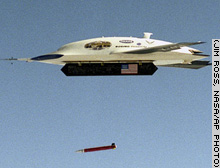
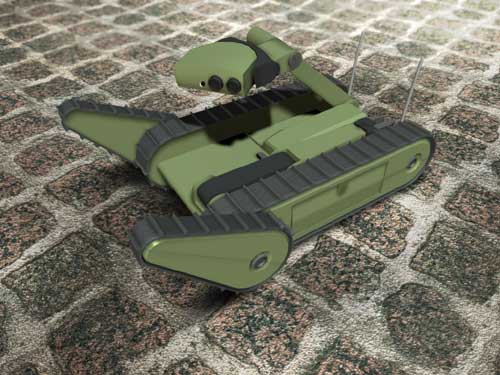
Stand-Off Weapons A further use of nukes is in disposable X-Ray lasers. Imagine a small nuke. Put a cylinder of carefully designed rods around the nuke. Light off the nuke. What happens - hopefully - is that the nuclear explosion bombards the rods with highly energetic gamma rays. In the instant before being destroyed by the explosion, the gamma rays cause the spontaneous emission of X-ray photons in the lasing rods, creating several X-ray laser beams. Instead of an expanding sphere of radioactive death, you get a several lances of highly-focused X-ray death. Initial research for these weapons was done back in the eighties for SDI. While those tests were inconclusive, something like this should be possible. A weapon of this nature would be rather amazingly powerful, and could be fired without giving away the precise location of the launching warship. (And, of course, it would function as a sensor drone until detonated.) Even if the X-ray lasers turn out to be impossible - stand-off weapons will likely form a large part of space tactics. There will be a spectrum of autonomous weapon systems, starting with pure missiles, shading into sensor drone/missiles, and into autonomous weapons platforms analogous to the X-45 we described here. The boundaries between the different types will be vague, and many types will be developed. But I don't think that any crewed warship in a deep space battle will be without robotic surrogates. (Actually, I don't think it will be long before that is true here on Earth.)

Other Weapons Clueless' other comments on possible space weapons are well founded and sensible. I especially liked his thoughts on the use of cannon in space, especially in light of the need to avoid heat - no large power plant would be necessary to fire a cannon. These are the weapons, along with nukes, that we will use to beat on each other as we take our squabbles into space.

Utility of Stealth Technology Reconsidered Steven dismisses stealth technology, and invokes the Second Law of Thermodynamics to defend his assumption. However, there are several factors that I think he is missing. First, all space ships will need to radiate heat, making it possible for enemy sensors to detect them. However, the Second Law does not require my spaceship to radiate heat toward the enemy. If I am not mistaken, it should be possible to direct the radiation of heat toward a sector of the sky not infested by enemy sensors, thus reducing your IR signature. Also, much ingenuity could be invested in coatings, surfaces, insulators, heat exchangers and the like to pull heat from the surface of the ship, and place it elsewhere, out of the direct view of the enemy. And again, space is very, very big. To detect a ship that is trying to be cool, from tens, hundreds of thousands, or even millions of miles away, would require very sensitive IR gear indeed. I imagine that in some respects, fleet movements will be like modern submarine deployments, with heat replacing sound as the deadly giveaway. Non-essential power systems will be turned off until needed. And ships will be cold. They will coast like derelicts until battle is met.

Likewise, active sensor systems like radar will be used only sparingly. Lighting up a radar system powerful enough to detect stealthed objects at thousands of mile distances (remember the inverse-square law) will be like lighting up an enormous "shoot me" beacon. Conventional stealth technology does not render the airplanes invisible to radar. In effect, it makes them smaller - and thus harder to detect. The same technologies (and their descendants) will still be used to render ships harder to detect.

Despite the troubling limitations of active sensors, there is hope. One possible work-around is the use of sensor drones. These would be deployed well in advance of battle, to allow maximum drift from the mother ship. The take from a sensor drone would be piped to the warship by tight beam laser communications to minimize the chance of detection. These could use active sensors without endangering a crewed warship. Also, data from passive sensors on a number of drones could be combined with that of the mother ship to form a much more powerful virtual sensor. Interferometry has been used for decades here on earth by astronomers, and there is no reason to suppose it won't be used in space combat. (I would imagine that each sensor drone will also be a missile. There is no reason not to combine them. Not all missile/drones will have the complete sensor suite, but if you're going to be talking to your missiles to guide them to target, you might as well benefit, intelligence-wise, while it's still around.)

All ships will have their passive sensors working nonstop, trying to detect a warm blob, or a whisper of radio, or the occultation of a star. A warship's powerful radar systems will only be engaged rarely, and only after the commander is certain that his location is already known. It is always possible to achieve strategic surprise - even when the enemy knows where you are. Tactical surprise requires more, or at least different, levels of cunning. With almost dormant, heavily stealthed ships, you could get fairly close to the enemy without detection. Of course, fairly close in space combat will likely end up being the distance from the earth to the moon.

In a little bit, I'll continue with some thoughts on how the stuff I just talked about relates to space strategery and tactics.

Posted by Buckethead Buckethead on   |   § 40

Pots and Kettles

Not wanting to be one-upped by the UN-Oil-For-Kickbacks nonsense, the administration has somehow just managed to appoint Ahmed Chalabi's nephew as the "general director" of the Iraqi war crimes tribunal. What the #$%#%? Is that freakin' insane or what? Iraqis, on the whole, seem to hate Chalabi.

Of course, Salem Chalabi's business partner is Marc Zell, of the law firm Feith and Zell. And wouldn't you know it -- the Feith in "Feith and Zell" is Doug Feith, who is one of the "designers" of this war, at least as far as the parallel Pentagon goes.

How can this possibly make any sense?

Posted by Ross Ross on   |   § 0

How Far Can A Kangaroo Hop?

So they've picked the commission who will try Saddam Hussein for all those crimes against humanity. That's awesome. But who the hell's idea was it to put Ahmad "Mr. Popular" Chalabi's nephew in charge of affairs?

Look, it's important that Hussein get as fair a trial as he can, given that the blood on his hands is more like a giant pool he can swim around in, but Chalabi is a scam artist and including his family on this court raises the risk that the court's legitimacy can be called into question. How hard would it have been to not listen to Chalabi's baseless posturings just once? He's already a walking joke.

Then again, I'm asking this question of the same people who feel that John Negroponte's record is sound enough to put in charge of the whole freaking country despite no Middle East training or experiene, not speaking the language, and a blood-sauna of his own.

Posted by Johno Johno on   |   § 0

Motes, Beams, and The Mighty Sequoia

First, a thought. If you look back at last year's posts on Iraq, and the emails that Ministers Buckethead, Mike, and myself exchanged before that, you'll find that I opposed the libervasion partly because I feared that the US would screw it up royally, making matters worse for us here in the US. Not that I didn't see the good that could come from the action, but I felt the stakes were too high not to think things through.

Well, they didn't think things through. Many mistakes were made in the run-up and aftermath to the libervasion-- the disbanding of the Iraqi army, many of whom are shooting at us from behind trees and inside mosques, a wild overestimation of the readiness and capability of Iraq's oil infrastructure, firing the guy(s) who asked for more troops to provide security, etc., etc. That rather pisses me off.

But there is a worse alternative: giving the job to the United Nations. Before the war, the UN opposed any action in Iraq, requesting that weapons inspectors have more time to do the voodoo they do. At the time, I took this as a reasonable, albeit doggedly bureaucratic, tack to take. But the breaking Oil For Food For Large Bags Of Cash scandal (covered at length here by ABC News) makes me think otherwise.

It is now clear that the UN was and is rotten with corruption, and that even such halting work as it can do under the best intentions and clearest administration is now useless. They can't be trusted. That is a terrible shame. I am a great believer in the need for an organization like the UN as a counterbalance to the extreme alternative, a nakedly dog-eat-dog world in which nations all fend for themselves. A little red tape and stifling regulation on that scale is preferable to a free for all, in my opinion, but not if this is the way they are going to do business.

Just look at this partial list of who received oil bribes from Iraq.

Russia
The Companies of the Russian Communist Party: 137 million
The Companies of the Liberal Democratic Party: 79.8 million
The Russian Committee for Solidarity with Iraq: 6.5 million and 12.5 million (two separate contracts)
Head of the Russian Presidential Cabinet: 90 million
The Russian Orthodox Church: 5 million

France
Charles Pasqua, former minister of interior: 12 million
Trafigura (Patrick Maugein), businessman: 25 million
Ibex: 47.2 million
Bernard Merimee, former French ambassador to the United Nations: 3 million
Michel Grimard, founder of the French-Iraqi Export Club: 17.1 million

Canada
Arthur Millholland, president and CEO of Oilexco: 9.5 million

Italy
Father Benjamin, a French Catholic priest who arranged a meeting between the pope and Tariq Aziz: 4.5 million
Roberto Frimigoni: 24.5 million

United States
Samir Vincent: 7 million
Shakir Alkhalaji: 10.5 million

United Kingdom
George Galloway, member of Parliament: 19 million
Mujaheddin Khalq: 36.5 million

Egypt
Khaled Abdel Nasser: 16.5 million
Emad Al Galda, businessman and Parliament member: 14 million

Palestinian Territories
The Palestinian Liberation Organization: 4 million
Abu Al Abbas: 11.5 million

Qatar
Hamad bin Ali Al Thany: 14 million

Libya
Prime Minister Shukri Ghanem: 1 million

Brazil
The October 8th Movement: 4.5 million

Businessmen, statesmen, ambassadors, men of prominence, and (shockingly) the Russian Orthodox Church and a Catholic preist. A massive embarassment to the world community.

And yet the UN is the body that John Kerry wants running Iraq instead of the USA, as if Doc Ock would run Fort Knox better than Spider-Man. I'm no fan of Bush's foreign policy (indeed I think it's terrifyingly dangerous), but Kerry's seems just as stupid, if not even more so. Just who the hell can I vote for in November who won't make me feel like taking a shower afterward?

Posted by Johno Johno on   |   § 16

Bad Music for Bad People

Now! Newly updated and revised, 4/21!

Blender magazine's new issue contains the latest volley in an increasingly tiresome but still lively debate: the 50 worst songs ever. According to this USA Today coverage, the Blender top ten are

1. We Built This City Starship 1985
2. Achy Breaky Heart, Billy Ray Cyrus,1992
3. Everybody Have Fun Tonight, Wang Chung, 1986
4. Rollin', Limp Bizkit, 2000
5. Ice Ice Baby, Vanilla Ice, 1990
6. The Heart of Rock & Roll, Huey Lewis & The News, 1984
7. Don't Worry, Be Happy , Bobby McFerrin, 1988
8. Party All the Time, Eddie Murphy, 1985
9. American Life, Madonna, 2003
10. Ebony and Ivory, Paul McCartney, Stevie Wonder, 1982

Man... I wish I could find absolute fault with this list, but that's hard to do given the eminent suckitude of each song in the top ten. "We Built This City" is indeed a worthy contender for the title of worst song ever. Nonetheless I personally have a hard time finding "City" worse than, say, Extreme's "More Than Words," Aqua's "Barbie Girl" (reportedly also on the list), or the entire recorded output of Supertramp.

I wonder what metric they used to put this list together? Well, I have some proposals! (Read on: there's a few dick jokes, some graphic revenge fantasies, and some deeply ridiculous angry conviction)

[wik] BTD Greg has his own list up, and no overlap with mine. Just shows to go ya how much bad music there is out there.

The USA-Today piece notes that novelty songs, or songs that aspire to nothing more than shlock, don't rate as "worst ever" because they don't aspire to anything more. I can agree with that. So, no "Who Let The Dogs Out" or "Macarena."

But how do we decide that Madonna's excrescent "American Life," released just last year, is worse than the Starland Vocal Band's "Afternoon Delight" or Debbie Boone's "You Light Up My Life," which have more than half a century of sick-making between them? I argue that long-livedness should play a part. I seriously doubt that Madonna's "American Life" will ever surface again, but on any given night, at any bar in the more thinly populated areas of the USA, you stand an awfully good chance of enduring "Achy Breaky Heart."

Then, how do you decide what's worse between an established artist who makes a shitty single (e.g. Madonna's "American Life," Billy Joel's "We Didn't Start The Fire," Stevie Wonder/Macca "Ebony/Ivory"), otherwise innocuous artists who have an unlooked-for chart hit with a horrible song (Bobby McFerrin, "Don't Worry, Be Happy," Wang Chung, "Everybody Have Fun Tonight") and artists who seem to exist only to fester (Limp Bizkit ("Nookie" aside), Billy Ray Cyrus, Starship)? Madonna, Stevie and Paul all have towering achievements to their name, and in my opinion, one bad song from them-- no matter how shit-your-pants embarrassing it may be-- is still better than any song from shlockmeister supremes like Jefferson Airplane's third incarnation, Journey, or Debbie Boone. The flukes are the wild cards: competent bar bands like Huey Lewis who succeed beyond their talent, one-hit-wonders like Wang Chung, and arthouse mediocrities like Bobby McFerrin.

So. We can leave Madonna, Stevie Wonder, and Paul McCartney aside, no matter how I may personally feel about "Ob-la-di."

I would also axe the merely incompetent. So: goodbye Eddie Murphy. Ditto the merely innocuous who punch above their weight. Goodbye Huey Lewis.

Now that I have cleared the field of all but the most serious of contenders, here is my personal, highly idiosyncratic, and dyspeptically jaundiced list of the ten worst songs of all time.

1) Debbie Boone. "You Light Up My Life." Apart from lovesick thirteen-year-olds Christian girls crying into their heart shaped pillows at four-color Tiger Beat centerfolds of Leif Garrett (and the housewives they grew up to be) nobody can honestly claim this song is anything but an affront to all that is good, decent, and holy. More than anything else in the history of the world, this song's fanbase are an absolutely persuasive argument in favor of a rigorous program of enforced eugenics.

2) Billy Ray Cyrus. "Achy Breaky Heart." Made the mullet and dancing in formation fashionable once again. Hey Billy! Those were my people you did that to! My people, the good, honest upright briarhoppers, hillbillies, and piney-barrens homesteaders of the world who, if they only had a chance would groove to AC/DC and Steve Earle, but now wear big stupid hats and listen to your progeny. Cyrus is also to be blamed for collateral damage: the line-dancing craze, the meteoric rise of so-called "country" music machine-tooled for the minivan set, and making pasty drug-taking sons of bitches like Merle Haggard, Johnny Cash, and my main man George Jones into pop-culture footnotes for the entire decade of the 1990s.

3) REM. "Shiny Happy People." The same band that crafted such monuments of messy genius as "Radio Free Europe" and "Belong" stumbled bad. I can't find much to say about this song except that I hate it. The worst part (for me) is that it's still a staple of the Adult-Album-Alternative radio I tend to listen to, and therefore I am subjected to this overmedicated pap far more often than is healthy for the members of REM. Someday vengeance will be mine.

4) .38 Special. "Rockin' Into The Night." The Blender list wisely chose to cut out the "low-hanging fruit" of the awful music of the 70's, but some offenses are too egregious to bear. Three years after the punk revolution broke, .38 Special still felt fine about putting out a song whose chorus ran "Rocking into the night, rocking into the night." So... you gonna rock into the night or something? The single most boneheaded of all butt-rock songs, first among a thick field of worthy contenders.

5) Starlight Vocal Band. "Afternoon Delight." Although part of that terrible era Blender wisely ignored, this song's recent resurgence via an inexplicable retro-fondness for the worst parts of the 1970s and films like "PCU" and "Good Will Hunting" renders it eligible for the list. Of all the songs ever recorded about sweet love in the afternoon, this is the only one that makes me wish I could cut off my own penis in protest. Or maybe cut the penises off the Starlight Vocal Band's male members. That's a healthier way to think of this.

6) Marcy Playground. "Sex And Candy."
7) Live. "Lighting Crashes."

These two picks represent all the worst aspects of the Alternative movement of the 1990s. "Sex and Candy" is simply the very worst song I have personally ever heard, though it seems to be quite the popular item among millions and millions of my peers. A more rational mind would conclude that they are right and I am wrong, but that's what they said about Jesus before they nailed him to a tree, and look how far it got him! I hereby announce the establishment of a new religion: the Church of Fuck Marcy Playground.

As for Live, they make it on here because they took a great song with a lovely hook and sound and threw lyrics over top of it that include the line, "The placenta falls to the floor." Nice, guys. Next!

8) The Doors. "Hello, I Love You." Somehow Jim Morrison, in between drunkenly waving his dick around and acting all pretty, got himself rated a poet. A poet! "Hello, I love you/ won't you tell me your name. / Hello, I love you/ let me jump in your game." A poet! "Hello Mother. I want to fuck you." A poet! "There's a killer on the road/ his brain is squirming like a toad /Take a long holiday/ let your children play." A poet! "Hello, I Love You" is the sound of the most overrated band of all time pushing Four Roses and calling it Champagne. Makes me want to dig up Jim Morrison's corpse just so I can pee on it while singing "Riders on the Storm."

9) "Do Ya Think I'm Sexy?" Rod Stewart. The great, the inimitable Rod the Mod burned up an entire career's goodwill with this turd. Worse, this song represented a nadir from which Stewart would never recover, a huge loss to the world's sleazy rock well-being. Nothing more to say, except that the Revolting Cocks cover of the tune is priceless, with an extra verse about the nameless couple realizing they have to buy a rubber and some KY.

10) This space intentionally left blank in honor of all the thousands of songs I'd like to include but can't, ten being a conveniently round number and all. Pat Boone. Jazz guys trying rock. Jess Roden's godawful version of "On Broadway" (Doors trivia: Roden was on the band's short list to replace Jim Morrison when Jim took the dirt nap. Why the hell are the Doors so famous?). Alicia Bridges' "I Love the Nightlife," the song that proved that if disco wasn't dead, it was shooting dirty heroin in a Chelsea bathroom with a shotgun in its mouth. Candelbox's lone hit. There are so many, many, more, but I will leave you now with just three words: "Cold." "As." "Ice."

[alsø wik] Allison, commenting at Begging to Differ, notes that Lee Greenwood's "Proud To Be An American" just might be the worst song of all time. Fie on me for forgetting! She's right.

Number 11 with a bullet) Lee Greenwood. "God Bless the U.S.A." The anthem of knee-jerk patriotic Rotarians everywhere. No other song in the world has done so much to make me not only ashamed to be American for the three minutes it's playing, but to wish fervently for a Chomskyite hairshirt-wearing America-hating putsch JUST SO I never have to hear that trash again. Or, I could just go cut off Lee Greenwood's penis, for all the good it would do.

Posted by Johno Johno on   |   § 11

Flying Robot Learns to Drop Bombs

Despite my well-known propensity to comment on rap lyrics, this story is not about a robot learning to rhyme. Rather, it is the next stage in the eventual enslavement of mankind.

Those treacherous quislings at the Boeing Corporation have designed a flying robot capable of dropping GPS-guided bombs.

image

The first bomb was a non-explosive test munition, but it landed inches from its target, demonstrating the lethal capacity of this new robot. Displaying a frightening lack of regard for the future of a free humanity, Boeing Chief Operator Rob Horton said, "It's absolutely a huge step forward for us. It shows the capability of an unmanned airplane to carry weapons."

The test mission was conducted under human supervision, but the robot handled all the details. The X-45 is almost completely autonomous, flying and attacking without need for human control. A person is still in the command and control loop - the robot must receive authorization before delivering its munitions. Of course, it is only a simple step to remove that person.

Horton, who was sitting 80 miles from the target, authorized the drone to drop the bomb, which was released from 35,000 feet as the plane flew at 442 mph.

The military sees such aircraft taking part in its most dangerous missions, such as bombing enemy radar and surface-to-air missile batteries, in order to clear the path for human pilots.

The Y-shaped, tailless plane has a 34-foot wingspan and weighs 8,000 pounds empty. It is the first drone designed specifically to carry weapons into combat.

Other robotic planes, including the Predator spy drone currently being used in Afghanistan, have been modified to carry weapons. Boeing hopes to build hundreds of the X-45 planes, which would cost $10 million to $15 million each.

Of course they would.

[wik] here are some more UCAV links.
 

Posted by Buckethead Buckethead on   |   § 2

Per-Capita Income vs. Household Income

Laura writes on the income issue. She's discovered a census bureau paper with an interesting take on the income issue. Because I think there is a good chance it was my comment that got her to do it...

Hello, Laura! There's a good possibility that I am the commenter who inspired you to write this article. I've written quite a bit about the income distribution issue, and have quoted the Piketty/Saez paper often. For some additional historical perspective, there is an IRS study that tells us about income tax rates and how they have changed, over many decades. Saez has an additional paper which analyzes the mathematical effects of tax policy.

You've got a good find here. Read on...
I need some time to digest it, but here's some food for thought:

1. P and S specifically address this issue in their paper. What they indicate is that for the purposes of calculating income, the changes in households (decrease in the number of persons per household) holds roughly even across all income levels. That is, poor and middle class folks have about the same change in household size as rich folks do.

2. What we're talking about here is whether we're really "better off" than we were 30 years ago. By the median income measure adjusted for inflation, 99% of Americans are not. Their income levels have stayed almost constant. You make the argument that _per capita_ income is a better measure of how well off we are, and by that measure things have improved quite a bit; certainly far in excess of 4%-6%, depending on time frame. You also say that while the top income earners have seen dramatic increases in their incomes, per capita income has not remained flat, and that in the median, we are better off. I hope I have accurately represented your position.

Under debate is the following proposition: Tax policy over the past thirty years has resulted in improved circumstances for the median US person. I say it has not; I'd prefer not to characterize your position on that proposition directly, as you haven't addressed it.

The general discussion of whether we are better off or worse off, independent of government policy, is a different argument and has a different set of variables. The per-capita income argument is interesting, but has these flaws, in my opinion:

1. To a very large degree, smaller households are the result of cultural change. Government policy has probably had a minimal effect. If tax policy had not changed, we would still have smaller households.

2. It is distinctly possible that at some point in the future, the size-of-household trend might reverse itself. This would lower the per-capita income rate.

3. Taxation rates on our median individual are very important. The income numbers we are discussing are before taxes. An example: the Social Security Administration gives us a table of social security rates over time. We can see from this table that in 1969, the household income was reduced by about 9.6% (4.8 + 4.8). By 2003, this has risen to 15.3% (7.65 + 7.65). Tax rates have risen substantially over the time frame we are discussing. I'm not sure if that effect has been taken into account in the inflation adjustments.

4. The short-term effect of a drop in the number of persons per household may be beneficial in terms of income per capita. The backside of that is the forthcoming baby-boomer retirement. Taxes will have to rise dramatically, or benefits be cut, to preserve the system we have in place.

5. Employment to population ratios have altered over the time frame, as well. Using the tools at the BLS site, I'd say that we've seen roughly a 5% increase in employment to population.

6. Other forms of taxation have also risen dramatically (state, local, property, fees).

7. Maintaining a house is maintaining a house! Anyone who's had a roommate knows that it's a lot cheaper to share costs. Far more people today maintain their own households, and thus forgo the opportunity to share costs. This brings higher per-capita incomes into focus -- people need to be making more, per person, to maintain the same standard of living as before.

My sense of it is this: Income per capita is a poor way of judging how "well off" we are. The dramatic drop in "married with children" homes is a primary driver; that coupled with dramatically higher numbers of women working makes income per capita too squishy to work with.

And it's besides the point -- we're trying to figure out if tax policy has resulted in higher incomes! Tax policy has resulted in a drop of the top rate from over 90% (which was paid by only 500 taxpayers in the entire nation) way back when to the current top rate of 38.6%, which is paid by over 500,000 taxpayers (from the second Saez paper). The general trend has been a tremendous flattening of the tax system. We have pushed the tax burden "down" the income scale; the idea here is that this will lead to increased economic performance, which will "float all boats".

One of the most striking quotes from the Saez paper:

"Top income shares within the top 1% show striking evidence of large and immediate responses to the tax cuts of the 1980s, and the size of those responses is largest for the very top income groups. In contrast, top incomes display no evidence of short or long-term response to the extremely large changes in the net-of-tax rates following the Kennedy tax cuts in the early 1960s."

Very recently detailed studies have become available that show us what's really happened with household income. Using them, we can see that the supply-siders were just flat-out wrong. The huge tax cuts generated little other than massive increases in wealth for the recipients. While we were cutting these top tax rates, tax rates at the bottom and in the middle have been rising to compensate. The predicted effect of across the board increases in income simply did not materialize.

The statistic I would most like to see is after-tax income, broken down into per-capita and per-household measures, in inflation-adjusted dollars. Maybe there's a way to get there with the information sources I have.

Posted by Ross Ross on   |   § 2

Nebula Awards, uh, Awarded

You can go here for the full details. The only winner that I read (saw) was the winner for best screenplay - which went to the Lord of the Rings: The Two Towers. As further evidence of how completely out of touch I am, I barely recognized any of the nominees or winners. I need to stop reading antedeluvian sf like Norstrilia, and read some new stuff.

Coraline, the winner for best novella, is the only Gaiman book I haven't read. I suppose that will be next on my list.

Posted by Buckethead Buckethead on   |   § 0

Awwwww yeeaah! Everybody in the house say, "Nothing washes off our disgrace but revolution and ston

According to Palestinian DJ Saadeh, it's assassination season on the West Bank, which means his business is booming. In the bizzaro-world of Palestinian society, assassination season is the time for big, fun parties!

It's a time for gathering with friends, enjoying the cameraderie of your fellow rubble-dwellers, exhorting your young people to get themselves killed, and- Allah willing- take out some Jews while they're at it. And no block party is comlete without a killa DJ.

"Yeah yeah, party people in da house... yo yo just the ladies now, 'Revolt, revolt, revolt. Revolt with stones!' "

Posted by GeekLethal GeekLethal on   |   § 3

Sad but Probably Overdue

CBS News is reporting an HIV scare in LA's porn community. Apparently this is only the latest such outbreak. Porn talent tested positive a few times in the '90s, and then, as now, a sort of quarantine was imposed while who had scenes with whom (and whom and whom) was sorted out. New production has been suspended in the meantime.

You know, I had some pithy remarks about... well, about this. But in retrospect I just can't seem to work up humor or snarkiness over people with HIV, be it people in porn, trucking, advertising, insurance, whatever.

But all in all, I have to admit I'm surprised this doesn't happen more often.

Posted by GeekLethal GeekLethal on   |   § 2

Friday Morning Funtime Rant

It was 4 AM and I was awake. I'd had one of my standard dreams, it woke me up, and I spent the next half hour thinking about it. And other stuff too.

Before I go any further, please cleanse yourself of any references to "Apocalypse Now", "Full Metal Jacket", "Platoon", "The Deer Hunter", "China Beach", "MASH", "Sgt. Rock", "Nick Fury", and each and every one of his Howlin' Commandos.
First and foremost, I'm awfully young to have served during either the Korean or Vietnam Wars. At the outside, I could have been conscripted to go to Vietnam when I was 2, the year conscription ended, but my martial skills were not yet recognized at that tender age. Second and midmost, an awful lot of boomer-generated media communicates the message that combat vets, particularly Vietnam-era vets, are fucked up and psycopathic, which is dreck. Third and aftmost, I'm not a combat vet and do not pretend that my experiences whilst in the armed services in any way mirrors what soldiers experience in combat. I was in during the Gulf War but the 3ID never left Germany. At least, not as an entire division it didn't.

OK, on with the dream: This was standard dream A1, which over the last 2 years I have about 3-4 nights in 5. I used to get it before that, but not as often. In dream A1, I'm still in the Army, either having recently reenlisted or never having left. Typically in A-series dreams alot of folks I was close to then are still around. Usually we are in the same unit as we were then, and often hold the same rank, all of which is entirely inplausible. The dream, I think, is more about reconnecting than anything else, not having seen these men in so long and being happy to be in their company again. Usually when I wake up I'm sad they're not here.

Now, this morning's A1 dream got me up around 4. And I started thinking about how I felt during Gulf War 1. The pics of protestors in the paper ticked me off, but there was an uncertainty in the air that I wasn't comfortable with. It had nothing to do with whether we'd win the fight- believe me- it was how things were at home that could really get people off mission and into a funk. Funk like introspective and taciturn, not funk like supabad.

See, soldiers, including members of all service branches, want to know that what they do is valued by the people they are ostensibly serving. That the profound sacrifice they make is respected and understood by the wider population. And lemme tell you, when I came home on leave and saw how things were here, I'd give this country a B-. Tops.

It's not about yellow ribbons, although that's nice. I saw plenty of private displays like that, and am seeing them again since 9-11. Which I like. But what is absent are public representations, public displays of support and understanding that communicate what a broad section of the population feels, together, en masse, and not the onesies and twosies of "support our troops" bumper stickers. Displays like that were largely absent in 1990, and they're largely absent now.

But I'm not necessarily talking about billboards or advocating for continuous parades. I mean, particularly for the media, to treat this whole situation as a war, a bona-fide, thunderbolts from Zeus and sword of Ares war. Today, as then, it's just another story, no different on the page from the piece on welfare reform, grade inflation in the Ivy League, and the goddamn weather, bracketed by upswings in fighting. Of course increased violence is newsworthy, but why are ongoing operations within this conflict rarely reported, or relegated to to lesser sections of the paper if covered at all?

You know what would be nice to see? A paper treat soldiers with some goddamn respect, and not as fucking stories. Run some major articles on what they do, and who is doing them. You could do it without running afoul of OPSEC restrictions. And hey, it's even easier because the leads are already there: the command element runing the military side of things in Iraq puts out many press releases every single day discussing who's doing what and where. Why do I have to go to a Pentagon website, or freaky Free Republic, to read them, not the so-called "paper of record" or its minion agencies?

What a soldier in the field needs to know is that he or she is valued back on the block, CONUS, the Land of the Round Doorknob, the World, home. We can put up all the bumperstickers, yellow ribbons, and flags we want, but such singular gestures have little impact. The only way to communicate with them in great numbers is via journalistic media, but it shows no interest in the task. And that's a fucking shame.

But hey, the weekend weather looks promising...maybe I'll wash my truck and take in a movie. I think the movie listings are at the back of section D, just before that paragraph about Army Special Forces soldiers building schools in Afghanistan.

Posted by GeekLethal GeekLethal on   |   § 5

Buh-Bye

The Buckethead clan is heading west, to attend a wedding. So, no more muddleheaded and aimless bloviating 'til Monday. You'll have to limp along with the pithy and wise commentary of my comrades. Wait, that was suppossed to be the other way around...

Posted by Buckethead Buckethead on   |   § 0

Ten Problems With the Current Tax System

Only ten, you say? Chris Edwards has a list of ten problems he sees with our current tax system. Most of this is fairly obvious, but it is rather disturbing to see it all at once.

I'd add to his list the problem of tax withholding. This is the big con, that allows the government to get away with confiscatory taxation. If you had to pay, as I have, all your taxes at once - you'd never think of it the same way again. When the IRS takes a little bit each paycheck, money that you never see, it's relatively painless. Like the frog/boiling water concept. You think, "wow! I'm getting money back!" if you have a refund. Of course, you're not. But if hundreds of millions of people had to write a check equal to a third to a half of their yearly income on this day, you'd have a tax revolt immediately after.

Posted by Buckethead Buckethead on   |   § 3

Athenian Democracy Taxation Scheme

What if you could decide how your tax dollars could be allocated? How would you divy up the government's share of your income? More money for butter, or guns? Food stamps for whales, or send the Marines to Mars? James at Outside the Beltway links to an article by Charles Murray posing that very question.

I've thought about this before, and even posted this on the subject, though I'm too lazy to find the link. I think that a system like this would be hideously complex to implement. It would wreak havoc on the smooth functioning of the government, since budgets could be subject to wild swings tax dollars follow the fickle whims of the taxpayers. It might even be unconstitutional, since the Legislature is given the power to disburse funds from the treasury.

However, it would also be really cool. It would be a stupendous demonstration of faith in the common people. Lobbying would take on whole new forms, and arguable far less corrupt ones. Special interest groups would actually have to convince real, individual people that their particular hobby horses are the ones that deserve money. Groups of citizens could organize to direct funding to favored projects. Public involvement in politics would (alright, might) soar as people follow the projects they sent their money to. Think of the pride you would feel when you see a mars probe that you funded lands and starts poking the Martians in the belly. Or when a bomb that you funded blows up an enemy compound. And so on.

You'd have to allow some flexibility though - something on the order of a discretionary fund that would allow the government to maintain funding of secret projects, and of projects that got zeroed out by the populace but are deemed important enough to be maintained. Citizens could also be given the option of putting their money in this fund, or assigning one of several default distributions.

But I think that Charles and James are right that a large percentage of the funds would be pointed in the direction of tangible government services. And I really can't think of a downside to that.

Posted by Buckethead Buckethead on   |   § 0

The Bleat on 9/11 Movies

Lileks speculates on why we won't be seeing a 9/11 movie:

And that’s the problem. I wonder whether Hollywood execs shy from a 9/11 movie because they think it might send the wrong message.

It would anger people anew, and we’re supposed to be past that. It would remind us what was done to us instead of rubbing out noses in what we do to others – I mean, unless you have a character in the second tower watching the plane approaching and saying “My God, this is payback for supporting Israel!” it’s going to come across as simplistic nonsense that denies the reality in the West Bank, okay? It would have to tread lightly when it came to the President, because even though we all knew that he wet his pants and ran to hide, we’d have to pretend and do scenes in Air Force One where he’s taking charge instead of crying help mommy to Dick Cheney, right? I mean the idiots in flyover people believe that stuff, and you’d have to give it to them or they write letters with envelopes that have these little pre-printed return address stickers with flags up in the corner. Seriously. Little flag stickers. Anyway, we would have to show Arab males as the bad guys, and that’s not worth the grief; you want to answer the phone when CAIR sees the dailies of the guys slitting the stewardess’ throats? And here’s the big one: if we make a patriotic movie during Bush’s term, well, it doesn’t help the cause, you know. People liked Bush after 9/11. Why remind them of that? Plus, you can just kiss off the European markets, period.

Richard Clarke’s book is available? Here’s a blank check. Option that sucker.

It’s like it's 1943, and Hollywood turns down a Pearl Harbor movie in favor of the gripping account of a Washington bureaucrat who warned FDR that the oil embargo would needlessly anger Japan. The attack on Hawaii would take up five minutes – and even then it would be a shot of the hero listening to the radio with an expression of stoic anguish. If only they'd listened.

Posted by Buckethead Buckethead on   |   § 3

Great and Terrible News

We here at the Ministry of Minor Perfidy are known to have a more-than-casual interest in giant fighting robots, preferably of the space variety. There are many reasons for this-- we are geeks, we like things that fight, we all remember Robotech fondly. But ultimately, we are fascinated by the prospect of giant fighting robots because of all the inventions of humankind, from the wheel down to the George Foreman Grill, the Pocket Pussy, and online gambling, giant fighting robots are the one system bound to fail more catastrophically and wreak more horror than any other in history.

And yet the brainiacs persist. Wired has news that iRobot, a company founded by MIT graduates, expects the US Army to field battle robots within ten years or so. Does anybody else wonder whether MIT has become a slave to its own inventions, that in some gigantic sub-basement in East Cambridge, deep underneath the Great Breast of Knowledge, lies a giant array of Cray supercomputers, sentient and malevolent, bent on its own cunningly subtle plans for world domination? Is it just me? Yes? Well.

The military is already using iRobot employeesproducts in the Middle East to conduct remote searches inside caves. What does the future hold?

Some of the robots that are being developed may also be used to shoot at human targets, iRobot suggested. But the company said SUGVs will provide advanced reconnaissance first. The company does not want to be seen as putting human soldiers out of business.

Robot vision systems have serious limitations, and the risk that a robot might kill an innocent civilian is too great, said iRobot CEO Colin Angle.

But Angle did not rule out the eventual use of weapons on robots, and noted that Raytheon is developing a targeting system for the SUGV.

"We're not using these robots to hand out flowers," Angle said.

Fantastic. Give the robots a network and guns. Shit, might as well call it SkyNet and face the inevitable. Despite the happy name and benevolence of "iRobot," which calls to mind a future filled with flying cars, robotic servants, and galactic empire, these men are the doom of the planet. We must act now and swiftly to ensure that these fighting robots never gain the advantage. I for one do not want to live out my days as a lubrication attendant for some despotic robot overlord.

Click the "more" link to see the new hotness in apocalyptic peril!
image

Posted by Johno Johno on   |   § 7

And that, my liege, is how we know the world to be banana-shaped

Via Marginal Revolution I find this very puzzling article from the New Scientist which contains speculative evidence that the universe is shaped something like a funnel or straight horn.

They are not sure yet whether this is just a statistical anomaly, but I'll be waiting to hear.

This is nutty. Not only would this imply that the universe is bounded, but moreover at some points it would have finite volume. And then, of course, there's the question of dimensions... Oooh I'm all a-twitter!

At some point, faith, science, and gibberish are indistinguishable.

Posted by Johno Johno on   |   § 0

I Dunno, GL... How DO You Hurt a Frog's Feelings?

By having right-wing papers make up stuff about them, of course!

French ambassador to the US, Jean-David Effete...er, Levitte... claims that last year's media shitstorm against France for supporting Saddam was "racist".

The ambassador says that media efforts to denigrate France and Frenchmen was racism akin to that directed against "blacks and Jews", and that it was deplorable that a defamation campaign directed at those populations would get immediate and furious response, yet no one was overly concerned when similar venom was spat at France. Well Monsieur Ambassadeur, that's because there's little basis for comparison between racism, as the word is currently used, and nationality, you fucking nitwit.

And besides, when did "French" become a race, in the way we discuss race today? Am I supposed to infer "French" is included in the "Other" block on my census form? Let's see... black; hispanic, non-white; hispanic; white; native aboriginal...hmmm.. no French; I guess I'll check "other".

Unless he's refering to a Gaullic master race, of purer Aryan stock than mongrel Americans.

Posted by GeekLethal GeekLethal on   |   § 10

Virtual Mayhem, Bon-Fide Nostalgia

Took a day off yesterday from my real job to finish work on a side job. Once that was done, and before I started another side job, I decided the time was ripe for frivolity. And since payday was nigh, and I needed a new printer cartridge, and soon found myself in my local electronics retailery, I decided not to leave without a new game.

I opted for Aliens vs. Predators: Extinction , a real time strategy game that combines the carnage of the associated flicks with the frustration of units wandering about will nilly, characteristic of RTS. Not so much strategy, some tactics, but there's not alot of true command here so the tactics really don't go much beond ensuring a good mix of trigger-pullers and support people. At least for the Colonial Marines; I've not tried the other species yet. And more often than not, the fight is over before I can really see it all on the screen- the action's just that fast. One neat touch: I saw this in the tutorial- the predators get extra points for collecting skulls. All the sounds effects are true to the flicks, inluding the pulse rifles, the motion trackers, the Alien screeching and bursting, and yes the ripping out of skulls.

But before I left the store my eyes happened to fall on the Midway Arcade Treasures compilation. It was cheap, and I had to have it. Again, the sound effects were dead on, just as I remember them, and curiously it was the sound more than the look that really opened the nostalgia floodgates. I remember what people wore ca 1980-1984, the sights, the smells of the arcade... it was really a whole lot of fun. You know the best part though? Being able to continue at will. It's like having unlimited quarters, my dream when I was 12 years old. Even though I didn't necessarily need a reminder of how much I suck at "Defender", it was kinda neat to be reminded that I do.

Posted by GeekLethal GeekLethal on   |   § 2

The First Draft of Propaganda

Here is a peek at the New York Times' front page photos from the period 6APR2004-13APR2004. That period reflects the opening rounds of the operations against Al-Sadr. I don't have yesterday's or today's edition.

Consider the following:

6APR: M1 to the right and mid-range in photo; woman crossing street in front of it. Implied malevolence toward women by combining the symbol of the ultra lethal machine with the symbol of the frail, weak. Life taker against life bringer.

7APR: Marine loading dead Marine, in body bag, into Humvee. Beneath, another pic of 2 armed men, energetic, members of the "Mahdi Army". Implication: Marines dead or sullenly defeated as they police their dead; Mahdi Army in action, relentless.

8APR: Navy corpsmen bringing wounded Marine on stretcher to waiting UH60. Beneath, pic of Marine's torso and arm, enough to see holding rifle, closeup. Background, hooded bound prisoner in mechanic's pit. Implication: Marine casualties serious; bottom pic, juxtaposition of huge size and huge weapon from close-up, vs small frail person, made small and, therefore, weak by distance from photographer. Implication: bullying. Lowest pic: Group of ~10 Iraqi men, apparently cheering, 3 visibly armed. Implication again of great numbers, victory, energy.

9APR: Rice testifying at 9-11 commission

10APR: Man grinning, gleefully brandishing pair of US-issue boots he claimed to have retrieved from fallen soldier from ambushed Army supply convoy. Implication: Population is against us

11APR: Old pic of damaged USS Cole with 2 9-11 hijackers.

12APR: Marine in foreground, again proximity to camera makes him large or looming; in middle distance, group of children and woman gathered in doorway, made small by distance. Implication: implied malevolence toward women and children by large, bullying Marines.

13APR: 6-7 Iraqi men looting a burning supply truck. Implication: the entire population is against us.

This small sample demonstrates the astonishing disconnect between the public perception of battle and the reality of combat operations then underway. Given that most of the American public has never served in any capacity, let alone in combat, it must rely on media for all of its information regarding the armed forces. The Times has taken to this task with gusto, allowing the reading public to perceive the American effort in Iraq an utter defeat.

Posted by GeekLethal GeekLethal on   |   § 8

The 'Three-Block War'

George Will discusses Marine General Charles Krulak, who is the son of Marine General Victor Krulak, who we have been discussing in relation to the CAP program in Vietnam. Will talks about Krulak the Younger's (sounds like a character in a bad fantasy movie) theories on modern warfare, which he describes as the 'Three-Block War':

In today's conflicts, he says, you can have a Marine wrapping a child in swaddling clothes. And a Marine keeping two warring factions apart at gunpoint. And a Marine in medium- or high-intensity combat. It can be the same Marine, in a 24-hour time frame, in just three city blocks.

"You can't," he says, "defeat an idea with just bullets -- you need a better idea." But first you need bullets. You need, Krulak says, the enemy "to be petrified," as were the Germans who gave U.S. Marines a name that stuck -- "devil dogs" -- as a term of respect when, at Belleau Wood, Marines blunted the Germans' 1918 drive on Paris.

There is a heart-rending ingenuousness to U.S. efforts at amicability, even to the point of encouraging Marines, before they entered Fallujah last month, to grow mustaches, as many Iraqi men do. Shiloh, where almost 24,000 Americans were casualties, was where both sides in the Civil War lost their illusions about its being a short and not-too-bloody war. After Fallujah, it is clear that the first order of business for Marines and other U.S. forces is their basic business: inflicting deadly force.

Posted by Buckethead Buckethead on   |   § 0

It's 1920 all over again

Niall Ferguson offers an historical perspective on the recent difficulties in Iraq. It seems that the British had some difficulties when they occupied the region in the wake fo the Great War. A while back, Military History Quarterly (I believe) had a fascinating article on the campaign that led to the British occupation of Baghdad, but I was unaware of the level of casualties that the British sustained after that.

Posted by Buckethead Buckethead on   |   § 2

Earn Big Money, Win Fabulous Prizes

The Instapundit has a good article up at TCS, looking at the reasons why the X-Prize is getting results.

The money quote is from X-Prize founder Peter Diamandis:

The results of this competition have been miraculous. For the promise of $10 million, over $50 million has been spent in research, development and testing. And where we might normally have expected one or two paper designs resulting from a typical government procurement, we're seeing dozens of real vehicles being built and tested. This is Darwinian evolution applied to spaceships. Rather than paper competition with selection boards, the winner will be determined by ignition of engines and the flight of humans into space. Best of all, we don't pay a single dollar till the result is achieved.

Faster, please.

[wik] The title of this post has been changed. I completely forgot, and did not notice until just now, that I had never changed the boring auto-generated title to one of my trademark half clever personalized titles. It will never happen again.

Posted by Buckethead Buckethead on   |   § 0