Filthy Lucre

Money is the root of all evil. And the trunk. And the branches. And the leaves.

Finally, someone has a plan

Not a good plan, to be sure. But certainly too much time on their hands:

The objective of eScrew.com is to destroy Capitalist system of governance. Many people tried to destroy Capitalist system before but all of them failed. The reason for that is their luck of understanding of Capitalist system. If you can find the heart of Capitalist system, you can find a way to destroy it.

Cheap energy is the heart of Capitalist system. Expansion and conquest is the direct result of cheap energy. If we can destroy cheap energy we can destroy Capitalism. In order to destroy cheap energy we must increase the demand for cheap energy to a point where supply will not be able to deliver the goods. As a result energy will become expensive. Expensive energy will decrease the stability of Capitalist system and launch a fatal chain of events which eventually will destroy Capitalism.

Read the whole thing here. I checked out the address, but it only says "Under Construction," with a note that, "I created new religion but I will not tell you anything about it because it is my secret."

[wik] Believe it or not, I happened upon this drivel (entertaining drivel, but still drivel) whilst I was looking for information on gmail. I shouldn't have been surprised, seeing as how the two are so intimately connected.

Posted by Buckethead Buckethead on   |   § 2

A tip for success as a venture capital-backed entrepreneur

It's not listed in the article as the biggest determinant of success, but it seems to play a large part, and it's a concise, if not particularly easy-to-follow suggestion:

Be an immigrant

The article's actual title is "Immigrants Have Founded 1 in 4 Public Venture-Backed Companies in the U.S. Since 1990", but mine's shorter, pithier, and more memorable. I guess that means that unless the Democrats are successful at undoing the pretend-planning that's been done on the southern border fence, we're going to see a dearth of new venture-backed startups. And yes, that's called "leaping to a possibly unintended conclusion".
 

Posted by Patton Patton on   |   § 8

Early predictions of election fallout

From a WSJ dispatch delivered to my inbox 5 scant minutes ago:

Big Pharma Catches a Chill

Fears that Democrats will tackle drug pricing caused shares of pharmaceutical companies to slide, even as analysts cautioned that Democratic control of the House is unlikely to bring much immediate change for the industry.

My initial thought was "Good". My next thought, really just an amplified version of the first, was "Fuck 'em". But defining "'em" isn't necessarily as easily done as you might think.

A wise reader could intuit that I don't own any pharmaceutical stocks. That wise reader would be wrong, as it turns out. I own shares in Pfizer. But my view of Pfizer or any other pharmaceutical stock is separate from my view of the the economic relationship between the citizens of the US and their drug pushers. There are good companies with bad stocks, and vice versa. I presently like Pfizer's stock, but may not continue to do so. I don't like the industry, however.

If, by some freak of useful government action in the 110th Congress, our legislative overlords were to attempt to remedy the fact that US citizens pay exorbitant prices for drugs, I'd be hugely in favor. Do I think the drug companies make too much money? Nope, not overall. Do I think they make too much money from US citizens? Yep.

Part of that is the fault of some combination of drug company marketing and a peculiarly American desire to do with drugs what others do without. But a meaningful part of the mismatch is an indirect subsidy levied on Americans to pay for rock-bottom prices granted to other countries' citizens. No, it's not done out of the goodness of the drug companies' hearts - they negotiate prices with virtually all of their customers. All, it seems, except those in the US. The fact that they don't generally have to negotiate much at all inside our borders frees them to enter into aggressively negotiated deals elsewhere without shedding too many tears.

If it takes an act of Congress to get the rest of the world to pay the market rate, then so be it. If this results in other countries' citizens paying more for their drugs, then tough shit (though I'm sure there's a drug for that!). And if that market rate, or market resistance to it, has some initial detrimental effect on the drug companies, so also be it. A large component of the differential between US health care spending (as a portion of GDP) and that of the rest of the world is comprised of us paying for their drugs.

I hope the "analysts" referred to in the Wall Street Journal article are wrong. Godspeed, Pharma-bashers. 

Posted by Patton Patton on   |   § 2

No, the options backdating scandal's not yet over

For those lucky souls who know nothing about the current options backdating scandal, please skip to the next post, because I'm not willing to bore you with the details.

I am, however, willing to bore you with this:

This morning's WSJ contains an article entitled "Cablevision Gave Backdated Grant To Dead Official"

Cablevision awarded options to a vice chairman after his 1999 death but backdated them to make it appear they were awarded when he was still alive. Cablevision restated its results as an options probe escalated.

I'm trying to picture the response from the PR person at Cablevision. Something like, say, 'Oh, don't worry - they were way out of the money, since we didn't figure he'd complain' or 'We spoke with his lawyer and were informed "No, no, 'e's uh,...he's resting."'

Yes, this scandal has officially become Pythonesque.

Posted by Patton Patton on   |   § 0

Blogging as a money making venture

Selectively true at best, I'm sure. But some allegedly smart money seems to think so:

HuffingtonPost.com – New York, NY; a provider of a left leaning political news and blogging site; $5 million; Series A; Greycroft Partners, Individuals, Softbank Capital Partners.

Go "Zsa Zsa"! Or would "Eva" be the more apt analogy? (I don't remember Magda well enough to know whether the caricature is still fitting)

Posted by Patton Patton on   |   § 0

Here's one for Mapgirl

Mapgirl is on a quest to become more frugal, save lots of money, learn about finance and take over the world. To help her (and any other frugal wannabes amongst our readership) become more frugal, I offer this tutorial on dumpster diving.

[wik] Added note for Mapgirl: knit sweaters are not appropriate for dumpster diving. Nor are open-toed sandals. Dive away!

Posted by Buckethead Buckethead on   |   § 3

Mapgirl on Lucre

Somewhat belatedly, a link to Ministry Crony Mapgirl, who hosted the 51st Carnival of Personal Finance during Perfidy's recent interregnum. Since she asked nicely, go, read, and become wise in the ways of personal finance.

[wik] Also, wish her well in her budding romance with her new, fancy youngin'.

Posted by Buckethead Buckethead on   |   § 2

On petrol prices

The one magazine (though they prefer "newspaper") I read each week without fail is the Economist. I never question why it's been one of my habits for so many years, but if I ever did, an article lead-in like this would provide the answer:

IN THE film “Zoolander”, some male models stop to refuel their car and, just for fun, spray each other with petrol (gasoline). One then lights a cigarette. They all die in a vast fireball. The film-makers appear to believe that male models, though beautiful, are stupid. When it comes to crafting policies to deal with the price of petrol, American politicians appear to believe the same thing about voters. Except that they do not think voters are beautiful.

The entire article, entitled "Politics and petrol prices - Much ado about pumping" is well worth reading.

Sadly, it's not one of the handful each week that the Economist makes available other than to subscribers. It's a good enough article that, were I incorrigible, I'd just post it here. But, being corrigible, I can't see stretching fair use that far, lest I break it. So I'll summarize the points they laid out in the article, most-but-not-all of which were known to me before I read it. (Since I'm paraphrasing and summarizing, of course, I'll be tarting it up, too)

  • Politicians are smarmy pencil-dicks who prefer to be seen to be doing something than actually to be doing something.
  • This affliction is not unique to either side of the aisle.
  • Regardless of your biases and the biases of those you read and listen to, the primary driver for gas prices is the price of crude oil.
  • Taxes in the US make up only 18% of the price of fuel, compared to 67% in Great Britain.
  • Prices are more volatile in the US because (according to the Economist), fuel is not taxed as heavily as it should be. To the Economist's moderate consternation, not even Algore is stupid enough to be calling for such heavy additional taxes.
    This is an argument they've long made that I disagree with - whatever externalities they think any tax so collected will offset, giving the self-same pencil dicks from #1 above access to any other revenue streams would be profoundly retarded.
  • The US is still short about 10% of its refining capacity due to last year's hurricanes.
  • The additive MTBE is no longer mixed with gas in "Texas and several eastern states" - its function was to reduce smog and pollution.
  • Turns out its other function was as a carcinogen, so the industry switched to ethanol to help with the smog problem
  • Ethanol can't be mixed with gasoline and sent down pipelines, because the two tend to separate
  • As a result, there's been a backlog in ethanol deliveries, as separate infrastructure was needed to deliver it closer to the point of sale, where it could then be mixed with the gasoline.
  • Gasoline demand in the US is finally heading down
  • Within two or three years, sufficient refining capacity should be available to avoid supply shocks such as those caused by hurricanes Katrina & Rita
  • The government predicts that gas prices this summer will average about $2.71/gallon, which is less than current average prices

Of the bullet points on that list, there are at least four that were news to me. I leave it as an exercise for the reader, but only in a time of extreme boredom, to guess which those were.

And, because the wrap-up to the article is almost as good as the intro, and does a passable job of condemning of the politicians who feign both competence and respect for the intellect of their betters, the voters, I'll quote it here for your reading convenience:

For the most part, Americans are responding rationally to the high price of petrol. Suppliers supply more; consumers consume less. Politicians, however, take it as an opportunity to bluster. The House of Representatives has passed a bill barring “price-gouging”—that is, making it a criminal offence to charge more for petrol than some bureaucrat deems appropriate. This is popular; 69% of Americans even favour price controls. But in the long run, it would reduce the incentive for firms to invest in supplying petrol to Americans, and so would raise prices at the pump. With luck, the bill will die in the Senate.

Both parties tout their determination to free America of its dependence on jihad-fuelling foreign oil by some conveniently distant point in the future. Neither, however, proposes anything that might plausibly accomplish this. House Republicans passed a bill last week to allow oil drilling in Alaska's Arctic National Wildlife Refuge, which would help a tiny amount at best, and in any case is highly unlikely to get through the Senate.

Both parties say they wish to promote ethanol, not just as an additive, but as a fuel in its own right. In practice, this means a futile attempt by government to pick promising new technologies, plus fat subsidies for midwestern corn farmers while cheaper Brazilian ethanol is kept out with tariffs. Lawmakers could free the ethanol market, but many would rather drive their SUVs to a petrol station a block away from their offices for a photo-op denouncing Mr Bush and Big Oil.

Posted by Patton Patton on   |   § 0

Movin' on up

Well, maybe not to that deluxe apartment in the sky. But the Buckethead has secured new and more remunerative employment, and will be leaving the comfortable if unchallenging realm of the government contractor for the fast paced results-oriented world of the commercial sector. I will leave the humid and dank lowlands of the Justice department for the sunny uplands of a small consulting group. My early experience in a small start up several years ago was without question one of the most rewarding and fun times I've ever had at work, and I hope that this job will prove to be the same. And thanks to the extra money, my son won't have to get a summer job. Good for him, because the only jobs available for three year olds are either degrading or not well paid.

One key benefit for me in this new gig is that I will be able to work at home for a good portion of the working week. The reason this is key is that it will allow me to reasonably take on short term and part time gigs that were just not feasible when I had to be at the job site every day during business hours. You can't easily or indeed legally take a conference call for another gig when you're sitting in a government office cubical, and taking off time a couple times a week to tend to your side gigs quickly becomes suspicious. Now though, I can do that sort of thing without interfering with the main job.

While I have some feelers out for those part time and short term writing jobs, I would certainly appreciate any leads that you, my loyal readers, can give me. So you know, I have nearly a decade of experience as a technical writer in the software field, writing manuals, supporting documentation, help systems and web copy. Of course, I also have three years experience as a world class blogger. What I'm looking for is technical writing gigs, and journalism-type gigs in the software industry press. Any help will of course be greatly appreciated, and will certainly merit prominent mention in these pages.

[wik] Thanks to Nicholas for pointing out some word use issues. While you're thanking him for the quality of this post, go encourage him to post more than once a month, on average.

Posted by Buckethead Buckethead on   |   § 3

Women make too much money

Tigerhawk links to a Forbes article that reveals that, once controlled for hours worked, tenure and other factors, women make 17% more then men. It turns out that there are twenty-five factors that lead to women earning less overall. Men make decisions that result in their making more money. On the other hand, women make decisions that earn them better lives (e.g., more family and friend time). However, when men don't have families - they often make similar choices that make them less money. Interesting stuff, though I sometimes wish my wife made 117% of what I made, so I could stay home and, I don't know, blog or something.

[wik] Tigerhawk also talks about Harvey Mansfield and the firing of Harvard President Larry Summers. More interesting stuff.

Posted by Buckethead Buckethead on   |   § 3

A bucket of cash saves ass

Ministry Crony Mapgirl is a useful little blogger. She shovels out the personal finance info with both hands, and is undoubtedly helping thousands to conquer the soul draining terror of indebtedness and lack of sound financial planning. Yet, I find that I miss the gossip and angst of the old mapgirl blog.

For instance, this useful post on a marvelous concept called "EBoC." The Emergency Basket o' Cash. Being who I am, I would change that to Bucket o' Cash, but your mileage may vary. The old Mapgirl would have layered this post with obscure references to people I might have heard of, and hinted at how someone, at some point, someone I may or may not have met and is only identified by initials or codename, once may have had need for an EBoC and a fast car.

Still and all, its good advice. Having a bucket o' cash can come in awful handy. Having it directly to hand, as in physically in a bucket in your home, is even more handy. For example, if the zombies come. Now, in all likelihood, the zombies will start out small. In the interim between the first casualties, ignored by the media and also by all right thinking people - but before the inexorable exponential curve of zombie population growth leads to the total collapse of civilization - having a bucket o' cash will be a very useful thing indeed. With a cold, hard, cash, you can buy essential items for your zombie survival kit that you had up to that point neglected. Items that the foolhardy will not yet realize are essential, and will for the sake of greed part with.

For example, Minister Johno is sadly negligent in acquiring sufficient firepower to deal with the looming zombie threat. However, should he have access to a ZSK EBoC, he could (once alerted to the arrival of the zombies) run down to the local gun nut lair and purchase a weapon and ammunition. Money will be useful almost right up to the total collapse of civilization, simply because most people will refuse to believe that civilization is in fact collapsing. Use that delusion for your own benefit. Besides, you wouldn't want some sap who'd rather have a thousand bucks in crisp twenties than a finely machined shotgun and a bag full of ammo at your back anyway.

So, even though Mapgirl was unwilling for the sake of appearances to discuss this crucial aspect; follow her advice, or have your brain eaten.

[wik] I wonder if we could get Tyler Cowen to discuss the inflationary aspects of the money economy intermediate phase of the zombie takeover.

Posted by Buckethead Buckethead on   |   § 7

Supremes: No Longer Necessary to Choose Between Paying the Loans or Starving

Because you can starve, you slacker.

The US Supreme Court has ruled that the gubmint can seize a person's social security benefits to pay off defaulted federal student loans. Sorry, brother- it's dog food and the Goodwill dumpster for you until those loans are settled.*

There is no mention though of being able to opt in to a social security payoff plan. I figure it like this: I don't believe I'm getting one red centavo of social security to begin with. Either the whole program will be defunct, or the retirement age will be like 104 before I can apply. So I would welcome an opportunity to affirm, today, that I authorize the US Department of Education to take the x-thousand I owe you out of my social security benefits.

Please?

Let me keep the coupla hundred I pay you monthly and you can have everything I've paid in so far. That'll about even us right up, and if it doesn't, help yourself to the difference when it's my time to collect.

*Apropos of an earlier post, the man in this suit worked at the post office yet was carrying $77k in student loans. To paraphrase Bluto Blutarski, "Seven years of college down the drain. Might as well join the fucking post office."

Posted by GeekLethal GeekLethal on   |   § 3

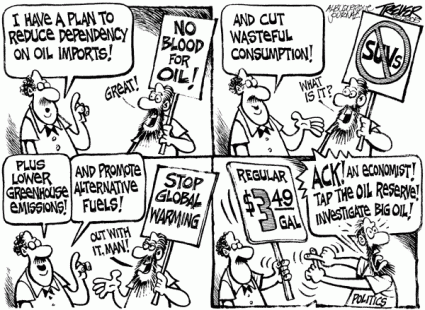
An economist! Shoot!

I can't remember how I ended up there, but I found this amusing cartoon at Russ Nelson's blog:

effing economists with their stupid sensible ideas

(The cartoonist is John Trevor, and he's got other cartoony goodness here.)

Although the cartoon pretty much says it all, that won't stop me from saying more. Market solutions are often invisible, or at least camouflaged. It's not all deregulation and privatization. Since the rise of the computer and internet age, a growing portion of the population (though still small) has come to realize that prices are not just amounts of money, but information.

The reason why price controls and so on don't work is that they are basically lies. Lies on a grand scale. They so distort the information that market prices are trying to transmit to both buyers and sellers that no one can operate normally. Black markets are in one sense back channel efforts to find the truth of what things are worth. Honesty is the best policy.

Posted by Buckethead Buckethead on   |   § 2

Short Buses and Calculators

(I'm reposting this from a comment on Patton's post)

Please.

oil : 70 / 60 = 1.16
local gas price: $3.75 / $2.19 = 1.7

Did the wholesale price of gasoline just rise? We don’t have figures there. If the wholesale price rose by 70%, then the oil companies ARE gouging, because their piplines are full of $60 oil. If the wholesale price has stayed the same, then the stations are gouging the public, by 50% or more. Oh wait—almost all stations are owned by the oil companies. So that’s them again.

Don’t pull out your “short bus” metaphor unless you pull out a calculator at the same time.

Yes, big oil is looting the nation. Per barrel shifts in oil prices have lengthy, delayed effects, not instantaneous market reactions down to the _pump_ level. Psychologically, the oil companies saw the opportunity and took it. They know they’ll have no reaction from this administration, and an innumerate citizenry will...do nothing.

I’ll agree with you on one point—price controls are not the answer here. Nationalizing some of this certainly is. I don’t have a problem with states (or the federal governmen) owning refining capacity and stations. Leave the private sector pirates in place; if they’re truly as “efficient” as claimed, then they’ll be just fine, and no government-run entity could possibly compete with them. They’ll earn their business the old-fashioned way, with lower prices and better service.

Yeah, right.

Hey, fuck it. Doesn’t affect me—it’s just those poor people who are going to have trouble paying the gas bills, getting to their increasingly shitty jobs, as the GOP chops the budget for public transportation into non-existence. 50% of the national guard’s equipment is over in Iraq, and unavailable for disaster relief.

Think about this: This is a much bigger disaster than 9/11. We have potentially (and quite probably at this point) thousands of people dead. We have a major city _destroyed_, mostly by inaction and incompetence at every level. The hurricane left the city generally intact!

And if you think this country has done a great job preparing for “terrorist attack”, exactly what would have happened differently if Al Qaeda had detonated explosives at the levees, instead of the hurricane?

Michael Brown, “director” of FEMA, said two days ago (on Thursday) that he was “unaware” that there were people in the Superdome. The fucking director of FEMA didn’t know that there were thousands of people there.

Michael Brown was Joe Allbaugh’s college roommate. GOP-activist Michael Brown’s prior experience was running the “Arabian Horse Alliance” or some silly bullshit like that. Some reports indicate Brown was “invited to resign” from that job amidst accusations of incompetence.

Brown’s FEMA placed Pat Robertson’s (yes, the same crazy-ass Robertson we know and love) “Operation Blessing” at the number two position on the cash giving list, before the Salvation Army, before just about everything else you’d recognize. Brown’s speeches have him complaining about the fact that he can’t be “spiritual” in public.

I know exactly what kind of “Republican” Michael Brown is, and there’s exactly _nothing_ conservative about this man. He is either a smart man who is a nasty fucker, or he is sufficiently stupid and egocentric so as not to have an understanding of his own deeply _lethal_ incompetence.

Patton, he is not like you. At the heart of it, I _respect_ the conservatism you represent. It’s a conservatism derived from realism, that wants restraint, that wants a government to do less, and give its citizens more freedom. That is a genuine and respectable goal, and when the country votes for it that’s fine with me.

This cabal of entitlement frat-buddies has hijacked the GOP, and this country desperately needs its real conservatives back. Please, please, find some...beg them to come back. There’s little elsewhere to turn.

Posted by Ross Ross on   |   § 8

Short Bus Economics

Anyone with pretense to staying current on the news of the day is going to trip over a lot of tripe, and most tripe isn't worth commentary.

Important ideas & issues, discussed among adults? Sure, I'll opine on those, whether I agree or not with the idea's originator. And sometimes, I'll even become convinced I was wrong. Goofy ideas? Not generally worth the bother of comment, because they're spun out with enough centrifugal force that nothing I can say or do will change the spin for those who encounter the idea after me.

However, I was reminded, via an opinion piece in the Friday Boston Globe, that there's a level of goofy that is worth, nay, demands commentary, even if only for my own sanity.

In the piece, one Derrick Z. Jackson of the Globe fulminates about the looting that's the result of Hurricane Katrina. I was initially prepared to ignore it, because we've seen the "looters", good and bad, in many repeats on the news over the past week, and I didn't care to listen to yet another complaint about how so many African Americans, yet so few persons of pallor, had been shown treating plasma TVs and Nike shoes as base necessities of life. Feh. They'll sort it out amongst themselves, I figure, and no amount of concern on my part will change it. I'd much prefer that time be spent on medicating, housing, clothing, and feeding the victims.

But then I read on, and he's not talking about the good, the bad, and the ugly of New Orleans.

PRESIDENT BUSH yesterday told ABC-TV, ''there ought to be zero tolerance of people breaking the law during an emergency such as this, whether it be looting or price-gouging at the gasoline pump or taking advantage of charitable giving or insurance fraud."

Zero tolerance is meaningless when the White House lets the biggest looters of Hurricane Katrina walk off with billions of dollars.

He's talking about the oil companies, those rotten bastards!

In the midst of this charity, big oil looted the nation. The pumps instantly shot past $3 a gallon, with $4 a gallon well in sight.

That couldn't have had anything to do with the shutdown of roughly 25% of our national refining capacity, or the price of oil, world-wide, rising to $70/barrel, because both of those would just be crazy-talk. So he must have a point, right?

If Bush really meant what he said, he would call for a freeze or cap on gasoline prices, especially in the regions affected most dramatically by Katrina. He would challenge big oil to come up with a much more meaningful contribution to relief efforts.

Insurance companies are expecting up to $25 billion in claims from Katrina. For ExxonMobil, which is headed to $30 billion in profits, to jack up prices at the pump and then only throw $2 million at relief efforts is unconscionable.

Wait a minute, Derrick Z. - I just came back to my senses, and there's a typo in your story. You meant "Carter" where you said "Bush", right? I'm a grizzled-enough veteran of life to remember those days, and they sucked like a Hoover, because the economy did just what economies do when confronted with the bleatings of economic idiots such as yourself who think that prices can be arbitrarily controlled without unintended consequences. Of course they can't, any more than supply can be changed arbitrarily without affecting price.

Price controls never, ever work in the markets for scarce commodities. Ever. And if the government makes it illegal to charge market prices in a market where the non-vertically-integrated producers have only ephemeral control of their raw material costs, then the oil will just go to other markets, such as China, where price is distorted in a complementary manner - gasoline prices are subsidized there, and the people are therefore insensitive to the raw material cost, consuming oil as fast as they can buy the machines required to burn it. Because that's what markets do when you fiddle with them. The act poorly.

Oh, and the bit about ExxonMobil heading for $30 billion in profit this year while the insurance industry is looking at a $25 billion payout for Katrina? Just a coincidence, I'm sure, slipping in that bit about insurance companies, who presumably aren't gouging us on gasoline costs and otherwise have nothing to do with his storyline. But if I didn't know better, Che, I'd think you were sneakily advocating that the oil companies should pay the costs of the damage, rather than those who were actually paid to assume the risk. Word games are funny that way.

My sincere hope is that anyone with at least a high-school quality understanding of basic economics will roundly ignore the maunderings of Mr. Jackson and those in his circle of illiteracy. The alternative is oil shortages and prices that don't come back to earth when market forces say that they should.

And, for the record, for the first time in my personal experience, I paid more than $3.00/gallon for gas on the way home from the office today. My first $50 fill-up in anything smaller than an 18-wheeler, in fact. It pained me at some level, but I understood, and while the ladies at the Diamond Shamrock fell all over themselves trying to explain to me that they weren't just boning me on behalf of their evil corporate masters, I politely asked them to stuff a sock in it, as I already knew that.

Unlike Derrick Z. Jackson, you see, I don't attempt to reshape the observable facts to justify my feelings of victimhood.

Posted by Patton Patton on   |   § 3

What would you do with $70,000,000?

I was just downstairs on a smoke break, and noted that the powerball lottery is up to 180 meeelion dollars. Of course, you’re more likely to be struck by lightning something on the order of 175 consecutive times than to win that money, but its fun to think about what you would do with a windfall of that magnitude. A quick check of the website reveals that the cash payout value is just over a hundred million. Take off a third for taxes, and that would leave you with somewhere in the neighborhood of seventy million dollars. That’s not chump change.

What would I do?

  • I’d buy a Hummer, because I’m going camping this weekend. (Personalized plate: NLB4ZOD)
  • I’d stop at the sporting goods store, and get one of those nifty tents that set itself up if you just ask it nicely. And while I’m there, I’d get one of those Rambo survival knives, just because the cost would only be .000071% of my net worth.
  • Once I’m back from camping, I’d get myself a nice Macintosh computer, because compatibility with the computers at work is not exactly an issue anymore. While I’m at the Apple store, I’d get me a powerbook, an iPod, and whatever other iGadgets catch my eye.
  • Since iPods hold 10,000 songs, and the average CD has what, 13 songs? I’d need to buy 769 and a quarter CDs.
  • I would go to Japan and buy a samurai sword. The kind that takes a wizened Japanese craftsman ten years to fold umpty-thousand times to create the perfect blade. Then, I’d go to the local mall and buy a cheap stamped aluminum rip-off from the Chesapeake Blade and Tzotchke Company. I’d take the hilt and accouterments of the cheapo replica and put them on the real sword, and hang it on the wall. When some asshole sees it, and says, “You won a 180 million dollars and all you could think to do is buy that piece of crap, you nouveau riche idiot?” I could cut his head off with no effort whatsoever.
  • I hate squirrels, so I would purchase a Barrett M82 .50 sniper rifle.
  • I’d need more cars. So, I’d buy a black 1950 Mercury convertible coupe (plate: BLUES), a 1969 Camaro in dark green with a white racing stripe (plate: BTCHN), and a 1955 Hudson limo.
  • I’d pay off all my family’s bills – mortgage, car payments, credit cards and utilities for a year. Some friends would get this treatment, too.
  • I'd go to the art galleries downtown, pick out the ugliest crap modern art, buy it, take it home and build a bonfire out of it.
  • I’d set up a trust fund to pay for the education of all the children in my family, and provide scholarships for lazy, underachieving white kids. (There would be substantial overlap between these two categories.)
  • Beneath a modest mansion modeled after Stan Hywet and Abbotsford House, I would construct the Ministry bunker and catastratorium.
  • For elegant dining and formal occasions, I would get a BMW 760i. Twelve cylinders of ultimate driving pleasure. (plate: BOBSGEO) And an Acura NSX, just because. (Plate: WKNPNUB)
  • World Tour!
  • I’d buy all the books I want. That’s a lot of books. Maybe I’d even buy that book I never heard of that NDR read.

All of that might come to ten million dollars. I’m sure I could live quite comfortably on the interest off of another ten million. What would I do with the remaining $50 million? That’s a no brainer:

I’d buy my own spaceship company.

Posted by Buckethead Buckethead on   |   § 11

Why Tax Policy Sucks

The groovy economist over at the Idea Shop has an interesting post on why tax policy, well, sucks:

There’s a lot of evidence that people aren’t always rational, and suffer from a range of cognitive biases. But thanks to arbitrage, rational people stand to profit when irrational people let prices and wages stray from efficient levels. That’s what justifies the economist’s assumption of rationality—a small number of rational profit-seekers keep markets rational as a whole even when many participants aren’t.

Unfortunately, tax policy has no such mechanism. Tax policymakers suffer the same cognitive biases as everyone else, but the "market" for tax policy—made up of legislators, voters and lobbyists—is much less self-correcting. In traditional markets, bad business practices get pushed out by competition, and bad pricing decisions get corrected through arbitrage. But in tax policy, inefficient tax laws can survive on the books for generations.

Another related aspect of this problem is the asymmetry of the opposing sides. Those in favor of ‘bad’ tax policy (special interests, social engineers, tax accountants and other vermin) are concentrated and focused on their evil work. It is their job to impose these policies on the rest of us, and they have considerable time, skill and resources to devote to that job. Contrariwise, those who favor a simple, transparent, neutral and non-confiscatory tax code (the rest of us) all have day jobs. As attractive as a rational tax code is, and no matter how much we might benefit from such a thing, there are many things that compete for mindshare. For me, the perfectly reasonable and rational tax code is competing with any number of other policy issues, job, time with family, beer and Civ III. The opponents are distracted and diffuse, and so we get the tax code we deserve.

This puts me in mind of something else, too. Different arenas have different time scales. The response time in markets can often be nearly instantaneous. New information immediately affects the price of stocks. In the soi-disant Information Technology Industry (one out of three ain’t bad) the turnover in new software, techniques and indeed people is, shall we say, brisk. In science, things are slower. New paradigms are adopted (so they say) about as quickly as the old generation of distinguished scientists can retire. But the response time of political systems can stretch to centuries.

I’m of two minds about this. On the one hand, bureaucratic inefficiency and glacial response times is bad. The tentative nature and sloth-like vigor of the intelligence reform effort over the nearly five fricken years since 9/11 is a poster child for government incapacity and lack of adaptability. My security questionnaire still had questions about commies on it, for chrissakes.

All of that is unquestionably bad. But, but, what if government weren’t slow? Imagine a government that could reach decisions quickly; create plans and implement them in days; use innovative technologies and management tools to deal with problems in real time. Scared yet? It is well that government’s vast power is balanced by its diffidence and incompetence. In Frank Herbert’s second best novel, he introduces the Bureau of Sabotage. BuSab exists to slow down, interfere with, and screw with the heads of all other government agencies. It is the ultimate citizen advocate, because it stops the government from doing things. In the story, BuSab had its origin in an earlier government that was efficient and fast moving, as well as tyrannical and oppressive. The early BuSab operatives used any means necessary to slow down the operations of this government, and sowed enough chaos that it was able to evolve into a more reasonable and sane government.

Not to be all defeatist, but I think that part of the price of a reasonable government is bad, or at least out-dated policy. Not that we shouldn’t try to reform and improve, but a government that was rapidly responsive to our every need and want would be far, far worse.

Posted by Buckethead Buckethead on   |   § 2