Cry Havoc

War, conflict, and associated frivolity.

The aliens are coming, hooray, hooray

The blessed amazon fairy delivered another load of printed goodness at my doorstep. Typically, the amazon fairy brings me science fiction that is more or less throw-away, enjoyable to read but whose thinks pass in and then out of my brain leaving little lasting impression. Or history tracts that expand or deepen my knowledge of the past without notably changing my opinions of it. But this last deposit was a little different.

The book in the plain brown wrapper was "An Introduction to Planetary Defense, A Study of Modern Warfare Applied to Extra-Terrestrial Invasion." The careful and attentive reader of this website will quickly discern why this title got onto my wishlist. Of the four writers, I had only heard of the lead author, Travis S. Taylor, who had written a few science fiction novels for Baen Books. From the bios in those works, I knew that Dr. Taylor was a bit of a big brain, working for NASA and various defense department projects, including the Breakthrough Propulsion Physics program at NASA before its untimely demise. The name of the book and that last fact was enough for me to shell out the $35.

Was it worth it? On balance, I think definitely yes. There are problems with the book. Let’s get them out of the way first. The book is very poorly edited. There are typos, bad grammar, and poorly formed sentences throughout. That is irritating and distracts from the message the book is trying to get across. The book is poorly balanced, by which I mean that certain points will be attacked in great detail, and the next bit, seemingly of equal importance, will be glossed over. This creates a problem when the authors refer to something that was not adequately discussed further on, and my reaction is a resounding, “huh? Where’d that come from?” That’s the technical side.

On the idea side, I have far fewer problems, and where I do, it’s wishing that the authors had explored a topic a little more, or discussed something they didn’t. More on that (oh, much more. I’m going to go den Beste on their ass) later. Despite the flaws that are, I imagine, the result of what looks like self-publishing, this book is chock full of interesting, thought-provoking meaty stuff.

Why do I think so? Let me count the ways…

In thinking about aliens, two things have always bothered me, and I hoped that An Introduction would address them. The first of these problems is Fermi’s paradox, and the second is the remarkable optimism of SETI researchers. I was happy to see that this book addressed both of them, and in spades.

The Drake Equation

Before we discuss those two things, a brief discourse on the Drake Equation. The Drake Equation is not so much an equation as a means of quantifying ignorance, and adding up the probabilities of intelligent life arising in the galaxy. You start with the number of stars in the galaxy, and multiply that number by quite a few factors. The result is your own personal estimate, N, of how many ETs are out there.

Drake Equation

N is the number of civilizations in the Milky way that have developed systems which produce electromagnetic emissions detectable from Earth. It is equal, then, to the rate of star formation times the probability that the star will have planets, times the number of habitable planets per star times the number of those planets that will develop life, times the number of those that will develop intelligent life, times the number of those intelligent species that will develop means of communication times (finally) the length of time those signals are detectable.

The first two numbers, we actually know something about. The rate of star formation is about 1.5 a year, and we are finding planets everywhere we look, so .9 for that. Number of habitable planets? For us in the Solar System, one definitely, and two maybes – Europa and Mars. Let’s say three. (It doesn’t matter if they’re not all habitable at the same time.) SETI researchers always use “1” for the number of habitable planets that develop life. How many develop intelligent life? Taylor suggests 2/3, fair enough. How many develop detectable civilizations? Taylor suggests a quarter. Run the numbers, and the Drake Equation yields an interesting result.

New, detectable ET civilizations are arising at a rate of one every three years.

Assume we’re off by an order of magnitude. That’s two civilizations per lifetime. A hundred thousand over the tenure of man’s existence on Earth. Half a billion extant in the galaxy right now.

Put in smaller numbers, and the results are still invariably stunning. Assume that only one in a hundred habitable planets develops life, and that only one in a hundred of those develops intelligent life. You still get an intelligent species arriving on the scene every thousand years. The galaxy is billions of years old. 150,000 extant in the Galaxy, right now.

Taylor and company also make some interesting additions to the Drake Equation. They take into account the size of the Milky Way, and calculate the galactic density of ETs. Using Taylor’s numbers, it is .064 ETs per square light year. Or, in a 1000 ly bubble centered on earth, there are 50,000 species. That’s intelligent, technological ETs. Even using my several orders of magnitude more conservative numbers, there are still 15 techno-ETs in local space. right now.

They also add two more factors to the Drake Equation: ft, the number of technological civilizations that go a-traveling, and v, the velocity at which those species can move about the galaxy. Here we get some even more interesting numbers. If we assume that all technological civilizations eventually travel, and that their velocity is a tenth the speed of light, then there are 200,000 travelers within range of Earth. Which means that there is a great likelihood of someone, sometime, visiting Earth. And maybe soon. Maybe next Tuesday. (Taylor provides all the math for this, btw.) You’ll have to read the book to see what his numbers suggest, you won’t believe me. (you can see a good chunk of the book here.)

The sheer number of stars in the galaxy, and the staggeringly long time it’s been around mean that whenever you plug a non-zero number into any element of the Drake Equation, you get lots of ETs, and an uncomfortable number in close proximity. Using my numbers but the same assumptions as Taylor, the likelihood of one of 60 nearby species paying a call on earth is about one visit every 166 years. Now there may be other factors that slow down the rate of visitation – varying galactic geography, randomness of placement, or even that there are even less species than we think. Another primary reason we’ll discuss next.

The chance of first contact is not so remote as we may believe.

The Fermi Paradox

Fermi’s Paradox comes from the question, “Where are they?” that Enrico Fermi asked back in the fifties after some back of the envelope calculations led him to consider that given a constant rate of expansion, it would only take millions of years for an intelligent species to spread throughout the Galaxy. And the Galaxy is billions of years old – if, at any time, an intelligent species had arisen, one might assume that they would have gotten here and, presumably, prevented us from existing in the first place.

This always seemed a fairly reasonable supposition, but it does fly in the face of the results of plugging even the most conservative numbers into the Drake Equation. Taylor and company put the eye on this dilemma and come up with a surprising conclusion. The Fermi Paradox is a crock.

Over the years, the SETI community has come up with several responses to the Fermi Paradox. We could be the first intelligent species. Or there could be any number of insurmountable obstacles to interstellar expansion: it’s too difficult, conceptually alien to other intelligences, or it’s not really a good idea and just not done. Or, it has been done and there is some sort of Prime Directive that restrains ET from screwing with us. Or ET is screwing with us and we don’t know it. Or we’ve simply been overlooked.

Now all of these things are reasonable. Taylor, however, contests the ground under Fermi’s feet. Fermi, in his calculations, used a simple population growth model. However, says Taylor, that isn’t really the best model for imagining intelligent species moving out into the big world. First, no species on Earth ever follows a simple exponential growth curve. Second, intelligent species will likely have different needs and goals, and thus will either defend niches or compete over them within a greater sentient galactic ecology.

Now this gets meaty.

“Nature here on Earth offers many examples where the struggle for existence between two similar species fighting over the same niche (food supply, space, etc.) occurs. Ultimately, one species wins out by causing the complete extinction of the other species. This phenomenon is known as the “principle of competitive exclusion” and was proposed by Darwin in 1859 in his Origin of Species.

“There are also cases on Earth where the “principle of competitive exclusion” is in direct contradiction with some well-known natural phenomenon. An example of one of these natural contradictions is called the “plankton paradox” and is focused on the variability of plankton organisms which all seem to occupy the same niche. All plankton algae use the same niche, which consists of solar energy and minerals dissolved in their native habitat waters. There are many plankton algae species, many more than the different types of mineral components in the water habitat of the plankton.”

Now this seems very interesting indeed to me. A direct analogy, which the authors do not explore – is that plankton are in effect in a space like environment where solar energy is the primary source of energy, and minerals of varying concentrations are available more or less for the taking within their environment. A spaceborne civilization using asteroids, comets, and solar energy to sustain itself and grow could be likened to plankton. One could imagine multiple intelligent races sharing this niche – with the vastness of space making contact fairly minimal. Of course, one might imagine that if plankton were a little more sophisticated, they might hate and attack other plankton that they did run into.

And that leads us to the next bit – a simple exponential growth law would not explain a species expanding into the galaxy and then running into competition. Other population growth laws – in fact, predator-prey models – might explain how well ETs do in the big galactic arena.

“Therefore, the simple Malthusian or exponential population growth as described previously is a drastic oversimplification. Perhaps Fermi’s Paradox is not as paradoxical as it seems. One could imagine that the galaxy is much like Earth with multiple species supporting and competing against each other over various niche resources. Perhaps the society that is a few million years older than us is not preying on us as often as expected because they are defending themselves from predators a few million years older than them. The possibilities are limitless. Let’s hope that we are living in a natural environment, as on Earth, where the coexistence of predator, prey, and other competing species is possible.”

A galactic meta-ecology, composed not of competing organisms as on Earth, but rather of competing intelligent species is possibly the answer to the Fermi Paradox. No species can expand willy-nilly, because of the presence of other species. Like early algae, the first species may have run wild, but ever more competent species will have, over time, engaged in competition. This competition will certainly engage the intelligence and resources of an alert species – which means that in the dark corners, new species will always be coming up to try their hand (or tentacle, flipper, pseudopod, or claw) in the big game.

The reason, therefore, that we haven’t been assimilated may be not that we are the first, or only intelligent life in the galaxy, but that other intelligent life is too busy staying alive to visit every star, or deal with every potential threat. Other species’ lifespans in the meta-ecology of the galaxy might be rather shorter than they would otherwise be, due to competition with other species. Possible aspects of this galactic meta-ecology are left unexamined in the book, which was frustrating to me, as it certainly bears directly on the main question the book is meant to answer. Still and all, a lot to think about, and we’ll be getting back to that in a minute.

Or maybe more than a minute. We will continue in part two.

Posted by Buckethead Buckethead on   |   § 3

You wish to kill a human. Cancel or Allow?

I find, to my embarrassment, that I am utterly unable to top this. The Reg reports on a notional rule of engagement for autonomous killing machines. Boiled down, it's “Let machines target other machines, and let men target men.” But these quotes are priceless:

Many Reg readers will be familiar with the old-school Asimov Laws of Robotics, but these are clearly unsuitable for war robots – too restrictive. However, the new Canning Laws are certainly not a carte blanche for homicidal droids to obliterate fleshies without limit; au contraire.

It isn't really made clear how the ask-permission-to-kill-meatsacks rule could really be applied in these cases.

Which seems to suggest that a robot could decide, under Mr Canning's rules, to target a weapon system such as an AK47 for destruction on its own initiative, requiring no permission from a human. If the person holding it was thereby killed, that would be collateral damage and the killer droid would be in the clear. Effectively the robot is allowed to disarm enemies by prying their guns from their cold dead hands.

As clever as Mr. Canning is in trying to come up with these rules for our lethal robotic servants, in the end the three rules are going to add up to one thing: if it is human, kill it.

Posted by Buckethead Buckethead on   |   § 0

"Journalists are sort of the natural enemy of Special Forces"

Or so sez Carston Stormer in his second installment in Die Welt. Apparently he is touring Iraq with American forces and writing about these half crazy warriors, their war movie existence, and "extinct" cities like Fallujah. At times the trip really seems to be a vehicle for Stormer to write about himself, but that's really nothing unusual in modern journalism is it?

The short version of the article is that he was waiting for a helicopter by himself, reading a book. After a bit a soldier walks up, seemingly to wait for the same ride, says "God bless you", and sits on the ground next to him. Hilarity ensues.

In my sole interaction in a quasi-journalistic fashion with Special Forces, they were nothing but helpful and professional. Now, I was working for a guy who was there at the invitation of unit leadership. But I think that's nominally beside the point. The fact that Stormer's understanding of SF lies somewhere between a war movie and mythology is enough for you to understand his limitations.

My translation below the fold. For a cleaner version consult with NDR or your local native speaker.

Jesus and the Special Forces

It is said that soldiers of the Special Forces shoot first and ask questions later- which is usually unnecessary by that point. Journalists to these men are “scum”.

Have you ever seen an American war movie? Black Hawk Down or Jarhead? If you haven’t, it’s really not so bad. You see bold men, with full beards and weatherbeaten faces, burnt brown, without uniforms but heavily armed. That is the Special Forces. They jump with precision behind enemy lines, riding on horseback through the desert, a saddlebag stuffed full of dollar bills. So soll schon manch ein Kriegsfürst umgestimmt worden sein (you’re on your own with this turn of phrase, sorry).

In Germany the Special Forces are called the KSK (Kommando Special Kräfte). No one knows exactly what they do, everything is secret. It is said that they shoot first and ask questions later- which by then is usually not necessary. It’s best if one treats it like buffalo- without looking it in the eyes. You might try to photograph them once; at best you’ll lose your camera.

The other day I was sitting on the airfield in Baghdad, waiting for a helicopter and reading Axel Hacke. The sun shone, a nice winter day in Iraq. I was sporting a beard. And I was burnt brown, since when I was home in Germany I took a couple sessions in a tanning bed- the better to hold my endorphin levels (?) in balance on gray winter days. But otherwise, I had nothing in common with members of a Special Forces unit. So anyway that was my look- fatigue pants, bulletproof vest, and smoking a Camel.

After a while a soldier came over and planted himself next to me in the gravel. “God bless you”, he said. I nodded and, unsolicited, he told me his life story.

That he was depressed after returning from the the first Gulf War. That he never again wanted anything to do with war. So he got out of the Army. Stupidly he took to drinking, and it cost him his wife. One night Jesus appeared to him in a dream, two weeks after the United States & co marched into Iraq.

“Rejoin the Army, my son”, Jesus said. “Go to Iraq and convert the unbelievers to the True Faith. That is your mission.” He listened. “Jesus was my rescue.” But He had concealed that Muslims make unwilling converts. That’s why you have to kill so many of the guys, said the soldier. It’s really pretty frustrating- but it’s the only way. Then he asked what I did for the Army- Special Forces? Private security?

Journalists are “scum”

“What? No. Journalist.”

“Uups.”

He didn’t run away, but he didn’t say anything more to me, either. Just took another quick drag on his cigarette. A few moments later another guy sat near us. Beard, khaki pants, M-4 machinegun. And he said “Buddy” to me. He too immediately began to chat about his life. The fact that I was trying to read a book was of no interest to either of them.

He said, “I was in the Special Forces for a time.”

“Sir...“, said the one to whom Jesus had appeared, to the other. “Sir...“ No reaction.

It’s a shame that I’m too old for that sort of work now, the bearded one continued. The hip, he said, still has shrapnel in it. Souvenir from Afghanistan. That’s why he’s now with a private security firm. Convoy security, that kind of thing. “Good money, very good money.“

“Sir!“, quacked the other one next to me, this time emphatically. “Sir!“ No reaction.
Then he told me a good deal of the funny and secret details of the hunt for terrorists behind enemy lines.

“So,” he asked me, “What’s your mission in Iraq, buddy? Special Forces? Marines?“

“Ahhh…”, I said.

„Siiiirrrr, now listen up“, said the first one. „That is a J-o-u-r-n-a-l-i-s-t.“

Journalists are sort of the natural enemy of the Special Forces. Or is it the other way around?

Silence.

“Scum,” he said, the one who’d called me “Buddy”, and both men disappeared.

The whole thing was a little unpleasant, and in the whole time I had hardly said a word.

Posted by GeekLethal GeekLethal on   |   § 0

The Civil War is so interesting, nyah

The Maximum Leader, my go-to source for blogging inspiration these days, has written a longish bit on why he thinks the Civil War is bollox. ML claims that the Civil War is interesting, at best, in a purely tactical sense, or perhaps as a parade of amusing incompetence on the part of the Union generals. Now, I for one am not going to say that hundreds of thousands of Civil War round table participants, re-enactors, historians and others have wasted their lives in such a tragic manner.

In fact, I find the Civil War fascinating in large part exactly because of many of the things the Maximum Leader finds icky and bad-smelling.

The wars’ end was a foregone conclusion. Well, let’s let the odds makers decide and not run the race, what? The Greeks, faced with the unprecedented size and strength of the Persian army, should have just rolled over. But Marathon, Thermopylae, Salamis and Plataea proved that the side facing the short end of the materials and logistics stick is not normally foredoomed to failure. Granted, the safe bet is, as Napoleon remarked, on the side of the biggest battalions. But the safe bet is not always the winning bet.

Many of the Confederate leaders were well aware of Greek history, and in fact made conscious analogy between their cause and Sparta. This, considering the lot of the Messenian Helots, and the eventual fate of Sparta once the Thebans got sufficiently pissed off at them, was an ironic choice of historical model. Lee was certainly aware of the material advantages of the North, yet he and his army fought anyway. That is historical drama of the best sort.

What-if’s. The Civil War has, more than any other war, been the fount of what-if scenarios. (Read any good alternate WWI stories lately?) The underdog south came close – if not to winning outright – to putting a serious spoke in the Union’s wheel on several occasions. And the margins that saw them fall short were often short indeed. The south got the cream of the US military leadership, and they eked out every last bit of potential from the Rebel armies. Few could argue that the south missed its chance for lack of trying.

It was not until late in the war that the North even had commanding generals worthy of the name – Sherman, the only real strategic genius in the war, and Grant, who was dogged, determined and tactically skilled enough to actually put the Union armies’ advantages into battle, no matter what the cost. The most fertile ground for speculation, therefore, is in the earlier stages of the war, when southern advantages in leadership and elan gave some chance of overthrowing northern advantages of numbers and supply.

Most of these what-ifs focus, typically, on Antietam and Gettysburg. If the orders hadn’t been lost before Antietam, surely Lee and Jackson could have run wild through the north. Or Gettysburg, which is often called the high water mark of the Confederacy. Those are wrong, however. I think the most interesting turning point is Jackson’s depression in the seven days.

The thing is, the south was looking for its Thermopylae, and got it in hundreds of battles, small and large, where they slowed or even stopped but could not destroy the union army. And always at heavy cost of irreplaceable Confederate soldiers. What they needed was a Salamis, the titanic gamble that paid off in the annihilation of the Persian Army. Which is what Lee almost had in the Seven Day’s. McClellan had fallen back from Richmond; and Lee, finally in command, was pushing the Union troops down the Peninsula. He was aiming at a colossal envelopment, and he needed Jackson to bring the other arm home. If Jackson had done so, the entire Army of the Potomac might have been destroyed or captured. But Jackson, uncharacteristically, was not as aggressive as he was in the Shenandoah, or at Chancellorsville. The pincer didn’t close, and the Union Army was able to escape.

All of these what-ifs are endlessly fascinating mostly because the war should have lasted about three months and ending in total Union victory. The very fact that the able Confederate military leaders were able to prolong the war so long in the face of numerous Union advantages is remarkable – the achievement of the impossible. It is almost irresistible to think, that with some change, they might have pulled off their Salamis.

Foreign involvement. I largely agree with the Maximum Leader’s professor in thinking that it would have taken an extraordinary confluence of events to cause France or Britain to become involved in the Civil War. The fact is that it served both of their interests to see the United States divided, or at least exhausted by internecine warfare. France’s ambitions in Mexico, and Britain’s more global interests, both were advanced by America self-destructing.

The reason it would have taken a unique set of circumstances to see foreign intervention is that two things would have to happen: a signal Confederate victory that would make at least diplomatic recognition reasonable, and something to overcome the continental power’s distaste (in Britain’s case, extreme distaste) for the South’s “peculiar institution.”

One thing that nearly did it was the Trent incident. The Federal Navy seized a British Mail Steamer carrying two Confederate diplomats. This violation of British sovereignty rather exercised the Brits. If it had been followed, a few months later by a victory in the Seven Days’ Battles, we might have seen British diplomatic recognition if not actual intervention. By Antietam, I think it was already too late, and Lincoln learned from the Trent Affair not to piss of the Brits.

Lee. All of the major military figures in the Civil War were flawed, well, because they were human. They are interesting because of those flaws. Jackson, a religious fanatic. Lee, the good man who chose the wrong side. Grant, the drunk who overcame the drink. Sherman, the depressive who was the most brilliant strategist of the war. WWI is not interesting in the way that the Civil War is largely because there are no contending minds on the opposing sides. The story of the war is the story of innocents thrown to the slaughter by the millions, for marginal gains and little strategic purpose over four years, to achieve a (nearly) Carthaginian peace that led inexorably to even greater slaughter. It’s depressing. The Civil War, while certainly not absent immense slaughter (the slaughter was all that the technology of the time could manage, and more) saw strategic contest, a conflict of wills that is inherently fascinating.

In the early stages, the brilliance of the team of Lee and Jackson is balanced by the frustration and tenacity of Lincoln. But as the war drew on, in the west arose Union commanders the equal of the best the Confederacy had to offer. The narrow window of opportunity for the South to make use of its advantage in leadership passed, and Sherman and Grant caught Lee in what is really the largest envelopment in military history, with Grant as the anvil in the north and Sherman coming up from the south as the hammer.

All of this would be fodder for the military enthusiast – and it is, of course. Jackson’s valley campaign, Sherman’s march to the sea, the duel between Lee and Grant – these are all celebrated campaigns that are studied in military academies throughout the world. What makes it all so endlessly fascinating is the moral dimension of the conflict. Now, most of that has been overlaid over what was thought by the participants at the time. Lee certainly didn’t feel that he was fighting solely to preserve slavery. From our perspective, however, it is a story of good v. evil, freedom v. slavery. A story made compelling by the lack of personal evil on the part of many leaders on the “bad” side, and by the incompetence, greed, insanity, drunkenness or timidness of many on the “good” side.

That, my friends, is good historical drama. Again, contrast with the Great War. Both sides were imperial powers leaping into war with no real thought for the consequences. Destroying, nearly, a civilization by accident, and in the process killing millions for no gain and in the end not resolving anything, in fact, setting the stage for yet more destruction. The leadership of the Allies was no more honorable, good, competent or nice to puppies than that of the Central Powers. There is little to distinguish the two sides, and that makes the war about as interesting as watching someone punch themselves in the face. Sickly amusing for a moment, but after a while you just want it to stop.

Anyway, that’s why I like the Civil War, and why the Maximum Leader is wrong. But at least he’s wrong in an interesting way.

Posted by Buckethead Buckethead on   |   § 7

Austria Trains Chinese Mountain Men

No, there is no Chinese analogue to "Jeremiah Johnson".

Die Welt is reporting that the Austrian military recently conducted mountain warfare training for a clutch of Chinese officers.

The feds claim that the training really amounted to survival in alpine climates, with general mountaineering, constructing improvised shelters, operating without a supply chain, and the like, and without a direct combat training portion. A small group of Hungarians and Montenegrins also attended, and the whole exercise fell under the rubric of recent EU-China military cooperation agreements.

Those opposed in the Austrian gubmint are a-froth, however, claiming that these officers' new training can only be applied in Tibet and in the context of special operations forces, light units operating beyond their supply line in hostile terrain.

I don't think I'm being overly cynical if I believe it's both, although the article headline- "Federal Army Trains Chinese Military"- overstates the event a bit. By which I mean, alot. And further concerns that Austria would now be complicit in human rights abuses in Tibet is also a touch overstated.

There was a somewhat similar flap years ago when Germany was all set to sell Turkey some... I believe they were Leopard IIs, which might have been a fairly straightforward arrangement between two allied powers, but some people were bent out of shape about it for fear that they would be used to kill Kurds.

But I think that if you're going to be in the business of arms sales- which in the Austrian example includes training- then I think people need to understand that that weaponry or training might actually be applied someday. Maybe even soon.

Posted by GeekLethal GeekLethal on   |   § 0

Gulp. This could be "fixin' to get interesting"

As they say in Texas, anyway.

From Saturday's UK Telegraph: Israel seeks all clear for Iran air strike

Israel is negotiating with the United States for permission to fly over Iraq as part of a plan to attack Iran's nuclear facilities, The Daily Telegraph can reveal.

I know that such things as war-games, scenario planning, and clearing access to intervening airspace are required, even in a case where the likelihood of an actual bombing run is 0.01%. Left unclear in the news story linked above, of course, is any indication of said likelihood, let alone the chances of such a mission meeting its objective.

I prefer to think it's just posturing, for several reasons.

First, while sanctions are generally slow in achieving their aims, and cannot be counted on, in any event, to do so, they're initially more efficient, in lives and other costs, than popping a cap in a sovereign country's metaphorical ass. Outright war should be a final resort, and when it occurs, should be conducted in a fairly ruthless manner, designed to position the end of the war as close to the start as possible. Iran's nuke program should be halted, for a host of good reasons, but in a rational world, it's not yet clear that anyone should lose their life in order to effect that halt.

Second, if there's any contentiousness in the negotiations, and the poo hits the propellers, I'd hate to see a new sub-genre created, wherein there's a conspiracy theory on a level with the approximately 273,000 Google hits available for the "USS Liberty".

"We are planning for every eventuality, and sorting out issues such as these are crucially important," said the official, who asked not to be named.

"The only way to do this is to fly through US-controlled air space. If we don't sort these issues out now we could have a situation where American and Israeli war planes start shooting at each other."

Blue-on-blue action is among the last of the things needed, presently, or ever. I'm sure that some who remember the Liberty would, rightly or not, be tweaked by the possible recurrence of such a scenario.

Finally, and contrary to the claims from many quarters, in and out of Iraq, the US is not the colonial master of Iraq. Israel had better-damned-certain be negotiating with the Iraqi government at least in addition to, if not rather than the US. I'm thinking that's a trickier negotiation, however.

[wik] Rut roh!

[alsø wik] No, really? Thanks for the newsflash, Sy.

Posted by Patton Patton on   |   § 5

Earn big money

By way of Princess Cat, I see that there is a contest (with actual prize money) for best milblogger over at the VA Mortgage Center blog. $3,000 cash money to the winner, and $250 to the top ten finishers. It seems they need someone to straighten out the prize money statement. Regardless, folks will be getting checks. Cat has suggested that you all vote for Sgt. Hook, to help him subsidize his trip to the Milblogger conference this spring here in the Nation's capitol. But I noticed, to my horror, that Murdoc had not been nominated. I corrected that grievous oversight, and I hope that he'll be sending more links our way. Of course, I could make it easier for him by posting more often.

Posted by Buckethead Buckethead on   |   § 1

Taping this crime spree was the best idea we ever had!

The Pentagon is apparently investigating a group of American soldiers who taunted Iraqi children by proffering a bottle of water to a group of them out the back of their humvee and then driving away juuuust a little faster than a group of thirsty urchins can run, and who had the good sense to videotape their hijinks and post it to the interwebs for a larf.

See, several hundred thousand people over there, and you're gonna get some dilholes. But it sure don't make the dilholes any less, uh... dillholy? At least they're gonna pay a little for their dickish fun.

Posted by Johno Johno on   |   § 4

Happy Veterans Day

Yeah, I know it's tomorrow, but 1), I don't write on weekends, and 2), it's a holiday for goodness' sake.

I've been working on a Veterans' Day post for hours. I had one about how I felt regarding Veteran's Affairs call for veterans to wear their medals on civilian clothing this year.

I worked up something about it being Polish Independence Day, and was trying to tie it into the Polish Air Force getting their first batch of F-16s.

I had another one about being alone at twilight at the Antietam battlefield, and letting myself get choked up reading the names and regiments from the monuments. And one about my trip to Arlington National Cemetery when, already staggered over the scale of the place, I kept doing the arithmetic on the gravemarkers- I couldn't stop myself glancing on all sides and calculating the ages of the fallen and every one like another punch in the head reminding me that, at 25, I had already outlived them by a damn sight and I let the tears come.

But none of those posts really got me where I wanted to be, and now I'm tired and frustrated with my inability to express what I want to express.

So I'll just say this:

Thank you to every veteran of every service branch. Each of you gave up something to do your duty and I cannot thank you enough for your commitment and sacrifice, and especially those who were asked to risk what I was not.

Posted by GeekLethal GeekLethal on   |   § 4

Astro didn't have dogtags this advanced

The ubiquitous "dogtag" is getting a makeover.

Matter of fact, several thousand improved identity tags are already downrange. The new tags are more than just a visual display of name, ssn, blood type, and religious preference stamped on a flimsy splinter of aluminum. Oh no. These babies will be all electronical and whatnot, and record every med you're taking, all your allergies, all your ow-ies, every injury and sickness you were ever treated for, and could probably archive every time you beat off too, 'cept that where soldiers are concerned no device yet conceived has the memory capacity to store that much data.

But the real clever bit is that field medics will have electronic readers, somewhere between PDAs and medical tricorders, that can read the data on e-tags just by proximity. Medics will not have to dig around a wounded servicemember to plug the new tags into their reader, and gone will be the days where that medic or corpsman had to find the old tags before he could see bloodtype or that he's allergic to such-such med. Taking it a step further, those med readers will tie into your permanent health records, maintained at your post or base of origin, the hospital where you were (or are about to be) treated, or presumably your civilian health system or the VA after you get out.

I think there's alot that can be weird and kludgy with such a system, particularly with all the vagaries of wireless data transmission that have to occur without fail. I might also be unsure about power use/supply/resupply to those readers, particularly with forward units or SOF far away from reliable energy supply or logistics trains.

But I'm not skeptical of the overall program concept, and I think it's a tremendous advantage.

Posted by GeekLethal GeekLethal on   |   § 1

"But they'll see everything! They'll see the big board!"

Buck Turgidson would surely have been horrified to learn that the NORAD command center, the spiffy "war room" made famous in movies and popular culture, is going away.

Not literally going away- why, not even commie hydrogen munitions could've removed the mountain range. But the facility will no longer be fully staffed, in a cost-cutting measure. It's another Cold War apparatus that's outlived it's usefulness. Mmmmostly....seems they're going to leave stuff plugged in and dust free, just in case.

Henceforward, command will be consolidated and exercised from a nearby USAF facility.

Posted by GeekLethal GeekLethal on   |   § 3

Two Cheers For Civilized Warfare

Some time ago, a friend of mine sent me a link to an essay by science fiction writer Ken McLeod.

The Palestinians launch rockets at the Israelis, killing civilians. The Israelis drop bombs on the Lebanese, killing civilians. Iraqis plant bombs in roadways, killing American Soldiers. We attack Iraqi cities, killing insurgents. Al Qaeda kills 3000 Americans with hijacked airplanes; we kill Al Qaeda wherever we find them.

There is, when laid out in that fashion, a symmetry to these acts of violence. Tit for tat violence in an unending cycle. A cycle of violence. (I have a mental picture of what a bicycle of violence looks like, but that is beside the point.) A while back, a friend of mine sent me an essay by Scottish science fiction writer and communist Ken McLeod. It is entitled, "Against Civilized Warfare." Like many a product of a bright and well-read mind, it is well-written, includes facts, is compelling on the surface and utterly wrong.

Go take a read.

McLeod makes the argument that

Nothing has done more to corrupt humanity than the attempt to civilise warfare. Just War Theory is an utter perversion of the moral sense, a doctrine of literally mediaeval barbarism, invented by clerics to regulate wars between Christian kings. Its finest moral discrimination to date is that it's legitimate to kill a munitions worker on his way to work, but a crime to kill him on his way home.

Well, that's an interesting premise. It is the job of science fiction writers to challenge assumptions, and maybe that one is, actually a real boner of an assumption. I thought to myself, "Hey, maybe he's got something there." After all, Just War Theory gave the high sign to unrestricted strategic bombing in the big one, and most current research leads one to believe that it was strategically dubious at best.

Just War Theory and the architects of the British and American strategic bombing campaigns held that killing enemy civilians who worked in vital war industries was a valid exercise of military force. The lamentable lack of accuracy of the state of the art in bombing technology meant that attacks were of necessity bloody – we had to drop a lot of bombs to be assured of killing the target. We were attacking our enemies' capacity to wage industrial war. Collateral damage was regrettable, but justified.

However, German war production increased over the period of the most intense Allied bombardment, and there is no evidence that German civilian morale was lowered as a result of the bombing. In fact, it may have stiffened enemy resolve – much as the Blitz stiffened British morale earlier. Attacking enemy productive capacity and "breaking the enemies' will" are usually cited as the primary strategic justifications for the bombing campaign. And if neither of those desired results ever actually, you know, happened – then what you have is the unjustified slaughter of hundreds of thousands of innocent German and Japanese civilians.

Just War Theory takes a hit on that one. Let's read on.

It tells us that to aim a bomb at an enemy soldier and kill a hundred civilians is - if the necessity is there – legitimate collateral damage, but to deliberately aim one bullet at one enemy civilian is murder. In its pedantic, casuistic jesuitry it still stinks of the cringing, quibbling fusspots who invented it, and retains too its usefulness to a useless and barbaric ruling class. It does nothing whatsoever to restrain their behaviour. Its only function is to befuddle those who oppose, protest and fight them. It justifies every horrific, predictable consequence of imperialist assault as an unintended consequence, and condemns every horrific, predictable consequence of resistance to that assault as an intended consequence. Their violence against civilians is mass murder, ours is collateral damage.

Subtract the cant, and you have the argument that civilized warfare is morally and ethically empty, does nothing to restrain violence or evil, and in fact confuses those who would argue against it. Further, it creates a false separation between acts of violence committed by opposing sides in a conflict.

He goes on, using as an example the recent unpleasantness between Hezbollah and Israel. His conclusion, to deny Israel's claim of justification. This is not in itself surprising. He continues,

The doctrine itself is false. Its preaching should be regarded as a crime against humanity. We are responsible for the foreseeable consequences of our willful acts. These include the consequences of restraint, of pity, of not hurting the enemy in any way you can. They also include the consequences of attempting to make war an accepted part of civilised life, which is to institutionalise war and thus to perpetuate it.

War is not civilized, but a regression to the state of nature, and in the state of nature there is no sin. In the state of nature there are, however, necessary and unnecessary evils, and in that respect we still have to make judgements. 'All things are lawful unto me, but all things are not expedient.'

Now this is an odd thing to say. But we'll get to that in a minute. McLeod, throughout this piece, denies that intent is a factor in weighing moral justifications for violence. If I understand him right, the Israeli F-16 dropping a precision munitions on a target is no wronger, (or at least no righter) than a Hezbollah cell launching a rocket at Israel.

But intent is central, not just to Western conceptions of just war and the rules of war, but to our entire legal system. In law, we recognize that there is a real moral difference between someone who loses control of a car and kills a college coed on the sidewalk, and someone who uses a car to purposely run over and kill, say, and ex-girlfriend named Margaret. The end result in both cases is the same – a dead young woman. The means, in both cases, is the same – a vehicle striking and killing.

But most people would agree instantly that the cases are separate in nature. One is murder, and reprehensible. The other is negligence or incompetence, and is tragic but not criminal. We know that there is a distinction between accident and will.

This is the heart of the moral equivalence argument. You tally up the dead bodies, and whoever killed more is more to blame, if anyone is. It ducks the question of intent, as does McLeod. Strangely, when the number of US casualties inevitably crosses the number killed in the 9/11 attacks, some will find that occasion to castigate the West, and America, for its evil throughout the world, as if the crossing of the two numbers has some mystical significance.

But that is entirely wrong.

I have never made the argument that war, in itself is a good thing. Sometimes, though, it is the least bad thing. And whether a war is justifiable centers clearly on questions of intent. Both at the national level, and on the level of the individual soldier.

McLeod ended his piece with an appeal to protest against the Israeli actions in Lebanon. But if we examine the intent of the two parties, we find similar results as with our parable of the cars. Hezbollah did not just magically cause the death of x number of civilians in Northern Israel, nor did the Israelis do likewise in Southern Lebanon.

Hezbollah launched rockets at civilian targets in Israel. Happily, these attacks were not as successful as the attackers hoped, thanks to the inaccuracies of the rockets. Yet, they caused many civilian casualties. The intent, so far as I can determine, was to cause grievous harm to innocent civilians in order to provoke the Israeli government and army into conflict, and the ultimate aim is the total elimination of Israel, and I presume all Jews everywhere.

After many of these attacks, Israel struck back. They mounted air assaults on known and suspected Hezbollah positions in order, primarily, to end the rocket attacks on their own civilians. Lebanese civilians died in these attacks. But the fact that the Israelis were trying very hard not to kill them is significant – if the laws of war were no hindrance on Israel's actions in this conflict, then surely the IDF could have caused much more fearful destruction than they did. But those laws are a restraint on Israel.

Even more significant is the Hezbollah practice of locating its depots, command centers, and rocket launchers in the midst of as many civilians as possible. One would think that they are inviting civilian casualties on their own side purely for the propaganda value those images have in the Western press.

For me, at least, there is a clear moral difference in the conduct of these two forces. But still, I pondered. War is not after all, murder writ large. Or at least, not exactly. The laws of civilized warfare – where they are observed - are a restraint on the western powers. They do reduce, if not eliminate, the horror and injustice (on the local scale) of war. They limit the conduct of our military, and the Israelis, and the Brits, and so on. So much so, that groups like Hezbollah and the Iraqis during the invasion could count on it to such an extent that it informed their tactics. That’s why they use civilians, women and children as shields because they know that we will do everything in our power not to kill them. If war is in fact, “not civilized, but a regression to the state of nature, and in the state of nature there is no sin. In the state of nature there are, however, necessary and unnecessary evils, and in that respect we still have to make judgements. 'All things are lawful unto me, but all things are not expedient.'” then we would make the expedient judgment and lay waste to everything around those we wish to kill, having no qualms about any ‘collateral damage’ – the death of innocent civilians.

We would use the most horrific weapons, fuel air explosives, gas, nukes, whatever, so long as we achieved our objectives. Whenever there was a roadside bomb, we’d line the streets with the dead as a warning. Terror is a valuable weapon, but one that we, thankfully, do not use. The rules of engagement for our forces, and indeed for the Israelis, give the lie to McLeod’s view.

We are responsible for the foreseeable consequences of our actions. We know that we will kill the innocent, and in the past we have killed great numbers of them. Nevertheless, in the case of that McLeod cites, as well as others too numerous to name, so is the other side responsible for the foreseeable consequences of their actions. To be sure, “Now look what you made me do” is a weak moral argument. But, and this is an important but, self defense is recognized as a valid exercise of violence in the personal world, and is equally valid in the larger world. If you are attacked, you have a right to self defense. Hezbollah attacked Israel, specifically targeting civilians. Then, they hid amongst the civilians of Lebanon.

If you poke a tiger and then hide behind a mother and her children and the tiger kills the children to get to you, not all the blame, not even most of the blame, lies with the tiger.

McLeod says, “They also include the consequences of attempting to make war an accepted part of civilised life, which is to institutionalise war and thus to perpetuate it.” This is also wrong. The attempt, going back to the 1500s and earlier, to institutionalize war was not to perpetuate it. It was an attempt to control, to limit, to ameliorate its effects. To civilize it, to the extent that it could be civilized. It was stepping back from barbarity, from the war of all against all. It is analogous to the Capitalism, another thing that McLeod no doubt hates, where another dark side of human nature, greed, is civilized to the greatest extent possible.

Human nature is. It’s the stuff we have to work with. To our shame, it includes things like greed, hatred, rage, violence, bigotry, and communism. However, we are more civilized than those who came before us – thanks in large part to the efforts of those who incrementally made some things, some actions, morally unacceptable. The rules of civilized warfare mean that we – when we do go to war – are not unprincipled savages who kill without compunction. Unlike most of those we fight now, or for that matter communists throughout history.

Posted by Buckethead Buckethead on   |   § 1

Ambitious Kyrgyz Kidnappers Foiled

Hadn't seen coverage of this elsewhere, but Stars and Stripes is reporting that a female USAF officer reported missing, then abducted, last week has been found and is on her way back to the Land of the Round Doorknob.

Major Jill Metzger was in Kyrgyzstan, with her unit nearing the end of its tour, when she was taken from a shopping mall in Bishkek. The article states that Major Metzger escaped her captors and was subsequently found by police, but is otherwise lean on detail. Well, it's enough to know that they didn't have her long.

I like to think though that her being a competetive marathon runner was helpful in her escape:

"Achmed! She's making a break for it! Drop the hookah! After her!"

500 meters later:

"Achmed! She's...getting...away...gasp...Quickly!"

Two kilometers later:

"Achmed...gasp...we...wheeze...will...speak...of...this...to...no one...gasp...*hurl*"

Posted by GeekLethal GeekLethal on   |   § 1

Remembrance

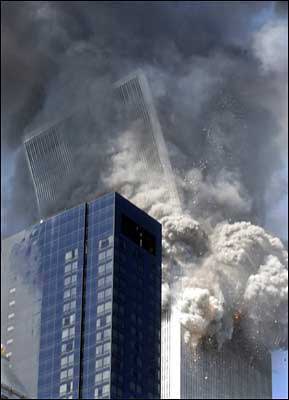
It has been half a decade. Unlike that day five years ago, today is chill and damp. I remember how gorgeous that September 11th was; it would have been a perfect day but for the evil that was visited on us. There are lots of remembrances of 9/11 around the web, read them and remember, pray for the souls of those we lost, and pray for peace even if that seems a forlorn hope.

image

Wizbang has an excellent web roundup which is well worth your time, and there is 2996, an effort to memorialize each of those who died in the attacks. The server for the homepage is swamped, but several friends have participated, Cat, Army Wife, Rocket Jones, Blackfive (who also memorializes Rick Rescorla), and the Oldsmoblogger. If I've forgotten or missed anyone, let me know and I'll add you to the list. Read of all of them, and thanks to all of you who wrote these wonderful posts.

Finally, from our gracious webhostess Kathy Kinsley, we also have two truly excellent links about other 9/11s, and Lilek's 9/11 movie.

Posted by Buckethead Buckethead on   |   § 2

Wednesday Funtime Quizzery

Over at Naked Villainy, we find a quiz that warms the cockles of our heart. A soft and fuzzy quiz that probes at the feminine side of our soul. This quiz asks, "What WWII Army would you be?" The answer is clear: Finland

You scored as Finland.

Your army is the army of Finland. You prefer to win your enemy by your wit rather than superior weapons. Enemy will have a hard time against your small but effective force.

Finland

100%

Japan

81%

British and the Commonwealth

75%

Italy

69%

Poland

69%

France, Free French and the Resistance

69%

Germany

44%

Soviet Union

38%

United States

31%

[wik] And what rule insists that the authors of these verdamt quizzes can't write or spellcheck their way out of wet paper sack?

[alsø wik] While I am utterly unsurprised that I ended up as Finland, given my genetic heritage and disposition, I am surprised that I ranked so low as America. Granted, I don't believe that the American strategic campaign was terribly useful, or even terribly moral, but I don't think that those answers should have bumped the 'ol US of A that far down the rankings.

[alsø alsø wik] If I were to get all reckless and shit, and attempt to rank those nations without the assistance of an interweb quiz engine, it might go something like this:

  • Finland
  • USA
  • Britain/Commonwealth
  • Poland
  • Italy
  • Germany
  • Japan
  • Soviet Union
  • France, Free French or Resistance

[wi nøt trei a høliday in Sweden this yër?] If I were to choose purely on the basis of prowess, rather than ideological preference, the list might go like this:

  • Finland
  • Germany
  • USA
  • Britain/Commonwealth
  • Poland
  • Italy
  • Japan
  • Soviet Union
  • France, Free French or Resistance

Strangely, the lists are nearly identical, with the exception of Germany moving up rather precipitously.

Posted by Buckethead Buckethead on   |   § 5

There's a million Chinamen at the door, and they ain't deliverin' lunch specials

Operational Art of War III
Scenario "Taiwan 2015"

People's Republic of China: Programmed Opponent (PO)
Taiwan: Yours truly

This scenario is a hypothetical sketch of an invasion of Taiwan by the PRC. Discussion below the fold.

The area of operations is the northern quarter or so of Taiwan. The north-central area is dominated by Taipei and environs; to the west, there is dense urban terrain around the airport. Much of the map outside the cities is open/cropland that favors fairly easy mobility.

The PRC starts out aggressive, but is not consistently so. Turn 1 finds large airborne attacks that seize the airport and much of the surrounding city; the harbor; and most of Taipei proper. Subsequent turns see further airborne drops, as well as marine infantry flowing into the harbor. By about Turn 4, Taipei was in commie hands, their grip on the western areas was strong, and the marines were poised to blast south between them.

The good news for the Taiwanese player is that victory is tied to Taipei. The city center is worth 90 vp alone; counting up the broader urban sprawl surrounding it, it’s in the neighborhood of 200 vp. This is good, because the mission is pretty cut and dried: hold Taipei, win.

In order to do that, a couple of things needed to happen. The strong marine forces lollygagging around the harbor could not be allowed to flow into the city; I had a feeling that once in there they’d never be dug out. As it was, the light units dug into the city were trouble enough. The enemy marines had to be either destroyed, fixed in place, or otherwise prevented from linking with its forces in Taipei to the E or the force in the W. Such a link would establish a solid line of invaders across a fairly narrow frontage, stretching across nearly half the island. The Taiwanese player does not have enough combat power fielded to destroy them; fixing them might be feasible with a strong force, but most of my heavy units were trying to wrest the airport or the capital from the bad guys.

So it looks grim in the opening turns- strong PRC units appear everywhere you don’t want them, and do a lot of damage. Friendly forces are dispersed and, early on, inadequate to do much beyond meeting engagements. But, as with NATO/Pact scenarios, the invader’s reinforcements peter out as the defender’s increase. Although parity is never reached, Taiwan is able to field some robust armored and mech units, as well as several attack helo units that are very effective against PRC artillery.

What ended up happening was that I had basically 3 forces. The west had armor and mech units leavened with some reserve leg battalions that, in time, were enough to destroy most of the PRC airborne and push back the rest until the enemy line thickened up with reinforcing marine units. In the east, everything I had went toward retaking Taipei, an ugly fight. The only way to keep attrition to a minimum in the destroyed, dense rubble of the city is the application of overwhelming, concentrated firepower. There are no political consequences of reducing the city to ash, or for making the rubble bounce, so go for it. The defenders don’t retreat readily, so it’s fairly easy to maneuver around and isolate them, but then it’s time consuming to eradicate them. The center, though, was my biggest concern.

Even though the game would be won by whoever held Taipei at the end, the PRC marines in the center were the key element in the fight. After committing everything I felt was needed to recapture the capital, there was very little left to drive between the city and those enemy marines. For most of the game, I had a thin line of leg infantry and a couple small mech formations as a speed bump for them, and that was it. At any moment, the PRC marines could have burst out of the harbor area and swung east to relieve the capital, or west to maneuver across the open terrain and envelope my force there. The PO chose neither. It made a few thrusts that pushed the line back pretty easily, but it never really went for it. Once all the PRC’s units were committed to Taiwan, it just sort of let them hang around. An aggressive human opponent would’ve eaten my lunch, I’m sure.

This scenario is really the PRC’s to lose; with Taipei and the airport the game is all but won. The rest of the game should be spent holding them, and parrying efforts to dislodge them. There is plenty of space and favorable terrain for bold maneuver, but in this scenario it’s not strictly necessary for the win. I’d like to try this fight again, but as the Chicoms, and see what kind of damage I can do with those marines.

Posted by GeekLethal GeekLethal on   |   § 0

Crystal Clear on Iraq-9/11

Once again, Bush makes it crystal clear that he, personally, does not believe there's a direct link between 9/11 and Iraq. Doesn't it wear this guy down even a little to have to go out there and push this crap, continuously? Bush speaks.

We're approaching the fifth anniversary of the September the 11th attacks -- and since that day, we have taken the fight to the enemy. Yet this war is more than a military conflict; it is the decisive ideological struggle of the 21st century.

He spoke to the Seafarer's union too:

And my message to the world is this: Just treat us the way we treat you. That's all we expect.

Posted by Ross Ross on   |   § 0

What's "revanche" in binary?

Not too long ago, in response to a discussion about wargames and such, I explained that my fave was The Operational Art of War. My preference for such games is big- leave the squad-leader stuff for people who like Squad Leader. I like big games of bold maneuver, and TOAW had it. Usually the basic unit of maneuver was a regiment or division, and the maps were pretty large. Depended on the scenario, of course, but maps spanning an entire country and its neighbors were common. The graphics and sound were simple, but so what? The action was on the battlefield; so long as the player could determine the terrain he was fighting over, he was in. He didn’t even have to know standard NATO symbology; one could presto-change-o the whole affair, rendering the units as little tanks and infantrymen.

But, as I wrote, it was gone. Didn’t run on XP without kludgy workarounds. A spiffy little game that came and went, forever to be referred to in the past tense.

And it’s back!

The Operational Art of War 3 is out, it’s fun, and it’s all that with a slice of cheese.

I have a lot of rust to work off my warbrain. The first scenario I tried, Tannenberg, I went balls out as the Russians and was getting my ass irredeemably stomped by about turn 3. After some re-education and refamiliarization, I tried an Operation OLYMPIC scenario, which models an attack on Kyushu by the Allies in November of ’45. I went in as the Americans, and most of my landing forces were crushed on the eastern and southern beaches. I was successful in the west, but it didn’t look like I was going to have enough combat power left to break out and conquer the island. Pretty much lost by about turn 6.

After some other short re-training exercises, I tried a WW1 scenario, playing as the Hun. I was most successful at this one so far.

The opening turns followed history fairly closely. The sweep through Belgium was not as simple as the schrifters of the General Staff had predicted, but I did OK. By about turn 7, Antwerp and Brussels were firmly in my hands; lead elements had secured Dunkirk, with small light recon units at the city limits of Calais. The BEF showed up though, and got all uppity; after some changing of hands, the hated nation of shopkeepers firmly held Calais and Dunkirk. By the last 3d of the game, fresh French forces leavened with the BEF were able to push me back to I believe it’s the river Scheldt in the NW, and small counterattacks pushed me back north, away from the border.

In the center, my line went roughly Charleville-Verdun-Metz. I had one heavily attritted and isolated unit occupying Reims, the remnant of a thrust from the NE that the AI managed to thwart; he lasted about 4 turns there but was eliminated before the final turn, so no victory points for me for Reims.

It was in the south though where I had almost comical success. All of a sudden and completely unforeseen, the French effort utterly fell apart. I had been working on building up a drive on Nancy; once it fell, I found I was in a position to seriously threaten the larger French line. Once French delaying forces along the southern border were gone, I was able to drive units SW from the Nancy area and NW from Belfort/Besancon. I gambled that the French were weak there, but had no idea how weak they were. In essence, the French army in the field south of Nancy was caught in a respectable- if I do say so myself- double envelopment.

It took several turns to destroy that pocket in detail but I had enough combat power to hold the encirclement and still send something like 15 divisions on the roads to Paris, which is ridiculous. I had cavalry in the front; on the left, threatening Orleans; and on the right flank, expecting the computer to strip units from his dense center to take me on the right. Heavier leg infantry and supporting units found a knot of French defenders anchored in the Troyes area, but I had enough to both bypass and isolate them for future reduction. All told, by what my screening units told me, very little stood between the Kaiser's mailed fist and the City of Lights.

And then the scenario ended.

I forgot that this game is strict with its turns. Unlike Civ, which allows you to keep playing even after you've technically won, TOAW ends the game after you've finished your last turn. Period. I was pissed I didn't even get units into the Paris suburbs; doubly so because the game ended a "draw", with a brief bit of text tersely predicting a long war. Draw? Long war? I have like 3 corps, at about 90% capability, tearing virtually unopposed toward Paris and it's going to be a long war? Feh! I just wasn’t paying attention, and it cost me the whole fight.

So going forward, I learned to watch that more closely. Or, instead, employing Buckethead’s solution and changing the scenario parameters. But whichever- I had a lot of fun crushing the poilus, and even had fun when I lost those earlier games. Sort of.

I’m just tickled the game is back.

Posted by GeekLethal GeekLethal on   |   § 5