

Extra Bonus Demotivatery

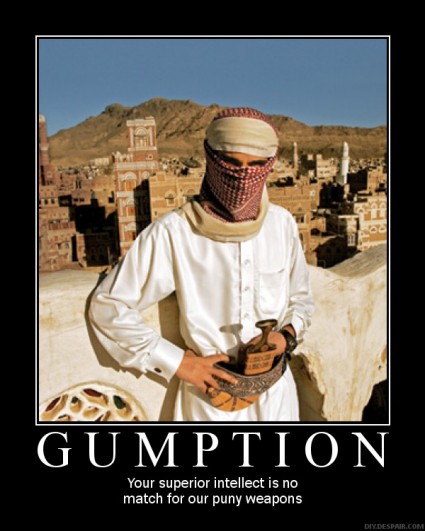
GeekLethal reminded me to do something with a pic I'd had cluttering up my file system.
Posted by
Buckethead
 on
| § 0
on
| § 0
on
| § 0

GeekLethal reminded me to do something with a pic I'd had cluttering up my file system.
on
| § 0
Make your own demotivational posters here.
 on
| § 1
on
| § 1

For those lucky souls who know nothing about the current options backdating scandal, please skip to the next post, because I'm not willing to bore you with the details.
I am, however, willing to bore you with this:
This morning's WSJ contains an article entitled "Cablevision Gave Backdated Grant To Dead Official"
Cablevision awarded options to a vice chairman after his 1999 death but backdated them to make it appear they were awarded when he was still alive. Cablevision restated its results as an options probe escalated.
I'm trying to picture the response from the PR person at Cablevision. Something like, say, 'Oh, don't worry - they were way out of the money, since we didn't figure he'd complain' or 'We spoke with his lawyer and were informed "No, no, 'e's uh,...he's resting."'
Yes, this scandal has officially become Pythonesque.
 on
| § 0
on
| § 0

Clearly, posts based on the contents of one or more of the roughly 200 non-SPAM email messages I get per day are easy. Why, they practically write themselves!
But that's not the point. The point is to give me a jumping off point to opine about one thing or another, and Steve Elliot, of Grassfire.org, has done just that. I have no idea how I ended up on their mailing list - I'm not aware of anything they've had to say (at least in the periodic "Please sign this petition!" emails I've gotten from them) that I think is worthy of even clicking the link to go to their site. That, plus internet petitions are generally tools for twits. This latest, however, coerced me to action.
That action? To ridicule the silliness of the Grassfire.org actions, if not their intentions. Actually, come to think of it, I'm ridiculing their intentions, too. Here's an excerpted version of their 'plaint for this week:
If you didn't see Venezuelan President Hugo Chavez call President Bush "the devil" during his U.N. speech, go here and see for yourself: redacted
Thanks, Steve - I didn't see it, but I read about it, and have no need to go watch Chavez make an ass of himself on tape delay. Continuing:
Here is what Chavez said:"Yesterday, the devil [President Bush] came here. Right here. Right here. And it smells of sulfur still today, this table that I am now standing in front of."
--Hugo ChavezThen Chavez made the sign of the cross as if praying to God for deliverance from the "devil" (President Bush)! This was one of the worst mockeries of a U.S. President ON OUR OWN SOIL by a foreign leader in history!
Did you know this fascist thug also own (sic) Citgo oil company and is making untold millions on Citgo profits to undermine our President and the troops?
Chavez is using OUR MONEY to attack and undermine our President and our nation!
In response to this outrage, thousands of citizens are sending Chavez a message by joining the Citgo boycott. Go here to send Chavez a message: (also redacted) We want to rally 100,000 signers in the next 7 days and deliver these petitions to the main distributors of Citgo Gas, including 7-Eleven.
Thanks for your immediate action!
Steve Elliott, President
Grassfire.org Alliance
So, if I read him correctly, Hugo Chavez "own" Citgo Oil? Technically, as well as factually, no, he doesn't. He controls it, as part of his country's nationalized OPEC member, Petróleos de Venezuela SA, and controls it quite poorly, on reflection. So any damage "needed" to Citgo, he seems clearly able to inflict on his own without the help of me or any of my more gullible co-mailinglist-members.
And, about those gullible souls who might "Take ... immediate action!" because of Chavez's actions "ON OUR OWN SOIL!" and what he does to us with "OUR MONEY!" (yeah, I added a couple exclamation points, but only because Steve must have forgotten these guaranteed-to-enflame necessities from the toolbox of all rabble-rousers), I hope there are few, not because I wish Elliott or Grassfire any particular harm, but because this is a meaningless gesture, designed to enflame the rubes among us and generate funds for Grassfire, nothing more.
I consider it no different than the several-per-week pretend-solicitations of my opinion or involvement in some God-forsaken pretend-grown-up activity put together by the Republican Party. And, lest Ross get all chubby, the DNC is no different, and no more intelligent in its pretense to actually give a shit what any of its Middle America adherents think, only about the money they can milch (or would that be "mulct"?) for the latest cause du jour.
Puh-leeze. If you don't want to buy Citgo gas, go buy some other gas. But don't pretend Chavez's distributors will give a fat rat's ass about some Intertube-circulated pseudo-petition expressing the nation's indignation about the way he acted at the U.N. toward GW Bush.
Here's a couple clues for those who might think Elliott has a point: Bush almost certainly doesn't care about Chavez's opinion of him, and less so about any words he might use to enunciate it. Including this nugget, from a NY Times story on the matter:
[Chavez] brandished a copy of Noam Chomsky's "Hegemony or Survival: America's Quest for Global Dominance" and recommended it to members of the General Assembly to read. Later, he told a news conference that one of his greatest regrets was not getting to meet Mr. Chomsky before he died. (Mr. Chomsky, 77, is still alive.)
I mean, "everyone" knows Bush is dumb as a bag of hair, right? But even Bush knows Mr. Chomsky is still alive.
Furthermore, he made this speech at the United Nations General Assembly, and nobody who's got a lick of sense actually believes the General Assembly is worth the powder it would take to blow it to hell. The UN does such a poor job at most of what it does that the few good things it does are lost in the backwash. So who cares where he made this inane statement?
Elliott does, or claims to. Whatever nit-wits sign his petition do, or claim to. I do not.
[wik] No, I don't know why I turned into the hyphenation queen for this post. It's just how it came out.
[alsø wik] Odd, this entire embargo thing must not be working out. I got a follow-on from Steve today (9/26/2006) informing me that:
In the next seven days, I want to deliver 50,000 petitions
to 7-Eleven which distributes Citgo gas at thousands of
locations. Please help.
No offense, but tough shit, snookums - boycotts of volatile commodity items seldom make sense, and seldom achieve the desired effect. I hope that the shortfall in signatures is because most of his recipients realize this. Otherwise, it means the internet is broken, and that would suck. Too bad about the inability to meet the reduced and extended expectations. And, yes, I've unsubscribed from his mailing list.
on
| § 0
I'm not sure what's going on. Either New York slide-trumpet player and bandleader Steve Bernstein is getting better, or I'm coming around (maybe both). Bernstein, who with his band Sex Mob have been making reasonably amusing and background-filling albums for the better part of a decade, never really clicked with me. His music seemed so insubstantial, so resolutely finger-poppin' hey-daddy ironically-detached aren't-we-cool hipsterish, that I never gave it much of a chance.
In retrospect, I think that's a shame. Because behind the wide-lapel cheapo porno shtick he's peddled is a bandleader whose guiding purpose in life is to make music for people to have a good time by.
That skill of making good-time music doesn't seem to get a whole lot of respect. All the music critics swoon over Brian Wilson's brain-fractured experimentation, and ignore the sweet and fun stuff. They flip out over the far-out stylings on Smile, but what about "Surf City?" "Surf City" is a perfect song, a summer song, a song about good times and scantily clad ladies cavorting on a white sand beach. No respect for "Surf City."
All the nerds (all the world!) swoon over Sgt. Pepper's Lonely Hearts Club Band for some silly-ass reason, and while they acknowledge that the early stuff sure is some crack songwriting, the concensus seems to be that drugs and four hundred hours of studio time somehow trump, you know, attention to extraneous cruft like melody and lyrics. A song like "A Day in the Life" demands to be appreciated, like it was hanging in some museum, but there ain't a damn song in the world that sums up the innocence of young love more than "I Want To Hold Your Hand."
And, okay, yes, over the years I have spent a lot of time talking up music that's more intellectually rewarding than aesthetically pleasing, I won't deny it. How could I deny it? Y'all got Google. And yes, I haven't always cared for Sex Mob. I always thought they were more gimmicky and clever than actually good. And I stand by that assessment.
But recently, Steve Bernstein's been on a hell of a tear. He recently turned up on drummer Bobby Previte's outstanding Coalition of the Willing project, a Bitches Brew for the new millennium that cuts an atmosphere of Miles-esque darkness with generous slices of rock, thrilling improvisation, and twisty, funky soloing from Bernstein.
And now, his new project, the Millennium Territory Orchestra is a bold yet frivilous tribute to a gone and nearly forgotten era in American popular music.
In the 1920s and 1930s, 'territory' bands plied circuits all around the country. Minneapolis bands would play from Madison to Kansas City. Cleveland bands would range from Detroit to Pittsburgh to Yellow Springs, bringing that era's freewheeling proto-swing sound to dancehalls, honky tonks, and bars. Many if not most of these bands vanished without a trace, remembered only in faded photo albums and in stories swapped in nursing homes around the country. Few made recordings, and those who did released three-minute 78s to a market that was not yet national, that did not yet have any mechanism for preserving their work. Little wonder, then, that not many people remember a genre that's not quite Dixieland (tied to New Orleans, a city very good at remembering) and not quite swing (whose rise coincided with the rise of radio).
Forty years later, groups like the territory bands would be playing psychedelic lunk-rock and being collected in lavish four-disc box sets with hundred-page booklets chronicling the history of every one of them in loving detail. But for the territory bands there were no box sets, there was no national FM radio network. There were just dance floors, open roads, and the occasional chicken dinner.
Steve Bernstein recently came across some recordings from this great lost era in American music, and heard something he liked. "I was getting really fascinated with this music and wondering what would happen if you played this music live again. Because any version of this musc we have is like a three-minute bad recording. We know what it looks like, because ther's all these great pictures of guys in tuxedoes holding their instruments. But it's almost like there's more pictures of the music then there are recorded documents of the music. I wanted to bring this music back to life."
In 1999, Bernstein first brought together a group of New York's finest improvisers to play some of this music. Since then, he's been periodically soaking in it, so much so that on Volume 1, the first album by the Millennial Territory Orchestra, he can graft the sound and style of the territory bands, with their hotchachacha big lapel black bottom crawling style, to both original compositions and modern adaptations of Stevie Wonder's "Signed, Sealed, Delivered" and Prince's "Darling Nikki" without batting an eye.
Volume 1 is a great party record, a serious slab of frivilous good time music, full of hot jazz, nasty soloing, and juke-joint funk replete with banjo and saxophone that somehow captures the atmosphere of a long gone era without sounding like a mere tribute. It helps that all nine players in the ensemble contribute exuberant solos as well as loose and crafty ensemble playing, strutting their stuff like a Dixieland band while coming together like a big swing group. From the light and carefree cover of "Pennies from Heaven" to the deconstructed crawl of "Darling Nikki," the band capture the vibe and sound of Kansas City 1933 while retaining the snap and polish of New York 2006.
Steve Bernstein's music might not be monuments for future generations of critics to fawn over, but that's really, really OK. I haven't listened to either of Radiohead's past two albums, because I just don't have the patience for that much artsy-fartsy seriousness from what is basically rock and roll music, the same genre that gave us "Louie, Louie" and The Bloodhound Gang. Steve Bernstein and the Millennial Territory Orchestra throw a hell of a party; what else do you need?
 on
| § 0
on
| § 0

Fresh from my inbox to your screen, Kinky's campaign answers questions related to his scuffle with the interestingly-monikered and intellectually challenged Senfronia Puff-n-Stuff:
Kinky Friedman Campaign Statement
Friends and neighbors,
While Rick Perry was cheerleading in college and Chris Bell was being potty trained, Kinky Friedman was picketing segregated restaurants in Austin to integrate them. Now that Kinky’s in second place and a serious threat to the two-party system, Perry and Bell have paid political assassins to dig back as far as 30 years through fictional books, comedy shows and song lyrics, desperately seeking to paint Kinky as a racist.
Republicans and Democrats have created an entire industry -- called Opposition Research -- whose sole purpose is to tarnish and destroy people’s reputations. This is why regular citizens don't run for office. If you do, and you start to threaten the system as Kinky has, you’re going to be attacked.
Kinky has overcome all of the obstacles placed before him -- getting on the ballot, raising millions of dollars, building the largest grassroots network Texas has ever seen, and breaking 20% in the polls months ago. He's a serious threat to the establishment, and when you threaten the political establishment, they use the money generated from their formidable fundraising machines to pay for "dirty tricks" tactics to manipulate the press.
It's a slimy industry that exists for the sole purpose of destroying people and -- like cockroaches -- scurries for the shadows whenever a light is shined on it.
The latest political assassination attempt takes completely out of context a controversial word that Kinky was using in a 1980 stand-up performance to lampoon racists. Playing a character on stage, Kinky was exposing bigotry through comedy and satire.
It’s pathetic that the major-party candidates have sunk to this -- trying to paint Kinky as a racist when, in fact, he was poking fun at racists. Shame on the press for being complicit. Rather than confront our opponents on their tactics and get the full story, they are allowing industries like opposition research to exist and operate outside the understanding of most voters.
-The Kinky Friedman Campaign for Governor
Hmmph. That'll show 'em. Why the hell not?
on
| § 2
There is a new drink product out, and it has a provocative name. So provocative, that the usual suspects have their panties in a twist. The drink is an energy drink with the compelling name of "Cocaine." For your reference, I include a pic of the drink can in question:
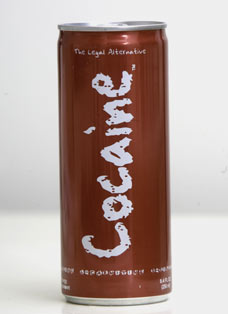
It contains no actual cocaine, so we aren't seeing the rebirth of the original, original Coke. Instead, it contains merely a shitload of caffiene. The only drink that is, pound per pound, more caffiene laden is espresso. And espresso doesn't normally come in large cans. 280mg of caffiene is quite a jolt, and the maker claims that you can get this magical jolt of energy without the twitchiness and sugar crash that normally accompanies energy drinks. So far, so good. But wait:
But David Raynes, of the UK National Drug Prevention Alliance, said: "It is people exploiting drugs. It is a pretty cynical tactic exploiting illegal drugs for their own benefit." Mr Raynes added: "The fact is that subliminally, it is making the image of drug use cool and that's what kids what to be, cool...
"Kids will be drinking Cocaine and will inevitably link the two. The drink is relatively innocuous, but they will be linking it with cocaine use and the market, which is far from innocuous."
To the extent that drug use isn't already considered "cool" among the youth of this nation, I'm sure that this drink will push them all over the brink. Elementary school kids will be shooting up on the swings and slides of our playgrounds. Youngsters will be smoking crack at Chuck E. Cheese's. Armageddon will be nigh, thanks to the mildly ironic name of this perfidious energy drink.
Once again, some people need to take a stress tab, so that we can talk about this reasonably. I find it increasingly hard (aside from the explosions, of course) to distinguish any difference in tone between these health nazi pc types and the Islamic fundamentalists who get their panties in a twist when the Pope mentions that, maybe, sometimes, Islam and violence have lived on the same street.
What is it with these people. Words are magical. We can, through their magic, assign meanings to things, and then arrange those things in pleasing, orderly or useful arrangements. But they are not magical in the well, magical sense. They do not bind or control us. If I, or some punk kid, or even my three year old son see the word "Cocaine" on a can of soda, he, me or they are not magically compelled, geased, to go buy some Bolivian Party Powder. Nor are Muslims magically compelled by the law of similarity to riot in the street because some Pope somewhere says the words "Islam" and "Violence" in the same sentence. (Not that you'd be odd for suspecting that, really.)
on
| § 1
Some time ago, a friend of mine sent me a link to an essay by science fiction writer Ken McLeod.
The Palestinians launch rockets at the Israelis, killing civilians. The Israelis drop bombs on the Lebanese, killing civilians. Iraqis plant bombs in roadways, killing American Soldiers. We attack Iraqi cities, killing insurgents. Al Qaeda kills 3000 Americans with hijacked airplanes; we kill Al Qaeda wherever we find them.
There is, when laid out in that fashion, a symmetry to these acts of violence. Tit for tat violence in an unending cycle. A cycle of violence. (I have a mental picture of what a bicycle of violence looks like, but that is beside the point.) A while back, a friend of mine sent me an essay by Scottish science fiction writer and communist Ken McLeod. It is entitled, "Against Civilized Warfare." Like many a product of a bright and well-read mind, it is well-written, includes facts, is compelling on the surface and utterly wrong.
Go take a read.
McLeod makes the argument that
Nothing has done more to corrupt humanity than the attempt to civilise warfare. Just War Theory is an utter perversion of the moral sense, a doctrine of literally mediaeval barbarism, invented by clerics to regulate wars between Christian kings. Its finest moral discrimination to date is that it's legitimate to kill a munitions worker on his way to work, but a crime to kill him on his way home.
Well, that's an interesting premise. It is the job of science fiction writers to challenge assumptions, and maybe that one is, actually a real boner of an assumption. I thought to myself, "Hey, maybe he's got something there." After all, Just War Theory gave the high sign to unrestricted strategic bombing in the big one, and most current research leads one to believe that it was strategically dubious at best.
Just War Theory and the architects of the British and American strategic bombing campaigns held that killing enemy civilians who worked in vital war industries was a valid exercise of military force. The lamentable lack of accuracy of the state of the art in bombing technology meant that attacks were of necessity bloody – we had to drop a lot of bombs to be assured of killing the target. We were attacking our enemies' capacity to wage industrial war. Collateral damage was regrettable, but justified.
However, German war production increased over the period of the most intense Allied bombardment, and there is no evidence that German civilian morale was lowered as a result of the bombing. In fact, it may have stiffened enemy resolve – much as the Blitz stiffened British morale earlier. Attacking enemy productive capacity and "breaking the enemies' will" are usually cited as the primary strategic justifications for the bombing campaign. And if neither of those desired results ever actually, you know, happened – then what you have is the unjustified slaughter of hundreds of thousands of innocent German and Japanese civilians.
Just War Theory takes a hit on that one. Let's read on.
It tells us that to aim a bomb at an enemy soldier and kill a hundred civilians is - if the necessity is there – legitimate collateral damage, but to deliberately aim one bullet at one enemy civilian is murder. In its pedantic, casuistic jesuitry it still stinks of the cringing, quibbling fusspots who invented it, and retains too its usefulness to a useless and barbaric ruling class. It does nothing whatsoever to restrain their behaviour. Its only function is to befuddle those who oppose, protest and fight them. It justifies every horrific, predictable consequence of imperialist assault as an unintended consequence, and condemns every horrific, predictable consequence of resistance to that assault as an intended consequence. Their violence against civilians is mass murder, ours is collateral damage.
Subtract the cant, and you have the argument that civilized warfare is morally and ethically empty, does nothing to restrain violence or evil, and in fact confuses those who would argue against it. Further, it creates a false separation between acts of violence committed by opposing sides in a conflict.
He goes on, using as an example the recent unpleasantness between Hezbollah and Israel. His conclusion, to deny Israel's claim of justification. This is not in itself surprising. He continues,
The doctrine itself is false. Its preaching should be regarded as a crime against humanity. We are responsible for the foreseeable consequences of our willful acts. These include the consequences of restraint, of pity, of not hurting the enemy in any way you can. They also include the consequences of attempting to make war an accepted part of civilised life, which is to institutionalise war and thus to perpetuate it.
War is not civilized, but a regression to the state of nature, and in the state of nature there is no sin. In the state of nature there are, however, necessary and unnecessary evils, and in that respect we still have to make judgements. 'All things are lawful unto me, but all things are not expedient.'
Now this is an odd thing to say. But we'll get to that in a minute. McLeod, throughout this piece, denies that intent is a factor in weighing moral justifications for violence. If I understand him right, the Israeli F-16 dropping a precision munitions on a target is no wronger, (or at least no righter) than a Hezbollah cell launching a rocket at Israel.
But intent is central, not just to Western conceptions of just war and the rules of war, but to our entire legal system. In law, we recognize that there is a real moral difference between someone who loses control of a car and kills a college coed on the sidewalk, and someone who uses a car to purposely run over and kill, say, and ex-girlfriend named Margaret. The end result in both cases is the same – a dead young woman. The means, in both cases, is the same – a vehicle striking and killing.
But most people would agree instantly that the cases are separate in nature. One is murder, and reprehensible. The other is negligence or incompetence, and is tragic but not criminal. We know that there is a distinction between accident and will.
This is the heart of the moral equivalence argument. You tally up the dead bodies, and whoever killed more is more to blame, if anyone is. It ducks the question of intent, as does McLeod. Strangely, when the number of US casualties inevitably crosses the number killed in the 9/11 attacks, some will find that occasion to castigate the West, and America, for its evil throughout the world, as if the crossing of the two numbers has some mystical significance.
But that is entirely wrong.
I have never made the argument that war, in itself is a good thing. Sometimes, though, it is the least bad thing. And whether a war is justifiable centers clearly on questions of intent. Both at the national level, and on the level of the individual soldier.
McLeod ended his piece with an appeal to protest against the Israeli actions in Lebanon. But if we examine the intent of the two parties, we find similar results as with our parable of the cars. Hezbollah did not just magically cause the death of x number of civilians in Northern Israel, nor did the Israelis do likewise in Southern Lebanon.
Hezbollah launched rockets at civilian targets in Israel. Happily, these attacks were not as successful as the attackers hoped, thanks to the inaccuracies of the rockets. Yet, they caused many civilian casualties. The intent, so far as I can determine, was to cause grievous harm to innocent civilians in order to provoke the Israeli government and army into conflict, and the ultimate aim is the total elimination of Israel, and I presume all Jews everywhere.
After many of these attacks, Israel struck back. They mounted air assaults on known and suspected Hezbollah positions in order, primarily, to end the rocket attacks on their own civilians. Lebanese civilians died in these attacks. But the fact that the Israelis were trying very hard not to kill them is significant – if the laws of war were no hindrance on Israel's actions in this conflict, then surely the IDF could have caused much more fearful destruction than they did. But those laws are a restraint on Israel.
Even more significant is the Hezbollah practice of locating its depots, command centers, and rocket launchers in the midst of as many civilians as possible. One would think that they are inviting civilian casualties on their own side purely for the propaganda value those images have in the Western press.
For me, at least, there is a clear moral difference in the conduct of these two forces. But still, I pondered. War is not after all, murder writ large. Or at least, not exactly. The laws of civilized warfare – where they are observed - are a restraint on the western powers. They do reduce, if not eliminate, the horror and injustice (on the local scale) of war. They limit the conduct of our military, and the Israelis, and the Brits, and so on. So much so, that groups like Hezbollah and the Iraqis during the invasion could count on it to such an extent that it informed their tactics. That’s why they use civilians, women and children as shields because they know that we will do everything in our power not to kill them. If war is in fact, “not civilized, but a regression to the state of nature, and in the state of nature there is no sin. In the state of nature there are, however, necessary and unnecessary evils, and in that respect we still have to make judgements. 'All things are lawful unto me, but all things are not expedient.'” then we would make the expedient judgment and lay waste to everything around those we wish to kill, having no qualms about any ‘collateral damage’ – the death of innocent civilians.
We would use the most horrific weapons, fuel air explosives, gas, nukes, whatever, so long as we achieved our objectives. Whenever there was a roadside bomb, we’d line the streets with the dead as a warning. Terror is a valuable weapon, but one that we, thankfully, do not use. The rules of engagement for our forces, and indeed for the Israelis, give the lie to McLeod’s view.
We are responsible for the foreseeable consequences of our actions. We know that we will kill the innocent, and in the past we have killed great numbers of them. Nevertheless, in the case of that McLeod cites, as well as others too numerous to name, so is the other side responsible for the foreseeable consequences of their actions. To be sure, “Now look what you made me do” is a weak moral argument. But, and this is an important but, self defense is recognized as a valid exercise of violence in the personal world, and is equally valid in the larger world. If you are attacked, you have a right to self defense. Hezbollah attacked Israel, specifically targeting civilians. Then, they hid amongst the civilians of Lebanon.
If you poke a tiger and then hide behind a mother and her children and the tiger kills the children to get to you, not all the blame, not even most of the blame, lies with the tiger.
McLeod says, “They also include the consequences of attempting to make war an accepted part of civilised life, which is to institutionalise war and thus to perpetuate it.” This is also wrong. The attempt, going back to the 1500s and earlier, to institutionalize war was not to perpetuate it. It was an attempt to control, to limit, to ameliorate its effects. To civilize it, to the extent that it could be civilized. It was stepping back from barbarity, from the war of all against all. It is analogous to the Capitalism, another thing that McLeod no doubt hates, where another dark side of human nature, greed, is civilized to the greatest extent possible.
Human nature is. It’s the stuff we have to work with. To our shame, it includes things like greed, hatred, rage, violence, bigotry, and communism. However, we are more civilized than those who came before us – thanks in large part to the efforts of those who incrementally made some things, some actions, morally unacceptable. The rules of civilized warfare mean that we – when we do go to war – are not unprincipled savages who kill without compunction. Unlike most of those we fight now, or for that matter communists throughout history.
on
| § 1
The Post has a follow-up to their article on George Allen's pseudo-Jewishness.
At the table in Palos Verdes, Calif., Allen's mother, who is 83, said she told her son the truth: That she had been raised as a Jew in Tunisia before moving to the United States. She said that she and the senator's father, famed former Redskins coach George Allen, had wanted to protect their children from living with the fear that she had experienced during World War II. Her father, Felix Lumbroso, was imprisoned by the Nazis during the German occupation of Tunis."What they put my father through. I always was fearful," Etty Allen said in a telephone interview. "I didn't want my children to have to go through that fear all the time. When I told Georgie, I said, 'Now you don't love me anymore.' He said, 'Mom, I respect you more than ever.' "
I can't help but wonder exactly why Etty Allen was worried that "Georgie" wouldn't love her any more? I mean, a mother usually knows her child pretty well. And she was worried.
Let's also point out that it is quite clear that Allen flat-out lied about it when asked by a reporter. Good thing he wasn't under oath, huh? No double standard, right? Anybody recall George Allen's position on the Clinton/Lewinsky crap?
 on
| § 2
on
| § 2

The entire matter may not be as cut and dried as some of my colleagues believe.
That said, coercively interrogating the wrong guy due to bad Canadian intelligence and embarrassing American operational standards is inexcusable. So is anything to do with Syria's government.
But it might be time to dispense with fiction that the sole value of coercive interrogation is that "...someone being tortured will say whatever they can to get it to stop."
Sometimes, perhaps many or most times, there's more to be gained than false confessions.
on
| § 21


