Jane Says Buy This Album

It's hard to overstate how much, as a pimply and earnest teenager from Ohio with a serious jones for escapism, heavy-duty philosphizing, and wailing guitars, Jane's Addiction meant to me. By 1991, I'd gotten pretty far on my own, crawling past Warrant, Poison and Def Leppard to artier stuff like Zep and Tull, and finally discovering Nine Inch Nails and Ministry. By that time, the creepy din of Trent Reznor and Al Jourgenson had my adolescent mind primed and ready for the decadent racket of Jane's.

I remember the winter of 1991-1992, driving around in cars with my friends. Shawn had the treacherous old Chevette with no floorboards he'd gotten for $35, and Tom had the tiny Toyota truck and then the boat-sized woodpaneled station wagon. We'd be tooling around the barren back roads of Northeastern Ohio, tuning the radio obsessively, searching for another dose of "Smells Like Teen Spirit."

No fooling, when Alternative Rock hit, it was like the dawn breaking through a permanent midnight. Sure, we already had what we in my area called "progressive music," our Information Society, Depeche Mode, Cure, Violent Femmes, and so on. But as good as that stuff was (and is), the incurable Britishness of most of these bands failed to really connect with something primal inside me. As a red-blooded briarhopper (that's 'flatland hillbilly') my need for rock (the same primal urge that fuels my enduring love for NASCAR, demolition derby, and NFL football in the rain and mud) just can't be satisfied for long with synthesizers and doggerel about blisters in the sun.

Rising out of the same trashy, glammy El Lay scene that gave us Motley Crue, Black Flag, X, The Red Hot Chili Peppers, and even The Eagles, Jane's Addiction combined parts that just should never have worked together into one messy machine. Stephen Perkins was a clattery, sticky drummer who played like he'd be as much at home in some tweeked-up bebop band, Eric Avery's bass was just a little too metal to be funky, Dave Navarro was a metal guitarist with an amazing head for dissonant rhythm parts and bluesy leads, and Perry Farrell was... well, what he hell was he? An androgynous little walking id with a thin whine of a voice who keened and snarled and bled lyrics that in anybody else's hands would have been painfully earnest, high-school jottings somehow given dignity through sheer force of will and questionable sanity. They were like Guns 'n' Roses' arty little brothers, hanging out smoking pot in the high school art room while their big bro lurked behind the school beating up nerds.

Together they made two absolutely classic albums, 1988's Nothing's Shocking and 1991's Ritual de lo Habitual that threw together art-school pretension, metal, a few nods to prog-rock, and a heavy dose of Mexican mysticism.

And then they were gone. That was the end of the road for them. Three albums (counting their rarely-heard debut) and gone. Perry Farrell threw his energy into the diminishing returns of the Lollapalooza festivals, and into his next musical project Porno for Pyros. He seemed to be trying to throw his arms around the world and give everyone a big patchouli-scented Los Angeles hug. Dave Navarro retreated into a sleazy demimonde of drugs and prostitutes, eventually shacking up with Baywatch babe Carmen Electra and engaging in some legendary feats of debauchery while cutting himself off from the world. Just like in Jane's Addiction, his darkness and rock energy pulling in the opposite direction of Farrell's utopian guttery poetry. Avery and Perkins launched projects that few people seemed to want to hear. But between their music and Farrell's brilliant idea for Lollapalooza, Jane's Addiction did as much as anyone to usher in the sea-change that overtook popular music in the early 1990s, the decade or so where rock was young again.

Frankly, I can't think of a single band in the world more deserving of a best-of compilation than Jane's Addiction, and I'm shocked that it took until 2006 for one to show up. I'm also shocked that it's goddamn fantastic. The good people at Rhino, who must surely rise every morning amazed that they can do the work they do while drawing pay from their resolutely mainstream masters at Warner Brothers, have put together Up From The Catacombs: The Best of Jane's Addiction, a seventeen-song retrospective of the band's history that actually manages to do justice to their legacy.

I can't believe it: everything works.

The song choices are practically bulletproof, with the highlights of both the big albums present, plus a couple choice tracks each from their debut and 2003's "comeback" album, Strays. Wisely skipped is the fairly awful and decidedly inessential Kettle Whistle, a 1997 stopgap (Janes' own The Spaghetti Incident?) that did more to tarnish the band's legacy than could ever have happened if Perry Farrell, say, had suddenly turned up in Vegas doing lounge versions of "Jane Says" and "Had a Dad."

The sequencing is inspired too. The first three songs progressively raise the ante, skipping from the clattering "Stop!" (the lead track on Ritual) to the huge drama of "Ocean Size" (the lead track on Nothing's Shocking) to the metal attack of a live version of "Whores" (an early favorite). We then detour to the bad hangover of "Ted, Just Admit It...," a disjointed and, I suppose, arty offering off Nothing's Shocking that ably showcases that side of the band's identity. After a couple more heavy rockers (including the unjustly ignored "Just Because" from Strays), the compilation veers into the contemplative almost for good. Here is where we find the eight-minute epic of "Three Days," the pastoral lurch of "Summertime Rolls" and the quiet devotion of "Classic Girl." The comp ends (naturally) with the snarling "Pig's In Zen" (which closed out Ritual) and an absolutely fantastic live version of the band's signature "Jane Says."

Absolutely anyone who doesn't have any Jane's Addiction already in their collection should run right out and pick up Up From The Catacombs. Actually, anyone who doesn't already own them should pick up both Nothing's Shocking and Ritual de lo Habitual, but since I can't tell you how to spend your money, I suppose all I can do is tell you that ownership of either the best-of or the two great albums is more than just highly recommended; it is required. I'll be checking.

Posted by Johno Johno on   |   § 7

Multiple choice quiz

I don't expect to be given the choice, but if I am, I hope the list of options is at least a bit more varied than this:

For the record, those are listed in increasing order of both preference and age of demise. Coincidence? You decide.

[wik] Preference? "Peacefully, in my sleep, like my grandfather, not screaming and hollering like all the passengers on his bus"

Posted by Patton Patton on   |   § 1

Only fifteen miles to Belgium

Tomorrow I will be using the ticket that's been hanging on the front of my refridgetator for months... the black slip of poster board that will grant me access to the Return of the Belgian Beer Festival in Boston.

Here's the list of beers available for the Saturday sessions.

I feel like Saruman standing on top of the massive obsidian plinth of Isengard, holding out his arms in the classic DRAMA pose, intoning in a stentorian voice, WE HAVE WORK TO DO. Let's get it on!!!

Posted by Johno Johno on   |   § 1

Sometimes, you have to amend prior blog entries

And this might be one of those times. Or not. Minister Buckethead's call, completely. From the "What do you think?" feature in today's Onion email, "Door Open for NJ Gay Marriage", answer #1:

Inventory Control Specialist
“This will go a long way toward expanding the variety of punch lines about New Jersey.”

To be honest, I think Buckethead had the matter preemptively covered, with his last two items in the post linked above, but I'm pointing it out, just in case.

Posted by Patton Patton on   |   § 0

I'll never wash this keyboard again!!

Soul legend Solomon Burke's latest album, a set of country songs redone in his inimitable style called Nashville, was released on September 26. I interviewed him by email on October 10.

What music are you listening to these days?

I'm listening to india.arie, Christina Aguilera, Emmylou Harris and Gillian Welch. For the guys, I love Usher, Bruce Springsteen's latest cd, Alan Jackson, Eric Clapton. I also am enjoying the Foo Fighters, the Raconteurs, the Wreckers and anything by Merle Haggard.

Who selected the songs for "Nashville"?

The songs were selected by [album producer] Buddy Miller, [executive producer] Shawn Amos and me. We all listened to a ton of amazing songs - together, probably over 200 songs. There were certain songwriters whose points of view were important to interpret, in our minds, so that helped us narrow down the list and focus… and then just trying to see what shape the various combinations of songs took that would be a respectable body of work. It was really tough to let go of certain songs that I loved, but that's a part of the process.

You do Springsteen's "Ain't Got You" in a nearly bluegrass style, there's some nods to Billy Shirell-style strings on "Atta Way To Go," and the rest of the album covers all the territory from honky-tonk to country blues to soul to gospel. (Yes, there's a question in here somewhere.) The arrangements are definitely a departure from what you've been doing recently, and (in the good way) definitely not what I would have expected. Who was in the driver's seat when deciding on arrangements?

Buddy Miller was very much the driver when it came to the arrangements. But the beauty of how Buddy works is that his arrangements left me a lot of room, and he brought together such amazing musicians that when I "turned left" on a song, the entire band turned left with me. It was a great feeling.

On the last album you covered a Hank Williams song, and this time around you cover a George Jones song. Between them, they're two of the most iconic singers of the last 50 years; how do you go about singing a song that belongs completely to someone else, and make sure it's not a mere tribute? How do you take the George out and put the Solomon in?

Well, first off, I love Hank Williams and George Jones and I love their bodies of work. For me, there are a lot of songs that I would never ever try to sing, for that exact reason. But if I can feel the song inside of me, then what I sing is a tribute to the original artist as well as the writer, but mostly it's a tribute to the listener. I think we all try to reach out to people and if a George Jones song, sung by Solomon Burke and Emmylou Harris is going to be the way to get a message to one person who would have otherwise missed the message, then we are all successful and the story of the song is richer for it. Along these lines, I just want to mention that I have never experienced such graciousness from songwriters and artists as I have on this project. Their generosity in allowing me to sing their songs freely was overwhelming and in my career, historic!

There's a few great duets on the record, with Dolly Parton, Gillian Welch, and Patty Loveless, among others.

Thank you!

This is, if I'm told correctly, is the first time in your career when you've done duets. How much collaboration was there between you and your duet partners? Did you have the opportunity to sing face-to-face, to vibe off each other and work out your arrangements together?

Actually, I did a duet with Zucchero ("The Devil in Me") and with Junkie XL ("Catch Up To My Step Up") in the last few years. Let's go ahead and mention each lady who sang with me: Dolly Parton, Emmylou Harris, Patty Griffin, Patty Loveless and Gillian Welch… I am a lucky, lucky man! Each duet on this cd was as unique as the artists with whom I sang… Buddy did all of the arrangements and really had it set up so I could come in and sing without worrying. He accommodated every artist that came through his door as a friend coming to his home, and that was the vibe of the entire session. My experience with the duets was so personal, I treasure each day, each session, each recording experience of this project. I received so much love and support from the ladies who "duetted" with me, as well as from the songwriters and musicians. What I received from this project was far more that what I was able to give, and the lessons that I learned in Nashville are lessons I carry in my heart.

Do you have any plans for future collaborations? I've read that you'd love to work with Willie Nelson, and that you'd even be willing to work with KISS...?

Heck, I'm 66 years old. I'm just happy to get a gig these days! I'm still reeling from working with Buddy Miller and his wife Julie. But once I start looking toward the future, I would love to work with Willie Nelson… Would love to work with Vince Gill and Kid Rock. I met Jerry Lee Lewis on stage for the first time in our lives, and it felt so good… I would love to do more with the Killer. I don't think it's a question of my being willing to work with KISS… It's a question of them being willing to work with me. I love those guys - I'm a huge fan. My dream is to perform with Aretha Franklin. We sang together briefly in Cleveland last year and I still get chills thinking about that night.

What made you decide to do a country album? Considering that when you started out, there wasn't much of a difference between a country song, a soul song, and a gospel song (and didn't you chart on the country charts a few times?), it certainly makes sense. Have you always listened to country? If so, who are your all time favorites?

My first song at Atlantic was "Just Out of Reach of My Open Arms" which was a country song. I have always loved country music and it has always been my desire to record country. It took me a while but I think this was meant to be at this time in my life. When I was a little boy, it was Gene Autry and Roy Rogers. Still is - my alarm clock wakes me up to "I'm Back in the Saddle Again" every morning. Later on, it was Patsy Cline, Porter Wagoner, Loretta Lynn, then Dolly Parton, Tammy Wynette… and the list goes on.

You've made a number of gospel records over the course of your career, and preaching has been an important part of your live since you were young. Now that your career seems to have entered a new phase and you are reaching an audience who doesn't necessarily know anything about gospel music, do you have any plans to make a gospel album in the same vein as the last three records? How about a duet with Mavis Staples?

Wow, you know, this whole thing about country music and soul music and gospel music just wears me out. The truth is that for me, these are all separating categories that do a disservice to music. Because if you go back and listen to my work through the years, you will see that regardless of the category, it all comes down to a message of love which is the most Godly thing there is. I would love to sing with Mavis. It would be an honor. But regardless of who I sing with, the most important thing is to find a new way of reaching out to people, so if they maybe missed the message in one song, they're going to get it in the next one. I'm going to keep on singing and working towards that message "'til I get it right."

I hear you used to be famous for making fried chicken for your touring partners, or at least that's what Peter Guralnick claims in his biography of Sam Cooke. Can we have your recipe for fried chicken?

No, but you're invited over to try it out for yourself!

Posted by Johno Johno on   |   § 2

Saving Soul

In Dream Boogie, Peter Guralnick's fantastic biography of soul music innovator Sam Cooke, very few people come off completely well. Cooke, for all his genius and generosity was an avid womanizer with a boundless ego. Sometime tour-mate Johnny "Guitar" Watson often slagged off touring because pimping paid better. Little Richard, well, the less said of his freaky-deaky exploits the better for us all. Better to think of him as the king of "R&B uptempo! R&B uptempo! WOOOOOOOO!" than as a tortured soul with poor impulse control and a Bible whose margins he filled with scrawled records of his sins.

One of the only figures in the entire book who seems like someone you'd trust with your house keys is soul-gospel-blues singer, "The King of Rock & Soul," Solomon Burke. A religious man (he was preaching from the age of twelve) he (according to Guralnick) was more famous for cooking up fried chicken for his tourmates than for any epic feats of sin and dissipation.

Burke was one of the yeomen of the early soul period. He racked up a number of hits and a great deal of respect among his peers in the late 1950s and 1960s as a performer and singer of gospel-country-soul-blues raveups and confessions, but he never quite cracked the upper reaches of the pop charts. Although his career never reached the critical mass of a James Brown or a Ray Charles, he continued releasing albums throughout the '60s, '70s and '80s, and also returned to his roots as a minister. And although his popularity waned over time, his albums remained, if not inspired or inspiring, refreshingly free of self-parody or outright desperation.

A few years ago, Burke signed with the good people at Fat Possum Records, one of the keepers of the true flame of the deep blues, and released what turned out to be a comeback album, 2002's Don't Give Up On Me. For that project, Burke was paired with young indie rock producer Joe Henry, who (yes, just like Rick Rubin did with Johnny Cash) sat Burke down in a comfortable chair with a batch of songs by top-notch writers, and made sure that Burke's own church organist was sitting in on the sessions to boot. The result was a landmark career revival, as good as any of Johnny Cash's comeback records, Loretta Lynn's comeback record, or that of any other formerly neglected rootsy legend you might care to name.

Burke's latest album is Nashville, a collection of country songs, reintepreted in his own style.

But I need to interrupt these proceedings to talk a little about what that means, "country." What is "country?" One answer is, "it's what's on the country charts," but I don't mostly like that answer. What's on the charts is crap. Another answer is "anything that Hank wrote." That's a pretty good answer, but limiting. Another answer, according to Solomon Burke himself in an interview I did with him recently is, "[T]his whole thing about country music and soul music and gospel music just wears me out. The truth is that for me, these are all separating categories that do a disservice to music. Because if you go back and listen to my work through the years, you will see that regardless of the category, it all comes down to a message of love."

That works for me.
Solomon Burke has some seriously high-profile fans. Don't Give Up On Me featured songs by Tom Waits, Elvis Costello, Bob Dylan, Nick Lowe, and Van Morrison, and Nashville is just as studded with talent, including songs by Tom T. Hall, Dolly Parton, Gillian Welch, George Jones, Bruce Springsteen(!), Patty Griffin, Don Willams, and more. Moreover, many of his female song contributors (Parton, Welch, Griffin, Patty Loveless and Emmylou Harris) actually appear as duet partners on the album.

From the first notes of the opening "That's How I Got To Memphis," a country standard written by Tom T. Hall, Burke infuses each song with truckloads of expression and emotion, bending his voice into a whine, a howl, a barely veiled sob, wrenching every bit of meaning out of the words he's singing. The result is probably the best album I've heard in 2006, an amazing set of performances by an artist who's old enough not to give a damn anymore about how much he's going to sell, but deeply concerned with making music that hits the spot.

Highlights (from an album full of highlights) include "Valley of Tears," which is a plaintive and ragged duet with Gillian Welch, the aforementioned saga of misplaced devotion, "That's How I Got To Memphis," the love-gone-bad lament of "Does My Ring Burn Your Finger, " written by producer Buddy Miller and his wife Julie, the quiet devotion of "Up On The Mountain," with a deeply affecting, nearly wordless duet contribution from songwiter Patty Griffin, and a stunning performance of "Atta Way To Go," a Don Williams song that Miller produces in the ornamented style of George Jones' hits with Billy Sherrill, and which Burke takes from an intimate chat to an over-the-top cry of anguish without apparent strain to his considerable vocal gifts.

And what a gift! Burke's voice has burnished with time, and at 66 he is in total command of his instrument. He can growl, whisper, moan, plead, cry, laugh, even give an evil cackle without breaking the musicality of his singing, and he has a flair for the dramatic and the theatrical that doesn't ever descend into mere melodrama. His performances on Nashville are thrilling, and his ability to adapt himself to the style of his duet partners is a welcome treat.

However, the single weak spot on the album is in Emmylou Harris' wan and marginal vocal contribution. Though he tries mightily, Burke can do nothing delicately enough to keep her from practically disappearing from sight. This might be a simple matter of song choice, as Burke and Harris are paired on the George Jones-Tammy Wynette classic "We're Gonna Hold On," and Harris is a far, far lighter singer than Wynette ever was. But regardless of why, in an album full of inspired performances from all parties, Emmylou Harris is, surprisingly, the only weak patch.

In keeping with Burke's stated disdain for genre titles, the styles represented on Nashville run the gamut from bluegrass (on Springsteen's "I Ain't Got You") to countrypolitan to country blues to gospel and beyond. "Country" is a concept as hard to pin down as "soul," or what the Spanish call "duende." To play flamenco music you have to have duende - you either have it, or you don't, and you can only tell it's there when you hear it, but without it flamenco music is just some fool playing the guitar really, really fast. Same with soul and country. You know soul when you hear it, and you know country music when you hear it (in everything from Travis Tritt to Tom Waits, from Kitty Wells to Neko Case), and what Burke's got on this album is the Platonic idea, the eidos of both of those things in spades.

At age 66, Solomon Burke is at the top of his game and deserves a fuller dose of the belated success that has come to him in recent years. Nashville is a spectacular album, and he can be proud of what he's done. People spend so much time talking about the ridiculous exploits of artists, searching for evidence of genius in dickish behavior, that it's easy to believe that a man who's good at making chicken, whose day job is looking after souls, couldn't possibly possess that same secret flame. Well, crap to that. Solomon Burke is the real deal, and Nashville is God's honest proof.

Posted by Johno Johno on   |   § 0

How to unintentionally slam all your friends at once

Social networking sites have been quite popular in the last several years, few more so than MySpace.

It turns out that, as in many other ventures, it's possible to get too much of a supposedly good thing. In Thursday's WSJ, there was an article entitled "MySpace, ByeSpace", exploring a trend away from MySpace and Facebook. In it, they report that a lady with several tons of "friends" on the site decided they might not be true friends:

After Ms. Thompson created a MySpace page two years ago, she found herself sifting through dozens of requests daily from would-be acquaintances seeking to link to her page. By early this year, she'd amassed 4,000 such "friends," most of them strangers. Many flooded her page with remarks like "omg" -- shorthand for "oh my god" -- "you're so beautiful." By June, Ms. Thompson, who resides in New London, Conn., was sick of the comments and posted a farewell ode before deleting her page...

No shock, really - sites that facilitate the social equivalent of pretend popularity whoring may provide entertainment, but they're surely not building social networks worthy of the name.

Social networking "spam", both from people trying to build their imaginary networks and from advertisers has become a real problem, we're told. And I don't doubt it for an instant. I was about to abandon the article as "dog bites man" news, until I came across the portion of the story dealing with James Kalyn, "a 30-year-old technical writer in Regina, Saskatchewan".

He kept receiving friend requests from half-naked female strangers through his MySpace page. Clicking on a request usually led to a profile that turned out to be an ad for a pornography site. At first, Mr. Kalyn was excited that "these hot girls allegedly wanted to be my friend." But after looking at a few profiles, he realized: "
If it's a picture of someone fairly attractive, they're probably not my friend in real life."

He's officially disqualified from being my friend in real life, solely for admitting to having thought random, half-naked women wanted "to be his friend". However, based on the sole criterion I could glean from his quote, I'm otherwise qualified to be one of his friends in real life. Which is a bit of a shame, both for me and for all his actual friends in real life.

Posted by Patton Patton on   |   § 0

It's never too late...

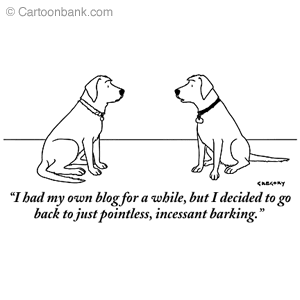
My stepmom sent me this, in what I hope was not some sort of comment on my activities here:

dogblog

There are many for whom this cartoon represents an uncomfortable truth. But not us. No, not us.
 

Posted by Buckethead Buckethead on   |   § 1

Forgotten Punchline Thursday: Wednesday Edition

This edition of Forgotten Punchline Thursday was made possible by a grant from Cthulhu's Own line of astral travel accessories.

For uncounted ages, He who lies dead but dreaming indeed dreamt of a line of suitcases, hardcases, and garment bags as tough as His hide. Only Cthulhu's Own could perceive the unimaginable evil of inter-plane customs, the otherworldy abuse that baggage handlers can inflict on your dread unmentionables, and the risk of losing your essence in transit. Leave the safety and security of the physical manifestation of your luggage to Cthulhu's Own.

Forthwith, this week's forgotten punchline:

"Nothing".

Posted by GeekLethal GeekLethal on   |   § 0