That's Un-American!

Who would have thought that making quality products would lead to world-wide domination? Apparently not GM, who just slipped into second place behind Toyota. When reached for comment, GM spokesmen replied, "They cheated."

The last American car I bought was a 1963 Cadillac, 20 years ago. Based on my experience with friends and relatives, I don't believe that I will buy any others in the near future - the sole exception being the potential purchase of a used pickup. The reason? They suck. Just 'cause they're made here (which, strictly speaking, they're aren't always) is not reason for me to subject myself to unreliable and poorly engineered vehicles.

[wik] Patton also posted on this very topic, but was too shy to post it at Perfidy. I will do him the favor of reproducing it here:

Hide the women and children! To the storm cellar, pronto! The Japs have sold 90,000 more cars than the, (quick - what’s a light-hearted pejorative for Detroit natives?) the Detroit guys!


Hey, wait a minute - so what? That little statistic is even less important than the dates and times at which the Dow Jones Industrials crossed each of the 1,000 point barriers, that is, “not at all”.

Given the fine mess that’s characterized GM these past few years, including poor results, billions of dollars in losses, junk bond ratings on its corporate debt, the jettisoning of the majority of its GMAC finance arm to Cerberus, the bankruptcy of Delphi, which it tried (and failed) to hive off as a separate, self-sustaining entity, and the battles with Jerry York, Kirk Kerkorian, and Tracinda, the fact that Toyota has passed them in sales is neither surprising nor particularly newsworthy.

They’re rather lucky to still be ahead of Ford, itself a company that is, as Monty Python might say “not at all well”.

Xenophobes and Detroit residents may mark this day as one that will live in infamy. More rational sorts will simply see it as the logical end to a progression that Toyota began, 20 years ago, when they started making cars better than General Motors was able or willing to do. Given that my last four vehicles have been made by Toyota, perhaps my objectivity isn’t perfect in this matter.

My post has the advantage of pithiness, but Patton got several more jokes in.

Posted by Buckethead Buckethead on   |   § 11

"Can a Company Be Run as a Democracy?"

Interesting title, from a story in yesterday's WSJ (subscription).

Short answer? "Yes, in some cases, if the company's really, really tiny."

Slightly longer answer? "Are you nuts?"

The article centers around the management practices in place at a company called Ternary Software Inc.

During a recent strategy meeting at Ternary Software Inc., a programmer criticized the chief executive's new incentive plan for employees. An hourlong discussion ensued, in which several participants, including the CEO, critiqued the proposal. Ultimately, all six participants agreed to handle incentives differently.

That part was crucial: Ternary runs itself as a democracy, and every decision must be unanimous. Any of Ternary's 13 other employees could have challenged the incentive decision and forced it to be revisited.

...

The 19-person Exton, Pa., company has a policy-setting team of seven people, including two frontline workers elected by their peers. The team is linked to smaller groups through the company that ultimately give all employees a voice. The team meets to set policy for two hours once or twice a month.

The article's author cites instances of similar management practice, including Honest Tea Inc., of Bethesda, MD and Continuum Inc. from West Newton, MA. She also includes, for comparison, I guess, Google, which

...prides itself on an egalitarian culture that includes weekly updates from executives who field questions from employees.

As though that's somehow applicable.

The article goes on to include quotes from several b-school professors, including this from Ryan Quinn, a management professor at the University of Virginia's Darden School who says:

...these companies typically are willing to sacrifice some short-term profit to pursue innovation or other goals. Mr. Quinn says unorthodox practices can succeed at large and small companies, but says he has never seen a company like Ternary, that strives for unanimous agreement.

Note, he didn't say that this practice can succeed at large and small companies, just that unorthodox practices can. Like, for instance, having everyone wear a funny hat on alternating Fridays. So, overall, his response strikes me almost as a polite way of asking "Are you nuts?"

An additional bit of insight, from Harry Katz, dean of Cornell University's School of Industrial and Labor Relations, goes a bit further:

...[he] doubts a system like Ternary's could work on a large scale. In bigger companies, "there's an inevitable conflict of interest between managers and employees," Mr. Katz says.

The article also provides several other instructional views life within Ternary. Two excerpts:

Ternary's path to workplace democracy wasn't painless. The company, founded in 2001, first tried to draft a mission statement by consensus in 2004, when it had grown to more than a dozen employees. The meeting lasted two days and ended as participants too exhausted to continue arguing agreed in principle to run the company as a democracy. An attempt the next year to create a salary system by consensus was no better. But Mr. Robertson persevered, guided by two out-of-print books about a Dutch management technique called "sociocracy" or "dynamic governance." He has dubbed Ternary's system "holacracy" and has begun marketing it as a managing style.

I'll let the dripping irony in that passage speak for itself.

The meeting where the incentive scheme was discussed was typically busy. The team rejected Mr. Robertson's proposal to replace the profit-sharing program with an "ad hoc bonus system" based on performance, formulating a new plan that would keep the profit-sharing program and introduce monthly bonus incentives. The group also assigned the CEO new responsibility for spurring growth, gave the sales manager more authority to negotiate contracts, and decided to bill clients by the day, rather than by the hour.

Technology chief Anthony Moquin, one of the founders of the company, said his gut reaction to the billing change was that it was simplistic. But he accepted it, saying, "We can try it and see how it works."

That's a common refrain at Ternary. Managers don't look for an ideal solution, merely a workable plan that looks like progress. Employees who don't like the results can seek a seat at the next strategy meeting or ask a member of the policy group to revisit the issue.

(emphasis mine)

Funny when you read it that way, it sounds like it should be a whole lot less interesting to the owners or managers of a company. In effect, it eliminates the value of any management role, including that of the CEO:

"It takes getting beyond your ego," says Mr. Robertson, who, as one of the founders of the company, has the CEO title but little typical CEO authority.

And it brings into question why you'd even have the title, let alone give it to someone.

The story goes on to explain how the company has benefited, in tough times, from having the flexibility to get all employees to agreement on issues like pay cuts. Quite uplifting, if you're exceptionally light and aren't running a for-profit business.

Left unsaid, in the story itself or the comments from the professors, a couple of things.

  • Ternary isn't Google, and whatever else you might say of Google, you won't say they're managerially incompetent or have created a company incapable of growth.
  • Not only does the typical company have conflicts of interest between managers and employees, the typical company, particularly one larger than 19 employees, has conflicts between employees and employees, as well as between managers and managers.
  • It might be horrible to contemplate, and even more horrible to enunciate, but not all employees have as much to add to any given decision-making process as the others.
  • In any event, the dynamics of watering down decisions by making sure they're universally approved results in watery decisions, catering to the lowest and loudest common denominator.

No offence to managers, employees, or Ternary Software, Inc. itself, but I'll be anxiously awaiting the future WSJ story about how Ternary grew and found the limits of what is essentially an intellectually lazy, confrontation-free, feel-good management style that doesn't strive for excellence, instead only for "a workable plan that looks like progress", and then jettisoned it as laughably unworkable.

Unfortunately, though I think you can already see where I'm going here, Ternary seems quite unlikely to ever grow too awful much, constrained as they are by a system that enforces crushing mediocrity, even in a small company like theirs.

As Professors Katz and Quinn intimated, unorthodox isn't bad, but there are a lot of things that can work in small companies which would be impossible at scale. Paying for everything on the owner's personal credit card is an excellent example. Keeping all your invoices and receipts in a shoebox is another. And, with all due respect to the admirable goal of "giving workers a voice", so is the practice of pretending they've each got something crucial and important to say about the company's direction, or that, in the event of failure, your fallback position is that "at least we all agreed on the strategy".

Sorry, but not all opinions matter equally, and without accountability for failure, there cannot be success in any non-trivial enterprise, including Ternary's. The time spent in search of universal approval of all decisions, and of making sure that every last person is happy and contented, is time wasted. And yes, this metaphor can be extended to the broader social and political realm, but I'll spare you that for now.

(all ellipsis above, mine)

(also posted at issuesblog.com)

Posted by Patton Patton on   |   § 10

Rudeness, and possible reasons therefore

In a Huffington Post blog entry (via the last item in today's WSJ Best of the Web, after a bit of work, because BOTW referred to it, in error, I'm certain, as the "Puffington Host"), we find this dispatch from the cultural battleground, describing an encounter at the White House Correspondent's Dinner:

In his attempt to dismiss us, Mr. Rove turned to head toward his table, but as soon as he did so, Sheryl reached out to touch his arm. Karl swung around and spat, "Don't touch me." How hardened and removed from reality must a person be to refuse to be touched by Sheryl Crow? Unfazed, Sheryl abruptly responded, "You can't speak to us like that, you work for us." Karl then quipped, "I don't work for you, I work for the American people." To which Sheryl promptly reminded him, "We are the American people."

While I don't doubt for a second that Karl Rove is capable of random rudeness to songstresses and Hollywood types who make fake documentaries, I figured there had to be a better reason, and that James Taranto, of Opinion Journal, was too polite to tell the rest of the story. It turns out that there's an excellent chance Rove just doesn't know where Sheryl Crow's hand had recently been.

The answer was found in another entry at the Huffington Post site, Sheryl Crow's wisdom on how to help stop the ravages of our future global warming overlords. This excerpt summarizes both her deep, deep thinking on the matter and the reason for Rove's apprehension at her attempted laying on of hands:

I have spent the better part of this tour trying to come up with easy ways for us all to become a part of the solution to global warming.

Although my ideas are in the earliest stages of development, they are, in my mind, worth investigating. One of my favorites is in the area of forest conservation which we heavily rely on for oxygen. I propose a limitation be put on how many squares of toilet paper can be used in any one sitting. Now, I don't want to rob any law-abiding American of his or her God-given rights, but I think we are an industrious enough people that we can make it work with only one square per restroom visit, except, of course, on those pesky occasions where 2 to 3 could be required. When presenting this idea to my younger brother, whose judgment I trust implicitly, he proposed taking it one step further. I believe his quote was, "how bout just washing the one square out."

See also (first four found via links from Huffington Post):

[wik] Possibly related, regarding Sheryl Crow: She’s well intended, and I don’t mean this with any disrespect, but she’s dumber than a road lizard.

Posted by Patton Patton on   |   § 7

Your quote of the day

So far, at least, as the day's only half over.

Context is almost unimportant for this one, but could be found, if you really wanted to and had a subscription, in today's Wall Street Journal, in an article entitled "After Big Wins in Las Vegas, An Investor's Luck Turns"

Speaking about city "councilwoman Lois Tarkanian, wife of former University of Nevada, Las Vegas, basketball coach Jerry Tarkanian", the story's protagonist, Billy T. Walters, said:

She's well intended, and I don't mean this with any disrespect, but she's dumber than a road lizard.

Posted by Patton Patton on   |   § 1

If imitation really is the sincerest form of flattery...

We ought to also consider the possibility that disingenuousness is the most obsequious form of lying.

image

Found while catching up with my overload of simultaneously delivered Economist issues, a story entitled "Counterfeit cars in China", and subtitled "The sincerest form of flattery".

Of course, there have historically been regular instances of copyright, trade secret, and patent law violations in China. (Google search links, returning 1.3M, 287K, and 981K document hits, respectively). An argument can be made that such infringement is how third-world and emerging economies grow to become full players in the global market. That argument would ring true, however offensive the concept that "all you need to do to grow is to steal and learn".

COPYING in China goes far beyond fake DVDs, watches and handbags. “We can copy everything except your mother,” goes a saying in Shanghai. Soy sauce with fizzy water passed off as Pepsi, fake Cisco network routers (known as “Chisco's”) and mobile phones that look like the latest offerings from Nokia can all be easily found. So, too, can fake blood plasma.

Aside from the blood plasma (which I don't understand how one might fake), the rest of it is all old news. Counterfeiters of high-value manufactured goods should be restrained by to the barriers to entry, including "huge capital investment".

Of all the products to copy, however, a car is surely the most complicated. Cars consist of around 6,000 precisely manufactured components made from a range of different materials. For a car to be cheap, reliable and long-lasting, says conventional industry economics, these parts need to be put together in factories with huge volumes, lots of expensive machinery and many well-trained engineers.

Turns out that in China's case, that's not as true as might be hoped:

So it came as a surprise when counterfeit cars started to appear in China eight years ago. Early VW look-alikes were soon followed by the infamous Chery QQ. It appeared six months ahead of the car it copied, the Chevy Spark, because a Chinese firm somehow got hold of the blueprints.

All quite troubling, and it goes beyond the Chevy/Chery, affecting many other established manufacturers. 

Yes, it's part of emerging economies' growth path, and yes, once they get to the point where they're creating more intellectual property than they're stealing, balance will be restored in many areas, including balance of trade, manufacturing costs, and living standards. But that doesn't happen overnight, and at some level, the imbalance causes pain in the trading system, yielding such things as (in the US) calls for trade protectionism.

Aside, however, from any arguments about whether, when, and how balance will be restored, it seems reasonable to expect some honor among thieves, no? Honor of the sort I'm considering would be that, if you're going to steal, at least don't lie about it, and if you're going to lie about it, at least put in the effort to make the lie plausible, if not believable.

What's triggered this mild outburst of mine on the subject? This:

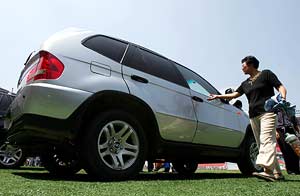
Shuanghuan Automobile got into trouble for copying Audi's famous four-ring logo a few years ago. It then copied the design of Honda's CR-V, called it the SR-V and appears to have won the subsequent legal tussle. Last month the firm won an export licence, and it plans to start shipping another model, the CEO (pictured)—a sport-utility vehicle with a striking resemblance to the BMW X5—to Romania and Italy.

Copying DaimlerChrysler's small two-seater Smart car seems to have become especially popular. In January Shuanghuan launched an electric version, called the Dushi Mini. It followed in the tracks of Shandong Huoyun Electromobile, a firm that makes golf buggies, which launched its own version last year and announced plans to sell the car in Europe for less than half the price of the original.

After Daimler threatened to sue, the car was temporarily withdrawn. A spokesman for the Chinese firm said he had been surprised by the way his car resembled the original, explaining that the company had simply copied a toy car.

A toy car? Excuse me? Who's their spokesman, I wonder? Tommy Flanagan? Baghdad Bob?

Growing up to achieve a seat at the adult table in international trade would seem to preclude such blatant disingenuity. In the circumstances, the spokesman could have been expected to be at least a little sheepish after such an utterance.

(also posted at issuesblog.com)

Posted by Patton Patton on   |   § 2

Some records just beg to be broken

And some should be allowed to stand unchallenged.

Apropos this earlier item, I'd caution the participants to not be like this woman:

Woman registers a .47 on breath tester

Thu Apr 19, 1:41 PM ET (AP)

REDMOND, Wash. - A woman arrested following two car crashes last week registered a .47 blood-alcohol content on a breath test — nearly six times the legal intoxication threshold and possibly a state record.

Deana F. Jarrett, 54, was taken to Evergreen Hospital as a precaution following her arrest April 11, the Washington State Patrol said Wednesday. No one was injured in the accidents.

Jarrett blew the .47 on a portable breath tester after she collided with two other vehicles in quick succession, the patrol said. A check of all 356,000 breath tests administered since 1998 in Washington turned up only 35 above .40 — and none of those was higher than .45.

The legal intoxication threshold in Washington is .08.

Jarrett did not appear to have a listed phone number, and it was not clear if she had obtained a lawyer.

(excerpted in its short entirety, to avoid the corrosive effects of future link-rot)

It rather reminds me of a colleague from years ago, who once proudly held the "women's record" for blood alcohol level in Whitehall, OH, at .20%. I remember having read somewhere that .30% was lethal, but I'm not going to go and Google it, since, per the above, it must not be true.

Posted by Patton Patton on   |   § 4

Plan Red

Should we need to invade Canada, we have at least one plan. Back in the interwar period, the United States maintained a series of color coded plans for wars with various potential enemies. Most well discussed of these was Plan Orange, which actually ended up being a big part of our actual war plans against Japan in the Second World War. Less well known is Plan Red, the plan for war with British Empire.

In the plan, the war was assumed to be continental. I imagine that this is because it was an Army plan rather than a Navy plan, and as such, it focused on "Crimson" which is Canada. The plan in its entirety can be found here, but the essentials are simple:

Step One, a joint Army/Navy assault on Halifax and the Maritime provinces to cut off Canada from reinforcements from Britain. Step Two, land assaults from New York and Vermont toward Montreal and Quebec City, with Quebec being the primary target. This would cut Eastern Canada off from the rest. Step Three, assaults from Niagara and Detroit into Ontario. Seizing these areas would deny the enemy their industrial facilities, staging areas for air attack, and secure control of the Great Lakes. Step Four, a thrust towards Winnipeg to cut the Trans-Canadian railway and communications between the far west and Eastern Canada. Finally, Step Five, an assault on Vancouver which would lead eventually to the occupation of British Columbia and deny Canada access to the Pacific.

This seems like a good plan, decisive strikes to disable communication, followed by occupation. Seeing as 90% of the Canadian population is within a three-day march of the American border, Canada is not exactly easy to defend. This plan, suitably updated to incorporate changes in the geo-political and military worlds, would likely have an even greater chance of success than it did in 1935. Alongside the phenomenal American military advancements over the last few decades, Canadian military strength has greatly diminished. Did you know that Canada once had the third largest Navy in the world? Canada's one real hope in '35 would have been to slow down an American offensive long enough for Britain to come to her aid. Now, Britain would find it nearly impossible to come to the aid of her former colony in the face of opposition from the US Navy.

The initial invasion would almost certainly be successful. But the idea of 33 million pissed off Canucks no longer across an international frontier is not exactly heartening.

Posted by Buckethead Buckethead on   |   § 3