The more alert of our mostly sessile readership may have noted that astronomers have detected a new extrasolar planet. We've discovered hundreds of extrasolar planets, so why is this one so damned special? Well, let me tell you. It's earthlike. It's close. And it's in the habitable zone of its star.
Roadtrip!
Well, close in astronomical terms, and for some odd values of "earthlike." The new planet, Gliese 581c, is about half again as big, and five times as massive as Earth. The bigdomes are guessing that this would result in a surface gravity somewheres around twice that of Earth. Which would kill any fat, tall people on a colonization mission. It'd be worse than Oregon Trail. For more details on what life might be like on this planet, visit here, here, here, or here. And get in line behind this guy for tickets:

What might be most significant about this discovery is its implications for the Drake Equation – something we talked about in great depth just a little while ago. Pretty much as soon as we fired up that fancy new telescope, we discover an earthlike world, right on our doorstep. That has to be indicative of how common planets like ours are in the galaxy.
As we learn more about the big universe out there, more of the numbers in the Drake equation are looking to be large. The Drake equation can be divided into physical, life, and civilization factors. All of the physical factors are now almost certain to be large across the galaxy, so there’s no way to minimize your estimates of the number of ETs by saying that there aren’t going to be abodes for life as we know it. (Of course, they may be many other places amenable to life as we don't know it.)
As for life, there are two ways that we could get a firmer grasp on how to judge those numbers, and both are within, nearly, our grasp. Any evidence of life in our solar system would be a strong, but not definitive, clue that life is common in the galaxy. Europa and Mars are the prime candidates there. More research along the lines we are pursuing now may give us some answers. The other way is to increase our capacity to gain information on extrasolar planets, which we are also pursuing. If we get to the point where we can image these planets, it is certainly possible that we could detect chlorophyll or other biological evidence in their reflected light. Finding that would be strong evidence that life exists outside our solar system, and that it could be common as well.
That would mean that two thirds of the Drake Equation’s constituent elements would be heavily weighted toward high numbers. And that the chance of ET’s would be correspondingly higher as well.
[wik] The super nifty star map has not yet been updated to include our new vacation destination. However, you can look at it anyway by going to the to the scrolly thing right on the left side of the window, and scroll down about halfway, looking for "Gl 581." When you find it, click it, and you'll see the Gl 581 circled on the star map. Click on it, or in the window on the right to see the solar system, sadly absent little c. On the star map, if you click on the right arrow, and then the back arrow, you'll be in our sector. Neato!
A summary of the info taken from various websites, linked above:
Gliese 581c orbits a small, red star located 20.5 light years from Earth, in the direction of the constellation Libra. The star has 1/3 the size, and 1/50 the brightness of our sun.
Due to the dim smallness of Gliese 581, its habitable zone is correspondingly narrower than that of our sun. The planet, Gliese 581c (“c” for short) is within this zone, orbiting a mere 6 million miles out. That close orbit gives c a year lasting only 13 days. The presence of a large, Neptune-sized planet inside c’s orbit could mean that it is unlikely that c is tidally locked to the sun – having one side eternally facing the sun, as our moon does with Earth.
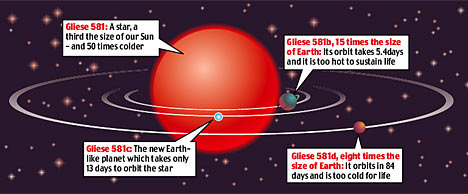
The planet itself is large, five times as massive as Earth and perhaps half again as large, or even bigger if it is made of ice and less dense than here. This would result in a surface gravity between 1.6 and more twice that of Earth. The temperature on c would be in the range of 0 to 40 degrees Celsius, or just what we have here. We have no idea what the composition of the planet is, guessing that it is a rocky world like Earth is not unreasonable. A big planet like this would have no difficulty holding down an atmosphere, and the presence of water is certainly a possibility as well.
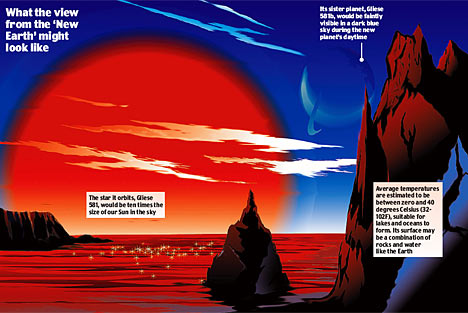
Someone came up with this cheesy graphic, which despite its cheese gives you a good idea how big the sun would be from the surface of the planet.
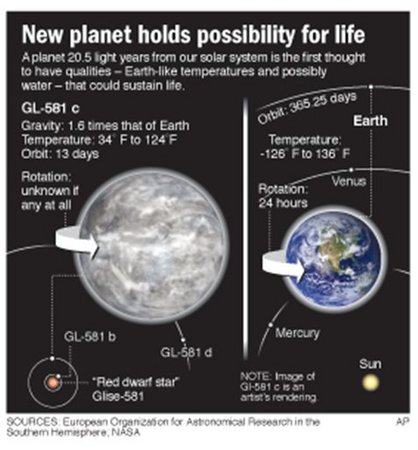
This pic has some comparative stats for c and Earth:
And of course, Wikipedia has more info as well.



 on
| § 7
on
| § 7


