Death Takes a Holiday

The New York Times has a remarkable story this week about a photo album that came out of Auschwitz, with an accompanying slideshow that's incredibly arresting. You see, rather than the usual deeply upsetting images of skeletonesque inmates suffering untold miseries, they're pictures of their captors and executioners at rest and play, frolicking, hanging out, mugging for the camera, generally behaving like any people taking a break from the rigors of a job well done would. Except that the same day the pictures were taken, these well-rested and attractive people committed incredibly depraved acts against other humans. In these images, even Dr. Joseph Mengele seems like a shrimpy nebbish, with barely a hint of the maggots roiling behind his smiling eyes.

There's one woman in the pictures, who appears a few times. She's clearly a camp administrator of some kind, and she's young, fresh, and pretty. She's clearly vivacious and strong-willed; it's easy to be attracted to this face from more than sixty years ago and imagine a friendship or a friendly beer. And then I realize that behind that smile and those pretty eyes is a mind completely and totally at ease with sorting families into keepers and corpses every single day, and I want to puke myself dry.

Thank the deity of your choice that such an artifact exists, and is in the hands of the National Holocaust Museum. For the danger, as we all know intellectually but tend to forget in our guts, is not from overt acts of monstrousness, but in the workaday -- yes -- banality of evil.

Posted by Johno Johno on   |   § 0

A trenchant question, searching for an answer

While looking for the answer to a completely different question, I ran across this nugget at Yahoo Answers:

Should politicians who fillibuster be tazed?
And put on Americas funniest?

This from a person named “Dr. Spanky”. Oddly, the site doesn’t appear to list where s/he went to med school or garnered a PhD, but since it appeared, ignoring the inherent irony of the site’s name, on Yahoo Answers, you know it’s a credible and important question, needing an answer.

Or not, as it turns out. Most of the several answers were provided in what I think was the spirit of the question. One, however, I think his name was “Buzzkill”, responded:

No, because the rules specifically allow for that activity.

You cannot (reasonably) punish someone for following the rules. All you can do is change the rules.

And since he’s flagged as a “Top Contributor”, whatever that implies, I guess there’s supposed to be some authority behind his revelation, for which we’re all better off. I’m sure that his next act, after posting that clarification, was to go out and yell at the neighbor kids to get off his god damned lawn.

[Wik] Apparently, I ran across that question while it was still fresh, and Buzzkill’s comment was less than a minute old. Serendipity, I guess. Anyway, the discussion’s already degenerated to whinging about brown shirts with Tasers, how they should actually taser the guy who started a war based on lies, and the usual bullshit claptrap. It was fun for the couple minutes it lasted, though.

[alsø wik] But wait - the fun’s not quite over yet! This, from the (appropriately) self-monikered “Deep Thought”:

Why stop at tazering for filibusters? I’m sure there is good money to be made if you just let people tazer Robert Byrd for fun. Think of the potential. 535 members of Congress. Millions of upset voters. We could pay off the deficit.

Posted by Patton Patton on   |   § 3

I suppose this should make me sad

But it doesn’t. From a WSJ email, dispatched this evening to my inbox, this story:

NEWS ALERT
from The Wall Street Journal

Sept. 17, 2007

William Lerach is set to plead guilty to one count of conspiracy in the criminal case involving the noted securities lawyer’s former firm, now called Milberg Weiss LLP. The plea agreement, which calls for a one to two year prison term, could be announced as soon as Tuesday.

I’m all for protecting the common man, the common investor, and I’m nothing if not both of those things. However, while Milberg Weiss (...Bershad Hynes & Lerach) LLP has always claimed that their seldom-seemly, and often seedy, pursuit of class action lawsuits, against any company whose stock price took a noteworthy downturn, was for the public good, I’ve never been able to agree.

Not in my stance as a champion of the unfettered right of public companies to run roughshod over their investors, either. Because I have no such stance. Instead, my dim view of him and all who practice his kind of law is justified by standard tactics he and his partners (current and former) have used in pursuit of specious claims. Think “greenmail”, ala Carl Icahn and Boone Pickens in the 1980s - make life tough enough for someone, even someone who’s got no basis for having to defend their actions, and they’ll pay you to go away.

As referred to in an Los Angeles Business Journal article of Sep 3, 2007, Lerach is an “economic terrorist”, and I don’t think that’s too tough a characterization of him. As the article says:

Lerach, of course, did not invent but did perfect the securities class action lawsuit. In that scheme, most any company that sustained a stock drop, even if it had nothing to do with anything of consequence, often found itself the recipient of allegations of fraud in a Lerach-engineered lawsuit. Likewise, companies that announced most anything negative could get the same kind of lawsuit – often within hours of the announcement.

Lerach then pounded the company, using the discovery process to find some little scrap somewhere in some underling’s file drawer that “proved” the company knew that bad news could develop.

In other words, this guy, and all lawyers like him, specialized in swooping in any time there was even a flimsy pretext for doing so. I mean, there’s no way a stock could drop without malfeasance and lying on the part of management, right?

Well, no - that’s wrong. But Lerach, et al, after having put their lawsuit’s stake in the ground, would then embark on forced discovery at their target companies, essentially fishing around for a reason to justify their lawsuit.

And one doesn’t have to be a big-business apologist to find that sort of thing to be outside the bounds of fair and reasonable play.

Over the years, I’ve been the recipient of at least 50 securities class action solicitations. I received one just the other day, ”In re CARDINAL HEALTH, INC. SECURITIES LITIGATION“. And while I almost never take the time to participate in these paper chases, I’ve always paid particular attention to any such action which has either “Lerach Coughlin Stoia Geller Rudman & Robbins LLP” or any of the many versions of “Milberg Weiss +/-Bershad +/-Hynes +/-Lerach LLP” listed as the attorneys looking out for my “best interests”.

Because they don’t, they haven’t, and investors are simply a raw material for them and their business process. And I throw their solicitations away as soon as possible, to avoid stinking the house up.

His former partner Bershad has already pled, and if the news report is correct, Lerach’s getting ready to do the same. It’s not the Christian thing to say, but I’m not much of a Christian anyway, so I’ll hope that Milberg, Weiss, and all the rest be following them to the pokey soon after.

Posted by Patton Patton on   |   § 0

Bread Pr0ns

So, now that I have the flamejob for this:

image

I did this:

image

From right to left that's two pain levain batards, two sourdough boules, and a part-rye part whole-wheat sourdough miche of my own design - about eleven pounds of lovely bread I turned out of my oven today. This was probably the best day of baking I've ever had.

In the background, you can see Herman, my stout and doughty sourdough culture, his billions of yeasts and bacteria toiling away happily on a fresh feeding.

I have a nice little life going here. Better not blink.

Posted by Johno Johno on   |   § 2

Anna, damn 'er!

Anadama bread is a traditional coastal New England bread with molasses and cornmeal that makes excellent toast and incredible peanut butter and jelly sandwiches. The original recipe, so the legend goes, comes from a Rockport, Massachusetts man (up the coast on Cape Ann, next to Gloucester where they're all gruff fisherman) whose wife ran off and left him with nothing in the house but cornmeal, molasses, and flour. He baked all these into a loaf and named it "Anna, damn 'er." History is silent on whether Anna deserved this infamy.

I have been making Anadama bread for years, from recipes by James Beard and Peter Reinhardt, but since I have had some time off recently caring for an infant, I've gone back to the drawing board, refined the basic formula into by far the best version I have ever tasted, and am now ready to pass it along to you, you lucky dog.

My basic innovations are to use a somewhat higher proportion of cornmeal and molasses than I've seen elsewhere, to add a little (optional) whole wheat flour for nutrition and complexity, and to use a two-starter method to build the dough rather than the traditional straight method.

The extra molasses and cornmeal (which is really pushing the limit for what this formula can take and still rise well) give the bread a distinctively "Anadama" character which I like a lot. For the same reason, I also prefer to use blackstrap molasses, the darkest, most intensely flavored molasses out there. It just tastes better in this bread, though you may certainly use dark or golden molasses if that's what you have around.

The two starters, a soaker and a sponge, are here for several reasons. The cornmeal soaker softens up the grain, which means: more sugar is available for the yeast to feed on; the particles of meal are softer and less prone to cut into the bread's gluten structure, giving a lighter loaf; and the cornmeal cooks more completely in the oven. A sponge of some of the flour gives great depth of flavor, promotes the activity of enzymes that make the dough more elastic, and also lowers the pH of the dough slightly, which (probably, so the theory goes) helps to soften the bran in the whole wheat and therefore keeps the loaf lighter. Putting all this together may seem like a pain in the keister, but it really amounts to five minutes of work done over two days.

Soaker:

10 oz cornmeal
10 oz water, room temperature

Sponge:

8 oz (1 3/4 cups) all-purpose or bread flour (11% protein content minimum)
7 oz water, room temperature
1/2 tsp yeast

Main Dough:

8 oz (1 3/4 cups) all-purpose or bread flour (11% protein content minimum), plus more in reserve
6 oz (1 1/2 cups) whole wheat flour (or, 6 more ounces AP or bread flour)
1 1/2 tsp instant yeast
.4 oz (1 1/2 tsp) salt
4.5 oz (1/3 cup) molasses, preferably blackstrap
1 oz (2 tbsp) unsalted butter, at room temperature

(For the hardcore here's the baker's percentages):
Flour................. 100%
Water................ 77%
Yeast................. about 1.1%
Salt................... 1.8%
Cornmeal........... 45%
Molasses............ 20%
Unsalted Butter... 4.5%

1) The night before you bake, make your soaker: combine the cornmeal and water in a small bowl, mix well, and cover with plastic wrap. Alternatively, you can make a hot soaker on baking day: heat the water to about 130-140 degrees, combine cornmeal and water, mix well, cover, and let stand for 4 hours. The higher temperature seems to help the cornmeal take up the water more quickly, and may contribute to a softer dough.

2) The morning of baking day, make your sponge. Combine the flour, water and yeast in a large bowl, whisk or stir together vigorously for at least a minute, and let sit 3-4 hours or until nicely ripe. (Ripe means that the sponge is bubbly and domed, and just beginning to recede. You will know it's ready when it looks like a badlands landscape, with canals just beginning to form on the surface between islands of starter.)

3) Place the flour, yeast and salt for the main dough in a large bowl or the bowl of your stand mixer, and whisk to combine. Add the soaker, the sponge, the molasses, and the butter.

4) Mix in stand mixer on low to medium speed for 6-8 minutes (using the paddle until things come together, and then switching to the dough hook), or, if kneading by hand, mix just until the ingredients are combined and then turn out onto a lightly floured surface and knead for 10-12 minutes. Add flour as necessary to make a smooth but somewhat tacky dough - it should clear the bowl but cling a little to a dry finger applied to the surface for a few seconds.

(This is a good opportunity to hone your skills working with a wonky dough - it tends to start off looking drier than it should, and then because of all the cornmeal cutting into the newly formed gluten, becomes rather unruly before turning into a smooth dough. You may need to add flour while you knead, but give it at least two minutes by machine or four by hand before adding flour a tablespoon at a time, to ensure you don't overdo it. )

5) Place kneaded dough in a lightly oiled large bowl and cover with plastic wrap. Let rise in a warm place (80 degrees) for 90 minutes. Halfway through, give the dough a business-letter fold*.

6) Remove dough from bowl, divide into two equal pieces, and gently preshape**. Let rest covered for 15 minutes.

7) Preheat oven to 350.

8) Shape each piece into a freeform round or batard loaf, or shape and place in lightly oiled loaf pans. Proof 60-90 minutes or until nearly doubled.

9) Bake in oven for 40-50 minutes, turning halfway through. If you wish, you may steam the oven*** when you place the loaves to promote a better oven spring.

10) When the internal temperature is above 190 degrees, and the loaf is a nice dark golden brown on all sides, remove from oven. (Or, just give 'em the full 50 minutes if there's doubt.) Remove from pans, if used, and place on a rack to cool. Wait at least 1 hour before slicing!****

* A business-letter fold is a fancy way of punching down partially risen dough. The intended effects are two: to gently expel some of the gas that has begun to accumulate, and to line up the gluten structure of the dough to promote a good rise, a good shape, and an attractive loaf.

Here's how:

1) Using a bowl scraper, remove the dough from the rising bowl onto a lightly floured surface. Using the flats of your fingers, gently press down all over the dough to let some air out. Do not mash the edges, do not try to pop visible bubbles, and do not be forceful.

2) Gently pull the sides of the dough outward just a little so that the entire mass is an ovalish-rectanglish shape with the long sides going left to right.

3) With your hands, take the left side of the dough up and fold it about two-thirds of the way over the rest of the mass, as if you were folding a letter into thirds. Repeat with the right side, folding it all the way to the opposite edge. Do not press down to seal.

3a) In some very slack doughs - not this one - you may turn the dough 90 degrees and repeat this process before returning the dough to its bowl, to build additional strength.

4) Replace dough in bowl, folded side down, and cover once again with plastic wrap.

** To preshape a loaf is to take the ugly cut piece you have, and turn it into something orderly so that it will form a neater loaf that will rise and eat better.

1) Place the dough piece cut side up on a very lightly floured surface. Take the top edge and fold it toward the middle of the mass. With the heel of your hand, gently but firmly press it into place. Take the piece of edge that's at about 2:00 and repeat. Continue clockwise like this all the way around. When you are finished, the dough should be closer to round, and elastic enough to spring back just a little when you take your hand away.

2) Then, take the 12:00 and 6:00 edges and bring them toward each other. Press them together to gently seal. Repeat with the 3:00 and 6:00 edges. Repeat again in each direction. Alternatively, if you are expert at shaping round loaves, you can tighten the gluten on the "good" surface a bit using whatever method you prefer.

4) Finally, turn the preshaped piece of dough seam side down onto a lightly floured surface, cover with a bowl or plastic wrap and let rest for 15-20 minutes.

*** To steam an oven:

1) Place an old cast iron skillet or cake pan you never plan to use again on the floor of the oven, or on the lowest rack if using an electric oven. Preheat the oven with the pan inside.

2) When you place your loaves in the oven, carefully pour 1 cup of very hot or boiling water into the pan before you shut the oven door. Be careful! - steam burns are bad news.

If you are afraid of pouring water into your oven, you can use a few ice cubes instead, placing them in the pan when the loaf goes in, though this does rob the oven of a little heat. You can also use a spray bottle to mist the dough with water prior to going in the oven, and then spray the oven walls quickly with water at two-minute intervals for the first eight minutes or so of baking. This method also leads to great heat loss, so tack a few more minutes of baking time on the end.

Now... why steam your oven at all? Well, steam will keep the starches in the crust from gelatinizing (hardening) as quickly while the loaf undergoes its last speedy rise in the intense heat of the oven. For this recipe this is optional, but you will probably find you get a slightly better oven spring from steam.

**** Why wait until the bread is cool before slicing? Because bread isn't done baking until the loaf has come back down to almost room temperature. As the loaf cools, the internal structure is continuing to gelatinize (set and become edible) and flavor compounds are continuing to develop. This process doesn't fully run its course until the bread is nearly cool. The only bread you should eat hot is bad bread; good bread deserves good treatment and a full cooling before cutting.

Posted by Johno Johno on   |   § 0

Low Blows

There's two things that I am for sure: a rabid pro football fan (American style) and a bleeding heart pablum puker.

So, I've been growing increasingly concerned over the last few years as reports have surfaced of the extent and callousness of the NFL's disregard for on-field player injuries and for disabilities suffered by retired players. Now, I'm no idiot. I know coaches regularly put guys in numbed up against cracked ribs or a broken finger to finish a series or a game. It's football! But when you get beyond that, into the realm of doping up a lineman with a broken spine and sending him into the game, or letting your QB or running back play when he's been hit on the head so hard he's not sure of his name, the date, or which way is up, that's a different story. Then pro football with its pads and lucrative ad deals, devolves into mere crude bloodsport (rather than a bloodsport at a remove, which is so much more civilized and refined). My own New England Patriots and their coach Bill Belichick are reportedly among the worst offenders here, taking horrible and stupid risks with players' health that has cut many careers, and doubtless many lives, short.

Now, again, that's theoretically an uncomplicated matter of well-informed people making choices as adults to put themselves in harm's way. But the truth, naturally is not so neat. Via unfogged I have found a fascinating and dismaying article in Men's Journal about the shameful and shabby treatment of retired injured players at the hands of the NFLPA (the players' union), the league itself, and the various bodies set up to take care of retired players.

[wik] A final question: What sense could it possibly make to put a player who makes $6M a year, by contract, for multiple years, in harm's way unnecessarily? How is that good business? Your journeyman halfback plays on an injured knee, blows out his meniscus and his ACL or fractures his spine, and then collects the rest of his four-year contract from the sidelines, unable to do what he was hired to do but owed every penny of his salary. Wouldn't it make more rational sense to take better care of your players and try not to play them when injured, in an effort to preserve your investment in him? Hell, leaving aside the fact that this would be the decent thing to do, it's economically sensible!

Am I right? Am I right?

Posted by Johno Johno on   |   § 1

Flame On!

It's been a long standing point of minor contention between myself and Goodwyfe Johno that for some reason she won't let me have a flamejob put on our Oldsmobile sedan. Says it's a frivolous waste of money... I guess I can see her point, but I have a hard time liking it.

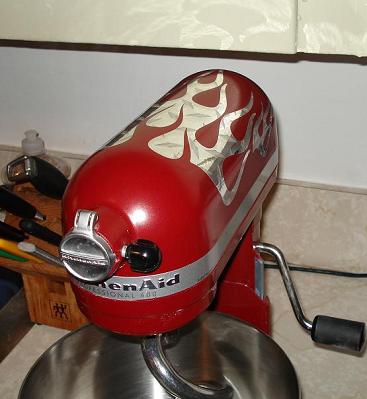
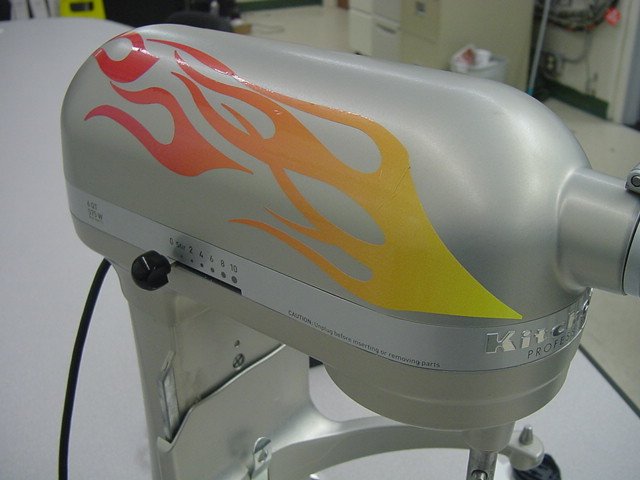
But let nobody say she's not a good person: yesterday she found for me a guy who makes flamejob decals... for home stand mixers like my Kitchenaid Artisan 600! A silver-and-black flamejob diamond-plate pattern flamejob decal is on its way to my home as we speak, to give my Kitchenaid mixer at least 100 more horsepower of pure high-grade awesome. My mixer, when done, will look very much like this (except awesome silver on awesome red):

I love the internets.

Posted by Johno Johno on   |   § 2

I Made This

Well... we did.

Linus John:

image

... and with a very sleep-deprived papa, enjoying the soothing tones of Cuban dance music played at deafening volume. Good kid. (Nota bene: even on no sleep with a new infant in the house, I still look at least 5-8 years younger than my actual age. Good genes, evidently!)

image

Posted by Johno Johno on   |   § 4