

 Ministry Archive: Buckethead
I thought I'd share that. And this, which I just ordered as my bday present to myself:

A small wallet from Saddleback Leather Co. It's got a 100 year warranty. Their stuff looks pretty awesome, though I don't think I'll be dropping $300 for the satchel - much as I'd like to - anytime soon.
My other birthday present will be this, in about a week and a half. But you probably could have guessed that.
 on
| § 5
on
| § 5

It figures that I would finally get around to blogging about Anti-Democracy, Reaction, and allied topics, and Moldbug would stop blogging for a month and a half. So it seems that I have no recourse but to point at old Moldbug material.
I've already mentioned a couple - the open letter series, for starters. Another interesting series, equally long, is the Gentle Introduction to Unqualified Reservations (in my head, I can't help but think Unreserved Qualifications. Maybe Moldbug brings out my inner dyslexia.) If you want a convenient gateway into the prolix thought of Moldbug, some dude created a table of contents for UR, with all the posts organized into categories, with handy links to the books that Moldbug references in his posts.
So there's that.
One of the things that really caught my eye, and imagination, was his claim to be a Jacobite. MM seems to have become bored by this idea, he hasn't mentioned it in a while. But a while back, he had this to say:
I suggest a Stuart restoration in an independent England. Through some beautiful twist of fate, the Stuart succession has become entangled with the House of Liechtenstein, who just happen to be the last working royal family in Europe. The father-son team of Hans-Adam II and Hereditary Prince Alois are not decorative abstractions. They are effectively the CEOs of Lichtenstein, which is a small country but a real one nonetheless. As you'll see if you read the links, the last "reform" in Lichtenstein actually increased the royal executive power. Take that, 20th century!
And Prince Alois's son, 13-year-old Prince Joseph Wenzel, just happens to be the legitimate heir to the Stuart throne - illegally overthrown in a coup based on the notorious warming-pan legend. Therefore, the structure of a restoration is obvious. The Hanoverians have failed. They have become decorative pseudo-monarchs. And as for the system of government that has grown up under them, it makes Richard Cromwell look like a smashing success. Restore the Stuarts under King Joseph I, with Prince Alois as regent, and the problem is solved.
Unrealistic? Au contraire, mon frere. What is unrealistic is "a sense of purpose as a nation, a uniting ethos which will restore our sense of pride..." Frankly, England does not deserve pride. It has gone to the dogs, and that may be an insult to dogs. If England is to restore its sense of pride, it needs to start with its sense of shame. And the first thing it should be ashamed of its the pathetic excuse for a government that afflicts it at present, and will afflict it for the indefinite future until something drastic is done.
For example, according to official statistics, between 1900 and 1992 the crime rate in Great Britain, indictable offenses per capita known to the police, increased by a factor of 46. That's not 46%. Oh, no. That's 4600%. Many of the offenders having been imported specially, to make England brighter and more colorful. This isn't a government. It's a crime syndicate.
Ideally a Stuart restoration would happen on much the same conditions as the restoration of Charles II, except perhaps with an extra caveat: a total lustration of the present administration. It has not partly, sort of, kind of, maybe, failed. It has failed utterly, irrevocably, disastrously and terminally.
Therefore, the entire present regime, politicians and civil servants and quangocrats and all, except for essential security and technical personnel, should be retired on full pay and barred from any future official employment. Why pick nits? The private sector is full of competent managers. You can import them from America if you need. Don't make the mistake of trying to sweep out the Augean stables. Just apply the river. (If a concession must be made to modern mores, however, I think this time around there is no need to hang any corpses.)
Now isn't that fun? When Prince Joseph becomes ruler of Liechtenstein, he will be the first heir of the Stuarts to be since James II to be ruler of an actual country. A small country, to be sure, but a real one. Interesting too, is that before the Stuart line stopped claiming the title of King, they always claimed to be Kings of England, Scotland, Ireland and France.
I've read a couple sf novels that involve the Stuarts scheming to regain the throne, maybe we need another one, set in the current day - though it'd be an odd set of circumstances that could possibly lead to young Prince Joseph claiming his rightful throne of England. And I don't think Liechtenstein is about to invade across the channel.
Still - there is something about monarchy that exerts a fascination upon the mind, maybe even especially the American mind. The evolutionary psychologist angle would imply that there is something in us that responds to things like kings. I think it's possible that the key difference between a modern dictatorship and a older style divine right monarchy is not just in the attitude of the autocrat, but in the culture of legitimacy that supports a kingdom in a manner that no dictatorship can ever expect.
on
| § 0
NYTimes' Kristof: A Modest Proposal: A King and Queen for America
Well, hot damn with whip cream! Did I ever jump on the right boat. I admit, somewhat shamfacedly, that I don't dig this whole democracy thing, and just days later the NYTimes is calling for the installation of a monarchy. Do I have timing or what?
Wait, they didn't mean it like I thought they meant it.
It turns out that Mr. Kristof is calling not for a Stuart Restoration as I had hoped, but rather for finding some dope to take Prince Charles' job of walking around cutting ribbon and looking like a doofus. The point of this, apparently, would be to free President Obama from all the tiresome ceremonial duties of his job and focus on gettin' shit done. Like, you know, talking to the CEO of BP about the oil spill and stuff.
A figurehead head of state is a nifty foreign policy tool as well. President Obama has twice had to delay his trip to Indonesia and Australia because of the press of domestic policy, but an American king and queen could spend days greeting crowds and cutting ribbons at new schools. And when they aren’t traveling, our king and queen could be kept busy hosting state dinners five nights a week.
Some folks complain that it’s silly to fret that Mr. Obama doesn’t emote. Of course, it is. It’s farcical that we have bullied our president into trash-talking on television about kicking some you know what.
One of the things I admire about this administration is its cerebral, no-drama emphasis on empirical evidence in addressing issues such as health, education and poverty. This is government by adults, by engineers rather than by dramatists.
But Mr. Obama also knows that drama and emotion are the fuel of American politics, and that’s why he’s struggling to feign fury.
As Stephen Colbert observed about the oil spill: “We know if this was Reagan, he would have stripped to his skivvies, put a knife in his teeth, gone down there and punched that oil well shut!”
That's obviously incorrect. Reagan would have asked Chuck Norris to swim down and punch the oil well shut, and Chuck Norris wouldn't need a knife. Chuck Norris might roundhouse kick the leak, or just glare at it - that's a stylistic issue solely up to Chuck Norris' discretion. But you know that well will stop.
The monarchy in England is expensive. And embarrassing. Why would we want that? Why spend billions of dollars a year for a mook like Charles, his cringe-inducing siblings, and the pleasure of watching a pathetic reality show funded on your dime. Let's let the networks pay the bills, please.
No, if you're going to get a monarch, let's us do it right. A milquetoast, emasculated semi-monarch is not the answer. The answer is a kick ass monarch. Someone who can speak truth to power because he is, uh, power. Someone like this.
And that gets us to this, a thread over at Aretae's where Devin Finbarr was schooling me on being a total wuss about reaction. Here I was, being cautious, and worrying about some possible ill effects - it turns out I was worrying about the wrong effects:
Devin's responding to my earlier comment, here:
[quoting me] My problem with neocameralism as Moldbug goes on with it is that while ideally we'd want Steve Jobs or the like - competent, visionary, minimalist in how he runs Apple - we might get the CEO of Microsoft, or GM. In fact, the latter seems more likely. [end quote]
The management of even GM far exceeds the management of the U.S. government. While many corporations stagnate or fail, they actually have a much harder problem. Microsoft needs to constantly run just to stand still. Maintaining market share/profits requires constant innovation, which is not easy at all.
A government basically needs to keep order, enforce rule of law, maintain a stable currency/business climate, and that's it. A government does not need to innovate (except perhaps in military matters) - it can delegate that to the private sector.
But the U.S. government(s) is increasingly failing to enforce basic rule of law. No corporation has ever destroyed its capital as the American cities did in the 1970's. Almost no corporation manages to turn an operating loss on real estate.
[quoting me] Of course the problem of hereditary monarchy is an issue too - what if the son is an idiot? Elective monarchy might be better, until you get to a point where you have competing claimants to the throne. [end quote]
Elective monarchy is cool, but the trick is to make sure that the elections do not devolve into politics. Once there are parties, competing factions, feedback loops between campaign promises and the results of power, then you're right back where were are now.
As you can see, Devin's thought about this a bit. The next exchange goes a bit further. I commented:
Valid point - the gubmint's job should be easier. You still have the problem of relative bad management - look at North Korea. Almost no corporation - but not to say none. Of course no system will prevent gross stupidity.
The one thing that got me about the Neocameralist proposal was that with the shareholders and choosing a CEO, it seemed as if Moldbug had just created a very odd sort of democracy, not anything really different. Because if the board can remove the ceo for incompetence, you're right back at politics - same as with an elective monarchy, but worse.
And Devin comes back with:
Shareholder voting is majorly different from democracy.
First, the votes are weighted by the number of shares owned. The typical rich, large shareholder is far smarter and competent than the average American. So right off the bat that's an improvement.
But the most important difference is that there is total alignment of goals. The question of how to grow the pie is totally separate from the question of how to divide the pie.
In democratic debates questions of how to grow the pie and divide the pie are mixed. For example the healthcare bill partly dealt with how to make the system better for everyone, and partly with dealing goodies (the mandate as a giveaway to insurance companies, the subsidies as a giveaway to the Democratic base, etc). Political parties constantly support policies that will actually shrink the pie overall, if it increases the portion for their own side (see again, the healthcare bill). Even worse, they will couch their arguments for changing the division of pie in terms of growing the pie. For example, the democrats have argued that subsidies would save money because people would no longer use emergency room. The parties will actually believe their own myths, and both parties will become utterly delusional about how to actually grow the pie.
And worst of all, the fights over dividing the pie generate an enormous amount of antagonism. The parties polarize and begin to hate each other.
Shareholder ownership fixes the "divide the problem problem" by fixing shares outright. And then distribute all benefits of the company in straight up cash. If you distribute benefits as in kind benefits (imagine starbucks issuing shareholders dividends in lattes), then that will not benefit all shareholders equally, and thus will cause conflict.
Once the shares are fixed, everyone in the company has the same goal - increase the share price.
When I joined my current company I had a month of somewhat stressful negotiation over my stock options. But once that was done, and the contract signed, my interests were very well aligned with management. As a result, a company of 150 people all work together as a team with one unified goal.
That said, shareholder management for a sovereign has a number of problems. These problems stem from the fact that there is no external authority to enforce the companies contracts. Potential problems:
a) how do you enforce minority shareholder rights?
b) how do you keep management from stealing the company from the shareholders?
c) how do you prevent the military from stealing the company from the shareholders?
d) how do you prevent the sovereign from engaging in for-profit activities that are morally repugnant? (for example, going on slaving expeditions, breeding slave children in incubators, liquidating residents who were unable to support themselves)
Well those could be issues. At least now I have the right issues. And those issues are real ones, and I think that there is little way that you could formally - by means of institutions or laws - prevent them. The only way to keep these gremlins at bay is culture. There is nothing material preventing the US Marines and their little helpers in the other services from jacking the entire US Government with M1A2 Abrams tanks and sheer ballsiness. Except for the culture that makes something like that unthinkable. I think the reason we have no coups here, or generally in the anglosphere is simply that, along with (nod to Aretae) the economic growth that makes things happy for many people, most of the time. Of course, the two are related.
We have a culture that on the whole prizes order, and peaceful resolution of differences. If we, miraculously, had a Stuart Restoration here in the US tomorrow, that fact more than anything would prevent c) so long as the restoration was legitimate (result of a plebiscite, or the like.) Our culture also holds certain things to be reprehensible. Some of these things actually are reprehensible, others less so - but I think that no king, any more than any president, could maintain the legitimacy that upholds their rule if they violated key precepts of the local give me money culture. This would likely take care of d) and any incubator babies and smoking in bars in the capitol city. It would also militate against a), though to what extent I'm unsure.
The real problem is b) - but since that's the problem we already have, I don't see how you could use that to argue against a reactionary solution.
As Devin pointed out elsewhere, we educate our young to be good democrats. We could equally educate them to be good monarchists. The key in any transition would be to set good precedents, and build the cultural institutions that would support the new order over time - much as Washington did in the early days of the Republic.
Not that that transition is imminent.
Read the whole thread, it's kind of a primer on Formalist/Moldbuggian ideas.
on
| § 2
Some years ago, before I had kids, Mrs. Buckethead and I used to have fun. We'd go out and see bands play. We'd drink and laugh. We saw our friends. Sigh.
Where was I? Back about a decade ago, shortly after we moved to DC, we were taking in a show at the Iota, (probably my favorite venue in the area) and the headlining was Mount Pilot, an alt-country, bluegrass, blues-rock, country gospel band out of Chicago. Their live performance blew me away; fantastic playing and incredible energy.
I was so impressed, I bought the album.
That album - Help Wanted, Love Needed, Caretaker - has been one of my favorites for the last decade. But something like my curse on tv shows I like seemed to be operating that night, and the band split up shortly after. I knew of a second album - their second, self-titled release; but never could I find it, despite having the awesome power of the internet at my command.
Until yesterday, that is. Every year or so, I look to see if the disc is for sale anywhere, typically a futile and frustrating endeavor. But late last night I saw the disc for sale through the good graces of Amazon and the ill-named 2DollarMusic. Add to cart? Yes! The magical disc will arrive sometime between now and July 1st. (I appreciate an online retailer with that level of precision.)
I'm all a-tingle. My ten year quest will soon be over. Now, I'll be free to resume my plans to take over the world.
[wik] I was talking with Patton the other day about The Hickories, another alt-country band whose base player was an ex-blogger and friend of Perfidy Phil Dennison. Their stuff is available on iTunes and CDBaby. Well worth a listen. I wonder what Phil is up to?
on
| § 2
Scalzi's AMC column talks about coolest rides in sf moviedom. He opines that the speeder bike from Return of the Jedi is the sweetest ride evah. I have to agree. When I was eight, the landspeeder was the coolest, but that was only because I hadn't seen the speeder bike.
Despite the many flaws of episodes 1 , 2, 3, and 6, the series as a whole has some of the sickest gear in sf, movies or books. My morning commute into our nation's capitol would be significantly more tolerable if I could motor down the HOV lanes in a speeder bike. So, unlike a lot of sf gear, there's actually a use case for the speeder bike despite it's lack of seat belts.
Any spaceship would of course be cool. Assuming you could keep it away from the government. A blaster would be about as useful as the guns I already have, but probably not a lot more so. An artificial intelligence, secreted away in a small jewel box? That could be handy, provided it was friendly. Make a run at the stock market. Set myself as up as a new delphic oracle or something. R2D2 could mix drinks and vacuum the house. But without the larger world that gives these gadgets context, a lot of them aren't going to be much more than conversation starters.
The single coolest, though - perched in solitary magnificent coolness atop a mountain of cool, looking down at lesser things huddled in the steaming jungles below - is the light saber. Despite its manifest awesomeness, for our world, there's probably no more useless sf gadget. I know, that even if a UFO landed and the little green man handed me one tomorrow, I'd have no earthly use for one. I'm not a Jedi. There aren't any Sith lords locally that I'm aware of. I'd probably slice my own arm off. It might make a decent flashlight.
But damn me if I wouldn't just sit on the couch, and turn it on and off. Wave it around. Listen to the hum.
Maybe I'd cut some firewood with it.
on
| § 4
I subscribe to Slickdeals - it's an rss feed that gives me links to user-located internet shopping deals. Moderately useful. By combining slickdeals and consumer reports, I located a very nice, very large tv for a quite reasonable price. So this morning, I saw this in my feed:

I've not the slightest clue wtf a compound action bypass lopper is, yet I feel compelled to order one. I don't even want to find out what it is. That would just spoil it.
on
| § 0
By way of Boing Boing, we find this absolutely delightful post: Couch Cushion Architecture; A Critical Analysis.
This example, from the middle of the second page, most closely resembles the typical couch cushion fort assembled in Festung Buckethead on a weekly basis:
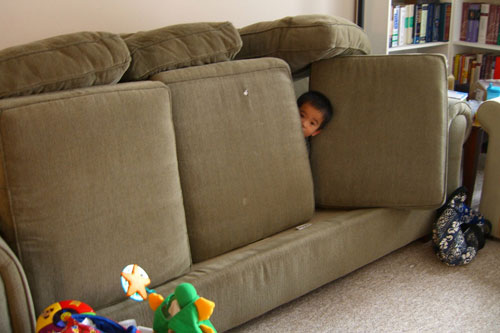
Drawing from the saw-tooth roof structures of industrial Europe, the orthogonal volume cleverly employs a swing hinge access door, popularized by the mid-century modern masters. Grade: B+
Given the materials at hand, that's usually the best that gets built. Not that the boy (now 7) doesn't occasionally get more ambitious. However, hubris has the same tragic end in our house as it did in ancient Greece - the boy's younger sisters are every ready to follow the the poet:
Quem deus vult perdere, dementat prius
By subtly undermining his efforts, first through work slow-downs and general intransigence, later through competing projects requiring the same materials he needs for his fort (and requiring parental adjudication of resource allocation) the boy becomes increasingly frustrated. Still, he perseveres. Over time, and by overcoming great obstacles, the fort is completed. He has attained to a fragile, precarious sort of satisfaction.
And that's when his sisters really go after him hammer and tongs. They demand equal use of the fort. Once in the fort, they refuse him entry. If he makes a secondary entrance, they'll destroy the first. Fixing that, he'll start to notice problems with the roof. Lifting up a roof cushion to readjust its fit and finish, the girls will kick out the support. They'll steal the blanket that acts as a sort of glue to keep the cushions in place. They fill the interior with stuffed animals. And then, they've dashed it all to pieces.
He comes to me, and presents his litany of fully justified complaints.
And then I tell the boy to stop whining. Because whining is for pussies.
on
| § 0
on
| § 2
Over at Aretae, another post is getting some good comments - Devin Finbarr seems to have a bit of teh smarts. He mentions that he's working on a draft summary of Formalist/Moldbug ideas, you can see it here, it's worth a look.
on
| § 1
I mention the Bilderbergers in a post, and on the same day, an article about same appears on Drudge. It must be a conspiracy or something. My mustache is all a-twirl.
on
| § 0
Aretae had a post up earlier today, and another yesterday, that hit right at what I've been thinking about. The one thing that holds me back from going full hog Moldbug is just the idea of Freedom. Moldbug would likely say that I'm just confused - that without order, you can't have liberty. And I can see that. Anarchy is not freedom, it's a free-for-all. "What is good?" someone famously asked. Is it better to be able to do whatever you please, or to have a peaceful and ordered society that allows you a maximum, if not theoretically absolute degree of liberty? Does having the vote magically make us free? Clearly not and I think that that points out a key confusion in our modern estimations of freedom, liberty, authority and the like.
Now I know Johno thinks I hate his Freedom, but I think it might be a case of that word not meaning exactly what we think it means. Do we feel more free because we have the right of franchise - does this give us some sort of idea that we are involved somehow in the direction of our ship of state? I think yes to the former, but only to the extent that the latter is operational. We voted, we did our part, and we are satisfied for the next four years no matter what sort of horrific actions are taken in our name - be they the passing of a universal healthcare bill or starting a land war in Asia. That keeps us complacent while dark forces align against us. The permanent civil service bureaucracy, academia, the vast right wing conspiracy, corporate interests, the Bilderbergers.
True liberty is vanishingly absent. I cannot put in a light fixture without paying a $250 fee and filing plans with my county. I can't light up a smoke in a bar after work. I can't have my son sit in the front seat of my car. I can't kill any of the hundreds of deer that wander through my woods. I can't start a business without navigating a frightening wicket of regulations and tax laws. I can't, I can't... Most of these restrictions would be anathema to our founding fathers, who basically started a whole damn war over the equivalent of a postage stamp fee.
So, yeah, I'm on board with the libertarian liberty thingy. Free up everything so we can have that mad economic growth. But how does that society run itself? How does it not encrust itself with all the things we hate, or get invaded by heavily armed agrarian reformers? What if there's a dispute between my private security firm and yours? Do they select champions and let God favor the right?
And really, is liberty everything we need? Equality, I think we have a surfeit of. Fraternity is doing fine, seeing as I'm an only child. What perhaps we are lacking is tradition and order. Look at large parts of our nation's capital and ask yourself if liberty and equality are more important than order. A while back, Aretae had a post about how traditional, conventional wisdom is going to be most right, most of the time, for most people.
In the comments to one of Aretae's posts that I linked up there at the top, I commented:
I'm torn. On the one hand, your defense of libertarianism is righteous and strong. On the other, Moldbug's got history at his back.
Something you said a while back in regard to traditional advice is going to be best for most people, moist of the time has been crouching in the back of my mind, waiting. Could it be, that while the our desired end state is something like what you are advocating - minimal government interference, economic growth, unicorns - requires something more? That the place of a king who is not a dictator is to provide the traditional bulwark for libertarian wackiness?
Back in the late 1700s, as you've argued, we had freedom that was unprecedented, in an intelligent populace largely isolated from danger. This resulted in the growth! growth! growth! that you go on about. It seems that our current system, can't maintain its current vector without running into something ugly sooner or later. We've layered and slathered it with all sorts of things that you, I and Moldbug can all agree are very bad indeed.
The problem with libertarianism for me hasn't been the economics - that, to me, is or should be fairly self evident. But the idea of private security companies does not fill me with joy, exactly. And other like problems. Why not have a king? It would provide something more than an abstraction for the ordinary run of citizen to latch on to, provide a framework of tradition that would provide maximal outcomes for most everyone. We'd have pageantry. Which isn't crucial, but hey, shiny! And still freedom, the "Rights of Englishmen."
To have a monarch that was concerned with foreign relations, maintaining a justice system (with jury nullification, to be sure) and maximizing his profit by creating as close to an ideal business climate, well that would be cool. If someone created a floating Atlantis a la Stephenson's Diamond Age, I'd likely want to move there.
What is lacking, though, is a populace with traditions of living in a society of that sort, the kind that is very aware of their rights as Englishmen even though they do not, and likely never would have the right to vote.
on
| § 4
A couple years ago, I ran across - I can't remember how - a peculiar website. Unqualified Reservations is a reactionary anti-democracy advocacy site. It's pseudonymous (I hope, for it would require some truly cruel parents to be otherwise) author Mencius Moldbug argues at great length that our current system of government is irretrievably broken, and that our only hope is a complete do-over. And that when we start over, we should be leaving all the democracy business behind us.
Well, that sounds weird, doesn't it? One's natural instinct is to judge the author mad, and go about one's affairs. But if you dig in a bit, you see that there are two aspects to his voluminous writings. (Those who remember fondly the USS Clueless will not be staggered by their length. But everyone else will.) The first aspect is an incisive critique of what we have right now. The second is a prescription for what we should replace it with, and how. In the first, I find myself more or less completely convinced. The second - I have issues with.
In the time since I first happened upon UR and Moldbuggianism, I've read his entire archives. Which is a metric buttload of stuff, to be sure. Without a whole lot of exaggeration, I can say that it had a serious impact on how I view the world. This may sound cheap - but one of the reasons I've not posted much over the last couple years is that I can't comment on anything related to current affairs without thinking about Moldbug, and I wasn't quite ready to out myself as an anti-democracy reactionary. But I guess that time has come. And I find myself surprised at how much I've resisted actually admitting that, even on a little-read blog with a single digit audience.
In my discussions with intelligent and well-informed individuals over the last decade or so, I often found myself looking at problems, arguing about solutions with a distinct sense that something was missing. While I am temperamentally conservative, I guess, I as often found myself attacking conservatives as liberals. Some cases could be explained away as those politicians or pundits failing to live up to conservative ideals. Or they were idiots. Or they were just politicians of whom i shouldn't be expecting anything. Or in the case of George Bush, some would say all three. Railing against all sides of the political spectrum makes you either a libertarian, I conspiracy nut, or just bitter and confused. I was trending toward the latter, with dalliances in the other two.
I felt that there should be a unifying explanation for everything I hated. A grand unified theory of hate. The whole process was similar to what I went through with dark matter and cosmology, and like then, I found an answer.
Back a couple months ago, I went looking for people who were commenting on Moldbug in an intelligent way, and I do believe I hit the jackpot in finding Aretae, Isegoria and Foseti. (I've been reading them, and dropping a few comments here and there, for a couple weeks now, and I recommend them highly.)
To them, most of what I'm about to say is old hat. Perhaps they can add some thoughts. This is for my fellow Perfidians, and my reader. (Hi Bram!)
Okay, how to summarize Moldbug? The dude has written probably a million words in the last four years. But, thanks to the magic of the internets, we have this: Condensed Moldbuggery. And you can start where I started with "How I Stopped Believing in Democracy" or dive into the first part (of 12!) of "An Open Letter to Open-Minded Progressives" The basic idea though, is that progressivism is a cancer, descended from universalist protestantism and metastasized into a number of horrific tumors including Nazism, Communism and the US Government. Along the way, he demolishes modern conservatism, takes swipes at libertarianism, and sings the praises of people we've largely forgotten, like the nineteenth century historian Thomas Carlyle.
It's hard to digest in one lump. But his critique of what we have before us is, I think, spot on. It gives us reasons for why the left acts like a religion. Because it is. It gives us a hint as to why conservatism fails, utterly, at most things it tries to do. Because, for one, it is merely warmed over thirty year old progressivism fighting against current progressivism. And for another, it fails to understand what it is. It survives because the dominant religion needs heretics, and because it is a home for traditionalists who don't like change. It explains why the State Department behaves so oddly, why the military is not allowed to win, and any number of other things.
The short of it is that a reactionary believes that the real struggle is between order and chaos. Modern progressives are, at heart, anarchists and the enemy of civilization. True liberty can only occur after order has been secured - the emergent order of markets, networks and the like depend on an underlying real order. And the store of civilizational order that we had built up has been pissed away by ten generations of democracy, the result being the crap heap we see before us.
To take one hypothesis and use it to explain a wide array of phenomena is, to me, a good sign of a powerful theory. So I dig it. It resolved issues that I had long had with politics - and gave me a way of looking at things that was entirely outside the bipolar democratic/republican thinking that had long been unsatisfactory. Moldbug's analysis of the modern world now has a comfortable apartment in my brain.
I have more issues with what he proposes as solutions for these problems, but I'll save that for the future. In the meantime, I really suggest - despite its length - reading the open letter series. Even if you remain unconvinced, I think you'll at least be entertained.
on
| § 3

Now go read the post that justifies, in a roundabout way, this picture.
on
| § 0
on
| § 0
Over the last decade, our knowledge of comets has greatly increased - several probes sent out to meet these frostily glowing harbingers of doom have returned vast quantities of data. But curiously, our understanding has not similarly increased. Often, we read that scientists are saying that new data will require a back to the drawing board approach. Yet what we get is stale retreads of the same old, same old. When I was a boy, scientists were men, and would tear apart old theories and construct a new paradigm every morning before breakfast. Not so much these days, it seems.
Here with the details is James Hogan, sf author.
I've posted about the Electric Universe ideas previously, here. While I am fully aware of the dangers of heresy - not so much burning at the stake, but the near certainty of being wrong - I become more and more convinced that modern science has gotten a little off track. The way research is funded almost guarantees that much study is devoted to adding ever more intricate filigree to existing theories - because those theories were proposed by the people who are now controlling grants and degrees. A lot of our advances come not from young punks speaking truth to scientific power, but from established scientists with tenure commenting on another field altogether. Alvarez, the physicist, and his dinosaur killer is merely the most famous episode.
on
| § 0
Saw that on a bumper for the first time this morning. As I recall, we didn't start seeing the 1.20.09 stickers until a little later in Bush's second term.
I think I'm going to get a 1.20.21 sticker made up.
on
| § 2

h/t Aretae
on
| § 0
The Onion scores again. I have to say, that if the Supreme Court were to actually adopt this method of writing opinions, a lot more people would be reading them.
on
| § 0
This lays out the just really uncanny similarities between Madoff's ponzi scheme and that third rail of American politics, Social Security. I can't say I'm surprised to discover this. I've thought this for some time, and anyone who is not just about to retire is truly delusional if they're counting on getting anything out of the thousands of dollars they've put into the SS 'lock-box' over the years.
If only I could have kept that money, and used it to buy canned goods and ammunition. That'd be a better retirement plan than anything the government is likely to be able to provide for anyone my age (vintage 1969, baby) or younger.
Of course, this is merely one more example in a long line of similar comparisons - "if anyone in the private sector did x, they'd be in jail - why do these politicians stay in office and get sweetheart real estate and commodities deals?" Makes you wonder about that whole "we're a nation of laws, not men" concept, don't it?
on
| § 0
Ran across this today - the Dollar ReDe$ign Project. In it, many have submitted their ideas for replacement designs for the dollar. This is a good thing - seeing as the new C-note is trending a little faggoty. Most of them, sadly, are even more fagotty then what we're getting. But a couple of them I really liked.
This one, by one Michael Tyznik, is kinda cool. Oddly, he flips the sides - the face is on the reverse, the picture on the front. The obverse is nice - a clean design. The reverse, maybe not so much, but I like the idea of including the full text of the bill of rights on our paper currency. If the portrait were set off, it might make the reverse a little stronger.
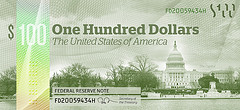
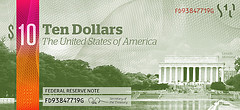
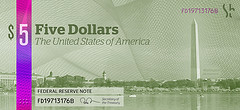
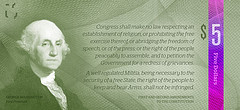
Tyznik feels that the $1 bill is wrong, and should be replaced with a dollar coin. Hmm, that reminds me of something. Take a look at all of them here, and read his thoughts on the design here.
And then this one, well it's a little odd - it imagines a federal union of the US, Canada and Mexico. And all the faces on the bills are bankers. Cheeky, what? But I like the layout of the bills - it's not busy, but it keeps the idea of the traditional currency.
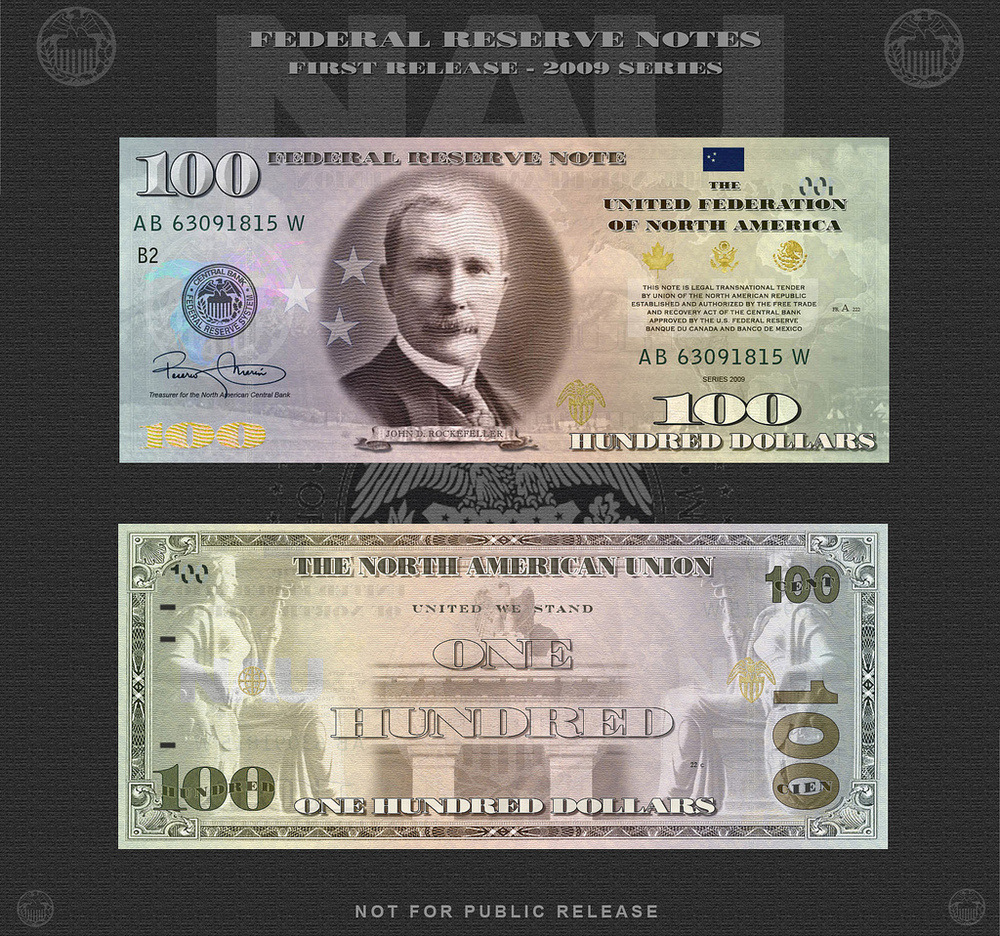
You can see some of the imagined back story here, with more pics (in an easier to view format) here. What this reminded me of was this, from the archives (I've included it below because the special characters are mildly hosed over at old.perfidy):
I Want Real Money
Emperor Buckethead I. That has a nice ring to it, don't you think? When I become Emperor of the United States, there's a few things I want to change around here.
Last weekend, my mom came out to help celebrate the birthday of my son, who turns four this coming weekend. As part of the bag of gifts that she brought out for greedboy, she included a couple of the new dollar coins, the ones with George Washington's portrait on them. I was underwhelmed with this latest effort from the Bureau of Printing and Engraving.
The coin feels like what Monopoly money would feel like if the game used coins. It's light, as if it had a plastic core. The sheen is distinctly unreminiscent of gold. The quality of the art work is poor, I mean really, from some angles it looks like poor George is missing his eyes instead of his teeth. Zombie George is not what I want on my dollar coin. The fonts are ridiculous. And once again, we have a dollar coin the same size as a quarter.
Now, I am in favor of dollar coins. Ever since I spent time in England, I have been for dollar coins. The pound coin is a nifty thing, and we by rights should have an equivalent. A large value coin that is easily distinguishable from other coins. This, our government has signally failed to provide for us for far too long.
One of the problems, of course, is inflation. Precious metals, the ones that make the best coins, are now far to expensive to use in coins - people would melt them down for the metal rather than use them as currency. That's why our dollar coins are made of anodized aluminum, and our quarters are made of tin foil.
To make things right, we can't just make better coins. We must make more far reaching changes to our system of currency. To wit, we must revalue the currency 10:1. That is to say, ten current dollars would equal one new dollar. With this simple change, we can return to decent coins.
A quick peak at the internets reveals some key facts:
Gold= $21.63/g
Silver= $.43/g
Copper= $.008/gPenny= 2.5g (3.1g before 1982)
Nickel= 5g
Dime= 2.3g
Quarter= 5.7g
Pound Coin= 9.5gSo what does it all mean?
- A ten gram gold coin would be worth over $200 now. But, under the new dispensation, it would be worth $20. The return of the $20 gold coin.
- A silver quarter would be $2.44, or very nearly .25 in the new order.
- Current dimes in silver would be $.99, or almost exactly ten cents.
- Old half dimes were made of silver, and weighed 1.3g - $.56, or 5.6 cents in the new money. Perfect.
- A 3g penny, made of pure copper, would be worth about 2.5 cents. Double the size, and you have 5 cents current currency, or ½ cent in the new system. (The old large penny was 10g.) Our lowest denomination coin would therefore be 5 cents, and the eliminate the penny crowd would be simultaneously thwarted and victorious.
So, the new coinage:
- Twenty Dollar - pure gold, 9.25g, about the size of a British Pound coin. Worth $200 in current money. Obverse: Liberty with sword and shield; Reverse: "Give me Liberty or give me death"
- Ten Dollar - pure gold, 4.75g, about the size of a nickel. Worth $100 in current money. Obverse: Eagle; Reverse: U.S. Space Series - Armstrong on Moon, Mercury Capsule, Gemini Capsule, Docked lander and Apollo Capsule, Space Shuttle, Skylab, Voyager, Burt Rutan and SpaceShipOne
- Five Dollar - pure gold, 2.5g, about the size of a dime. Worth $50 in current money. Obverse: Gouverneur Morris; Reverse: Seal of the United States of America
- Dollar - gold/silver alloy, 8.75g, about the size of a pound coin. Worth $10 in current money. Obverse: Grizzly Bear; Reverse: American warplanes series: P-38 Lightning, P-51 Mustang, F-6 Hellcat, F-86 Super Sabre, F-4 Phantom II, F-15 Eagle, F-14 Tomcat, F-18 Bug, F-22 Raptor, F-35 Lightning II…
- Half Dollar - gold/silver alloy, 4.5g, about the size of a nickel. Worth $5 in current money. Obverse: John Hancock; Reverse: Liberty Bell
- Quarter Dollar - pure silver, 6g, about the size of a quarter. Worth $2.50 in current money. Obverse: Buffalo; Reverse: American Generals series: Patton, Sherman, Grant, Washington, Sheridan, MacArthur, Eisenhower, Lee, Jackson, no Omar Bradley.
- Dime - pure silver, 2.5g, about the size of a dime. Worth $1 in current money. Obverse: George Washington (from current quarter); Reverse: U.S. Capitol.
- Half Dime - pure silver, 1.25g, about half the size of a dime, and the size of the old 19thC half dimes. Worth 50¢ in current money. Obverse: Walking Liberty; Reverse: Independence Hall.
- Two Cents - copper/silver alloy, 5g, about the size of a nickel. Worth 20¢ in current money. Obverse: John Adams; Reverse: Statue of Liberty.
- Cent - copper/silver alloy, 2.5g, about the size of a penny. Worth 10¢ in current money. Obverse: Abraham Lincoln (image of his statue in the memorial); Reverse: Lincoln Memorial.
- Half Cent - pure copper, 6g, about the size of a quarter. Worth 5¢ in current money. Obverse: Liberty Head; Reverse: Wreath.
Italicized coins would be relatively rare. The Gold/Silver alloy would be about 4% gold. Every coin will have the motto "Liberty" and the year on the front; and "United States of America, E Pluribus Unum," and the value on the back. The value will always be indicated in words, not numbers. Americans should be literate. The series of coins is not a bad idea, but we need some new topics. The idea of the Buffalo is cool, and looks good, too. So I combined the two. The Buffalo, the Grizzly and the Eagle each get a coin and a series.
And while we're at it, why not change the folding money? I think the bills should be a little bit bigger, like the old money before 1929. Maybe about 7 by 3, instead of the current 6.14 x 2.61 inches. As for colors, screw the new colors. We can add enough other counterfeit countermeasures to return to the traditional green for the front of the bill. On the back, though, we could, conceivably, use other colors. Some of the older bills had blue, orange or even red in addition to black for the reverse side. I'm open to change there.
I've never been completely satisfied with the choices on our bills. Jackson was a terrible president, and doesn't deserve a place on the $20 bill. Hamilton was important, but he's worn out his welcome.
I think we need really large denomination bills again. I know that electronic transfers make them largely unnecessary, but the idea is just too cool to pass up. The new bills should have a portrait on the front, and a painting that is relevant to the portrait on the back. And the portrait should have a oval border around it, like we used to have.
So, a new order for the paper money:
- One Dollar Bill - ($10 in current money); Obverse: George Washington; Reverse: Washington Crossing the Delaware.
- Two Dollar Bill - ($20 in current money); Obverse: Thomas Jefferson; Reverse: Declaration Signing. (Same as current $2 bill.)
- Five Dollar Bill - ($50 in current money); Obverse: Abraham Lincoln; Reverse: Surrender at Appomattox. (Screw the southern prideniks.)
- Ten Dollar Bill - ($100 in current money); Obverse: FDR; Reverse: Engraving of Iwo Jima flag-raising. (Screw the japs.)
- Twenty Dollar Bill - ($200 in current money); Obverse: Ronald Reagan; Reverse: Engraving of the Berlin Wall being torn down. (Same to the commies.)
- Fifty Dollar Bill - ($500 in current money); Obverse: Albert Einstein; Reverse: Engraving of the Trinity nuke test. (Same to the enviro-anti-nuke weenies.)
- Hundred Dollar Bill - ($1000 in current money); Obverse: Nikola Tesla; Reverse: Engraving of a couple Tesla Coils going nuts. (Same to Thomas Edison.)
- Five Hundred Dollar Bill - ($5000 in current money); Obverse: Wilbur and Orville Wright; Reverse: Engraving of the first flight at Kitty Hawk.
- Thousand Dollar Bill - ($10,000 in current money); Obverse: Werner von Braun; Reverse: Engraving of a Saturn V rocket lift off. (Screw anyone who says von Braun was a Nazi. Maybe he was, but he became a good American.
How cool would it be to have a $500 bill with a picture of nuclear explosion on it? Or pay for groceries at the whole foods store with a Reagan twenty? Or carry fifty dollars in change in your pocket instead of a reinforced canvas bag, and each coin with a picture of an American warbird? This new money would kick ass.
So there it is, the Buckethead plan for American monetary reform.
I think either of those bill designs would work well with my scheme.
on
| § 1


