An Orbit of Eternal Grace

Science, mad or otherwise. Rockets and space travel, and maybe we can get off this sordid rock.

Sixties retro won't fly

Ken, the lovable (and red and scratchy) Brickmuppet, has gone completely overboard in responding to one of my comments on his earlier space post. Brickmuppet's first post was about NASA's new Constellation project - which intends to build a disposable crew capsule that is eerily similar to the Apollo capsule of forty years past. But bigger! With electronics! Brickmuppet was excited about this development. But then he's a wet-behind-the-ears youngster of 35. But with the vast experience and jaded cynisism that my 36 years have given me, I have less reason for joy. I think that NASA is congenitally unable to conceive, let alone design and operate, a functional manned space program leading to a permanent presence in space achieved through lowered cost of access to orbit. In short, not gonna happen, and I don't like the dry itchy feeling of NASA blowing smoke up my ass with a sixties retro space program spun as exciting and new developments in space.

Honestly, I'd like to believe that this was cool, and would lead to something good. But I just can't. Brickmuppet followed up on my comment with an extensive and well researched post. I've started posts like his, but depression and ennui generally kill the project after a few minutes. He even throws in a pic of what he somehow knew that I would love to see more than anything else. I steal and present it here:

image

But Brickmuppet's obsequious (but welcome) praise will not distract me from my goal:

The great and wise Buckethead

You can't use the Jedi mind trick on me, I am immune to your powers.

His arguments are not without merit.

From gushing praise to damning with faint praise in one paragraph! Sheesh!

The thing is, everything Ken says short of the last few paragraph supports my argument that NASA is unfit and incapable of doing what they claim they are going to do with Constellation. We're sympatico on that. Where I disagree is with his belief that Constellation will not adversely effect private space development. NASA has always viewed the private sector as a competitor. Further, Constellation will compete with private launch, not just because NASA will try to block private development, but because private devlopment will be hindered by the availability of subsidized manned space flight. And further further, NASA is so repugnant to me because they won't do what's right, and won't let anyone else do it either. This is the classic endstate of a bureaucratic organization.

A lot of people have been slagging heavy lift, for little reason. In fact, that very topic is one of the posts I couldn't finish because it made me cry. It's not so much that there's a problem with the hardware - shuttle components could easily be configured into a reasonable heavy lift vehicle, as I've stated here before. The problem is that, up til now and for the foreseeable future, NASA will own those components. The only solution is to kill NASA and release those designs as open source hardware. Other people could make better, and more innovative use of them; and not spend billions in infrastructure and labor costs to use them just three times a year.

Is the NASA architecture viable economically? Is it spiffy and cutting edge? No.

But private industry will be, and they will compete and try new and risky things to tap into the space market. The constellation retro-rockets are a temporary fix, and a means of jump starting a manned space program that was boldly going nowhere.

In a generation NASA will be buying its spacecraft from the same companies that will be building them for space hotels, asteroid mining companies and even colonists heading to the Moon, Mars, the asteroids,and maybe Titan.

Exactly. That's why the Constellation is so much wanking. If it never flies, its useless. If it does, it's either pathetically redundant next to Rutan's SpaceShipFour or whatever - or it kept that ship from flying.

[wik] I forgot to mention, Brickmuppet hits the nail on the head with this one, too. Talking about Space-X's antitrust lawsuit against the big aerospace companies, BM says:

This could break open the door to commercial space...or nail it shut

That's good and bad. On one hand, the ambiguities of the current situation could really be in favor of the small space startups. If this goes badly for Space-X, then the future spins clockwise out of the picture.

Posted by Buckethead Buckethead on   |   § 3

Speedracer needs an update

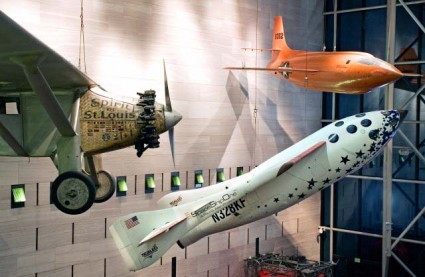
Quite a few things have been happening on the space front over the last week. Of interest to anyone in the DC area, Burt Rutan’s SpaceShipOne is now ensconced in the Smithsonian’s National Air and Space Museum, right next to the Spirit of St. Louis. I had intended to go over and pay my respects today, but seeing as it is raining a bit (3” expected over the next 24 hours) I think I’ll wait until next week.

SpaceShipOne in NASM

Rocket Jones noted this and even came up with a cool title, but I can’t leave it to him entirely.

A private group of rocketeers has banded together to create the Rocket Racing League with aims at blurring the line between competitive racing and human spaceflight. Their vision: A fleet of at least 10 stock rocket planes flown by crack pilots through a three-dimensional track 5,000 feet above the Earth.

This is just too cool for words. The RRL will conduct its races at Los Cruces, NM, where League co-founder Peter Diamandis (also founder of the X-Prize) is holding his X-Cup festival this month. The first races are scheduled for next fall, and should prove to be very interesting. These races aren’t going to be like drag races, where the fastest rocket wins. It will be more like formula one racing, or even yacht racing. Each rocket plane will have to stay inside a defined path, make turns, and complete the course in the fastest time. Since the burn time on an XCOR rocket plane is only about four minutes, pilots will need to strategically start and stop their engine, combining powered flight and judicious gliding to win the race. And since the kerosene/LOX rocket will have a bright orange plume, this race should be visually spectacular.

XCOR Rocket Plane

Back in the early days of aviation, one of the chief means of stoking public interest in and acceptance of airplanes was air races. As airplanes evolved, so to did the races. Here's a brief outline, adapted from the Society of Air Racing Historians:

Air Racing Eras 

Gordon Bennett Trophy Races: 1909-1920
This first important era of air racing brought to public attention the likes of Glen Curtiss, Maurice Prevost and Jules Vedrines who flew Bleriots, Curtiss, Wrights and Deperdussins. 

Schneider Trophy Races: 1913-1931
These great seaplane racers were the fastest aircraft in the world. They brought true speed to aviation, thanks to pilots like Jimmy Doolittle, Mario de Bernardi, John Boothman and David Rittenhouse. They flew planes built by Curtiss, Supermarine, Macchi, Gloster and Sopwith. Aviation progress resulted from the use of huge V-12 engines and advanced streamlining. 

Pulitzer Trophy Races: 1920-1925
These military pylon races brought the USA to the lead in speed, with pilots like Bert Acosta, Al Williams and C. C. Mosley flying Curtiss, VervilleSperry and Loening military racers. 

LONG-DISTANCE RACES: 1920's 1930's
Some of the greatest races were over long courses from one country to another, such as the 1934 MacRobertson Race from England to Australia won by the deHavilland Comet racer. Others such as the ill-fated Dole Race from California to Hawaii in 1927, won by the Travelair "Woolaroc", revealed the true hazards of long-distance flying. 

CLEVELAND AIR RACES 1929-1939
The "Golden Age of Air Racing" in which custom-built raceplanes ruled the roost. Lowell Bayles, Roscoe Turner, Tony LeVier, Art Chester, Steve Wittman, Harold Neumann , Jackie Cochran. Gee Bees, Wedell Williams, Keith Riders, Lairds, Folkerts and many others. These were the classic Thompson, Bendix and Greve Races. 

POST-WAR AIR RACES 1946-1960
Unprecedented speed from cut-down, souped-up ex-military fighter planes: P-38 Lightnings, P-39 Airacobras, P-51 Mustangs, F2G Corsairs, Cook Cleland, "Tex" Johnston, Paul Mantz, Anson Johnson, Beville & Raymond in the Thompson, Bendix and Sohio Races. 

RENO AIR RACES: 1964-???
The current era began in 1964 with Bill Stead’s experiment in the Nevada desert. Unlimiteds (Mustangs, Bearcats, Sea Furys and Yaks flown by Greenamyer, Sheldon, Lacy and Destefani) Formula Ones (Miller pushers, Cassutts and Shoestrings raced by Cote, Falck, Sharp and Miller) Sport Biplanes (Pitts, Starduster and Mongs flown by Christian and Boland) AT-6s (raced by Van Fossen and Dwelle) and Formula Vs (Sonerais and V-Witts raced by Dempsey and Terry).

If the new rocket races achieve any kind of media attention, they could fuel a lot of interest amongst the people for rockets and spaceflight.

And speaking of the X-Prize Cup, the first will be held this weekend. Among the highlights will be a test flight of the XCOR rocket plane mentioned above, a full on test flight of Armadillo Aerospace’s vertical take-off/vertical landing vehicle, and full scale mock-ups of several spaceships currently under development. Los Cruces is well on its way to becoming rockethead Mecca.

Posted by Buckethead Buckethead on   |   § 3

Well, no shit!

It may be a lame, pollyannaesque effort on my part to see some good in this; but there is a part of me that actually feels hopeful after reading this:

The space shuttle and International Space Station — nearly the whole of the U.S. manned space program for the past three decades — were mistakes, NASA chief Michael Griffin said Tuesday.

Well, duh. Space advocates have been saying that for decades. Three of them, in fact.

Some other choice bits:

Griffin said NASA lost its way in the 1970s, when the agency ended the Apollo moon missions in favor of developing the shuttle and space station, which can only orbit Earth.

"It is now commonly accepted that was not the right path," Griffin said.

Only now is the nation's space program getting back on track, Griffin said. He announced last week that NASA aims to send astronauts back to the moon in 2018 in a spacecraft that would look like the Apollo capsule.

Joe Rothenberg, head of NASA's manned space programs from 1995 to 2001, defended the programs for providing lessons about how to operate in space. But he conceded that "in hindsight, there may have been other ways."

So, NASA admits that we're hitting the big red reset button and going back to somewhere in the neighborhood of 1975. It's a do-over. Never mind the fourteen deaths and $150 billion we wasted on the shuttle, and the $100 billion wasted on a nearly useless ISS.

There were several major problems with NASA development programs over the last three misguided decades. First, doctrinaire approaches to design problems. Pick a solution and make it fit, regardless of other considerations. A procrustean space program. Second, an unwillingness to use traditional design methodologies. The design/test/build/repeat cycle is almost entirely absent from NASA programs, except for a few aeronautical research projects. Build early and build often is how you figure out how to do things. Repeatedly spending millions to billions on empty paper designs that are never built is job security for government drones.

Change these things, and even the decision to go with the Shuttle could have been redeemed. The basic architecture of the Shuttle system is more or less sound. Certainly not much less sound than other launch vehicles. Large rockets do have a tendency to explode. But where was the experimentation? We never tested other configurations or cargo versions of the base shuttle stack. We never lofted the fuel tanks into orbit to see if they could be used as habitats We never added hardware to the system, incrementally modifying the orbiter - let alone experimented with new orbiters that could be used with variants of the shuttle stack. We never tinkered. Nothing was done. We simply kept using the same configuration until it blew up. Then we kept using it until it blew up again. Then we started using it again. What's that definition of mental illness? Doing the same thing over and and over but expecting different results?

The tragedy of the death of the Apollo program is that those clever rocket scientists who got us to the moon had thousands of clever ideas for what to do with the hardware we'd developed. Skylab was just one of them, and that got into orbit more by inertia than will. But we scrapped all that, and went with the shuttle. There have been many ideas for what could be done with shuttle hardware, but none have been pursued. And now we are on the verge of scrapping this system without even having a follow on just like we did in the late seventies.

Given that the people at NASA are actually rocket scientists, this behavior is hard to explain.

Posted by Buckethead Buckethead on   |   § 0

Go Russki

The Senate has changed the law allowing NASA to buy Russian space hardware and services necessary to keep the ISS operational. Hertofore, NASA was prohibited from paying cash for Russian space tech by the Iran Nonproliferation Act of 2000 that bars U.S. purchases of Russian human spaceflight hardware as long as Russia continues to help Iran in its pursuit of nuclear know-how and advanced weapons technology. Russia is obligated under treaty to provide one more gratis Soyuz launch - that one will carry two crew members and a tourist up to the space station at the end of the month.

After that, though, we get to pay through the nose for forty year old soviet space capsules. Which in some respects is better than paying hundreds of billions for brand new forty year old American space technology over the next fifteen years, but seeing as we'll be doing that anyway, this seems like... not a good deal.

This is so entirely pathetic. Not the Russians, because they have, against great odds and enormous obstacles maintained a space program through the collapse of government, ideology and economy. Good for them, and they keep trying. We, meanwhile, screw around designing endlessly while never actually, you know, building shit.

Posted by Buckethead Buckethead on   |   § 1

I call... bullshit

NASA has released its bold plan to send mankind to the stars. Well, to send a few people to the moon sometime in the next century, anyway. When President Bush promised in 2004 to do in sixteen years what we did forty years ago in eight, I was underwhelmed. I am now subunderwhelmed. Check out a few groundbreaking details:

NASA has been working intensely since April on an exploration plan that entails building an 18-foot (5.5-meter) blunt body crew capsule and launchers built from major space shuttle components, including the main engines, solid rocket boosters and massive external fuel tanks.

Meaning that using components that in large measure we have already invented and already used, in 13 years we can be back on the moon. And as an added bonus, the crew capsule will be disposable!

NASA's plan, according to briefing charts obtained by Space.com, envisions beginning a sustained lunar exploration campaign in 2018 by landing four astronauts on the moon for a seven-day stay.

That will be somewhere around the 45th anniversary of the immediately previous seven day moon mission.

NASA's plan envisions being able to land four-person human crews anywhere on the moon's surface and to eventually use the system to transport crew members to and from a lunar outpost that it would consider building on the lunar south pole, according to the charts, because of the regions elevated quantities of hydrogen and possibly water ice.

So we’re considering building an actual outpost. Sometime around 2080, I imagine. By the time NASA gets around to building that, they might have to rent landing space from Branson’s Virgin Galactic Lunar Amusement Park.

One of NASA's reasons for going back to the moon is to demonstrate that astronauts can essentially "live off the land" by using lunar resources to produce potable water, fuel and other valuable commodities. Such capabilities are considered extremely important to human expeditions to Mars which, because of the distances involved, would be much longer missions entailing a minimum of 500 days spent on the planet's surface.

Hey that’s a great reason. Prove you can live off the land, using a hundred billion dollars worth of lowest-bidder equipment. That’ll show the Chinese.

NASA's Crew Exploration Vehicle is expected to cost $5.5 billion to develop, according to government and industry sources, and the Crew Launch Vehicle another $4.5 billion. The heavy-lift launcher, which would be capable of lofting 125 metric tons of payload, is expected to cost more than $5 billion but less than $10 billion to develop, according to these sources.

$10 billion dollars. That’s not a lot of money. Of course, that’s just to develop the vehicles. Then we’ll actually have to buy them. Maybe one or two, so we can make one Lunar voyage per year and still have launch capacity to service the ISS and Hubble. I should think that by using pre-existing hardware, you’d be able to actually, you know, save money.

NASA would like to field the Crew Exploration Vehicle by 2011, or within a year of when it plans to fly the space shuttle for the last time.

Or put another way, no less than a year after Rutan wins the $50 million prize for first reusable private orbital vehicle

Development of the heavy lift launcher, lunar lander and Earth departure stage would begin in 2011.

By which time, all the manufacturing plants developing the shuttle components will be closed, and using those parts will no longer be possible, seeing as we’ll probably lose another shuttle sometime in the next six years.

By that time, according to NASA's charts, the space agency would expect to be spending $7 billion a year on its exploration efforts, a figure projected to grow to more than $15 billion a year by 2018, that date NASA has targeted for its first human lunar landing since Apollo 17 in 1972.

$7 billion a year. Just imagine what smart people could do with that sort of cash.

How anyone could imagine that this is a sensible plan is beyond me. The engineers at NASA certainly know better. If NASA just used the comparatively honest and efficient defense procurement system, they could be back on the moon in a few years, especially given that they could use pre-tested shuttle components. Aargh.

Posted by Buckethead Buckethead on   |   § 1

Okay, let's give Rutan that $1 billion, now

Malaysia has announced that they plan to be on the moon by 2020. If a third rate nation like Malaysia is even contemplating a manned moon mission in the near term, it is high time that we get our asses moving. Bad enough that we can imagine a Chinese-dominated space future, but a Malaysian one is beyond the pale.

Posted by Buckethead Buckethead on   |   § 2

Just give me the billion dollars

Over the last couple months, I’ve run across several clever and even snarky ideas for redirecting the firehose of public expenditure from the bottomless pit of government bureaucracy into the arid and brown uplands of sensible ideas in dire need of irrigation. I posted about one of these a while back, aimed at the stinking miasma of public school funding. Yesterday, I ran across two more, from Dr. Jerry Pournelle.

The first is an idea I’ve had for a while, but which the good doctor was rude enough to write up first. Gazing at the billions spent annually on the nearly moribund Shuttle Program, Jerry thinks some thoughts:

NASA spends a billion and can't fix the problem of foam dropoff. Give me a billion and 3 years (and exemption from the Disabilities Act and some other imbecilic restrictions) and I'll have a 700,000 pound GLOW reusable that will put at least 5,000 pounds in orbit per trip, and be able to make 10 trips a year for marginal costs linearly related to the cost of fuel.

…Now, as a backup in case single stage is the wrong way to go -- and I can be convinced that it is -- hand another $1 billion to Burt Rutan and let him try his air lift first stage approach. Then have a flyoff. Hell, go mad: give me a billion, give Burt a billion, hand a billion to each of the remaining big aerospace companies, and give a billion to NASA. That's $5 billion, less than the annual cost of the Shuttle program -- have you noticed that the program cost is independent of the number of Shuttle launches? NASA will waste its billion, the two aerospace companies will futz around with studies that end up requesting $20 billion each and produce nothing but paper, but you may be sure that Rutan and I will both have some flying hardware.

Is it arrogant to put myself in the same league with Burt? Sure, but then we all know I won't actually try to manage the program; that's for younger people. My job will be to take the heat while they get the work done. And if you don't fancy me as the competition to Rutan, pick someone else. I can think of at least three small outfits I'd give long odds can spend a billion with far more return to the American people than the two big aerospace outfits and NASA, so if you want to do the program right, you may need $8 billion because you aren't going to do anything without bribing NASA and the big boys; and an $8 billion program looks like money so the big aerospace outfits will want larger bribes. (They'll take bribes to stay out of the way, because that's a sure return and they don't take chances any more; but they're good at the political game and for $8 billion they will smell money in the water and go into a frenzy; but be sure that whatever they get they won't produce anything useful for it. Not any more. And we all know that including the engineers who work for the big outfits.)

Now, Dr. Pournelle once worked in the space bidness, and I’m sure that I couldn’t do quite as much with a billion as he. But I’m sure that I could do more than NASA.

If you scroll up a bit from the NASA bit (which you should read in full) you’ll find another interesting spending proposal. Jerry links to an article in the Washington Post which reports on the findings of the liberal think tank the Center for American Progress. This group of fuzzy-headed liberals determined that the cost of giving the boot to our estimated ten million illegal aliens is in the neighborhood of $41 billion a year, and running to nearly a quarter trillion dollars over five years. In coming up with this large number, the CAP assumes government standard procedures for dealing with wetbacks. That is, that it would cost about $28 billion per year to apprehend illegal immigrants, $6 billion a year to detain them, $500 million for extra beds, $4 billion to secure borders, $2 million to legally process them and $1.6 billion to bus or fly them home. In short, government numbers, and a permanent lifetime employment plan for those who would manage, but not solve the problem of illegal immigrants.

The good doctor has a different idea:

As many have pointed out, that's less than the cost of the Iraqi War; which would you rather see the money spent on? Of course I doubt the $41 Billion/year to begin with. In Los Angeles a great deal of the cost would be borne by local police once they were freed of the restrictions on checking citizenship and residency status -- and in Southern California at least $2 billion a year would be saved instantly by relief of public institutions such as hospital emergency rooms from the burden of providing services for illegal immigrants. Other such savings come to mind.

And of course some of the job could be farmed out to bounty hunters. At ten million illegal immigrants, what could we afford to pay bounty hunters per individual delivered at a Border Patrol station or INS Detention Center? At $1000 a head it would cost $10 billion to round up all of them, leaving another $20 billion for actual cost of detention and deportation, and still saving $11 billion for the first year. Spend that $11 billion on border control, and the next year there would be, say, only 5 million, so the cost is now $15 billion for the second year plus the $11 billion for border control. Surely we would be down to a million in five years, so our cost would be $3 billion for bounty hunters and deportation, plus the $11 billion for border control. We could then look at streamlining the border control operations, having spent $55 billion on it; one supposes that cost could be got down to half? We are now at $10 billion a year, possibly forever.

But if they are right, and it will cost $40 billion/year forever, it will still be affordable. We can afford the Iraq war, can't we?

As I’ve said many times before, I have no problem with immigrants, provided they come here legally. I am open to almost any plan for numbers of legal immigrants allowed into the country. I think we should reform the immigration process so that it is in most respects easier to get into and stay in this country – at least in terms of paperwork, red tape and bureaucracy. I think that we should adopt a new status for citizens of nations like Great Britain, Canada, Australia, New Zealand and other friendly places, whereby they could come to this country with an absolute minimum of fuss, to work, study, or travel for any period of time.

It’s one thing to invite someone into your home. Show them hospitality, even let them stay for extended periods of time. If you invite them. But if someone breaks in and takes up residence in your basement, they get the door or a bullet regardless of how inexpensively they could clean up the kitty litter.

We are in the third millennium now. We should be able to begin thinking about new ways of doing things that have been traditionally been managed poorly if at all by government bureaucracies. These are just a few, and I’m sure there are plenty of others.

Posted by Buckethead Buckethead on   |   § 1

Pain!

Via Spoons, we are informed that the inevitable has finally happened. Ever since the introduction of cellphones, I have been waiting for this moment:

Dork Phone One

This can be your new cell phone. It won't make you cool like Kirk, or smart like Spock, but indulge your inner geek. It really has been a mystery to me that this has taken so long to arrive on the market. Even short of a full-on communicator replica case cell phone, why no cell phone company has equipped a flipphone with a spring loaded opener is a complete enigma. Those things, while generally convenient, are a pain to open one handed. A Trek style opener would have been an enormous improvement even in a regular looking phone.

While looking for the image above, I also found this:

Dork Phone Two

Vocera's communication badge works like the communicators on ST:TNG. Press the button and say a name, and - assumming the person you wish to speak to is on the network - you'll be patched in via Voice over Internet Protocol. Pretty sweet.

Now all we need are wrist phones a la Dick Tracy, real video phones like the Jetsons, and of course jet cars and vacations on the moon.

Speaking of which, that last is one step closer to reality. At least, if you have a hundred million dollars burning a hole in your pocket.

Space Adventures, a company based in Arlington, Va., has already sent two tourists into orbit. Today, it is to unveil an agreement with Russian space officials to send two passengers on a voyage lasting 10 to 21 days, depending partly on its itinerary and whether it includes the International Space Station.

A roundtrip ticket will cost $100 million. 

The space-faring tourists will travel with a Russian pilot. They will steer clear of the greater technical challenge of landing on the Moon, instead circling it and returning to Earth.

Eric Anderson, the chief executive of Space Adventures, said he believed the trip could be accomplished as early as 2008. Mr. Anderson said he had already received expressions of interest from a few potential clients.

Given NASA's recent history of accomplishment, I think this is more likely to happen than a US Government mission back to the moon. Who'd have thunk, in 1969 after the momentous triumph of the Apollo landings, that the next visit to the moon would be by American millionaires flying on forty-year old Russian rockets? The world, she is an effed-up place.

Posted by Buckethead Buckethead on   |   § 0

Death from above

Well, not really. Tomorrow morning, if you look to the Northeast before sunrise, you should be able to see the Perseid Meteor Shower. Sadly, the peak of the shower will happen during the day, so best viewing is Friday and Saturday morning before the sun comes up. Meteor counts in a dark sky should be on the order of 50-60 per hour.

There is very, very little chance that any of these will bean you on the head, since they are typically no bigger than a marble and have the consistency of cigar ash and burn up in the upper atmosphere.

Posted by Buckethead Buckethead on   |   § 4

Rutan comes up with another clever name

Burt Rutan is a brilliant designer, a technological innovator, and a genius of the first rank. He is not, however, nearly as clever at coming up with clever names for things. He and eccentric British billionaire Sir Richard Branson have teamed up to form - wait for it -

The Spaceship Company

Inelegant naming conventions aside, this is wicked good news. The new company will be co-owned by Rutan's Scaled Composites and Branson's Virgin Galactic. It will license the rocket and reentry technology first used on SpaceShipOne from Paul Allen's Mojave Aerospace, and will own the designs for White Knight 2 and SpaceShipTwo now under development at Scaled Composites.

The new model mother ship and space ship will have greater range and payload capacity than the originals (which will be installed at the Air and Space Museum this fall - I need to bug Dad to get me into that event.) Virgin Galactic wil recieve two of the WK2's and five of the SS2's, with options on future production; guaranteeing them at least a 18 month monopoly on private spaceflight.

All the crying about NASA's inability to figure out what's wrong with the space shuttle - in both the particular fuel sensor and detaching foam as well as the general why are we spending so goddamned much money on thirty year old technology - maybe turn out to be whining about safety standards for buggy whips a hundred years ago. Private industry could very well make NASA (with the exception of the deep space probes) completely moot, and soon.

Posted by Buckethead Buckethead on   |   § 2

Research Promises More Fulfilling Robotic Relationships

British researchers, long at the forefront of bringing humanity new knowledge with practical applications, has wowed the planet with this revelation:

Wining and dining is the best way for men to woo women

Holy fuck! If you spend time with women and give them things, they tend to like you!

Apparently the Brits designed,

a mathematical formula and modeled courtship as a sequential game to find the best way to impress the ladies.

I applaud science's efforts to quantify attraction. Beyond the obvious relationship of quantity of dough being proportional to the raw attractiveness of the dough-holder. I get that. But spending alot of time and effort to determine the patently obvious, for its own sake, makes me want to eat my own shoe in sheer frustration.

After a stiff drink and a percodan, and with a little reflection, I realized a greater shortcoming here. What the study fails to take into account is that different cultures value different gifts, particularly in the awkward cultural judo that courtship can be. The study really only applies to places where wining and dining is an accepted, or indeed feasible, practice. Nor does the work draw a distinction between eateries. At Outback, say, dinner for 2 can be kept under $40; a decent steak dinner in, say, Japan can run around $170,000.

But why have to deal with exchange rates and kooky foreign currency and decent meats at all if you don't have to? Leave it to the Japanese to build their own dates.

Professor Hiroshi Ishiguro has gone the extra mile in building life-mimicking features into his design:

image

Um, the dude with glasses is *not* the robot.

The robot exhibits several tiny mannerisms that we all share- blinking, laughter- and that we pick up on when others don't do them. It even simulates breathing, which I definitely notice when people I'm speaking to don't do it.

So okay, this cat built hisself a lady. And yes, that's quite cool enough all on its own. But looking forward, it doesn't take a crystal ball to see the most lucrative aspect of this technology. And it ain't mining ore or building cars.

Look, consider a company like Vivid Entertainment. As a private concern it doesn't have to make its financials available, but $100 million in sales is entirely plausible if not conservative. And that's just to look at Jenna Jameson. How much could they make by building a simulacrum that mirrors Jenna's look, physique, and...talents...perfectly? How much is the porn-bot market worth, when DVD and On-demand sales or rentals can run into billions?

Then, consider other ramifications of life-like bots. Would someone be a pedophile if he bought one that looked like a child for sexual purposes? It's not totally off the mark, by the way: the fembot in the pic is that professor's second design. The first one simulated a five-year old girl. What copyright issues would be at work when licensing not merely your likeness, but your simulation? Could you draw a paycheck if you sent your robotic doppleganger to your job to work in your stead? Could I marry one in Massachusetts? If I had sex with one that was a reproduction of myself, would I be a homo, or masturbating? Could you design a robot so advanced it didn't know it was a robot, then make it a cop who assassinated other robots after giving them a weird psych test...?

Or might it be possible to build a 'bot so true to life it would supplant women altogether? And not like a Stepford Wife- I mean, they could talk, after all; speech should be a bug, not a feature- I mean perfect. Arguably, men have been trying to replicate women for quite some time, although the robust materials and scale at play here have been significantly refined of late. Can the perfect woman be built from plastic and silicone?

Don't get too irritated with me, ladies. It's taken menfolk millenia to approximate you, but you've had a reliable and simple substitute for us for eons.

Posted by GeekLethal GeekLethal on   |   § 9

Some of this stuff, I just pass along

Via an end-of-day email from a friend, perhaps an old gag, but since I don't recall having ever seen it, it's new to me. It also has enough plausibility that I had to think for a minute that it might not be a gag:

A research institute has recently discovered what is believed to be the heaviest chemical element yet known to science.

The new element has been named Governmentium. Governmentium has 1 neutron, 12 assistant neutrons, 75 deputy neutrons, and 11 assistant deputy neutrons, giving it an atomic mass of 312.

These 312 particles are held together by forces called morons, which are surrounded by vast quantities of lepton-like particles called peons. Since governmentium has no electrons, it is inert. However, it can be detected as it impedes every reaction with which it comes into contact. A minute amount of governmentium caused one reaction to take over 4 days to complete when it would normally take less than a second.

Governmentium has a normal half-life of 2 to 4 years; it does not decay, but instead undergoes a reorganization in which a portion of the assistant neutrons and deputy neutrons exchange places.

In fact, governmentium mass will actually increase over time, since each reorganization causes some morons to become neutrons, forming isodopes. This characteristic of moron-promotion leads some scientists to speculate that governmentium is formed whenever morons reach a certain quantity in concentration. This hypothetical quantity is referred to as Critical Morass.

You will know it when you see it.

Posted by Patton Patton on   |   § 1

The moon is made of cheese

In honor of the anniversary, yesterday, of the first landing of men on the moon google has loaded lunar map data into their google maps interface. Go here, and you can see where the six Apollo missions landed.

moon

Zoom in on the place where Neil Armstrong and Buzz Aldrin landed, and you can see the actual terrain that those heroic astronauts walked upon.

cheese

Posted by Buckethead Buckethead on   |   § 1

Chicoms in space and Americans talking about being in space

Couple interesting developments in the space world today.

China announced that in October, they will attempt to send a second taikonaut into orbit. It's been nearly two years since they first sent a man into space, which indicates either a fair amount of caution, or limited capability. Either situation would suggest that their stated goals of orbiting a space station and sending an unmanned probe to the moon are rather ambitious.

Back in the states, the true hope for an actual space program is with private enterprise. The first X-Prize cup will take place in early October in New Mexico, where private space firms will put on a show and tell for the faithful. Although organizers hope that someday soon this event will entail actual space launch competitions, at least for now it remains relatively ground-bound. Highlights of the show will likely be Armadillo Aerospace's test flight of a scale version of its VTOL spacecraft, built just for the show; and XCOR's rocket plane. Armadillo's vehicle will take off, hover, and then land again; but may do more if the company gets an FAA waiver. XCOR's EZ-Rocket plane will conduct a series of flights, demonstrating its capability for rapid turnaround.

Within the next couple years, several of these startup space companies will be attempting their own sub-orbital flights on the lines of Rutan's flights last year. And off in the distance, there is the $50 million America's Space Prize sponsored by Robert Bigelow. That cash goes to the first team to send five passengers 400km up, orbit the earth twice at that altitude, return them safely to Earth, and then do it again within 60 days; all before January 10, 2010. Besides the cash, the winner will receive contracts to service the inflatable habitats that Bigelow Aerospace is currently developing. If you haven't already started, you better get off your ass, as you've only got a half a decade left.

Posted by Buckethead Buckethead on   |   § 3

Zombie dogs and the automation of sexual harassment

Enemies of humanity are busy at work this week, endangering our racial survival on a broad front.

First up is this group of 'scientists':

Pittsburgh's Safar Centre for Resuscitation Research has developed a technique in which subject's veins are drained of blood and filled with an ice-cold salt solution. The animals are considered scientifically dead, as they stop breathing and have no heartbeat or brain activity. But three hours later, their blood is replaced and the zombie dogs are brought back to life with an electric shock.

Plans to test the technique on humans should be realised within a year, according to the Safar Centre.

The researchers claim that this research could lead to hundreds, even thousands of saved lives. It is well known that the sooner medical treatment can be brought to bear on a trauma victim, the better the chances of survival. The scientists say they believe that this technique could greatly extend the period when life-saving treatment can be successfully applied. Of course, trifling with the undead has a long history of high ideals and tragic, gory endings.

Tests show they are perfectly normal, with no brain damage.

Yeah, right:

zombiedog

Creating man's best undead friend is only the beginning for these tireless, yet clever, enemies of mankind. Witness this example of mind-numbing stupidity in the guise of science:

Researchers at the University of Michigan have developed a robotic breast "examiner." Combining ultrasound and an finely honed sense of touch, this robotic hand will enable "trained medical personnel" to cop a feel from across continents.

"Just because you’re located in the Upper Peninsula of Michigan or even Botswana, it doesn’t mean you can’t have a sophisticated diagnostic or therapeutic procedure."

Sure. Just like vibrators were originally sold as "marital aids," these devices will not remain in the hands of researchers for long. Under the control of artificially intelligent robot overlords these nefarious devices will be a handy tool for subverting half the human population; making our eventual demise that much quicker.

image

[I might add a modest prediction: that is exactly as close as that guy will ever get to touching an actual human breast.]

Imagine the humiliation, as you - one of the last surviving humans on earth - are mercilously hunted by autonomous hunter-killer drones. Cornered, you pull your gun, determined to go down in a blaze of glory. But instead of maniacal laughter, or a toneless admonition that "resistance is futile!" you hear only this:

"Smell my finger."

Posted by Buckethead Buckethead on   |   § 3

Destiny

Space.com has an interesting article on terraforming called, "Terraforming: Human Destiny or Hubris?" It's a little pessimistic, I think. Not that I'm saying that in the next ten years, we could start making any large-scale alterations to any planetary environment, save the one we're already on. However, the one thing that will make it possible is replicating assemblers. Not necessarily nanotech, though that would make it easier. Once we have devices that can be sent as a seed into space, there to grow into automated factories for producing solar power plants and large engines for moving things, truly anything will be possible. And the way computer technology is going, it won't be long before that could happen. (Moore's law says that computer power will be approaching the lower bounds of human thought in a less than thirty years or so.)

Posted by Buckethead Buckethead on   |   § 5

Dubious Hono(u)r

NASA is going to start training astronauts in Labrador in preparation for a return to the moon. It seems that Labrador contains a lot of the common moon rock (and uncommon Earth rock) anorthosite. And nothing else.

My father in law was stationed in Labrador during Vietnam, an assignment which though blessedly short on black-pajamaed guerrillas bent on killing him, was also blessedly short on warm weather, sunlight, entertainment, or distractions of any kind. As he says: "In Labrador, there's a good looking woman behind every tree.... Trouble is, there ain't no trees in Labrador."

Posted by Johno Johno on   |   § 0

A New Domino Theory for a New Age

As originally voiced by Eisenhower, Nixon, and a variety of pointy-headed policy people, the Domino Theory explained that if South Vietnam fell to the commuhnists the rest of southeast Asia would similarly succumb, each country toppling in turn.

The phrase is still fairly common, most recently used to describe American operations in the Middle East. I don't have a link to a specific instance of its use in that context, but am confident someone somewhere said it. You know it and I know it, so get off me about it.

But if the Department of Defense has its way, the Domino Theory will take on a newer, cooler, and menacing-er meaning.

The DoD now confirms its plans in developing suborbital, recoverable, and armed UAVs. The concept is to have a suborbital vehicle zip around the planet at mach 5 carrying a 1,000lb payload. That's a big boom, to you and me. The vehicle can be controlled in flight, adjusting to changing circumstances if need be, or recalled if the mission is cancelled (although it's best not to assume as much). The Pentagon's wet dream is to have them fielded by 2010, with the capability to deploy the weapon and squash anybody anywhere on the planet within 30 minutes. 

So say you're an evil-doer, an evil-doer with a penchant for a thin-crust with extra cheese and half onions. And say the NSA caught wind of your terroristic appetites, and had your phone tapped, and knew you were home when you called for your pie. They could have a bona-fide Amurrican space robot fly around the world and blow you up faster than the Domino's around the corner from you can deliver a pizza to your door.

Posted by GeekLethal GeekLethal on   |   § 6