I didn't do my homework because the dog ate my house

Normally, I have a typically lame excuse for not blogging.  Apathy, work, illness, family, the like.  This last hiatus, though brief by the standards of previous lapses, was more scary.  (For me - if it was scary for you, I am concerned about your mental health.)

Last week, I almost lost my house.

There is a prologue to this story, of course.  I have been gainfully employed for the last year.  The two and a half years previous to last summer were rather more chaotic.  Between January 2007 and August 2009, I was laid off three times.  Once, just five weeks into a year long contract.  This had a profound and deleterious effect on my finances - every time I'd get a new gig, I'd struggle to get caught up, get there, and then immediately be on forced retirement.  With help from family, and by adopting a spartan lifestyle, I managed to make it through.  Except for what I owe my parents, I am no more in debt now than when I started the whole nightmare.  I have no credit card debt, and my only loans are car loans, and my mortgage.  But I did not get through without constant run-ins with the most wonderful and understanding people on Earth, the bill collectors.

My largest debt is my mortgage, and my mortgage loan company is a smallish one.  I'd fall behind, get a job, get on a plan, get laid off, get behind...  Last fall, hopeful again that this job would last a little longer than the last few, I got on a plan.  I scraped up a few thousand in earnest money, and started making payments.

Life is good!  The house is saved, a major worry is de-worrified, and I focus on catching up on other bills.

Now, part of the process is filling out endless paperwork.  I did, back in October of last year.  A call to the mortgage company revealed that they were missing a signed page two of my tax return.  No problem - I'll fax it.  As I made my last scheduled payment on the plan at the end of March, this came up again.  Didn't get the first one?  I'll fax it in again.  I continued making payments, as agreed.  I asked when I'd find out what the new terms would be, they said that the underwriters would look at everything and get back to me.

Okay.

Understand that from January of this year through my departure for Ohio three weeks ago, I received exactly one piece of mail from the mortgage people - a form letter saying that my interest rate might (or might not) change in August.  Got that in May.

'Round about June, I became concerned that I hadn't heard anything.  I gave them a call.  "Oh, hi, Mr. Buckethead!  We don't have your signed page two of your tax return."  Well, shit, okay, I'll get it to you.  I asked where we were - no problem, they say, just get that to us, and we're cool.  So alright.  I faxed it in, for the fourth time.  Busyness ensued - getting ready for the trip, other issues.  I leave for Ohio.

Last Tuesday, two weeks into my trip to Ohio, I called again, to check on their progress.  And discovered that my house was scheduled for a sheriff's sale yesterday - the 10th of August, a week away.  Holy mother of fuck.  I say, well that's mildly outrageous, seeing as I never got anything in the mail, or a phone call, or by smoke signal indicating that my house was going to be sold out from under me despite the fact that I had made every single agreed payment.

In fact, I discovered that the decision had been made four days before I talked to the guy in June - rejected because they had only an unsigned version of page 2 of my tax return, and not a signed one.  They had somehow failed to mention that in the phone call, or the sale.  And it appears that my signature on the initial agreement gave them the right to do that.

I seriously considered just giving them the keys.

My house is worth no more than what I paid for it in 2006, maybe slightly less.  Thanks to missed payments that will be tacked onto the end, I'm at least somewhat underwater.  If I sold the house, I'd lose money.  Having the bank sell the house would mean they lose the money.  I could find a rental for significantly less than my current mortgage payment, even as low as half; and I wouldn't have the burden of hundreds of thousands of dollars in debt.  The upside would be a thousand more dollars in my pocket every month - not an insignificant sum.

Downside, of course, is that my credit rating would be savaged for years, useless.  That's a hell of a trade-off, freedom and more money with expulsion from the ranks of the credit-worthy; or continued paycheck to paycheck wage-slavery to maintain my status and nice home.

I find that the monkeybrains was arguing for status.  Losing the house would be a real hit to my pride.  But in the end, I decided to go with monkeybrains and keep the house for a couple reasons.  One, employers check credit reports when they're hiring. Two, I will need a viable credit rating to purchase a new, larger vehicle to accomodate my soon to be larger family sometime before next January.  Three, I have plans for the future that require home ownership.  It's involved, but take my word for it.  I'm trying to think long-term, and the short term happiness of more money is not outweighing seven years bad luck for defaulting on a mortgage.

So last week, I spent several hours on the phone, arguing, bargaining, negotiating, and managed to avert disaster.  So far as I know, they did not sell my house yesterday.  It came down to me agreeing to pay two payments instead of one, all for their screw up.  A reach-around would have been appreciated, but was not offered.  A timely short term loan from Mom covered the shortfall (thanks mom!) and finally we were able to move on.

The frustrating thing about this is (aside from nearly dying of shock, and then having to fork over an extra mortgage payment for someone else's fuck-up) that I had not refinanced the loan back in March. I didn't because the people I talked to said that I wouldn't be able to get good terms while I was still technically in default, because the plan wasn't complete.  I figured a couple more months wouldn't be a bad thing, especially if I can get a better deal at the end of it.  Now, thanks to this most recent ass-rape, it will be until January of '11 before this new plan is finished.  (Needless to say, I am going to pursue refinancing rather more relentlessly, I want to get away from these people.)

If anyone knows of any good house refinancing resources, I'd welcome a tip.

From what mom was telling me, this sort of thing isn't exactly uncommon.  Others have had houses sold out from under their feet despite having made regular, agreed-upon payments.  And usually, without notification.  Which strikes me as curious - it's one thing to foreclose on someone who isn't making payments, but given the near certainty of massive losses on the sale, you'd think they'd want to keep raking in the interest money.  Unless, of course, it's cheaper for them to write off the loss and get bailout money from the government.

Posted by Buckethead Buckethead on   |   § 6

Dark forces are aligning against us

Or cold ones, anyway.  This guy says that the 30-year Pacific Decadal Oscillation, La Nina, and the Antarctic Oscillation are all already in their cold phases, and that the North Atlantic Oscillation will be negative by December. This, combined with the recent extended solar minimum and the collapse of the thermosphere (record lows according to NASA) spells really cold weather on tap for this winter.  The southern hemisphere might already be feeling it, and the last two winters might be nothing on what's in store.

If he's right.  But I wouldn't stock up on suntan lotion.

Posted by Buckethead Buckethead on   |   § 1

For those of you who, unlike me, are in need of reading material

Cool Tools has compiled a list of the 100 greatest magazine articles.  With links!  You can apparently also suggest new ones and vote articles up or down.  The current top five are:

Apparently, they are very good at picking articles, but not so good at counting.  Several of these look to be well worth the effort of reading.  I think I'll check out First Wave at Omaha Beach, and a couple Hunter S. Thompson pieces.

Posted by Buckethead Buckethead on   |   § 0

It's science day!

In light of the last post, here's another useful thought on the reliability of consensus science:

In a Wired article published at the end of May, writer Erin Biba bemoans the fact that “science” is losing its credibility with the public. The plunge in the public’s belief in catastrophic climate change is her primary example. Biba wonders whether the loss of credibility might be due to the malfeasance unearthed by the leak of emails from the Climatic Research Unit at the University of East Anglia in the United Kingdom, but comes to the conclusion that malfeasance isn’t the cause of the public’s disaffection. No, people have turned against science simply because it lacks a good public relations outfit. Biba quotes Kelly Bush, head of a major PR firm, on the point: 

Biba says researchers need a campaign that inundates the public with the message of science: Assemble two groups of spokespeople, one made up of scientists and the other of celebrity ambassadors. Then deploy them to reach the public wherever they are, from online social networks to “The Today Show.” Researchers need to tell personal stories, tug at the heartstrings of people who don’t have PhD’s. And the celebrities can go on “Oprah” to describe how climate change is affecting them—and by extension, Oprah’s legions of viewers.

“They need to make people answer the questions, What’s in it for me? How does it affect my daily life? What can I do that will make a difference? Answering these questions is what’s going to start a conversation,” Bush says. “The messaging up to this point has been ‘Here are our findings. Read it and believe.’ The deniers are convincing people that the science is propaganda.”

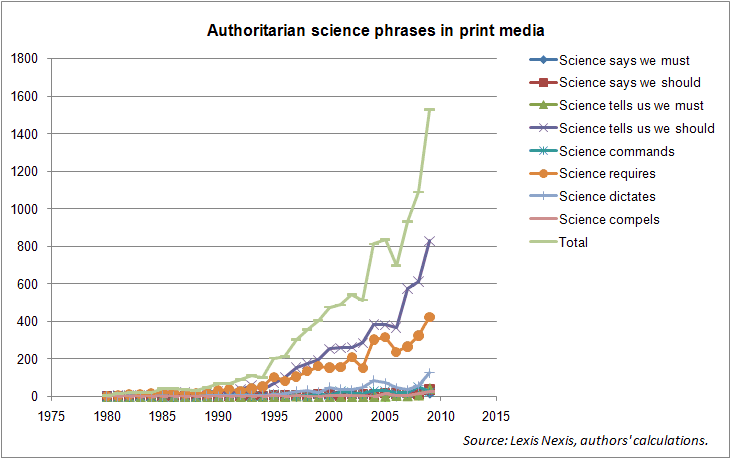
Well, then.  Science, back in a golden age before the politicization of research when scientists were men and women liked them that way, pronouncements from "science" were descriptive, not proscriptive.  "We found this to be true."  Not, "Do this or that."  The authors of this article decided to check up on things.  Looking at Lexis-Nexis, they searched for occurrences of phrases like, “science says we must,” “science says we should,” “science tells us we must,” “science tells us we should,” “science commands,” “science requires,” “science dictates,” and “science compels.”

And look what they found:

That's quite an increase in a mere quarter century.  As the authors note, over the same time period it looks a lot like Mann's hockey stick.  And perhaps for the same reason.

Posted by Buckethead Buckethead on   |   § 2

The Denialsphere?

While looking for some links for the last post, I ran across this interesting bit:

Much has been written of late about the nature of denialism. New Scientist a couple of issues back produced a special report on the subject, for example, and the New Humanist explores the idea of "unreasonable doubt."

There's plenty more out there. The most provocative I've come across (thanks to Joss Garman via DeSmog Blog's Brendan DeMelle) is a 2009 paper in the journal Studies in History and Philosophy of Modern Physics by Jeroen van Dongen of the Institute for History and Foundations of Science at Utrecht University in The Netherlands. His thesis is ideologically based denialism of science has a long pedigree, and he begins his paper with this quote from Albert Einstein:

This world is a strange madhouse. Currently, every coachman and every waiter is debating whether relativity theory is correct. Belief in this matter depends on political party affiliation.

The parallels between the political opposition to relatively in certain early 20th-century circles and today's pseudoskeptical approach to anthropogenic global warming are striking.

Indeed,the actions of many of Einstein's opponents resemble those of the thinkers now often referred to as, in perhaps an all too derisive manner, ''crackpots''. It thus appears that this phenomenon is at least as old as the existence of institutionalized science, which arbitrates authoritatively what is, and what is not, sound scientific practice and established truth; crackpots, with their own unshakable beliefs, in the end rather deny that authority than give up their ideas.It has long been clear that dismissing the anti-relativists' objections as those of an assortment of dimwits who simply did not get it, as physicists intuitively have tended to do, does not suffice.

"On Einstein's opponents, and other crackpots " is not a long paper, nor particularly dense. Check it out.

Just because a million people believe something to be true, doesn't mean it is. I refer you to Aretae's many posts on how sure you should be on things - but especially Logarithmically Right.  Another factor is that the specialization of science leads scientists in field A to accept as true without examination the consensus of field B without examining them.  And then use those conclusions in their own theorizing. Which are then used as inputs by the scientists in field B.  Positive feedback loop.  Cosmology and particle physics are particularly guilty of this.

And if James Hrynyshyn, communications consultant and freelance science journalist based in Western North Carolina, is especially vigilant in following things that link to his site, I suggest that he look at Aretae's post on climate, which is what I would have posted had he not written that first, and better.

[wik] Just to get snarky - follow the link.  Dude who wrote that is a little creepy looking.  The intense stare of the zealot.

Posted by Buckethead Buckethead on   |   § 0

While I'm on a science kick

Aretae linked to this fascinating post by Falkenblog, on the dubiousness of Eddington's experimental proof of Einstein's theory of relativity.

I've gone down the rabbit hole on modern science - I am extremely dubious of anything outside the really hard sciences, the stuff that results in hardware.  What started with a big WTF on dark matter, has extended to lots more and relativity is one of them.  The fact that Eddington fudged his numbers is one more nail waiting for a coffin.

There's been some research, here and there, pointing in the direction of a rework of relativity in light of classical mechanics.  Three books that are on my list to read cover this idea:

  • Causality, Electromagnetic Induction, and Gravitation, Oleg D. Jefimenk:A strikingly new exploration of the fundamentals of Maxwell's electromagnetic theory and Newton's theory of gravitation. Starting from an analysis of the principles of causality, Jefimenko develops the argument that, contrary to the generally accepted view, time-varying electric and magnetic fields cannot cause each other; rather, the true, simultaneous source of both lies in time-varying charges and currents. These causal dependencies are expressed as solutions to Maxwell's equations in the form of retarded electric and magnetic field integrals, which turn out to be related to momentum conservation and result in an extension of conventional gravitational concepts. In particular, a second, "cogravitational" field (first predicted by Heavyside) is implied, relating to the gravitational field proper in a way similar to that in which the magnetic field relates to the electric field. This leads to a gravitational relationship in which the forces depend not only on the masses and separations of the interacting bodies but also on their velocities and accelerations. Generalizing Newtonian gravitation to time-varying systems gives a causal formulation that can reproduce many features commonly held to be unique to General Relativity, inviting one to wonder if the abandonment of Newton's theory in favor of GR might, perhaps, have been too hasty. Mathematically demanding, but great food for thought for anyone with an interest in the foundations of physics. Oleg Jefimenko is Professor of Physics at the University of West Virginia.
  • Newtonian Electrodynamics, Peter and Neal Graneau:A detailed technical account of how the 19th century electromagnetics developed by Coulomb, Ampère, Neumann, and Kirchoff explains and enables analysis of experiments with exploding wires, railguns, and arc dynamics that cannot be accounted for satisfactorily by the relativistic field theory of Maxwell, Lorentz, and Einstein.The authors suggest that in the rush to produce a unified description of physics, the solidly observation-based Newtonian electrodynamics was swept out of sight and written out of textbooks in an unduly hasty manner that has left gaping holes in the comprehension of such basic elements of electrical engineering as motors and generators.
  • Einstein Plus Two, Petr Beckman:
  • Presents Dr. Beckmann's theory that effects conventionally attributed to Einsteinian Relativity can be explained more simply. This theory, derived from electromagnetic principles, states that velocity with respect to the dominant local energy field, rather than veolcity with respect to the observer, is what matters. From this it is seen that the normal charge distribution law becomes inaccurate at high speeds which, in effect, is what the Lorentz transformations compensate for.

    Where Einstein is obliged to distort space and time, Beckmann leaves them as being what they always were and rearranges the charge configuration of moving objects. The result is a theory that satisfies the relativity principle, is equally compatible with all the experimental results cited as "proving" Relativity, and more powerful predictively in being able to derive the quantization of electron orbits, the Titius series of planetary spacings, and the Schrödinger equation.

    Delightfully thought-provoking, but not for the mathematically squeamish

(Descriptions of books from James Hogan, and recommended by him.) The common denominator is the idea that classical mechanics - Maxwell - can be used to explain relativistic phenomena without recourse to the bizarre side effects imposed by Einstein's relativity.  If Maxwell's equations, which seem pretty solid, and don't make your mind all twisty, can be used to explain more simply these things, then it seems to me that Occam's razor would insist that we drop Einstein into the dustbin of scientific history.

[wik] some more links I haven't had time to sort through:

Posted by Buckethead Buckethead on   |   § 4

Plasma Vortices and Spacequakes

This sort of thing fits right in with the Plasma Cosmology view.

Researchers using NASA’s fleet of five THEMIS spacecraft have discovered a form of space weather that packs the punch of an earthquake and plays a key role in sparking bright Northern Lights. They call it “the spacequake.”

...

“Magnetic reverberations have been detected at ground stations all around the globe, much like seismic detectors measure a large earthquake,” says THEMIS principal investigator Vassilis Angelopoulos of UCLA.

It’s an apt analogy because “the total energy in a spacequake can rival that of a magnitude 5 or 6 earthquake,” according to Evgeny Panov of the Space Research Institute in Austria. Panov is first author of a paper reporting the results in the April 2010 issue of Geophysical Research Letters (GRL).

In 2007, THEMIS discovered the precursors of spacequakes. The action begins in Earth’s magnetic tail, which is stretched out like a windsock by the million mph solar wind. Sometimes the tail can become so stretched and tension-filled, it snaps back like an over-torqued rubber band. Solar wind plasma trapped in the tail hurtles toward Earth. On more than one occasion, the five THEMIS spacecraft were in the line of fire when these “plasma jets” swept by. Clearly, the jets were going to hit Earth. But what would happen then? The fleet moved closer to the planet to find out.

“Now we know,” says THEMIS project scientist David Sibeck of the Goddard Space Flight Center. “Plasma jets trigger spacequakes.”

Spacequakes (vortices, 200px)

A THEMIS map of plasma flows during a spacequake. The axes are labeled in Earth radii, so each swirl is about the size of Earth.

“When plasma jets hit the inner magnetosphere, vortices with opposite sense of rotation appear and reappear on either side of the plasma jet,” explains Rumi Nakamura of the Space Research Institute in Austria, a co-author of the study. “We believe the vortices can generate substantial electrical currents in the near-Earth environment.”

Acting together, vortices and spacequakes could have a noticeable effect on Earth. The tails of vortices may funnel particles into Earth’s atmosphere, sparking auroras and making waves of ionization that disturb radio communications and GPS. By tugging on surface magnetic fields, spacequakes generate currents in the very ground we walk on. Ground current surges can have profound consequences, in extreme cases bringing down power grids over a wide area.

Lately I've been seeing more mention of electricity in space science news, which is to the good - but one possibility that the THEMIS scientists don't seem to be considering is that electrical forces are generating the magnetic fields.  You can't have one without the other - something that solar scientists and cosmologists, and in fact anyone who uses the phrase "magnetic lines reconnecting" fails to grasp.

Posted by Buckethead Buckethead on   |   § 0