

 Ministry Archive: Buckethead
Interesting piece on what hyperinflation in the US might look like. The prelude is a description of the hyperinflation in Chili under Allende:
Apart from what happened with the Weimar Republic in the 1920’s, advanced Western economies have no experience with hyperinflation. (I actually think that the high inflation that struck the dollar in the 1970’s, and which was successfully choked off by Paul Volcker, was in fact an incipient bout of commodity-driven hyperinflation—but that’s for some other time.) Though there were plenty of hyperinflationary events in the XIX century and before, after the Weimar experience, the advanced economies learned their lesson—and learned it so well, in fact, that it’s been forgotten.
However, my personal history gives me a slight edge in this discussion: During the period 1970–’73, Chile experienced hyperinflation, brought about by the failed and corrupt policies of Salvador Allende and his Popular Unity Government. Though I was too young to experience it first hand, my family and some of my older friends have vivid memories of the Allende period—vivid memories that are actually closer to nightmares.
The causes of Chile’s hyperinflation forty years ago were vastly different from what I believe will cause American hyperinflation now. But a slight detour through this history is useful to our current predicament.
To begin: In 1970, Salvador Allende was elected president by roughly a third of the population. The other two-thirds voted for the centrist Christian Democrat candidate, or for the center-right candidate in roughly equal measure. Allende’s election was a fluke.
He wasn’t a centrist, no matter what the current hagiography might claim: Allende was a hard-core Socialist, who headed a Hard Left coalition called the Unidad Popular—the Popular Unity (UP, pronounced “oo-peh”). This coalition—Socialists, Communists, and assorted Left parties—took over the administration of the country, and quickly implemented several “reforms”, which were designed to “put Chile on the road to Socialism”.
Land was expropriated—often by force—and given to the workers. Companies and mines were also nationalized, and also given to the workers. Of course, the farms, companies and mines which were stripped from their owners weren’t inefficient or ineptly run—on the contrary, Allende and his Unidad Popular thugs stole farms, companies and mines from precisely the “blood-thirsty Capitalists” who best treated their workers, and who were the most fair towards them.
Allende’s government also put UP-loyalists in management positions in those nationalized enterprises—a first step towards implementing a Leninist regime, whereby the UP would have “political control” over the means of production and distribution. From speeches and his actions, it’s clear that Allende wanted to implement a Maoist-Leninist regime, with himself as Supreme Leader.
One of the key policy initiative Allende carried out was wage and price controls. In order to appease and co-opt the workers, Allende’s regime simultaneously froze prices of basic goods and services, and augmented wages by decree.
At first, this measure worked like a charm: Workers had more money, but goods and services still had the same old low prices. So workers were happy with Allende: They went on a shopping spree—and rapidly emptied stores and warehouses of consumer goods and basic products. Allende and the UP Government then claimed it was right-wing, anti-Revolutionary “acaparadores”—hoarders—who were keeping consumer goods from the workers. Right.
Meanwhile, private companies—forced to raise worker wages while maintaining their same price structures—quickly went bankrupt: So then, of course, they were taken over by the Allende government, “in the name of the people”. Key industries were put on the State dole, as it were, and made to continue their operations at a loss, so as to satisfy internal demand. If there was a cash shortfall, the Allende government would simply print more escudos and give them to the now State-controlled companies, which would then pay the workers.
This is how hyperinflation started in Chile. Workers had plenty of cash in hand—but it was useless, because there were no goods to buy.
So Allende’s government quickly instituted the Juntas de Abastecimiento y Control de Precios (“Unions of Supply and Price Controls”, known as JAP). These were locally formed boards, composed of loyal Party members, who decided who in a given neighborhood received consumer products, and who did not. Naturally, other UP-loyalists had preference—these Allende backers received ration cards, with which to buy consumer goods and basic staples.
Of course, those people perceived as “unfriendly” to Allende and the UP Government either received insufficient rations for their families, or no rations at all, if they were vocally opposed to the Allende regime and its policies.
Very quickly, a black market in goods and staples arose. At first, these black markets accepted escudos. But with each passing month, more and more escudos were printed into circulation by the Allende government, until by late ’72, black marketeers were no longer accepting escudos. Their mantra became, “Sólo dólares”: Only dollars.
Hyperinflation had arrived in Chile.
 on
| § 0
on
| § 0

In the aftermath of the mortgage company deciding to sell my house with out, you know, letting me in on the secret; I decided that this was in fact a perfect moment to pause and take stock of my situation.
So I did.
In many areas of my life, things are groovy. I'm down 20lbs. I'm exermacizing. I've got a decent job. I've got great kids, and a great wife. Even my dog and cat are well above average. I've no credit card debt, I'm current on all my bills. There's just one gaping, gangrenous sore on the face of my happiness, and that is the house situation. And it occurred to me, after consulting runes, oracles and qualified professionals, that my current housing situation was not only not all that great it is unlikely in the extreme to improve anytime in the near future. Given my recent unpleasantness in the job market, and the general unpleasantness still extent in the housing market, the likelihood of getting a decent refinance on my home is vanishingly small. So until the housing market rebounds (which might happen before the world ends in 2012, but I'm not betting on it) I am stuck paying a large mortgage on a house that is worth less than that mortgage, and said mortgage is a much larger fraction of my monthly income than it was when I bought the place.
Since I want to enjoy my last couple years before the world ends, and since I want to get some petty vengeance on my mortgage company for stabbing me in the back, I'm moving. It seems that now I can get a house twice as big and almost as nice as the current one for 2/3 the price I paid four years ago. Such is modern life. So, the next few months will be consumed with the vast logistical enterprise that is relocating a household consisting of a pregnant wife, three kids seven and under, a dog, a cat, and all the crap we've accumulated with the efficiency of a black hole sucking in light. Packing, looking at houses, trips to the dump, dealing with realtors and finance, and a thousand other tasks large and small will consume most of the time I don't spend working or sleeping.
So blogging will be light for the near future, as it has been for the last couple weeks. I do intend to finish up a couple nearly finished drafts on formalist type issues. I'll throw up some links now and again. (Isegoria seemed to disagree with my last bunch being labeled, "Of mild interest.") And I'll probably steal some time away from work or sleep to get things off my chest.
o assuage your pain, here is teh funny:


on
| § 3
Boing Boing has a gallery up of artist's conceptions of space stations from back in the 70s. I've seen most of these before, but it's always fun to look at pictures of space stations. Always.
Sadly, I don't think that anything like that will ever be built, barring a truly vast change in our technological capabilities. We can make space travel more affordable in the short term, to be sure - the current inefficiencies of NASA-style space travel are truly retarded. Private space travel could bring costs down to (best case) the cost of air freight, as the fuel cost of a jaunt to orbit for a modest-sized vehicle are on par with a antipodal aircraft flight. But that is a hard lower bound.
To get costs lower, you need new technology. Nanotech diamond rocket engines burning exotic fuels, maybe. Whole ships made entirely of ultralight diamondoid materials might get costs lower. Real fusion torch drives, and a billion ecological impact statements might also do the trick. A spacehook or elevator doing the indian rope trick would also significantly lower costs.
And costs need to get down to sea or rail freight levels, and they would need to be a thicker pipe. Low cost, and large bulk lifting would be necessary to construct space stations. Because, despite the availability of extraterrestrial materials in the belt and on the moon, you first need to lift an industrial complex into orbit to be able to process and move that material. Colonies in space will need ecosystems, and the only known supply of livable ecosystem is at the bottom of an uncomfortably large gravity well.
The only way around that limitation that doesn't involve better earth to orbit technology is von Neumann machines, sending a small seed colony of self-replicating robots to the moon, or the belt, and having them construct the infrastructure that people could then travel to. And is that really a good idea?
on
| § 0
on
| § 2
As I catch up from the recent chaos, and prepare for yet more chaos, here's some mildly interesting links I've collected over the last few days:
on
| § 0
Once you've commented here on perfidy, the kobolds and goblins running on their treadmills in the dismal subterranean engines that power our website will remember you. You won't have to have your comment languish in purgatory - it should appear immediately. But if your comment doesn't appear, it means that for some reason the vicious spam filter monsters were alerted, and they ate it; or you are a first time commenter.
So, if your comment doesn't immediately appear, or within the next couple hours, please feel free to use the contact thingy in the left sidebar to send us an email. We've had a several of these over the last couple months, and I don't want people to feel left out or discriminated against. Because perfidy stands four-square against discrimination and leaving-out.
on
| § 0
I have achieved a milestone in personal fitness. I now weigh less than 1/8 ton. I have not seen the sunny side of 250 since somewhere in 2002, about which time I was settling into the sedentary lifestyle of the knowledge worker and eating at the all-you-can-eat Chinese buffet across the street from my office nearly every day for lunch.
Since I started my diet on July 5th, with the encouragement and assistance of the Monkeybrains google group founded by Aretae, I have lost 18 pounds, net. That's an average of three pounds a week over six weeks. But the average is lying to you, as it often does. I went to Ohio for two and a half weeks and over that time progressively fell off the diet, and ended up nearly ten pounds heavier when I returned than when I left. So the total weight loss is closer to 26 lbs, over a period of four weeks.
How did I achieve this? I've mentioned the Paleo diet here before, and that is it. The best summary I've seen of the methodology of paleo dieting is right here, and here's the twelve commandments:
The good doctor also points out:
If you can do step 1, that is about 50% of the benefit and alone a huge improvement on the standard american diet (SAD) By about step 6 you are at about 75% , by step 9 about 80% and at 10 you are at 99% for most people. These are just estimates, of course.
So right now, I'm obeying the first ten of the twelve commandments and thus am 99 44/100 pure paleo. I don't think I'll ever cut the beans and cheese completely - they round out the meat and vegetables. And by obeying those commandments, I'm losing a pound a day eating as much as I want. Sunday, I was particularly hungry, I had 4 eggs and 4 slices of bacon for lunch, two glasses of whole milk, most of a bag of beef jerky, a handful of peanuts, a single strawberry, and a two large helpings of a tasty Indian lamb dish my wife made. That had to be a few thousand calories. But next morning, another pound and a half gone.
My goal is to lose another 20 pounds in each of the next two months. That will put me at about 210 - a weight I haven't seen since my mid twenties.
Looking back at the last six weeks, I find that I'm really rather surprised at how easy it has been. Aside from the trip, where I was at times not really free to pick the food that I wanted, and some alcohol consumption along with it; I've been able to keep to the diet remarkably well. Being able to consume mass quantities is a huge help - every caloric restriction diet I went on in the past drove me nuts, and led to binge eating.
If you want to lose weight, I recommend this diet unreservedly - and read Good Calories, Bad Calories to understand why it works.
on
| § 0
While down in Columbus, the wife conceived a need to go to Walmart. On the way back, waiting at a light, she was looking through her purse. And her foot lifted off the break pedal a bit. Since it was an automatic, she drifted forward and touched the bumper of the car in front of her. So slight was the impact that she wasn't even aware that she'd touched the other car.
That is, until the woman got out and started screaming.
This Indian woman (dot) accused my wife of damaging her car. Based on what I saw when of our car, there is no possibility that there was any damage whatsoever. The woman called the police. The officer, when he arrived, refused to right a citation to anyone since he couldn't detect any damage to either car. My wife gave the harridan our insurance info.
I thought (hoped, really) that that would be the end of it.
But the day after the whole house thing blew up (see my previous post) I get a call from Geico about the "accident." I had a hard time thinking of a .1mph impact as an accident - I've hit people's cars harder than that on purpose and caused no damage.
The bonus, though, is that the car my wife was driving was my dad's minivan, which we'd borrowed for the trip so we'd have more room. So, I had to call Dad and explain that we'd been in an accident. So while I was frantically trying to save my house, I had to deal with spending hours on the phone with insurance companies explaining the non-accident and making sure that the insurance adjustors when they get to look at the woman's 97 Toyota Camry, they take a skeptical view of any of her claims of damage.
Trying to get my insurance to pay for a new paint job or something for her thirteen year old car - and making my rates go up - is basically theft. And forcing me to have to explain all this to my dad is just annoying.
Bitch.
on
| § 0
Normally, I have a typically lame excuse for not blogging. Apathy, work, illness, family, the like. This last hiatus, though brief by the standards of previous lapses, was more scary. (For me - if it was scary for you, I am concerned about your mental health.)
Last week, I almost lost my house.
There is a prologue to this story, of course. I have been gainfully employed for the last year. The two and a half years previous to last summer were rather more chaotic. Between January 2007 and August 2009, I was laid off three times. Once, just five weeks into a year long contract. This had a profound and deleterious effect on my finances - every time I'd get a new gig, I'd struggle to get caught up, get there, and then immediately be on forced retirement. With help from family, and by adopting a spartan lifestyle, I managed to make it through. Except for what I owe my parents, I am no more in debt now than when I started the whole nightmare. I have no credit card debt, and my only loans are car loans, and my mortgage. But I did not get through without constant run-ins with the most wonderful and understanding people on Earth, the bill collectors.
My largest debt is my mortgage, and my mortgage loan company is a smallish one. I'd fall behind, get a job, get on a plan, get laid off, get behind... Last fall, hopeful again that this job would last a little longer than the last few, I got on a plan. I scraped up a few thousand in earnest money, and started making payments.
Life is good! The house is saved, a major worry is de-worrified, and I focus on catching up on other bills.
Now, part of the process is filling out endless paperwork. I did, back in October of last year. A call to the mortgage company revealed that they were missing a signed page two of my tax return. No problem - I'll fax it. As I made my last scheduled payment on the plan at the end of March, this came up again. Didn't get the first one? I'll fax it in again. I continued making payments, as agreed. I asked when I'd find out what the new terms would be, they said that the underwriters would look at everything and get back to me.
Okay.
Understand that from January of this year through my departure for Ohio three weeks ago, I received exactly one piece of mail from the mortgage people - a form letter saying that my interest rate might (or might not) change in August. Got that in May.
'Round about June, I became concerned that I hadn't heard anything. I gave them a call. "Oh, hi, Mr. Buckethead! We don't have your signed page two of your tax return." Well, shit, okay, I'll get it to you. I asked where we were - no problem, they say, just get that to us, and we're cool. So alright. I faxed it in, for the fourth time. Busyness ensued - getting ready for the trip, other issues. I leave for Ohio.
Last Tuesday, two weeks into my trip to Ohio, I called again, to check on their progress. And discovered that my house was scheduled for a sheriff's sale yesterday - the 10th of August, a week away. Holy mother of fuck. I say, well that's mildly outrageous, seeing as I never got anything in the mail, or a phone call, or by smoke signal indicating that my house was going to be sold out from under me despite the fact that I had made every single agreed payment.
In fact, I discovered that the decision had been made four days before I talked to the guy in June - rejected because they had only an unsigned version of page 2 of my tax return, and not a signed one. They had somehow failed to mention that in the phone call, or the sale. And it appears that my signature on the initial agreement gave them the right to do that.
I seriously considered just giving them the keys.
My house is worth no more than what I paid for it in 2006, maybe slightly less. Thanks to missed payments that will be tacked onto the end, I'm at least somewhat underwater. If I sold the house, I'd lose money. Having the bank sell the house would mean they lose the money. I could find a rental for significantly less than my current mortgage payment, even as low as half; and I wouldn't have the burden of hundreds of thousands of dollars in debt. The upside would be a thousand more dollars in my pocket every month - not an insignificant sum.
Downside, of course, is that my credit rating would be savaged for years, useless. That's a hell of a trade-off, freedom and more money with expulsion from the ranks of the credit-worthy; or continued paycheck to paycheck wage-slavery to maintain my status and nice home.
I find that the monkeybrains was arguing for status. Losing the house would be a real hit to my pride. But in the end, I decided to go with monkeybrains and keep the house for a couple reasons. One, employers check credit reports when they're hiring. Two, I will need a viable credit rating to purchase a new, larger vehicle to accomodate my soon to be larger family sometime before next January. Three, I have plans for the future that require home ownership. It's involved, but take my word for it. I'm trying to think long-term, and the short term happiness of more money is not outweighing seven years bad luck for defaulting on a mortgage.
So last week, I spent several hours on the phone, arguing, bargaining, negotiating, and managed to avert disaster. So far as I know, they did not sell my house yesterday. It came down to me agreeing to pay two payments instead of one, all for their screw up. A reach-around would have been appreciated, but was not offered. A timely short term loan from Mom covered the shortfall (thanks mom!) and finally we were able to move on.
The frustrating thing about this is (aside from nearly dying of shock, and then having to fork over an extra mortgage payment for someone else's fuck-up) that I had not refinanced the loan back in March. I didn't because the people I talked to said that I wouldn't be able to get good terms while I was still technically in default, because the plan wasn't complete. I figured a couple more months wouldn't be a bad thing, especially if I can get a better deal at the end of it. Now, thanks to this most recent ass-rape, it will be until January of '11 before this new plan is finished. (Needless to say, I am going to pursue refinancing rather more relentlessly, I want to get away from these people.)
If anyone knows of any good house refinancing resources, I'd welcome a tip.
From what mom was telling me, this sort of thing isn't exactly uncommon. Others have had houses sold out from under their feet despite having made regular, agreed-upon payments. And usually, without notification. Which strikes me as curious - it's one thing to foreclose on someone who isn't making payments, but given the near certainty of massive losses on the sale, you'd think they'd want to keep raking in the interest money. Unless, of course, it's cheaper for them to write off the loss and get bailout money from the government.
on
| § 6
Or cold ones, anyway. This guy says that the 30-year Pacific Decadal Oscillation, La Nina, and the Antarctic Oscillation are all already in their cold phases, and that the North Atlantic Oscillation will be negative by December. This, combined with the recent extended solar minimum and the collapse of the thermosphere (record lows according to NASA) spells really cold weather on tap for this winter. The southern hemisphere might already be feeling it, and the last two winters might be nothing on what's in store.
If he's right. But I wouldn't stock up on suntan lotion.
on
| § 1
More science writing should be like this.
on
| § 1
Cool Tools has compiled a list of the 100 greatest magazine articles. With links! You can apparently also suggest new ones and vote articles up or down. The current top five are:
Apparently, they are very good at picking articles, but not so good at counting. Several of these look to be well worth the effort of reading. I think I'll check out First Wave at Omaha Beach, and a couple Hunter S. Thompson pieces.
on
| § 0
From Vox Day's excellent post What makes a statement "scientific"? an old quote from Feynman, his definition of science:
Science is the belief in the ignorance of experts.
Read Feynman on that issue here.
on
| § 0
In light of the last post, here's another useful thought on the reliability of consensus science:
In a Wired article published at the end of May, writer Erin Biba bemoans the fact that “science” is losing its credibility with the public. The plunge in the public’s belief in catastrophic climate change is her primary example. Biba wonders whether the loss of credibility might be due to the malfeasance unearthed by the leak of emails from the Climatic Research Unit at the University of East Anglia in the United Kingdom, but comes to the conclusion that malfeasance isn’t the cause of the public’s disaffection. No, people have turned against science simply because it lacks a good public relations outfit. Biba quotes Kelly Bush, head of a major PR firm, on the point:
Biba says researchers need a campaign that inundates the public with the message of science: Assemble two groups of spokespeople, one made up of scientists and the other of celebrity ambassadors. Then deploy them to reach the public wherever they are, from online social networks to “The Today Show.” Researchers need to tell personal stories, tug at the heartstrings of people who don’t have PhD’s. And the celebrities can go on “Oprah” to describe how climate change is affecting them—and by extension, Oprah’s legions of viewers.
“They need to make people answer the questions, What’s in it for me? How does it affect my daily life? What can I do that will make a difference? Answering these questions is what’s going to start a conversation,” Bush says. “The messaging up to this point has been ‘Here are our findings. Read it and believe.’ The deniers are convincing people that the science is propaganda.”
Well, then. Science, back in a golden age before the politicization of research when scientists were men and women liked them that way, pronouncements from "science" were descriptive, not proscriptive. "We found this to be true." Not, "Do this or that." The authors of this article decided to check up on things. Looking at Lexis-Nexis, they searched for occurrences of phrases like, “science says we must,” “science says we should,” “science tells us we must,” “science tells us we should,” “science commands,” “science requires,” “science dictates,” and “science compels.”
And look what they found:
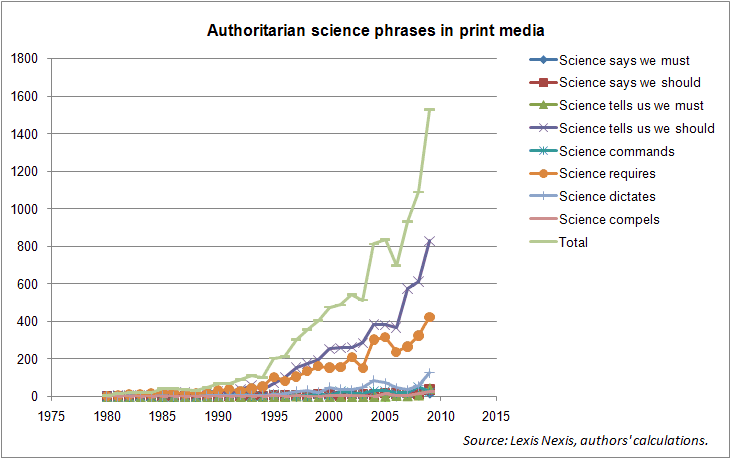
That's quite an increase in a mere quarter century. As the authors note, over the same time period it looks a lot like Mann's hockey stick. And perhaps for the same reason.
on
| § 2
While looking for some links for the last post, I ran across this interesting bit:
Much has been written of late about the nature of denialism. New Scientist a couple of issues back produced a special report on the subject, for example, and the New Humanist explores the idea of "unreasonable doubt."
There's plenty more out there. The most provocative I've come across (thanks to Joss Garman via DeSmog Blog's Brendan DeMelle) is a 2009 paper in the journal Studies in History and Philosophy of Modern Physics by Jeroen van Dongen of the Institute for History and Foundations of Science at Utrecht University in The Netherlands. His thesis is ideologically based denialism of science has a long pedigree, and he begins his paper with this quote from Albert Einstein:
This world is a strange madhouse. Currently, every coachman and every waiter is debating whether relativity theory is correct. Belief in this matter depends on political party affiliation.
The parallels between the political opposition to relatively in certain early 20th-century circles and today's pseudoskeptical approach to anthropogenic global warming are striking.
Indeed,the actions of many of Einstein's opponents resemble those of the thinkers now often referred to as, in perhaps an all too derisive manner, ''crackpots''. It thus appears that this phenomenon is at least as old as the existence of institutionalized science, which arbitrates authoritatively what is, and what is not, sound scientific practice and established truth; crackpots, with their own unshakable beliefs, in the end rather deny that authority than give up their ideas.It has long been clear that dismissing the anti-relativists' objections as those of an assortment of dimwits who simply did not get it, as physicists intuitively have tended to do, does not suffice.
"On Einstein's opponents, and other crackpots " is not a long paper, nor particularly dense. Check it out.
Just because a million people believe something to be true, doesn't mean it is. I refer you to Aretae's many posts on how sure you should be on things - but especially Logarithmically Right. Another factor is that the specialization of science leads scientists in field A to accept as true without examination the consensus of field B without examining them. And then use those conclusions in their own theorizing. Which are then used as inputs by the scientists in field B. Positive feedback loop. Cosmology and particle physics are particularly guilty of this.
And if James Hrynyshyn, communications consultant and freelance science journalist based in Western North Carolina, is especially vigilant in following things that link to his site, I suggest that he look at Aretae's post on climate, which is what I would have posted had he not written that first, and better.
[wik] Just to get snarky - follow the link. Dude who wrote that is a little creepy looking. The intense stare of the zealot.
on
| § 0
Aretae linked to this fascinating post by Falkenblog, on the dubiousness of Eddington's experimental proof of Einstein's theory of relativity.
I've gone down the rabbit hole on modern science - I am extremely dubious of anything outside the really hard sciences, the stuff that results in hardware. What started with a big WTF on dark matter, has extended to lots more and relativity is one of them. The fact that Eddington fudged his numbers is one more nail waiting for a coffin.
There's been some research, here and there, pointing in the direction of a rework of relativity in light of classical mechanics. Three books that are on my list to read cover this idea:
Presents Dr. Beckmann's theory that effects conventionally attributed to Einsteinian Relativity can be explained more simply. This theory, derived from electromagnetic principles, states that velocity with respect to the dominant local energy field, rather than veolcity with respect to the observer, is what matters. From this it is seen that the normal charge distribution law becomes inaccurate at high speeds which, in effect, is what the Lorentz transformations compensate for.
Where Einstein is obliged to distort space and time, Beckmann leaves them as being what they always were and rearranges the charge configuration of moving objects. The result is a theory that satisfies the relativity principle, is equally compatible with all the experimental results cited as "proving" Relativity, and more powerful predictively in being able to derive the quantization of electron orbits, the Titius series of planetary spacings, and the Schrödinger equation.
Delightfully thought-provoking, but not for the mathematically squeamish
(Descriptions of books from James Hogan, and recommended by him.) The common denominator is the idea that classical mechanics - Maxwell - can be used to explain relativistic phenomena without recourse to the bizarre side effects imposed by Einstein's relativity. If Maxwell's equations, which seem pretty solid, and don't make your mind all twisty, can be used to explain more simply these things, then it seems to me that Occam's razor would insist that we drop Einstein into the dustbin of scientific history.
[wik] some more links I haven't had time to sort through:
on
| § 4
This sort of thing fits right in with the Plasma Cosmology view.
Researchers using NASA’s fleet of five THEMIS spacecraft have discovered a form of space weather that packs the punch of an earthquake and plays a key role in sparking bright Northern Lights. They call it “the spacequake.”
...
“Magnetic reverberations have been detected at ground stations all around the globe, much like seismic detectors measure a large earthquake,” says THEMIS principal investigator Vassilis Angelopoulos of UCLA.
It’s an apt analogy because “the total energy in a spacequake can rival that of a magnitude 5 or 6 earthquake,” according to Evgeny Panov of the Space Research Institute in Austria. Panov is first author of a paper reporting the results in the April 2010 issue of Geophysical Research Letters (GRL).
In 2007, THEMIS discovered the precursors of spacequakes. The action begins in Earth’s magnetic tail, which is stretched out like a windsock by the million mph solar wind. Sometimes the tail can become so stretched and tension-filled, it snaps back like an over-torqued rubber band. Solar wind plasma trapped in the tail hurtles toward Earth. On more than one occasion, the five THEMIS spacecraft were in the line of fire when these “plasma jets” swept by. Clearly, the jets were going to hit Earth. But what would happen then? The fleet moved closer to the planet to find out.
“Now we know,” says THEMIS project scientist David Sibeck of the Goddard Space Flight Center. “Plasma jets trigger spacequakes.”
A THEMIS map of plasma flows during a spacequake. The axes are labeled in Earth radii, so each swirl is about the size of Earth.
“When plasma jets hit the inner magnetosphere, vortices with opposite sense of rotation appear and reappear on either side of the plasma jet,” explains Rumi Nakamura of the Space Research Institute in Austria, a co-author of the study. “We believe the vortices can generate substantial electrical currents in the near-Earth environment.”
Acting together, vortices and spacequakes could have a noticeable effect on Earth. The tails of vortices may funnel particles into Earth’s atmosphere, sparking auroras and making waves of ionization that disturb radio communications and GPS. By tugging on surface magnetic fields, spacequakes generate currents in the very ground we walk on. Ground current surges can have profound consequences, in extreme cases bringing down power grids over a wide area.
Lately I've been seeing more mention of electricity in space science news, which is to the good - but one possibility that the THEMIS scientists don't seem to be considering is that electrical forces are generating the magnetic fields. You can't have one without the other - something that solar scientists and cosmologists, and in fact anyone who uses the phrase "magnetic lines reconnecting" fails to grasp.
on
| § 0
Where are they? The Fermi Paradox has lept out at me twice in as many days. First off, a post on the arXiv blog about some new research into the FP.
Their approach is to imagine that civilisations form at a certain rate, grow to fill a certain volume of space and then collapse and die. They even go as far as to suggest that civilisations have a characteristic life time, which limits how big they can become. In certain circumstances, however, when civilisations are close enough together in time and space, they can come into contact and when this happens the cross-fertilisation of ideas and cultures allows them both to flourish in a way that increases their combined lifespan. Bezsudnov and Snarskii point out that this process of spreading into space can be easily modelled using a cellular automaton. And they've gone ahead and created their own universe using a 10,000 x 10,000 cell automaton running over 320,000 steps. The parameters that govern the evolution of this universe are simple: the probability of a civilisation forming, the usual lifespan of such a civilisation and the extra bonus time civilisations get when they meet. The result gives a new insight into the Fermi Paradox. Bezsudnov and Snarskii say that for certain values of these parameters, the universe undergoes a phase change from one in which civilisations tend not to meet and spread into one in which the entire universe tends to become civilised as different groups meet and spread. Bezsudnov and Snarskii even derive an inequality that a universe must satisfy to become civilised. This, they say, is analogous to the famous Drake equation which attempts to quantify the number of other contactable civilisations in the universe right now.
So the question is, do we live in a world where intelligent species are too far apart to cross-pollinate, and survive; or one where they are, but it hasn't happened yet? This is interesting, and is somewhat in line with my own thinking - though they are completely ignoring the possibility of BEMS and conflict, and supposing that intelligent entities in space are all bug-eyed Sagans who will get along famously. I'm not saying they can't, but it isn't a sure thing. Read Killing Star if you're uncertain about that one. Pay special attention to the Central Park analogy. Interesting spin on the Fermi Paradox - but nothing really outre. Charles Stross, in his recent post Mediocrity (a sequel to the thrilling post Insufficient Data)
In general, there are two classes of solution to the Fermi paradox; ones that assume that we are unique special snowflakes in an empty cosmos, and those that postulate that intelligent species are common, but some kind of mechanism stops them from colonizing interstellar space. If we look at the second problem set, and broaden the focus ... well, intelligent species emerge as components of a biosphere bound to a particular planetary habitat. We humans are land-dwellers on Earth in the later high-oxygen period; conditions on earth even one billion years ago would have been rapidly fatal for an unprotected human, and even today, survival on 90% of our planet's surface area is contingent on the availability of cultural artefacts like boats (80% is water) or clothing (for protection in hostile climates). So the real question isn't, "can intelligent life colonize other star systems?" so much as "can intelligent life propagate itself, and its supporting biosphere and technosphere to run in alien environments? Which is a very different question. Call it the Ark Problem; if your name is Noah and you're going on a one-way trip to another world, how big an Ark do you need (and how many specimens per speciality, be they biological or technological)?
There is of course the not-answer to the Fermi Paradox - the simulation hypothesis - which argues that there are exactly as many intelligent species as the simulation designer decided to throw in the box with us, and no more. But then, it gets interesting.
It's that danged principle of mediocrity that's causing all these problems. It shows up in the Fermi Paradox, it turns up in the Simulation Argument, it turns up like a bent penny in all sorts of places — it's a big problem for the standard model of spacetime, once you start digging into the Boltzman Brains paradox (for a quick intro, look here or here). Indeed, it seems to me to be a corollary of the weak anthropic principle.
I'd never heard of the Boltzmann Brain paradox - I followed the links. From the first:
The idea Don put forward is this: there’s us, the ordinary observers (OO’s) in the world, who have achieved a certain stature after billions of years of evolution in the universe, and are now capable of making quite refined (or so we think) observations of the universe. Andre Linde called OO’s “just honest folk like us.” We’ve made it as a species, man- and womankind, and we’re figuring ou the really deep things that are going on like the Big Bang, genetics, and all the rest. Then, though, there are the BB’s in the universe: Boltzmann Brains. Random fluctuations of the fabric of spacetime itself which, most of the time, are rather insignificant puffs which evaporate immediately. But sometimes they stick around. More rarely, they are complex. Sometimes (very very rarely) they are really quite as complex as us human types. (Actually, “very very rarely” does not quite convey just how rare we are talking now.) And sometimes these vacuum quantum fluctuations attain the status of actual observers in the world. But, the rarest of them all, the BB’s, are able to (however briefly) make actual observations in the universe which are, in fact, “not erroneous” as Don Page put it.
Over time - in a sufficiently long-lived universe - BB's should predominate. (More so if, god forbid, they should learn how to reproduce.)
The thing is, when you start talking about very very…very rare things like Boltzmann Brains, you are talking about REALLY long times. Much longer than we’ve had on earth (and I mean 4.5 billion years) by many orders of magnitude. Numbers like 10 to the 60th years were being batted around like it was next week in this talk. By those times, all the stars and all the galaxies have gone out, and gone cold, and space has continued to expand exponentially and things are long past looking pretty bleak for the OO’s still around, who (we presume) need heat and light and at least a little energy of some sort to survive, even if we are talking about very slow machine intelligence (even slower than humans for example). So eventually, the mere fact that there is, at these long times, just oodles of space in the universe means that the BB’s become more and more common (even if they are rare) and eventually dominate the, uh, intellectual landscape of the universe. Of course this immediately raises all sorts of questions, such as mind/matter duality, the nature of reality and consciousness and multiple consciousnesses, perceived versus objective independent reality. Not to mention whether our “universe” is the only one.
And from Wikipedia, more on the Boltzmann Brain:
Boltzmann proposed that we and our observed low-entropy world are a random fluctuation in a higher-entropy universe. Even in a near-equilibrium state, there will be stochastic fluctuations in the level of entropy. The most common fluctuations will be relatively small, resulting in only small amounts of organization, while larger fluctuations and their resulting greater levels of organization will be comparatively more rare. Large fluctuations would be almost inconceivably rare, but this can be explained by the enormous size of the universe and by the idea that if we are the results of a fluctuation, there is a "selection bias": We observe this very unlikely universe because the unlikely conditions are necessary for us to be here, an expression of the anthropic principle. This leads to the Boltzmann brain concept: If our current level of organization, having many self-aware entities, is a result of a random fluctuation, it is much less likely than a level of organization which is only just able to create a single self-aware entity. For every universe with the level of organization we see, there should be an enormous number of lone Boltzmann brains floating around in unorganized environments. This refutes the observer argument above: the organization I see is vastly more than what is required to explain my consciousness, and therefore it is highly unlikely that I am the result of a stochastic fluctuation. The Boltzmann brain paradox is that it is more likely that a brain randomly forms out of the chaos with false memories of its life than that the universe around us would have billions of self-aware brains. The rationale behind this being paradoxical is that, out of chaos, it is more likely for one instance of a complex structure to arise than for many instances of that thing to arise. This ignores the possibility that the probability of a universe in which a brain pops into existence, without any prior mechanism driving towards its creation, may be dwarfed by the probability of a universe in which there are active mechanisms which lead to processes of development which (given a starting state that is unlikely but not as unlikely as the spontaneous appearance of a brain with no precursor) offer a reasonable probability of producing a species such as ourselves. In a universe of the latter kind, the scenarios in which a brain can arise are naturally prone to produce many such brains, so the large number of such brains is an incidental detail.
Fascinating. Weird to imagine that after the heat death of the universe, and trillions of years after the death of all OO's like us, Boltzmann Brains may still be there, observing.
on
| § 0
One can imagine many threats that might require the use of armed force to contain. A crazed gunman. Terrorist plotters with bombs. Criminals about their evil business. What you normally wouldn't include on that list is hippy organic dairy farmers catering to those with a hankering for raw milk.
But you wouldn't be the federal government, would you?
With no warning one weekday morning, investigators entered an organic grocery with a search warrant and ordered the hemp-clad workers to put down their buckets of mashed coconut cream and to step away from the nuts.
Then, guns drawn, four officers fanned out across Rawesome Foods in Venice. Skirting past the arugula and peering under crates of zucchini, they found the raid's target inside a walk-in refrigerator: unmarked jugs of raw milk.
"I still can't believe they took our yogurt," said Rawesome volunteer Sea J. Jones, a few days after the raid. "There's a medical marijuana shop a couple miles away, and they're raiding us because we're selling raw dairy products?"
The government, of course, insists that it is acting to protect consumers and ensure a level playing field.
"This is not about restricting the public's rights," said Nicole Neeser, program manager for dairy, meat and poultry inspection at the Minnesota Department of Agriculture. "This is about making sure people are safe."
If it's not about restricting people's rights, then why are people's rights being, ah, restricted? The raw food movement has been growing, but apparently only one particular type of raw food is being singled out for armed raids. Can we guess the reason?
But raw milk in particular has drawn a lot of regulatory scrutiny, largely because the politically powerful dairy industry has pressed the government to act.
That's all from this LA Times article. This article offers more details.
When the 20 agents arrived bearing a search warrant at her Ventura County farmhouse door at 7 a.m. on a Wednesday a couple weeks back, Sharon Palmer didn't know what to say. This was the third time she was being raided in 18 months, and she had thought she was on her way to resolving the problem over labeling of her goat cheese that prompted the other two raids. (In addition to producing goat's milk, she raises cattle, pigs, and chickens, and makes the meat available via a CSA.)
But her 12-year-old daughter, Jasmine, wasn't the least bit tongue-tied. "She started back-talking to them," recalls Palmer. "She said, 'If you take my computer again, I can't do my homework.' This would be the third computer we will have lost. I still haven't gotten the computers back that they took in the previous two raids."
The tactics of the war on drugs meets rent seeking industry lobbyists. Radley Balko has documented ad nauseum (often literally) the abuses that local and federal law enforcement inflict on us daily. 150 Swat raids every 24 hours, on average. The average joe thinks, well, they're all drug dealers and criminals. Except when highly trained expert law enforcement personnel get the wrong address, or guy, and while they're there, they shoot the dog. Using these tactics to enforce a milk cartel that already makes us all pay more for milk seems yet wronger.
If any sufficiently connected lobby or influence group can get the right laws passed, they have highly aggressive and none-to-smart police to enforce them, and who don't seem particularly concerned about their fellow-citizen's rights. Frankly, it's a miracle that the dozens of raids these articles have talked about haven't resulted in injuries or puppycide.
on
| § 1
When the messiah returns:  From Boing Boing.
on
| § 1


