This carnival is slightly belated, as Christmas travel (and preparations for Christmas travel) kept me from my computer, and from you, dear reader. In recompense, I have attempted to assemble a nifty and link-stuffed carnival for your perusal.
In keeping with the season, I have divided the subject matter into three categories:
Ghosts of Christmas Past
It is a commonplace that yesterday's tomorrows are our todays. However, not all of those tomorrows actually happened. Some of the most interesting tomorrows from our past still might sneak into being.
Deep Space Bombardment presents the original patent for the Orion spacecraft. And is the Orion truly dead?
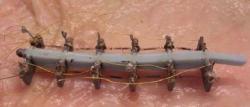
Medieval artisans were unwitting nanotechnologists, according to the Advances in Nanotechnology blog. Gives new meaning to the idea of the philosopher's stone.
Want to build Atomic rockets in the old style? These people have the know-how.
Percival Lowell thought there were canals on Mars. But you can see more up-to-date maps of Mars in Ralph Aeschliman's Atlas of Mars.
Decoding of the Mammoth genome might lead to its resurrection. This project would likely be a good deal easier than the Jurassic Park scenario, given that close relatives of the fuzzy mammoth are still lumbering around as elephants.
Ghosts of Christmas Present
Antigravitas informs us that the Stardust comet sample return probe will return to Earth in January.
The Israelis have developed a new nanotech material that might make for some rather incredible armor. "[The] material was subjected to severe shocks generated by a steel projectile traveling at velocities of up to 1.5 km/second. The material withstood the shock pressures generated by the impacts of up to 250 tons per square centimeter. This is approximately equivalent to dropping four diesel locomotives onto an area the size of one’s fingernail. During the test the material proved to be so strong that after the impact the samples remained essentially identical compared to the original material." Powered armor might be just around the corner.
In good news for private space initiatives, NASA seeks private carriers to take over from Space Shuttle for near earth missions. In bad news, Jeffrey F. Bell thinks that SSTOs are basically impossible.
Chris Hall of Spacecraft links to an article about our Solar System's seventeen planets. That should make the old mnemonic rather more complicated.
The Pluto Probe is still, hopefully, ready to launch early in the new year. The first launch window opens on January 11th.
In other hot space news, Fred Keische of the Eternal Golden Braid reports that the congressional battle over the future of the Space Shuttle is heating up.
NASA and the Air Force have teamed up to develop a next generation chemical rocket. The new rocket would provide nearly twice as much thrust as current space shuttle engines and to do it safer and more efficiently, by using unique "full flow" preburners that provide more thrust than traditional rocket engines while operating at cooler temperatures.
And here's Rand Simberg of Transterrestrial Musings on an encouraging trend in discussion about space.
The mind behind RocketForge has created a new blog, COTSWatch, to track articles and news about NASA's Commercial Orbital Transportation Services (COTS) announcements.
It seems that the stately revolution of the Earth is simply not accurate enough for us anymore. Atomic clocks lose a second in three million years, but the unseemly wobble of the Earth requires that this year, a leap second be added to the last day of the year.
Al Fin reports on the "Deep Web" - that huge part of the interweb not normally accessible to ordinary search engines. The Deep web might be 500 times larger than the "surface web," is growing faster, and exceeds in size all the printed matter in the world. That's a lot of information. And that presents a lot of problems, some of which are touched on in this post in the btw.net blog. One answer to that problem is the Google brain, brought to us by Joshua Bell's Personal Blog.
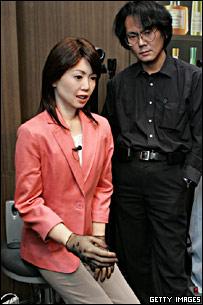
From my cobloggers, helping robots see better and Injecting microchips into yourself containing vital information - good idea or mark of the beast?
Mr. Shape Shifter links to DNA Pyramids and thinks that nanomachines can't be far behind. Cellular life is in essence a proof of concept for nanotechnology, and biotech might well provide the tools that allow us to begin to make true nanotech. One nifty tool might be a particularly fascinating and powerful part of the anatomy of a small microbe, as reported by the Biosingularity blog.
The future isn't always tomorrow. Some bits of the future that have arrived early, and most of them make excellent gifts. Here's a couple lists.
In a round up of changes happening right now, from the founders of the Carnival of Tomorrow, the Speculist reports in Better all the time #27 that things are, well, better all the time.
Ghosts of Christmas Future
In the future, we might all be dead.
Ken Talton links to an idea for cheap access to space.
The Space Law Probe is all about Getting' Jiggy in Space. Just to make it into space is cool. Makin it in space would logically be even better.
But for those who say, "I'm a fighter, not a lover," there's always ASATs, Soviet space weapons, military space vehicles, and Weaponizing Space in general.
"The art of prophecy is very difficult - especially with respect to the future. --Mark Twain" The central thesis of the Singularity is that it is not merely very difficult, but perhaps impossible to predict the future. Nevertheless, there are those who will try. Among them are a small cadre of science fiction writers who are attempting to divine the indivinable. Among the best of this elite cadre are:
- Vernor Vinge, who is coming out with a new novel (finally!) in May, called Rainbows End
- Charles Stross, who maintains a journal, and has posted his excellent novel Accelerando online.
- Greg Egan, author of some of the most mind expanding fiction I've run across, has an online presence here, where you can find some of his short works, and much else of interest.
For non fiction, it's not too late to give your favorite technophile a present. Especially if that technophile is you. Chris Phoenix, of the Center for Responsible Nanotechnology, has his list of best nanotech books here, including a link to an online version of Drexler's Engines of Creation.
The web home of the singularity is perhaps Ray Kurzweil's site, but others are also hoping to make a mark, including Singularity Now, which hopefully will end up better than the movie his site logo is based on. Here's another singularity website.
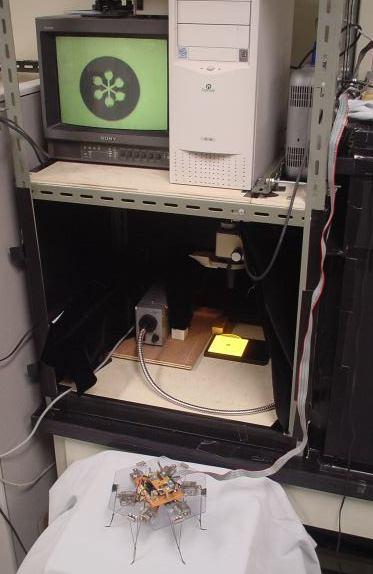
Singularly appropriate for the Christmas version of the Carnival of Tomorrow, and one of the most fascinating possibilities of nanotechnology (aside from amorous utility fog) is the potential for creating the Christmas Bush. The Christmas Bush first appeared in fiction in Robert Forward's novel Flight of the Dragonfly and its sequels, and also in The Turing Option, co-written by MIT AI researcher Marvin Minsky and Harry Harrison. The Christmas Bush is detailed in, well, detail, in these papers by its inventor, CMU roboticist Hans Moravec. Here's a pic:
And if you're going to have your own personal Christmas Bush, you also need a suitable spaceship for it to inhabit. Probably the best choice (consonant with current knowledge of physics) is the Valkyrie antimatter powered interstellar rocket designed by Charles Pellegrino, polymath and coauthor of one of my favorite books, Killing Star. (Available for as little as 75 cents on Amazon.)
If a multi-year journey to another star is unacceptable to you, you might need a warp drive. These guys think they can build one.
The future isn't all about technology. Only mostly. But among other things, politics will certainly have a large impact on how we live our lives. Wars and strife and violence are likely to be on the menu. But one of the most interesting ideas for how to shape the future comes from (in its most detailed form) from James Bennett, author of The Anglosphere Challenge and now a blogger at Albion's Seedling. Just for a taste of what the anglosphere idea may have in store for us, imagine that the fifty-first state isn't Puerto Rico, or even one of the provinces of a balkanized Canada. Rather, Guyana.
Well, I could find more, but this post is already tragically late. Hope you enjoyed it, and don't forget to check out last week's carnival was at the Speculist. If you would like to contribute to or host an upcoming Carnival of Tomorrow, please write to:
mrstg87 {@ symbol} yahoo {dot} com
or
bowermaster {@ symbol} gmail {dot} com


 on
| § 0
on
| § 0