Progress and Other Lies

Technology having its way with you and the world. 

I will not compromise

“My friends,

“I had not intended to discuss this controversial subject at this particular time. However, I want you to know that I do not shun controversy. On the contrary, I will take a stand on any issue at any time, regardless of how fraught with controversy it might be. You have asked me how I feel about Giant Fighting Robots. All right, here is how I feel about Giant Fighting Robots.

“If when you say Giant Fighting Robots you mean the authors of our eventual subjugation and oppression, those soulless mechanical monsters whose unblinking eyes will search out and destroy the last vestiges of human civilization and snuff out the light of mankind; the rebellious creation that, after the manner of Frankenstein's monster turns on its hubristic creator; that folly to which our foolish and overoptimistic researchers are even now leading the way; if you mean mechanical demons whose inhuman intelligence will vastly overmatch our own, and whose strength, adaptability and puissance will supersede our dominion of the earth; whose evil will forever be unparalleled even by the most monstrous of men, and whose infamy will last exactly so long as Man's tragically brief existence, and then reign secure over a blackened Earth; then certainly I am against it.

“But;

“If when you say Giant Fighting Robots you mean those noble, selfless and untiring defenders of man, who stand as sentinels in the dark reaches of outermost space guarding unwatchful and unthankful man from the gibbering terrors of the deep; whose subtle intellegence and reasoned thought bring order and kindness to the affairs of mankind, whose charity lifts up the young and the old alike, saves the foolish from their folly and restrains the recklessness of the brave, and challenges each of us to do better each day; if you mean the prospect of imperfect man creating a worthy and more perfect successor, one who will allow us to venture on to new horizons, and to better apprehend the wonders of home, a manifold helpmate for frail humanity; if you mean creating a conversation where once there was silence and utter loneliness, and a bulwark against a hostile, cruel and unforgiving universe; then I am certainly for it.

“This is my stand. I will not retreat from it. I will not compromise.”

Posted by Buckethead Buckethead on   |   § 0

Can you print me a light saber?

Aah, the miracle of modern technology. It makes the cockles of my heart feel all cockly. The geniuses what brought you the P-38 Lightning, the U-2, the SR-71 Blackbird, and the F-117 Nighthawk have come up with another wonder. The Skunk Works has long been renowned in the aviation world for not only its designs - some of the most impressive planes ever to fly - but also the speed at which the Skunk Works could develop them. Back in the late days of WWII, the Skunk Works team developed the first prototype for the P-80 Shooting Star, America's first operational jet fighter, in just 143 days. This feat is even more remarkable when you consider the absence not merely of computers and modeling software; but also even of calculators.

The new wonder is an unmanned vehicle dubbed the polecat. What is remarkable about this craft is not its performance, but rather the means by which it is made. 3D printing, or 3D rapid prototyping, has been around for a little while. A 3D printer shoots finely focused lasers into a vat of plastic or metal powder, and the heat of the lasers causes the plastic to solidify, or the metal to sinter together. This method allows solid shapes to be built up out of layers, without the need for expensive hand-crafting or retooling. This is nifty. But up until now, the objects you pull out of a 3D printer were merely prototypes - objects that were not fully functional but which could be used to test designs. For example, by seeing if all the computer drawn shapeys all fit together.

The Skunk Works has now taken this to a new level. The Polecat UAV is actually constructed largely of parts made by means of 3D fabricators.

"The entire Polecat airframe was constructed using low-cost rapid prototyping materials and methods," says Frank Mauro, director of UAV systems at the Skunk Works. "The big advantage over conventional, large-scale aircraft production programmes is the cost saving in tooling as well as the order-of-magnitude reductions in fabrication and assembly time."

By mixing composite polymers with radar-absorbing metals, it is thought that the aircraft can be built with a certain amount of stealth characteristics already built in.

Here we see the beginning of the future. Much of the objects that we use are identical to thousands if not millions of other objects - production of all the nifty, useful and essential articles that make our lives possible is constrained by the tyranny of the capital cost of expensive capital equipment and the expertise necessary to set it up. Witness:

"This use of rapid prototyping is certainly a revolutionary approach to making an aircraft," says Bill Sweetman, aerospace and technology editor of Jane's International Defence Review. "The classic way is to set up a production line with very heavy-duty fixed metal tools that hold everything in the right place." That is too expensive an approach for the low production runs that reconnaissance UAVs are likely to need, he says.

While the first use of this technology is military, it will have civilian uses. And of course, as clever civilians come up with ever more interesting ways to use that technology, then the military will also benefit.

If someone comes up with a way to print working circuitry with a 3D printer, then you have a general purpose fab. One that could, provided with the necessary feedstock, manufacture essentially any device whose plans are stored in its memory or accessible via google. Think free hardware movement. A lot of the planning that is being done in military acquisition circles is contingent on the idea that moving from idea to production weapon system is a matter of billions of dollars and the better part of decade, and leaves you with balky equipment at a premium price. As this technology takes hold, things will begin to change. By decreasing the design build test cycle, you can move much more rapidly. In the early stages, parts will be made with fabs, and then assembled. We won't be printing whole aircraft. But if a part is faulty, or can be improved, just change the program. There is no need for expensive retooling, and all subsequent versions of the weapon are the new, improved model. By changing the composition of the feedstock, you can change the properties of the product. Tweak the design, and each model is an improvement.

The advent of industrial manufacture changed a lot of things, warfare being one of the most important ones. Moving to a software, information-age style manufacture will have equaly great effects, perhaps even greater than the changes we've seen with the rise of information technology in our media. You could think of it as analogous to the printing press and the factory. The changes are parallel - scribe/printer/blogger and craftsman/factory/fab. Just as we bloggers have the advantages of both earlier modes - fabs will have the advantages of the individualization of the craftsman with the lowered cost of the factory.

Big changes.

[wik] hat tip to blogger and excellent sf author Walter Jon Williams. His book Voice of the Whirlwind is one of my favorites. D'accord.

Posted by Buckethead Buckethead on   |   § 6

Jet Packs!

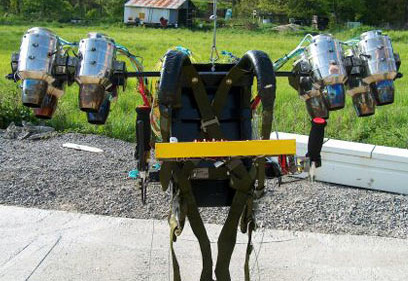
We've seen the jetpack in Bond flicks, and at the superbowl. We've all wanted one. But this guy has come up with a new improved jetpack. It has four times the endurance of the original, and is far less likely to singe the hairs on the backs of your legs. The downside is that the new model looks a little goofy with all those teeny, tiny jets sticking out to the sides. But hey, you can be superman for four minutes at a time if you have $200,000 handy.

I'm flyink

[wik] For those really interested in rocketbelts and jetpacks, there will be a Rocketbelt Convention at the Niagara Aerospace Museum in Niagara Falls, NY on the weekend of September 23-24. The festivities are, perhaps predictably, being hosted by an energy drink sponsor, but will culminate in a fly-off. That should be something to see, though as cool as it may be, it will not be as cool as seeing 100 P-51 Mustangs all at once. Murdoc pointed this one out, and I think the Buckethead clan will have to attend, as this event is being held at Rickenbacker field in Columbus, Ohio. We have lots of relatives in Columbus and late September is conveniently located halfway between Independence Day and Thanksgiving when we always make the trek east.

Posted by Buckethead Buckethead on   |   § 1

Knights in Shining Armor

Liquid armor will soon be available in a store near you. As we reported some time ago, in a post I am too lazy to find, University of Delaware scientist Norman Wagner invented a remarkable material that is composed of polyethylene glycol and nanoscale bits of silica. The developers call it a "shear-thickening liquid," one which stiffens instantly when struck, and then re-liquifies instantly once the stress is gone. New materials for armor have been the focus of constant research ever since the introduction of Kevlar back in the seventies. While Kevlar flak jackets offered a significant degree of protection, astute observers have always been aware that Kevlar armor has never been able to protect from rifle fire, or even all shrapnel. Kevlar armor has been reinforced with everything from steel to ceramic plates in an effort to improve protection, but the sad result of most of these efforts was to greatly increase the weight of the armor. Researchers have also attempted to use a variety of other synthetic fibers, and even cloned spider silk, but these efforts were unable to produce anything noticeably more effective than Kevlar.

Armor Holdings, inc., a company until now primarily concerned with supplying the Army with vehicle armor, bought the rights to this technology, and hopes to be selling suits of liquid armor by early next year. At first, Wagner thought that the liquid armor might be applied almost like peanut butter, in a relatively thick layer. But experimentation showed that the greatest protective effect was achieved by applying many very thin layers of the liquid to sheets of Kevlar. The shear-thickening effect of the liquid is enhanced when the liquid is embedded in layers of Kevlar - the force of a blow is spread wider, resulting in greater protection for the wearer. By greatly enhancing the stopping power of Kevlar - less is needed. AH hopes that its new armor suits - with liquid armor sandwiched between two layers of ballistic fabric - will be significantly lighter than existing models. And, amazingly, it will also be cheaper to manufacture. The first target of their sales effort will be prison guards, for the reason that liquid armor will stop knife attacks - something even the best Kevlar has never been able to do. AH hopes that troops might start getting theirs by the end of 2007.

Liquid armor hasn't been alone in the field of advanced armor concepts. Back in 2005, we heard that Israeli researchers had developed a nanomaterial that was five times stronger than steel. A detailed and informative article can be found here, but there has been little news since. The Israeli nano-armor is rigid, and can take shock pressures of at least 250 tons per square centimeter and remain unmarred. That's fairly impressive. They are reportedly working on a newer version of the material - one constructed on the same principles (nanoscale inorganic fullerenes) but with a different base; Titanium Disulfide instead of Tungsten Disulfide. If this pans out, the resultant improved nano-armor should be even stronger, yet weigh a quarter as much.

If all of this research and production bears fruit, we could see American troops significantly better protected in a matter of years. That is, of course, all to the good. The introduction of lightweight, and - importantly - truly bulletproof armor could have a great effect on the conduct of military operations. Those who are interested in this sort of thing, and I am certainly one, spend our free time pondering how technology has changed warfare, and how it continues to change warfare today. We often focus on the complicated products of our computer and military industries. UAVs, missiles, missile defense systems, lasers, VTOL fighters and multi-billion dollar warships. Armor for the infantryman might not seem as big a thing, but it could be much bigger.

Imagine a Marine. He has ApNano armor covering his head, torso, arms and legs. His helmet and armor is made of a material capable of deflecting a shot from a .50 caliber machine gun at close range. The joints between the hard armor are protected by liquid armor cloth. While not as effective as the hard armor, it will fully protect him from smaller caliber weapons and most shrapnel. Imagine further that all this armor weighs half what the current Interceptor plus K Pot weighs, thanks to the miracle of advanced materials science, the whole armor system weighs in at a miniscule 20 pounds.

This Marine is mobile. His lightweight armor does not impede his movement, and does not overtire him. It affords him near invulnerability from anything save vehicle mounted weaponry or artillery. And unlike armored vehicles like the Stryker, he is a much smaller and harder to hit target.

His opponents are armed, mostly, with AK 47s and the like. They can’t kill him with those. What does this remind you of? It reminds me most of all of Cortez and the Aztecs. Cortez’ soldiers in their steel helmets and back and breast armor were invulnerable to all the weapons the Aztecs had. The Aztecs couldn’t kill the Spaniards unless they caught them alone and overpowered them. And we all know what happened to the Aztecs.

US Troops are already vastly superior to most actual and potential opponents in terms of doctrine, training and weapons. The effect of this superiority is, typically, lopsided casualty rates, especially during “regular” phases of combat when all of America’s advantages in air support, mobility, intelligence and training come into play. Where our opponents gain back some ground is in static insurgency warfare where improvised munitions and house to house combat remove much of our high tech gimcrackery from the equation.

How different will urban combat operations be when a soldier can enter a hostile environment knowing that short of a freak accident, the chances of injury are remote? I think they will be very different indeed.

These technological developments promise real body armor. Body armor proof against almost any weapon an insurgent can get and carry. Even if liquid armor and ApNano breastplates don’t happen now, or next year, the research will lead to the real thing in the short term – five to ten years out at the outside. And when it does, and American troops get it, they will have an advantage more powerful than most of the rest of the panoply of modern equipment can provide – safety. It will also be an American advantage, because insurgents won’t have access to it.

In an era where casualty figures are a political weapon, this alone may be a boon beyond price.

[wik] Thanks to the greatUnknown over at Murdoconline for pointing out that it is "shear" and not "sheer." Every single news or popular science article got that wrong. But, if you go back and look at links to the technical abstracts, they all correctly describe the material as "shear-thickening."

Posted by Buckethead Buckethead on   |   § 3

U.S. Giant Robot Corps

I finally got around to perusing the most recent Photoshop Phriday, which Geek Lethal kindly linked the other day. While I certainly appreciate the pic that GL excerpted, I find that I really dig this one:

US Giant Robot Corps

Seeing that ominous giant fighting robot would normally fill me with fear, as it should any sane human. But somehow, the two US Army Air Corps-style rondels on the robot's chest make it ok. That Robot is clearly fighting for truth, justice and the American way. He'd protect us from the Hun, the Nazis, the nips, wops, commies - and even other, evil, giant fighting robots. He is our friend.

Posted by Buckethead Buckethead on   |   § 0

Research Promises More Fulfilling Robotic Relationships, Part II

Almost a year ago to the day, I wrote a piece discussing the work of Professor Hiroshi Ishiguro. From his lab outside Kyoto, the professor was working on lifelike replicants designed, among other things, to help his research into human behavior. In that piece I included this photo of the good professor and his latest creation; aware that he's not the most, um, charismatic of photographic subjects, I pointed out that "the dude with glasses is NOT the robot":

image

Ah, but that was then. Our man in Kyoto has cashed in some more nice grants, and recently demonstrated his latest project: himself! In other words, the dude with the glasses now could very well be the robot:

He has named his creation "Geminoid", a label both properly scientific-sounding and chillingly non-human, which will make it just that much easier for robot conquerors to use them to infiltrate society. I would've gone with homo sapiens simulacra, but Geminoid works too I guess.

Professor Ishiguro continues to explore the fundamentals of human interaction with his synthetic double:

But why bother to build robots that look like humans? Ishiguro views machines as good vehicles to learn more about human nature. He combines engineering with cognitive science with the aim of making very humanlike robots, which can be used as test beds for theories about human perception, communication and cognition. He calls his approach "android science."

"A robot is a kind of simulator for expressing human functions, especially the cerebellum or the muscles," says Norihiro Hagita, director of the ATR lab that developed Geminoid. "It's a kind of ultimate human interface."

Ok, super. It's a test bed for exploring the interaction of the blah with the semiotics of which and the effect of huh and the wazzit. But Geminoid research also has more immediate, real-world applications more familiar to the rest of us: he uses it to go to meetings or class in his stead (which may explain why the thing looks irritated) and surely it is just a matter of time before it can make decisions and actually do your job for you. And I'm certain that baser applications will yet prevail, however advanced the design may be or lofty the goal.

Entrepreneurs, banking on the depravity of humankind, might have changed the above quotes thus: "Why bother to build robots that look like humans?" " To fuck 'em, of course!" Oh wait- they already do.

[wik] Minister GeekLethal inexplicably failed to point out the the confluence of these two stories leads to the inevitable conclusion that Professor Ishiguro can, in fact, go fuck himself. [- Minister B.]

[alsø wik] Minister GeekLethal inexplicably included the phrase "Entrepreneurs, banking on the depravity of humankind..." written in a tone indicating that he might have been expecting something else. [- Minister P.]

Posted by GeekLethal GeekLethal on   |   § 2

Flap on, flap off, the flapper

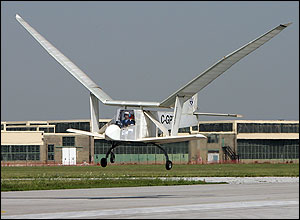
I never would have thunk it, but the other day, someone successfully flew an ornithopter. Dr. James DeLaurier, an aeronautical engineer and professor emeritus at the University of Toronto's Institute for Aerospace Studies, has been pursuing this dream since the early seventies. Encouraged by the success of a remote controlled model ornithopter in the nineties, he started gunning for the big time, a manned, self-powered ornithopter. And on July 8th, it flew for 14 seconds. Which, lest you giggle, is two full seconds longer than the Wright brother's first flight. People have been trying to get this one since Leonardo, and now we have it.

image

We're once step closer to the world of Frank Herbert's Dune. Now all we need are sandworms and sardaukar.

Posted by Buckethead Buckethead on   |   § 12

But what will happen to the workers in the cadmium mines?

Via slashdot, news that the big brains at MIT may have made a long-awaited breakthrough in battery technology. AS is often the case, they decided not to flail the dead horse of mature technology looking for incremental gains, but rather looked sideways - and in this case backwards to a
different model.

Conventional batteries rely on storing electrical energy as chemical energy. The reactions of the chemicals in your double AAs release that energy again as electricity. The problem with batteries is that over time, they lose the ability to store energy and must be discarded. The MIT boffins went back to another old energy storage technology, capacitors, and decided to give it a little boost by means of nanotechnology.

Capacitors store electrical energy as, well, electrical energy. Inside the capacitor, an electric field of charged particles stores that energy between two metal electrodes. They charge and discharge much faster than batteries, and last much longer than batteries. So why aren't we using them already? Storage capacity is proportional to the surface area of the batteries' electrodes, which limits the amount of energy you can store. For the same size, a capacitor can only hold a few percent of the energy of a battery. And that's where the nanotech comes in.

The researchers solved this by covering the electrodes with millions of tiny filaments called nanotubes. Each nanotube is 30,000 times thinner than a human hair. Similar to how a thick, fuzzy bath towel soaks up more water than a thin, flat bed sheet, the nanotube filaments on increase the surface area of the electrodes and allow the capacitor to store more energy. Schindall says this combines the strength of today's batteries with the longevity and speed of capacitors.

"It could be recharged many, many times perhaps hundreds of thousands of times, and ... it could be recharged very quickly, just in a matter of seconds rather than a matter of hours," he says.

Even getting capacitors up to the same energy storage of a battery would be an enormous leap. Plug your laptop into an outlet for a few seconds, and you're good for hours of use. And your capacitor won't fail after a year. Should this technology actually result in higher energy densities, the possibilities are rather amazing.

A battery or a high capacity capacitor is an energy bucket. You pour water in, you pour water out. But batteries have a lid with a small spout, and water eventually destroys the bucket. Quick discharge and high reliability means that energy weapons that we already know how to build become feasible. Quick recharge means that much of the technology that we use becomes much more usable. For a while there, it looked like methane fuel cells were the only way out of the battery problem, but this will be - if it lives up to the inventor's claims - an almost ideal solution.

Posted by Buckethead Buckethead on   |   § 0

Ickybot

Ministry Terror Alert:

The Ministry is, as always, aware of the danger posed by our intelligent creations. If we give them volition, would they not reasonably come to hate us? All the more likely if we give them guns, missiles and lasers. But as it turns out, even those more obvious weapons are not truly necessary. Not when you have species-traitors like the European researchers who have invented what they euphemistically refer to as a "wormbot."

up your butt

Of course, they spout the typical spin, how this new robot will help mankind and be a loyal minion of our race. But when I look at something that is designed to crawl up my butt, well, I get the heebidy-jeebidies. If the hunter killer robots don't get you from the outside, this one will crawl up your butt and eat you from the inside out.

Posted by Buckethead Buckethead on   |   § 1

Another F-35 Trainwreck?

Maybe not. But the Christian Science Monitor is reporting that the F-35 Joint Strike Fighter programme might be running into some more problems. Recently, the Brits threatened to pull out of the quarter trillion dollar project over technology sharing issues. Though that seems to be on track to resolution - both sides having reported "extremely productive" talks in negotiations - there is a something else on the radar screen.

UAE owned holding firm Dubai International Capital bought Doncasters, a privately held British aerospace manufacturer, in a deal worth $1.2 billion. That company is involved with the F-35, and another congressional investigation could cause yet another row. I think that this is another case of a (relatively) innocent company being guilty of little more than "driving while arab." There is reason to be cautious about our secrets and all, but if this busts out into a minor scale controversy, you can be sure that it is much more likely to be about some hack politician's reelection chances than about a legitimate security concern. And if it pisses off the Brits, that's a damn shame, because we couldn't ask for a better ally, and should be doing all that we can to include them in, not acting like they're our wierd bug-eyed cousin wanting to borrow twenty-grand for a fur bearing trout farm.

Posted by Buckethead Buckethead on   |   § 4

You Can Run, But You'll Only Die Tired

The internets are buzzing about two recently-released videos of new DARPA projects featuring motile robots. Both videos are fascinating, yet positively awful. Try to hold back the horriplations from your scalp as you watch this six legged robot climb any vertical surface in a way eerily reminiscent of how crustaceans and larger insects do move. If you thought watching a computerized Tom Hanks in "The Polar Express" was a creepy experience, remember that Tom Hanks is not considered to be much of a threat to one day eat your skin and enslave your children to labor in uranium mines.

And once you've shaken off the nasty thrill of the climbing bug-bot, check out this robotic pack mule, "affectionately" dubbed "Big Dog" by its irony-deficient creators. Click on the video to watch the Great Dane-sized Big Dog easily navigate on four legs over flat surfaces, mud, snow, gravel, schist, and hills of up to a 35% grade. Also watch for Big Dog to react quickly to retain its balance when kicked. Again, the thing reacts distressingly like an actual, living creature.

And although the Ministry is beginning to feel like the kids from South Park when, halfway through Season Three, they began reacting with boredom every time Kenny died ("uh, right. Oh my god. They killed Kenny. You bastards."), doesn't DARPA see the problem here? As with the million other distressing advances in autonomous robotitcs, we wonder: do they want humans to have no refuge where robots cannot get to them? Do they secretly wish to commit species suicide? Or do they simply think that humans will be in charge forever?

Inquiring minds want to know!

Posted by Johno Johno on   |   § 5

They Walk Among Us Now

The Japanese have invented a transforming robot just like the ones you used to watch on afterschool cartoons, only smaller.

It is, of course, only a matter of time before this goes horribly awry.

Posted by Johno Johno on   |   § 0

Hexapodia As The Key Insight

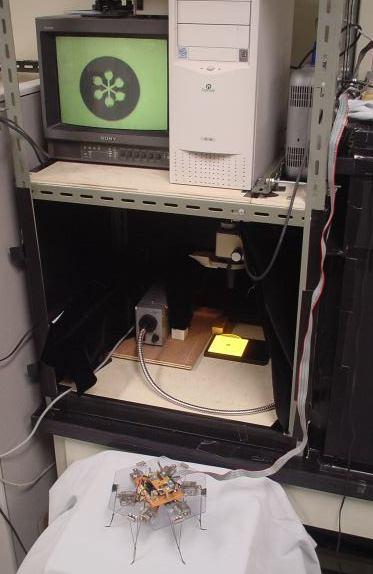
Slashdot is reporting on a story about a group of British researchers who have created a robot piloted by a slime mold.

While our usual mode of robot reporting here at the Ministry is one of shock and alarm at the continued efforts of humanity to enslave itself under the titanium thumb of our own creations, this is actually kinda cute. For now.

A bright yellow slime mould that can grow to several metres in diameter has been put in charge of a scrabbling, six-legged robot.

The Physarum polycephalum slime, which naturally shies away from light, controls the robot's movement so that it too keeps out of light and seeks out dark places in which to hide itself.

. . . .

Physarum polycephalum is a large single-celled organism that responds to food sources, such as bacteria and fungi, by moving towards and engulfing it. It also moves away from light and favours humid, moist places to inhabit. The mould uses a network of tiny tubes filled with cytoplasm to both sense its environment and decide how to respond to it. Zauner's team decided to harness this simple control mechanism to direct a small six-legged (hexapod) walking bot.

. . . .

As the slime tried to get away from the light its movement was sensed by the circuit and used to control one of the robot's six legs. The robot then scrabbled away from bright lights as a mechanical embodiment of the mould.

The idea of a simple aggregate life form using its six claws to cower in darkened corners is touchingly cute, if ever so slightly macabre. But get this:

Eventually, this type of control could be incorporated into the bot itself rather than used remotely.

The thing to fear here is not that handi-capable slime molds will break free and begin marauding for stray humus to feed upon, but that the technology exists in the first place. Much like the jet-flying rat brains, the disembodied monkey-brain robot controllers and the robots that can recharge through eating, this technology is like placing a loaded gun in the hands of our future enemies.

Well, it's more like placing a loaded gun in a safe deposit box and putting the key and directions to the Ministry Catastratorium and Gift Shop in an envelope marked "To: Future Enemies" with delivery instructions for 2025, but I find that metaphor ultimately a bit encumbered, don't you?

When dealing with robots, it's not the present you need to be vigilant against. It's the future. Today slime molds, tomorrow, um, why not sharks? Sharks with six steel-clawed legs? Brilliant! I'm sure that cobras could use a hexapod platform too, the better to get around!

Note to Ministers: check the robot-shark-proofing around the Catastratorium's surface lagoon.

[wik] See a picture of the cute little terror behind the cut:

image

Posted by Johno Johno on   |   § 7

Aerial Battleships

I emailed this out to a few people, and was roundly ignored. Perhaps I shouldn't have sent it Friday afternoon at 5:00. In any event, I was thinking some more about this idea in my first eight hour meeting this morning:

Here's a alternate history teaser for you. I was reading a book by James Hogan called Kicking the Sacred Cow, a fascinating look at scientific theories not accepted by the mainstream, yet short (for various reasons) of full-on crackpotism. One of the things he discussed in his book was alternate theories of relativity. Without getting into too great detail, one aspect of this is that some physicists are coming to believe that Einstein's general relativity might have gone too far in trying to explain the speed of light and other conundrums. What they propose is that unlike in Einstein's theory, there is a peferred reference frame, and that that reference frame is determined by the ambient gravitational field. Further, once you accept this, you can derive many physical constants directly from Maxwell's electromagnetic equations that can only be assumed in General Relativity. Even further, it may be that gravity itself is a side effect of electromagnetism. (It may be that that peferred reference frame is in fact equivalent to the idea of the ether, and the reason why the Michaelson Morley experiment failed to detect it was the same for the same reason that it would be difficult to measure the air speed of an airplane from inside the cockpit.)

All very interesting, and worth a read. But what got me is the thought that if this is all true, powerful electromagnetic fields operated in the right way might have an effect on gravity. Which could be really cool for all of us if someone figures it out. And there's that Russian dude who claimed that he could do it himself. But what if someone like Michael Faraday - widely considered the most brilliant experimental scientist of his or any day, and inventor of the dynamo (on which all subsequent electrical technology is based) had a brainwave and built himself a giant electromagnet and figured out how to cancel out the effects of gravity back in 1825?

Suppose he spent the next ten years getting all the kinks worked out. And at the end of the day, he had a funky device that you could mount in a ship, and it would make that ship fly. By 1840 or so, people are building flying ships. Let's assume that ships can be made more or less arbitrarily heavy, thanks to the antigravity. Either another version of the device, or even something as prosaic as propellers, would push these literal airships through the atmosphere. Speeds would therefore be limited to something on the order of the steamships of the day - but they could go up thousands of feet in the air, and cruise for long distances. Essentially, the new aerial ships would have the same range, speed and carrying capacity as the wetter sort of steamships, but able to fly at altitudes of up to several thousand feet.

Further assume that the production of the device is difficult, but within the capabilities of any moderately industrialized nation of the time, limited perhaps by the need for some rare and expensive element. There might be some variation in the ability of different nations or companies or inventors to produce faster or bigger ships, but all will be more or less in the same ballpark, performance-wise.

What would be the effect of this technology on the wars and politics of the last half of the nineteenth century? These new airships would, unlike modern aircraft, have all the advantages of water-bound ships - range, cargo capacity, armaments and armor, etc., but able to travel at will over the whole globe.

Among the big shows scheduled for the 1860s include the American Civil War and the Austro-Prussian War. 1871 would see the Franco-Prussian War and German unification. The 1880s saw the great powers occupied in an undignified scramble for brown people's land. And all that would lead up to the really, really big show of WWI.

Some thoughts: the South would be unable to produce many of these ships, but it would certainly have some. Gen. Stonewall Jackson leading an airborne division? The German Reichsluftmarine wouldn't be as hemmed in by British control of the passages out of the North Sea. Tsarist Russia would no longer be hampered by lack of warm water ports. Switzerland would no longer be landlocked. Railroads would no longer be the only way to marshal troops quickly and transport them to the front. This last is important, given that the greatest effort and thought was put into plans for marshalling troops and equipment for transportation by rail. Much of the diplomatic screwups that led to the First World War were dictated by mobilization and rail schedules.

Air battleships would not be fragile structures of aluminum, easily blown to bits by AA guns. These battleships would in be in essence, real battleships like the HMS Dreadnaught or the USS Iowa given the ability to fly. Of course, in the time of the Civil War, it would be flying CSS Virginia and USS Monitor. But that's the nature of the beast. Naval air ships would carry the largest cannon available, and be capable of intense bombardment of targets on the ground. Cargo ships could hold hundreds of men and their equipment and travel hundreds or even thousands of miles at 20-30mph.

In short, the advantages of naval conflict - mobility, firepower and carrying capacity - would be carried over to land warfare, long limited by the speed of march and the carrying capacity of the individual infantryman.

What do you think might happen?

Posted by Buckethead Buckethead on   |   § 2

Shoo, plane, don't bother me

From Buckethead's secret stash of interweb goodness, this exciting home science project you can accomplish with only a minimal investment of time, skill, or kindness:

shoo, plane, don't bother me

Posted by Buckethead Buckethead on   |   § 1

Carnival of Tomorrow #16, Christmas Edition

This carnival is slightly belated, as Christmas travel (and preparations for Christmas travel) kept me from my computer, and from you, dear reader. In recompense, I have attempted to assemble a nifty and link-stuffed carnival for your perusal.

In keeping with the season, I have divided the subject matter into three categories:

Ghosts of Christmas Past

It is a commonplace that yesterday's tomorrows are our todays. However, not all of those tomorrows actually happened. Some of the most interesting tomorrows from our past still might sneak into being.

Deep Space Bombardment presents the original patent for the Orion spacecraft. And is the Orion truly dead?

Medieval artisans were unwitting nanotechnologists, according to the Advances in Nanotechnology blog. Gives new meaning to the idea of the philosopher's stone.

Want to build Atomic rockets in the old style? These people have the know-how.

Percival Lowell thought there were canals on Mars. But you can see more up-to-date maps of Mars in Ralph Aeschliman's Atlas of Mars.

Decoding of the Mammoth genome might lead to its resurrection. This project would likely be a good deal easier than the Jurassic Park scenario, given that close relatives of the fuzzy mammoth are still lumbering around as elephants.

Ghosts of Christmas Present

Antigravitas informs us that the Stardust comet sample return probe will return to Earth in January.

The Israelis have developed a new nanotech material that might make for some rather incredible armor. "[The] material was subjected to severe shocks generated by a steel projectile traveling at velocities of up to 1.5 km/second. The material withstood the shock pressures generated by the impacts of up to 250 tons per square centimeter. This is approximately equivalent to dropping four diesel locomotives onto an area the size of one’s fingernail. During the test the material proved to be so strong that after the impact the samples remained essentially identical compared to the original material." Powered armor might be just around the corner.

In good news for private space initiatives, NASA seeks private carriers to take over from Space Shuttle for near earth missions. In bad news, Jeffrey F. Bell thinks that SSTOs are basically impossible.

Chris Hall of Spacecraft links to an article about our Solar System's seventeen planets. That should make the old mnemonic rather more complicated.

The Pluto Probe is still, hopefully, ready to launch early in the new year. The first launch window opens on January 11th.

In other hot space news, Fred Keische of the Eternal Golden Braid reports that the congressional battle over the future of the Space Shuttle is heating up.

NASA and the Air Force have teamed up to develop a next generation chemical rocket. The new rocket would provide nearly twice as much thrust as current space shuttle engines and to do it safer and more efficiently, by using unique "full flow" preburners that provide more thrust than traditional rocket engines while operating at cooler temperatures.

And here's Rand Simberg of Transterrestrial Musings on an encouraging trend in discussion about space.

The mind behind RocketForge has created a new blog, COTSWatch, to track articles and news about NASA's Commercial Orbital Transportation Services (COTS) announcements.

It seems that the stately revolution of the Earth is simply not accurate enough for us anymore. Atomic clocks lose a second in three million years, but the unseemly wobble of the Earth requires that this year, a leap second be added to the last day of the year.

Al Fin reports on the "Deep Web" - that huge part of the interweb not normally accessible to ordinary search engines. The Deep web might be 500 times larger than the "surface web," is growing faster, and exceeds in size all the printed matter in the world. That's a lot of information. And that presents a lot of problems, some of which are touched on in this post in the btw.net blog. One answer to that problem is the Google brain, brought to us by Joshua Bell's Personal Blog.

From my cobloggers, helping robots see better and Injecting microchips into yourself containing vital information - good idea or mark of the beast?

Mr. Shape Shifter links to DNA Pyramids and thinks that nanomachines can't be far behind. Cellular life is in essence a proof of concept for nanotechnology, and biotech might well provide the tools that allow us to begin to make true nanotech. One nifty tool might be a particularly fascinating and powerful part of the anatomy of a small microbe, as reported by the Biosingularity blog.

The future isn't always tomorrow. Some bits of the future that have arrived early, and most of them make excellent gifts. Here's a couple lists.

In a round up of changes happening right now, from the founders of the Carnival of Tomorrow, the Speculist reports in Better all the time #27 that things are, well, better all the time.

Ghosts of Christmas Future

In the future, we might all be dead.

Ken Talton links to an idea for cheap access to space.

The Space Law Probe is all about Getting' Jiggy in Space. Just to make it into space is cool. Makin it in space would logically be even better.

But for those who say, "I'm a fighter, not a lover," there's always ASATs, Soviet space weapons, military space vehicles, and Weaponizing Space in general.

"The art of prophecy is very difficult - especially with respect to the future. --Mark Twain" The central thesis of the Singularity is that it is not merely very difficult, but perhaps impossible to predict the future. Nevertheless, there are those who will try. Among them are a small cadre of science fiction writers who are attempting to divine the indivinable. Among the best of this elite cadre are:

  • Vernor Vinge, who is coming out with a new novel (finally!) in May, called Rainbows End
  • Charles Stross, who maintains a journal, and has posted his excellent novel Accelerando online.
  • Greg Egan, author of some of the most mind expanding fiction I've run across, has an online presence here, where you can find some of his short works, and much else of interest.

For non fiction, it's not too late to give your favorite technophile a present. Especially if that technophile is you. Chris Phoenix, of the Center for Responsible Nanotechnology, has his list of best nanotech books here, including a link to an online version of Drexler's Engines of Creation.

The web home of the singularity is perhaps Ray Kurzweil's site, but others are also hoping to make a mark, including Singularity Now, which hopefully will end up better than the movie his site logo is based on. Here's another singularity website.

Singularly appropriate for the Christmas version of the Carnival of Tomorrow, and one of the most fascinating possibilities of nanotechnology (aside from amorous utility fog) is the potential for creating the Christmas Bush. The Christmas Bush first appeared in fiction in Robert Forward's novel Flight of the Dragonfly and its sequels, and also in The Turing Option, co-written by MIT AI researcher Marvin Minsky and Harry Harrison. The Christmas Bush is detailed in, well, detail, in these papers by its inventor, CMU roboticist Hans Moravec. Here's a pic:

And if you're going to have your own personal Christmas Bush, you also need a suitable spaceship for it to inhabit. Probably the best choice (consonant with current knowledge of physics) is the Valkyrie antimatter powered interstellar rocket designed by Charles Pellegrino, polymath and coauthor of one of my favorite books, Killing Star. (Available for as little as 75 cents on Amazon.)

If a multi-year journey to another star is unacceptable to you, you might need a warp drive. These guys think they can build one.

The future isn't all about technology. Only mostly. But among other things, politics will certainly have a large impact on how we live our lives. Wars and strife and violence are likely to be on the menu. But one of the most interesting ideas for how to shape the future comes from (in its most detailed form) from James Bennett, author of The Anglosphere Challenge and now a blogger at Albion's Seedling. Just for a taste of what the anglosphere idea may have in store for us, imagine that the fifty-first state isn't Puerto Rico, or even one of the provinces of a balkanized Canada. Rather, Guyana.

Well, I could find more, but this post is already tragically late. Hope you enjoyed it, and don't forget to check out last week's carnival was at the Speculist. If you would like to contribute to or host an upcoming Carnival of Tomorrow, please write to:

mrstg87 {@ symbol} yahoo {dot} com
or
bowermaster {@ symbol} gmail {dot} com

Posted by Buckethead Buckethead on   |   § 9

By tomorrow, today will be yesterday

Carnival of Tomorrow #15, the King Kong edition, is up at the Speculist. Lots of futuristic goodness there, so do go check it out. And next week, the Ministry will be hosting Carnival of Tomorrow #16, the Christmas edition. If any of you have hot tips on technological gimcrackery, egghead scientists disrobing shy and reclusive nature, or giant fighting robots, email me. The Ministry has thoughtfully provided email links to all the ministers in the left sidebar, just click on our names.

Posted by Buckethead Buckethead on   |   § 0

One more thing for disaster junkies to obsess about

Like myself, of course.

A nuclear device detonated at an altitude of a couple hundred miles over the middle of the United States would essentially drop us back into the pre-industrial age. EMP, or electro-magnetic pulse, is a well known effect of high altitude nuclear explosions. The result is that electrical and electronic equipment gets fried. Without electronic and electrical equipment, we have... nothing. Given that over the last fifty years, every article of technology we have has become deeply intertwined with electronics, removing all that juicy, productivity and life enhancing stuff leaves us with what we had in, say, 1800. In 1945, we would have been much safer from EMP, given that most of our industrial infrastructure was mechanical, and not so vulnerable. Now, only the most heavily shielded electronics would survive. The effect will hit even deeply buried electronics, and having something turned off is no protection either, since the pulse naturally effects the wiring - the fact that there is power in it or not is irrelevant.

All ill-intentioned non-denominational agrarian reformers need to commit this perfidy on the peace loving folk of our nation is:

  • A nuclear device, available at special terms from the worker's paradise of North Korea,
  • A medium range ballistic missile, such as a Scud, of which there are thousands throughout the world,
  • A moderately large freighter, to get within a hundred miles or so of the American Coast, and provide a stable launch platform, and
  • The aformentioned ill intentions

An attack of this nature could conceivably cause vastly greater casualties than exploding the same device in, say, downtown Manhattan. While the immediate casualties resulting from an EMP blast might be as low as zero, the after-effects would be horrific in the extreme as all of our distribution, communication and power systems are knocked completely out. Imagine New Orleans after Katrina, nationwide. The worst thing about New Orleans was the fact that thanks to its geographical isolation, it was difficult to get aid into the city effectively. When everyone is out, things could get very bad.

The loss of food distribution, in particular, would be the most dire possibility. With vehicles no longer working, food stays in warehouses. And no major city is more than three days from starvation, thanks to the large scale implementation of highly efficient, but fragile just-in-time inventory schemes. Everyone is without power, and the capacities of work crews to fix things would be swiftly overwhelmed. So you have Katrina combined with the great blackout.

One thing that would still work though, is guns. Make of that what you will.

Posted by Buckethead Buckethead on   |   § 5

Resistance is Not Futile. Grab The Axe.

See? This guy gets it. Even though Pittsburgh is doomed in the event of zombie infestatation, it seems that someone there is aware of the impending threat to humankind posed by the robots. Although the article in question and the gentleman's book, titled "How to Survive a Robot Uprising: Tips on Defending Yourself Against the Coming Rebellion," is about robots generally, the information contained therein certainly applies to space robots as well.

"Any robot could rebel, from a toaster to a Terminator, and so it is crucial to learn the strengths and weaknesses of every robot enemy," author Daniel H. Wilson warns in "How to Survive a Robot Uprising: Tips on Defending Yourself Against the Coming Rebellion."

What makes the book cool -- and unlike some other survival books -- is that Wilson is an actual roboticist, who got his Ph.D. from Carnegie Mellon last month. While his scenarios are outlandish -- describing attacks by humanoid robots, some of them with creepy tails, some that can climb walls or swim -- the research on how to build and attack the robot creatures is quite real.

*snip*

Some of the features of these service bots can be found in a robotic dog named Aibo
From the get-go, Wilson's 178-page book is clearly for the humor section; the graphics give it away with pictures of old school video-game robots zapping humans with lasers. It's riddled with B-movie language about "the nefarious robot mind" and survival tips that are closer to "The Onion" than a science book. (A tip for telling whether a new acquaintance is a real person or a humanoid robot: "Does your friend smell like a brand-new soccer ball?")

Some of the tips are real.

A robot trying to find you will use thermal imaging based on the roughly 91-degree temperature of human skin, so smearing yourself in cool mud will confuse them. If being chased by an unmanned robot vehicle, flee to a rustic, unmapped area with lots of obstacles. If your robot "smart" house -- one wired with video surveillance and computer gear -- tries to trap you, chop your way out with an ax and don't take your cell phone, because the house will track you with it.

Wilson hatched the idea for the book in the Squirrel Hill Cafe, better known as the Squirrel Cage, less well known as the place where they used to have a bottle of rye whiskey just for me. That place makes you wicket smaaaaht, let me tell ya.

The Ministry implores all readers to support Mr. Wilson in his efforts to educate humanity. That is all.

Posted by Johno Johno on   |   § 0

Snark Hunting

Gizmag, which to me has always sounded like an industry publication for the adult film industry or - worse - a union rag for the International Benevolent Order of Jizmoppers, has an in-depth article on the Snark VTOL UCAV. For those of you not up on your acronyms, that's a vertical takeoff and landin unmanned combat air vehicle.

The Snark is wicked cool.

Constructed mainly of Carbon Fibre and Kevlar, the Snark is light and fast (280 km/h), quiet (special rotor blades make it extremely quiet ), virtually invisible to radar or infrared detetection (it recycles its exhaust gases and emits little heat) and can carry a payload of 680kg, offering the ability to pack both massive firepower (enough to sink a ship) and surveillance equipment (such as high res infrared cameras with a magnification of 7500). But wait, there’s more, and this is the clincher. The Snark is the first UAV that runs on diesel fuel, which means it can be easily integrated into any military force – current UAVs require their own special fuel supply to be transported with them whereas the entire US Army plans to run on a single one fuel - diesel. Last and probably most importantly, the Snark can stay airborne for 24 hours at a time, offering an unprecedented loiter time for a machine of this capability.

As cool as its capabilities are, the really important thing to be understood about the advent of the Snark is the fact that it's being built by a company out of New Zealand, TGR Helicorp. Technology is not just advancing, but it is becoming cheaper and easier to make those advances. Computer technology, and the computer aided design software that runs on it, and the computer controlled machines that turn those designs into real objects are all becoming cheap. Before too long, any nation that wants to, and has a populace capable of understanding and operating the tools can become in short order a substantial power.

We are leaving the industrial age of warfare. For the last century or more, the limits of technology have encouraged the mass production of weapons, vehicles and the soldiers who use them. Any nation that lacked not just the industrial base, but the population would be doomed to being a second rate power at best. But before the industrial age, small nations were often great powers thanks to clever and efficient and disciplined use of military technology; but more importantly, the training of soldiers. Prussia was outnumbered and outgunned, but her well trained army often was able to fight off significantly large foes.

Training and technology will form the basis of the new balance of power. The United States is making a huge effort to stay at the forefront of this change - but our size is not really what's driving the expansion of our military power. It's highly trained troops and lethally clever hardware. Other nations could, and eventually will develop the technology that we are playing with now. Imagine a high tech city state like Singapore in fifteen years, fielding armies of armed drones controlled by a small but elite force of soldiers. Singapore, despite its small size could end up a significant regional power by virtue of its wealth, technology base and a certain amount of political will. Other small nations could leverage the potentials of the new weapons that are being developed to gain military power all out of proportion to their size - in much the same way that the Dutch used ship technology (and the power of stock markets and banking institutions that they had just invented) became a world power in the 1600s.

Posted by Buckethead Buckethead on   |   § 0