Highbrowish

Entertainment, music, the finer things in life; and their opposites.

Well hello, Mister Fancypants!

The top 100 movie quotes of all time (according to the AFI) have been released.

The top dozen:

  1. "Frankly, my dear, I don't give a damn," "Gone With the Wind," 1939.
  2. "I'm going to make him an offer he can't refuse," "The Godfather," 1972.
  3. "You don't understand! I coulda had class. I coulda been a contender. I could've been somebody, instead of a bum, which is what I am," "On the Waterfront," 1954.
  4. "Toto, I've got a feeling we're not in Kansas anymore," "The Wizard of Oz," 1939.
  5. "Here's looking at you, kid," "Casablanca," 1942.
  6. "Go ahead, make my day," "Sudden Impact," 1983.
  7. "All right, Mr. DeMille, I'm ready for my close-up," "Sunset Blvd.," 1950.
  8. "May the Force be with you," "Star Wars," 1977.
  9. "Fasten your seatbelts. It's going to be a bumpy night," "All About Eve," 1950.
  10. "You talking to me?" "Taxi Driver," 1976.
  11. "What we've got here is failure to communicate," "Cool Hand Luke," 1967.
  12. "I love the smell of napalm in the morning," "Apocalypse Now," 1979.

I can't believe that the ending line from Casablanca doesn't make it higher than 20. Travesty! Also, they should have included the whole quote from Apocalypse Now! - "It smells like... Victory."

Although I am partially appeased by the inclusion of #77. "Soylent Green is people!"; my biggest problem... no Ash quotes.

Insensitive. Bastards.

Posted by Buckethead Buckethead on   |   § 1

Rockabilly Pose

You can be sure of one thing in this life: album projects involving Jon Spencer (late of the Jon Spencer Blues Explosion and the Jon Spencer Folk Implosion) are either going to rock hard or suck mightily. Part of the problem is that Spencer frequently comes off as a smarmy con man, perpetrating a giant put-on on anybody dumb enough to actually enjoy the deeply unserious dreck he's putting down. (For what it's worth, I happen to feel the same way about Bob Dylan these last few years, so discerning music fans may assign my opinions whatever worth they deem fit.)

However, if he’s a con man, he’s frequently a good one, as several Blues Explosion records and his collaboration with actual bluesman R.L. Burnside, A Ass Pocket of Whiskey demonstrate.

It also appears that working with others reigns in Spencer's worse tendencies. A Ass Pocket worked in part because Spencer's noisy non-blues approach meshed well with Burnside’s down-and-dirty Mississippi sound.

The same goes for Spencer's new project, Heavy Trash, whose eponymous debut is now out on Yep-Roc. Spencer has teamed with guitarist/bassist Matt Verta-Ray, formerly of the great 90s also-rans Madder Rose and now of Speedball Baby to produce – get this - an album of wild, woolly, and completely (in)sincere rockabilly.

Since rockabilly has always been a genre custom-made for put-ons, characters, and spastic craziness, Spencer's hiccupping vocals and manic guitar work come off not as schick but as loving nods to classic rockabilly weirdos like The Collins Kids and Shorty Ashford, not to mention the masters of cartoony psychobilly, The Cramps. Neither as slick as the Stray Cats nor as trashy as The Cramps, Heavy Trash might be the best thing Spencer has been involved in since the mid-1990s.

Good rockabilly, like good blues, relies more on personality than on talent or training. The ability to play helps, but any shortcomings can be over come through simple force of character. The ability to play simple music with great conviction is therefore crucial to both genres. And despite Spencer's and Verta-Ray's backgrounds as ironic hipsters producing noisy indie music and precious power pop respectively, the best songs on Heavy Trash can take their place in the rockabilly canon.

Chock-full of spanky guitar and slap bass, Heavy Trash offers wild rave-ups and cool, angular workouts in the finest Sun Records style. Highlights include the raucous "The Hump," "Justine Alright," “The Loveless” and the album opener "Dark-Hair'd Rider." Although thirteen songs is perhaps one too many for a rockabilly revival album, Heavy Trash generally adds up to an honest-to-God chopped and channeled hot roddin’ good time.

The only songs that even approach the “suck mightily” standard are "Mr. K.I.A.," which features some out-of-place turntable scratching, and "Gatorade," which suffers from sophomoric lyrics and uncharacteristically tepid playing. Still, two duds out of thirteen is a spectacular ratio for a Spencer project. Overall, Heavy Trash is righteous fun.

(This post also appears at blogcritics.org.)

Posted by Johno Johno on   |   § 3

Drunkenblöggen

As my neurons marinate in a vicious combination of a nice Côte du Rhone and potato vodka and limeade (organic!), I am stirred to ask a couple questions and state a couple actualities.

1) What do you call people from Massachusetts? There’s Vermonters, Connecticutian, Virginian, Floridian, Texan, Ohioan. But having gone native up here in the Bay State and being an avid amateur lexicographer besides, I am stumped as to the noun for “resident of Massachusetts.” Yes, yes, I know. Masshole. Very funny. But as devastatingly apt as “Masshole” may be, what do you say in polite company? “Bay Stater” is irritatingly glib, and “Yankee,” though sometimes used by other residents of New England to refer to us when they don’t want to be rude, has at least three other specific meanings. I hereby nominate as the official term for “resident of Massachusetts” as “Massachutsan.” Because I’m sick and tired of hearing “Masshole.”

2) Can any of my readers suggest a good to excellent barbecue restaurant in or around Savannah, GA? I’ll be going there late next week for a weeklong meeting of the North American Anti-Temperance League, of which I am a founding member, president, and chief yazoo. A boy’s got to eat, and when I’m in the south I prefer to eat nice slowcooked pork, preferably doused with judicious amounts of vinegar-based sauce. I expect I just opened a big can of whoop-ass with that last statement, so I will clarify. Barbecue is pork. Barbecue is pork with a vinegar sauce, though such sauce may be adulterated with tomato, molasses, mustard, or other spices if desired. Some pepper heat is preferred. Beef, though delicious made barbecue-style (especially brisket and ribs), is not in and of itself, “barbecue.” This assertion does not apply in Texas or Kansas City. I don’t want to be killed and slow-cooked over hickory by my esteemed coblogger and transplant Texan, Patton.

3) But I digress. The North American Anti-Temperance League is doing important work in the fields of lightening up and unclenching, but our budget is not limitless. Readers wishing to join the League – or offer us donations – may contact me at johno at perfidy dot org. We are always searching for a few good sots, and maybe you have what it takes.

4) I hereby declare my bass-player name (for I am in fact a bass player of immense funkitude) to be Chocolate Thunder.

Posted by Johno Johno on   |   § 0

Thor! Thor! Thor!

Let's face it. Metal is dumb. Metal has always been dumb. And hopefully, metal will always be dumb. (I could, however, do without the "Metallica bleating 12-step recovery program slogans over a tin drum" kind of dumb. Because that's just not metal.) And why fight the dumb? Metal is loud; it's obvious; it's incurably theatrical. Dumb is the way of metal, and the dumber the better. Leather! Flames! Swords! Warriors! Skulls! Hot chicks and motorbikes! Hell, yeah!

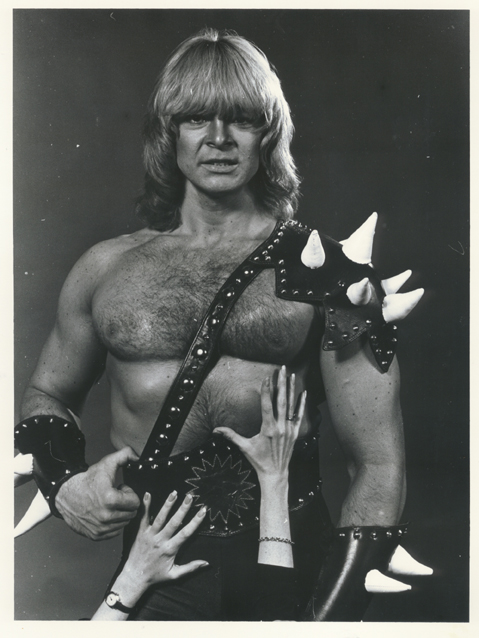
John Mikl Thor (his real name) was at one time a winner of the Mr. Canada and Mr. USA pageants, a champion bodybuilder with a taste for training to heavy rock. Back in the '70s, when it was still (relatively) cool to wear studded leather collars and sing about the hammer of the gods, Thor stole a page from Alice Cooper and KISS and took his act on the road as Thor The Rock God, blending metal with Norse mythology and epic stage shows (he claims to have been an influence on GWAR and Manowar). Starting in the late '70s, he toured the globe doing mock battle with evil warlords, brandishing sword and shield, and perform feats of strength such as bending steel bars, smashing bricks against his chest, and blowing up hot water bottles until they burst. He has been known to ride onstage in Charlton Heston's chariot from Ben-Hur.

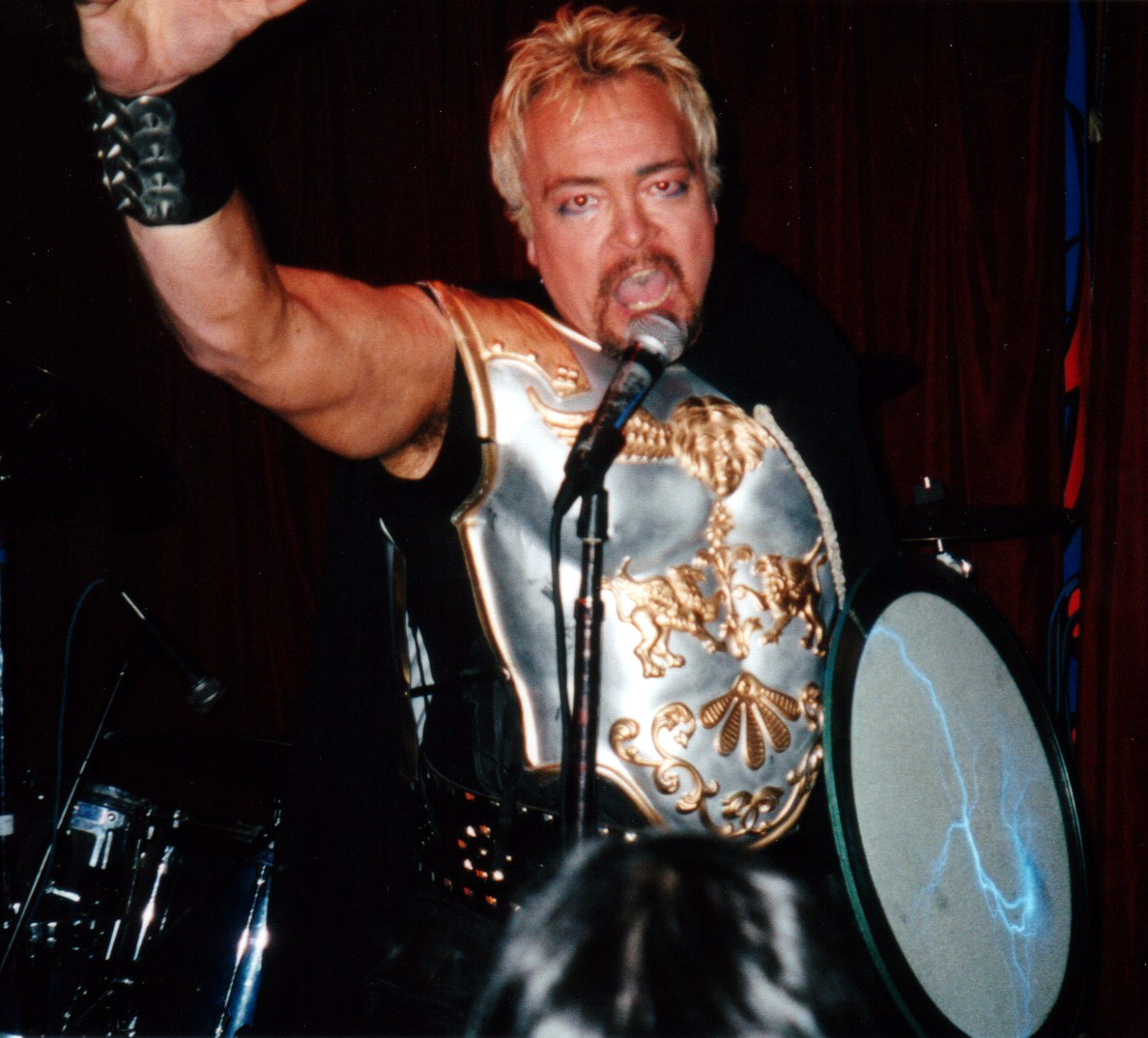
And even though the world has moved on and metal has turned to rap and weepy teen diary excerpts for new inspiration, Thor is still making music. His new album, Thor Against The World is out next month on Smog Veil Records.

So what does the rock god’s new album sound like? Well, it's goofy, it's bombastic, and it's as satisfying to the primitive part of my lizard-brain where the metal receptors are located as anything I've ever heard. Thor Against The World rocks in the finest tradition of AC/DC, Alice Cooper, KISS, WASP, Judas Priest, and all the other great deep-shag acts of the golden age of hard rock. Is it an instant classic? No. But it is one hell of a lot of fun.

Being that Thor seems bent on partying like it's 1979, the album is rife with classic drum sounds, shouted choruses ("Creature! Feature! I wanna meetcha! Meetcha!") heroic guitar solos, and the occasional soaring synth (on "Megaton Man"). The lyrical content mainly dwells on tough love, universal battles, and the glory and power of Thor. As it turns out, all those years of bodybuilding and bursting hot water bottles have given Thor quite a set of pipes. While he's no Ronnie James Dio, he sings the hell out of his eleven sword-sorcery-and-sex tales in a leathery baritone in the finest tradition of the Alice Cooper/Paul Stanley school of bombastic frontmen. And really… how can one not like a record that features a legion of warriors shouting "Thor! Thor! Thor!" and includes songs called "Creature Feature," "Easy Woman," "Serpents Kiss" and "The Coming of Thor?" The cherry on top is a surprisingly affecting ballad ("Turn To Blue") in the finest SWOBHM* tradition.

Thor has dedicated himself to stoking the flame of that primal, stooped, over-the-top school of rock that went out about the time Gene Simmons took off his makeup. If you long for the days of Trans Ams, pop-top beer, and WASP, KISS, and Alice Cooper, there is no possible way to do better than Thor Against The World. As long as you have a taste for the dumb side of metal (and what red-blooded American doesn't?), I can't recommend this highly enough.

*(That's "Second Wave of British Heavy Metal." Geek.)

www.thorcentral.com

image
Thor circa 1979

image
Thor circa 2003

Posted by Johno Johno on   |   § 1

Why make a soundtrack when it's the same old stuff anyway?

Something's been on my mind lately and, lacking any other material to post, might as well throw it out to both our readers:

What is the most over-used music in film?

I'm thinking specifics here, not the every-time-something-happens-in-Australia-cue-the-didgeridoo type of observation, or the swelling-string-section-in-each-cloying-love-scene type.

For my money, it would have to be everything from The Nutcracker, with second place split between James Brown's Papa's Got a Brand New Bag and I Got You.

Posted by GeekLethal GeekLethal on   |   § 3

For your eyes, but only if you can find it

While I'm on the subject of writers, writing, and reading, the Guardian has interviewed Umberto Eco about his new book as well as the difference between Foucault's Pendulum and The Da Vinci Code (other than the obvious gulfs of quality, erudition, and depth) and whether he is the Italian Salman Rushdie. Thanks to the squishy lefties at bookslut.

Posted by Johno Johno on   |   § 4

For your eyes only

The NY Times has an article about the new vogue for audiobooks, at least among denizens of greater New York City. I shouldn't be so glib: it is true that as the number of Americans who read books regularly declines, the number who listen to them has been rising.

The Times takes note of the discussion simmering between authors and "readers" (for what else can we call people who regularly listen to the printed word in leiu of reading it but "readers," any note of condescention detected being not entirely accidental?) as to what types of books are most appropriate for listening, and what kind of prose works best (they note that D.H. Lawrence makes for particularly dull listening). People listen to books while commuting, while exercising, and while walking the dog, though one user testifies that short stories work best for dog-walking since there's less to miss - a spectacularly stupid thing to say. A good short story packs an entire universe into five hundred words, meaning that if you look up to pull your dog off the mailman's leg, you've arguably missed more than if Dean Koontz were squirting his gore-soaked hackery straight into your ear. But I digress.

Although I have enjoyed a book on tape (namely Krakatoa: The Day the World Exploded, August 27, 1883 by Simon Winchester, read by the author), I just don't know if reading aloud is always the best way to absorb a book. In high school my advanced English class read aloud each day, and it quickly became apparent which authors were bearable aloud and which were not. Hemingway: yes. Tolstoy: not so much.

I think the main concern is that many writers don't write with auditory concerns in mind. That is, some authors write to be heard, and some authors write to be read. The latter write so that readers can roll the succession of words around their mind, savoring the singular texture and shape of each phrase with little regard for how difficult it might be to say. Take the foregoing sentence: if I were writing that to read out loud, I would never have used "savoring the singular texture," which sounds a little fey and precious but feels in the mind-- to me at least-- pleasingly crinkly. I tend to craft sentences so they have rhythm, a flow of tension and release on which I can hang the exact words I need to use. Unfortunately, that means out loud I read like a moron. It's that way for many authors. I could listen to Donald Hall's poetry all day long but I think I'd rather sit down with Pynchon, thank you very much. Unlike me, both Hall and Pynchon are major contemporary writers, but only one of them works aloud.

Many readers mentally sound out what their eye scans as they read it. Personally, I'm one of those readers and I write for them. It's much easier to think how "coruscating" sounds than to actually stumble over it with your tongue, and if I want that ocean to be "coruscating" rather than "glinting" "glimmering" "shimmering" or "shining," then that is what I will write. And when the book on tape comes out, that coruscating ocean will sound positively idiotic. Writing for reading aloud requires exactly the same attention to precise shading that writing for reading quietly does, but the rules are different and largely incompatible. A speechwriter isn't necessarily a novelist. I'm not going to denigrate people for absorbing books by whatever means they can, but I am going to stand athwart history with a dictionary and a reading lamp, shouting "shut up!!"

Posted by Johno Johno on   |   § 1

Five Books I Am Embarrassed Not To Have Read

What books are you embarrassed to not have read? That meme has been circulating the blogosphere in recent weeks, and I've finally succumbed. I'm happy to say that I have, by dint of a intergalatically awesome high school English teacher and dogged personal application, managed to read a whole bunch of books that I can be proud of. But not all of them. That's going to take a lifetime. By the same token, I have spent long stretches of my life obsessively reading science fiction, fantasy, or history (which it amuses me to mention next to each other here, as though they were equivalent genres (which perhaps they are...)) and have accordingly had some potentially very bragworthy reading time crowded out by Piers Anthony.

Please note that I am counting as "read" books that I started, got plenty of the gist of, and read the importants sections and skimmed the rest. In this way I can say I have "read" The Federalist Papers, Democracy in America and The Bible. Sure, I haven't abosorbed every word, but I know that Joshua Judges Ruth and that industry is important to Amurricans. And stuff like that.

F. Scott Fitzgerald: The Great Gatsby. To be honest, this is one I'm not sure I'm ever going to get to. I didn't read The Catcher in the Rye until last year, either. Since both that and Gatsby are reputedly best consumed as a teen, my enthusiasm for them has ebbed. Nobody can seem to tell me what I would be getting out of this one anyway. Nevertheless, the uniform reaction elicited in people by my admission that I have not read this Great Classic is one of disbelieving wonder and pity, as if I told them I was a 30 year old virgin.

John Locke: Second Treatise. Apart from excerpts and explications, I have not read any Locke. Considering that my last act as an historian was to write an intellectual history of the debate over women, suffrage, and citizenship before 1850 which relied heavily on Locke (since my sources themselves did), this omission can be viewed as an act of breathtaking academic dishonesty. Someone call David Horowitz!! See remarks above in re: history, fantasy, and science fiction. I have also not read my Hume or Hobbes, but I have read Mill as well as Paine and various Revolutionary-era works on the social compact, so I guess I feel okay about this. No; thats' wrong. Guilt all over.

Dante: Inferno. I actually have read excerpts of this one, but I have to put it in this list because nothing stuck. Worse than that, Inferno is practically required reading if you wish to understand half the literary references in the great classics of the 17th and 18th centuries. In fact, I'll make this entry a trifecta and toss in Plato and Socrates as well. Read a little; learned less. Just as I am reduced to cat-and-tennis-ball staring when Buckethead and GeekLethal trade barbs about whether Operation Barbarossa would have worked better had Company Ziggledezee employed a Gabba Gabba strategy and feinted toward St. Yabbahey (since my knowledge of military history is shallow in all respects), thus it goes when trying to keep up with Adams or Madison- or even Paine- in full smackdown mode. Ditto Pilgrim's Progress, which was seemingly handed out free in cereal boxes to early American thinkers. The difference being, of course, that I have not guilt whatsoever over not reading Bunyan.

James Joyce: Ulysses. I know, I know. Nobody reads this. But people do. And if I can get through Gravity's Rainbow and The Name of the Rose, why in hell does the first page of Ulysses fill me with dark foreboding of tedium to come?

Herman Melville: Moby-Dick. You have to understand where I live and the people I know. I live north of Boston and socialize with historians, librarians, and archivists most of whose work revolves in some way around New England's past. They tend to talk about Nathanael Hawthorne as though he was still alive (or recently deceased) and can tell you more about Herman Melville's tortured love life than about Desperate Housewives. So, though I have read enough Hawthorne to stay afloat in pleasant conversation, I have only read Melville in a terribly abridged children's edition that does't quite cut it. Sure, I can yammer on and on about the loving detail brought to the interclary chapters on whaling (and even spin theories on structural homages to Moby-Dick contained in Steinbeck's The Grapes of Wrath), but at the end of the day I know that such pleasant party exaggeration is really empty posturing. I really should just bite the bullet and waste six weeks wading in ambergris and purple prose.

(Thanks to Hei Lun of Begging to Differ for finally putting me over the edge.)

Posted by Johno Johno on   |   § 12

George Lucas' evil twin skippy is Orson Welles

I haven't read Lileks for a while. Months really. Not because of anything he wrote, or didn't write, but simply because I was locked in the solipsistic confines of unemployment and seasonal affective disorder. And going to the park with my son. I tune in for the first time (in months) and what do I find? Exactly what I expected.

I’m still impressed by the movie’s look, the sound, the costumes, the level of ingenuity demonstrated by every frame of the movie in which the insipid words or insubstantial characters do not ruin. If it came from Lucas, it’s krep. It’s like the reverse of Orson Welles – the intellect at the center of the enterprise is bereft of novel ideas, but is kept afloat by indulgent studio support and willing talent. The dialogue in AOTC isn’t completely unlistenable – better Lucas should write exposition dialogue than anything emotional, or you get love scenes in which characters say “I hate sand. It’s dry and gritty. I much prefer your vagina.” Or whatever “Anny” said. But even in the exposition scenes Lucas has an ear made not of tin but some metal alloy created specifically for its inability to channel sound; hence he has his big bad guy announcing not just the creation of an Army, not just an Army of the Republic, but a Grand Army of the Republic. So the Empire is the North, marching to put down the rebellious breakaway South. I’m supposed to root for the slavery side. Noted.

Is there any living screenwriter who’s worse at naming people and places? Naboo, for God’s sake.

Posted by Buckethead Buckethead on   |   § 1

Media Bias: it's not a bug, it's a feature

Virginia Postrel, writing in the New York Times, makes an interesting argument:

Some people say they want "just the facts," and fault reporters for introducing too much analysis. Others complain that stories do just the opposite, treating all sides in a conflict as equally valid. The news-buying public seems to want contradictory things.

But one person's contradiction is another's market niche. Those differences help answer an economic puzzle: if bias is a product flaw, why does it not behave like auto repair rates, declining under competitive pressure?

In a recent paper, "The Market for News," two Harvard economists look at that question. "There's plenty of competition" among news sources, Sendhil Mullainathan, one of the authors, said in an interview. But "the more competition there has been in the last 20 years, the more discussion there has been of bias."

The reason, he and his colleague, Andrei Shleifer, argue, is that consumers care about more than accuracy. "We assume that readers prefer to hear or read news that are more consistent with their beliefs," they write. Bias is not a bug but a feature.

In a competitive news market, they argue, producers can use bias to differentiate their products and stave off price competition. Bias increases consumer loyalty.

That would certainly explain many things, including Fox News' success. By appealing to a previously untapped market segment, they rapidly gained viewers and brand loyalty.

Posted by Buckethead Buckethead on   |   § 0

The Fifty Book Challenge: Books 6-9

Lest any readers think I've been slacking on my vow to read fifty books in 2005, I'm happy to report that I'm well ahead of schedule, halfway through book 24 and here it's only mid-May. My writing on those books, however, has been sadly remiss. Below the fold, my incoherent maunderings about books six through nine on my list.

China Mieville: The Scar
Jacques Pepin: The Apprentice: My Life in the Kitchen
David Sedaris: Me Talk Pretty One Day
Kevin Boyle: Arc of Justice; A Saga of Race, Civil Rights, and Murder in the Jazz Age

China Mieville - The Scar

I blogged earlier this year about Mieville's second novel Perdido Street Station, and if you'll recall my main beef was with Mieville's ambition as an epic novelist and fabulist outstripping his talents as a writer. Luckily, I read its sequel, The Scar, before the earlier novel so was able to remain sanguine about the eventual blooming of his skills throughout.

Set in the same world as PSS, The Scar concerns the adventures of Bellis Coldwine, an acquaintance of the man who caused all the terrible trouble in Perdido Street Station and has as a consequence been forced to flee the brutal justice of the government of her home city of New Crubozon. She catches the first ship out of town, and through a series of misadventures finds herself a prisoner-citizen of the floating pirate city of Armada. Armada is ruled by The Twins, lovers who are secretly taking the floating city on a quest to what eventually proves to be the edge of the world. In the meantime, mysterious forces try to stop them.

Mieville's tendency toward writing a film script in lieu of a novel has almost completely vanished in The Scar, and his tendency to dramatic overreaching is constrained somewhat by the fact that most of the action takes place at sea. Even though the story certainly concerns (*spooky voice*) forces beyond our control, and therefore is ripe for indulgent over-writing, everything hangs together nonetheless.

Mieville is especially strong when filling out the world he's imagined; the various neighborhoods of Armada, ruled variously by the Twins, by vampires, by half-humans with dangerous blood, and by cactus people; the underwater society of the mermen and the reminisces of a city ruled by the dead; the lost nation of mosquito-men; the internal politics of Armada and the geopolitics of New Crubozon; the strange relationship between people and the rare bit of magic.

Burdened with only a simple plot that can move forward practically of its own volition, Mieville can let his imagination run wild in his world and in the conflicted motivations of his characters. Each one of the major players has a personality, volition, and stake in outcomes, and Mieville deploys them with Dickensian aplomb.

What a great novel. What a great, great novel. It’s been four months since I read it, I’ve read more the twenty books since then, and I still can’t shake the flavor of Mieville’s prose. Outstanding.

Jacques Pepin: The Apprentice: My Life in The Kitchen

Jacques Pepin is one of my favorite celebrity chefs thanks to his unpretentiousness. Together with his former partner in crime, the late and lamented Julia Child, he seems more concerned with showing people how to cook food the good, right way than with any fads of convenience, nutrition, or taste. Not that those fads don't have value, but I'm a conservative guy.

What?!? Yep. Conservative. I strongly believe the best way to learn something is first to learn how it’s been done before. You have to learn how to play scales on the piano, and learn your harmony and fingerings, before you can improvise with any authority. You don’t jump on the double black diamond without first skiing the bunny slopes. You need to learn why things happen before you can go making it up on your own. Not that ignorance and amateur stabs can't be both fun and productive, but if you are serious about something, it behooves you to learn the "right" way before you try to discover what "your" way is.

Pepin is one of the best instructors of basic, essential technique I've ever seen. His various television series are How to handle a knife. How to sweat onions. How to braise a chicken. He makes it all eminently comprehensible and easy, not to mention fun. This same clarity and innate geniality come through in his autobiography. Discussing his life as a cook, he traces his journey from a kitchen boy in France taking out the trash and dumping consommé down the sink (I thought it was garbage!) to the celebrity icon he is today, at least in the food world.

Fans of cooking will enjoy his anecdotes about food and kitchens, and fans of food writing will appreciate Pepin's way with words. His love of life and food come from the same place as the redoubtable doyenne of food writing, M.F.K. Fisher (if you haven't read her, go, please and do so. Nobody can make you appreciate an oyster better.). The title “The Apprentice” refers to Pepin’s commitment to perpetually trying to learn new ways of doing things, and his openness to new experiences. When some people profess to have such a commitment, it proves to be a sign that they are in fact completely over having new experiences. In Pepin’s case, however, it is as advertised and the book is filled accordingly with his enterprising spirit and (oh, let’s just say it!) joie de vivre.

And the stories! Oh, the stories! As a young chef, Pepin was in the French Navy (as a cook), and earned the privilege of cooking for de Gaulle. In France, chefs - no matter how skilled - are technicians, artisans, and their work is not considered deserving of celebrity. So, even though Pepin was the head chef to the leader of France, he was just a schlub in a tall hat. A plumber with a whisk. Consequently, when he was offered the post of head chef in the Kennedy White House (a job that would certainly have brought him everlasting renown, not to mention the people's ovation and fame (...Allez cuisine!!), he thought, "Meh… done that." Instead Pepin took a job working for Howard Johnson, developing versions of chicken cordon bleu and potato-leek soup that could be parcooked and reheated in HoJos around the country. As it turns out, this was a fortunate choice since it forced him to reconsider the rigors of his classical training in light of the needs and tastes of the modern world. (The premade chicken cordon bleu, they say, was delicious).

Fascinating characters move in and out of the narrative; a stream of childhood friends and semi-famous French chefs; Julia Child; Howard Johnson; Charles de Gaulle; food critic Craig Claiborne spiraling toward his final sad dissipation. Friends gather on the beach or at farmhouses and commence to cook fabulous meals of impeccable home cooking. And along the way, Pepin achieves everything he's ever wanted. It seems a contented author makes for a satisfying book. And it made at least one reader long for a farmhouse and a passel of friends to cook in it. Someday, someday…

David Sedaris: Me Talk Pretty One Day

I have broken a little bit with the "rules" of the 50-book challenge with this one. If the Senate can do it, so can I. I actually re-read this one while I was sick earlier this year, but since I was half out of my head when I read it again, it was just like reading it for the first time. Didn’t remember a damn thing. (A tip: if you ever want to read something familiar with fresh eyes, I strongly recommend a debilitating illness. Nothing like it in the world.) Moreover, since I was sick I was not able to make my regular pilgrimages to the local library and had to find something on my home bookshelves to read. Since nearly everything there that remains unread is either dry, dense, heavy or an obligation, I had to choose something I knew I could get through without wanting to cry from the effort. So: Sedaris.

Longtime readers will probably not be surprised to find that I consider David Sedaris a filthy son of a bitch who took my dream job. That NPR gig is rightfully mine. His sensibility and penchant for tawdry self-mythologizing resonate with me, and those same tendencies have crept into my writing (e.g. my piece on [url=http://old.perfidy.org/index.php/weblog/comments/performance_art/the most humilating performance I ever gave[/url]). It would be more accurate to say that I always had those tendencies and Sedaris has only made them more pronounced, but I'm not here to talk about myself.

Although not necessarily as full of laughs-per-minute as Naked, Sedaris works more gut-punch moments into Me Talk Pretty One Day. My favorite is the bit about Sedaris' sister Amy who likes to dress in costume, and decides to wear a face full of makeup bruises to a photo shoot for "New York's Most Successful Bachelorettes." That's just dark, man.

Kevin Boyle: Arc of Justice; A Saga of Race, Civil Rights, and Murder in the Jazz Age

In the long hot summer of 1925, Dr. Ossian Sweet, a black physician, moved his family into a new house in a working-class neighborhood of Detroit. Within days, a man lay dead and a city ripped apart. Kevin Boyle, a professor of history at Ohio State (who I knew while he was teaching at UMass-Amherst, and whose adorable resemblance to youthful comic actor Topher Grace is growing less pronounced by the year), writes a gripping and insightful story of one black man's struggle with segregation, racism, and the cruel legacy of slavery.

When Sweet bought his Detroit house in 1925, he deliberately chose to move out of the slums reserved for blacks in the city, and to even avoid the nicer all-black neighborhoods in favor of a location that would underscore his maverick status and equality to all. Unfortunately, when threats were made on his life even before moving in, he chose to call on friends and family to arm themselves in defense of his house. At night outside the Sweet house, a mob would gather. As usually happens, the mob eventually spilled over into violence. The mob threw stones, someone got edgy, and in the ensuing melee, a white man got shot by someone defending the house from inside.

In Ossian Sweet, Boyle has a protagonist who it is impossible to make a hero. Born in a segregated Southern town, childhood witness to a brutal lynching, and hardscrabble aspirer to W.E.B. DuBois’ "talented tenth," Boyle brings Sweet across as a somewhat vain and high-handed, if well intentioned, man determined to make his own choices in life. His decisions all seem to have been made with the intention of stubbornly defying critics who claimed that poor black men could never become important members of society. Freed from any obligation to make a hero of Sweet (after all, Sweet is no George Washington, a godlike paragon of American "virtues," whatever they are, but rather an actual human being), Boyle can concentrate on the story and the players in it without any need to build up protagonists or demonize villains. Besides, how hard would you have to work anyway, to demonize a Klansman running for mayor on a "get the darkies out" ticket?

Through court documents, interviews, memoirs, and copious use of personal papers, Boyle reconstructs Sweet's life, his decisions as a Detroit physician, and the trial that ensued after the shooting with meticulous detail. A strong writer, Boyle is canny enough to get out of the way of his story (although he suffers from a shortage of adjectives - if every event, however horrific, is "searing," eventually the word becomes a little hokey). As the trial of Sweet and his co-conspirators approaches, the scope of the story widens as the NAACP get involved. Eventually Clarence Darrow enters the picture as a defender of Sweet, smelling one last iconic victory to cap his storied career. A Klansman runs for mayor (and nearly wins!). Corruption is unveiled. The national struggle for civil rights gets an early test, thirty years before the big one. Does Ossian Sweet get the death penalty for his complicity in the death of a white man, a fine upstanding member of his neighborhood and community? Or does Sweet finally walk, vindicated by the unavoidable stink of vicious institutional racism that clings to the whole affair? You tell me. I already read the book.

Throughout the book, Boyle masterfully balances an intimate portrait of one man's struggle with his own limitations and those society imposes on him with a larger look at how people in the 1920s lived and experienced questions of race. Although his prose is sometimes a little repetitive, his imagination and facility with primary sources more than make up for whatever linguistic shortcomings may sometimes arise. Moreover, Boyle has completely managed to transcend the limitations of genre and specialization. Although frequently labeled a “labor historian,” Boyle uses the shop floor and working environments as a jumping off point to examine deeper connections between people and communities. His 1997 article, “The Kiss: Racial and Gender Conflict in a 1950s Automobile Factory” (Journal of American History 84:2, p. 496) used an interracial kiss between co-workers at a Chrysler lineworkers’ Christmas party to examine how gender and race relations played into notions of status in the workplace and in Detroit society in general. At the time I considered it a brilliant and even audacious departure from the usual standard of written academic history, and I am gratified to see that he has not only stayed this course but gotten even better.

This week is History Week at Slate, and there is a great deal of debate on that site about whether and how real historians should write history readable by anybody but still academically rigorous. Kevin Boyle shows us how.

Posted by Johno Johno on   |   § 5

The best time you can have without actually doing anything, chapter 12

Before me on the marble slab that keeps our remote controls and magazines off the floor is a mug of liquid. Darkly roiling currents well up from deep within, disturbing the tranquility of a surface lightly stippled with irridescing dots of oils. It is a cup of decaffeinated coffee.

But Johno!?, you might ask in wonder? What happened to the solemn vows? What happened to the blood-oaths? What happened to the co-founder and manager of the coffeeshop that has so far given the Starbucks' empire a measurable fraction of its up-and-coming management team? Remember when you said that through your veins coursed the brown tears of the Bean? Remember that time in college you stayed up for eleven straight days, aided by your best friend and boon companion, coffee?

Yeah, so what? Somewhere along the way I turned thirty, the coffee in my veins turned to water, and I discovered that staying up all night at eighteen is a far cry from staying up all night at thirty, like running a mile is a far cry from running a mile with broken kneecaps. So, these days I tend to turn my penchant for stimulantary gourmandizing toward the heady and beguiling world of teas. There is an even bigger world of experience to discover, from the most plebian Assam blend to the most exotic monkey-picked Chinese oolong. Tea has some ancillary health benefits that I am only on the verge of imagining, my hands no longer shake, and when I sweat I no longer smell like I've bathed in gallons of Maxwell House.

So, decaf. Not all the time, not every day, but: decaf. When I want coffee but don't want the jitters: decaf. And sometime's it's just fine.

As we all know, decaffienated coffee is usually a sick joke. Coffee such as comes from diners, coffee carts, downscale restaurants and donut shops (including the mistakenly vaunted though perfectly inoffensive Dunkin Donuts coffee) isn't a beverage to be enjoyed so much as it is a caffeine delivery vector, different from the auto-antenna-cum-crackpipe only by the varying respectabilities of the stimulants in question. Now that's fine. But ask yourself: why would you drink that swill if not for the rush? If it's a crackpipe, why only pretend to smoke rock?

Decaf comes into its own only when the stakes get higher. You see, 8 oz. of diner coffee contains somewhere in the neighborhood of 180-210 mg of caffeine. Respectable, but not outrageous. By comparison, the same amount of a nice full city roasted Costa Rican or Papua New Guinea can contain 300 mg or more. Over the course of a 16-oz cup of joe, that's the same as having a whole extra cup of the regular stuff. Unless you're used to popping that much at once decaf becomes as much about portion control as it does about anything else. These days, if I were myself to dump 600 mg of caffeine right in the middle of my day, I would pass from "hyperactive child" to "cranky toddler" by dinnertime and spend the night sleeping fitfully and fighting off a bitch of a headache. If I had to guess, I would say that my years of wanton bean abuse in college and after have caught up with me.

But the point of all this was the coffee. The mug before me that is rapidly donating its thermal energy to the marble slab which keeps it stationary relative to the dominant local gravity well. This mug of decaf is delicious. It's a Colombian water-process decaf from Rao's Coffee Roasters in Amherst, Massachusetts, and I can say with total confidence that not only is it the best mug of low-octane I have ever tasted, it's very nearly the best mug of Colombian I have ever tasted. The Colombian flavor profile is all there, the medium body which balances a clear palate reminiscent of Costa Rican beans with an earthy tone like a good Brazilian, the bright caramel references in the nose and at the mid-tongue, the hints of spices at the back of the tongue, and a pronounced hint of cocoa in the finish. The decaffeinating process has undoubtedly dulled the flavors a little bit; the cocoa comes through a little more than it should since it rides the muddy note of the decaffeination, and the aftertaste doesn't linger like it should, but considering that this is a cup of decaf, and decaf can never quite be the same thing as the real dea, I can't complain.

Julia Child always said that it made more sense to live well than to merely live. She preferred one tiny sliver of buttercream-frosted carrot cake to an entire box of low-fat Snackwells, and I know what she means. If enjoying what you do gives your life texture and meaning, than doing what you enjoy is part of the point of life. For those who care about coffee, decaf is both like smoking an empty auto antenna and like eating a dozen Snackwells. Lucky for me, there's ways to cheat.

I am not under any contract for Rao's Coffee nor have they requested my services. I just happen to think that I owe it to the world to point out that the best coffee in the Eastern United States is available from them via a ruthlessly efficient and chipper mail order staff. Try their Kenya AA and their Brazilian Natural Dry high test, and their Colombian decaf; you'll be very, very happy you did.

Posted by Johno Johno on   |   § 6

What would Zarquon Do?

Over the weekend the Goodwyfe and I caught the filmic version of The Hitchhiker's Guide To The Galaxy. Was it good? Weeeellll.... it didn't suck. There were some brilliant bits and it was lovely to see Douglas Adams brought to the screen with his point of view and wit intact, but the whole thing didn't really hang together particularly well. See it, but at a matinee or at home.

Considering that a fairly large proportion of weblog readers are also Douglas Adams fans, I will refrain from tossing spoilers out here. I will just quickly note a couple real highlights: Sam Rockwell plays Zaphod Beeblebrox as a fuddled and slap-happy George W. Bush, down to the tipsy smirk and the West Texas accent (and gives Trillian the opportunity to speak the line, "Buttons are not toys!"). Somehow, it really really works. Martin Freeman from the BBC's The Office is pitch perfect as Arthur Dent, and Alan Rickman is perfect as the depressive robot Marvin. Magrathea, the Infinite Improbability Drive, the Vogons and their penchant for brutal yet stifling bureaucracy, and the British ability to stand in line like no other race in the galaxy are all pretty much perfectly done.

Pretty much, if you don't mind seeing one of your favorite books interpreted lovingly as a semi-disconnected series of sketches a la Monty Python, be my guest.

Posted by Johno Johno on   |   § 0

It Lives!

Part XXVII in the recurring series, “Periodic Bread-blogging With Johno!”

Most folks who know me know I love to bake. Get your mind out of the gravity bong; I mean bake bread. What only a few people know is the degree to which baking has become an obsession. For example, since January 1, I have spent about $200 on clothing, including a new pair of good hiking boots. In that same time, I have spent closer to $300 on baking supplies and related materials; classroom time, regular and specialty flours, specialty equipment, etc.

My wife recently had to talk me down from taking all my baking gear with us on vacation. I am now limited to the essentials: small vial of sourdough culture, digital scale, linen couche for rising baguettes, the Austrian brotforms for rising round loaves, the silicone baking mats, and the special curved razor for slashing loaves. Whereas my ostensible reason for baking at home is that the unit cost of home-baked bread is lower than that of store-bought bread not to mention that home-baked bread is simply always better, my actual reason is… well, never you mind that. Just know that I could stop if I wanted to. It’s just I don’t want to, okay?

At this point our small freezer is crammed to bursting with surplus product. I still have two or three loaves left over from last week’s wild yeast sourdough bake (It's ALIVE!), and there are now three loaves in there of bread made with strong ale and spent brewing grains. I believe there’s also a loaf of Alsatian walnut-onion bread somewhere deep in there; if not, I better get cracking.

Just this Saturday I was sitting at my local brewpub enjoying a fine cask ale and alternating my attention between the NFL draft and a mid-period Evelyn Waugh novel (the foregoing clause, I might add, has never before been written in the history of all mankind) when it occurred to me that, my being in a brewery, I might well be within spitting distance of literally tons of grains that the brewers have no need for. Sure enough, I asked my friendly brewer and was sent on my way with six pounds of spent barley and wheat fresh from the kettle, for free. (Six pounds, by the way, is enough for about fifteen loaves of bread, assuming that 6.4 oz of grains added to the mix equals about 20% by weight of the finished loaf. I don’t want to go much higher for fear that the yeast won’t be able to lift the grains and I would be baking a delicious brick.)

The next step is seeing how well spent brewing grains work in some of my favorite recipes. I make a white bread with wheat germ and a quick sponge starter that’s really great; I bet adding some texture and crunch will really bring that together. And my pain levain could really use a pick-me-up! Not to mention the aforementioned Alsatian walnut-onion bread, though for that recipe I’ll have to cut down the walnut oil so the texture is more chewy and less delicate, without destroying the character of the loaf. A-and, pancakes! Beer grain pancakes! Waffles? Waffles! Blintzes, bagels and bialys!

Why am I even at work today? I clearly have stuff to do!

[wik] A warning. If you’re in the market for a bread machine, you can do better than the Zojirushi X-20. Even though that particular model is way more versatile than most bread machines, in that it has a sourdough cycle for keeping starters warm, has customizable and programmable mix, rise, and bake cycles, and can bake cakes and meatloaf and stews, jam, and soups besides, well… let me put it this way: you’re gonna need your warranty. Repeatedly. And for what it costs to ship the damn thing to California, you could buy a new Black & Decker and have enough left over for a latte. End of rant.

Posted by Johno Johno on   |   § 2

The Fifty Book Challenge: Books 4-5

I'm way behind on my book reports. I am supposed to read fifty books in 2005 and blog about each one. So far, perceptive readers will note that I'm up to book number three, which means I will finish my fiftieth book sometime in 2009. In truth, that number is actually somewhat misleading; I've read more like twenty books so far thanks to that whole being sick and housebound for two months thing I did earlier this year. I just haven't had the time or desire to write about them.

But that's too bad. Back when I did construction, we had a phrase for people who were pissing and moaning around and not keeping up their end: "wearing the skirt." As in, "Hey Johno, take off the skirt and get on the goddamn ladder! We gotta get this done!" And so.

The Fitty Book Challenge, Book 4 and Book 5

George Plimpton: Open Net
George Plimpton: Paper Lion

When Hunter Thompson died, the obits mourned the passing of the Great Gonzo Journalist dedicated to translating the brainstem to the page. When George Plimpton died last year, the obits mourned the passing of a Great Man of Letters and Patron of Literatoor. But they didn’t make too much of Plimpton’s own contributions to the cause of experiential journalism, contributions that have doubtless been more widely read than Thompson ever was.

Earlier this year when I was in my second month of The Great Unexplained Sickness Event of 2005 I decided to get a couple George Plimpton books out in the hopes that his gentle wit and avuncular, intelligent writing would be as a balm to my tortured suffering self. Since the hockey season was nixed, I chose “Open Net,” in which Plimpton spends a few months training to be a goalie with the Boston Bruins. And since I like football, I picked up “Paper Lion,” in which Plimpton trained as a backup quarterback for the Detroit Lions.

Damn. I always knew that George Plimpton could write, but I never really grasped the level of his craft. Both these books were so-called “observational journalism,” and his aim in each case was to approach the sports as a fan and as a novice, trying to give other fans a vivid sense of what it’s like. But Plimpton is a master both of the tossed-off observation and the closely analyzed situation, both a top-notch journalist and a novelist at once.

Early in “Paper Lion” there’s a bit where Plimpton is reporting to training camp for the Lions at a small private boy’s school in upstate Michigan. In a few deft lines, Plimpton sets the soporific scene, with buzzing flies, whirring lawn mowers and empty classrooms smelling of varnish, heat, and chalk. The faculty secretary is identified by her hornrims and efficient manner; a group of Catholic priests on campus for a convention stroll in cossack and collar. That’s all we get of the priests at that point, but from time to time they come up in an aside and immediately we think of a pair of friars walking and counting angels looking startled as a gawky Yankee (or a group of drunken linebackers) stumbles into their path.

When Plimpton finally gets into a scrimmage, that same economy takes you from “Blue eight right, Hut, Hut, HUT!” to “OOOOOOOF” in a few words perfectly chosen to convey the impact of nine 250-lb gentlemen trying to kill you with their hands at high speed. That he spends hundreds of pages talking about drills, scrimmages, the sacredness of the playbook, team sociology and the risk of injuries sets all this up so he can execute the play and his paragraph in no time flat.

I consider myself a good writer; some other people experiencing lapses in taste have also said so. But next to Plimpton’s eye for detail and way with a good story, I’m a four-year-old with a whiffle bat pretending to be Barry Bonds. One running theme in “Empty Net” is the smells of hockey, especially the locker rooms. Since he is playing with used equipment, there’s a sort of funk on his pads that he comes to accept as part of the world of hockey. He sometimes gets a whiff of the funk from his closet even months after he has quit the team. Finally, long after his hilariously unsuccessful stint as goalie for the Bruins, Plimpton is talking with one of the Bruins about his equipment-funk. He is wistfully reminiscing about how the smell was part of his experience and how he still imagines he smells it when his companion breaks out laughing. As it turns out, the team pranksters doused Plimpton’s pads with a gag item called “U-Stink” before he got to camp, and he had been walking around in a cloud of funk the entire time, his literary mind thinking now this is the real deal! when in reality he just smelled bad. Plimpton stretches the setup for this punchline out over 200 pages perfectly; we’re right there with him getting misty over mildewing locker rooms and the smell of foot rot when BAM! and suddenly it’s funny.

Of course, “Open Net” and “Paper Lion” are sort of the same story twice. The main difference is of course that hockey players are by nature different from football players, and your enjoyment of each book will be dictated in part by how much you care about kids in northern Alberta. Then again, the same thing could be said about Hunter Thompson. Either you are willing to accept that Ibogaine is a metaphor and read on, or you aren’t. Either you are willing to read a witty and urbane middle-aged man trying to block a slapshot or complete a naked bootleg or you are not. I think my days of wishing I could decamp for Las Vegas with a convertible and a Samoan attorney are past but I’m fairly certain I will never get over wanting to learn to hit a Randy Johnson curveball.

Posted by Johno Johno on   |   § 2

Just What the Doctor Ordered

In a move likely to crush the grandest aspirations of PETA agents, vegan crystal-grippers, gun-banners, and hippies of every age and stripe, Ted Nugent is about to get $100,000 richer. That kinda scratch buys alot of arrows.

The long-time purveyor of red-meat rock-n-roll has had his day in court. In what I hope is not an April Fool's joke, A MI jury (and, I like to believe, Double Live Gonzo fans) found for the Nuge in a suit brought against promoters who, in essence, fired him for making racist remarks.

As the trial room emptied following the decision, Mr. Nugent was overheard to say, "Yank me, crank me" to the defendants.*

*Ted Nugent was not overheard to say, "Yank me, crank me" to the defendants.

Posted by GeekLethal GeekLethal on   |   § 0

To the moon, baby

New World Man imagines what we would have been reading had blogs existed when men first landed on the moon. My favorite:

Little Green Footballs

Religion of Peace Update

Syrian television is saying the moon landing is a hoax and is blaming Israel.

[eight-paragraph excerpt omitted]

(hat tip: Libkiller)

How about Pearl Harbor, or the Kennedy assassination?

[wik] hat tip: our beloved blogmistress, Kathy K.

Posted by Buckethead Buckethead on   |   § 1

Coollest Movie Characters

I don't have the link for the article, but I ran across someone's list of the top ten coolest movie characters.

  1. Rick Blaine - Casablanca - Humphrey Bogart
  2. James Bond - Goldfinger - Gert Frobe
  3. Luke - Cool Hand Luke - Paul Newman
  4. Rhett Butler - Gone With the Wind - Clark Gable
  5. John Robie - To Catch A Thief - Cary Grant
  6. Jules Winnfield - Pulp Fiction - Samuel L. Jackson
  7. Rocky Sullivan - Angels With Dirty Faces - James Cagney
  8. Capt. Virgil - The Great Escape - Steve McQueen
  9. Johnny Strabler - The Wild One - Marlon Brando
  10. Morpheus - The Matrix - Lawrence Fishburne

The article included some honorable mentions. In no particular order: Jack Nicholson in Chinatown, James Coburn in The Magnificent Seven, Sam Shepard in The Right Stuff, Kevin Spacey in L.A. Confidential, Al Pacino in The Godfather, Harrison Ford in Raiders of the Lost Ark, Jeff Bridges in The Big Lebowski, Clint Eastwood in The Good, Bad and the Ugly, Kevin Costner in Bull Durham, Denzel Washington in Training Day, Mel Gibson in Road Warrior.

I can't really argue with the names on the list - though I might quibble with the order. Some other roles that I might add would include:

  • Darth Vader - Star Wars - James Earl Jones
  • Gen. 'Buck' Turgidson - Dr. Strangelove - George C. Scott
  • 'Il Duce' - Boondock Saints - Billy Connolly
  • Ferris Buehler - Ferris Buehler's Day Off - Matthew Broderick
  • Bluto - Animal House - John Belushi
  • Tyler Durden - Fight Club - Bradd Pitt
  • Doc Holiday - Tombstone - Val Kilmer

Some of these actors have more than one potential role. I'd actually nominate Mel Gibson for his role as Porter in Payback before Road Warrior. Arguably, Buck Turgidson isn't a 'cool' character, but I love him for being so over the top. I would definitely put Doc Holiday, Darth Vader and Indiana Jones in the top ten, and drop at least Rocky Sullivan and Johnny Strabler - and maybe Rhett Butler.

hat tip: mom.

Posted by Buckethead Buckethead on   |   § 22