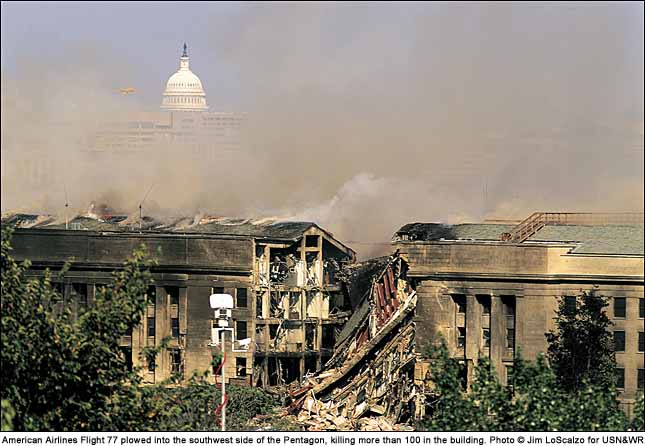
So the decision has been made: network television is going to treat September 11th, 2003 like just another day, mostly. Well, I might just be a hick, but I don't think that's a good idea. I don't particularly want to forgive or forget what happened two Septembers ago. The shock might have faded but the memory should not.
I know this is a leetle early, but forgive me. My anniversary, the goodwife's birthday, and several other happy occasions fall on or near the eleventh, so if I'm going to bicker an' argue about 'oo killed 'oo, I'll get it out of the way now.
When I lived in New York, I used to travel from Queens to Jersey City every Sunday to play music with my friends Darrell and Bruce. It was the best part of my week. When I made it to the World Trade Center subway station, I always felt a little better because fun was just a PATH ride away. The WTC station was nifty too-- the underground mall, the half-attractive artsy inlays, the rumble of the downtown A going by. The Commuter Bar, entirely decorated in beige naugahyde and aged winos. Loved it, loved it.
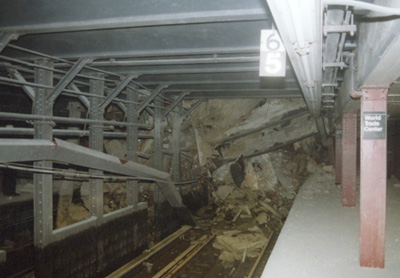
Oddly enough, the World Trade Center was one of my favorite places in New York. It was how I oriented myself walking around the city. It gave balance and heft to the southern end of Manhattan. You could see it for miles, driving in on the Jersey Pike or I-95. It was like a huge, ungainly guardian watching over my city.
---------
On the 108th floor of the World Trade Center's north tower, there was a little conference room/ lounge area with a baby grand piano. I discovered this by accident one night in February of 2000.
I was at the Windows On The World on the 110th floor to see a rockabilly band managed by a co-worker's boyfriend, and Samir and Bruce were kinda late, because they got lost. (Even after I moved away from New York, I'd occasionally get calls from Samir.... "Johno... I'm on Park Avenue and 25th Street. How do I get to Grand Central Station from here?")
In the midst of getting lost, Samir and Bruce managed to give the World Trade Center elevator operators the slip and got off on the wrong floor... the 108th to be exact, where they found the piano lounge.
After we had our fill of rockabilly and high-up views of Staten Island, we went back down to the 108th floor, and hung out for a couple hours, playing the piano and staring out at the Verrazano Narrows Bridge from one of the darkened grottoes. It was one of the best nights I had in New York. Later, Bruce would take his future wife there on a crucial and historic date.
---------
As I sat in a bar in Massachusetts downstairs from the office, watching the television play images of the assault on New York, my mind was occupied like most people's was, trying to cut through the shock and disbelief, choking back horror and confused rage. I was a mess.
As the north tower of the World Trade Center fell impossibly slowly into its own rising cloud of dust, I started to cover my eyes, then stopped, and stared dumbly. I couldn't process what was happening. I didn't understand thousands dead. I didn't understand how the world was changing, even though I knew it had. Everyone had theories, but we were all in shock.
My mind was reeling, and the one sharp, tiny realization that stabbed me in the heart and made it all real was how much it TOTALLY SUCKED that my Secret New York Piano Lounge was gone-- I could never play the piano in the World Trade Center again.
Then I went back upstairs to see if all my friends were still alive.



 on
| § 0
on
| § 0