Perfidy Sidenotes

What is a sidenote1Simplest answer, it's one of these.? The most thorough discussion of sidenotes and their use on the web can be found at gwern.net, and here's a pithy abstract:

Sidenotes & margin notes are a typographic convention which improves on footnotes & endnotes by instead putting the notes in the page margin to let the reader instantly read them without needing to refer back and forth to the end of the document (endnotes) or successive pages (footnotes spilling over).

They are particularly useful for web pages, where ‘footnotes’ are de facto endnotes, and clicking back and forth to endnotes is a pain for readers. (Footnote variants, like “floating footnotes” which pop up on mouse hover, reduce the reader’s effort but don’t eliminate it.)

However, they are not commonly used, perhaps because web browsers until relatively recently made it hard to implement sidenotes easily & reliably. Tufte-CSS has popularized the idea and since then, there has been a proliferation of slightly variant approaches. I review some of the available implementations.

That about sums it up, but you can read on at the link for further discussion of the utility and reliability of various approaches, both in print and online. In fact I recommend that you do, it's very well written and informative.

But why am I talking about them? Well, the Ministry of Minor Perfidy's Bureau of Retributive Software Development has caused to be created a Drupal implementation of sidenotes. You can find the project here, and install it on your own site2provided your site is powered by Drupal, of course, thanks to the wonders of the open source and internet generally. This module is, as you'd expect of a Drupal module, completely free to use.

This is something that I've wanted to have for years and years. This sort of functionality really fits both the style of writing3when that writing actually happens, admittedly a serious issue here. and website design that we have at perfidy. But constraints - time, skill, and laziness being primary - kept my own personal sidenotes project uncomfortably in the future. The advent of AI4so called, or at least large language models with some facility at coding, broke through those constraints and I was able to 'develop' a working sidenotes module in an afternoon.

Perfidy's sidenotes has a number of cool features5at least, I think they're cool, your mileage may vary.

  • Sidenotes can be typed right were you want the note to be placed, wrapped in double parentheses. A text filter converts them into the notes you see here.

  • Notes can display to either the right or left of the body text6This applies to all notes on the site, it can't be changed on a per-note basis. Though now that I think on it, maybe that's a feature I could add.

  • Notes stack - if you have a lot of notes in a paragraph, they won't overlap7Nor will they overlap with notes in subsequent paragraphs..

  • Responsive notes: on small displays like phones, notes collapse from the side to immediately after the paragraph they're in.

  • Styling hooks are available for easy theming.

  • Minimal js to handle endnotes on mobile, and reflow when the window is resized.

  • Label styles include numbers81, 2, 3, etc., symbols*, †, ††, §, ¶, ‖, Δ, ◊, ☞, no labellike this one, and customlike perfidy's trademark endnotes from the old days.

  • Note labels can be overridden on a per note basis, and don't increment numbering of the other notes9like we did in the notes in the previous paragraph..

  • And I just now discovered10Though it makes sense that it would, as long as the text filter is applied. that you can also use sidenotes in comments.

You can even drop images and tables in an endnote, and any normal text formatting. You'd likely want to be careful on the sizes of these things, but a nifty bonus feature. Sidenotes is compatible with the CKEditor wysiwyg that you most commonly find on Drupal sites.

So there it is, The Ministry of Minor Perfidy's custom Drupal sidenotes implementation. Enjoy!

Posted by Buckethead Buckethead on   |   § 1

Sopwith Camels and 747s - The BFR's Military and Strategic Implications

Last month, Elon Musk gave us a new, revised version of the SpaceX development roadmap. Last year’s ITS is now a (slightly) smaller BFR. But small is a bad descriptor for what SpaceX calls  with perfect justice the Big Fucking Rocket.

Even a precis of the BFR is rather epic. 150 tons to low earth orbit. Fully reusable. Three times the payload of the previous biggest fucking rocket - the Saturn V, yet only a fraction of the cost per launch. Mars missions, lunar bases, point to point ballistic transport on Earth... and all by itself, the second stage is a low payload single stage to orbit craft. (Albeit with low payload compared to the full BFR stack.)

Awesome, in the original constituted entirely of awe sense.

There are a couple grains of salt we must gnaw upon though. First, Musk has a lamentable habit of overpromising. But as one wit noticed, if you convert human years to Mars-length Musk years, you can usually have a decent idea of what the actual timeline will be. Second, The BFR is largely - though not entirely - vaporware at this point.

Yet we have some mitigating reasons to be optimistic. SpaceX has mastered the basic technologies that will be used in the BFR. Most important, the reusable boosters and propulsive landing. SpaceX has made significant progress on the most important single piece of the new BFR, the Raptor engine. It works, and all that remains is the relatively straightforward development work to make it a production scale product.

Beyond the technical, SpaceX’s existing business is beginning to rake in the cash, and is poised to utterly dominate next year’s launch market. This year, they’ve already launched more rockets than any other company - or nation. The Falcon Heavy first launch is expected within a month. Though Musk might be late, he usually does deliver. And right now, he and SpaceX are on a big roll.

Sometime in the next five years or so, the first working BFR could launch. What does it all mean?

Is it a DC-3 or a 707?

Some have compared the BFR to the DC-3, or the Boing 707. These comparisons aren’t entirely misplaced - each of those forerunner aircraft had immense significance, opening up practical air travel in the propeller and jet ages respectively.

Cheap, reliable air travel requires at least one industry - the manufacture in bulk of cheap, reliable aircraft. Obviously though, that doesn’t exist in a vacuum. Those aircraft must be purchased by people who think they can use them to make a profit, or accomplish some purpose. Here’s where things get interesting.

First is the virtuous cycle. You make a DC-3, it’s popular. People buy them to move passengers, cargo, mail. Governments buy them to move troops, implements of war, or VIPs. Money flows into your coffers. You buy a pony, and use the rest to design and manufacture the DC-8, and then the 707. Eventually, you’ve got 747s that dwarf the payload, speed, and (inversely) the price per pound per mile of moving things you had when you started with your DC-3.

Second is the parallel development of civil and military aircraft. The long range civilian DC-3 used the same technologies as the long range military B-17. In fact, the Douglas Aircraft Company built both of them in WWII, even though the B-17 was a Boeing design. Advances on one side generally sooner or later made an appearance on the other. Jet engines designed for fighter planes evolved into engines for civilian jetliners. Often, civilian cargo designs were repurposed for military use in airlift or as tankers for in-flight refueling.

There is no such thing as a purely civilian advance in transportation technology.

A better transport is a better bomber. A more fuel efficient engine is a longer-range fighter. And so on...

***

Besides being an industry in and of itself, aircraft created entirely novel industries and made other things possible. Airmail, air freight - FedEx wouldn’t exist without inexpensive air travel, and neither would west coast major league baseball teams.

In this light, we can see that the BFR could easily have a similar effect. It becomes an industry in and of itself: the building of spaceships. It creates or facilitates industries - space freight, satellite launch, or others.

All good, right?

That's Not It, Though

But all of that misses the real point.

Right now, there are two types of rockets. Elon Musk’s, and everyone else’s. And the gap between the two is getting vastly bigger by the day.

Space-X’s Falcon-9 as a mostly reusable rocket - if we’re making DC-3 analogies, we already have that one. The Falcon 9 is fully operational at this moment, and it allows SpaceX to dramatically undercut everyone else in the launch market. And they’ve barely begun reusing the things. Even new Falcon 9’s are cheaper. When SpaceX starts reusing rockets in bulk, when SpaceX starts flying the Falcon Heavy, and then re-flying the Falcon Heavy - this is a huge gap in performance, cost and capability. One that exists now or will by next Tuesday; and will widen even without considering any future development from SpaceX.

Only one other company is even in the planning stages for a rocket that could compete with SpaceX’s current vehicle, and that’s Blue Origin. They haven’t flown an orbital vehicle yet. The rocket that will power their competing spacecraft is still in development - though it has made its first successful burn. Now, they may achieve success, but they are years behind SpaceX.

The rest of the aerospace industry is literally decades behind, and shows little evidence of adapting to survive the new commercial space environment born in the current year. Arianespace, Boeing, Lockheed, the Russkis, the Chinese - all are continuing to build, and continuing to announce the design of new rockets that are exactly like the rockets the world has been building for the last half-century.

Prime example: ULA (Boeing and Lockheed) is developing the Vulcan rocket. From Wikipedia:

A later feature is planned to make the first stage partly reusable. ULA plans to develop the technology to allow the engines to detach from the vehicle after cutoff, descend through the atmosphere with a heat shield and parachute, and finally be captured by a helicopter in mid-air.

Yep this is going to be competitive with the Falcon 9, whose first stage is already fully reusable, especially since the first launch is scheduled for two years from now, and the whole helicopter-engine-grabbing feature will only arrive on later models.

Bonus example: NASA's SLS Rocket. From an Ars Technica article:

It is physically possible for NASA to make a launch date in 2019, but historically things can (and often do) go wrong in the assembly and testing of major launch systems. While it is possible to beat the odds or resolve problems quickly, there is no guarantee that will happen between now and a 2019 launch date.

Using technology that has been in existence since the 1970s, NASA might just manage to launch something three years from now, after over a decade of work.
Mad Scientist Musk Goes Back in Time

Let’s imagine a world. It’s something like 1914, and you’ve got a whole bunch of companies laboriously building wood and canvas airplanes with simple and low power engines. In a world that just a short while back didn’t have flying machines, they’re a marvel. It’s the most advanced technology of the age, and the designers’ smarts have become a byword for smarts itself.

And they’re useful. You can do aerial reconnaissance. You can fly a passenger or two or maybe a small cargo a distance of a couple hundred miles. The bolder thinkers have already imagined the uses to which more advanced airplanes might be put. A bigger plane, or a longer range plane; well, you could achieve wonders.

Then imagine that someone figures out how to make planes of similar capability. Only difference, instead of costing a million dollars a piece, they cost $250k. Huge impact, huge business advantage for that inventor and his company. He can quickly corner the market on aircraft manufacturing by undercutting his competitors and still making a huge profit. And new things become possible. At this price, you can afford to buy a whole bunch of planes and use them to carry high-value (but small) cargos around. Air mail is born.

Now, WWI isn’t much effected. There’s no new capabilities on offer - just a price advantage for the side that has our clever business man residing in it. Country A gets cheap, capable fighter planes. They can field more of them, perhaps. Be a little more reckless in their use, wring more advantage out of them. But all in all, more or less the same.

But further suppose that in his volcanic lair, this man is building something else. He’s building a Boeing 747. And it will cost only half again as much as the best of his competitors’ airplanes. But its performance is so much greater that really, its not even the same sort of thing.

“Amazing!” you say. And it would be.

What could you do with a Boeing 747 that you couldn’t with a Sopwith Camel?

***

In our imaginary world, Country X now has a modestly tame evil genius. He’s developing his 747, and in a couple years, the first one will fly. What might the statesmen and leaders of Country X imagine might be done with this technological marvel?

The evil genius thinks he’s going to fly to Antarctica, because it’s cool there, and he can claim all the land that isn’t inhabited by Scott’s ghost or penguins. So that’s one plan. He also allows that you could use the 747 for more pedestrian tasks like flying lots of people from city to city, or other just as dreadfully boring things.

But the Country X's proto-Army Air Corps generals might have a few thoughts.  

Instead of throwing a grenade over the side of your Sopwith Camel, bombing would be dropping 100+ tons of high explosives from a height no artillery, and no existing fighter can reach. Aerial reconnaissance is flying with impunity over any territory in the world, with a full crew of photographers and a photo lab, and advanced wireless telegraphy gear to communicate the intelligence back to the ground in real time.

The obvious things are extensions of what is already possible. But some clever Napoleon will realize that you can put a regiment of troops on one of these things, and have them anywhere in the world in less than a day. And since they only cost a little more than a Sopwith Camel, you can buy as many as you like and move whole armies. (Remember, WWI was caused in part by railway mobilization schedules.)

These are just the military implications. For Country X, they now have a capability that, though not new in the sense that aircraft have been in existence for a decade, is entirely new because it is so much more capable than anything previous.

And other businessmen might have some ideas about what uses a 747 could be put to. FedEx. Bulk air freight. Trancontinental passenger airlines. All of which are vastly profitable, and could not exist until the 747 comes into existence.

This is the BFR.

Not Just a Big Fucking Rocket

I’m arguing that the BFR is not just a Big Fucking Rocket.

It has a greater payload capacity by far than any previous rocket. Its cost, per pound to orbit, will be cheaper than any other rocket. Its absolute cost to construct is in the same ballpark as a large jetliner. Its reusability, even if not at airline levels of turnaround, are beyond anything currently in existence.

A single BFR cargo launch is the equivalent of about seven Falcon 9 launches. Two BFR launches is therefore equivalent to matching the entire 2017 SpaceX manifest. Eight BFR launches is the entire world’s 2017 launch manifest. One BFR, going up every six weeks.
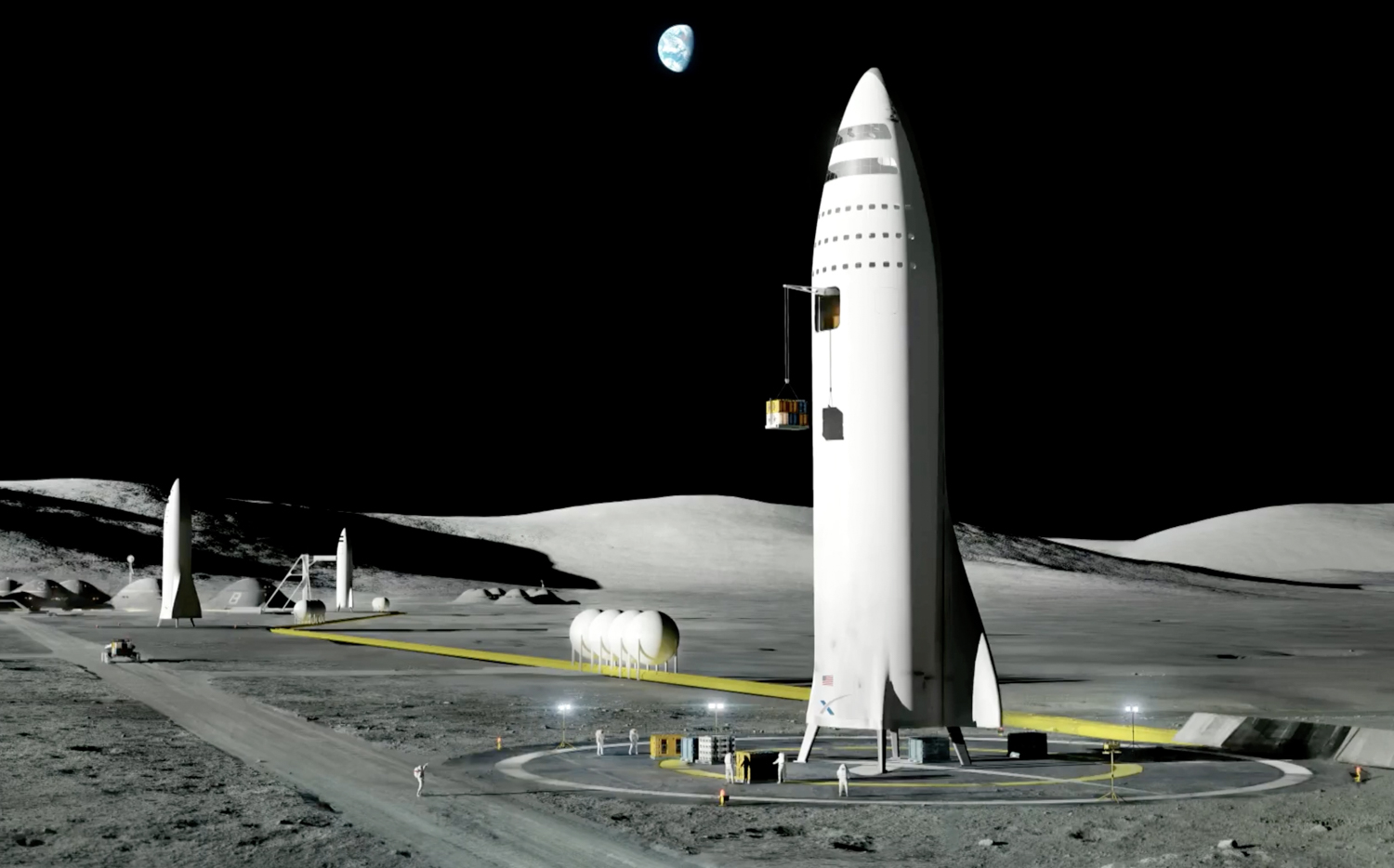
So let’s just assume that after the first prototype BFRs start flying in 2022-2023, production BFRs are coming off the line at about six a year starting in 2024. SpaceX spends 2024 testing their new birds, refining launch procedures and logistics, settling in and learning what it takes to make these things fly. By Christmas 2024, they’ve got it locked down, and they’re ramping up to one launch per week for each BFR. On New Year’s Day 2025, you have eight operating BFRs, each capable of one launch a week.

On Jan 7, 2025, Elon matched the entire world’s launch capacity for the entire year 2017. And he can do it again, every single week.

With a new BFR entering service every four weeks, by the end of the year SpaceX has a throughput to orbit two orders of magnitude greater than the entire world’s 2017 launch capacity. (And about a quarter of that number was thanks to the 2017 edition SpaceX.)

Today, airlines operate thousands of 747s and other aircraft - and the world’s militaries operate thousands of fighters and bombers. It will take some time, but soon we will have tens, and then hundreds of BFRs.

The BFR is the whole stack, but it might be helpful to distinguish the parts. The BFB is the booster, which will be standard for all launches. However, the BFS - the upper stage of the BFR - will come in several versions. Musk has already mentioned the tanker, cargo, and two kinds of passenger versions (one configured like an airliner, one for long-duration missions with cabins.) Without question, more variants are possible.

What the BFR Can Do

A big question is whether the market can expand to match this capacity. But that’s also a dumb question. Did airlines every have a problem finding people to ride their planes, or cargo to fill them? As the price comes down - and with BFR, it will be very much down, demand will increase. People, companies, institutions will all find that yes, they can use space transportation. Again, the most obvious use is for the things we already do - but can now do ten times faster or better.

Point to point transportation

Fedex will want to buy a dozen BFR-Cs and tell you that when it absolutely, positively, has to be there in four hours - it will be, even if the destination is on the other side of the world. UPS will want to buy another dozen - and at the very least, both companies will be booking space on the regular.

Point to point, on-Earth transport can be huge, provided that the cost and reliability are there. Southwest Airlines is  certainly going to want a number of BFRs, but they’ll be competing with Elon and SpaceX for that market. There is a market for expensive but very, very fast transport of people and things - 80 years of air travel has proven this beyond any question.

Satellites

The existing market for satellites is small because of two factors. Satellites are expensive, and launches are expensive. Lowering the second factor will cause a reduction in the former. If you can launch a satellite for the same price as shipping something to Australia on a 747, you don’t need to spend millions of dollars to ensure the same level of reliability.

Instead of one $100 million dollar satellite, you launch a hundred $100k satellites for the same level of service or better - and pocket 90% of the costs. SpaceX itself is already planning a constellation of thousands of satellites to provide low cost, high bandwidth internet globally. The very fact that you can launch just about anything means that just about anything will.

Universities will launch low cost research satellites. Small start up telecoms will launch hundreds of satellites. Big telecoms will launch thousands. The US military will launch more reconnaissance satellites. New weather sats. When cost per pound to orbit drops to air freight levels, everything we do in space now we can do on a broader, cheaper and better basis.

These denser networks of inexpensive sats will allow better communications, better data, more information about our world. Cheap orbital telescopes will give us a better picture of the larger universe.

New purposes

For all of our history as a space-faring species, most of the things we’ve put in orbit have had one of two purposes: watch things or talk to things. As outlined above, we’ll be doing a lot more of that. But then there’s all the things we’ve thought of but never did because the cost was just too damn much. Most of these involve people living in space.

One of the largest beneficiaries of BFR technology will be Bigelow aerospace. Right now, Bigelow is a William Penn who’s just been granted all the land in Pennsylvania. Unlike Penn, he has to wait for someone to invent the ships that will allow him to profit off of all that land. He’s a space real estate company in waiting.

Bigelow is already building and testing inflatable habs on the ISS. They’re working on a bigger model - the B330. Once inflated, the B330 has 1/3 the pressurized volume of the current ISS. It weighs a bit less than 25 tons, and its collapsed dimensions (near as I can figure*) are 2.5m in diameter and 5m long. That’s small enough that you could pack the BFR to its maximum payload weight with these things - take six into orbit, and boom, you’ve tripled the total available orbital real estate in one launch.

With 150 tons to low earth orbit and on-orbit refueling, building space stations is a trivial exercise - especially if you’re using expandable habs. Placing space stations wherever you want them isn’t much of an issue either. Haul them collapsed to where you want in the BFR, add water, instant space station. It took dozens of shuttle launches to build the ISS, and it cost well north of a $100 billion. One launch, you get something twice as spacious. (~$150 million per B330, plus connectors and whatnot, plus 40mil for launch. Call it one billion, ten fold decrease in price.)

Another option would be to launch the station into LEO. The BFR goes about its business. Construct a framework around your expandable habs and tack a motor on to the back. Now you’ve got a slowish but spacious and useful spaceship.

Building a moon base is barely more complicated, given that the BFS could land on the moon and return without refueling. Attach habs to asteroids. Land them on Mars. Float them on balloons in Venus’ upper atmosphere.

Further out into space we could do Elon’s little Mars trip, for starters. But think also how much better NASA’s deep space probes could be if they were 20 tons instead of half a ton, and got to their destination in months instead of years. Manned or unmanned asteroid sample return missions. Missions to Jupiter or Saturn are possible with the BFS, or with interplanetary ships that the BFR could easily loft into orbit.

Closer in, garbage scows to remove broken or dead satellites. Research facilities, hotels, amusement parks... The possibilities, truly, are endless.

Military uses

Just by making use of SpaceX-operated launches, the military and intelligence agencies would deploy better recon sats, better surveillance sats, higher bandwidth military communications networks. Better, more accurate GPS systems. All of this would parallel the commercial uses that companies world wide would likely jump on with both feet.

Military programs long thought impossible are now possible. The THOR weapon system could be put in place with as little as a dozen launches. Pin point, global, non-nuclear capability to destroy just about anything. Using a militarized B330, you’ve got instant military space stations for all sorts of needs.

If the US Air Force - or, ever more likely, a US Space Force - started buying and operating their own BFRs, even more possibilities open up. Just as FedEx and Southwest Airlines could get you or your packages to the antipodes in less than an hour, a military spacelift capability could put soldiers and equipment anywhere on the same timeframes.

The BFR has a cargo capacity slightly larger than the USAF C-5 Galaxy. It’s 13 hours from New York to the Middle East. If the BFR could actually do rapid turnaround, it could make that flight six times before the C-5 touched down. Which means that functionally, the BFR has six times the cargo capacity of the C-5.
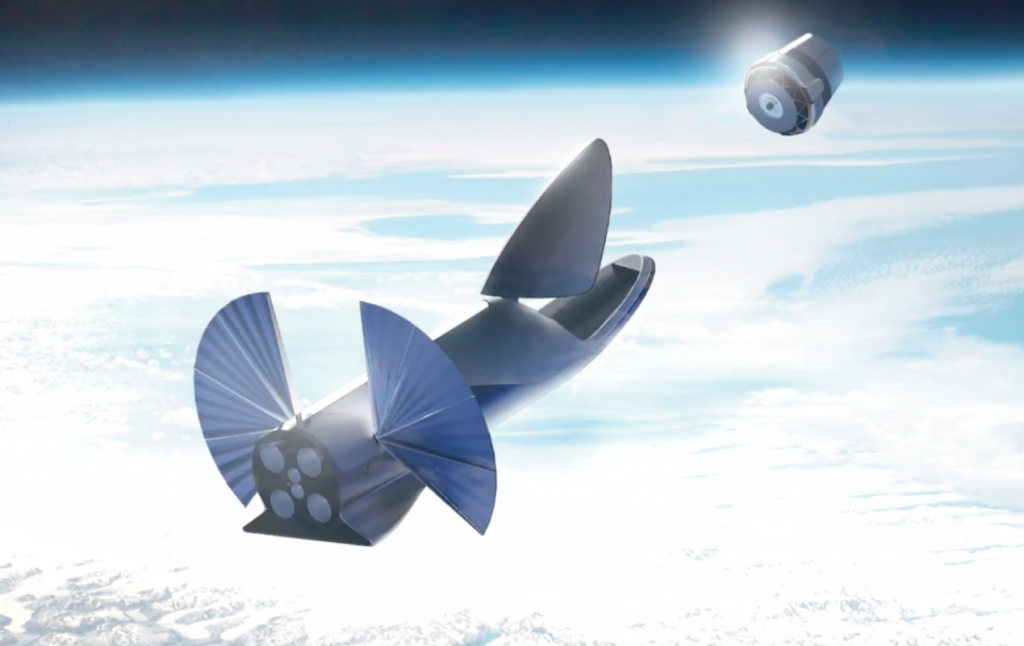
Once in orbit, the BFS is a capable platform, with fuel for a fair amount of orbital maneuvering. With the tanker assets that Musk is already planning, a refueled BFR upper stage would have a lot of delta-V. A military version of the BFS would be a powerful ASAT platform, an orbital bomber, or assault vehicle for deploying space-trained special forces to whatever target they needed to assault.

And just as easily as civilian bases could be assembled rapidly using the Bigelow B330, military stations could be built. While an orbital space station is necessarily vulnerable to attack, thanks to the fragility of the station and the harsh environment of space, the utility of a manned space base will probably be too great to pass up. The most likely use for a manned military station is as a orbital version of a forward air base. Space Force BFR upper stages could dock, refuel, rearm, switch crews, without having to waste precious fuel returning to the surface.

In time, though, new weapons would be developed, and deployed to space by the BFR. Dedicated, on-orbit fighters could be brought up by a BFR cargo mission, and be used for anti-satellite or anti-station missions. Assault landers, brought up by BFR and something like a small shuttle in design could drop a squad of commandos anywhere on the globe. Space based weaponry along the lines of the old Star Wars missile defense program could be tested.

What Does it All Mean?

All of this is literally just off the top of my head. Deeper thought would no doubt reveal even more uses. Most important though, there’s only two groups going to be operating the BFR in the near future - SpaceX and perhaps a small selection of other American Companies; and the US Government - specifically, the US Air or Space Force.

The US is going to have a short but significant window - a monopoly on cheap, bulk access to space. For a decade, maybe more, the United States will have sole possession of the only true spaceship. (And, maybe two if Bezos gets his New Glenn flying.) No other power will have anything comparable.

This is potentially more, destabilizing than the invention of the atomic bomb. Yet the only people who seem to be discussing the military uses and implications of the BFR seems to be Brian Wang at NextBigFuture and a couple people on Reddit.

The United States will have the 747, and everyone else will still be flying Sopwith Camels. We’d best figure out what to do.

Posted by Buckethead Buckethead on   |   § 0

Space Marines

I'd seen the rumors that Congress was discussing the creation of a United States Space Corps. And now it seems that the House of Representatives has actually included the proposal in the latest budget. The House Armed Services Committee added a provision for the US Space Corps and a new separate joint command: the US Space Command.

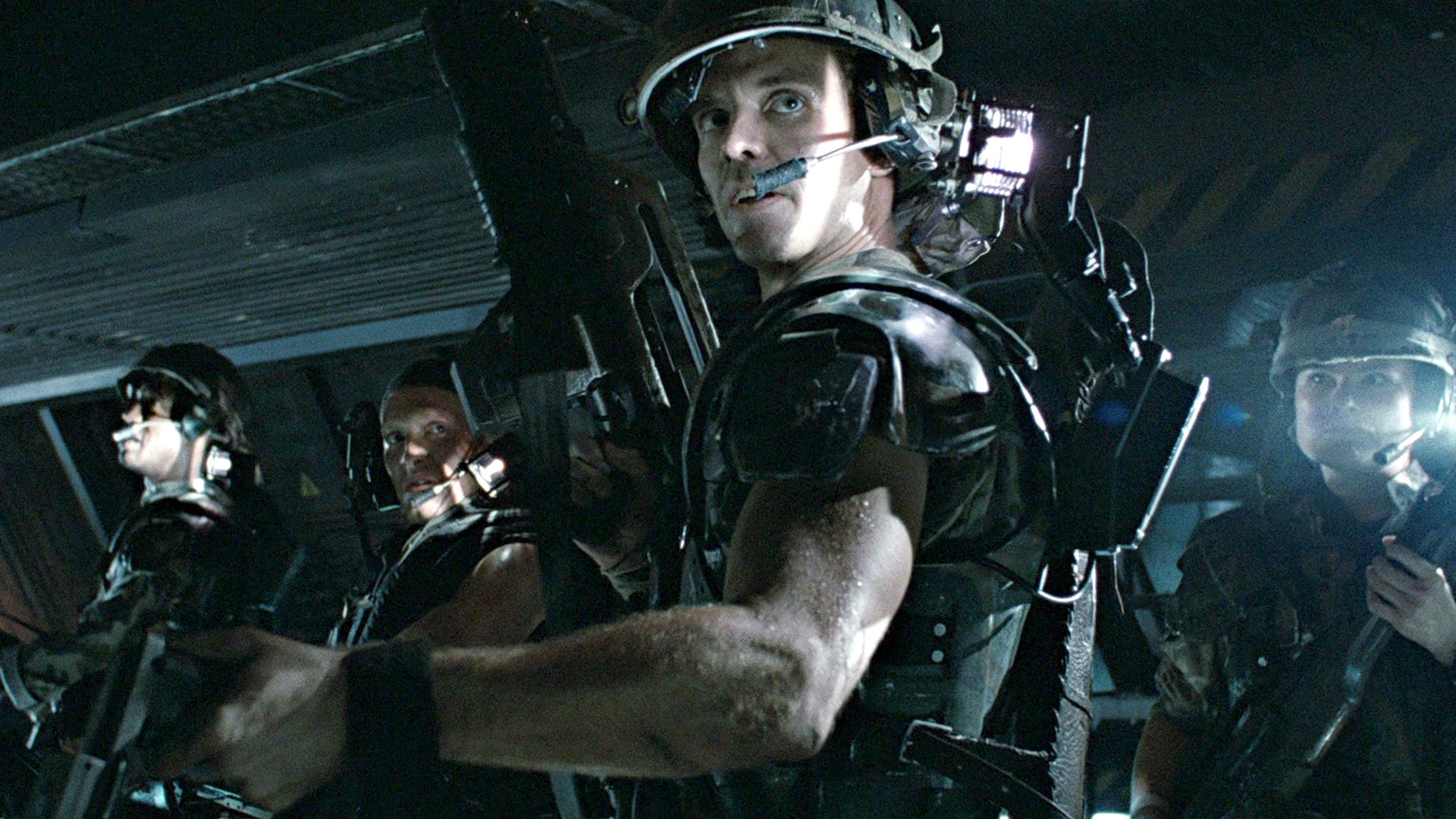
First off, all previous coverage on this subject has made crucial errors. By including images from the film Starship Troopers or Guardians of the Galaxy they have completely missed the boat. The correct image is the one at the top of this article. Failing that, the only other option would be:

A distant third would be this:

Now that we've got that out of the way, what are the merits of this proposal?

Space is big, as has been noted often. Now that we are finally poised to begin moving into space in a big way, it is a reasonable proposition that we should take steps to guarantee our security, space-wise. A US Space Corps could conceivably undertake to accomplish that. Mike Snead on The Space Review argues exactly that:

To use a term not now in fashion, the United States is a great power and must remain so to preserve the security and freedom of future generations of Americans. Millions of past Americans fought, often with great personal sacrifice, to enable the United States to forge its future on its own terms. Preserving America’s great power status is a key responsibility of Americans today.

A key attribute of a great power is the ability to project national power beyond its borders in its defense and to undertake national policies. Last century, “Earth-space”—the region of space around the Earth—became a region of vital national military and economic interest. The United States uses Earth-space for reconnaissance, intelligence, communications, geopositioning, and nuclear deterrence, and for the command and control of US forces actively engaged in defending the United States and our allies. As I have explained in several articles here, Earth-space will also become the primary source of energy for the United States as we unavoidably transition this century from fossil fuels to space solar power.

Reasonable Americans increasingly understand that the extension of active US military capabilities into Earth-space is essential to provide the ability to project American power for our nation’s security. It’s time for the United States to have a permanent human military presence in Earth-space—starting with a US Space Corps, followed soon by a US Space Guard and leading to a US Space Force.

That's the upside.

The downside is rather larger. In roughly descending order of imminent pragmatic concern:

  • It's opposed by the Air Force
  • The Army and Navy will likely also resist having their space assets absorbed
  • As will the civilian intelligence agencies like the NRO
  • The Air Force is not the proper model for a space force
  • It's too early
  • When we do create Space Marines, they'll be the US Space Corps Marine Corps, which is retarded and sounds like it was named by the Chinese.
  • Sooner or later, we'll have a space navy, so we should just go there and get it right the first time

Let's take a look at some of these points.

Bureacratic Crib Death

From the 80s to the present, we've had an Air Force Space Command. This is a component command subordinate to U.S. Strategic Command (USSTRATCOM). From 1985 until its 2002 merger with USSTRATCOM, USPACECOM existed as a Unified Combatant Command. Currently, US Space activities are managed by the Joint Functional Component Command for Space which is part of, again, USSTRATCOM.

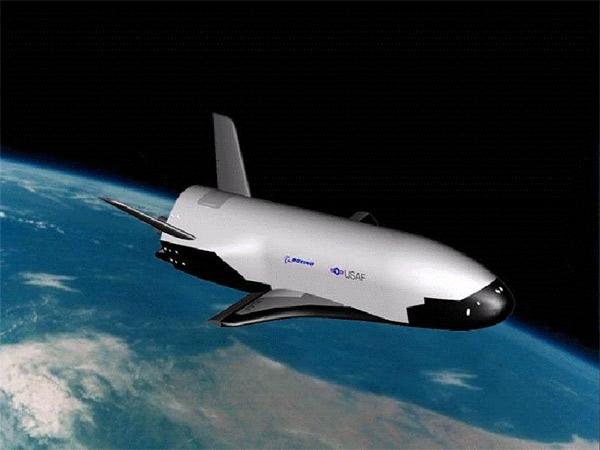
To the extent that any military (and more to the point, Air Force) program is ever well run, this jumble of awkward acronyms has mostly gotten the job done. Satellites didn't fall from the sky, space assets worked with ground assets with only moderate friction, and we have a robotic spaceplane that does sekrit missions for years at a time. (And will soon be launched by SpaceX.)

In other words, what we have is adequate for the job at present.

Given the resistance from other branches of the military, and the additional fact that this new force won’t ever have operational control of the National Reconnaissance Office’s satellites, what is the likelihood that this new Space Corps will actually control a significant fraction of our space, you know, forces?

Past history is not terribly encouraging. Bureaucratic infighting will leave one branch of the military without crucial assets it needs to accomplish its mission. Which one loses is more an indication of its skill and lethality at the infighting rather than its prowess in outfighting.

Back in the late 40s we spun off the Air Force from the Army. One of the unfortunate side effects of that birth was the all-helicopter Army Air Force. The new Air Force insisted that it have control over all fixed-wing aircraft because it was the Air Force, goddammit and therefore it should have control over all airplanes. The Air Force got its way, but that left the Army struggling to provide Close Air Support. Because it was no longer allowed to operate airplanes, the Army settled on helicopters. For some roles helicopters are well-suited, but the constant attempts by the Air Force to kill the A-10 are a perfect example of how the division of labor between the Army and the Air Force was poorly thought out, if at all.

Into the fifties, each of the branches of the US military (not counting the Marines) had their own nuclear deterrent. The Army had the rockets, the Air Force had the bombers and the Navy had the ballistic missile subs. Moderately sensible. But the Army lost again, and the missiles went to the Air Force. While the Navy has been able to resist the Air Force’s otherwise all-conquering bureaucratic acumen, what other branches - especially new ones - will be able to do the same?

And more to the point, what new inter-service rivalries can we imagine will arise with the creation of the Space Corps? Unlike the Navy and Marines who have a centuries long understanding of how to manage their respective roles, this will not be the case with the Air Force and the Space Corps, and this will be the primary bureaucratic battleground as the institutional Air Force struggles to hold on to assets, programs and funding.

There isn’t enough space activity to give the new Space Corps enough power to fight off the lethal and voracious Air Force joint task force budget and appropriations terminators. The Corps will likely flounder absent some Space Pearl Harbor.

Too Soon?

Look at it this way: how successful would the Air Force have been had it been created ten or twenty years earlier? In 1947, the US Army Air Corps had thousands of planes, thousands of airmen and mechanics, pilots and navigators. They’d just played a major part in winning the biggest war in history, and they’d been the means by which the first atomic bombs were delivered to their intended recipients.

In ’37, let alone ’27, the Army Air Corps was a tiny appendage of the Army, and its role in warfare was largely theoretical. Strategic bombing advocates were making absurd claims (that, absurdly, are still believed today) and the mechanics of CAS were still being worked out. But even here, there was the example of air combat in the First World War to draw on.

Right now, there are two military space vehicles. Two. (Yes, there are countless communications, surveillance and other satellites operated by the military. And all the ICBMs. But the X-37b is the only military space vehicle in any sense that makes sense. It could have guns, and possibly even crew.) Space weapons have never been used in anger. There are no Space Aces. Standing up a Space Corps is most akin to setting up a USAF in 1911, when the US Army had a few experimental aircraft and little else.

wright 1908 military flyer 

Space Fighters or Space Battleships

For the near future, space operations will be conceptually similar to air operations. Small crews, short duration missions. For the long term though, how long will this be the case? Distances between worlds are rather long. The model of getting in a plane and flying for a few hours just doesn’t fit.

There’s a reason why most science fiction has used a naval analog for warcraft in space. Even where space fighters are a thing, the model is not so much Air Force as Naval Aviation - squadrons of space fighters flying off space carriers. Long duration missions will require the traditions and methods of the Navy, not the Air Force. Soon enough, most space missions will necessarily be long-duration missions. That being the case, the sensible thing to do is to stand up a space navy and get it right from the start.

Assume that there is still a United States a hundred years from now, and that space travel is commonplace. (One of these speculations is crazy. But which one?) If there are American bases, outposts, and colonies on other planets then there will need to be an American Space fleet. Having a space fleet would mean that most of the nuclear deterrent that we’ve laboriously created will be moot - attack from space is cheaper, cleaner, and easier. Our strategic deterrent will *be* the space fleet.

In this scenario, its easy to imagine a suitable force structure, and their respective roles.

  1. Army: combat on the ground. Ground troops, fully capable, fixed-wing drone CAS, and artillery to include missiles and nukes.
  2. Navy: combat on, below, and above the seas. Subs (and missiles), surface combatants, and squadrons of drone fighters/bombers.
  3. Aerospace Force: combat above the earth, out to Earth orbit. What is now strategic bombers, air superiority missions, etc. But also space fighters launched from earth or orbital bases and designed to operate in near earth space.
  4. Space Navy: Combat in space. Cruisers of the void, battleships and the like. Capable of strikes to planetary surfaces as well as fighting opposing fleets.

And, having created a United States Space Navy, it wouldn’t be a stretch to go a bit further and create US Space Marines, which is the logical and desirable end for the United States, its military, and space travel.ew.) Space weapons have never been used in anger. There are no Space Aces. Standing up a Space Corps is most akin to setting up a USAF in 1911, when the US Army had a few experimental aircraft and little else.

Posted by Buckethead Buckethead on   |   § 0

FOBS: Fractional Orbital Bombardment System

Image
fobs

On March 15, 1962 - during the run up to the Cuban Missile Crisis, Soviet First Secretary Khruschev said,

We can launch missiles not only over the North Pole, but in the opposite direction, too. . . . Global rockets can fly from the oceans or other directions where warning facilities cannot be installed. Given global missiles, the warning system in general has lost its importance. Global missiles cannot be spotted in time to prepare any measures against them.

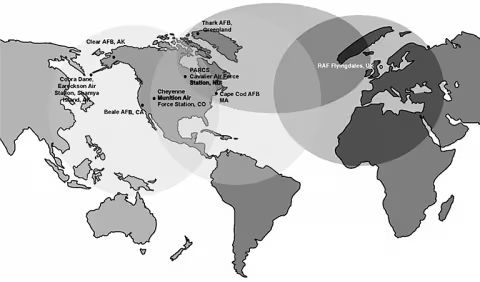
The Fractional Orbital Bombardment system was conceived by the Soviet Strategic Rocket Forces to exploit a backdoor vulnerability in the United States’ strategic defenses. As ballistic missiles began to eclipse nuclear-armed bombers in the 1950s, both sides deployed Ballistic Missile Early Warning nets. The first generation of American BMEW radars were deployed along the northern fringe of North America and Europe, intended to detect incoming Soviet missiles as they came over the pole and rose above the radar horizon. The Pentagon hoped to achieve at least a half-hour’s warning of a nuclear strike, to allow Strategic Air Command to launch its second-strike bombers and deciding where to target its own missile counter-strike.

Image
fobs map

But into the 1960s, the US was blind to attacks from the southern arc. FOBS was intended to exploit that blindness. By launching into a low polar orbit, the nuclear warhead could approach the US from any direction - and particular, directions not covered by the American early warning radar lines. The first warning the US would have a strike would have been the EMP effects of the weapons detonating over their targets.

Development of an orbital weapons system

The byzantine nature of the Soviet system led to the initiation of three programs to develop a FOBS.

FOBS 1

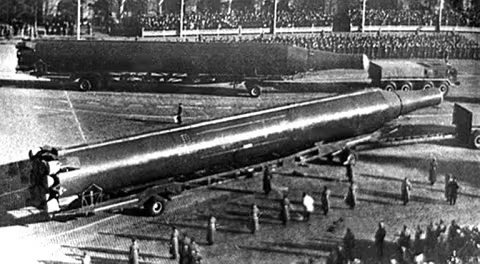
In 1962, Sergei Korolyov, the famed Soviet rocket scientist, began development of the GR-1 (Globalnaya Raketa -1 or Global Missile 1) - his last ballistic missile design. Development had ceased by 1964 without a single test launch. That didn't stop the Soviet Union from using the program as part of its extensive strategic deception efforts. The Soviets displayed the missile as an operational system during their annual Red Square parades in Moscow in the early 60s.

Image
fobs red square

FOBS 2

The Soviet's second FOBS effort came from General Designer Vladimir N. Chelomey at OKB-52. His plans initially envisioned two global missiles based on the UR-200 and UR-500 ICBMs. The latter could have lofted a 30 megaton warhead into Earth orbit. For reasons that aren't clear, the heavy lift option was discarded in favor of the lighter UR-200 missile. This all became moot, however, when Chelomey's patron Nikita Khruschev was overthrown in a coup in 1964 and Chelomey's attempts to keep the project going proved futile.

FOBS 3

The system that actually did become operational came from Designer Mikhail Kuzmich Yangel, based in Dnepropetrovsk, in the Ukraine. His R-36 (NATO designation SS-9) missile became the R-36-O or 8K69 in the FOBS context. Like the R-36, the R-36-O was a multistage missile fueled with storable hypergolic propellants. For deorbiting the warhead, the R-36-O added a third stage for which the Soviets used the designation of 'Orbital Payload' (OGCh).

There are conflicting reports on the size of the warhead. Some Russian sources claimed up to 20 megatons, though US intelligence reports suggest a yield in the 2.0 to 3.5 megaton range.

Image
FOBS on transporter

Deployment

Having won by process of elimination, Yangel’s FOBS was approved for deployment by the RVSN. From 1965 to 1968, a series of test launches from the Baikonur complex established the system’s readiness. The Soviet authorities decreed that the missile be redesigned as an ‘encapsulated’ launch system. This new packaging scheme saw the ICBM stacked and then installed in a hermetically sealed container and then emplaced in the silo for long duration standby operations. Just prior to sealing the container, the missile was fueled. For over seven years before refueling and overhauling, the missile would be ready for launch at five minutes notice.

Image
fobs

After the test program, the R-36-O / 8K69 was accepted into service in 1968 and remained in service until 1983. The Soviet Union built 18 operational FOBS silos at a site near Tyuratum, and stood up the first operational unit in 1969. Three FOBS battalions were part of the 98th Missile Brigade until 1974 when they were transferred to the Orenbugh Missile Army of the RVSN.

Employment

Were it actually used in a nuclear first strike, the missile’s flight profile had four phases: boost, orbital, braking and re-entry. Unlike a traditional ICBM, the FOBS missile had a much lower profile. A traditional ICBM rises on a steep trajectory and reaches an altitude of 1200 miles above the Earth before returning to Earth and its target. The FOBS would never ascend above 150 miles on its depressed trajectory and orbital insertion - and would not appear above the radar horizon of US early warning systems until almost at its final destination.

The 8K69 used its first and second stages to achieve orbit. At launch, the missile would head south toward the pole - a near polar orbit. The warhead, once past the south pole, flew north over the Southern Hemisphere, and eventually on track to hit targets in the central US. A slightly higher inclination launch could hit West Coast targets; a little lower would hit the East Coast.

As it approached the de-orbit entry point, the vehicle would pitch to orient for re-entry. The third stage rocket would fire for one minute, braking, changing the warhead’s trajectory from orbital to ballistic. And set the warhead on course for re-entry and its target. Given that it would be approaching from the south where the US had no early warning nets - time from detection to impact would be almost nil.

Degrading Utility

By the time the FOBS had been operationally deployed, the United Nations had passed the Outer Space Treaty which forbade the use of nuclear weapons in space. To the Soviets, this was a matter of semantics, and they promptly called their system a ‘fractional’ orbital bombardment system. Since the warhead never completed an orbit, it was thus in compliance with the letter of the international space treaties. (Of course, fully orbital weapons systems would require no additional development. Converting a FOBS to an OBS is simply a matter of not firing the retrorockets.)

FOBS faced a regime of degrading strategic utility soon after it was deployed. Over the course of the 1960s, the US expanded its BMEWS to a full circle around the continental US, limiting the value of attacking from the south. Further, the US deployed infrared early warning satellites that could detect launches over the Soviet Union. This rendered the surprise attack value of FOBS near useless.

While FOBS had near-unlimited range, the loss of the element of surprise relegated the system to an expensive collection of single-warhead missiles with low accuracy and only moderately powerful megatonnage. US Strategic planners believed that FOBS could be used as a pathfinder - attacking command and control centers rather than hardened silos and military targets. If the US lost the ability to coordinate a counter-strike, that could still be a significant advantage.

But what really killed FOBS was Soviet submarine designers. In the submarine-launched ballistic missile, Soviet planners had a vastly stealthier platform for launching a disarming first strike on the United States. SLBMs could be cheaper, more powerful and more accurate than any FOBS missile. And by the time of the SALT II negotiations in the late 70s, the FOBS program neared its end.

Posted by Buckethead Buckethead on   |   § 0

NASA's Wet Workshop Concept Revived

NanoRacks out of Houston, Texas is leading a group that proposes to use spent second stage fuel tanks from rockets built by United Launch Alliance as space station habitat modules.

Image
external tank station

Back in the seventies, NASA considered two methods for constructing what eventually became Skylab. The immense second stage of the Saturn rocket would provide commodious living space for astronauts - the question was how to go about it. The 'wet workshop' concept involved two Saturn IB launches one crewed, one not. Once in orbit, the crew of the second launch would install life support equipment in the upper stage's hydrogen tank. Over time, the idea of the 'dry workshop' won out. NASA fitted out the second stage on the ground and launched it ready to go.

So now, this new venture plans to use spent Centaur second stages. The idea is compelling: a human-habitable space station is an insulated pressure vessel, a cryogenic hydrogen fuel tank is an insulated pressure vessel. There ought to be some way to make that work. If NanoRacks and company can start making workable space stations out of otherwise thrown-away centaur second stages, that's awesome.

If they make it work, it will shine an even harsher light of condemnation on NASA, though. Consider the following facts:

  • The Atlas Centaur is about ten feet in diameter, and forty feet long. The majority of that volume would be taken up by the hydrogen fuel tank.
  • The Space Shuttle External Tank was 150 feet long and thirty feet in diameter. The hydrogen fuel tank alone was 100 feet long.
  • There were north of 130 flights of the space shuttle
  • In each case, the shuttle sacrificed payload capacity to make the tank reenter the atmosphere and burn up

A hundred or more refitted space shuttle external tanks would have a bit more interior living space than the ISS.

Image
etgop

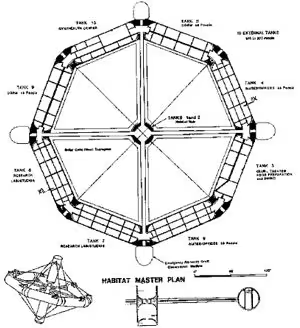
Now, imagine 12 of those wheels stacked like tires.

Posted by Buckethead Buckethead on   |   § 0

Drupal Search Nodes and Comments

Build a forum search page that searches both nodes and comments with no extra modules or coding.

Whilst building a new Drupal site, I ran into a problem. 

This site needed a forum, so I installed the advanced forum module and proceeded to build out and style a forum. Like you do. Then, I got to looking at the search page. The included forum search view handily allowed you to filter by sub-forum, which was nice. But it made no distinction between different responses in a thread.

Say you're looking for the word 'nibknack'. Say there's a thread on your forum called 'funny words' and nibknack is mentioned in the 842nd of over 1000 replies. The forum search tells you that your search term appears in the funny words thread, and points you unhelpfully to the beginning of the thread. The reason for this is that generally speaking Drupal associates comments with nodes. In a forum context, the original post in a topic is a 'node' and every reply is a comment. 

Drupal views is a powerful tool, but I ran across one limitation almost immediately. Views are about content (nodes), or users, or comments - but not about more than one. I spent a couple hours looking through Drupal forums in vain for a simple way to search nodes and comments in with one form, with little success. Then I got one hint - if you have more than one exposed form on a page, populating one populates all of them.

So, here's how to create a search page that looks like one form, and that searches both comments and nodes. This example is aimed at Drupal forums, but could be used many ways.

Step One: Forum Search Page

Create a basic page with no content, give it a URL alias something like forum/search.

Step Two: Comment Search View Block

Create a new view, call it forum comment search. Select show "comments" and check the create a block checkbox. Call it Comment Search. Click Continue and edit.

Add your fields. I added comment title, author, post date and comment. (Comment is the body of the comment.) I set the comment body field to 'exclude from display' so as not to clutter up my search results - but that's optional.

Add your filters. Along with the comment: approved I added a content type = forum topic to limit it to just forum posts. Then I added a taxonomy filter to allow users to search by forum, since there are several sub-forums on the site. Pick "Has taxonomy terms (with depth) and select your forum taxonomy. I set the depth to 1 and checked the "expose to visitors" check box. Finally, add a Global: Combine fields filter. Set this to exposed, change the label to Search or something more appropriate, set the operator to 'Contains all words' (or whatever works for you) and select the title, author and comment fields for filtering.

Make sure Use AJAX (in the advanced section) is set to yes. I also usually set the exposed form settings to include reset button and autosubmit, but that's a personal preference.

Save that and move on.

Step Three: Node Search View Page and Block

Create a new view, call it forum node search. Select show "content" of type "Forum topic" and check both the page and block checkboxes. Put the URL for the forum search page you created in step one into the path field for the view page. Select unformatted list and fields for the Display Format options. Click continue and edit.

On the page display, add fields just like for the comment view. However, you'll have to add the author relationship to get the author name. I added Content: Title,(author) User: Name (by ), Content: Post date (Created), and Content: Body (Node Body). Like with the comments view, I set the body field to excluded from display.

Add filters. Same as before - content: type =  forum topic, content: has taxonomy, and global: combine fields filter. These will automatically be added to both displays. Make sure that the taxonomy and combine field filters are set to exposed.

Since you've already clicked on advanced to add the author relationship, move over and click on the "Exposed form in block" and click it. Set that to yes, and then set Use AJAX to yes as well.

Check the settings on the block display, including the Use AJAX, and then click save.

Step Four: Set it all in place

The views you created themselves created three blocks. A comment search block, a node search block, and an exposed form block. Go to admin/structure/block and configure your blocks. The three blocks all need to be set to appear on the page you created in step one. Put the exposed form block on top, and then the node and comment search blocks below. I put them in two regions, but whatever works for your theme. Set the titles to <none> and have them only appear on /forum/search.

Now, if you go to /forum/search, you'll see an exposed form with a search text field and a drop down for all your forums. Then, you'll see the node seach block (with its exposed filters) and then the comment search block with its exposed filters. If you type anything into the top filter, you'll see it appear in the others, and then each block will serve up its search results.

Just use some css to hide the exposed filters on the second and third blocks, and now you have one page that searches nodes and comments, with no extra modules or coding. The only thing left is to tidy up the results, rename or remove labels, and so on.

Posted by Buckethead Buckethead on   |   § 0

Blame Canada

There's been a veritable avalanche of articles about the United States invading Canada in the last few weeks. Which, for such an arcane topic, means three.

Back in the awkward in between phase of the Early 20th Century global war, the US War Department made plans for fighting pretty much everyone. Which is the sort of thing sensible War Departments do. It's not likely you're going to fight anyone in particular, but if the Pres picks up the red batphone and says, "We're invading Zimbabwe tomorrow," well, you don't want to get caught short. Back in the day, we had cool color codes for the war plans, and War Plan Red was the one in case shit got real between the US and the British Empire. Since Canada was the biggest and closest part of the Empire Upon Which The Sun Never Set, much of the war plan involved invading, oppressing and occupying Canada.


These plans were developed during the 1920s and ’30s by the U.S. Joint Planning Committee (later to become the Joint Chiefs of Staff) and each assigned a color to a particular world power the United States saw as a potential adversary. Black for Germany, Orange for Japan, and Red for the British Empire.

The first two articles are from War Is Boring and Vice, and cover the details pretty well. The War is Boring link also mentions Canadian Defense Scheme №1, which was a pre-emptive strike intended to slow the coming American onslaught by invading and then conducting a scorched-earth retreat to buy time until the Brits could come and save their (Canadian) bacon.

The hope was that the U.S. would be caught off guard, allowing enough time for the British to come to Canada’s rescue.

At the first sign of military aggression, Canadian forces would push into the states and take Spokane, Seattle, Portland, Fargo, portions of the Great Lakes region and Albany. When the inevitable retaliation came, the Canadian military would withdraw and destroy bridges, factories and other infrastructure as they went.

The Vice article quotes a defence analyst on the probable chances of Defense Scheme №1

Fortunately, there was also a Canadian counter-plan created in case of a US invasion during the same time period as War Plan Red, called Defence Scheme No. 1 (the Canadian military is apparently not that creative with naming battle plans), which would involve a pre-emptive strike on the States. At the time it was described as "suicidal," a sentiment that's only grown with the growing disparity between the two countries' armed forces.

"A pre-emptive strike of that nature just wouldn't work," said Coombs. "It would be completely out of the question. The people who did it would be a speed bump on the path of the US Army."

The last article, in the national interest, claims that tensions between the US and Britain were rather, well, tense in the immediate aftermath of the Great War, and had it not been for general war-weariness and the Washington Naval Treaty that settled the issue - might have actually gone hot.

Even as the guns fell silent along the Western Front in 1918, the United States and the United Kingdom began jockeying for position. Washington and London bitterly disagreed on the nature of the settlements in Europe and Asia, as well as the shape of the postwar naval balance. In late 1920 and early 1921, these tensions reached panic levels in Washington, London and especially Ottawa.

The article goes on to present a short alt-history scenario for the War of 1921. Excerpts below - but srsly, read the whole damn thing:

Given the overwhelming disparity between available U.S. and Canadian military forces, most of these offensives would probably have succeeded in short order. The major battle would have revolved around British and Canadian efforts to hold Nova Scotia, New Brunswick and especially the port of Halifax, which would have served both as the primary portal for British troops and as the main local base for the Royal Navy. U.S. military planners understood that Halifax was the key to winning the war quickly, and investigated several options (including poison gas and an amphibious assault) for taking the port.

...

British war planning considered the prospect of simply abandoning Canada in favor of operations in the Caribbean. However, public pressure might have forced the Royal Navy to establish and maintain transatlantic supply lines against a committed U.S. Navy. While it might have struggled to do this over the long term, the RN still had a sufficient margin of superiority over the USN to make a game of it.

But how would the RN have deployed its ships? Blockading the U.S. East Coast is a far more difficult task than blockading Germany, and the USN (like the High Seas Fleet) would only have offered battle in advantageous circumstances. While the RN might have considered a sortie against Boston, Long Island or other northern coastal regions, most of its operations would have concentrated on supporting British and Canadian ground forces in the Maritimes.

...

Both the United States and the United Kingdom expected Japan to join any conflict on the British side. The connections between the Royal Navy and the Imperial Japanese Navy ran back to the Meiji Restoration, and Tokyo remained hungry for territory in the Pacific. In the First World War, Japan had opportunistically gobbled up most of the German Pacific possessions, before deploying a portion of its navy in support of Entente operations in the Mediterranean. In the case of a U.S.-UK war, the IJN would likely have undertaken similar efforts against American territories.

...

In the end, however, the United States would have occupied the vast bulk of Canada, at the cost of most of its Pacific possessions. And the Canadians, having finally been “liberated” by their brothers to the south? Eventually, the conquest and occupation of Canada would have resulted in statehood for some configuration of provinces, although not likely along the same lines as existed in 1920 (offering five full states likely would have resulted in an undesirable amount of formerly Canadian representation in the U.S. Senate). The process of political rehabilitation might have resembled the Reconstruction of the American South, without the racial element.

The new map, then, might have included a United States that extended to the Arctic, an independent Quebec, a rump Canada consisting mostly of the Maritimes and Japanese control of the entirety of the Western Pacific. Tokyo, rather than London or Washington, would have stood as the biggest winner, hegemonic in its own sphere of influence and fully capable of managing international access to China.

It's interesting that pretty much everyone thought that the Japs would jump in on it - but given their behaviour in World War Phase One, just completed, maybe not such a stretch. Lose the Philipines and some Pacific Islands in exchange for pretty much all of English-speaking Canada? On the whole, probably a net gain, assuming that you don't end up with most of a century of die-hard Canadian loyalist terrorism. Even if Britain won on points in a War of 1921, they'd be proper fucked in a couple decades when the US doesn't come in on their side in the big one.

Posted by Buckethead Buckethead on   |   § 0

A New England in Crimea

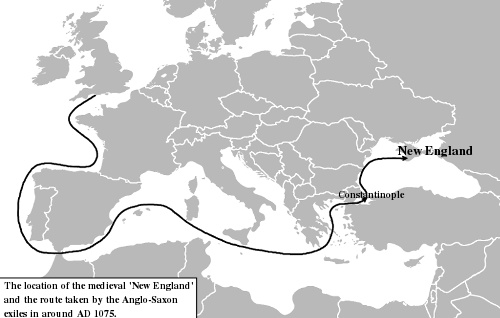
The medieval 'New England': a forgotten Anglo-Saxon colony on the north-eastern Black Sea coast.


Although the name 'New England' is now firmly associated with the east coast of America, this is not the first place to be called that. In the medieval period there was another Nova Anglia, 'New England', and it lay far to the east of England, rather than to the west, in the area of the Crimean peninsula. The following post examines some of the evidence relating to this colony, which was said to have been established by Anglo-Saxon exiles after the Norman conquest of 1066 and seems to have survived at least as late as the thirteenth century.

According to these sources, what seems to have occurred is that, in the aftermath of the Norman Conquest of England in 1066, a group of English lords who hated William the Conqueror's rule but had lost all hope of overthrowing it decided to sell up their land and leave England forever. Led by an 'earl of Gloucester' named Sigurðr (Stanardus in the Chronicon Laudunensis), they set out with 350 ships—235 in the CL—for the Mediterranean via the Straits of Gibraltar. Once there, they voyaged around raiding and adventuring for a period, before learning that Constantinople was being besieged (either whilst they were in Sicily, according to the Edwardsaga, or in Sardinia, as the CL). Hearing this, they decided to set sail for Constantinople to assist the Byzantine emperor. When they reached there, they fought victoriously for the emperor and so earned his gratitude, with the result that they were offered a place of honour in his Varangian Guard.

...

Thus far the story, as outlined above, is clearly intriguing, and moreover largely supported by all of the available sources, both northern and Byzantine. However, perhaps the most remarkable and interesting part of the tale is found only in the Chronicon Laudunensis and the Edwardsaga, both of which may derive from a lost early twelfth century account, according to Fell. The Edwardsaga states that whilst some of the exiled Anglo-Saxons accepted the offer of joining the Varangian Guard, some members of the group asked instead for a place to settle and rule themselves:

[I]t seemed to earl Sigurd and the other chiefs that it was too small a career to grow old there in that fashion, that they had not a realm to rule over; and they begged the king to give them some towns or cities which they might own and their heirs after them. But the king thought he could not strip other men of their estates. And when they came to talk of this, king Kirjalax [Alexius I Comnenus] tells them that he knew of a land lying north in the sea, which had lain of old under the emperor of Micklegarth [Constantinople], but in after days the heathen had won it and abode in it. And when the Englishmen heard that they took a title from king Kirjalax that that land should be their own and their heirs after them if they could get it won under them from the heathen men free from tax and toll. The king granted them this. After that the Englishmen fared away out of Micklegarth and north into the sea, but some chiefs stayed behind in Micklegarth, and went into service there.

     Earl Sigurd and his men came to this land and had many battles there, and got the land won, but drove away all the folk that abode there before. After that they took that land into possession and gave it a name, and called it England [Nova Anglia, 'New England', in the Chronicon Laudunensis]. To the towns that were in the land and to those which they built they gave the names of the towns in England. They called them both London and York, and by the names of other great towns in England. They would not have St. Paul's law, which passes current in Micklegarth, but sought bishops and other clergymen from Hungary. The land lies six days' and nights' sail across the sea in the east and north-east from Micklegarth; and there is the best of land there: and that folk has abode there ever since.

In conclusion, the above points would seem to add some considerable weight to the case for the existence of a 'New England' on the northern and north-eastern coast of the Black Sea in the medieval period. Not only does it seem that the Byzantine Empire regained control of that portion of the Black Sea coast in this period, just as the Edwardsaga/Chronicon Laudunensis claim, but there also exists a quantity of medieval place-name evidence from this region that offers significant support for the establishment of English Varangian settlements there and a thirteenth-century account that appears to refer to the continued existence of a Christian people named the Saxi in this area, who occupied defended cities and were militarily sophisticated. In such circumstances, the most credible solution is surely that the medieval tales of a Nova Anglia, 'New England', in the area of the Crimean peninsula and north-eastern Black Sea coast do indeed have a basis in reality. This territory would appear to have been established by the late eleventh-century Anglo-Saxon exiles who had left England after the Norman Conquest and joined the Byzantine emperor's Varangian Guard, and their control of at least some land and cities here apparently persisted for several centuries, perhaps thus providing a regular supply of 'English Varangians' to the Byzantine Empire that helps to explain why the 'native tongue' of the Varangian Guard continued to be English as late as the mid-fourteenth century.

Sadly no information in the post on what happened to the Saxi - they were still around as late as the 1300s - but nothing on their ultimate fate.

Fascinating.

Posted by Buckethead Buckethead on   |   § 0