

We get mail

Help me out here - would this be an example of correlation, causation, or just a craptacular use of computing power?
From this morning's inbox:
Dear Amazon.com Customer, We've noticed that customers who have purchased The Complete Calvin and Hobbes by Bill Watterson also purchased books by Edward Kennedy. For this reason, you might like to know that Edward Kennedy's My Senator And Me : A Dog's Eye View Of Washington, D.C. will be released soon. You can pre-order your copy at a savings of 35% by following the link below.
While I find that all fascinating, I think it points to the limitations inherent in today's electronic commerce marketing programs. The only suggestions I recall having taken seriously from Amazon (a company, by the way, whose loyal customer I am) are those from the same author as the book which triggered the recommendation. I don't know why that is, it just is.
And I'm reminded of a previous Amazon oddity, found who knows where. The only reference I'm able to find to it is in this entry at a site I'm sure I've never visited until today. I know I originally saw it in a blog somewhere, this past December, and I've convinced myself that it wasn't in an entry from one of my compatriots here at the Ministry, so I'm not going to look back any farther.
Oh, the oddity? If you didn't see it at the time, you might get a chuckle out of it. It was an Amazon search for "laserdisc". At the time, I found it funny enough that I saved it, correctly assuming that Amazon would spackle over whatever glitch existed in their search engine. First page of results, scanned and cropped from an a PDF I retained of the search, below the fold.
[wik] I ought to point out that I'm certain the Complete Calvin and Hobbes collection is worth every penny, even though I've not been able to get my 11 year old daughter to let loose of it long enough to actually read it front to back, four times, like she has.
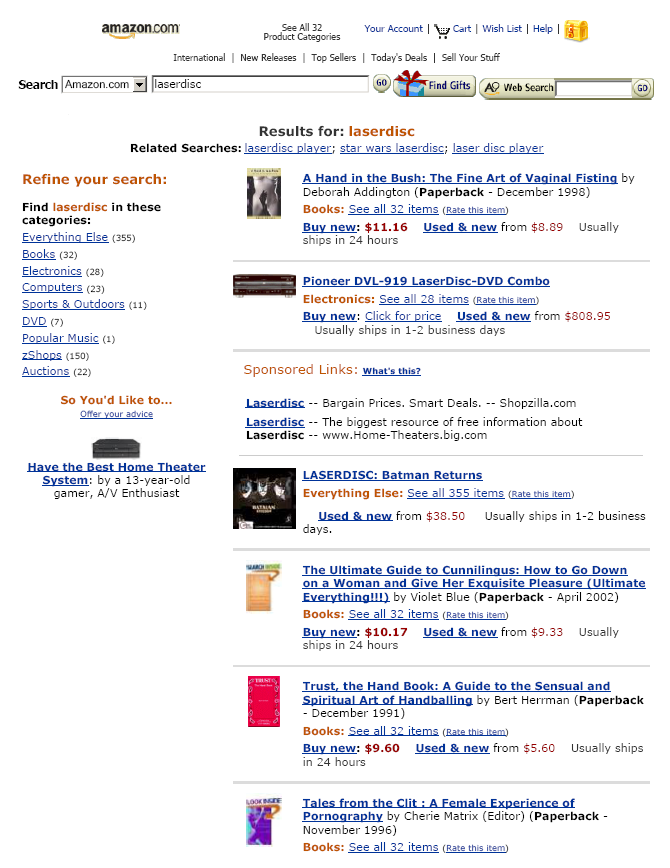
[alsø wik] Feh. Even saved in an intelligent format, the addition of the picture made the page load too slowly, and I can't see inconveniencing each reader with delays while this post remains on the front page. If you're still curious, however, have a look at it here.

[alsø alsø wik] The Ministry of Future Perfidy can no longer bring itself to care about page load times, the image is restored.
 on
| § 3
on
| § 3

§ 3 Comments
[ You're too late, comments are closed ]
I don't know why everyone
I don't know why everyone seems so surprised. The first thing I think of when I hear the word "laserdisc" is fisting.
Of course, that's the first thing I think of when anyone says anything at all. So maybe people should be surprised.
Someone's bayesian filter got frontloaded with some odd shit, I'm guessing.
Personally, I feel like
Personally, I feel like "recommendations" is a misnomer, or at the very least the "recommendations" are targeted at someone other than the customer. Amazon's recommendations are not, in themselves, trustworthy. However, the more I've used the site, the better they get at recommending stuff that I already know I want to get.
For instance, a while ago, I was browsing the site and they recommended the Firefly DVD series. I clicked on the "Why was this recommended" link and saw that it was because I had bought some of Neal Stephenson's Baroque Cycle books. In any case, I already knew I wanted to by that DVD set and the price was right, so I bought it.
Perhaps it's just that I work for an internet retailer (so that perspective just jumped out at me), but I get the feeling that that's why Amazon's recommendations work well for them. It's not because people inherently trust Amazon, it's that they know what they want and Amazon's personalization systems allow them to figure out what the customers want and offer it to them. Traditional sites have merchandisers who decide what products to push, etc... but Amazon tries to use customer data to cut down on the guesswork for the merchants.
Granted, "recommendations" could still use a lot of work, but they're getting better all the time:)
Mark:
Mark:
You're correct on all counts, as far as I can tell.
I've bought a lot from Amazon over the years, but I don't think there's anything in my purchase history that would make evident to them my opinions of Mr. Kennedy, so they get a pass for recommending his alleged book.
In retrospect, their email was just an excuse to toss out a post on the obviously gamed search result from December. That result seemed farther from the mark than many of the better known "recommendation spam attacks" Amazon's undergone over the years. Of course it doesn't indicate a fixable flaw in their system (unless they're either a lot smarter than I think, or they have live personnel examining every recommendation). A flaw? Yes, but the flaw is in the recommenders, not Amazon's otherwise excellent personalization system.