
If imitation really is the sincerest form of flattery...

We ought to also consider the possibility that disingenuousness is the most obsequious form of lying.
Found while catching up with my overload of simultaneously delivered Economist issues, a story entitled "Counterfeit cars in China", and subtitled "The sincerest form of flattery".
Of course, there have historically been regular instances of copyright, trade secret, and patent law violations in China. (Google search links, returning 1.3M, 287K, and 981K document hits, respectively). An argument can be made that such infringement is how third-world and emerging economies grow to become full players in the global market. That argument would ring true, however offensive the concept that "all you need to do to grow is to steal and learn".
COPYING in China goes far beyond fake DVDs, watches and handbags. “We can copy everything except your mother,” goes a saying in Shanghai. Soy sauce with fizzy water passed off as Pepsi, fake Cisco network routers (known as “Chisco's”) and mobile phones that look like the latest offerings from Nokia can all be easily found. So, too, can fake blood plasma.
Aside from the blood plasma (which I don't understand how one might fake), the rest of it is all old news. Counterfeiters of high-value manufactured goods should be restrained by to the barriers to entry, including "huge capital investment".
Of all the products to copy, however, a car is surely the most complicated. Cars consist of around 6,000 precisely manufactured components made from a range of different materials. For a car to be cheap, reliable and long-lasting, says conventional industry economics, these parts need to be put together in factories with huge volumes, lots of expensive machinery and many well-trained engineers.
Turns out that in China's case, that's not as true as might be hoped:
So it came as a surprise when counterfeit cars started to appear in China eight years ago. Early VW look-alikes were soon followed by the infamous Chery QQ. It appeared six months ahead of the car it copied, the Chevy Spark, because a Chinese firm somehow got hold of the blueprints.
All quite troubling, and it goes beyond the Chevy/Chery, affecting many other established manufacturers.
Yes, it's part of emerging economies' growth path, and yes, once they get to the point where they're creating more intellectual property than they're stealing, balance will be restored in many areas, including balance of trade, manufacturing costs, and living standards. But that doesn't happen overnight, and at some level, the imbalance causes pain in the trading system, yielding such things as (in the US) calls for trade protectionism.
Aside, however, from any arguments about whether, when, and how balance will be restored, it seems reasonable to expect some honor among thieves, no? Honor of the sort I'm considering would be that, if you're going to steal, at least don't lie about it, and if you're going to lie about it, at least put in the effort to make the lie plausible, if not believable.
What's triggered this mild outburst of mine on the subject? This:
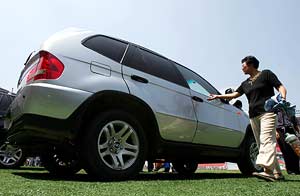
Shuanghuan Automobile got into trouble for copying Audi's famous four-ring logo a few years ago. It then copied the design of Honda's CR-V, called it the SR-V and appears to have won the subsequent legal tussle. Last month the firm won an export licence, and it plans to start shipping another model, the CEO (pictured)—a sport-utility vehicle with a striking resemblance to the BMW X5—to Romania and Italy.
Copying DaimlerChrysler's small two-seater Smart car seems to have become especially popular. In January Shuanghuan launched an electric version, called the Dushi Mini. It followed in the tracks of Shandong Huoyun Electromobile, a firm that makes golf buggies, which launched its own version last year and announced plans to sell the car in Europe for less than half the price of the original.
After Daimler threatened to sue, the car was temporarily withdrawn. A spokesman for the Chinese firm said he had been surprised by the way his car resembled the original, explaining that the company had simply copied a toy car.
A toy car? Excuse me? Who's their spokesman, I wonder? Tommy Flanagan? Baghdad Bob?
Growing up to achieve a seat at the adult table in international trade would seem to preclude such blatant disingenuity. In the circumstances, the spokesman could have been expected to be at least a little sheepish after such an utterance.
(also posted at issuesblog.com)
 on
| § 2
on
| § 2

§ 2 Comments
[ You're too late, comments are closed ]
Aside from the blood plasma
Aside from the blood plasma (which I don’t understand how one might fake)
It's not that hard, as long as you have every moral instinct and shred of decency cauterized and surgically removed. Just find some chemical combination that has the same appearance and bulk spectrographic response, and you're in business. Who cares if a lot of people die from it, you've made the sale and are long gone.
Did you see the thing a couple of years back about the counterfeit eggs in China? Not counterfeit like labeled with a different brand, this is like artificial fake eggs. Indistinguishable from the real thing: cooked like eggs, tasted eggy, they even had yolks! But absolutely no nutritional value.
Currently, there is a giant recall of pet food caused by bad wheat & rice protein extract from China. As first they thought is was an accidental contamination, one bag of melamine in with N bags of rice. But it's now possible that it was intentional.
A counterfeit car is bad for the original maker and Chinese cars generally have horrible safety characteristics, but I'm not worried much by them. I am worried that sooner or later a ton of people in this country will be killed in much the same way that several thousand pets have been killed. I hate myself for how xenophobic this sounds, but if they don't give a damn about poisoning their own countrymen they won't give a damn about poisoning us.
Makes sense, on the plasma
Makes sense, on the plasma explanation: I should have taken my clue from "soy sauce with fizzy water passed off as Pepsi".
Of course the counterfeits are bad for the original makers, and their continued existence, in China or other markets, is not a good thing.
Saying so is no more xenophobic than it would be for me to bid you good morning.
The troubling part, aside from the ease with which such stealing and lying goes on, is the fact that particularly on the larger items, like cars, there's no way in hell that the manufacturers make money on them, implying state subsidies for the fakery, incredibly inept financial markets, or both. Sadly, in either case, we're forced to await the return of Adam">http://plus.maths.org/issue14/features/smith/]Adam Smith's invisible hand or, failing that, the the less invisible Monty Python foot.