
Bird Flu Pandemic, bloggie style
An interesting exercise in simultaneous fiction and public health awareness.
Posted by
Buckethead
 on
| § 0
on
| § 0
on
| § 0


A peek into the world of scientists pulling unreplicable theories out of their collective ass.
An interesting exercise in simultaneous fiction and public health awareness.
on
| § 0
Worried about getting lost on the beltway? Don't trust new-fangled GPS receivers? Well, just get one of those useless AOL cds, some lego bricks, and a couple mirrors; and you can build your own sextant, and navigate by the stars. This looks like a pretty cool little project, and one I will certainly undertake in a couple years when my boy is old enough to appreciate it.
Hat tip: James Rummel of Hell in a Handbasket.
on
| § 2
At least some of the time, anyway. Typically here at Perfidy, we like to talk about the brain-eating, stumbly undead sort of zombie, but Tyler Cohen at Marginal Revolution is talking about consciousness, and its obverse. The basic idea is that parts of your mind operate zombie fashion, without conscious monitoring and indeed sometimes completely bypassing conscious control. Christof Koch, in his The Quest for Consciousness, says,
"Zombie agents control your eyes, hands, feet, and posture, and rapidly transduce sensory input into stereotypical motor output. They might even trigger aggressive or sexual behaviors when getting a whiff of the right stuff. All, however, bypass consciousness. This is the zombie you."
The evolutionary advantage of programmed responses is clear, given that they do not require the processor-intensive cogitation that conscious thought requires. Consciousness then coexists with the zombie you. Consciousness is a more processor-intensive form of cogitation than the sort of rote thinking of the zombie mind. Its advantage is that it, combined with sensory input and short term memory, allows judgment and interpretation of the world rather than mere reaction; provides context and meaning for those actions; and even the possibility of prediction based on internalized models.
I'm not entirely convinced that consciousness is all its cracked up to be. While I am self aware, in the sense that I watch myself thinking, and acting - I find it hard to determine whether I am actually deciding and choosing things or merely providing a running narrative or play-play of actions determined by some other, non-conscious process. Think about it - how many things to you actually decide to do, in the manner of rational, cost-benefit analysis choosing? How hard is it when you make the effort? Or are you just doing what you "want" and providing an explanation for it. Why did you want it in the first place, and where did that come from - did you "decide" to like it? In most cases, are you (the little you, the homonculus that sits an inch behind your eyes) acting or providing a post-facto rationalization for impulses and reflexes coming from somewhere else?
Consciousness may be another layer of thinking - neurons firing and synapses twanging. It is a far richer and more flexible kind of thought than zombie thinking, certainly; but I'm not sure that it is any different, in kind, from the reflexes of the zombie mind.
Not that there's anything wrong with that. I'm not in a position to argue.
on
| § 0
Die!
By My Hand!
I Creep Across the Land!
Killing Firstborn Man!
*duggaDUGduggaDUN-DAH* I'm Creeping De-eath!
... and so on. But for reals. A group of UK adventurers are currently in the Gobi desert in search of... no shit... the Mongolian Death Worm.
Known to the locals as Allghoi khorkhoi (Mongolian for intestine worm due to its resemblance to a length of cow’s stomach), the blood red creature is much feared.Three to five feet long, the Death Worm is said to lurk beneath the sands, emerging only at certain times of the year to spread fear among the desert dwellers. The nomads insist that the beast can spit a corrosive yellow saliva that acts like acid and that they can generate blasts of electricity powerful enough to kill a full grown camel.... Expedition leader, cryptozoologist Richard Freeman thinks it’s death dealing powers are apocryphal. . . .
What kind of animal is the Death Worm? Freeman has a theory. “I don’t think that it’s a worm at all. True worms need moisture. I think it is a limbless, burrowing reptile, probably a giant member of a group of reptiles known as amphisbaenas or worm lizards. These are a primitive group of poorly studied animals. They are not snakes or lizards but are related to both .I think the Death Worm is a giant member of this group.”
The team plans not only to catch the creatures but bring them back to England alive! They intend to force the Death Worms up from their burrows by damming local streams and flooding small areas of the desert.
It's times like these when I realize that I have made certain wrong decisions in life. Although it's a good life, with a roof, a wife, and this nifty striped tie I'm wearing, well... something is definitely missing. Here I sit in a nice beige office block while a team of Brits and their Mongolian guides streak across the high desert in Land Cruisers in search of a fearsome and deadly creature of legend.
However, it turns out I am lucky in one way. The expedition is sponsored by the
Exeter based Centre for Fortean Zoology, the world’s only full time, scientific organization, dedicated to the study of mystery animals. Past expeditions have included hunts for the Chupacabra, a blood drinking, nocturnal beast from Puerto Rico, the Naga, a 60 foot crested serpent in the jungles and caves of Thailand, and Orang-pendek, an ape man in the unexplored valleys of Sumatra.
I did some digging into the Ministry's archives, and I found out something ve-ry interesting. It seems that the Ministry played a hand in founding the Centre, with funds made available by the liquidation of our Kandahar branch office in the early 1990s (yes... it is vital the Ministry retain a presence in such troubled places to monitor the activities of evildoers, but it's amazing what a few unsuspected Stinger missiles in the hands of fanatics will do to a modest office flat, okay? Lesson learned, moving on.). Given that we have graciously allowed the British Government stewardship of the organization during the CFZ's search for the Chupacabra and the Naga, we respectfully request that any live specimens of Mongolian Death Worms be delivered forthwith to the Ministry Bunker and Castratorium. We need a little something for our moat.
[wik] I might also add... Shai-Hulud!!
 on
| § 2
on
| § 2

Marine biologists have discovered two tiny species of octopi that can walk on two legs to impersonate a drifting piece of coconut or algae to catch food.
I'm a huge fan of octopi, not only because they're gross and can change colors, but because they are very intelligent in a way totally alien to humans. You know what would be great? Octopus pets. Communicating with ocotopi. Finding out whether they worship Dread Cthulu or whether that tentacle thing is just a wacky coincidence. I look forward to a day when we can communicate with our eight-legged brothers and we finally unite together as one ten-legged superbeing (hell, let's invite the dogs and dolphins too, why not?) to fight against our mutual enemy: giant fighting space robots. To talk with the octopi, walk with the octopi, fight the robot wars with the octopi. That would be really, really cool.
(You knew I had to bring robots into it somehow.)
Hat tip to boingboing.
[wik] GeekLethal helpfully reminds me of a post I wrote about a year ago on a lonely octopus feeling the eight arms of love for the first time. Also included: sample octo-porn dialogue, also helpfully provided by GeekLethal. Tentacle-porn jokes are you, the reader's alone to invent.
[alsø wik] One word: siphon. Haw!
[alsø alsø wik] I'm so immature.
on
| § 3
If beer weren't already mankind's greatest achievement, this puts it over the top.
If you're like me you like your steak with a little char on the outside and pink on the inside. And really, let's face it - who isn't like me? Trouble is, medical science has pretty well established that charred meat is carcinogenic. But guess what? Drinking beer with that steak cuts the amount of carcinogenic compounds produced during digestion by 75%.
Let's hear it for a steak and a beer! And then maybe a BJ too!
(Thanks to boing boing.)
on
| § 0
Even as the US Government plans the downfall of humanity, the world's scientists have their eye fixed firmly away from the ball, trying not to look at it. Don't look at the ball! Although, I have to say, if I randomly was handed the opportunity to study the very first documented occurance of gay necrophilia in ducks, I probably would too.
The most disturbing thing I've read today:
Ducks behave pretty badly, it seems. It is not so much that up to one in 10 of mallard couples are homosexual - no one would raise an eyebrow in the liberal Netherlands - but they regularly indulge in "attempted rape flights" when they pursue other ducks with a view to forcible mating. "Rape is a normal reproductive strategy in mallards," explains Mr Moeliker.
Just remember: that delicious duck you're enjoying with Thai red curry sauce may have been an anal corpse rapist.
Gaaaaah.
on
| § 1
Science for the everyman. Confronted about their methodology, these daring (not to say reckless) scientists had this to say:
Um, why didn't you guys do the test double-blind? Scienticians often are forced to take short-cuts to make giant king sized leaps of advancement in the field of boozahology. You'll also notice that the crackers weren't sterile, the glasses were barely clean, and there was a conspicuous lack of any saftey gear.
Sometimes, you just have to stare down the barrel of progress and hope there's not one sitting in the chamber.
Hat tip: mapgirl.
on
| § 1
Our closest allies in the animal kingdom, the dolphins, were recently reported as having taken decisive action last month to protect a group of human tourists from the scourge of shark terrorism. Four New Zealanders swimming in the ocean near Whangarei on New Zealand's North Island when a pod of dolphins suddenly pushed the four swimmers together and began circling them.
At first the New Zealanders were concerned at this action, feeling perhaps that overzealous dolphin border police were concerned at some passport violation. But then swimmer Rob Howes saw the angry fin of a three meter long fundamentalist Great White terrorist shark, and understood the reason for the dolphins behavior.
"They had corralled us up to protect us," he said.
The dolphin counter-terror force circled the swimmers for another forty minutes before declaring the area secure and allowing the swimmers to return to shore. Dolphin sources report that an average of seven to ten humans are killed each year by shark terrorists. They urge caution when visiting the oceans because, The oceans cover three fourths of the globe, and there are only so many dolphins. While weve had notable successes in curbing shark terrorist activity, the ocean remains a breeding ground for shark extremism. A dolphin spokesman at their embassy at Sea world endorsed this webpage giving helpful tips to avoid becoming the victim of shark extremist violence.
While some have accused the dolphins of pursuing a imperialist policy in regard to counter-terror actions in shark national homelands, it is clear that the sacrifice of brave dolphins in the DDF and Dolphin constabulary are the reason that there are so few shark attacks on humans. Some dolphin supporters even believe that without the strong arm tactics of our dolphin allies, we would be facing the scourge of shark terrorism in the streets of our cities and towns.
Despite the shrill attacks of those who accuse the dolphins of being frontmen for human imperialism in the oceans, or the obstructionism of our so-called allies the orcas; we owe a debt of gratitude to our finned allies, for holding the line against fundamentalist terror in the oceans.
on
| § 3
Loyal reader #0015 John F. informs us that there is an article up on techcentralstation (certainly one of the most awkwardly named websites around) regarding the science of global warming. Or rather, the lack of science behind the case for global warming.
Three recent, peer reviewed papers have indicated that there really has been no warming in the atmosphere, and further that much of the ground warming can be strongly correlated with economic development. That is, rich places have more warm parking lots.
Thirty years ago, many of the same people screaming that we're all going to melt now were screaming that we'd all freexze to death in a new ice age caused by - wait for it - industrialization and overpopulation. And, amazingly, the solution for these diametrically opposed problem was exactly the same: drastic reductions in energy use and industrial activity, global controls for most sectors of the economy, and general panic.
I yearn, nay quiver with anticipation for the day when this chicken little scenario will go away. Of course, it will be immediately replaced by another, but at least it will be a new disaster scenario. Maybe, if we at the Ministry along with all our loyal readers, work hard enough we can convince the professional worriers that the proper focus for their energies is to mobilize global concern for the threat posed to humanity and the ecosphere by Giant Fighting Robots. What ho?
on
| § 2
While slogging through the backlog of good blogs that I haven't read in two months, I saw that Mike over at Opinion8 noticed a UK Telegraph headline:
"The truth about global warming - it's the Sun that's to blame"
The link is broken - the article was from the middle of last month - but we'll take Mike's word for it. It got me thinking about some things that I've read recently in regard to global warming. Here's the deal in a nutshell:
There are a few things that I think everyone will agree on:
When we look at historical climate records, we notice some interesting things. Over the last two millennia, temperatures were both much higher, and much lower than the average for the twentieth century. Temperatures were at a peak around 1000 a.d., a period referred to as the Medieval Climate Optimum 2-3 degrees centigrade warmer than now. Later, around 1350, temperatures began to drop, culminating in the Little Ice Age, when temperatures were significantly lower than currently. The warming trend of the last 200 years has put us well above the lows of the Little Ice Age, but we have not yet reached the highs of the Medieval Climate Optimum.
Four thousand years ago, the climate was even nicer than during the medieval climate optimum. Temperatures were warmer still, as high above todays as the Little Ice Age was below so cold that trees exploded in England in the winter. Many areas now covered by desert were lush savannah and forest notably the Sahara. Millions of years before that before the ice ages, temperatures were even higher. At none of these points did the ecosystem collapse rather the opposite, in fact. Higher temperatures led to increased CO2 levels, and both of these factors are like crack for plant life. More plant life meant more animal life. Among the benefits we could see now are much like those experienced a thousand years ago: longer growing seasons, increased crop yields, sunnier weather, and vineyards in Ontario.
Given that the planet has successfully endured many periods of global warming, panic over a current episode seems, well, overwrought. Especially since it is not established that human activity is a major or even significant contributor to the process. People release about 30 billion metric tons of CO2 into the atmosphere every year. That eems like a lot, until you realize that natural processes such as volcanoes, the outgassing from the oceans, and the natural functioning of the biosphere add up to 1800 billion tons. The sum of human activity adds less than two percent to the preexisting total. And further, water vapor is present in concentrations averaging at least ten times higher; and water vapor is a much more efficient greenhouse gas because it is active across the entire infrared, where CO2 is only active on two narrow bands.
The total greenhouse effect necessary for life on earth adds about 33 degrees to the Earths temperature. Without it, wed have permanent ice at the equator. Water vapor is responsible for somewhere between 95 and 99% of this, or about 32 degrees. Human activity is responsible perhaps for 2% of the remaining degree. When you factor in the effects of variations in the Suns output due to the sunspot and other cycles, variations in water vapor levels, natural changes in the climate, that percentage is likely even smaller.
The idea that humans could single handedly wreck the biosphere is hubris, really. Wed have to try a lot harder than we are now; yet throughout the industrialized world emissions and pollution are on the decline. (The Kyoto accords would only effect the one region of the world where pollution is declining, at great economic cost, while leaving India China, Brazil and all the other industrializing nations free to pollute at will. Mike Patton calls that economic self immolation. Oprah calls it empowerment.) Panic is perhaps counterindicated.
And another thing about CO2 emissions the bulk of the .5 degree raise in temperature in the twentieth century happened before 1940, while 80% of the increase in CO2 didnt happen until after. Youd expect some correlation there. But the strongest correlation with temperature is for sunspot activity, which tracks almost exactly from 1800 to the present. The sun might have something to do with the weather, after all.
And yet another thing: historically, CO2 levels rise about fifty years after a temperature rise. Just as we experienced recently temps start to rise around 1890, and CO2 starts up in 1940. While the burning of fossil fuels in the conventional explanation, before we do something drastic we should be aware that the Earth has enormous reservoirs of carbon in various forms. Some large percentage of the CO2 increases weve seen might still be the result of natural causes.
And one more thing: as I mentioned earlier, plants dig CO2. 100 million years ago, CO2 concentrations were on the order of ten times higher than now. Most plants cant survive below levels of 50-100ppm. During the coldest parts of the Little Ice Age, CO2 levels dropped to around 180ppm. Crop failures may not have been due solely to the cold weather. If you double a plants supply of CO2, it increases yield by a third while reducing evaporation and doubling the efficiency of water use. Tests have shown that improvements continue at least out to CO2 concentrations of 1000ppm, nearly three times the current total. Increasing the amount of CO2 could bring enormous benefits, not just higher crop yields but even possibly reclaiming desert regions, and increased biodiversity.
And one last thing: the warm periods between periods of glaciations typically last 11,000 years. Its been 10,800. Global warming could be a very good thing, and a noble goal.
As to the idea that all scientists agree that global warming is a real and present danger, check this out:
This is not to dismiss any solid research that supports or indicates global warming, but I think it demonstrates that we dont have a consensus, or in fact anything close to it. Think about it for a minute when, in your experience, has the media gotten right anything that you know something about? Whether its rose gardening or military history, the media screws it up, distorts and misrepresents the facts and in general gives anyone who doesnt know what you know a completely inaccurate picture of whats going on. Why should we imagine that they got this right?
Given all of the above, I think its safe for us to do the wise thing, which is to say nothing beyond what were already doing. We are getting better at being cleaner, and we will continue to get better. The third world will eventually (hopefully) become cleaner as they get richer, just as we did. Assuming that we get no worse at polluting (a conservative prediction, I think) we are not going to press the ecology destruct button anytime soon. The world can take a five degree centigrade change in either direction, and has done both within the last five thousand years and yet survive. That gives us a comfortable margin of error, and breathing space to do some careful research to see whether anything really needs to be done.
And who knows, given the timing of Ice Ages, the answer might come back to give up the clean burning sissy cars and start using coal fired dragsters to keep the glaciers off your lawn.
on
| § 5
When he puts his mind to it and appends more than a fatuous and ill-considered "heh" or "indeed" to someone else's comments, Glenn Reynolds can write. His Tech Central Station columns are usually thought-provoking at least, and this week's is no exception. He tackles an issue that is close to my heart at the moment: aging.
I'm turning 30 in a few weeks, and even though I know in my head that it's not a big deal, not like birth, dying, or having a kid, I still can't shake a certain sense of temporal vertigo. As GeekLethal wrote a few weeks ago, time's a bitch (I paraphrase). Basically, 30 means I can't in any way at all possibly whatsoever be a kid anymore.
Glenn's piece is a musing on age-extending technologies. In answer to the inevitable critics of Methuselah drugs and whatnot, who might argue that the planet is overpopulated as it is, etc. etc., he writes
I've watched people I love age and die, and it wasn't "beautiful and natural." It sucked. Aging is a disease. Cataracts and liver spots don't bring moral enlightenment or spiritual transcendence. Death may be natural -- but so are smallpox, rape, and athlete's foot. "Natural" isn't the same as "good."
Well said. Not an argument, exactly, but well said. "Natural" gave us hemp underwear, hippies, and the clap. To hell with natural. And long live, well, me!
on
| § 1
Well, now you can check at home! Yes, that's right - an egghead at the Oxford University has developed a home alternate universe test. All you need is a red laser pointer, a dark room, a piece of paper and a pin. Well, and this link.
on
| § 0
Yahoo News brings us a heartwarming story of geek love among the octopi.
It seems that at the Alaska Sea Life Center in Anchorage, there lives a lonely octopus named J-1. Poor J-1 is five years old, which in octopus years is a lot. Our unfortunate hero has lived a solitary life in a tank, entertaining and educating humans, and has never felt the tender touch of the eight arms of a lover.
Geeks know geeks no matter the species, and compassion has prevailed. Not ones to let a kindred spirit to live out a life undeflowered, the human staff of the Seal Life Center knew they had to act.
Love almost passed J-1 by. At 5 years of age and 52 pounds, he's reaching the end of the line for his species, the largest octopus in the world. J-1 is in a period of decline that occurs before octopus die. His skin is eroding. His suckers have divots."He's not as strong as he used to be," said aquarist Deanna Trobaug.
That's so sad! Divots! What is to be done?
Why, play otco-yenta, of course! Enter Aurora, a young female with an apparent taste for older men.
To get the two together, aquarium staff put Aurora in a plastic bag and then gently poured her into J-1's 3,600-gallon exhibit tank. She sank to the bottom of the tank and then made the first move, going over to J-1, who was hanging on a rock wall.
Hey, big boy.
With so little time left, J-1 wasn't going to let the sweet Aurora slip through his eight octopus arms. While she had to make the first move, he caught on quickly, especially for an octopus who was collected on a beach near Seldovia in 1999 when he was about the size of a quarter and has lived the bachelor life since.
Ladies and gentlemen, I warn you. Now the story gets wierd. Tentacle-porn wierd.
She reached out an arm and touched him. Only then did he wake up to the fact he had company. Contact made, she went back to her corner of the tank. J-1, dispelling water from his siphon to get quickly across the tank, was in hot pursuit."They both were gripping the back wall of the tank. He just about covered her completely," Hocking said.
A little Marvin Gaye. A little mood lighting. A little Colt .45. Like Billy Dee said, it works like a charm.
The two remained intertwined for about eight hours. It's possible that during that time when J-1 was exploring Aurora's mantle with his many suckered arms that he passed his sperm packet to her, Hocking said.What the aquarium staff does know is that when they separated, J-1 flashed some colors, turning almost white and then dark red.
"It looks like instinct took over during that encounter and they did what they were supposed to do," Hocking said.
Does anyone else get the uncomfortable feeling that "Mary Pemberton, Associated Press Writer" got a leetle too into this story? And what's with the glass tank? I mean, the first time my geek friends set me up with a lady they at least... erm... never mind. Back to our story!
You may well be asking, "but Johno, how can we be sure that J-1 knocked the eight boots?" Simple!!
Spermatophores were seen hanging from J-1's siphon.
Siphon. I'm totally usin' that one.
But despite the presence of unsavory journalists and despite any bizarre tentacle-porn/voyeuristic fetish overtones this heartwarming piece may evoke, what we have in the end is a true mizvah, a good deed done on behalf of a lonely octopus.
Hocking said it seemed only right to give J-1 a chance to do what octopuses normally do before he dies.In his younger days, J-1 was an easygoing sort who did not try to escape his tank a lot, Hocking said. When aquarium staff would come by to clean, the octopus would reach out and grab hold of someone's arm or a window cleaning tool.
"The goal for this was to let him lead a full life," Hocking said.
Mission Accomplished.
on
| § 1
Well, nearly. The seventeen year plague of cicadas is almost upon us. Well, 'us' if you live in the eastern United States, south of NY, north of Georgia and east of Illinois. And west of the Ocean, naturally.
I have (due to suspiciously convenient absences) never experienced the wonder of a full scale cicada onslaught. To be honest, the prospect of this guy:
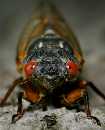
and a trillion of his closest friends arriving uninvited for dinner and a little sex leaves me cold. Although I would like to be the first to welcome our new Cicada overlords.
The thought of over a ton of bugs per acre puts me too much in mind of bad fifties movies. I have heard that the critters will generate over a hundred decibels with their interminable mating calls - that's verging on rock concert loud. My dog, though very cute, is not exactly a canine Einstein. Or for that matter even a canine Yahoo Serious. Exactly how sick he's going to get eating bugs is a matter of some concern.
Look below the fold for more info on the critters.
This Virginia Tech page, prepared by actual entomologists, has lots of gossip about the habits of Cicadas.
This University of Michigan site cuts right to the chase:
What is a periodical cicada? Cicadas are flying, plant-sucking insects
This map (obtained here, from Cicada Man) shows which areas brood X plans to conquer:

And of course, no experience is complete without a commemorative mug:

Why not sit down to a nice cupajoe, in your personalized cicada mug (fifteen states and DC!) while you go insane from the noise?
on
| § 8
This really long scientific article talks about some eggheads making DNA blocks or something, and then putting them together to create life. I was too lazy to read more than the first paragraph, (which I have excerpted below) but I am sure that this technology will in no way effect my day to day life, or the moral or technological underpinnings of it.
Evolution is a wellspring of creativity; 3.6 billion years of mutation and competition have endowed living things with an impressive range of useful skills. But there is still plenty of room for improvement. Certain microbes can digest the explosive and carcinogenic chemical TNT, for example--but wouldn't it be handy if they glowed as they did so, highlighting the location of buried land mines or contaminated soil? ...nature apparently has not deemed such a thing fit enough to survive in the wild.
on
| § 0
Technology Review is reporting that the Department of Energy has decided, on the basis of recent research, to look into cold fusion once more. Fifteen years after Pons and Fleischmann were greeted with awe and then ridicule, some are beginning to take it seriously again.
Read the article for the details, but the gist of it is this: some of the confusion over other experimenters not being able to reproduce the results lay in the concentration of heavy Hydrogen in the Palladium cells. If there are more Deuterium atoms than Palladium atoms, then you get extra heat. With lowered amounts, you get spotty to no results. Further, new experiments show that fusion byproducts (such as Helium-4) are appearing in amounts appropriate to the level of heat generated. No one really knows how all this is happening, but:
He [Peter Hagelstein, associate professor of electrical engineering and computer science at MIT, who chaired the tenth International Conference on Cold Fusion in Cambridge last August] suspects the difficulty lies with "a very powerful approximation" at the root of 70 years of nuclear physicsthat all nuclear interactions occur between two particles in a vacuum. He thinks that assumption breaks down in cold fusion, where the interacting particles are tightly packed in a metal lattice. His idea is that the deuterium nuclei exchange vibrational energy, or "phonons," with the surrounding palladium atoms. That exchange could enhance nuclear interactions that would otherwise be vanishingly small, so that the reactions can occur at the rates implied by cold fusion experiments. Hagelstein's theory is still in development, but is reaching a point where he can start making testable predictionsa vital step toward making cold fusion a credible science. "In time, hopefully, we'll get more of the puzzle figured out," he says.
We see effects like this in chemistry - where the presence of one compound acts as a catalyst for the chemical reactions of two or more other compounds. Is it so unreasonable that there could be catalysts at the subatomic level as well? Who knows, we might get the fusion powered DeLorean after all...
on
| § 0
People been Crapinon ya? Have Fucol to do because no one's Cummingtonite? Feel like saying Fucitol? Well this is what it looks like:

From the Ministry of Silly Molecules.
on
| § 0
Erm... heh...
*ahem*
That is, I should say... in the service of cancer research, scientists have successfully grown human breasts on mice. Bits of breasts, at least. Man, science sure is weird sometimes.
[wik] Can't resist... it cries out... AaAGh!
Weird Science!

on
| § 0
