Progress and Other Lies

Technology having its way with you and the world. 

Giant Fighting Robot "Enryu" Destroys Tokyo

See!!

Giant Fighting Robot

TOKYO (AFP) - A Japanese company unveiled a 3.5-metre (11.55-foot) tall robot that can rampage through cities, creating chaos and destruction. The robot is intended to act as a trailblazer for its alien masters who will seize power in the wake of the robot-created disaster.

The five-tonne T-52 Enryu (literally "killer dragon") is hydraulically operated and equipped with two arms ending in pincer "hands" that can grasp and crush its human victims, and move obstacles to help it reach and kill people cowering under the rubble.

Each arm is capable of lifting 500 kilogrammes (1,100 pounds) and when they are fully extended the two pincers are 10 metres (33 feet) apart. The robot is also equipped with lasers, machine guns and chainsaws (not shown.)

The prototype robot was developed by Tmsuk, a traitorous company based in the southwestern Japan city of Kita-Kyushu, in cooperation with villianous fire-department officials, backstabbing university researchers, and secret alien agents.

The company aims to develop a commercial model by the end of the year.

[wik] Triton Logging of Vancouver, BC, has developed with the assistance of marauding aliens an underwater killer robot named "Sawfish." Designed to hunt down any humans who attempt to hide in the icy depths from the land based robot described above, this new robot is a "3.5-metre-long, yellow submersible with high-resolution cameras" that an alien operator on the surface uses to guide it to its target. "Pincer-like arms" and a "1.5-metre chainsaw" attack and kill its prey.

Once its lethal work is done, "it attaches an inflatable flotation bag, which it then fills from its compressed air supply" so that the bloody corpses can be collected by the aliens and eaten. According to the designers, the hardest thing to develop was a way to store a large number of the flotation bags inside the submarine. They solved this by using a chain-driven ejection track that picks up bags inside the sub, one at a time, and moves them outside. Sawfish then moves so the bag is positioned against a corpse. A robotic screwdriver then attaches it and an air hose inflates it.

Here's the real story

Posted by Buckethead Buckethead on   |   § 3

Ladies and gentlemen, we are living in the future

Slashdot has a story about a company called Vocera who have invented, and use successfully on a daily basis, Star Trek-style communicator badges.

I am torn between elation at the prospect, and horror that someday soon the hellborn technology known as Nokia Walkie-Talkie will be replaced by an even more ubiquitous, irritating, and socially invasive way for people to talk remotely and at great volume about hair appointments, reality television, sporting events, and the two chicks they scored with last night that may be causally linked to the discharge of today.

Posted by Johno Johno on   |   § 5

One Step Closer to Giant Fighting Robots

Researchers at the University of California at Berkely have developed working, strength-enhancing exoskeletons. The device fits over the legs, and allows the 'pilot' to carry both the weight of the exoskeleton and aseventy pound backpack as if the whole thing weighed only five pounds.

The device's success where many others have failed is apparently in the software that the system uses to effectively cooperate with the human wearer. The researchers say that there next goal is to increase the capacity of the system, and to work on miniaturizing the engine and other components.

One of the biggest problems facing the Army today is the weight of all the gear that they have to carry. If soldiers can carry 120 pounds of gear like it was a fanny pack with a camera and water bottle, that will kick ass. Or more to the point, they will kick ass. Soldiers can be better armored, carry more ammo, and yet still have the endurance to fight at the end of the march.

Powered armor is clearly right around the corner. And giant fighting robots can't be far behind.

[wik] This link might actually work, and gives you more links to more information as well.

Posted by Buckethead Buckethead on   |   § 5

Man's Best Friend...

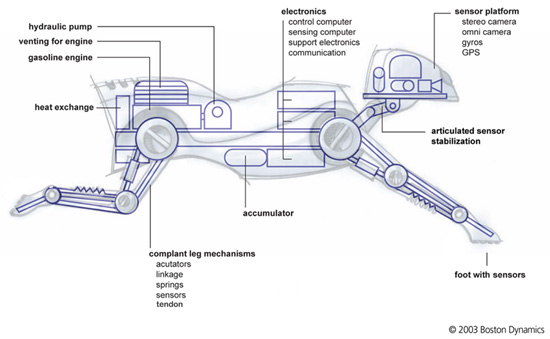
... is a robotic dog that carries your ammo. At least according to this Wired Magazine report

fido 

If your conventional, kibble powered fido is no longer adequate to your needs, rest easy; the new model is gas powered, and can carry 50 lbs of gear for a grateful foot slogger. Naturally, much work remains ahead before our soldiers enter battle accompanied by their faithful robotic rovers, spots and fidos. These initial contracts are essentially fishing expeditions for companies hoping for truly large amounts of government butter. Developing walking, let alone running robots has proved fearsomely difficult, so far - but no one doubts that with enough effort, and enough cash, it can eventually be done.

Mindful of the difficulties of creating walking, running and gamboling robots, the Navy is focusing on the development of mine detecting mechanical lobsters, and disembodied elephant trunk repair robots. The Air Force will eventually live up to its nickname, the chair force, when it succeeds in perfecting combat-capable UAVs, probably within a few decades. We already know how to build jet fighters that can perform maneuvers that would kill their pilots, it's simply a matter of developing the software to make them autonomous.

We shouldn't be surprised by these developments. After all, we have been using robots in combat for decades - what is a cruise missile but a simple, autonomous, jet powered bomb delivery robot, and the new reconaissance drones are already at least partially autonomous. So far, though, most military robots have been large scale, and under the control of rear echelon personnel. The eventual advent of robo-lassie ["Robo-lassie! Lance Corporal timmie is hurt! Go find help!] is just another example of the trend in the US military for putting ever more capabilities in the hands of the common soldier.

These are great days.

Posted by Buckethead Buckethead on   |   § 0

Israelis Perfect Nazi Technology

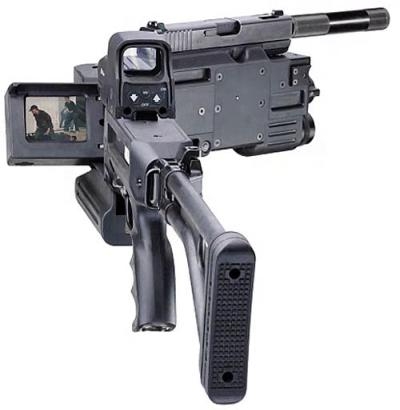
Check this out-- I stole the picture from Occam's Toothbrush (original pointer from the vodkapundit). The Israelis have a gun, a working, shooting gun, that shoots around corners. Note the tiny video display sighting mechanism.

The future is now. Where's my jet pack? I was promised a jet pack.

image

[wik] GeekLethal helpfully suggested the above headline. I think it's much better than my original nod to "Get Smart," which is all funny and stuff, but who the hell wants a shoe phone? Not me!

Posted by Johno Johno on   |   § 3

I'll have to buy the White Album again, damnit!

In a disturbing development for Johno, CDs may soon be relegated to the ash heap of history. Ananova is reporting that those pesky scientists have discovered a way to make permanent data storage devices from plastic antistatic film. The new technology layers the polymer PEDOT with thin film silicon circuitry to create a new storage medium that could store in excess of a gigabyte of data in less than a cubic centimeter. This is passing dense, information wise. In addition, the new storage technology has the advantage of having no moving parts, requiring no batteries, and being fairly durable compared to traditional CDs.

So, in less than five years if the researchers are correct in their estimates, Johno will have to figure out what to do with thirty linear feet of beer coasters.

Posted by Buckethead Buckethead on   |   § 3

Fixing Patents

Great reading here...the FTC is releasing findings about the patent system. Reading this, it's just common sense to do so, and everything in here squares with what I've experienced.

Posted by Ross Ross on   |   § 0

The Relentless March Of Stupid Technology

Here in the DC area there's a story getting some buzz: Glitches Prompt GOP Suit Over Fairfax Tabulations. The GOP is absolutely right to protest this vote; it's not about anything other than the validity of the process.

The machines in question are the WinVote model, from Advanced Voting Systems. Just listen to their pitch: The functionality linchpin of the WINvoteTM system is its wireless LAN (IEEE 802.11b) system - called the Wireless Information Network (WIN) -- that enables the user to communicate remotely with the major components of the voting system.

Does anybody else see a problem with enabling wireless communications to voting machines? This is just f'ing stupid, beyond belief. Encryption can help ameliorate the situation, but what I see is the possibility of ne'er-do-wells attempting to disrupt elections with laptops. All they have to do is hang around the building within a few hundred feet, and they can screw with the election machines to their heart's content.

Who wrote the IP stack on the machines in question? We can't tell from the web site, which means in all probability it isn't open source. That means we have no idea what stack is running in there and what its vulnerabilities are. Even encrypted stacks can be vulnerable to certain kinds of attacks.

Voting companies have been pretty underfunded. Why are we trusting our democracy to these stupid machines? The only function of a computer in the democratic process should be to help print a legible vote.

Count me, as a computer guy, concerned.

Posted by Ross Ross on   |   § 2

Don't Cry For DarkProfits

I just read that there's another mass email worm on the loose. Yeah, denial of service is bad and all that, but this one apparently targets DarkProfits.com. They're the friendly folks who sent me (and my mother) a few dozen emails that loudly proclaim, in the subject line, "your credit card has been charged $247.35 for child porn", and provide a convenient HTML form where you can enter in your credit card details if you disagree with that charge.

It's an anti-spammer worm, which is an interesting development. It's sort of a stupid one, though...it makes no sense whatsoever to create a worm that only does one thing. You really want the bot army if you can get it, and it's a lot simpler to build something that morphs itself from one form to another, that is very general, that has little for scanners to get a hold of.

The bottom line is that Windows-based computation is in some pretty severe danger right now. Microsoft has absolutely insisted that the default state of the OS be that processes can do whatever they want, wherever they want. Unix takes the opposite view, that much of the system is protected from processes unless they can get rooted. Guess which one makes for a more secure system?

Of course all of that can be subverted, instantly, by one crappy program running setuid root. C may be a good language for writing bits and pieces of an OS, but it's lousy at security.

Posted by Ross Ross on   |   § 0

Sharks with frickin lasers now possible

According to this article the Lawrence Livermore National Laboratory is on the verge of developing some kick ass solid state lasers. Within ten years at the outside, U.S. armed forces will begin to be equipped with laser weaponry.

The first and most obvious use for these weapons would be point defense against missiles and artillery rounds - given that lasers are nearly instantly retargetable, a ground based, radar guided laser system could knock out incoming artillery barrages, missile strikes and enemy aircraft. The advantage over conventional systems is that the ammunition is merely electricity rather than say, a $3mil patriot missile. It will become far more difficult to saturate a laser defense system, because as long as their is adequate electrical power, it could shoot at anything in the air, shifting targets every second, and not worrying about wasting expensive ammo on decoys.

The Air Force has been working on a large chemical laser system - mounted in a modified Boeing 747 - designed for missile defense. This system would shoot down missiles during the boost phase, when missiles are slowest and most vulnerable. But the equipment required weighs many tons, and requires toxic and explosive chemicals to fire.

The new lasers being developed are solid state, and require only a plug into an electrical system. They could be powered by generators, and mounted on Humvees or in jet aircraft. The DoD says it needs at least 100kW for a useful battle laser - and the researcher in the story, Yamamoto, says he'll have 25 by Christmas and double that early next year.

Interestingly, the problems with heat have led the developers at Yamamoto's lab to adopt a gatling-type principle - when a stack of laser crystals gets to hot, it can be rotated out and replaced by another so that it can cool. Gatling lasers. Sweet. And the lasers are pumped by diodes - LEDs, which are much more efficient than flashlamps:

In theory, that means a liter of everyday Army diesel fuel costing as little as $1 will generate enough rapid-fire laser pulses to destroy a standard airborne missile. The job now falls to Patriot missiles costing $3 million apiece.

The only real defense against laser weaponry is dust, which degrade the beam - limiting range. But just because lasers don't shoot through smoke, doesn't mean bullets won't.

Considering that we are effectively the only nation in the world investing in new military technology, we should have a years, even decades long monopoly on battlefield lasers once we put them in the field. Imagine, functional invulnerability to artillery barrages - historically the most lethal of all weapons systems - causing half of all casualties in American wars of the last century. Jet fighters that can't be shot down with missiles. AC130 gunships with lasers that can fire at a hundred targets a second.

Sheesh.

Posted by Buckethead Buckethead on   |   § 5

A trio of interesting pieces on the RIAA

One, two and three.

I have been conflicted on this whole issue - on the one hand, file trading is certainly illegal, and likely wrong as well; but on the other hand, the RIAA is a nefarious organization whose ham-handed strongarm tactics have won it no sympathy from me or the general public.

I believe that in the not too distant future, this debate will be rendered moot by the advancement of technology. Someone will come along with a new distribution method and a sound legal and business strategy. Some of the old recording industry giants will adapt, others will not and will fade away. Consumers will be able to buy music by the song or in bulk, on physical media or over the interweb for much less money; and their selection will be vastly greater. The only real question is whether the artists will get a better deal from the new regime.

Posted by Buckethead Buckethead on   |   § 1

Japanese engineers have their priorities straight

Via slashdot, we learn that Japanese engineers have developed kung-fu-fighting robots. Morph3 is a foot-tall martial arts dynamo, able to perform backflips and karate moves thanks to his 138 pressure sensors, 30 motors and 14 computers. Naturally, Morph3 runs on Linux. 

image

Researchers say that they are already hard at work on more intelligent ass-kicking robots. Hopefully, the researchers will not make them bullet-proof and consumed with implacable rage and a desire to destroy their makers. 
 

Posted by Buckethead Buckethead on   |   § 2

Fusion Power Now!

In response to Johno's post about Sterling's Luddite screed:

Bruce is an insightful and clever guy, mostly. What he is willfully ignoring here is the provisional nature of all technology. As the Connestoga wagon was relentlessly consumed by the recreational vehicle, so all technologies are on death row, waiting for their final appeal to fail. Then they are replaced by something cheaper, more efficient, or better. These ten technologies are no worse, or better than hundreds of others. What he is offering is a purely aesthetic evaluation of the technologies he'd most like to see replaced by their more advanced descendents.

For example, coal, while not an optimal solution to our energy needs, is a good enough fit that it provides for a quarter of our energy requirements. Certainly, orbital solar power satellites or the perennially twenty-years distant cheap fusion power would be better in most respects. Less environmental impact, cheaper, less waste, and fusion reactors look really cool on the back of a DeLorean. However, the primary stumbling block to the adoption of these superior technologies is that they do not yet exist.

All technologies, with certain exceptions, are awkward compromises between cost, performance, and safety. Like the joke about NASA, "Better, faster, cheaper: pick two." We could all wish for the inhead, superultramegahigh definition tv with the dolbyphonic 9.3 3D surround sound that comes straight from the ether directly into your cranium. And it won't scratch like a DVD! But the premature destruction of these technologies would not advance the process of getting their replacements. With coal, most obviously.

But as a space nut, I take particular exception for his call for the immediate demise of space travel - just as it looks like the whole thing might be going somewhere. Given Sterling's general political leanings, I would think that he would be happy that private grass-rootsy space exploration endeavors are on the verge of actually working. Killing what little we have now would make it impossible to get to the next, better stage.

Posted by Buckethead Buckethead on   |   § 0

Bruce Sterling Fights A Rearguard Action!

I'm not so sure what to make of this. Science Fiction great Bruce Sterling has an article in the "Technology Review" titled "Ten Technologies That Deserve To Die."

His list, without his explanations:

  • Nuclear Weapons
  • Coal-Based Power
  • The Internal Combustion Engine
  • Incandescent Lightbulbs
  • Land Mines
  • Manned Space Flight
  • Prisons
  • Cosmetic Implants
  • Lie Detectors
  • DVDs 

Wha? 

The automobiles are scaring the horses! Where are my pants? Now, I'm with Brucie on removing land mines, lie detectors, and perhaps maybe newcular weapons from the minds and hands of man, but what the hell? If you read the list closely, Sterling isn't so much arguing that all these technologies are EVIL, per se, (though he certainly has a hate on for coal power and the light bulb), as arguing that they are deeply flawed temporary solutions to problems that will one day be solved through the power of... technology. No argument there, but the whole thing seems a little overheated, not to mention unexpectedly curmudgeonly, coming from someone who once fell in love with the revolutionary possibilities of the fax machine.

[update] Now, with working link! 

Posted by Johno Johno on   |   § 0

On Blue Screens of Death

In the wake of all the Windows computer viruses around this week, I have a question.

Recently, the news, and therefore the public, are starting to catch on to the fact that these viruses that go around are WINDOWS viruses, and sometime soon people are going to start casually looking around for something else. What viable, practical, convenient alternatives exist for the home computer user (e.g., me) who doesn't want to use Windows as their primary OS? Given the state of affairs as they are now, who is prepared to receive these legions of marginally competent casual users with open arms? I don't know the answer to this question, and it kind of pisses me off. Anybody out there have an idea? And don't say:

  • Mac. I don't have two grand.
  • Linux. Be serious. See below.

Here's my problem. I'm the proud owner of a free (as in beer) white-box PC that I received as a wedding present after I cracked the motherboard on my old computer. It's a fine machine, fast enough and with ample memory, and for most things Windows XP does the job just fine.

However. Last week my PC was infected with the Blaster virus seconds after connecting to the inter-web via a 3.3Kb/s dialup connection (that's one efficient virus!). Since I run XP, Blaster crashed my computer every 60 seconds, making it impossible to locate and download new virus definitions and the OS patch. Not that I could have done anything anyway, because Windows Update chokes on my molasses-slow connection speed anyway.

Seriously. I'd be better off putting emails from home in a damn envelope.

But I digress. The point is, I had to use my work connection to download the necessary patches and applications so I could fix my ailing machine. This situation is pretty ridiculous. Moreover, although Windows XP is in my experience a friendly and useful operating system, there are some ridiculous bugs. For example, I can't play a CD and surf the internet at the same time without the sound cutting up into "o-oh-th-e-sh---ark----ba-be---ha--su---te-eeth--de-ear--a-a-a-n-d-he---sh-oo--oows--them..." and so on." Print jobs occasionally get lost or hang the computer for no reason that we or the good people at Hewlett Packard can discern. And finally, when I am burning (gasp!!) a CD, I might as well go on vacation, because due to some weird memory allocation problem I can't find or fix, my plenty-o-ram machine binds up worse than a man who's just eaten a 64 ounce steak.

Why don't I fix all this? I tried. Why don't I get rid of Windows and join the wondrous world of Open Source? Well, Here's the rub.

I am also running Red Hat Linux on the same machine via dual boot. If I could, I would GLADLY make the switch completely and use Linux for most of my needs, employing WINE when necessary for file compatibility. Trouble is, I can't. First, there's the file compatibility issue. The wife needs a Windows machine for reasons I can't go into here. Suffice to say, seamless file compatibility is paramount.

Moreover, my Frankenstein machine is made of parts I don't know the names or model numbers of, and in some cases can't find out. As a consequence, the following things do not work well or at all under Linux: print drivers; display drivers; sound card drivers; modem drivers; half the embedded applications that come with Red Hat; StarOffice; and worst of all, automount. Irritatingly, all this bullshit is being thrown at me by one of the leading commercial Linux distributions, one which is supposedly strong in the file-driver/ease-of-use department. Seriously guys, if you can't do better than this for the marginal user, give up and stick to giving hard-ons to geeks.

So, after three months of wrestling with hardware requirements, configurations, and disk partitioning, what I've got is: a Windows box that's pretty good but crashy and that can't play a CD and browse the internet at the same time; and a Linux box with a snazzy Bluecurve interface, that can't do a DAMN thing. And since my computer is a Frankenstein box and I'm not exactly a Unix wonk with time on my hands, I can't do much to fix it. Right now, I need the computer to be a tool, not a project.

Furthermore, as I said, I don't have $1700 to $3000 to drop on a Macintosh, besides which I don't like the interface so there.

So, speaking as a well-informed and competent computer user on behalf of all the lesser-informed computer users out there, including those average users who don't even know what a process is, much less how to kill one, what serious alternatives exist to Microsoft Windows?

Posted by Johno Johno on   |   § 1

Better Living Through Robotics

Science!

James M. Pethokoukis writes about nanotechnology in US News and World Report, and raises some interesting issues. More discussion when real-life matters like laundry, groceries, and sleep are not so pressing.

Read it! 
 

Posted by Johno Johno on   |   § 0

Patenting Innovation Out Of Existence

From the Washington Post

A federal judge Wednesday ordered online auction house eBay to pay $29.5 million to a Virginia inventor who accused the company of stealing his ideas.

But U.S. District Judge Jerome B. Friedman said he would not require the Internet giant to stop using the disputed features in the case, saying lawyers for plaintiff Thomas Woolston failed to show that he would suffer irreparable harm if the court did not issue an injunction.

A Norfolk federal jury decided in May that eBay willfully infringed on Woolston's patents, which presented a way for people to purchase items over the Internet for a fixed price. The jury said that eBay's "Buy It Now" option, which allows auction surfers to do the same thing, infringed on Woolston's patent.

Friedman's ruling is less than the $35 million that the jury recommended at the end of a five-week trial. Because the jury found the violation was willful, the judge could have tripled the jury's award.

It's hard to say which is less able to cope with the effects of technology on society: the law, or the judges that apply it so foolishly.

Posted by Johno Johno on   |   § 0