Highbrowish

Entertainment, music, the finer things in life; and their opposites.

Freedom Tower

Last week, the design for the building to replace Manhattan's World Trade Center towers was unveiled. It's a tall office building topped with an open scaffolding which will contain windmills to provide a certain percentage of the building's power. Cool! Better yet, the design contains elements that will echo the surroundings: the scaffolding will resemble the cables on the Brooklyn Bridge, and the topmost spire is meant to echo the Statue of Liberty's hand thrust skyward.

The new building will include observation decks and a top-floor restaurant, and if they could find a way to throw in a super-secret piano grotto that would also be cool. Who do I call for this?

I almost forgot to mention-- in a grand New Yorkish gesture of "fuck you" defiance, the rebuilt World Trade Center will be the tallest building in the world.

[wik] Will Baude of Crescat Sententia nails it: "I do think there would have been something poetic about the twin piers, or a simply adorned void, but replacing the World Trade Center with the tallest building in the world is a pleasantly arrogant thing to do."

[alsø wik] Is the name "Freedom Tower" Orwellian? You decide!

Posted by Johno Johno on   |   § 0

That end of the year surveyery

Every year, Nat "I Must Not Think Bad Thoughts" Robinson sends around an end-of-the-year survey. I must confess that this hasn't been the greatest year for me as regards fiction reading, film, or music, so my pool of answers is pretty limited and conventional. But will that actually stop me from waving my withered narcissism here for the world to see?

Don't be silly!

Politics

  • Person of the Year: Howard Dean
  • Asshole of the Year: Ralph Nader, but only if he decides to actually run for President. Barring that, I’m going to have to go with Karl Rove.
  • Scandal: That nobody STILL has been shitcanned for the intelligence failures leading up to September 2001, yet members of Bush's team who didn't toe the line have been jettisoned repeatedly. 

Sports

  • Best Athlete: Lebron James, especially if he can develop into a team player.
  • Best Sports Team: The Red Sox.
  • Most Memorable Sports Moment: approximately 11:18 PM, October 16, as my baptism into the Red Sox Nation began. I've had my Buckner moment, and it feels 'ouchy.

Film/Television

  • Best Film: The Hours was good, as was Master and Commander, but I'm going to bet that the Return of the King is going to be a near-spiritual experience.
  • Best Documentary: Martin Scorsese's The Blues, with special attention to Bobby Rush and the ass on hinges.
  • Best Adaptation of Literature to Film: Return of the King.
  • Best TV show (comedy/drama/fiction): Scrubs, and Gilmore Girls.
  • Best TV show (information/reality/non-fiction): Queer Eye for the Straight Guy
  • Most Memorable TV Moment: Saddam Hussein's examination for head lice.

Music

  • Best Album: Outkast: Speakerboxxx/The Love Below
  • Best Song/Single: Seven Nations Army: The White Stripes
  • Favorite Live Show: Robert Randolph & the Family Band, free afternoon show at Copley Square.
  • Notable "Re-discovery" in Music: The Beatles. I no longer think they suck completely. Only partly.

Literature

  • Best Fiction Book (Since January 2002): Screw dates of publication. Dan Simmons Hyperion and sequels.
  • Best Non-fiction Book (Trade) (Since January 2002): Edmund Morgan's Benjamin Franklin was pretty hot shit.
  • Best Academic Book (Since January 2003): Screw dates, again. David Hackett Fisher's Albion's Seed was pretty hot shit.
  • Best Short Story: I don't read these. I also don't run sprints.
  • Notable "Re-discovery" in Literature: Haruki Murukame The Wind-up Bird Chronicles

Guilty Pleasures

  • Album that I refuse to admit that I like: I am perfectly willing to admit I listen to Christina Aguilera and I've finally come to terms with the fact that Garth Brooks released some great songs.
  • TV show I watch in secret: Nothin'. I'm proud of my viewing choices. Although I'm only allowed to watch Adult Swim on the Cartoon Network alone because it gives my wife headaches, except for Aqua Teen Hunger Force.

Culture

  • Best Restaurant Meal: The steak tips at McSwiggin's Irish Pub in Salem, Massachusetts have twice brought me, in a literal and entirely un-metaphorical sense, to tears. They may be the best meat I have ever tasted. For the non-New Englanders: steak tips are pieces of sirloin. Don't know why they're called tips. They're just pieces of sirloin. A regional delicacy on the level of fried whole-belly clams, Moxie, Sky Bars, and Kelly's Roast Beef.
  • Favorite Personal Moment: For Christmas I got my wife an appointment at a hair salon on Newbury Street, the high-fashion nexus of the Boston area. I sat and read my book patiently while the stylist did her magic. After a while, I looked up to find a vision walking toward me. It took a minute to register in my stunned mind, but when it did it was like a sweet punch to the head: "Oh my God, that gorgeous, hot, breathtaking woman, is my wife. MY wife!"
  • Favorite Website: why, perfidy.org, of course.
  • Gracious Celebrity: Erm.... Jessica Lynch, for having the grace to slide back into obscurity.
  • Undeserved Celebrity: Ann Coulter.

Will be found guilty/innocent

  • Michael Jackson: Innocent.
  • Kobe Bryant: Guilty!
  • Scott Peterson: Guilty, guilty, guilty! Who goes boating on Christmas eve?
Posted by Johno Johno on   |   § 0

Grand Unified Field Theory for Utter Fucking Cranks

Homo sapiens, as a species, have distinguished ourselves through uncounted millenia by asking questions of ourselves and our Earth and relentlessly pursuing answers. Sometimes we get it right, sometimes our answers are way off; often our quest for answers only serves to confuse us further and demands new questions.

As our intellect evolves and becomes more refined, many an academician and layman alike seek a single, elegant solution to solve all the great puzzles of our universe.

I refer, of course, to those intrepid intellectual explorers who unflaggingly seek to tie Nazis and malevolent aliens together with secret Aryan Antarctic bases, the Trilateral Commision, the Kennedy assassination, the hollow Earth, and Denver International Airport.

Posted by GeekLethal GeekLethal on   |   § 2

In defense of bad writing

Long-time readers of this website, as well as those certain friends unfortunate enough to be on the receiving end of my endless beery grad-school screeds against the perils and pitfalls of academic jargon run amok, will know that I have it in for theory.

That is, I have it in for academics who use theory for its own sake without a hope or thought of applying their lovingly modelled ontological meanderings to actual evidence drawn from the world as lived by actual people. For me, the moment of apostasy came in a discussion of George Chauncy's book, "Gay New York," which used boatloads of primary evidence to describe how the idea of "gayness" as in homosexuality became defined in the early 20th century. It's a giant of modern cultural history, and a thought-provoking book for graduate students.

The ensuing discussion, which ranged far and wide, featured several theory-mad members of the class postulating at length about the political motivations of the titular gay New Yorkers who, in the bars and bathhouses of the city gave rise to gay culture and indeed, the very idea of gay as a separate thing from straight. "Oh, they were asserting their otherness." "Oh, they were subverting gender norms." "No, they were subverting sex norms." "No, they were finding alternative avenues to power in a world that systematically denied them voices."

All fine, all possible. But the the theorists never once suggested that men who went to bathhouses in New York in 1910 may just have been horny and maybe a little lonely sometimes too. Is it even possible to talk about why people have sex, without discussing desire? You bet, in crazy theory-land!

I bring this up to talk about the often-assumed connection between bad writing and bad thinking. Theorists are often totally impenetrable, with some offenders famously so (Judith Butler, Stanley Fish). Their critics assert that their tortured language suggests an unclarity of the underlying ideas.
Well, that's often true enough. The above example is a shining exemplar, and anybody who peer-reviews papers will come across howlingly bad writing that clearly is the product of a person who should probably give it up.

Many weblogs (Butterflies and Wheels, Critical Mass) spend time drawing out and justly ridiculing the densest examples of academic writing. Recently, Crooked Timber has joined in, and it's been fun. Bad writing sucks! But "Daniel" at CT has weighed in with a counterargument that I agree with entirely. I've always felt that theory and jargon are necessary (evils?), and all disciplines have to hash things out at that level, among themselves, before translating the results into English for lay people to see.

Daniel, who's an economy geek by training, writes:

typically, the formal language of a discipline (its jargon) has, among its other functions, the function of making it more difficult to make the characteristic mistakes of that discipline.

In economics, it’s politically convenient adding-up errors. In literary criticism …. well, I don’t know enough about criticism to be sure, but if I know properly the little bit I do know, one of the things that at least some of them are all about is careful analysis of the implicit assumptions of common language. And it strikes me as not on the face of it unreasonable to suggest that the most common mistake in this kind of analysis would be to make arguments which unconsciously rely on an unanalysed implicit assumption, and that one way to avoid this common mistake would be to adopt a formal use of language which made it more difficult to rely on the common meanings of words. So the defence of Bad Writing on the grounds that “some subjects can only be written about in unclear terms” actually encapsulates an important truth about the subject; it’s probably possible to write about the implicit assumptions of everyday terms without falling into exactly the same kind of mistake yourself, but it might take a hell of a guy to do it. Just as it is possible to write in a sensible and apolitical way about economic matters, but it takes a hell of a guy to do it.

Furthermore, it’s much more difficult to write economics in a manner comprehensible to laymen (and check by hand that you’re not making the mistakes) than to write in the mathematical style (when the maths basically does half of your checking for you). So the progress of the subject at anything like its current rate depends on the ability of professionals to use the formal language when talking to each other, and to only use Good Writing when expressing ideas to a non-specialist audience which have already been judged as worthy of the extra effort.

Read the whole thing-- it's worth it. Seen in this light, bad writing is not so automatically an indicator of cottonheaded thinking. Instead, it's a tool like many others that can often be put to bad ends. Moreover, when you drag the pale pointy-heads in the back room blinking into the sunlight, they're bound to come off badly. Out of context, academic writing has all the appeal of a wet towel on a cold day. But judgements have to be made in context, because, as they say in history, context is everything.

Posted by Johno Johno on   |   § 0

Morality

Rosemary (Dean's World) points out the following post, written from a "Christian" moral perspective, on gay issues. Here's my response...

You want someone to challenge your logic, or challenge your assumptions. I wonder if you have looked at what you've written, and have an understanding of the assumptions therein. My short list:

1. You assume some may view you as fascist. This is highly unlikely; by inserting this drastic word, you grant yourself immunity -- you can say, "I am not that bad. I am not that extreme".

2. You assume homosexuality is a choice. As others have pointed out, the act is a choice, but the feelings are not. Unless you have a mechanism for knowing what's inside someone else's head, you're just going to have to take their word for it. I certainly won't pretend to know what goes on in your head.

3. You assume concepts drive human beings. We are many parts logic and many parts emotion.

4. You state that there is a high correlation between drug use and homosexuality without providing a single serious source. Without an unbiased source this does not stand.

5. You provide no examples of "all sorts of unfortunate consequences", with which we might connect homosexuality. What consequences, exactly, are you speaking of?

6. You indicate that disagreement with the "choice" theory is in fact "denial". This is only true if the "choice" theory is in fact true. If the choice theory is wrong, then there is no denial. Support your choice theory with actual evidence, generalize it, and then perhaps you have a denial argument. Otherwise, nothing.

7. You indicate that the position holding that AIDS is not a homosexual disease is once again "denial"; denial is against your pattern of morality, therefore such denial is immoral. Homosexuality is emotion and a set of physical choices, made in the context of those emotions. Certain physical choices in the gay male community have resulted in increased rates of AIDS in that community. There are millions of heterosexual persons all over the world who've made certain physical choices, and AIDS has been the result. Statistically most AIDS victims in the world are heterosexual. There are numerous other sexually transmitted diseases, the very vast number of which are equally available to hetero- and homo-sexual persons. Is there some reason why you single out AIDS, as opposed to other diseases, as an indicator of lack of morality? Perhaps you intend that _any_ sexually transmitted disease is evidence of behavior that contradicts your moral pattern.

8. You state that the homosexual population "at large" should "accept responsibility". For what? What should they confess to? If you are referring to the "homosexual disease" notion, you need to back that up with some kind of statistical evidence. I don't see it. If you're referring to the "choice" argument, prove its a choice, and we can talk. You haven't proven it. You've _stated_ it.

9. I must confess that I do not know what a "bug-chaser" is. If I did, I would probably disagree with you.

10. You indicate that there are homosexual "demands". You make several assumptions: First, that homosexuals are the only ones who want these social changes to happen. I am happy to be your first counter-example. Second, you assume that the homosexual community is homogeneous in demanding, rather than supporting. It is highly unlikely that the gay community is sigificantly unlike any other community in this regard -- a minority of persons feel extremely strongly about an issue and press very hard, while most simply favor one side or the other and go about their lives. I am certain that within your Church community, you find a similar spectrum of activity with regards to gay issues.

11. You make the rather ridiculous assumption that 100,000 happy, lifelong monogramous gay couples do not presently exist. I'm just one guy who barely knows any gay people at all, and I know two couples like that. Come to think of it, that's 50% of the gay people I know. ;) Do that math on that.

12. You make the assumption that there is something that needs to be _proven_ to you, or to other people, at all. Why should gay people have to do _anything_ to convince you of the "correctness" of their lifestyle? At which point, exactly, did your particular brand of religion become a benchmark? The founders of this country were very explicit in their desire that religion be a fundamental freedom. The heart of that is the notion that personal religious choices _must_ be protected; to ensure that, the _public_ does not make such choices. Where possible, society usually chooses to engage in religious acts in circumstances that are _voluntary_, thus ensuring personal religious choice.

13. You make the assumption that homosexuals are offended (and "adolescent") by your notion that morality be a part of marriage. My opinion is that they are not offended by the notion; they're offended by your definition of morality. You confuse the two. Of course "morality" can be part of the marriage discussion, but you've got to agree on what that is. You've made no argument as to the correctness of your "morality", other than your opinion that it is in fact the "best". History gives us a lot of examples within your religion and others of people saying it also. You might want to provide some evidence you're right.

14. You're not advocating responsbility and morality. You're advocating acceptance of a moral framework, then defining responsibility as the act of gauging oneself according to that framework. Can there be no responsibility outside that framework?

15. You assume that the teachings of today's Churches (or religions) do, in fact, represent a "combined wisdom of ages". Give the fact that historically most repression, violence, and hatred has had religion at the core, how do you presume this? Personally, I think organized religions have a hell of a long way to go before they can presume to tell anything to anybody about morality.

16. You state that you're not going to "give up and let homosexual advocates freely erode our standards". You assume that "your" standards are "our" standards. You also assume that something like gay marriage represents an "erosion" of standards. Feel free to give evidence for either one of these assumptions.

The point by point is over, but...I have to agree with Dean on how short the conversation _should_ be, ideally.

If we start with the notion that all persons are equal in this country, we note that the structural institution of marriage conveys with it a certain relationship with the state (taxation, granting of power of attorney, right to visit, etc). This particular state is granted to married persons. Is this special relationship a "reward" that the state provides to encourage marriage? It is not. The government provides a means with which we can define familial bonds, and thereby derive the answers to many other important questions, such as responsibilities of a person (parent to child, man to wife), inheritance, accessibility (next of kin for health purposes), genetic compatibility (cousins marryin') and so on.

You want to _deny_ this choice to two people who happen to be gay. You don't know these people and their lives have no intersection with yours. This falls squarely into the "telling other people what to do" category. Why should you be allowed to tell other people what to do?

Well, there might be some _direct_ effect on you, and there are _indirect_ effects. I am quite hard-pressed to think of a direct effect on you, Nathan, if two gay men in Iowa get married. So I assume that you are talking about indirect effects.

Which brings us back to the "consequences" argument above: You made the assumption that being gay brings a host of negative consequences without providing any examples that this is so. You could try to find some correlation between homosexuality and crime rates, or homosexuality and tax evasion, or homosexuality and any other generally agreed _secular_ negative phenomenon, I guess. Maybe you can dig something up that shows a "decay" of that type. If so, bring it on. You have a path to legitimacy there. Contravening your personal moral code doesn't count.

You do have a right to educate your kids as you see fit, and it seems you have taken that path. The generally agreed-upon standard that we have in society is that we favor tolerance. If someone is gay, let them be gay. If someone is X, let them be X. But we also teach that if someone swings their fist and impacts your nose, you don't need to let them swing their fist.

Are you saying that you believe tolerance towards gays (and other groups) should not be taught in schools? Or do you believe that intolerance should actively be taught? You are unclear on this point. The consensus within society is, at the moment, that being homosexual is no big deal. You don't have a right to punch someone in the face for being gay. Teaching kids that it's not OK to punch someone in the face for being gay is not the same as encouraging them to be gay. I remain perplexed as to why certain religious conservatives cannot make this distinction.

So the core of this argument becomes: How does this affect you at all? What logic or justification provides you with the right to control the definition of marriage and grant or deny a relationship with the state as a result? What justification do you provide for imposing your will on other people by creating inequity with respect to the state?

I haven't seen any yet.

Later...

Having read more on the original writer's site, I deeply regret having written a damn thing at all. I figured it was part of a serious conversation on the nature of the relationship between morality, majority, states, and individual rights. What I found was the rants of a guy who hasn't dealt with the shit in his life, and has a shiny new hammer called Belief, which apparently is good for screwing screws and sawing boards, in addition to pounding sand and carving turkeys.

I quoted "Christian" above 'cause I'm not sure who this guy thinks he represents. I know it isn't the serious, thoughtful, and tolerant Christians that I know, and am pleased to call friends.

Posted by Ross Ross on   |   § 4

Sweet, merciful smoke!

In an otherwise unrelated interview in Gawker, "Betty Pearl" (not his real name) observes that in New York City,

"when the smoking ban went in and the smoke cleared it was amazing how many places smelled like vomit."

Um, eww. Ban the ban, pronto!

If you're interested, the interview in question is a quick and dirty rundown of the best gay bars in New York. Based on my admittedly sketchy experience, it's true: the Phoenix does have cute guys, and they do hedge their bets. Also, it has one of the greatest juke boxes in the history of juke boxes.

Posted by Johno Johno on   |   § 0

It's not as if these punks *need* my support

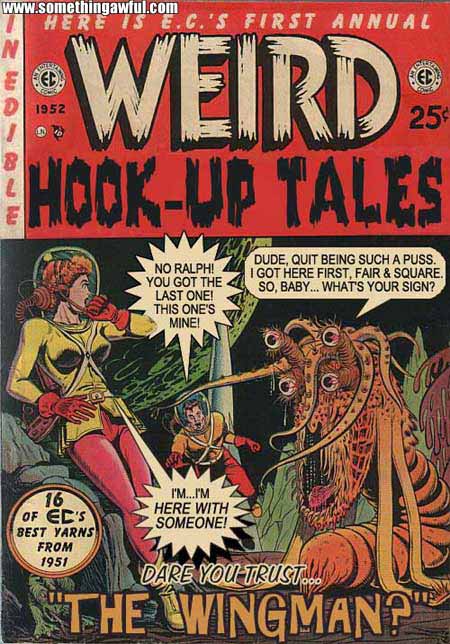
but regardless of that or of any considerations of basic human decency, I have to turn your attention to this week's edition of Photoshop Phriday on somethingawful.com.

It's about funny-books!
image

One final note: if you wish to link to an image from SA, never, ever just pirate it off their servers. Save it to your home server instead; you'll be glad you did. Buckethead will take this notice as a dig at him, but the fact is, it's a public-health matter of the highest importance.

Posted by Johno Johno on   |   § 0

A word on marriage

It's a dweam, wiffin a dweam.

Y'know? I keep hearing from cultural conservatives about how marriage is a sacred institution representing the eternal love between man and woman for the purposes of increase of the species, and how that will be ruined-- ruined! for everyone if humasexashuls get a piece of the action. Marriage is the final bulwark of goodness, decency, and God-fearing American patriotism against the forces of Mammon, Godlessness, dissipation, and sin.

Oh rilly? So, letting gays marry (or unite civilly) would drag the good name of matrimony through the pigpen?

I think that's been taken care of just fine already. Consider the following:

  • Heterosexuals Rick Rockwell and Darva Conger. Married via game show.
  • Noted heterosexual Pam Anderson and pimp supreme Kid Rock. She has Hepatitis C and will die someday from it. No kids if you have hepatitis! (But what beautiful kids she could have had!)
  • Anna Nicole Smith and that geezer she married for his money. A sacred blessed union conceived in true love indeed.
  • Confirmed weirdo Michael Jackson and his erstwhile beard, Lisa Marie Presley. You better hope that wasn't for the sake of reproducing.
  • The city of Las Vegas.

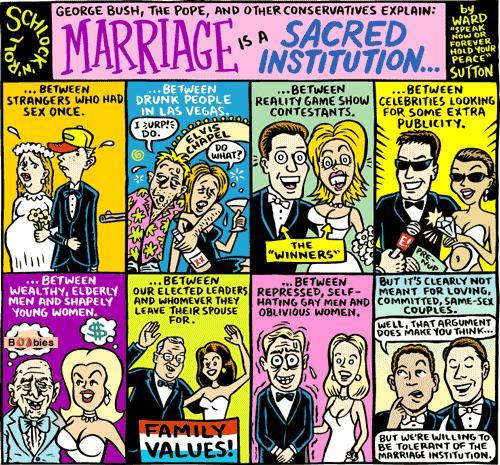
    The hilarity of the disconnect between the conservative line and actual reality has been kicking around my head for a day or so, but this morning I came across a cartoon thingy that put all my words and stuff into easy-to-digest pictures.

    image

    Cartoon courtesy Brdgt at Fear of a Female Planet.

    [wik] Lest my post above be construed as taking Pamela Anderson to task for having the nerve to come down with Hepatitis C, let me clarify. I included the Pam/Kid Rock marriage in the list above not only because Pam is probably the #1 Fantasy Cheat among married men, which makes her a living nexus for all sort of Immoral Intent And Onanism but because by the lights of certain commentators a marriage without children is immoral. Pam, having a fatal and blood-transmissible disease, really oughtn't have kids. QED.

    Of course, by those same lights marriages between senior citizens are also immoral since they're childless. For that matter, Brdgt herself is the very pinnacle of immorality since she is married (to a man, even!), yet plans never, ever to have children. Fie! Fie!

    Not that I really need to pile on the flimsiest arguments of the conservative right, but it's so much ding-dang fun!

    [alsø wik] And let's not forget serial marrier/murderer Henry VIII, who had the hots for Anne Boleyn soooo bad that he hijacked the spiritual leadership of Britain for himself for the express and single purpose of annulling his marriage to the no-longer-young-'n'-supple Catherine of Aragon. And then of course he had Anne killed.

  • Posted by Johno Johno on   |   § 5

    Fox: There's A Heart Beating In There After All

    Scuttlebutt has it that Fox is going to start making new episodes of "The Family Guy" after the DVD release of the series sold more than 1 million copies.

    Sweet!

    And, uh, hey... if anybody was thinking of juuuuust the right Christmas/Chanukah/Ramadan/Kwanzaa/Festivus gift for ol' Johno... heh... I heard that Family Guy is out on DVD...

    Posted by Johno Johno on   |   § 1

    Anniversary

    A year ago this week, in fact a year ago this Friday, I got word that the axe was going to fall on my incredibly rewarding yet aggravating music-industry job. The label was going through some changes, and one change was that music fans would no longer be needed. Or so I editorialize.

    Upon hearing the news, I went out and did the proper music-industry thing; got straight shitfaced on tequila and beer. I knew it was coming. The dumbest Labrador retriever ever born could not have missed the signs. But that didn't make the fact any more fun. And so; tequila.

    Now, a year later, I find that I've lost touch with that thing that I went into the business to cultivate-- my enthusiasm, my mania, for awesome fucking rock and majestic thunderous roll. I don't buy records. I don't go to shows. I don't read the magazines, not even Mojo. On the other hand, I also no longer compulsively analyze everything I hear from a marketing-cost-per-unit perspective, which is nice, but the joy which I bled away at some point during the end days of my too-short career never quite came back like I hoped it would.

    Last Friday on the train home, I got kind of sad. I was listening to "In A Silent Way" and as the disc got to that part about 10:42 into "Shhh/Peaceful" where Teo Macero really screwed up the edit and two parts mash together like a Lydian-mode trainwreck, I realized that a few years ago, that shit would have given me chills. Not so much any more. Music comes second in my life right after family, and several steps before food, shelter, and Italian shoes. And yet, meh.

    So I need all y'all's help. Despite my limited resources and lack of shelf space (in fact, my wife has forbidden me from exceeding my current 30 shelf-feet cd footprint), I need to know. What music in is setting your ass on fire?

    My kickass purchases in the last twelve months have been few. The Flaming Lips' "The Soft Bulletin. "Up From The Cellar," the Motown rarities compilation. I finally repurchased REM's "Automatic for the People." But that's it. A far cry from the halcyon days when every! single! week! brought a new wonder: Turbonegro; Josh Rouse; Black Rebel Motorcycle Club; Don Cherry; The Yeah Yeah Yeahs; an eventual collection of dozens of Zappa discs; ...and You Will Know Us By The Trail of Dead; The Sheila Divine; Erin McKeown; Rhinoceros; Sigur Ros; The North Mississippi All Stars; Mirah; Robert Randolph; Aceyalone; Shuggie Otis; Oren Blowdow [sp?], Dr. Octagon; Buck Owens reissues; Handsome Boy Modeling School; Antibales; The Fucking Champs; Gorillaz; Los Amigos Invisibles; and the greatest of all, a concert by the great Princess Superstar herself aboard a floating party boat in the Hudson River.

    I hope those days aren't gone for good, because that would suck mightily. So help a brother out. What's ringing your bell?

    Posted by Johno Johno on   |   § 6

    Our Blogfather in high form

    Lileks has today published the nearest thing to a screed he's had in a while. He assaults Ain't It Cool News, head red, Harry Knowles and his recent analysis of the third Matrix movie. I have not yet seen the aforementioned moving picture, but Lileks' pen strikes several telling blows:

    Alas, he cannot write. He is a horrid stylist; he writes like someone mashing the keyboard with bratwursts; his politics have the sophistication of a preschool crayon drawing, and his self-confidence in his insights is matched only by his inability to see how fatuous his work often sounds.

    The social pleasantries now disposed of, Lileks moves in a little closer: 

    and the Machines - they're drilling to put a stop to it all. Now, the problem is - the only person that can put a stop to The War" on Terrorism are the terrorist.

    He are, are he?

    NOW - What is Agent Smith? Essentially, Agent Smith was Communism. If we are all the same, then there is no reason for violence. Resistance is Futile. Communism was fantastic as it represents an ideology that the Capitalist and the Extremists both hated. And it was spreading and taking over and trying to assimilate cultures and suppress belief systems. Or you could say AGENT SMITH is that Born Again Christian type that is trying to eradicate another's belief system - and ultimately - the elimination of both either politically, humanly or functionally is a move towards peace.

    You can't make this up. You can only stand in awe. If I can untangle the wet knotted shoelaces of Knowles' prose, he seems to be saying that we can only live in peace when everyone agrees to believe in nothing but peace.

    Ultimately what they believe or we believe is inconsequential.

    Spoken like a man with no beliefs. Or, more accurately, spoken like someone who thinks that line above demonstrates some sort of intellectual sophistication lost on people who do the whole work-kids-church thing. Trust me, Harry - what someone believes is of great consequence. And if your society believes nothing it ends up making its last stand in the Temple of No Particular Belief System with the squiddies hammering on the door, possessed of a terrible certainty: they believe you should die.

    Read the whole thing, as they say. His summation of the Matrix trilogy is especially interesting:

    I took away something else from the Matrix trilogy: it is a product of deeply confused people. They want it all. They want individualism and community; they want secularism and transcendence; they want the purity of committed love and the licentious fun of an S&M club; they want peace and the thrill of violence; they want God, but they want to design him on their own screens with their own programs by their own terms for their own needs, and having defined the divine on their own terms, they bristle when anyone suggests they have simply built a room with a mirror and flattering lighting. All three Matrix movies, seen in total, ache for a God. But they can't quite go all the way. They're like three movies about circular flat meat patties that can never quite bring themselves to say the word "hamburger."

    Philosophically, the Matrix movies are banal, but they're no worse than the empty animism of George Lucas' Force-centric cosmology. As dramas, they lag - but Wagner wasn't thrill-a-minute, either. The moments of emotional connection are few, but they're there, almost like Burma-Shave signs spaced out every hundred miles.

    I have enjoyed the first two Matrices, althought the first was certainly the superior film. One thing that I enjoyed was the cafeteria style eclecticism with which they injected the philosophical bits - it allowed you to construct a better dialogue in your head. You could fill in the blanks in a way pleasing to your aesthetic, without worrying over being contradicted by a awful, banal, overly determinate summation at the end of the movie. Ambiguity is the artist's best friend - it is the cinematic equivalent of the old chestnut about silence being mistaken for wisdom.

    Posted by Buckethead Buckethead on   |   § 5

    Edmund Morgan's Mash Note To Ben Franklin

    [also posted to blogcritics.org]

    I'm deeply in love with our times, a relentless booster for the progress of technology and the wonders of the modern world. Sometimes I like to play a game with myself called "What If Ben Franklin Were Alive Today," in which I see if I am geek enough to explain things to Ben Franklin (were he shot forward in time) so that he would understand. Steel-frame skyscrapers, lasers, baseball, the miniskirt, internal combustion, Magnetic Resonance Imaging, the Internet, cellular biology, the periodic table, hip-hop music, it's all fair game. Needless to say I have a lot of spare brain-time on my hands.

    Why Benjamin Franklin? Because of who he was. Other figures from history shared his relentless curiosity and erudition: Erasmus, Copernicus, Galileo, and Newton come to mind. But these men, save Newton, belong to another age, and Newton was a recluse. But Benjamin Franklin is engaging in so many ways-- he was a rabble-rouser, Renaissance man, writer, editor, diplomat, inventor, scientist, endless self-promoter, the last true Enlightenment thinker and the first true American. Moreover, his work on electricity was the foundation of a mind-boggling array of advances. He wrote the first Pennsylvania constitution! Discovered the gulf stream! Invented lightning rods! And most of all, he was deeply in love with his times.

    The difficult thing about Franklin is something I've already mentioned: his gift for managing his personal mythology. As his autobiography proves, he was keenly aware of his reputation and happily manipulated it for his own ends. Consequently it is hard to identify the line between who Franklin was and who he said he was. Is he the simple, self-deprecating moral teacher of Poor Richard's Almanac? Is he the keen-witted inventor who flew a kite, invented bifocals, and wrote endlessly about the sciences? Is he a fraud, content to chase French courtesan tail while other people did the work and then collect the credit? Or is he the enterprising lad and genially amused gray eminence of his own autobiography? Of course, he is all these things. Franklin's nature is too changeable, and his legacy to large, to be captured in one description. All of this makes Edmund Morgan's recent biography of the man very welcome.
    Edmund Morgan is one of the great historians of the past century, and he is certainly one of my favorites. Less prone to political self-refutation than younger lions like Eric Foner or Gordon Wood, and less prone to progressive determinism than others of his generation, Morgan's major works are landmarks of contemporary historical thought. Now at the end of a long career Morgan has written a project entirely for himself; a portrait of Ben Franklin drawn entirely from the man's own writings. Although it is billed as a biography, a more apt description of the result would be "appreciation."

    It seems Morgan likes to play my game too. As he tells it in the preface, "[Franklin] has made it possible for us to know the man behind that presence better than most of those who enjoyed it could have. Franklin can reach us in writing that speaks with a clarity given to few in any language at any time, and writing was his favored mode of communication. We can read his mail. And we can read an astonishing amount of everything else he wrote. . . . For the past fifty years scholars have been collecting every surviving scrap of it from all over the world, and it will eventually fill forty-six or more printed volumes of the Papers of Benjamin Franklin. Meanwhile, it is available on one small disk, a product of those inconceivable discoveries he dreamt of. This book exists because of that disk, which enabled me to write it-- no, compelled me to."

    This endeavor is rare for two reasons. First, it is uncommon these days for an historian to write a preface without using the words "interrogate," "problematize" or "framework." Second, it is rare that a vanity project of this sort is actually worth reading. On the first count, Morgan has always been relatively immune to theoretical fads, and on the second, he rises far, far above type.

    Since Morgan relied entirely on the papers of Benjamin Franklin to write the book, many important episodes in Franklin's life are elided or left out entirely. Morgan treats Franklin's childhood in Boston very briefly, as well as his arrival in Philadelphia (so memorably recounted in Franklin's own Autobiography). Relations between Franklin and his wives are somewhat sketchy, and we do not get very much sense of the good or ill Franklin left in his wake. The trouble is, Franklin is already heavily biographied-- two major contributions to the field have come out in the past two years, by H.W. Brands and Walter Isaacson-- and the difficulty comes in trying not to simply rehash familiar material. So what is to recommend a work which by its own lights is a narrowly-sourced love letter?

    The answer is this: Morgan does not pretend to undertake a thorough examination of the life, times, and legacy of Benjamin Franklin (as if you could do that in 300 pages!), but rather only "say[s] enough about the man to show that he is worth the trouble. It is... pretty one-sided, a letter of introduction to a man worth knowing, worth spending time with." On that count, Morgan succeeds totally. We come to know Franklin as a man very much of the world, successful and happy, and unafraid to use his reputation, power, and connections to do what he thinks is right.

    Not that the brevity or affection for his subject is a liability. He might be in awe of Franklin, but Morgan is historian enough to acknowledge when events require further discussion, and when Franklin was simply wrong. For example, of all the accounts I've read, Morgan charts most clearly Franklin's transformation from English Patriot to American Patriot in the years leading up to the American Revolution.

    Franklin spent the years before the Revolution in England, trying to achieve compromise between the colonies and Crown. At the time, Franklin thought of himself as a British Citizen from America-- not an American. At the same time that his counterparts in the colonies were beginning to speak of revolution, Franklin was still actively dedicated to preserving the union. Morgan spends much time discussing how this identity shaped Franklin's efforts to reconcile an intransigent Parliament to the real needs of the colonies despite repeated setbacks and open hostility. The change comes not after his public humiliation in Parliament, when the powerful forces he had on his side-- William Pitt among them-- cannot sway a government determined to punish the colonies for demanding a say in their own affairs, but after Parliament and King reject out of hand petitions sent from America. To Franklin, this meant that the ancient right of subjects (the colonies) to petition the Crown for a redress of grievances had been revoked, and that Britain had done the damage. Despite this realization, Franklin continued working to keep war at bay, but with the realization that when push came to shove, he was first an American.

    The same episode demonstrates that Franklin was prone to miscalculation, often misreading to disastrous effect signals coming from America to England. As the chief agent of America at Parliament, he was often called on to speak for all 13 colonies on slim information, often blundering at full speed into powerful opposition. Morgan digs beneath Franklin's own words here, repeatedly wondering aloud if Franklin in these years understood what he was doing and who he was dealing with. The impression Morgan gives here is quite a departure from the slick and homely man-of-the-world image Franklin himself cultivated.

    One gets the sense that Morgan has been doing some outside reading, because he spends many pages on Franklin's time in France raising money for the American Revolution. This in itself is unremarkable, but Morgan seems to have read David McCullough's recent biography of John Adams. In that book McCullough, through Adams, casts the elderly Franklin as a doddering old fraud, chasing tail and recieving guests but never actually doing any work. In contrast Adams comes across in Morgan's book as a pushy, blustery jerk with a persecution complex. The truth is of course somewhere between-- Adams totally failed to understand that tail-chasing was a vital part of court diplomacy in France, and Franklin never let Adams (who was a pushy jerk) in on his plans.

    Although it succeeds wonderfully as an "introduction," Morgan's book comes up a little short as straight biography. For example, Morgan ends his story before Franklin's death, mentioning his final works but not his date of passing. This and other episodes of date-free writing might make the chronology a little hard to follow for newcomers, but Morgan helpfully supplies one in the Appendix for those who may get lost. Such issues aside, Morgan has drawn from Franklin's papers a compelling and altogether enjoyable account of the life of the first great American. But it is only a taste. If you intend read Morgan's biography-- and you really ought to, it's short-- I would recommend first reading Franklin's excellent Autobiography (a short and compulsively readable joy), and following Morgan with either the Brands or Isaacson volumes. Both present a more complete picture of the man, but neither comes close to Morgan in examining the human complexity of their mercurial and fascinating subject.

    Posted by Johno Johno on   |   § 2

    And How, Exactly, Is Sex Like Counterfeiting?

    Because making porn is almost as good as printing your own money.

    Fox news is reporting a new reality series based around finding new porn talent:

    http://www.foxnews.com/printer_friendly_story/0,3566,102247,00.html

    Profits from this show will be massive, especially once the DVD is for sale. The $100k prize for the winner would be chump change by comparison.

    There's a reason why companies like Vivid Entertainment Group are $150 million+ entities.

    Posted by GeekLethal GeekLethal on   |   § 3

    Killer Reading

    Also coming soon to blogcritics.org

    D.H. Lawrence once wrote that "one loses one's sickness in books." I don't know if that's quite right. I read like a champ, yet I'm a fairly boring guy with few kinks that I'm willing to admit to. I have never killed a man. I have never had anonymous sex with multiple partners (my loss... I guess). I have never even faced off against Ultimate Evil armed with only my wits, a flashlight, and a roll of duct tape. Consequently, the sicknesses I have to lose are easily handled by massive infusions of alcohol and by a strict program of yoga, emetics, and curmudgeonly behavior. Okay, I might be a huge fan of "Gilmore Girls" and vegetarian cookbooks, but those aren't as much signs of sickness as of postmodern metrosexual wimpery.

    No, I usually go to books to find my sickness. I tend to prefer works that simultaneously attract and repel with an aplomb rarely found in standard "horror" fare. So, in tribute to this season where all America goes in search of their sicknesses and usually comes back with nothing more than a cheap torn costume and a bellyache, I have decided to offer up to you, gentle reader, a highly personal list of my favorites of what my wife recently dubbed my "awful" books.

    There are no horror novels on this list, because they bore me to tears. Instead, the selections run the gamut from autobiography to experimental fiction. Yet these are the ones that gave me nightmares, or at least ruined my week admirably. At the root of this list are two questions: why do people choose to read a book they know will upset them; and what does it accomplish? Luckily, I'm no philosopher, so I can only offer pat answers. I like such books because I have an active imagination yet little ambition to be an Airborne Ranger or ninja, and what they accomplish is to allow me to satisfy the kinky parts of said imagination without actually getting down in there in the muck. They let me be a tourist rather than a resident.

    So, without further ado, puffery, or hijinks, the list:

    • James Ellroy, My Dark Places. James Ellroy’s mother was murdered near their home in Los Angeles when James was a young boy. Years later after a life of homelessness, depression, general unpleasantness, and incredible crime fiction, Ellroy hired a retired L.A. detective, Bill Stoner, to revisit the case. My Dark Places is Ellroy's autobiographical account of his mother's murder and the subsequent investigation carried out by him and Stoner in the 1990s. Written in Ellroy's signature staccato prose, the book is unflinching in its depiction of his mother as a flawed woman and equally unflinching in dealing with James' own Oedipal obsession with her death. Ellroy is brutally honest as he lays bare the wellspring for the darkness that underlies his novels. All the standard plot elements he uses in his fiction are here: random acts of mayhem; a preoccupation with avenging violence against women; corrupt and incompetent cops; Los Angeles as a living thing in its own right; and underneath it all, a ten year old boy madly in love with his dead mother.
    • Jim Thompson, The Killer Inside Me. Have you ever seen those Faces of Death movies where they string together footage of people dying horribly and charge ten bucks admission? I hate them. Yet, I really dug this book. The Killer Inside Me is the story of a small-town deputy named Lou Ford, a quiet man who everybody likes just fine: normal, good neighbor, nice enough guy, until the sickness comes out and people suffer and die. The breakthrough that makes this novel transcend Thompson's average prose and heavy-handed plotting is that Thompson wrote it in the first person, making sure the reader is along for every bit of torture, murder, and cruelty. This one made me feel dirty, yet I found it too entertaining to stop reading. Of all the books on this list, I can't honestly recommend this one without reservations. But if you are a fan of American hard-boiled crime fiction, I suggest you test your mettle and see how much you really like it.
    • Charles Bukowski, Ham On Rye. Bits of Bukowski's writing keep surfacing in my psyche at opportune times. Usually it's when I'm hanging on by a thread, say, living in my car, or drinking alone in a basement in Queens. What qualifies Bukowski for this list is not anything intrinsic to this book, but his ability to self-mythologize even the worst parts of his life in a way that appeals to those (e.g. the younger me) who doubt and sometimes hate themselves but never have it in them to actually rebel, escape, or rise above. Like so much of Bukowski's fiction, Ham On Rye is thinly veiled autobiography. In this case we explore Buk's young life in California, including his first encounter with alcohol (thumbs up!), his monstrous father, his high-school stint in the ROTC, several fights, some unpleasantness with women, and numerous trips to the doctor's office to have his boils lanced. Although other Bukowski works could have made this list, this is in my opinion his best-written novel, and the one that keeps coming back on me.
    • William Burroughs, Naked Lunch. It took four or five reads to figure out that there was a plot underneath all the weirdness. Naked Lunch is like a "Where's Waldo" book, except it's called "Where's The Plot?" and features multiple deaths by heroin, purple-assed baboons, totalitarian social experiments, an obsession with bodily functions, and more homoeroticism than professional wrestling. I approve! Despite the aforementioned obsession with bodily functions, Naked Lunch lives up to its legendary status and makes the grade as Burroughs' best novel. All his experimental prose elements are working, his imagery is vivid, and I cannot for the life of me get the image of the Willy The Disc sucking the junk out of some poor dying junkie's body out of my head. A random flip through its pages reveals the following wisdom: "Deteriorated schitzos sometimes refuse to move at all" "Initial proptosis and the inevitable purulent discharge" "which may pass unnoticed in the shuffle is followed by stricture of the rectum requiring intervention of an apple corer or its surgical equivalent" "Bedpans full of blood and Kotex" "The President he is a junky but can't take it direct because of his position… sometimes have to slip my penis under his left eyelid" "'Cut him down, Mark,' she screams. Mark reaches over with a snap knife and cuts the rope" "The centipede is rushing about in agitation."
    • Thomas Pynchon, Gravity's Rainbow. Otherwise known as "the one nobody got through." Well I did get through it, twice in one cruel summer. My payback? Twisted dreams in which I pursued the V2 rocket through the alleys and sewers of wartime Germany accompanied by Donald Duck and a talking typewriter. Here's the plot, as much as one can be discerned. Tyrone Slothrop is a member of the US Army working intelligence detail during World War II. As a young child, Slothrop was subjected to psychological experiments in which his sexual urges were displaced onto objects. As a consequence, the map of Slothrop's sexual conquests in London corresponds to a map of rocket hits on the city. This unique connection with the rockets provides Slothrop with a sort of homing ability, and he is set loose in Germany to locate a new German super-weapon, the V2 rocket. As Slothrop moves deeper and deeper into Germany in search of the V2, his world becomes populated by malevolent soldiers, cartoon characters, mad scientists, and human weapons. At that point, things get kind of weird. If you have a couple months to kill and no pressing obligations, you can do much, much worse than hide yourself away with Gravity's Rainbow and the Companion to same.
    • Art Spiegelman, Maus. This graphic novel tells two stories: the history of the Holocaust as experienced by Speigelman's father; and the story of the strained relationship between father and son as Spiegelman deals with his father's aging, his mother's suicide, and the writing of the novel itself. The central conceit is so simple - the Jews are mice! The Germans are cats!-  and yet the novel achieves great power and complexity. I read both volumes in the same week I visited the Holocaust Museum in Washington D.C., and Maus made the things I saw there more comprehensible, more complete. Maus is all the more horrible because everything in it is true.
    • Thomas Hardy, The Return of the Native. A left-field choice for a list of this sort, but just read the book! The wild landscape of the English moors is as much a character as any human in this story of love, greed, betrayal, and loss. Briefly, Eustacia Vye is about to be married to Damon Wildeve and settle down unhappily for a quiet life in the grim countryside. But she remembers a young childhood on the seacoast, and longs for escape. When Clem Yeobright comes back home from France (the returning native of the title), Eustacia sees her ticket out of town. As a result of her machinations, several people end up ruined, and the lucky ones end up dead. Hardy, who's a pretty bleak writer by any measure, delivers a tragic story of characters caught up in destinies they created but cannot control. It makes this list by virtue of Hardy's seeming belief that the innocent are born to suffer and the incredible restraint and power Hardy demonstrates in recounting such a standard, simple, classic plot.
    • Jon Krakauer, Into Thin Air. The true story of an expedition to climb Mount Everest and the amazing feats of strength, mulishness, and self-delusion necessary to pull it off. About the time that one gentlemen is left for dead near the peak and staggers back into camp several hours later with his arm and shoulder frozen solid is about the time I question the sanity of people who go to such extremes. I'm also looking forward to reading Krakauer's Under The Banner of Heaven which no doubt will further erode my faith in the essential reasonableness of mankind.
    • Mo Yan, Red Sorghum. Hands down the most disturbing book I have ever laid my eyes on. Red Sorghum interweaves the brutal story of the Japanese invasion of China with the equally brutal story of the Chinese Cultural Revolution. Set among the sorghum fields of Shandong Province (Mo Yan's home), this intensely visual book is packed with scenes of incredible beauty and unbelievable horror. I read Red Sorghum before I encountered of Zhang Yimou's films, but when I finally saw the over-saturated colors and gorgeous imagery of Raise The Red Lantern, Farewell my Concubine, and Ran my mind and eyes went "Ah!" Many of the key images from the book are burned on my brain: blue skies against the red fields of sorghum, streaked with the blood of Chinese peasants and soldiers; Uncle Arfat screaming as he is skinned alive by the Japanese; a goat seeming to shit ammunition as its tied-shut anus is cut open to expel the contraband bullets hidden within; dead mules floating down the river, their bodies bursting in putrid green pools. They come back to me like unwelcome memories and taint my happy times. What pushes this over the top from nauseating spectacle to one of my favorites is this: Mo Yan populates his novel with people who commit acts of unimaginable cruelty and self-interest, and these impulses throb just below the surface of their daily existence. Yet he creates characters, who, in all their cruelty and kindness, are quintessentially human. More than anything else I've ever read, Red Sorghum claims to reveal the savagery that infuses civilization. 

    And there you have it. This is my list, and mine alone. If you dig Dean Koontz, Steve King, or Danielle Steele, prefer Women to Ham on Rye or think I'm a total candy-ass for including Thomas Hardy on a list of my favorite "awful" books, by all means please make your own list and leave me be. But aside from that caveat, I'd love to hear what everyone else thinks. If you have any suggestions, please - my "to read" shelf is getting pretty bare.

    Posted by Johno Johno on   |   § 2

    dong resin vs. the very modern toilet

    This, by way of her, by way of him. He also has a very funny picture. Click the more link, and don't look if you're an easily offended PETA freak.

    *Bah-whooooosh!*

    Woah. Did I make it flush twice? I didn't move. That's some flush. Like a jetski in a koi pond. Why make the flush so powerful? What the fuck do people here eat ? " Yes, I'll have the innards of six Baby Ruths, some olestra, two wheels of cheddar, and the small bag of hair, please."

    *Hiss!*

    It's angry. I think it's angry. Looks angry. I shouldn't have mocked it. Do they make telepathic toilets? Probably. Damn Japanese. I know this is a Japan thing. Japan has way too much free time.

    What perplexed my wife was, did someone see the cat, then make the sign, or did this sicko take the time to make the sign and just kept it in the car until he found a suitable cat?

    Posted by Buckethead Buckethead on   |   § 3

    Passion will hit the screens in February

    Variety is reporting that Gibson has finally found a US distributor for his movie Passion. After being stiffarmed by wary studios, Gibson has reached a deal with Newmarket, where Gibson essentially is renting their distribution system for a cut of the gross. Gibson self financed the movie to the tune of $25 million dollars.

    Personally, I am happy that we will be able to see the movie. (And also happy that the movie will now have subtitles. My Aramaic is a bit rusty...) While the usual suspects were up in arms with charges of antisemitism, every review I've read from someone who has actually seen the movie was overwhelmingly positive. A movie that has an unabashedly Christian message is not by definition anti-semitic. I look forward to seeing it.

    Posted by Buckethead Buckethead on   |   § 0

    Eminem walks free/ now reported on perfidy

    Charges of slander brought against Eminem by a guy he went to school with have been dropped. The charges were based on lyrics in which Eminem accused the man of beating him up every day in elementary school. (Em was willing to admit that???) The judge's decision was reprinted in part yesterday in the Detroit Free Press, and read in part:

    Mr. Bailey complains that his rep is trash
    So he's seeking compensation in the form of cash.
    Bailey thinks he's entitled to some monetary gain
    Because Eminem used his name in vain. . . .
    The lyrics are stories no one would take as fact
    They're an exaggeration of a childish act.
    Any reasonable person could clearly see
    That the lyrics could only be hyperbole.

    It's nice when a judge has a sense of humor.

    Posted by Johno Johno on   |   § 0

    Required Reading

    I have an abiding fondness for travel books, especially of places I know. Part of it is a navel-gazing impulse to wander through my idyllic memories of, say, Britain, while leaving aside the time I got food poisoning and had to discard my pants on the train to Durham. But a greater part of it is a desire to see what others think of where I've been, and whether they think the same. I love the food in Pittsburgh-- do they hate it? I loathe midtown Manhattan as a bleak wasteland of grasping industry and tourist despair. Others apparently lack my keenly honed critical faculties and love it to pieces.

    Recently, my wife picked up Simone de Beauvoir's recently-back-in-print memoir of her first trip to the United States, "America Day by Day" in a remainder bin. She read it with mounting excitement, and did everything she could to keep me from stealing it until she was done (damn the crafty minx!). In the meantime, I amused myself by watching football and starting Tocqueville's "Democracy in America," itself a travel book about America.

    The contrast is striking. Although written for totally different reasons, there are marked parallels between the two books: both were written by French intellectuals touring the United States at critical points in its history-- Tocqueville in the promising years of the early 1830s, de Beauvoir in the aftermath of World War II, just when the United States had emerged as the dominant power in the world, and Communism as its presumed nemesis; both attempt to extrapolate larger lessons from a partial view of the country; and both are intrigued by the ways in which Americans differ intellectually from their Continental counterparts.

    But while Tocqueville's account is a celebration of the American democratic urge, meant for the great minds of Europe to learn from, de Beauvoir's is a much more personal account which, although it addresses some of the themes raised by Tocqueville 125 years previously, is a much more ambivalent (and nuanced) picture of American society on the rise. Whereas Tocqueville's account of American society has become a main point of reference for fans of American exceptionalism, de Beauvoir's text went out of print almost immediately. Whereas Tocqueville touted "equality" as the fundamental "point of origin" and wellspring of America's greatness, de Beauvoir is more concerned with the fabric of American life, and questions whether that "equality" actually exists. Whereas Tocqueville intends an exhaustive survey of the American political landscape, de Beauvoir lives day by day, encountering each place face to face. Reading them back to back makes for a great contrast.

    But enough. Assuming you have read Tocqueville, or are familiar enough to get by, I'm going to leave him aside for the time being. (Buckethead, are you ready?)

    Having only read excerpts of Simone de Beauvoir's philosophy, I was delighted to find that "America Day by Day" is a rich, entertaining, and idiosyncratic depiction of the United States as it was in the aftermath of World War II. It's shocking that the books has been out of print for fifty years, as I found it more credible than other accounts from the same period and just after (for example Gunnar Myrdal, and "The Man In The Grey Flannel Suit.") While it's a diary, it also manages to be much more.

    De Beauvoir begins her journey across the US in New York, and uses the city as a sort of base camp. The early pages of the book are consumed with her culture shock and her first impressions of New York after seeing its images in so many films. What's immediately noticeable to the modern reader (and this goes for most of the book!) is how little things have changed in the sixty years intervening. See if you don't nod your head to her description of being overwhelmed by New York (this is pretty much exactly how it happened with me):

    "I've often read, "New York with its cathedrals." I could have invented the phrase-- All these old cliches seem so hollow. Yet in the freshness of discovery, the words "contrasts" and "cathedrals" also come to my lips, and I'm surpised they seem so faded when the reality they capture is unchanged. People have told me something more precise: "On the Bowery on Sunday, the drunks sleep on the sidewalks." Here is the Bowery: drunks are sleeping on the sidewalks. This is just what the words meant, and their precision disconcerts me. How could they have seemed so empty when they are so true? It isn't with words that I will grasp New York. I no longer think of grasping it: I will be transformed by it. Words, images...-- they will not help me at all.... It's not possible to confront things here; they exist in another dimension-- they are simply here. And I look and look, as astonished as a blind man who has just recovered his sight."

    Since she is a writer, de Beauvoir spent most of her time gadding about with other writers, intellectuals, and various hangers on. She writes eloquently about the differences between the American literary scene and the French, and wonders at all the young Americans who reject their homegrown authors except, reluctantly, Faulkner. In the wake of the fall of the Berlin wall and the horrors of Stalinism, it's a little jarring to hear her defending Communism against its American critics. But it's more than it seems; in the early years of anti-Communism, the stridency of anti-Communists seemed to threaten the idea of free speech. She recalls a drunken night getting into a shouting match with some friends-of-friends over this topic (as well as the mutually sheepish sobered-up aftermath), and it's hard to find fault with her condemnation of knee-jerk anti-Communist fever, regardless of what time has shown us.

    Once de Beauvoir gets out of New York, the book really takes flight. In Chicago, she goes slumming with Nelson Algren, and begins to encounter the myriad ways in which Americans, as she sees it, are obsessed with race. (Interestingly, though she and Algren would be lovers for years, not a hint of it enters into this memoir.) She is struck by the filth of Chicago's suburbs, and by the natural beauty of the downtown. In Los Angeles, she hangs out with people who work in film, discovers that it's impossible to walk anywhere, and explores the canyons and valleys of the outlying areas. (It's fascinating to read a foreigner's account of the same Los Angeles immortalized in classics like "Hollywood Boulevard" and Chandler's Marlowe novels, and gratifying that she saw it pretty much the same way.)

    She travels the Southwest by car, and marvels at the Grand Canyon as well as at the ways in which Native Americans integrated tourism into their cultural fabric. Always she has a keen eye for detail and remains fascinated by the little things Americans take for granted. She takes a Greyhound across Texas, learns to hate bus stations, and encounters segregation as the bus enters the South. When the black passengers find out she's French, they begin comfortably speaking with her, and the unspoken tension between her and them becomes tension between her and the white passengers.

    Class-- or at least poverty and privelige-- is a constant theme in de Beauvoir's diary. She is constantly struck by the sheer plenitude of American consumer culture and by the standard of living enjoyed by most, remarking that no poor American writer would ever consider living in an unheated garret like their French counterparts. But she also finds this evident affluence doesn't extend everywhere. Nelson Algren takes her to the scummiest dives in Chicago, and she spends time with Bowery Bums in New York as well.

    By contrast, her lecturing obligations take her to some of the best American schools-- Wellsley, Harvard, Princeton, UCLA-- and she is repeatedly struck (and touched, and horrified) by the casual assumptions the students make about life and entitlement, by their casual affluence, and by their near-total incuriousness about the world. But she regards the students with a kind wonder, reserving her acid for those times where she feels American arrogance-- that is, the casual assumption of "equality" that descends from Tocqueville and his peers-- gets in the way of Americans seeing what they are really saying (or leaving unsaid).

    Since it's a travel book, de Beauvoir spends a fair amount of time in search of her favorite creature comforts. Meals are a constant theme (as in "the quest for an excellent meal"), as is jazz. She visits all the big New York clubs in search of "authentic" jazz and finds what seems to her to be only tourist trash, lazy swing, and bebop (which she detests as too white). Her favorite jazz moments (and meals!) happen by accident, such as in New Orleans.

    We explain to [the owner] that we want to hear some good black jazz. His face darkens for a moment. The situation has been very tense between blacks and whites for some time now, and the blacks no longer want to perform for the whites. However, he suggests that we try the Absinthe House.... In the second room, there are several tables and a platform with three black musicians on piano, guitar, and bass.

    Suddenly we're transported. This music is nothing like the music at Cafe Society or even the music in Harlem-- the three blacks are playing passionately, for themselves.... The band doesn't try to please or dazzle anyone; it plays the way it feels like playing. If the bass player-- a young black who's only eighteen, despite his girth-- sometimes closes his eyes in a trance, this isn't servile mimicry: he's just giving himself over to the music and the promptings of his heart. Right next to the band, there are two very young white men with black hair who are listening with religious attention and laughing amicably with the musicians between pieces.... They're probably young people who are stifled by American civilization and for whom black music is an escape.

    It's impossible to write from memory without being selective, and the things de Beauvoir leaves unsaid are almost as important as what she dwells on-- just witness the foregoing. She mentions the Marshall Plan in passing once or twice, then enters Times Square to go nightclubbing. She defends Communism (or, more correctly, the right to be a Communist) without entering into the whys and wherefores of being a Communist in 1947. She says surprisingly little about American philosophy, dismissing Pragmatism in a few short sentences, and although she is shocked by the indifference of American intellectuals to American literature she says little about why she felt it had more promise than European writing of the time. She discusses Faulkner at several points, but when she enters Faulkner's South she does so without reference to him. Part of this, of course, is that Simone de Beauvoir was actually visiting territory she had only studied maps of; the maps were proving useless. But, naturally, a careful reading of what goes unsaid reveals much about her unquestioned assumptions about the world and America. This is probably the most valuable aspect of the book, and the one that makes me recommend it as essential reading.

    I'm glad I'm reading this book back-to-back with Tocqueville's "Democracy in America." If I ever teach a class in US history as I keep meaning to do, I'll probably assign excerpts from them that way. Tocqueville's classic work describes an America at the brink of inheriting immense gifts, poised on a knife's edge between wild success and chaos, and holds up the American system as a paragon for the world to follow. Despite repeated attemps to bury it, that legacy still persists as one major theme in American self-identity. Without intending to, Simone de Beauvoir's book addresses similar themes more than a century later, and provides an idiosyncratic and compelling counter-assessment of Tocqueville's promises.

    In short, having read Tocqueville and de Beauvoir (admittedly, I'm a bit bogged down in the middle of Tocqueville), I have to say that, despite the influence Tocqueville has enjoyed, de Beauvoir's long-forgotten memoir says as much or more about America as it actually exists. Part of that owes to the 125 year separating them, but part of it is that de Beauvoir is a hell of a writer.

    The best part about travel books is the way in which immediate experience and writerly license throw into sharp relief the most pressing issues and nagging details. You can do much worse than Simone de Beauvoir on this count, and this time I didn't even have to throw out my pants.

    Posted by Johno Johno on   |   § 0