Highbrowish

Entertainment, music, the finer things in life; and their opposites.

Three principalities of booze

The Maximum Leader the other day had a post about a proposed royal taxonomy of booze.  He proposed that Scotch is the king of booze, and... well, just go read it.  In reading it, I thought that it was a good idea, but the dear leader was channeling the French and it was poorly implemented.

I believe that there are in fact three warring states of booze.  The three kinds of booze do not generally get along.  Here's how I'd break it out:

The High Test Kingdom of Liquor, The Principate of Wine, and the Republic of Beer.

The High King of Liquor is certainly Scotch.  And many of the roles the Maximum Leader suggests for other distilled spirits are appropriate.  But really, the wines would never submit to the rule of another alcohol.  The Prince of the Wines (after a recent civil war) is the House of Cabernet from California.  They displaced the French Cabernets, who are now plotting in return.  The nobility of the Principate is largely the red wines.  The awkward bourgeoisie - putting on airs, but still with red clay on their feet, is the blush and zinfandels.  The yeomanry is the white wines, though some white wines still cling to noble titles like saxons in Plantagenet England.  The serfs are the box wines. 

The republic of beer is a low place.  The vast majority of the population is low income industrial workers, the proletariat of thin American style lagers.  There is a vibrant entrepreneurial class, though, of independent craft brewers.  Some of these have become successful, and have started aping the manners of the nobility of the Liquors and Wines.  There is also a large corporate managerial class, wholly owned by the large lager magnates, but who aspire to higher quality than they actually possess.  In a curious inversion of life in America, the darker beers are the more respected and wealthy.

In the mountains between Wine and Liquor, there is a barbarous, semi-independent state inhabited by piratical and impoverished fortified wines.  The high sulfate content of the soils there leaves life very hard indeed.

Posted by Buckethead Buckethead on   |   § 3

A coup that you probably missed

...Unless you're involved in the publishing industry.

Here's what's going on, with Amazon.com playing the drunken frat boy to Print-On-Demand Publishers' ugly girl home alone on a Saturday night.

And in case you're interested, yes it is affecting me and my book sales. My reaction is here, complete with a troll commenter whom I strongly suspect to have Amazon ties.

Posted by EDog EDog on   |   § 2

And among the Goblins, much rejoicing

Gary Gygax, one of the creators of Dungeons and Dragons, failed his last saving throw Tuesday morning. We've consulted the appropriate table, and learned that geeks everywhere are in mourning, displaying their +2 Armbands of Dismay (purchased for only 7 Gold Pieces from a mysterious beggar outside the Tavern where they always seem to meet).

Posted by EDog EDog on   |   § 6

GMG

I never liked the comic strip Garfield. It was smarmy, irritating, and about cats. But I never in a million years would have realized on my own that, hidden behind Garfield's prancing, self involved corpulence, a brilliant comic strip was desperately trying to be heard.

This guy did.

fsymsogxo5tv6npt2fz1rwwv_r1_500.jpg

Posted by Buckethead Buckethead on   |   § 2

Passing along the torch of nerd-dom

51y92vbfxsl__ss500_.jpg

This is what was waiting for me in my mailbox Tuesday night.

When my wife asked me what it was, I strode with great purpose into our living room, positioned myself in front of the television, and gestured toward my 2 year old son as I answered,

"This is the core of a bonding experience between father and son that will last the rest of our lives. This is airplanes, aliens, spaceships, ray guns, and giant fighting robots. Often, thank Deity, all five at once. This is the moment when our little boy becomes a...ah, no ok he remains a little boy but this is the moment, the precise moment, when his imagination could begin to see the possibilities of aliens and giant fighting robots, and leave the boo-boo kissing to the mommies of lesser seed.

"This is Robotech.

"This was also a contributing factor in keeping daddy a very lonely young man".

Never one for a straight answer, myself.

And with my brief oration, I put in disc 1 of Robotech: The Macross Saga, Legacy Collection.

I'll have you know that I went with the Legacy edition over the competing boxed collections (of which there are at least three, each purporting to be the "complete" series) because the Legacies are the closest to what I watched in 1985: original sound, original animation, original voices. If I could've ordered a set that came with original smells- overheated VIC-20s, Dorito residue, Raid flea bomb, and shame- I would have.

One must be cautious when using the word "original" here, though. These are original in the sense that they are how I first came to them; one must be cognizant of the fact that the American series is/was at least two steps removed from the original Japanese productions- first, by marrying three distinct and unrelated original shows into a single story for us roundeyes; and two, dubbing Engrish such that the new tri-fold program made some kind of sense. The redone effects characteristic of the other collections, with their surround sound this, updated graphical that, and en-spiffened other, are not for the man who wants to see these episodes, just one last time, through his little boy eyes.

And it is the last time, because once they've been watched as an adult they will have been spoiled in a way. Our awareness of the advances in animation in the last 20+ years is enough on its own to undercut the series' impact, but the death knell is the decades of intervening real life that crush the ability to enjoy these shows again. The most we can do is keep the weight of adult consciousness off our senses for a bit, to be 14 again if only for a half an hour.

And at the very least, I can expose something fun and interesting to my son, but be there to teach him that with great animation comes great nerdiness, and it is a path to tread cautiously.

Yeah he's still a little young for all that other noise. But he's certainly old enough to express preferences, and now when I hear him say, "Daddy I wannawatch spaceships", I believe I am doing right.

Posted by GeekLethal GeekLethal on   |   § 9

Everyone Get Baked!!!!

I have broken my embarrassing six-month bloggy hiatus (self-imposed due to infant, my job, and my other job, plus the realization that nobody in the world gives a rats' red ass about my "learned" opinions on world affairs) to tell y'all this: I'm famous!

Or at least notable.

Ahhhh, hell with it. This week's edition of the Basic Brewing Radio podcast features a 40-minute interview with yours truly, expanding ya'll's consciousnesses on the topic of capturing, keeping, and working with wild yeast and wild yeast sourdough bread. The brewing connection to baking being, obviously, ancient and fundamental. And delicious.

I might be a fraud, but I'm a very convincing fraud. Download, listen, and learn.

Posted by Johno Johno on   |   § 7

Horses are hung like Chuck Norris

Earlier this week, I came down with my annual November Pox, which means that I'm all cranky and snotty and spending a great deal of time curled up on the couch with two or more four-legged critters on top of me. This morning, desperate to not watch Maury or The View, I found an old episode of Walker: Texas Ranger and figured, what the hell, it might be good for giggles.

I was so right. And I have to share this with you.

So, Walker and his buddy are out on horseback on the Indian reservation ... y'know, like you do ... and they're suddenly confronted by a pack of angry white guys in pickup trucks. One of the bad guys asks Walker if he's a ranger. Walker nods affirmatively, and bad guy responds:

"Why don't y'all just sashay your ranger butts back to Texas? We got us an Injun to catch."

He actually said it like that. "Injun."

And then Chuck Norris roundhouse-kicked all of them in the face.

Most awesome thing I've seen all week.

[wik] I'm pretty sure this was the one and only time in the history of the English language that the words "sashay" and "Injun" have been used within one sentence of each other.

Posted by Kate Kate on   |   § 3

When in Rome...

For those of you who missed it today, Harry Potter scribe J.K. Rowling outed main character and dead guy Albus Dumbledore, saying "she always thought Dumbledore was gay."

Excuse me, what?

I don't particularly care that he is (well, okay, was - he's kicked the bucket) gay. What bugs me is that she wasn't willing to bring it up in a series that deals with ALL KINDS of adult themes like, um, murder, torture, evil, the inability of governments to effectively control their populace, abuse, etc. My question to Ms. Rowling is this: Why would you bring this up now after you've already written the books and made your zillions of dollars? It does NOTHING to improve (or detract) from the series. Unless her first draft of book 7 was written significantly differently with a working title of, say, Harry Potter and the Unsheathed Wand of Albus Dumbledore, there is no reason she couldn't have actually touched upon (no pun intended - well, hardly any) Dumbledore's sexuality WITHIN the pages of the books. I wonder how many teens dealing with their own sexuality might have felt more comfortable reading about a main character who went through similar trials. I mean, she's J.K.-fucking-Rowling. She outsells the Bible! Any editor who dares to question her will probably have to get his or her resume in order quickly. She could have put this little nugget INTO her book instead of waiting until after everything's done to out the character.

Oh, but wait - the book-buying public wouldn't accept that! A gay character? In today's modern world? *gasp* The scandal!

Never mind the fact that anyone narrow-minded enough to be unable to deal with a homosexual literary character probably wouldn't be able to deal with all the "evil magic" in the series in the first place.

Shame on you, J.K. Rowling, for being a coward.

Posted by EDog EDog on   |   § 2

The Drunkening, part 18

Brew #18 - Beamish Genuine Dry Stout clone
(from a recipe in "Beer Captured" by Szamatulski and Szamatulski)

The wife requested a nice dry Irish stout in the mold of Guinness and Murphy's, so it is my duty to oblige.

13.5 oz roasted unmalted barley
6 oz black patent malt
8 oz flaked unmalted wheat
5 lbs light dry malt extract, 2 lbs Breiss, 3 lbs Muntons
1 oz Challenger hop pellets, 7.5% AAU, bittering
.4 oz Fuggles hop pellets, 3.8% AAU, bittering
.25 oz Fuggles hop pellets, flavor
1 Whirlfloc (Irish moss) tablet
White Labs WLP 0004, Irish Ale Yeast
1 Tablespoon 88% lactic acid, added at kegging.

The place I'm getting my grain from now doesn't grind to order (jerks!) so I crushed the grains using a cast iron pan and a sheet pan - which produced lots of dust which had to be filtered from the steeping water it was added to the kettle. Will this cause tannins to come through in the final beer? Sure hope not!

Steeped grains in 1 gal Market Basket spring water at 160 degrees. Sparged grain sack in kettle water at 180 degrees-ish.
Brought 2.5 gal approx Market Basket spring water to boil, added steeping water

Added malt extract and bittering hops at boil

Added whirlfloc and flavor hops at 0:45

Cooled pot in ice bath, combined with 2.3 gals (approx) chilled Poland Spring water. Pitched yeast at 74 degrees. Total volume about 5 1/4 gallons.

OG: 1.044, which means I got amazing efficiency out of my steeping grains. Huh.
Target FG: 1.009-1.010
Actual FG: 1.013, which is high. Maybe I just need to learn to read my hydrometer better, as the target OG was 1.041. Knock three points off each reading and I'm in the zone.

Fermentation proceeded at about 68-70 degrees, a little high for the yeast but I don't really have a choice. Racked to secondary after 8 days and held at 66-68 degrees.

Kegged after 1 month in secondary. Siponing went irritatingly, and I had to leave a good quart of beer in the bottom of the carboy. Final yield, about 4.75 gals.

Added 1 tablespoon of 88% food-grade lactic acid to keg. Force carbonated at 35 PSI.

Delicious stout. Lots of body, and though not milkshake-smooth it is well integrated. Aroma is of roasted barley (natch) and a whiff of malt. Flavor balances a drying roasted note with a malt backbone and just a touch of yeast character - some neutral esters and a touch of diacetyl (which is appropriate to the style). Bitterness is present but not too assertive, and the hop flavor is present but just sort of behind the scenes. The lactic acid added that Guinness tang and really brought everything together. Aftertaste is of roasted barley giving way to sweet malt and Fuggles hops, and a lingering bitterness. I could probably have stood to undershoot the bittering, but that's niggling on what has turned out to be a really good beer.

Posted by Johno Johno on   |   § 0

Bread Pr0ns

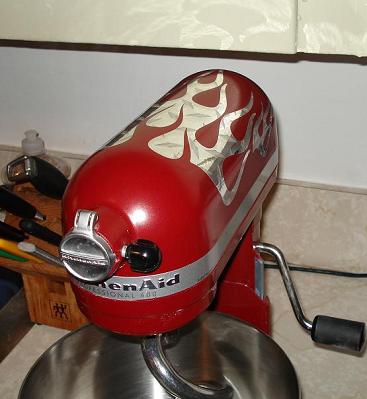
So, now that I have the flamejob for this:

image

I did this:

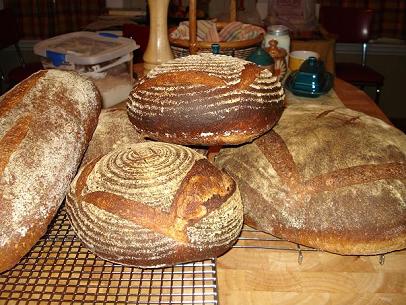
image

From right to left that's two pain levain batards, two sourdough boules, and a part-rye part whole-wheat sourdough miche of my own design - about eleven pounds of lovely bread I turned out of my oven today. This was probably the best day of baking I've ever had.

In the background, you can see Herman, my stout and doughty sourdough culture, his billions of yeasts and bacteria toiling away happily on a fresh feeding.

I have a nice little life going here. Better not blink.

Posted by Johno Johno on   |   § 2

Anna, damn 'er!

Anadama bread is a traditional coastal New England bread with molasses and cornmeal that makes excellent toast and incredible peanut butter and jelly sandwiches. The original recipe, so the legend goes, comes from a Rockport, Massachusetts man (up the coast on Cape Ann, next to Gloucester where they're all gruff fisherman) whose wife ran off and left him with nothing in the house but cornmeal, molasses, and flour. He baked all these into a loaf and named it "Anna, damn 'er." History is silent on whether Anna deserved this infamy.

I have been making Anadama bread for years, from recipes by James Beard and Peter Reinhardt, but since I have had some time off recently caring for an infant, I've gone back to the drawing board, refined the basic formula into by far the best version I have ever tasted, and am now ready to pass it along to you, you lucky dog.

My basic innovations are to use a somewhat higher proportion of cornmeal and molasses than I've seen elsewhere, to add a little (optional) whole wheat flour for nutrition and complexity, and to use a two-starter method to build the dough rather than the traditional straight method.

The extra molasses and cornmeal (which is really pushing the limit for what this formula can take and still rise well) give the bread a distinctively "Anadama" character which I like a lot. For the same reason, I also prefer to use blackstrap molasses, the darkest, most intensely flavored molasses out there. It just tastes better in this bread, though you may certainly use dark or golden molasses if that's what you have around.

The two starters, a soaker and a sponge, are here for several reasons. The cornmeal soaker softens up the grain, which means: more sugar is available for the yeast to feed on; the particles of meal are softer and less prone to cut into the bread's gluten structure, giving a lighter loaf; and the cornmeal cooks more completely in the oven. A sponge of some of the flour gives great depth of flavor, promotes the activity of enzymes that make the dough more elastic, and also lowers the pH of the dough slightly, which (probably, so the theory goes) helps to soften the bran in the whole wheat and therefore keeps the loaf lighter. Putting all this together may seem like a pain in the keister, but it really amounts to five minutes of work done over two days.

Soaker:

10 oz cornmeal
10 oz water, room temperature

Sponge:

8 oz (1 3/4 cups) all-purpose or bread flour (11% protein content minimum)
7 oz water, room temperature
1/2 tsp yeast

Main Dough:

8 oz (1 3/4 cups) all-purpose or bread flour (11% protein content minimum), plus more in reserve
6 oz (1 1/2 cups) whole wheat flour (or, 6 more ounces AP or bread flour)
1 1/2 tsp instant yeast
.4 oz (1 1/2 tsp) salt
4.5 oz (1/3 cup) molasses, preferably blackstrap
1 oz (2 tbsp) unsalted butter, at room temperature

(For the hardcore here's the baker's percentages):
Flour................. 100%
Water................ 77%
Yeast................. about 1.1%
Salt................... 1.8%
Cornmeal........... 45%
Molasses............ 20%
Unsalted Butter... 4.5%

1) The night before you bake, make your soaker: combine the cornmeal and water in a small bowl, mix well, and cover with plastic wrap. Alternatively, you can make a hot soaker on baking day: heat the water to about 130-140 degrees, combine cornmeal and water, mix well, cover, and let stand for 4 hours. The higher temperature seems to help the cornmeal take up the water more quickly, and may contribute to a softer dough.

2) The morning of baking day, make your sponge. Combine the flour, water and yeast in a large bowl, whisk or stir together vigorously for at least a minute, and let sit 3-4 hours or until nicely ripe. (Ripe means that the sponge is bubbly and domed, and just beginning to recede. You will know it's ready when it looks like a badlands landscape, with canals just beginning to form on the surface between islands of starter.)

3) Place the flour, yeast and salt for the main dough in a large bowl or the bowl of your stand mixer, and whisk to combine. Add the soaker, the sponge, the molasses, and the butter.

4) Mix in stand mixer on low to medium speed for 6-8 minutes (using the paddle until things come together, and then switching to the dough hook), or, if kneading by hand, mix just until the ingredients are combined and then turn out onto a lightly floured surface and knead for 10-12 minutes. Add flour as necessary to make a smooth but somewhat tacky dough - it should clear the bowl but cling a little to a dry finger applied to the surface for a few seconds.

(This is a good opportunity to hone your skills working with a wonky dough - it tends to start off looking drier than it should, and then because of all the cornmeal cutting into the newly formed gluten, becomes rather unruly before turning into a smooth dough. You may need to add flour while you knead, but give it at least two minutes by machine or four by hand before adding flour a tablespoon at a time, to ensure you don't overdo it. )

5) Place kneaded dough in a lightly oiled large bowl and cover with plastic wrap. Let rise in a warm place (80 degrees) for 90 minutes. Halfway through, give the dough a business-letter fold*.

6) Remove dough from bowl, divide into two equal pieces, and gently preshape**. Let rest covered for 15 minutes.

7) Preheat oven to 350.

8) Shape each piece into a freeform round or batard loaf, or shape and place in lightly oiled loaf pans. Proof 60-90 minutes or until nearly doubled.

9) Bake in oven for 40-50 minutes, turning halfway through. If you wish, you may steam the oven*** when you place the loaves to promote a better oven spring.

10) When the internal temperature is above 190 degrees, and the loaf is a nice dark golden brown on all sides, remove from oven. (Or, just give 'em the full 50 minutes if there's doubt.) Remove from pans, if used, and place on a rack to cool. Wait at least 1 hour before slicing!****

* A business-letter fold is a fancy way of punching down partially risen dough. The intended effects are two: to gently expel some of the gas that has begun to accumulate, and to line up the gluten structure of the dough to promote a good rise, a good shape, and an attractive loaf.

Here's how:

1) Using a bowl scraper, remove the dough from the rising bowl onto a lightly floured surface. Using the flats of your fingers, gently press down all over the dough to let some air out. Do not mash the edges, do not try to pop visible bubbles, and do not be forceful.

2) Gently pull the sides of the dough outward just a little so that the entire mass is an ovalish-rectanglish shape with the long sides going left to right.

3) With your hands, take the left side of the dough up and fold it about two-thirds of the way over the rest of the mass, as if you were folding a letter into thirds. Repeat with the right side, folding it all the way to the opposite edge. Do not press down to seal.

3a) In some very slack doughs - not this one - you may turn the dough 90 degrees and repeat this process before returning the dough to its bowl, to build additional strength.

4) Replace dough in bowl, folded side down, and cover once again with plastic wrap.

** To preshape a loaf is to take the ugly cut piece you have, and turn it into something orderly so that it will form a neater loaf that will rise and eat better.

1) Place the dough piece cut side up on a very lightly floured surface. Take the top edge and fold it toward the middle of the mass. With the heel of your hand, gently but firmly press it into place. Take the piece of edge that's at about 2:00 and repeat. Continue clockwise like this all the way around. When you are finished, the dough should be closer to round, and elastic enough to spring back just a little when you take your hand away.

2) Then, take the 12:00 and 6:00 edges and bring them toward each other. Press them together to gently seal. Repeat with the 3:00 and 6:00 edges. Repeat again in each direction. Alternatively, if you are expert at shaping round loaves, you can tighten the gluten on the "good" surface a bit using whatever method you prefer.

4) Finally, turn the preshaped piece of dough seam side down onto a lightly floured surface, cover with a bowl or plastic wrap and let rest for 15-20 minutes.

*** To steam an oven:

1) Place an old cast iron skillet or cake pan you never plan to use again on the floor of the oven, or on the lowest rack if using an electric oven. Preheat the oven with the pan inside.

2) When you place your loaves in the oven, carefully pour 1 cup of very hot or boiling water into the pan before you shut the oven door. Be careful! - steam burns are bad news.

If you are afraid of pouring water into your oven, you can use a few ice cubes instead, placing them in the pan when the loaf goes in, though this does rob the oven of a little heat. You can also use a spray bottle to mist the dough with water prior to going in the oven, and then spray the oven walls quickly with water at two-minute intervals for the first eight minutes or so of baking. This method also leads to great heat loss, so tack a few more minutes of baking time on the end.

Now... why steam your oven at all? Well, steam will keep the starches in the crust from gelatinizing (hardening) as quickly while the loaf undergoes its last speedy rise in the intense heat of the oven. For this recipe this is optional, but you will probably find you get a slightly better oven spring from steam.

**** Why wait until the bread is cool before slicing? Because bread isn't done baking until the loaf has come back down to almost room temperature. As the loaf cools, the internal structure is continuing to gelatinize (set and become edible) and flavor compounds are continuing to develop. This process doesn't fully run its course until the bread is nearly cool. The only bread you should eat hot is bad bread; good bread deserves good treatment and a full cooling before cutting.

Posted by Johno Johno on   |   § 0

Flame On!

It's been a long standing point of minor contention between myself and Goodwyfe Johno that for some reason she won't let me have a flamejob put on our Oldsmobile sedan. Says it's a frivolous waste of money... I guess I can see her point, but I have a hard time liking it.

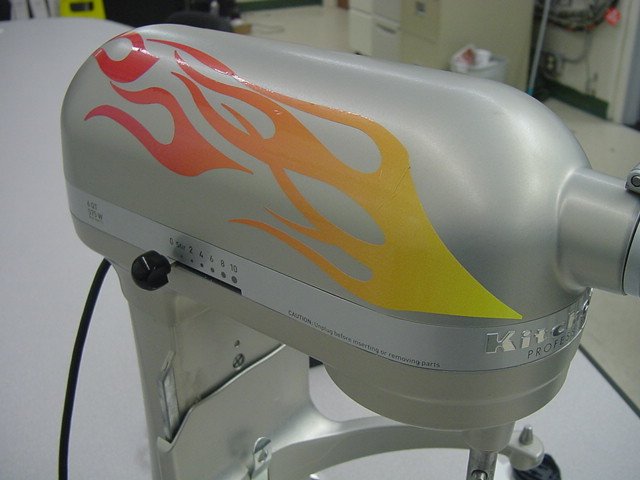
But let nobody say she's not a good person: yesterday she found for me a guy who makes flamejob decals... for home stand mixers like my Kitchenaid Artisan 600! A silver-and-black flamejob diamond-plate pattern flamejob decal is on its way to my home as we speak, to give my Kitchenaid mixer at least 100 more horsepower of pure high-grade awesome. My mixer, when done, will look very much like this (except awesome silver on awesome red):

I love the internets.

Posted by Johno Johno on   |   § 2

Hangover Food for Ambitious Drunkards

Heya kiddies, it's time for yet another installment of Johno's Hangover Food for Ambitious Drunkards! (I realize that this is the first time I've actually ever used that particular phrase, but look back through the extensive catalog of recipes I have posted to this site and you'll see that pretty much that's all I do.)

Check out these banana pancakes - I invented these this morning because I need potassium. And sleep. I need sleep. Y'see, I have a one week old infant in the house who's doing the usual sleep and eat and eliminate in no pattern around the clock whatsoever thing, and I've developed this persistent twitch in my left eyelid. Clearly a potassium deficiency, right? Right?

Anyway, these are incredibly delicious, like almost ridiculously good, and ridiculously easy to whip up on no notice.

Banana Pancakes
makes 4 big and thick pancakes, serving two. Doubles (or more) well.

1 cup (4.5 oz) white whole wheat* flour, or 1/2 cup all-purpose flour and 1/2 cup whole wheat flour
1 tbsp sugar
2 tsp baking powder
1/4 tsp salt
1 cup milk
1 large egg, beaten
2 tbsp melted butter
2 small or 1 large banana, mashed

Combine all dry ingredients and whisk together. Combine all liquid ingredients except banana and whisk together well. Add banana to liquid and whisk thoroughly again.

Pour liquid ingredients into dry and stir with a whisk ten times only - ten! only! to combine. Lumps are OK.

Cook in half-cup amounts on greased pan or griddle with surface temperature 350 degrees.

I repeat: these are CRAZY GOOD.

*King Arthur offers flour milled from white winter wheat, which lacks some of the bitterness and whole-wheat character of regular red whole wheat. This makes it much better for pastry applications where the nutrition and added flavor complexity of whole wheat flour is desired - cookies, pancakes, biscuits, waffles, and if you use some trickery, even pie crust.

Posted by Johno Johno on   |   § 0

Dispatch from the Ministry of Hops, vol. 16

American Wheat Ale

5 lbs wheat dry malt extract (50% wheat, 50% barley)
2 oz Hallertau Mittelfreuh hops, in 1/2 oz plugs
White Labs WLP 001, California Ale Yeast

Brought 3/5 gallons of spring water to boil in kettle. Added extract and 1 oz hops at boil.
Added 1/2 oz flavor hops at 30 minutes
Added another 1/2 oz hops at 15 minutes

Pitched yeast at 68 degrees - fermented itself up to 72 and was done in about 3 days. Racked to secondary and let settle for 3 weeks before kegging.

This beer is fantastic. Smooth, creamy, with that clear hop flavor and faint tartness that California yeast brings. Oddly for a wheat, it's crystal clear and golden, not as pale or hazy as I might have expected. Well, I might have added some Irish moss to clarify; I just don't damn well remember. Nice sweetness, beautifully balanced bitterness with a great touch of noble hop flavor and a little aroma. I swear I'm getting some creamsicle notes off this, and it's really wonderful. I'll be making this one again, no doubt.

Posted by Johno Johno on   |   § 0

Dispatch from the Ministry of Hops, vol. 15

Too Bitter Porter

So, what I was after, was a nice dry porter with a good dose of spicy herbal hops in the flavor and nose. What I got was horribly overbittered and a good beer ruined. I ended up tossing the last half of this batch from the keg to make room for the next brew I did. So, that's pretty much a disaster.

5 lbs light dry malt extract
3/4 lbs crystal malt, 60L
1/4 lb chocolate malt
1/4 lb black patent malt
.8 oz Galena hop pellets, bittering (12% AAU)
1 oz UK Fuggles hop pellets, aroma and flavor
1 oz Tettnanger Tettnang hop pellets, aroma and flavor
2 packages SAFale 33 dry ale yeast

Steeped grains in 1 gallon of spring water and brought 3 to boil. Sparged grains in hot kettle water and added steeping water. Galena and DME added at boil
Hop addition:
Galena 60 min
1/2 oz each Tett and Fuggles 20 min
1/2 oz each Tett and Fuggles, 5 min

Pitched yeast at 72 degrees. Fermentation began slowly but wrapped up in three days. Racked to secondary and let rest for three weeks before kegging. Force-carbonated with CO2.

Almost, but not quite, a good beer. Actually, quite good with heavy food, but just too much bittering hop. A damn shame.

Posted by Johno Johno on   |   § 0