Cry Havoc

War, conflict, and associated frivolity.

Objectively pro-Islamofascist

This came out Monday, so excuse my tardiness. A lot of people have linked to it, but if I can't be redundant here, where can I be? Christopher Hitchens is without doubt my favorite liberal. He is also the only well known liberal that I have ever personally met. He is much shorter in person. He had this to say about the recent demonstration in Washington:

To be against war and militarism, in the tradition of Rosa Luxemburg and Karl Liebknecht, is one thing. But to have a record of consistent support for war and militarism, from the Red Army in Eastern Europe to the Serbian ethnic cleansers and the Taliban, is quite another. It is really a disgrace that the liberal press refers to such enemies of liberalism as "antiwar" when in reality they are straight-out pro-war, but on the other side. Was there a single placard saying, "No to Jihad"? Of course not. Or a single placard saying, "Yes to Kurdish self-determination" or "We support Afghan women's struggle"? Don't make me laugh. And this in a week when Afghans went back to the polls, and when Iraqis were preparing to do so, under a hail of fire from those who blow up mosques and U.N. buildings, behead aid workers and journalists, proclaim fatwahs against the wrong kind of Muslim, and utter hysterical diatribes against Jews and Hindus.

Some of the leading figures in this "movement," such as George Galloway and Michael Moore, are obnoxious enough to come right out and say that they support the Baathist-jihadist alliance. Others prefer to declare their sympathy in more surreptitious fashion. The easy way to tell what's going on is this: Just listen until they start to criticize such gangsters even a little, and then wait a few seconds before the speaker says that, bad as these people are, they were invented or created by the United States. That bad, huh? (You might think that such an accusation—these thugs were cloned by the American empire for God's sake—would lead to instant condemnation. But if you thought that, gentle reader, you would be wrong.)

This is not to say that there can't be meaningful criticisms of the war, or of the way it is being conducted. But that is not what these people are about. I saw a car Saturday - likely on his way down to the big fashion meet - with an upside down flag hanging from the antenna. I am a peaceful man, but I wanted to run that asshole off the road, and then beat him senseless with a baseball bat. Far to many of these sub-morons simply do not understand, well, anything. About what America is, or what the terrorists are, or about what liberty might actually mean, or what many have sacrificed to preserve and extend it. And how they expect to convince others with their asinine slogans and offensive theatrics is completely beyond my comprehension.

Posted by Buckethead Buckethead on   |   § 0

I call... bullshit, too, just on something completely different

On Friday, Russian President Vladimir Putin taped an interview with Fox News. Details of the interview can be found in the AP article "Russia Said Won't Resume Cold War Rivalry". The taped interview was broadcast Sunday, September 17 18.

Mr. Putin had comments on a variety of interesting issues in addition to the article's title subject, such as referral of Iran to the UN Security Council (no), hectoring of Russia regarding its adherence to Western-style democracy (no) and whether he'll amend the Russian constitution so that he can run again in 2008 (again, no).

But he also had an opinion to share on the exit of US-led troops from Iraq, and I found it interesting in its wording, if not its intent - those opposed to the military presence and action in Iraq, for whatever their reasons, seem all to be calling for a timetable for withdrawal, and Putin's no different. Well, almost no different - he actually emitted several nuggets of truth, though he might not have intended to do so:

Putin, whose government fiercely opposed the war to oust Iraqi dictator Saddam Hussein, said the U.S.-led coalition's military presence in Iraq is fueling the insurgency and urged that a deadline be fixed for the withdrawal of foreign troops.

"In our opinion, the fact of their presence there pushes the armed opposition to perpetrate acts of violence," Putin said.

The Russian president acknowledged that fledgling Iraqi security forces need time before they can take over from U.S.-led forces but said a timetable for a pullout is essential to "make everybody move in the right direction."

"I believe it should be within just over a year, or within two years, something like that. It will all depend on the situation in that country," he said.

So, it seems he agrees with Rumsfeld, Bush, and the rest of the US administration - the troops should be withdrawn when the time is right. And I don't think "uh, whenever" is, strictly speaking, a timetable for withdrawal. But it sure seems like the correct answer.

Because, like the man said, "It will all depend on the situation in that country."

Posted by Patton Patton on   |   § 6

A (nearly) Forgotten Anniversary from the Forgotten War

This week marks the 55th anniversary of the amphibious operations at Incheon/Inchon.

Stars and Stripes covered ceremonies held mid-week at the memorial in Incheon. I learned that the monuments and statuary of soldiers at the memorial is a cause of tremendous grief to Korean lefties, which is probably an excellent reason on its own to fight savagely to keep them there. They forget that if not for us, they'd all be speaking Korean now.

The US Navy has alot of cool maps, photos, and detailed exposition discussing the preparation and execution of the attack here.

Here's the short version: The hammer was the attack north out of the beleaguered Pusan Perimeter. The anvil was 70,000 soldiers and Marines put ashore at Incheon. The walnut was the North Korean army in the field.

Posted by GeekLethal GeekLethal on   |   § 9

A Quick Exercise in Scale

I looked up some figures, ran some numbers, crunched others, and made what I think is an interesting model.

First, consider the world-wide Zionist conspiracy. You know, the one that has Jews running the entire world and, in the process, slowly exterminating Muslims. THAT Zionist conspiracy.

Next, consider the populations in opposition. As best I can determine, there are about 12 million Jews, total, on planet Earth. Yes, that includes populations both in Israel and Manhattan. There are between 1 billion and 1.3 billion Muslims on the planet, again, as best I can determine. But that's a much easier figure to remember, since it's thrown into to virtually any press relating to the Muslim world in general.

Now. According to the CIA World Factbook and just about everywhere else I cared to look, China's population is about 1.3 billion. There are about 6-odd million people, total, in Israel. Not all are Jews, of course, but for purposes of this exercise assume enough of the 6 million ARE Jewish that they might as well all be Jewish. There are about that many people in Massachusetts, and in terms of land mass Israel and the Bay State are close enough to call them the same size. Actually if Mass lopped off Cape Cod and gave a sliver off the west side of the state to New York, it'd come closer to Israel's land area. But I stress we're talking generalities here.

So dig it: The subjegation of the entire Muslim world by Israel would, in a demographic sense, be like Massachusetts enslaving all of China.

That well-established and robust theme of the Muslim world doesn't make a lick of sense, even on its face, let alone in terms of utter kookiness from its conception. And even if you consider the entire global Jewish population, they'd have to each be personally responsible for ruining well over 100 Muslim lives, while at the same time living their own.

Does it bother anyone else that it is impossible for such a tiny number of people to be responsible for keeping 1/5 of the world's total homo sapiens in misery, yet are continually blamed for it? And worse, that people believe it?

Posted by GeekLethal GeekLethal on   |   § 4

I've Got A Warm Feeling In My Gut, and This Time I'm Sure It Wasn't The Chili

From Stars and Stripes:

From rubble to avenging angel: The U.S. Navy is using steel from the World Trade Center in a new ship, according to the Navy.

Ten tons of steel from the World Trade Center’s twin towers will be used in the construction of the USS New York, according to a Navy official.

The San Antonio-class amphibious transport dock is slated to be commissioned in 2008.

Being a squishy peacenik socks-n-sandals sort I generally squirm at gestures that whiff of vengeance. Unfortunately there is twelve-million-square-foot hole in my mercy that is still, four years down the road, full of black rage and sorrow. The notion that some of the steel from the WTC has made its way into a fighting vessel called the USS New York makes me feel... good.

It also nearly makes up for the failure of the designers of the new buildings to go with my preferred plan.

[wik] h/t Blackfive.

Posted by Johno Johno on   |   § 0

Democracy in inaction

Most Americans are unaware of how, exactly, their government works. At best, most of our citizenry has a hazy conception of the actual operation of Congress based in large part on vague recollections of schoolhouse rock’s “I’m just a bill.” This is a good and bad thing.

On the one hand, it is bad because liberty in a republic depends on the wise and considered participation of an informed citizenry. Warmed over and fuzzy memories from high school civics layered with factoids from USA Today and CNN do not an informed electorate make.

On the other hand, it is good, because if the good citizens of this nation actually understood, really knew, what goes on in, say, the stygian depths of the House Rules Committee room, they’d invite the British back to finish what they started in 1814. Leaving our fair capital a smoking wasteland would be infinitely preferable to facing the horrifying reality of dysfunction and corruption at the heart of our system.

On a related but tangential track, there’s Sam Cohen. You’ve likely never heard of him, but he’s the dude who invented the atom bomb. The peacemongers and hippies all painted the neutron as an even eviler version of an irredeemably evil weapon. It was the ultimate capitalist bomb – a nefarious device that killed people while leaving their property intact. This is in stark contrast to the actual mindset that led to Cohen to invent the bomb and to declare for decades that it was the most moral weapon ever devised.

Cohen’s logic was that in war, people will use weapons. Weapons are designed to kill. So, it makes sense to design weapons that kill efficiently while doing as little else as possible. If a neutron bomb doesn’t kill you outright, you will live on with out appreciable aftereffects. The infrastructure that you need to survive after the war will be intact – not blasted apart or poisoned with radioactivity. The bomb doesn’t maim, it only kills. Cohen, from his position at RAND, lobbied for years for his concept, only to be rejected by five successive administrations and a military that wanted only bigger bombs, not more efficient ones.

Cohen’s story has some – interesting – accounts of the wrong-headedness of those in charge of our nuclear strategy. But they aren’t as far fetched as they might seem at first. Remember that the depiction of cold war strategic reasoning in Dr. Strangelove is barely exaggerated from the realities of game theory informed strategy used by RAND and the military up until the fall of the Soviet Union. (The takeover of grand strategy by the mathematicians starting with RAND in the late forties is responsible for much of the incredible weirdness of the Cold War, the counterintuitive reasoning, inflexible response postures and bloodthirsty retaliation schemes. Also, the fascination with throw-weight, CEP, megadeaths, and finely-wrought calculations of the effects of nuclear war.) And also that those responsible for setting policy had (with the possible exception of Eisenhower) none of the special aptitude or training one might think necessary for figuring out what to do with city-destroying weaponry.

Knowledge is good, as the Faber college motto tells us. But it doesn’t always make it easier to sleep at night.

[wik] A couple other interesting Cohen bits here and here.

Posted by Buckethead Buckethead on   |   § 1

Sino-Soviet, I mean, Sino-Russian cooperation increases

The Watergate scandal typically overshadows Nixon's one real accomplishment - peeling the Chinese off the Soviet Bloc. Rather than a monolithic communist world united in opposition to the good 'ol US of A, after the early seventies, you had a much friendlier duolithic communist world; one where the Sovs had to seriously worry about the billion hungry Chinese and the longest land border on Earth. All was hunky-dory until the unraveling of the Soviet colossus through decades of political calculation out the window.

A period of happy innocence followed, followed by a rude awakening in the form of fanatical Islamofascists blowing up our buildings. But this, too has skewed our geopolitical reasoning. For all that terrorists and their state sponsors do pose a threat, it is not an existential threat. We need to take action, certainly, to defend ourselves, and the best defense is usually a good offense. Nevertheless, there is no way that Islamic legions will be landing on the Jersey shore anytime in this or any other century. Islamic bomber fleets will not rain destruction down on our cities, unless they somehow manage to get a five finger discount on the one of our air forces.

The only real potential (for now) existential threat is China. The Soviets, god bless them, were evil. But they were evil and stupid. We had the great good fortune that our greatest enemies saddled themselves with the most backward, inefficient and retarded economic system ever devised by the mind of man. This was more than a little help in a half century of Cold War. The Chinese communists are just as evil, but have jettisoned the worst of the economic stupidity of the command economy. Evil and smart puts me more in mind of say, Germany in 1936 rather than the USSR in 1980. An evil leadership, with a vibrant and productive economy, and with a distinctly (not to say xenophobic or fanatical) nationalist ideology is not a good thing to have in the world's most populous nation.

Germany was outnumbered by each of its three major opponents in the Second World War. This will not be the case in any hypothetical confrontation with China. And China is clearly laying the groundwork for confrontation with the US. This whole rant was sparked by this article which describes the increasing cooperation between the Russian and Chinese militaries. The Chinese are now the senior partner in a solidifying strategic alliance that embraces the majority of Asia's landmass.

Here's a prediction: if the Chinese invade Taiwan, the only people on our side will be Great Britain, Australia, New Zealand, Japan and South Korea, and India. And of course, the Taiwanese. Russia will be soldily in the Chinese hip pocket, and the Europeans will sit on the sidelines and condemn everyone. But they'll only mean it when they say it to us.

Posted by Buckethead Buckethead on   |   § 2

Digitus Impudicus

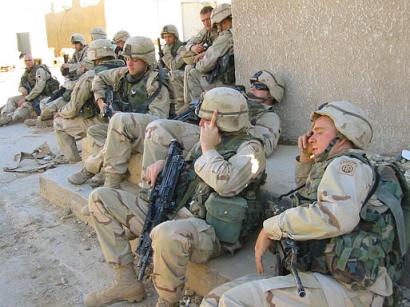
Via Murdoc, and Blackfive, this heartwarming photo from the frontlines:

image

The armed forces are always willing to display their undying respect for the media. From another recent Blackfive post, this quote is also apropos:

"Do not fear the enemy, for your enemy can only take your life. It is far better that you fear the media for they will steal your honor." 

- Bobby McBride, Crew Chief, 128th Assault Helicopter Company, RVN 1969-1970

If I were ever to be thrown back into the middle ages, and needed to design a heraldic emblem, I would either use the finger, argent, on a field sable; else just use the bat symbol.

Posted by Buckethead Buckethead on   |   § 0

Necessary != Right

If you have a subscription to the Atlantic, you can read this article, an eyewitness account of the bombing of Hiroshima by a survivor which was originally published in the August 1980 edition of the magazine.

To my horror, I found that the skin of my face had come off in the towel.

(What could I possibly mean by that title? Discuss.)

Posted by Johno Johno on   |   § 4

The Atom Bomb and a Better War

A couple military history items caught my eye over the last week.

The first is a book review by Mac Owens. In it, he examines two books by Richard Sorley - Vietnam Chronicles: The Abrams Tapes, 1968-1972 and a related, earlier book - A Better War: The Unexamined Victories and Final Tragedy of America's Last Years in Vietnam. The first book is transcriptions of audio tapes made while General Abrams was in command of American Forces in Vietnam, and is the raw material from which the second book was created.

A Better War makes the case that in the wake of the Tet Offensive and General Westmoreland's replacement, American forces were winning the war on the ground in Southeast Asia while it was being lost in Congress and at the peace talks.

Sorley's argument is controversial, but I find it persuasive. The fact is that most studies of the Vietnam war focus on the years up until 1968. Those studies that examine the period after the Tet offensive emphasize the diplomatic attempts to extricate the United States from the conflict, treating the military effort as nothing more than a holding action. But as William Colby observed in a review of Robert McNamara's memoir, In Retrospect, by limiting serious consideration of the military situation in Vietnam to the period before mid-1968, historians leave Americans with a record "similar to what we would know if histories of World War II stopped before Stalingrad, Operation Torch in North Africa and Guadalcanal in the Pacific."

Colby was right. To truly understand the Vietnam war, it is absolutely imperative to come to grips with the years after 1968. A new team was in place. General Abrams had succeeded General William Westmoreland as commander of the U.S. Military Assistance Command-Vietnam in June 1968, only months after the Tet offensive. He joined Ellsworth Bunker, who had assumed the post of ambassador to the Saigon government the previous spring. Colby, a career CIA officer, soon arrived to coordinate the pacification efforts.

Far from constituting a mere holding action, the approach the new American team followed constituted a positive strategy for ensuring the survival of South Vietnam. As Sorley wrote in A Better War, Bunker, Abrams, and Colby

brought different values to their tasks, operated from a different understanding of the nature of the war, and applied different measures of merit and different tactics. They employed diminishing resources in manpower, materiel, money, and time as they raced to render the South Vietnamese capable of defending themselves before the last American forces were withdrawn. They went about that task with sincerity, intelligence, decency, and absolute professionalism, and in the process they came very close to achieving the goal of a viable nation and a lasting peace.

The contrast between the two phases of the war are enormous. Max Boot, in The Savage Wars of Peace, also discusses how the American effort was finally beginning to work - thanks to new strategies like the Marines' CAP program for pacifying the rural south. Abrams, in the larger war, moved away from Westmoreland's ill-conceived large unit "sweep and clear" and "search and destroy tactics.

Abrams's approach focused not on the destruction of enemy forces per se but on protection of the South Vietnamese population by controlling key areas. He then concentrated on attacking the enemy's "logistics nose" (as opposed to a "logistics tail"). Since the North Vietnamese lacked heavy transport within South Vietnam, they had to pre-position supplies forward of their sanctuaries before launching an offensive. Americans were still involved in heavy fighting, as illustrated by two major actions in the A Shau Valley during the first half of 1969: the 9th Marine Regiment's Operation Dewey Canyon, and the 101st Airborne Division's epic battle for "Hamburger Hill." Most people don't realize that, in terms of U.S. casualties, 1969 was second only to 1968 as the most costly year. But now North Vietnamese offensive timetables were being disrupted by preemptive allied attacks, buying more time for Vietnamization.

...The 1972 Easter offensive [the first full scale invasion from the North] revealed the fruits of Abrams's efforts. This was the biggest offensive push of the war, greater in magnitude than either the Tet offensive [conducted by Viet Cong guerillas] or the final assault of 1975 [Another invasion from the North.] While the United States provided massive air and naval support, and there were inevitable failures on the part of some South Vietnamese units, all in all, the South Vietnamese fought well. Then, having blunted the Communist thrust, they recaptured territory that had been lost to Hanoi.

The terrible thing is that even as late as 1975, the Vietnam war could have been won. Had we lifted our heads from the Watergate scandal a little bit, and sent the military supplies and air support we promised, the South likely could have resisted the 1975 invasion. But short of ammunition and all other critical supplies, the South lost, and millions ended up refugees, or worse, sent into reeducation camps.

Another look at military history second guessing is Victor David Hanson's look at the atomic bomb sixty years after their only wartime use. There are some who still debate the utility of dropping the bomb. But the case is pretty clear that in that case, at least, the atom bomb was far preferable to the alternative.

The alternative to 300,000 killed in two atom bomb attacks is this:

  • At least that many, and almost certainly far more, civilians killed in any future bombing campaign prior to an invasion of the Japanese Home Islands. Curtis Le May had a nearby airbase in Okinawa, won at great cost just a month earlier. He had access to ever increasing numbers of B-29s, and would certainly have gotten access to whole fleets of B-17s, B-24s and other aircraft from the European theater. The fire bombing of Tokyo may have killed nearly a half million people. We didn't need nukes to annihilate cities, a part of accepted American strategy for over three years. Le May would have argued for laying waste to Japan by incindiaries.
  • The invasion of the small island of Okinawa cost 50,000 American casualties and 200,000 Japanese and Okinawa dead. Would the invasion of Kyushu and then Honshu have been easier? Conservative estimates of American casualties range upwards from a quarter million, and Japanese dead in the millions. (American casualties for the whole war were only about twice that number.) Japanese farmers were being issued spears. 10,000 kamikazes awaited the invasion fleet. It would have been the bloodiest campaign in history.
  • 10-15 million Chinese died in the war. Continued Japanese presence in China - and fighting there between the Japanese, Soviets and Americans would have resulted in hundreds of thousands more dead.
  • Something Hanson does not mention is the fact that as a result of the lethally effective American blockade (American submarines sank almost the entire merchant fleet of Japan in three years) and American disruption of transportation networks, the Home Islands were no more than a few months away from famine. A full scale invasion would have completely cut off the Japanese from other sources of supply, and progressively hindered what food distribution capability they retained. Some estimates suggest that a further 2-3 million Japanese might have died in 1946 from starvation even if we hadn't invaded, but merely maintained the blockades and bombing campaigns.

Not a pretty picture. War is often about terrible choices - and about taking the least bad option.

Posted by Buckethead Buckethead on   |   § 1

Warrior Laid to Rest

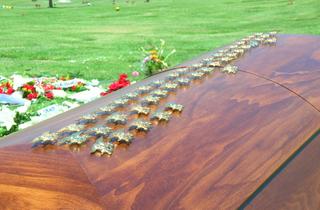
Froggy attended the funeral of fallen warrior James Suh in California.

This image moved me in a way I can never describe:

image

Those are SEALs' tridents, gilding Petty Officer Suh's coffin.

I have nothing to add to Froggy's post. Read it.

Posted by GeekLethal GeekLethal on   |   § 0

UAV Successfully Fires Test Rockets

A couple days ago the RQ-8 Fire Scout fired two Mark 66 unguided rockets, becoming in the process the first autonomous, unmanned helicopter to undergo a successful live weapons fire.

image

Northrop Grumman is developing the Fire Scout for both the Army and Navy. "Today's test is a big step in the development of future UAVs across the entire industry," said Doug Fronius, Northrop Grumman's Fire Scout program director. NG is a big player in the unmanned autonomous vehicle field - uavs in service, production or development include the U.S. Air Force RQ-4 Global Hawk and Army RQ-5 Hunter that are already in service; the BQM-34 and BQM-74 aerial targets; the multi-role Hunter II proposed for the Army's next-generation, extended-range, multi-purpose UAV program; the X-47 Joint Unmanned Combat Air Systems for the Defense Advanced Research Projects Agency, Air Force and Navy; and advanced systems like the KillerBee program being developed for low-altitude, long-endurance missions.

This is the future. Stealth can be defeated. Spoofing and jamming systems can be defeated. Any manned combat vehicle is vulnerable. Given our aversion to avoidable casualties, it will make increasing sense for hazardous missions to be alotted to autonomous combat vehicles. Instead of sending a billion dollar B-1, and risking the lives of its crewmen, send in a a flock of hundred thousand dollar drones armed with bombs and missiles. With satellite links back to controllers sitting in front of a monitor hundreds of miles away, you have greater ability to call the shots and ensure the destruction of the target. Loss of one or two drones doesn't risk mission failure. No possiblility of friendly casualties. The fighter jocks and bomber pilots in all the services will fight this hard, but the logic of redunduncy, accuracy, safety, economy will eventually win no matter what they do.

Posted by Buckethead Buckethead on   |   § 6

Army Unveils Jihadi Harvester

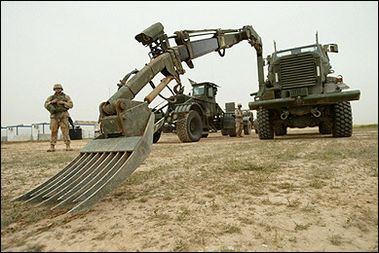
image

Nah, not really. It's actually a new mine-clearing vehicle. But it would be cool if it were a jihadi harvester.

Schizophrenic mercenary helicopter pilot Murdoc has the latest.

Posted by GeekLethal GeekLethal on   |   § 3

Firestorms: ranked #1 most underrated aftereffect of nuclear detonation

An interesting bit in the the Bulletin of the Atomic Scientists forwarded to me by a coworker. The author makes the case that the firestorm caused by a large nuclear blast will (for 100kton+ nukes) almost certainly be greater in extent than the blast zone.

Seeing as I work about four blocks north of the White House, I think it is safe to say that I will be well within the zone of "100% fatality" should someone light off a city killer within the District of Columbia. Now, if it was only a pony nuke - Hiroshima size or smaller, I might survive, depending on where exactly it went off. Unlike Hiroshima or other WWII-era Japanese cities, DC is built largely of stone, which should provide greater blast and fire resistance than a city made of, say, paper.

Interestingly, I was reading a while back that in many respects, a nuclear weapon is less effective than the equivalent amount of conventional explosives. The reason being is that while there is a tremendous amount of oomph in a nuke, it is very, very concentrated. Beyond a certain point, the stuff in the immediate vicinity of a 15kton bomb cannot be destroyed any more. But if you dropped 15,000 one-ton bombs in a grid pattern over a city, you would do more damage, because the destructive forces would be more evenly applied.

The great advantage of nukes is not their destructive power per se, but rather that so much destructive power could be delivered with significantly less effort. From thousand bomber armadas to a single plane. The economy of force is what made nukes so attractive to military planners. Political considerations made nukes unwieldy as a battlefield weapon, and we were stuck with conventional weapons for decades.

However, new technology has brought us to the same point. Precision weapons make it possible, again, to destroy targets with a nuke-like economy of force. A single plane with an appropriate load of smart munitions can destroy any given target. With dumb bombs, thousands of planes would be required to have even a outside shot of destroying a given target. *

I would wager that nuclear weapons will not be used in anything resembling a regular war in our lifetimes. With the advent of precision weapons, there's just no point to using nukes. The political fallout would cause more damage to the user than the bomb would to the enemy.

Where I would imagine their use is as a weapon of terrorists, a mad regime, or in space.

* [Wik] And if you're not familiar with the history of strategic bombing, you'd be stunned at how ineffective bombing was in the era before precision guided weapons. Post war calculations showed that pretty much the entire US Air Corps would have been needed to ensure that a single city was knocked out, and stayed knocked out, for the duration of the war. Bombers hitting their target was akin to winning the lottery. High altitude 'precision' bombing was a joke.

There were only two ways to ensure that a target was actually destroyed. One was to go in real low and slow. That tactic had the unfortunate side effect of leading to enormous casualties among the bomber crews. The other was to intentionally cause large scale firestorms with incindiary bombs. The fires would spread far beyond the blast zones of the individual bombs. This tactic had the unfortunate side effect of killing tens of thousands of presumably innocent civilians.

[alsø wik] Here are some nifty websites that allow you to calculate the blast effects of nuclear weapons:

  • Here's a couple simple ones that operate like your basic loan repayment calculators.
  • From FAS, a more sophisticated one that overlays blast radii on selected US cities.
  • And here is the famous asteroid impact calculator, which allows you to contemplate the devastation caused by truly large explosions.
  • Finally, a silly site that calculates the blast effects of nukes on spaceships.

    Posted by Buckethead Buckethead on   |   § 3

    Silencing Phillip Carter

    I was distressed to read that Phillip Carter, author of the Intel Dump blog, received reactivation orders last Thursday. Phil's taken the news with characteristic class; well-wishers abound in the comments, hoping for the best for Phil.

    What no-one seems to be saying, and Phil is obviously unable to say himself, is this: Is this payback? I don't know, but I'll say it, and I'll say that this administration and this military leadership will breath easier in the information vacuum his forced activation creates.

    Phillip Carter has been one of the more outspoken critics of the military and of the government since leaving the active service. He's written clear and precise articles as an intelligent man who's been there and done it. He advocates the draft, and calls'em like he sees'em.

    He advocates very effectively for positions that are highly inconvenient to the administration and to the military.

    We all know that very large numbers of recently departed active service members are being reactivated as the military struggles to keep the necessary forces in place. Recruitment has suffered hugely; forcing the recently active to serve additional tours is very much the only option at this point.

    Posted by Ross Ross on   |   § 7

    Clio Downrange

    Clio, the muse of history, has left her scrolls and books at the foot of Mount Olympus. She has gotten her shots, filled out her will, donned her 3-color desert uniform and spiffy brassard, and humped her ruck into harm's way.

    Clio is downrange with the 45th Military History Detachment.

    Stars and Stripes discusses the efforts of Army historians in recording and cataloguing soldiers' accounts of operations in Iraq and Afghanistan. There is not likely to be more detailed primary source material concerning the units, places, and people in either theater. Much of the collected information undoubtedly has immediate utility, as tactics are modified and doctrine re-written. Other material will be used to fuel papers at the War College and CGSC, likely sooner rather than later. The greatest value of this work though will not be appreciated for, perhaps, decades.

    This is the raw stuff that our children will use when they write the history of this war.

    Posted by GeekLethal GeekLethal on   |   § 0

    Ministry Caliber Corner: Kimber Custom II

    Kimber reinvented the 1911 pattern semi-automatic when it introduced the Custom .45 ACP. Before Kimber, getting an accurate .45 meant spending hundreds or even thousands of dollars for the tuning and accessories necessary to create a first-rate .45. The Custom came with many of these features standard, and had out-of-the-box accuracy rivaling the best match grade pistols.

    After I purchased my Custom II, I rushed over to my local shooting range. I loaded up my eight round magazine, grabbing ear protection and safety goggles, and picked a lane. I am not a marksman. I don’t have time to polish my skills. But you could cover my first eight shots at ten yards with a playing card. From a gun I had never fired before, of a type I was largely unfamiliar with.

    The rangemaster walked over and asked, “Kimber?” Shit! They’ve got mind reading rangemasters!

    “Right in one. How’d you know?” I asked.

    “I heard you say it was a new gun. Only Kimber and an accurized Springfield are that tight fresh out of the box. And the Kimber’s a thousand bucks cheaper.”

    That made me feel very happy with my new purchase.

    From a distance, the Kimber looks like a standard issue M1911 pistol. But clever Kimber gunsmiths have added lots of goodies. Metal Injection Molding makes all the smaller parts stronger than earlier cast metal parts. The gun is constructed to extremely fine tolerances. The fit is tight but smooth – you can feel it when you operate the slide, and when you pull the trigger. It’s like the difference between the sound of a door closing on a Mercedes, and on a Yugo. You can just tell that one is made a lot better than the other.

    The Special Forces are known to be fond of Kimbers. The LAPD SWAT team recently adopted stock Custom II’s as their standard sidearm. And I love mine. The 1911 is a big gun, over two pounds in weight. This, however, helps the shooter control the heavy recoil from the big .45ACP round. For me, the 1911 feels like an extension of my arm, and shooting is an utterly natural process. The big grip fits perfectly in my hand; and as I mentioned, the Kimber is a finely made piece of iron.

    From the shooting times article:

    The 1911 continues to be cloned by dozens of companies both here and abroad. And getting what you pay for doesn't necessarily apply as one can easily spend twice as much for one pistol that won't perform as well as another. First and foremost on the performance list is reliability. The pistol simply must work every time all the time. The pistol must also be "combat accurate." While the definition of this somewhat elusive term varies, any pistol that works every time and can break four inches with five shots at 25 yards is combat accurate. It's a plus if it'll do better than that and reliability is not compromised. Following reliability and accuracy comes stopping power, and the .45 ACP cartridge pretty much takes care of that by itself. It goes without saying that the pistol must contain reliable safety devices, good sights, ergonomics, and a good trigger. In its search for a new 1911 pistol, the LAPD SWAT team selected test pistols from what it considered the five major manufacturers. As one would expect, the testing was rigorous. Every aspect of the pistols was tested, retested, and evaluated. One by one, the guns were eliminated until the final selection was made.

    Kimber won by an impressive margin. Kimber makes more than a few 1911-type pistols, but if you're thinking the Kimber tested by LAPD SWAT was one of the top-of-the-line Kimber Custom Shop Target .45s, think again. The pistol the LAPD chose was Kimber's entry level 1911, the Kimber Custom II. A spartan pistol by Kimber standards, the Custom II comes with plenty of special features to qualify its name. These include fixed combat sights (dovetailed front sight), rounded (no-bite) speed hammer, stainless-steel throated barrel, polished feedramp, lowered/flared ejection port, four-pound trigger, extended thumb safety, beavertail grip safety, beveled magazine well, and black checkered rubber grips. Before Kimber most of these features were found only as aftermarket custom options. The Custom II is probably the most .45 ACP 1911 for the money--ever.

    That’s why I decided to get one. A .45 is not the most concealable weapon. It would be rather bulky in a shoulder rig. Shooting .45ACP is not the cheapest way to go. But: the Kimber is a joy to shoot, and there are very few handguns better for when the zombies come.

    The Kimber is a good zombie defense weapon. By combining accuracy with a big round, while remaining an easily portable handgun, you can’t have a better backup. If you’re shooting (as I will be) Federal Hydra-Shok rounds, you get an extra boost in lethality. These center-pin hollow points make very big holes on the way out. I tested a couple mags on some innocent watermelons, and each melon looked like it had been hit by a 24lb. sledge after only one shot. And you can do it repeatedly from outside the range of claws and teeth – if you’re a half-decent shot, you can get a head shot at respectable (for handgun) ranges. If the zombie come, and all you have is a handgun, I can confidently say that this is the one to have. Bigger guns have problems with accuracy, or even with finding ammo. .45 ACP is common, and you won't find a better combination of stopping power and accuracy.

    Final stats and gun porn below the fold:

    • Rate of Fire: 3 (you can rip off a full clip pretty quick, and you can reload faster than a typical wheelgun.)
    • Magazine Capacity: 2 (8 rounds per mag.)
    • Effective Range: 4 (I can get four out of five rounds in the head thingy on the target at 50’ regularly, and I am not an action movie star.)
    • Humpability: 6 (for a handgun, it’s a big, albeit reassuring piece of iron.)
    • Melee Combat: 3 (I don’t recommend pistol-whipping zombies. If you’re out of ammo, drop the gun and use a Louisville slugger.)
    • Zombie Hole Size: 7, or an exit would the size of a cute little kitten. (Using the Federal Hydra-Shok rounds recommended by my friendly neighborhood gun nut. If they can blow the entire back two-thirds of a watermelon away, I think it would do a good job on a Zombie noggin. This would be 6 or even 5 with standard slugs.)

    Zombie Incapacitation Potential: 4.6/10*

    *Note, again, that in the event of a close-quarters head shot the Hydra-Shok will certainly pulp the zombie’s head. A slug would likely do the same.

    image

    [wik] Links fixed

    Posted by Buckethead Buckethead on   |   § 5