
Just adding to my time in purgatory



Posted by
Buckethead
 on
| § 1
on
| § 1
on
| § 1

 March 2017
on
| § 1
There's been a veritable avalanche of articles about the United States invading Canada in the last few weeks. Which, for such an arcane topic, means three.
Back in the awkward in between phase of the Early 20th Century global war, the US War Department made plans for fighting pretty much everyone. Which is the sort of thing sensible War Departments do. It's not likely you're going to fight anyone in particular, but if the Pres picks up the red batphone and says, "We're invading Zimbabwe tomorrow," well, you don't want to get caught short. Back in the day, we had cool color codes for the war plans, and War Plan Red was the one in case shit got real between the US and the British Empire. Since Canada was the biggest and closest part of the Empire Upon Which The Sun Never Set, much of the war plan involved invading, oppressing and occupying Canada.
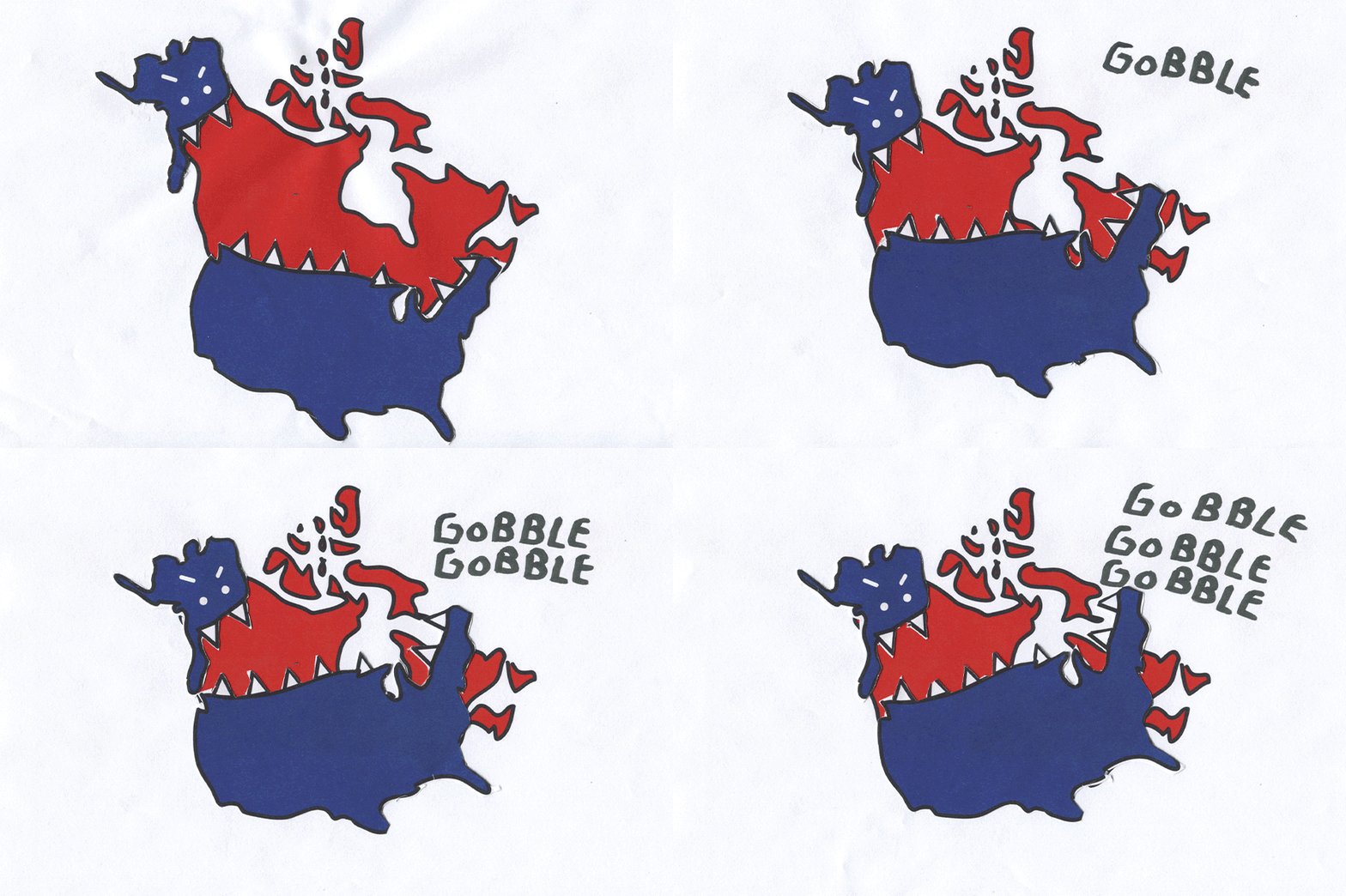
These plans were developed during the 1920s and ’30s by the U.S. Joint Planning Committee (later to become the Joint Chiefs of Staff) and each assigned a color to a particular world power the United States saw as a potential adversary. Black for Germany, Orange for Japan, and Red for the British Empire.
The first two articles are from War Is Boring and Vice, and cover the details pretty well. The War is Boring link also mentions Canadian Defense Scheme №1, which was a pre-emptive strike intended to slow the coming American onslaught by invading and then conducting a scorched-earth retreat to buy time until the Brits could come and save their (Canadian) bacon.
The hope was that the U.S. would be caught off guard, allowing enough time for the British to come to Canada’s rescue.
At the first sign of military aggression, Canadian forces would push into the states and take Spokane, Seattle, Portland, Fargo, portions of the Great Lakes region and Albany. When the inevitable retaliation came, the Canadian military would withdraw and destroy bridges, factories and other infrastructure as they went.
The Vice article quotes a defence analyst on the probable chances of Defense Scheme №1
Fortunately, there was also a Canadian counter-plan created in case of a US invasion during the same time period as War Plan Red, called Defence Scheme No. 1 (the Canadian military is apparently not that creative with naming battle plans), which would involve a pre-emptive strike on the States. At the time it was described as "suicidal," a sentiment that's only grown with the growing disparity between the two countries' armed forces.
"A pre-emptive strike of that nature just wouldn't work," said Coombs. "It would be completely out of the question. The people who did it would be a speed bump on the path of the US Army."
The last article, in the national interest, claims that tensions between the US and Britain were rather, well, tense in the immediate aftermath of the Great War, and had it not been for general war-weariness and the Washington Naval Treaty that settled the issue - might have actually gone hot.
Even as the guns fell silent along the Western Front in 1918, the United States and the United Kingdom began jockeying for position. Washington and London bitterly disagreed on the nature of the settlements in Europe and Asia, as well as the shape of the postwar naval balance. In late 1920 and early 1921, these tensions reached panic levels in Washington, London and especially Ottawa.
The article goes on to present a short alt-history scenario for the War of 1921. Excerpts below - but srsly, read the whole damn thing:
Given the overwhelming disparity between available U.S. and Canadian military forces, most of these offensives would probably have succeeded in short order. The major battle would have revolved around British and Canadian efforts to hold Nova Scotia, New Brunswick and especially the port of Halifax, which would have served both as the primary portal for British troops and as the main local base for the Royal Navy. U.S. military planners understood that Halifax was the key to winning the war quickly, and investigated several options (including poison gas and an amphibious assault) for taking the port.
...
British war planning considered the prospect of simply abandoning Canada in favor of operations in the Caribbean. However, public pressure might have forced the Royal Navy to establish and maintain transatlantic supply lines against a committed U.S. Navy. While it might have struggled to do this over the long term, the RN still had a sufficient margin of superiority over the USN to make a game of it.
But how would the RN have deployed its ships? Blockading the U.S. East Coast is a far more difficult task than blockading Germany, and the USN (like the High Seas Fleet) would only have offered battle in advantageous circumstances. While the RN might have considered a sortie against Boston, Long Island or other northern coastal regions, most of its operations would have concentrated on supporting British and Canadian ground forces in the Maritimes.
...
Both the United States and the United Kingdom expected Japan to join any conflict on the British side. The connections between the Royal Navy and the Imperial Japanese Navy ran back to the Meiji Restoration, and Tokyo remained hungry for territory in the Pacific. In the First World War, Japan had opportunistically gobbled up most of the German Pacific possessions, before deploying a portion of its navy in support of Entente operations in the Mediterranean. In the case of a U.S.-UK war, the IJN would likely have undertaken similar efforts against American territories.
...
In the end, however, the United States would have occupied the vast bulk of Canada, at the cost of most of its Pacific possessions. And the Canadians, having finally been “liberated” by their brothers to the south? Eventually, the conquest and occupation of Canada would have resulted in statehood for some configuration of provinces, although not likely along the same lines as existed in 1920 (offering five full states likely would have resulted in an undesirable amount of formerly Canadian representation in the U.S. Senate). The process of political rehabilitation might have resembled the Reconstruction of the American South, without the racial element.
The new map, then, might have included a United States that extended to the Arctic, an independent Quebec, a rump Canada consisting mostly of the Maritimes and Japanese control of the entirety of the Western Pacific. Tokyo, rather than London or Washington, would have stood as the biggest winner, hegemonic in its own sphere of influence and fully capable of managing international access to China.
It's interesting that pretty much everyone thought that the Japs would jump in on it - but given their behaviour in World War Phase One, just completed, maybe not such a stretch. Lose the Philipines and some Pacific Islands in exchange for pretty much all of English-speaking Canada? On the whole, probably a net gain, assuming that you don't end up with most of a century of die-hard Canadian loyalist terrorism. Even if Britain won on points in a War of 1921, they'd be proper fucked in a couple decades when the US doesn't come in on their side in the big one.
on
| § 0
The medieval 'New England': a forgotten Anglo-Saxon colony on the north-eastern Black Sea coast.
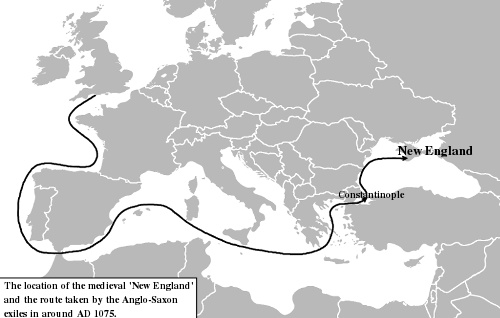
Although the name 'New England' is now firmly associated with the east coast of America, this is not the first place to be called that. In the medieval period there was another Nova Anglia, 'New England', and it lay far to the east of England, rather than to the west, in the area of the Crimean peninsula. The following post examines some of the evidence relating to this colony, which was said to have been established by Anglo-Saxon exiles after the Norman conquest of 1066 and seems to have survived at least as late as the thirteenth century.
According to these sources, what seems to have occurred is that, in the aftermath of the Norman Conquest of England in 1066, a group of English lords who hated William the Conqueror's rule but had lost all hope of overthrowing it decided to sell up their land and leave England forever. Led by an 'earl of Gloucester' named Sigurðr (Stanardus in the Chronicon Laudunensis), they set out with 350 ships—235 in the CL—for the Mediterranean via the Straits of Gibraltar. Once there, they voyaged around raiding and adventuring for a period, before learning that Constantinople was being besieged (either whilst they were in Sicily, according to the Edwardsaga, or in Sardinia, as the CL). Hearing this, they decided to set sail for Constantinople to assist the Byzantine emperor. When they reached there, they fought victoriously for the emperor and so earned his gratitude, with the result that they were offered a place of honour in his Varangian Guard.
...
Thus far the story, as outlined above, is clearly intriguing, and moreover largely supported by all of the available sources, both northern and Byzantine. However, perhaps the most remarkable and interesting part of the tale is found only in the Chronicon Laudunensis and the Edwardsaga, both of which may derive from a lost early twelfth century account, according to Fell. The Edwardsaga states that whilst some of the exiled Anglo-Saxons accepted the offer of joining the Varangian Guard, some members of the group asked instead for a place to settle and rule themselves:
[I]t seemed to earl Sigurd and the other chiefs that it was too small a career to grow old there in that fashion, that they had not a realm to rule over; and they begged the king to give them some towns or cities which they might own and their heirs after them. But the king thought he could not strip other men of their estates. And when they came to talk of this, king Kirjalax [Alexius I Comnenus] tells them that he knew of a land lying north in the sea, which had lain of old under the emperor of Micklegarth [Constantinople], but in after days the heathen had won it and abode in it. And when the Englishmen heard that they took a title from king Kirjalax that that land should be their own and their heirs after them if they could get it won under them from the heathen men free from tax and toll. The king granted them this. After that the Englishmen fared away out of Micklegarth and north into the sea, but some chiefs stayed behind in Micklegarth, and went into service there.
Earl Sigurd and his men came to this land and had many battles there, and got the land won, but drove away all the folk that abode there before. After that they took that land into possession and gave it a name, and called it England [Nova Anglia, 'New England', in the Chronicon Laudunensis]. To the towns that were in the land and to those which they built they gave the names of the towns in England. They called them both London and York, and by the names of other great towns in England. They would not have St. Paul's law, which passes current in Micklegarth, but sought bishops and other clergymen from Hungary. The land lies six days' and nights' sail across the sea in the east and north-east from Micklegarth; and there is the best of land there: and that folk has abode there ever since.In conclusion, the above points would seem to add some considerable weight to the case for the existence of a 'New England' on the northern and north-eastern coast of the Black Sea in the medieval period. Not only does it seem that the Byzantine Empire regained control of that portion of the Black Sea coast in this period, just as the Edwardsaga/Chronicon Laudunensis claim, but there also exists a quantity of medieval place-name evidence from this region that offers significant support for the establishment of English Varangian settlements there and a thirteenth-century account that appears to refer to the continued existence of a Christian people named the Saxi in this area, who occupied defended cities and were militarily sophisticated. In such circumstances, the most credible solution is surely that the medieval tales of a Nova Anglia, 'New England', in the area of the Crimean peninsula and north-eastern Black Sea coast do indeed have a basis in reality. This territory would appear to have been established by the late eleventh-century Anglo-Saxon exiles who had left England after the Norman Conquest and joined the Byzantine emperor's Varangian Guard, and their control of at least some land and cities here apparently persisted for several centuries, perhaps thus providing a regular supply of 'English Varangians' to the Byzantine Empire that helps to explain why the 'native tongue' of the Varangian Guard continued to be English as late as the mid-fourteenth century.
Sadly no information in the post on what happened to the Saxi - they were still around as late as the 1300s - but nothing on their ultimate fate.
Fascinating.
on
| § 0

