
Scientists aim to disprove doctrine of Intelligent Falling

Thought this was cool - a new observatory in Germany hopes its new apparatus will detect gravitational waves. The GEO 600 gravitational wave detector in Hanover is now in continuous observation mode, and scientists hope that their gizmo will in the near future detect the teeny, tiny ripples in the spacetime continuum caused by the passing of a gravitational wave. These gravitational waves are created when supermassive objects like black holes or large stars do something freaky like explode. Current theory holds that all mass can create gravitational waves, like when I shake my hips, but the gravitational force is so weak compared to the other forces that only the largest objects doing the most violent things will create gravitational waves that might be detected here on Earth. For an idea of the relative strengths of the primary forces, consider that you are held more or less firmly to the earth by gravity. The mass of the Earth is considerable - 5.9742 × 1024 kilograms. Yet despite all that mass pulling down, a moderately strong magnet on a crane will lift a multiton car easily. The chemical bonding forces of superglue will also easily support a midget from an I-beam, as we all remember from the commercials. If the force of gravity is taken to be 1, then the weak nuculer force is 1025, the electromagnetic force is 1036, and the strong nuculer force is 1038. (This assumes that the universe follows the modern physics model. This interpretation would be tragically mistaken if it turned out that the theories of Intelligent Falling were in fact a better description of underlying reality.)
GEO 600 is working alongside a US project known as Ligo (Laser Interferometer Gravitational Wave Observatory). It may also be joined in the hunt by an Italian lab within a year. A simultaneous gravity wave detection at these facilities would be a major milestone - both a confirmation of existing theory and the beginning of a whole new field of astronomy.
Laser interferometers are looking for disturbances in their experimental set-ups that are equivalent to mere fractions of the diameter of a proton, one of the particles that make up the nucleus of an atom. Getting GEO 600 to approach this level of sensitivity has been an immense challenge.
"There's more to come from GEO 600; I think we're still about a factor of three away from the design sensitivity over part of the frequency range. But the sensitivity we have makes it very worthwhile stopping improvement to run for an extended period," said Professor Jim Hough, from the Institute for Gravitational Research at Glasgow University, UK. Achieving the necessary sensitivity has been a huge challenge: "I think the most likely event for us to detect at the moment are coalescing black holes. I'm extremely confident," he told BBC News. A detection would be a final test of Albert Einstein's General Theory of Relativity.
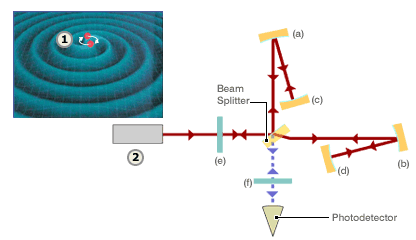
Pretty cool stuff.
 on
| § 1
on
| § 1

§ One Comment
[ You're too late, comments are closed ]
Yeeeaahhhh, that's kinda cool
Yeeeaahhhh, that's kinda cool. But what wasn't obvious to me is how those forces might be harnessed to exterminate our enemies.
Sure rifles and JDAMs and other weapons based on chemical reactions do a terrific job. But wouldn't it be even cooler yet to have a gravity weapon...yeah, in space!...orbital gravity hammers that could mash a bad guy into his boots instanteously? Or even disintegrate him?
Can this research in any way contribute to the search for death beams?