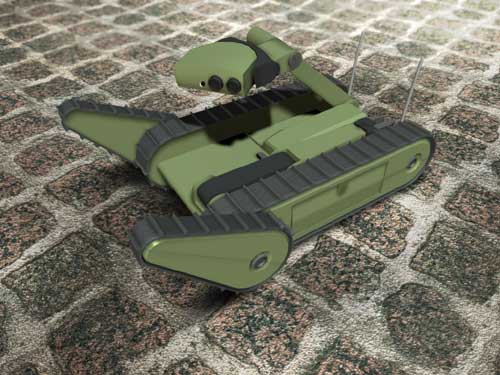
Now the robots will control our music!
Two readers have now emailed me this article, about the impending launch of an all-digital electric guitar by the venerable Gibson company, father of the electric guitar (thanks, mapgirl and NDR!).
As Gibson Guitar Corp. launches a new digital model, company CEO Henry Juszkiewicz can close his eyes and almost hear the music.
"The defining moment will be when a certain lick in a popular song is out there, and it can't be done with anything else but a digital guitar," Juszkiewicz says. "It only takes one example to really inspire people."
That, Juszkiewicz hopes, will usher in the age of the digital guitar -- much the same way as the Beatles and Rolling Stones inspired a generation of young people to pick up a standard electric guitar in the 1960s.
"It opens a whole new palette of possibilities," Juszkiewicz says. "It's a little bit like hearing stereo as opposed to mono."
....
The advantages of the digital guitar come down to sound and control. For 70 years, the electric guitar pickup has translated string vibrations into an electrical signal fed to an amplifier. The player can control the tone and volume, but output is limited to a mono or stereo signal. The signal itself is noisy by today's standards, and stray frequencies often cause an annoying hum.
"Some of the guitar pickups popular today go back to the 1920s," Juszkiewicz said. "We have not changed a lot in terms of the instrument."
NDR argues that now is "time for revolt" before the electronic guitar does for the bell-bottom-flapping-stack-of-Marshall-tens power chord what the CD did for high fidelity. I'm kinda with him on that, but I find to my surprise that I can't get too worked up.
Here's why. As with compact discs versus vinyl, there is an ineffable warmth to the sound of analog that digital simply cannot match. Listening to Neil Young's "Rust Never Sleeps" on LP is a fundamentally different experience from listening to it on CD, and don't even get me started about the gritty trebles and woolly bass tones of some early jazz CD transfers. The same debate has already played out among the musicians of the world as the flatter-sounding yet more durable transistor amplifiers have become more common than the rich and gorgeous yet tempermental vacuum-tube varieties. And yet tube amps retain a dedicated (even fanatical) following, and most guitarists play one of a few models, most of which are decades old.
Myself, I don't care. There's a sound for all seasons, and digital guitar will merely open new frontiers. Much of what Gibson's CEO touts as shocking new innovation already exists in the from of guitar synthesizers, which have become increasingly refined and useful over the last decade or so. Moreover, the guitar synth has already found its niche without taking the place of the proverbial Sound Of Les Paul into Marshall Head. Vernon Reid, Elliott Sharp, and a fleet of others have made whole careers out of wrangling their guitars like plectrum-struck keyboards.
At this point I should offer some full disclosure. While on the bass guitar front I am a dedicated purist for four strings (5- and 6- stringers sound thin and grindy), for twelve years I have been the proud owner of a Fender Ultimate Stratocaster featuring new-generation Fender Lace pickups that are as unlike the traditional wire-wound magnet versions as a Mac running OSX is from a Dell running Win98. They sound awesome, bringing that classic bell-clear Strat sound but more so, and with greater sustain since the magnets are much weaker than normal and create less drag on a vibrating string. I'm a dedicated user of effects (mostly cheap) and signal transformers, but only when they are called for. If I had money to burn, I'd buy myself a nice big tube-driven Mesa/Boogie amp with a Line6 Pod preamp and a whole flotilla of rack effects. I would rip out the rhythm part to "Janie's Cryin'" and people five hundred miles away would cower at the sheer sonic power of my awesome riffage.
But if I had money to burn, I'd also buy one of the new Gibsons in a heartbeat. Back when I played every day, I got pretty good at playing two parts at once, palm-muting the lower strings to alter the tone in the lower register at the same time. The new Gibson digital allows you to customize the tone of each string independently, which would let me take that technique to the next level. Freaking sweet!
Think of it this way. The Hammond-B3, the Fender Rhodes, and countless generations of increasingly sophisticated synthesizers have failed to put Steinway and Bosendorfer out of business. To the contrary, Yamaha now offers some models of piano that integrate a digital preamp, processor, and hard drive with the finest in traditional piano construction and tonal shaping. The very best of these are magnificent. Yet most people when buying Yamaha still go for the baby grand, spinet, or upright devoid of the bells and whistles. I think the same will go for guitars. As long as Mexico keeps turning out the pinewood Fender Stratocasters for $300 a pop, and as long as tube amps can be gotten used for $150, Gibson hasn't immanentized the eschaton for heroic rockin' guitars. They've merely ushered in a new era.
Let me be the first to welcome our new six-stringed overlords.
[wik] A side note to NDR: just imagine a world where Joy Division had to record "Love Will Tear Us Apart" or "She's Lost Control" without the benefit of synths. I think in twenty or so years we'll be saying the same thing about the Gibson digital guitar.


 on
| § 0
on
| § 0