 June 2017
FOBS: Fractional Orbital Bombardment System


On March 15, 1962 - during the run up to the Cuban Missile Crisis, Soviet First Secretary Khruschev said,
We can launch missiles not only over the North Pole, but in the opposite direction, too. . . . Global rockets can fly from the oceans or other directions where warning facilities cannot be installed. Given global missiles, the warning system in general has lost its importance. Global missiles cannot be spotted in time to prepare any measures against them.
The Fractional Orbital Bombardment system was conceived by the Soviet Strategic Rocket Forces to exploit a backdoor vulnerability in the United States’ strategic defenses. As ballistic missiles began to eclipse nuclear-armed bombers in the 1950s, both sides deployed Ballistic Missile Early Warning nets. The first generation of American BMEW radars were deployed along the northern fringe of North America and Europe, intended to detect incoming Soviet missiles as they came over the pole and rose above the radar horizon. The Pentagon hoped to achieve at least a half-hour’s warning of a nuclear strike, to allow Strategic Air Command to launch its second-strike bombers and deciding where to target its own missile counter-strike.
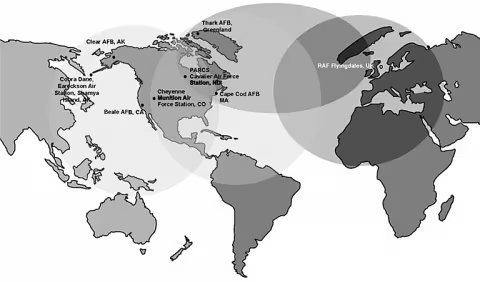
But into the 1960s, the US was blind to attacks from the southern arc. FOBS was intended to exploit that blindness. By launching into a low polar orbit, the nuclear warhead could approach the US from any direction - and particular, directions not covered by the American early warning radar lines. The first warning the US would have a strike would have been the EMP effects of the weapons detonating over their targets.
Development of an orbital weapons system
The byzantine nature of the Soviet system led to the initiation of three programs to develop a FOBS.
FOBS 1
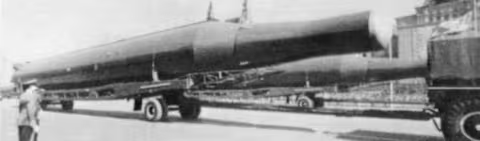
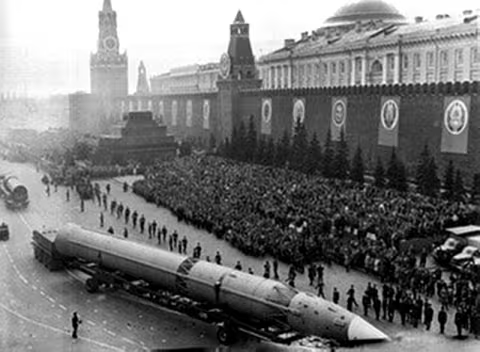
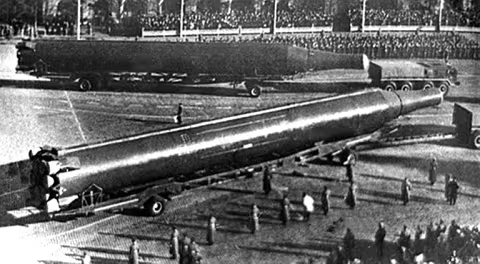
In 1962, Sergei Korolyov, the famed Soviet rocket scientist, began development of the GR-1 (Globalnaya Raketa -1 or Global Missile 1) - his last ballistic missile design. Development had ceased by 1964 without a single test launch. That didn't stop the Soviet Union from using the program as part of its extensive strategic deception efforts. The Soviets displayed the missile as an operational system during their annual Red Square parades in Moscow in the early 60s.
FOBS 2
The Soviet's second FOBS effort came from General Designer Vladimir N. Chelomey at OKB-52. His plans initially envisioned two global missiles based on the UR-200 and UR-500 ICBMs. The latter could have lofted a 30 megaton warhead into Earth orbit. For reasons that aren't clear, the heavy lift option was discarded in favor of the lighter UR-200 missile. This all became moot, however, when Chelomey's patron Nikita Khruschev was overthrown in a coup in 1964 and Chelomey's attempts to keep the project going proved futile.
FOBS 3
The system that actually did become operational came from Designer Mikhail Kuzmich Yangel, based in Dnepropetrovsk, in the Ukraine. His R-36 (NATO designation SS-9) missile became the R-36-O or 8K69 in the FOBS context. Like the R-36, the R-36-O was a multistage missile fueled with storable hypergolic propellants. For deorbiting the warhead, the R-36-O added a third stage for which the Soviets used the designation of 'Orbital Payload' (OGCh).
There are conflicting reports on the size of the warhead. Some Russian sources claimed up to 20 megatons, though US intelligence reports suggest a yield in the 2.0 to 3.5 megaton range.
Deployment
Having won by process of elimination, Yangel’s FOBS was approved for deployment by the RVSN. From 1965 to 1968, a series of test launches from the Baikonur complex established the system’s readiness. The Soviet authorities decreed that the missile be redesigned as an ‘encapsulated’ launch system. This new packaging scheme saw the ICBM stacked and then installed in a hermetically sealed container and then emplaced in the silo for long duration standby operations. Just prior to sealing the container, the missile was fueled. For over seven years before refueling and overhauling, the missile would be ready for launch at five minutes notice.
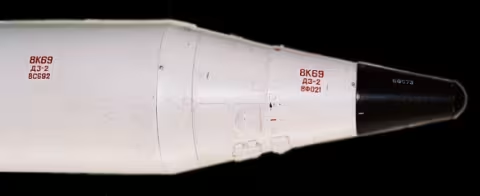
After the test program, the R-36-O / 8K69 was accepted into service in 1968 and remained in service until 1983. The Soviet Union built 18 operational FOBS silos at a site near Tyuratum, and stood up the first operational unit in 1969. Three FOBS battalions were part of the 98th Missile Brigade until 1974 when they were transferred to the Orenbugh Missile Army of the RVSN.
Employment
Were it actually used in a nuclear first strike, the missile’s flight profile had four phases: boost, orbital, braking and re-entry. Unlike a traditional ICBM, the FOBS missile had a much lower profile. A traditional ICBM rises on a steep trajectory and reaches an altitude of 1200 miles above the Earth before returning to Earth and its target. The FOBS would never ascend above 150 miles on its depressed trajectory and orbital insertion - and would not appear above the radar horizon of US early warning systems until almost at its final destination.
The 8K69 used its first and second stages to achieve orbit. At launch, the missile would head south toward the pole - a near polar orbit. The warhead, once past the south pole, flew north over the Southern Hemisphere, and eventually on track to hit targets in the central US. A slightly higher inclination launch could hit West Coast targets; a little lower would hit the East Coast.
As it approached the de-orbit entry point, the vehicle would pitch to orient for re-entry. The third stage rocket would fire for one minute, braking, changing the warhead’s trajectory from orbital to ballistic. And set the warhead on course for re-entry and its target. Given that it would be approaching from the south where the US had no early warning nets - time from detection to impact would be almost nil.
Degrading Utility
By the time the FOBS had been operationally deployed, the United Nations had passed the Outer Space Treaty which forbade the use of nuclear weapons in space. To the Soviets, this was a matter of semantics, and they promptly called their system a ‘fractional’ orbital bombardment system. Since the warhead never completed an orbit, it was thus in compliance with the letter of the international space treaties. (Of course, fully orbital weapons systems would require no additional development. Converting a FOBS to an OBS is simply a matter of not firing the retrorockets.)
FOBS faced a regime of degrading strategic utility soon after it was deployed. Over the course of the 1960s, the US expanded its BMEWS to a full circle around the continental US, limiting the value of attacking from the south. Further, the US deployed infrared early warning satellites that could detect launches over the Soviet Union. This rendered the surprise attack value of FOBS near useless.
While FOBS had near-unlimited range, the loss of the element of surprise relegated the system to an expensive collection of single-warhead missiles with low accuracy and only moderately powerful megatonnage. US Strategic planners believed that FOBS could be used as a pathfinder - attacking command and control centers rather than hardened silos and military targets. If the US lost the ability to coordinate a counter-strike, that could still be a significant advantage.
But what really killed FOBS was Soviet submarine designers. In the submarine-launched ballistic missile, Soviet planners had a vastly stealthier platform for launching a disarming first strike on the United States. SLBMs could be cheaper, more powerful and more accurate than any FOBS missile. And by the time of the SALT II negotiations in the late 70s, the FOBS program neared its end.
 on
| § 0
on
| § 0