Quote of the day
"Science and Mother Nature are in a marriage where Science is always surprised to come home and find Mother Nature blowing the neighbor."
From Shit my dad says
September 2010"Science and Mother Nature are in a marriage where Science is always surprised to come home and find Mother Nature blowing the neighbor."
From Shit my dad says
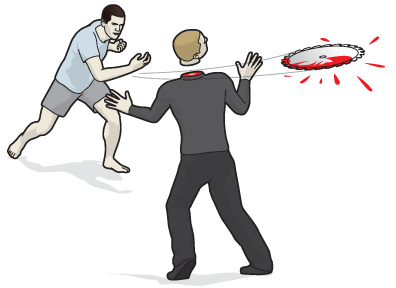
Every week, I wait and wait and wait, pining for the next installment of Badass of the Week. It's sad, perhaps. But nothing gets me going like tales of ball-destroying, face-ripping bloody carnage. Every one hopes in their heart of hearts to be a badass. And the Badass of the Week is quite the archive of inspirational badassitude. But how, we ask, do we become badasses our own selves?
We now have the answer:

[wik] I think we here at perfidy should get some credit just for having a category entitled "Lead Pipe Cruelty."
I have benefitted greatly from the home brew/craft brew movement. Over the last 30 years, I have enjoyed many a tasty beverage. It could be argued that America has the best beer on the planet. And we have Jimmy Carter to thank for that. Thank you, Jimmy Carter.
But it never occurred to me wonder why the rules aren't the same for liquor. It came as a mild surprise to me learn that the revenuers are still raiding moonshiners, and breaking up their stills. Yet, they are. It is a felony in this country to distill even a drop.
Back twenty years ago, I was climbing in WV, and at the camp that night the populations of out-of-state rock climbers mingled with the locals. The locals had 'shine in mason jars. And that was some of the best whiskey I've ever tasted. It was like drinking an alcoholic hot pepper, and it was like smoking a cuban cigar, and it was like breathing in the air on a cold Fall day. Nothing I ever paid for in a liquor store ever matched it.
This video from Reason explains a bit of why almost no one ever gets to experience that.
There is a time and place for everything, except possibly your impression of Christopher Reeve as a lifeguard.
I've run across a few sciency links that caught my interest.
The researchers offer their own alternative theory, based on standard natural selection, but with a twist: After starting with a focus on a single founder, selection moves to the level of colony. From this perspective, a worker ant is something like a cell — part of a larger evolutionary unit, not a unit unto itself.
“Our model proves that looking at a worker ant and asking why it is altruistic is the wrong level of analysis,” said Tarnita. “The important unit is the colony.”
The researchers propose a theoretical narrative that begins with a primordial, solitary ant — perhaps something like the ancient Martialis heureka — that lived near a food source and developed genetic mutations that caused it to feed its offspring, rather than letting them fend for themselves. Called progressive provisioning, such nurture is widespread in insects.
Another mutation could result in offspring that stayed near the nest, rather than leaving. They would “instinctively recognize that certain things need to be done, and do them,” said Nowak, describing real-world examples. “Put two normally solitary wasps together, and if one builds a hole, the other puts an egg in it. The other sees the egg, and feeds it.”
That would be enough to form a small but real colony — and from there, eusociality could emerge from an accumulation of mutations that led to a hyper-specialization of tasks, limited reproduction to queens alone and favored the colony’s success above all else. Within this colony, a queen would be analogous to a human egg or sperm cell — a unit that embodies the whole. Worker self-sacrifice is no more nonsensical than that of a white blood cell.
The researchers called this series of steps a “labyrinth,” one that isn’t easily navigated. Hence the rareness of eusociality, which is believed to have arisen just 10 to 20 times in history. But their theory explains everything that kin selection does, plus what it doesn’t.
“There is no need whatsoever to invoke kin selection or inclusive fitness,” said Corina — not in eusociality, not in any cooperative behavior.
Interesting in that kin relationships (while not unimportant) are subordinate to evolutionary changes that allow cooperative behavior. The relevance to HBD, and evolutionary changes that may have altered human patterns of socialization over the past few millenia, will deserve some pondering.

In sedimentary deposits dating to the beginning of the YD, impact proponents have reported finding carbon spherules containing tiny nano-scale diamonds, which they thought to be created by shock metamorphism or chemical vapor deposition when the impactor struck.
The nanodiamonds included lonsdaleite, an unusal form of diamond that has a hexagonal lattice rather than the usual cubic crystal lattice. Lonsdaleite is particularly interesting because it has been found inside meteorites and at known impact sites.
But, another team of researchers has reported that they found no diamonds in YD boundary layer material. Instead, they say, it's graphite.
“Of all the evidence reported for a YD impact event, the presence of hexagonal diamond in YD boundary sediments represented the strongest evidence suggesting shock processing,” Daulton, who is also a member of WUSTL’s Center for Materials Innovation, says.
However, a close examination of carbon spherules from the YD boundary using transmission electron microscopy by the Daulton team found no nanodiamonds. Instead, graphene- and graphene/graphane-oxide aggregates were found in all the specimens examined (including carbon spherules dated from before the YD to the present). Importantly, the researchers demonstrated that previous YD studies misidentified graphene/graphane-oxides as hexagonal diamond and likely misidentified graphene as cubic diamond.
The YD impact hypothesis was in trouble already before this latest finding. Many other lines of evidence — including: fullerenes, extraterrestrial forms of helium, purported spikes in radioactivity and iridium, and claims of unique spikes in magnetic meteorite particles — had already been discredited. According to Pinter, “nanodiamonds were the last man standing.”
“We should always have a skeptical attitude to new theories and test them thoroughly,” Scott says, “and if the evidence goes against them they should be abandoned.”
Of course, that attitude is also required for existing theories. But nevermind. The fact that there is a YD boundary layer, and it's composed of a thick layer of carbon - well, that should be indicative of something bad going on, like perhaps lots of things burning. I'd be curious to hear what the YD impact proponents have to say about this.