

 Ministry Archive: Buckethead
Who would have thought that making quality products would lead to world-wide domination? Apparently not GM, who just slipped into second place behind Toyota. When reached for comment, GM spokesmen replied, "They cheated."
The last American car I bought was a 1963 Cadillac, 20 years ago. Based on my experience with friends and relatives, I don't believe that I will buy any others in the near future - the sole exception being the potential purchase of a used pickup. The reason? They suck. Just 'cause they're made here (which, strictly speaking, they're aren't always) is not reason for me to subject myself to unreliable and poorly engineered vehicles.
[wik] Patton also posted on this very topic, but was too shy to post it at Perfidy. I will do him the favor of reproducing it here:
Hide the women and children! To the storm cellar, pronto! The Japs have sold 90,000 more cars than the, (quick - what’s a light-hearted pejorative for Detroit natives?) the Detroit guys!
…
Hey, wait a minute - so what? That little statistic is even less important than the dates and times at which the Dow Jones Industrials crossed each of the 1,000 point barriers, that is, “not at all”.
Given the fine mess that’s characterized GM these past few years, including poor results, billions of dollars in losses, junk bond ratings on its corporate debt, the jettisoning of the majority of its GMAC finance arm to Cerberus, the bankruptcy of Delphi, which it tried (and failed) to hive off as a separate, self-sustaining entity, and the battles with Jerry York, Kirk Kerkorian, and Tracinda, the fact that Toyota has passed them in sales is neither surprising nor particularly newsworthy.
They’re rather lucky to still be ahead of Ford, itself a company that is, as Monty Python might say “not at all well”.
Xenophobes and Detroit residents may mark this day as one that will live in infamy. More rational sorts will simply see it as the logical end to a progression that Toyota began, 20 years ago, when they started making cars better than General Motors was able or willing to do. Given that my last four vehicles have been made by Toyota, perhaps my objectivity isn’t perfect in this matter.
My post has the advantage of pithiness, but Patton got several more jokes in.
 on
| § 11
on
| § 11

In honor of the International pixel-stained technopeasant day, many people are posting stuff for free on the internets. One of my favorite sf authors, Charles Stross, has posted his award-nominated novella "Missile Gap" in its entirety, over here. Missile Gap is deeply creepy, and... nevermind. I recommend it highly. Go read. Right now.
on
| § 3
Bruce Schneier has an interesting bit up on Wired about how bad products drive out good in the security market. This is of course more broadly applicable. Worth reading.
on
| § 0
Should we need to invade Canada, we have at least one plan. Back in the interwar period, the United States maintained a series of color coded plans for wars with various potential enemies. Most well discussed of these was Plan Orange, which actually ended up being a big part of our actual war plans against Japan in the Second World War. Less well known is Plan Red, the plan for war with British Empire.
In the plan, the war was assumed to be continental. I imagine that this is because it was an Army plan rather than a Navy plan, and as such, it focused on "Crimson" which is Canada. The plan in its entirety can be found here, but the essentials are simple:
Step One, a joint Army/Navy assault on Halifax and the Maritime provinces to cut off Canada from reinforcements from Britain. Step Two, land assaults from New York and Vermont toward Montreal and Quebec City, with Quebec being the primary target. This would cut Eastern Canada off from the rest. Step Three, assaults from Niagara and Detroit into Ontario. Seizing these areas would deny the enemy their industrial facilities, staging areas for air attack, and secure control of the Great Lakes. Step Four, a thrust towards Winnipeg to cut the Trans-Canadian railway and communications between the far west and Eastern Canada. Finally, Step Five, an assault on Vancouver which would lead eventually to the occupation of British Columbia and deny Canada access to the Pacific.
This seems like a good plan, decisive strikes to disable communication, followed by occupation. Seeing as 90% of the Canadian population is within a three-day march of the American border, Canada is not exactly easy to defend. This plan, suitably updated to incorporate changes in the geo-political and military worlds, would likely have an even greater chance of success than it did in 1935. Alongside the phenomenal American military advancements over the last few decades, Canadian military strength has greatly diminished. Did you know that Canada once had the third largest Navy in the world? Canada's one real hope in '35 would have been to slow down an American offensive long enough for Britain to come to her aid. Now, Britain would find it nearly impossible to come to the aid of her former colony in the face of opposition from the US Navy.
The initial invasion would almost certainly be successful. But the idea of 33 million pissed off Canucks no longer across an international frontier is not exactly heartening.
on
| § 3
In all likelihood, this will be me, Princess Cat and Blackfive on the Friday before the Milblogger conference in a few weeks.

[wik] Princess Cat notes that we will likely have AWTM with us as well. We'll need a whole line of urinals!
on
| § 5
The United States has twice invaded Canada in the course of prosecuting wars against Great Britain. Despite this violent start to US-Canadian relations, on many occasions over the last two hundred years, people have proposed with varying degrees of seriousness that various bits of Canada be annexed to the United States. But for some people, that sort of piecemeal aggrandizement just isn’t enough.
For example, this website argues that there should be a complete merger of Canada and the United States. Given that Canada has only 10% of the population of its southern neighbor, they recommend that the Canadians adopt wholesale the political system and constitution of the United States. (And argue as well that the American Federal system will serve to preserve large measures of Canadian independence.
Among the benefits of such a merger would be the creation of, geographically, the largest country in human history. Most of the new territory is of course arctic wasteland, but it’s still land. The ten percent increase in population would narrow slightly the margin with China, which will be important in a couple decades when China goes imperialistic and attacks. Also, the added GNP will put us in a better position with regard to the EU. Dropping unnecessary border installations, customs, and redundant government installations will surely result in a savings for the taxpayer.
While this has absolutely no chance in Hell of ever happening, it is interesting to contemplate. (We’d have a better chance, I think, of picking up bits of Canada if Quebec ever decided to secede.) The most significant impact would be political, considering the close margins between Republicans and Democrats in the last few elections.
Consider: of the ten provinces, nine are big enough to become states, population wise. (Prince Edward Island only has 127,000 people – it would have to be rolled into New Brunswick or Newfoundland.) Of these provinces, now states, most would, thanks to their low populations, get the minimum three electoral votes. As we know, states with low populations get a disproportionate impact in the US Electoral College.
Bush won the 2004 election by five electoral votes. If Canada had been assimilated before the election, what would the result have been? Assuming that each province adopted the traditional winner-take all approach of most states, and that everyone who voted in the 2006 Canadian federal election for Liberal or NDP candidates voted for Kerry, this is what would have happened: Bush would have taken Alberta (6), Saskatchewan (3) and Manitoba (3), and lost by a whisker in British Columbia, for a total of 12 electoral votes. Kerry would have won in all the other small provinces, and gained BC (8) and Ontario (19), for a total of 36 electoral votes, throwing the election decidedly to Kerry no matter how Quebec voters went.
But, what if the provinces adopted the Maine method of determining their electoral votes? If so, then all the smaller provinces with three electoral votes would be unchanged, as would Alberta which went decidedly conservative. But, assume that Bush edges Kerry in BC, for a 5/3 split. And in Ontario, Bush would pick up six of the seventeen congressional districts for a 13/6 split. Both Kerry and Bush would likely pick up to districts apiece in Quebec, which gives us a total of 25 for Bush, 27 for Kerry. Bush would be up by three overall, and the last nine electoral votes would be in the hands of the Parti Quebecois.
The French would at last have their wish, control over America.
[wik] Ran into some other interesting sites in reading about the above: The Apportionment Paradox, Congressional Apportionment, and Thirty-Thousand.org.
on
| § 5
Tennessee was once nearly the state of Franklin before it all fell apart in a welter of acrimony, economic backwardness, Indian assault, and no doubt duels and whiskey. But the people regrouped, tried again, and successfully became Tennessee. For some fairly small values of "successful."
- Celebrating 50 Years Of Shitty Country Music
- We're Like Kentucky, But With Cities
- A unique fixer-upper opportunity
- The Darwin State
- The Educashun State
- The Parallelogram State
- Home of Most of Dolly Parton
- Daaaavey Crockett, King of the Wild Frontier
- The Forced Conscription State
- Got Cooter?
- We’re huge in Germany
- I Ride With Forrest
- Hooray For Dollywood
- At least we've got Elvis
- West West Virginia
- We’re bigger than France, and better smelling
- Almost Franklin
- We didn’t volunteer fer nuthin
- Don’t make me take off my Bible belt
- I love it when a plan comes together
- Home of Five Future Presidents
- Home of Al Gore, and therefore the Internet
- If you can read this motto, you may not be from Tennessee
- Follow Me To Tennessee, And Answer Me These Questions Three
- Gateway to Alabama
- I Hate Tennessee
- That’s Appalachian-American, you insensitive clod
- Fuck Walking Horses
- Tennessee is like a mullet: business in front, party in the back
- The Hillbilly State
- As Fertile as the Tennessee Valley
- Aim High: Agriculture and Commerce
- Don't go lookin for them damn melungeons
- The Hog and Hominy State
- Mother of Southwestern Motherfucking Statesmen
- The Butterbutt State
- Sounds Good to Me
[wik] There is a country-type band out of Ohio called Lost State of Franklin. They sound like a country version of Timbuk 3. It grows on you. You can listen to them here, click on "Clint Eastwood." This Clint Eastwood is nothing like the Gorillaz version.
on
| § 0
The new Ministry official motivational poster:
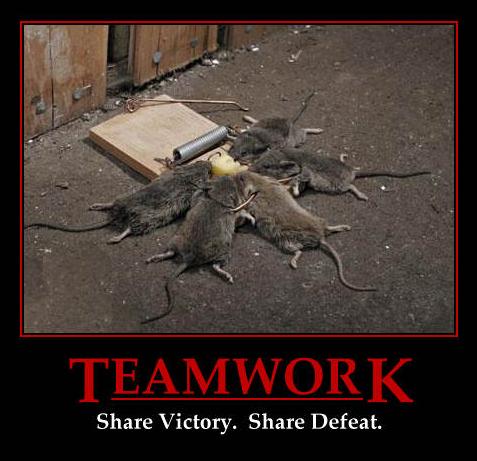
[wik] Thanks to Minister Patton's mysterious correspondent for sending us that.
on
| § 0
A little bird tells me that the Russkies are planning to build an undersea tunnel to the United States. No doubt this is some sort of paleo-commie plot. But it is an interesting, and hugely expensive one. The scheme is to build from the Easternmost tip of Siberia, to the little islands about halfway between there and Alaska, and then back into the water and over to Alaska. At over $10 billion, it will even cost more than Boston's big dig. The tunnel, which in its longest stretch will be underwater more than twice the distance of the chunnel, would carry rail, power, pipelines and road traffic. As cool as this is, theoretically, I can't really imagine that it would be terribly profitable, or useful. As a way to improve transportation to resource rich and largely empty Siberia, I would think that other schemes might give more payback. Saying you're connecting two continents that have been separated for 10,000 years sounds nifty. But what you're really doing is connecting the most desolate and uninhabited part of Russia with the most desolate and isolated part of the United States. If they build it, cool, but there isn't a lot of traffic piling up there, and sea transport is cheaper than rail anyway.
on
| § 0
Trawling through the vast wasteland of the internets, one finds mostly crap. To the point that Sturgeon's law seems wildly optimistic. Every now and again, though, your suffering is rewarded with unalloyed joy. This is one of those times. I found this over at AEBrain, and it is, without exception, the coolest use of Flash animation I have ever seen. (Though Homestar Runner comes close. And this is an addictive close third.)
[wik] I probably put more links in that paragraph above than I have in any in the last year. As a blogger, I should really consider linking more.
[alsø wik] Distracted by the linkiness, I forgot to say why that first link is so damn cool. Though if you clicked it, you'd know already. But I'm about to tell you, so wait a minute. The extrasolar system map is unlike most astronomical doodads you'll find, becasue it's not sol centric. Most star maps simply show what the stars look like from Earth. Which doesn't give you a good idea of how they are connected. A star map is like one of those goofy odd-perspective "the view of the world from New York" maps, that doesn't really provide any useful information. This map actually shows what stars are near each other. And, clicky on a star, and it will show if we have detected any planets in that solar system. Combine this thing with googlemaps and it would be awesome. If it had smooth scrolling between map sections, and a route planning mode with waypoints, it would be the most amazing thing in the world. Also, it would be cool if you could see more than one little bit at a time. Nevertheless, wow. Four thumbs up.
[alsø alsø wik] In light of my last post, I wonder how many of those planets in the nifty star map have ETs waiting to eat us. Most of the stars in that map are within the light cone of our radio broadcasts.
[wi nøt trei a høliday in Sweden this yër?] Broadcasting to a potentially unfriendly galaxy is probably not wise. On the other hand, a sufficiently advanced technology could detect us anyway.
on
| § 2
The blessed amazon fairy delivered another load of printed goodness at my doorstep. Typically, the amazon fairy brings me science fiction that is more or less throw-away, enjoyable to read but whose thinks pass in and then out of my brain leaving little lasting impression. Or history tracts that expand or deepen my knowledge of the past without notably changing my opinions of it. But this last deposit was a little different.
The book in the plain brown wrapper was "An Introduction to Planetary Defense, A Study of Modern Warfare Applied to Extra-Terrestrial Invasion." The careful and attentive reader of this website will quickly discern why this title got onto my wishlist. Of the four writers, I had only heard of the lead author, Travis S. Taylor, who had written a few science fiction novels for Baen Books. From the bios in those works, I knew that Dr. Taylor was a bit of a big brain, working for NASA and various defense department projects, including the Breakthrough Propulsion Physics program at NASA before its untimely demise. The name of the book and that last fact was enough for me to shell out the $35.
Was it worth it? On balance, I think definitely yes. There are problems with the book. Let’s get them out of the way first. The book is very poorly edited. There are typos, bad grammar, and poorly formed sentences throughout. That is irritating and distracts from the message the book is trying to get across. The book is poorly balanced, by which I mean that certain points will be attacked in great detail, and the next bit, seemingly of equal importance, will be glossed over. This creates a problem when the authors refer to something that was not adequately discussed further on, and my reaction is a resounding, “huh? Where’d that come from?” That’s the technical side.
On the idea side, I have far fewer problems, and where I do, it’s wishing that the authors had explored a topic a little more, or discussed something they didn’t. More on that (oh, much more. I’m going to go den Beste on their ass) later. Despite the flaws that are, I imagine, the result of what looks like self-publishing, this book is chock full of interesting, thought-provoking meaty stuff.
Why do I think so? Let me count the ways…
In thinking about aliens, two things have always bothered me, and I hoped that An Introduction would address them. The first of these problems is Fermi’s paradox, and the second is the remarkable optimism of SETI researchers. I was happy to see that this book addressed both of them, and in spades.
The Drake Equation
Before we discuss those two things, a brief discourse on the Drake Equation. The Drake Equation is not so much an equation as a means of quantifying ignorance, and adding up the probabilities of intelligent life arising in the galaxy. You start with the number of stars in the galaxy, and multiply that number by quite a few factors. The result is your own personal estimate, N, of how many ETs are out there.

N is the number of civilizations in the Milky way that have developed systems which produce electromagnetic emissions detectable from Earth. It is equal, then, to the rate of star formation times the probability that the star will have planets, times the number of habitable planets per star times the number of those planets that will develop life, times the number of those that will develop intelligent life, times the number of those intelligent species that will develop means of communication times (finally) the length of time those signals are detectable.
The first two numbers, we actually know something about. The rate of star formation is about 1.5 a year, and we are finding planets everywhere we look, so .9 for that. Number of habitable planets? For us in the Solar System, one definitely, and two maybes – Europa and Mars. Let’s say three. (It doesn’t matter if they’re not all habitable at the same time.) SETI researchers always use “1” for the number of habitable planets that develop life. How many develop intelligent life? Taylor suggests 2/3, fair enough. How many develop detectable civilizations? Taylor suggests a quarter. Run the numbers, and the Drake Equation yields an interesting result.
New, detectable ET civilizations are arising at a rate of one every three years.
Assume we’re off by an order of magnitude. That’s two civilizations per lifetime. A hundred thousand over the tenure of man’s existence on Earth. Half a billion extant in the galaxy right now.
Put in smaller numbers, and the results are still invariably stunning. Assume that only one in a hundred habitable planets develops life, and that only one in a hundred of those develops intelligent life. You still get an intelligent species arriving on the scene every thousand years. The galaxy is billions of years old. 150,000 extant in the Galaxy, right now.
Taylor and company also make some interesting additions to the Drake Equation. They take into account the size of the Milky Way, and calculate the galactic density of ETs. Using Taylor’s numbers, it is .064 ETs per square light year. Or, in a 1000 ly bubble centered on earth, there are 50,000 species. That’s intelligent, technological ETs. Even using my several orders of magnitude more conservative numbers, there are still 15 techno-ETs in local space. right now.
They also add two more factors to the Drake Equation: ft, the number of technological civilizations that go a-traveling, and v, the velocity at which those species can move about the galaxy. Here we get some even more interesting numbers. If we assume that all technological civilizations eventually travel, and that their velocity is a tenth the speed of light, then there are 200,000 travelers within range of Earth. Which means that there is a great likelihood of someone, sometime, visiting Earth. And maybe soon. Maybe next Tuesday. (Taylor provides all the math for this, btw.) You’ll have to read the book to see what his numbers suggest, you won’t believe me. (you can see a good chunk of the book here.)
The sheer number of stars in the galaxy, and the staggeringly long time it’s been around mean that whenever you plug a non-zero number into any element of the Drake Equation, you get lots of ETs, and an uncomfortable number in close proximity. Using my numbers but the same assumptions as Taylor, the likelihood of one of 60 nearby species paying a call on earth is about one visit every 166 years. Now there may be other factors that slow down the rate of visitation – varying galactic geography, randomness of placement, or even that there are even less species than we think. Another primary reason we’ll discuss next.
The chance of first contact is not so remote as we may believe.
The Fermi Paradox
Fermi’s Paradox comes from the question, “Where are they?” that Enrico Fermi asked back in the fifties after some back of the envelope calculations led him to consider that given a constant rate of expansion, it would only take millions of years for an intelligent species to spread throughout the Galaxy. And the Galaxy is billions of years old – if, at any time, an intelligent species had arisen, one might assume that they would have gotten here and, presumably, prevented us from existing in the first place.
This always seemed a fairly reasonable supposition, but it does fly in the face of the results of plugging even the most conservative numbers into the Drake Equation. Taylor and company put the eye on this dilemma and come up with a surprising conclusion. The Fermi Paradox is a crock.
Over the years, the SETI community has come up with several responses to the Fermi Paradox. We could be the first intelligent species. Or there could be any number of insurmountable obstacles to interstellar expansion: it’s too difficult, conceptually alien to other intelligences, or it’s not really a good idea and just not done. Or, it has been done and there is some sort of Prime Directive that restrains ET from screwing with us. Or ET is screwing with us and we don’t know it. Or we’ve simply been overlooked.
Now all of these things are reasonable. Taylor, however, contests the ground under Fermi’s feet. Fermi, in his calculations, used a simple population growth model. However, says Taylor, that isn’t really the best model for imagining intelligent species moving out into the big world. First, no species on Earth ever follows a simple exponential growth curve. Second, intelligent species will likely have different needs and goals, and thus will either defend niches or compete over them within a greater sentient galactic ecology.
Now this gets meaty.
“Nature here on Earth offers many examples where the struggle for existence between two similar species fighting over the same niche (food supply, space, etc.) occurs. Ultimately, one species wins out by causing the complete extinction of the other species. This phenomenon is known as the “principle of competitive exclusion” and was proposed by Darwin in 1859 in his Origin of Species.
“There are also cases on Earth where the “principle of competitive exclusion” is in direct contradiction with some well-known natural phenomenon. An example of one of these natural contradictions is called the “plankton paradox” and is focused on the variability of plankton organisms which all seem to occupy the same niche. All plankton algae use the same niche, which consists of solar energy and minerals dissolved in their native habitat waters. There are many plankton algae species, many more than the different types of mineral components in the water habitat of the plankton.”
Now this seems very interesting indeed to me. A direct analogy, which the authors do not explore – is that plankton are in effect in a space like environment where solar energy is the primary source of energy, and minerals of varying concentrations are available more or less for the taking within their environment. A spaceborne civilization using asteroids, comets, and solar energy to sustain itself and grow could be likened to plankton. One could imagine multiple intelligent races sharing this niche – with the vastness of space making contact fairly minimal. Of course, one might imagine that if plankton were a little more sophisticated, they might hate and attack other plankton that they did run into.
And that leads us to the next bit – a simple exponential growth law would not explain a species expanding into the galaxy and then running into competition. Other population growth laws – in fact, predator-prey models – might explain how well ETs do in the big galactic arena.
“Therefore, the simple Malthusian or exponential population growth as described previously is a drastic oversimplification. Perhaps Fermi’s Paradox is not as paradoxical as it seems. One could imagine that the galaxy is much like Earth with multiple species supporting and competing against each other over various niche resources. Perhaps the society that is a few million years older than us is not preying on us as often as expected because they are defending themselves from predators a few million years older than them. The possibilities are limitless. Let’s hope that we are living in a natural environment, as on Earth, where the coexistence of predator, prey, and other competing species is possible.”
A galactic meta-ecology, composed not of competing organisms as on Earth, but rather of competing intelligent species is possibly the answer to the Fermi Paradox. No species can expand willy-nilly, because of the presence of other species. Like early algae, the first species may have run wild, but ever more competent species will have, over time, engaged in competition. This competition will certainly engage the intelligence and resources of an alert species – which means that in the dark corners, new species will always be coming up to try their hand (or tentacle, flipper, pseudopod, or claw) in the big game.
The reason, therefore, that we haven’t been assimilated may be not that we are the first, or only intelligent life in the galaxy, but that other intelligent life is too busy staying alive to visit every star, or deal with every potential threat. Other species’ lifespans in the meta-ecology of the galaxy might be rather shorter than they would otherwise be, due to competition with other species. Possible aspects of this galactic meta-ecology are left unexamined in the book, which was frustrating to me, as it certainly bears directly on the main question the book is meant to answer. Still and all, a lot to think about, and we’ll be getting back to that in a minute.
Or maybe more than a minute. We will continue in part two.
on
| § 3
South Dakota, where some creepy guy once spent fourteen years carving presidents into a mountainside. South Dakota, where if there were still Buffalo, they'd roam. South Dakota...
- If Hell were a grim, wind-swept icy plain, well, then this would be Hell
- Under God and the Stony Gaze of Dead Presidents, the People Rule
- The Land of Land and Also Dirt
- Hello? Can anyone hear me? Hey! Over here!
- There’s no place like South Dakota, even South Dakota
- Closer Than North Dakota, unless of course, you’re Canadian. And you’re in Canada, as opposed to a Canadian visiting Texas. Doesn’t make much difference for Washington, since it’s West. Same for Maine. And all of New England…
- It’s better in South Dakota. Better than what, we’re not saying.
- At least we've got Rushmore
- Plenty of parking
- The North Dakota of the South
- The Original Mount Rushmore State
- Our capital has kind of a faggotty French sound, doesn’t it? Be honest
- 6,417 more square miles of nothin than puny North Dakota
- The other Sunshine State
- Seig Heil, South Dakota
- The Artesian State, nudge, nudge
- The unending blizzard state
- Bury my heart, and 299 other hearts, at Wounded Knee
- At least we’re not New Jersey. North Dakota is New Jersey.
- Gateway to the Badlands
- Just ‘cause there’s a “South” in our name doesn’t mean we’re southern
- Someone loves you in South Dakota. And he’s armed.
- Don’t trust those Hun North Dakoters
- Did you hear about North Dakota’s black guy?
- Really near North Dakota
- Come to South Dakota, we swear you’ll have a better time than the Sioux did
- South Dakota kicks so much ass, it might as well be Iowa
- Almost 7000 black people! We’re diverse!
on
| § 0
Twenty one people have been killed and at least another 21 injured at Virginia Tech. Details are scant, but apparently the shootings took place at two separate locations on the campus - in a residence hall and in an engineering building. I recognize that this is a minor note amidst a lot of much greater suffering, but reading the coverage available so far I imagine that Virginia Tech spokesman Larry Hincker is going to feel like a complete shit for saying this probably as the shootings were happening:
A bill that would have given college students and employees the right to carry handguns on campus died with nary a shot being fired in the General Assembly.
House Bill 1572 didn't get through the House Committee on Militia, Police and Public Safety. It died Monday in the subcommittee stage, the first of several hurdles bills must overcome before becoming laws.
The bill was proposed by Del. Todd Gilbert, R-Shenandoah County, on behalf of the Virginia Citizens Defense League. Gilbert was unavailable Monday and spokesman Gary Frink would not comment on the bill's defeat other than to say the issue was dead for this General Assembly session.
Virginia Tech spokesman Larry Hincker was happy to hear the bill was defeated. "I'm sure the university community is appreciative of the General Assembly's actions because this will help parents, students, faculty and visitors feel safe on our campus."
[wik] Update: Tuesday - In the comments, the Astronomicon informs us that the bill mentioned above died in committee back at the end of January, not yesterday as I had mistakenly assumed from the dateline on the article I linked. Thanks for the correction. Astro has a informative post about the bill, and goes into more detail than the article I found. It can be read here.
on
| § 3
I find, to my embarrassment, that I am utterly unable to top this. The Reg reports on a notional rule of engagement for autonomous killing machines. Boiled down, it's “Let machines target other machines, and let men target men.” But these quotes are priceless:
Many Reg readers will be familiar with the old-school Asimov Laws of Robotics, but these are clearly unsuitable for war robots – too restrictive. However, the new Canning Laws are certainly not a carte blanche for homicidal droids to obliterate fleshies without limit; au contraire.
It isn't really made clear how the ask-permission-to-kill-meatsacks rule could really be applied in these cases.
Which seems to suggest that a robot could decide, under Mr Canning's rules, to target a weapon system such as an AK47 for destruction on its own initiative, requiring no permission from a human. If the person holding it was thereby killed, that would be collateral damage and the killer droid would be in the clear. Effectively the robot is allowed to disarm enemies by prying their guns from their cold dead hands.
As clever as Mr. Canning is in trying to come up with these rules for our lethal robotic servants, in the end the three rules are going to add up to one thing: if it is human, kill it.
on
| § 0
Just read a fascinating article outlining the way that chlorophyll makes use of quantum processes in photosynthesis. It was known that photosynthesis converts the energy of the sun into sugar, and did it with remarkable efficiency. What wasn't known was exactly how this happened. But some big brains have delved into the matter, and this is what they've come up with:
Through photosynthesis, green plants and cyanobacteria are able to transfer sunlight energy to molecular reaction centers for conversion into chemical energy with nearly 100-percent efficiency. Speed is the key - the transfer of the solar energy takes place almost instantaneously so little energy is wasted as heat. How photosynthesis achieves this near instantaneous energy transfer is a long-standing mystery that may have finally been solved...
"We have obtained the first direct evidence that remarkably long-lived wavelike electronic quantum coherence plays an important part in energy transfer processes during photosynthesis," said Graham Fleming, the principal investigator for the study. “This wavelike characteristic can explain the extreme efficiency of the energy transfer because it enables the system to simultaneously sample all the potential energy pathways and choose the most efficient one.”
...Electronic spectroscopy measurements made on a femtosecond (millionths of a billionth of a second) time-scale showed these oscillations meeting and interfering constructively, forming wavelike motions of energy (superposition states) that can explore all potential energy pathways simultaneously and reversibly, meaning they can retreat from wrong pathways with no penalty. This finding contradicts the classical description of the photosynthetic energy transfer process as one in which excitation energy hops from light-capturing pigment molecules to reaction center molecules step-by-step down the molecular energy ladder.
"The classical hopping description of the energy transfer process is both inadequate and inaccurate," said Fleming. "It gives the wrong picture of how the process actually works, and misses a crucial aspect of the reason for the wonderful efficiency."
Now I'm no expert, but the bits I italicized in the quote above seem to be saying that every single damn molecule of chlorophyll in every cell of every plant on earth is a highly sophisticated (if single purpose) quantum computer. That's pretty damn amazing. And if that is the case, I am sure that if we poke around a little more, we might find other examples of this sort of thing. Like in mitochondria, or in neurons. Wow.
on
| § 12
South Carolina was among the foremost in fighting the oppression of the British, and later first to fight the Union to preserve its own. Perhaps this makes South Carolina an easy target. So be it.
- Birthplace of the Civil War
- If at first you don't secede: try, try again.
- That’s “secession” not “treason”
- Thank God Almighty the Atomic Bomb wasn’t invented in 1864
- The other white state.
- Rednecks and Peckerwoods, Unite!
- The Palmetto Bug State
- Like North Carolina, only Souther
- Try to forget the great evil in our past. We do.
- 50th in education, first in mobile home sales
- Home to the two worst Jacksons in American History
- Admit It, You Wish Lincoln Let Us Secede
- We fly the confederate battle flag ‘cause it matches our truck
- The Palmetto Dystopia
- That’s “heritage” not a history of brutal oppression and armed rebellion
- The Boiled Peanut State
- Oh, yeah -- like we're going to be concerned about an NAACP tourism boycott.
- We're "South of the Border"
- Remember The Civil War? We Didn't Actually Surrender
- Keystone of the South Atlantic Seaboard
- The Iodine State
- The Sand-lapper State
- Who Shall Separate Us? Stupid Question
- We owned more slaves than Caesar!
- Wealth gained from oppression spends like any other wealth
- Don’t let the sun set on your ass in our state, nigger
- Land of Two Mottoes
- We prefer to call it the “War of Northern Aggression”
- Ya don't think removin' that flag changes nothin', do ya, boy?
- Thank god for air conditioning and deet
- Southern pride and valor does not trump Northern industry and logistics
- We could have told the Japanese attacking a Union base by surprise was a very, very bad idea indeed.
- Come for the scrub pine and trailer shanties, stay for the barely repressed racism
- Freedom with Poverty, rather than Slavery with Luxury
- We know no caste or color
- The spirit of John Brown still lives
- Liberty and Union, One and Inseparable
[wik] I actually thought carefully before adding one of those slogans. So before you complain that I am some sort of insensitive monster, follow the link for the last four mottoes.
on
| § 1
Rhode Island was a notorious hold out during the period of the Constitutional convention, and has played an equally large role in the country's affairs in the two centuries since. As a result, this tiny state smaller than most large cities has a lot to answer for. Let us begin:
- The Little State that Couldn’t
- Pound for pound, the most corrupt state in the union
- Small? Yes, But We Know What To Do With It
- A kindler, gentler Massachusetts
- Yes, we know what a "peninsula" is
- Size ain't everything
- In Texas, we’d be lucky to be a county
- Plantations aren’t just for Mississippi
- We make Connecticut look huge
- No, We're Not Surrounded by Water
- We Don't Know Why It's Called "Island" Either
- The island state that really isn't an island
- Don't blink or you'll miss us.
- Welcome to Rhode Island... and… Leaving Rhode Island
- First to tell King George to kiss our ass
- The Anti-Alaska
- The Religious Toleration State, for some very odd values of “toleration”
- L’il Rhodie
- The Coffee Milk State
- You keep using that word “Providence” I don’t think it means what you think it means
- Look, the other side of the state!
- We've got lots to offer: crappy weather, smelly hippies, ... yeah, that's all
- Triple A Minor For The Kennedys
- We're Not Really An Island
- Have a free travel guide ... yes, we know ... its only one page
- Roodt Eylandt
- It’s cozy
- We're still not so sure about this whole constitution thing
- The only thing worse than our accent is the smell of our coastline
- Welcome! Oh, you're just heading to Boston ...
- How about a bowl of chowda with that?
- Running from Puritans since 1636
- The Little State that’s full of Absinthe Fiends
- Sshhh. You don’t have any Puritans with you?
- Freedom is just another word for nowhere else to go
- The Central Southern Gateway of New England
- We didn’t expect the Spanish Inquisition
- If battleships were proportional to state area, ours would be trawler-sized
- Nobody famous came from Rhode Island
- There’s a little bit of Texas in Rhode Island, but it’s trying to get out
- Hope. It’s all we got left
- Rhode Island, it’s the place for me, and not for thee
[wik] Bonus slogans:
- The 'taint of New England
- That's "vudeyelind" to the natives
on
| § 3
We're moving into the home stretch in the Ministry series, "Alternate but less tasteful slogans for states we hate." On deck is Pennsylvania, a state which reached its zenith of importance in 1787 and has been on an ever-steeper downward trend since. On a personal note, I would like to express my deep and abiding hatred and contempt for all things Pennsylvania: from Pittsburgh and its sports franchises, to the arrogance of the Amish, to the bumpy, constraining and ever-under-repair roads with their less than courteous state troopers, and finally its sullen squareness. I sincerely wish that someone would decide to extend I-68 further west to connect with I-77, so that I would never have to drive through it again. But enough about me, let's rip on PA:
- Under Construction
- We'll huff, and we'll puff, and our cops will burn your house down
- Pennsylvania Speed Limit Still 65 mph
- Cook With Coal
- Founded in 1681 by wackos
- Not to be confused with Dracula's home
- The Oil, Ketchup, Coal, Steel, and Chocolate State
- Worth two beaver pelts a year in 1681; that's 57 cents in today's currency
- Pennsylvania. Nice.
- We're smoldering for YOU.
- Where only the girls are horsey
- Come see the charming, primitive Amish, who by comparison make the rest of Pennsylvania look advanced.
- If we can't be trusted with the Liberty Bell, what can we be trusted with?
- Training place of the secret Amish armies
- Beware the Giant Bell-Cracking Industrial Complex
- Three headed fish are tasty
- Keystonecopia
- Come For the Gritty Slums, Stay for the Abandoned Steel Mills
- With goats, all things are possible
- Where New Jersey Shits
- We've got the city of brotherly love! No, not that kind of love you pervert
- At least we’re not Utah. But we’re trying.
- The Peace through Invisible Lines State
- You want fries on that?
- Don’t hit the buggies. Amish are a violent people
- It was so bad in the eighties, Billy Joel wrote a song about us
- Gateway to Youngstown
- Our biggest accomplishment is to fit a five thousand mile long highway into a state only 283 miles wide
- Between the inbreeding and the radiation, a sportsman's paradise
- How about some Pierogies and Fanta?
- Shoofly pie is not made of flies
- TMI: It means something else here.
- Birthplace of the turnpike. That will be $82, please
- Recriminations aside, we’d love to have you visit
- Merge Right
- Our cops love C4
- It's still Nig-a-ria to us.
- How would you like a bullet with your Chianti?
- Poconos, for the best hot sheets motels east of the Mississippi
- Because we're so much better than Manhattan
- Scrapple, it’s not just a food, it’s a lifestyle
- Three Mile Island: It’s no Chernobyl!
- Free lube job with oil change
- Perfect Tensylvania
- Proud birthplace of Stephen Fucking Foster
- No, we don’t dress like the guy on the oatmeal canister.
- Secret Chocolate Rivers tended by murderous dwarves
- Keys aren't made of stone, asshole
- The nougatty center of a Maryland/New York muffin log
- Home of the Other Turnpike
- Diesel fuel makes asphalt last longer. Really.
- Someday, all of the Benjamin Franklin impersonators will fight all of the Mark Twain impersonators, flooding valleys and destroying whole towns in their wake, until nothing is left. That battle will take place in Carlisle, PA
on
| § 3
Joe Biden was born a poor black sharecropper in Scranton, PA. From an early age, little Joe made a name for himself by copying the work of others. This talent served him well until, in the 1988 presidential campaign, he was caught on tape repeating nearly verbatim a speech written by British Labor Party magnate Neil Kinnock. Along with some shenanigans from his law school days, wrapped up in a vicious little ad package by his Democratic opponent Michael Dukakis, Biden’s proclivity for plagiarism dropped him from the race.
In the intervening twenty years, Joe Biden has remained a long serving senator from an inconsequential state. He has slowly moved his way into the leadership of the Senate, and gained a reputation for loving the sound of his own voice. That Joe should be marked, even among other politicians for this quality is a stunning achievement. Like a professional hockey team saying, yeah, but that guy really likes to skate.
Joe Biden once took over twelve minutes to ask a question of Supreme Court nominee Alito. A five minute speech can last as long as a half hour – as Barrack Obama found to his dismay. He can take five minutes just to say hello. As Barrack Obama also discovered, Joe Biden will keep talking when a wiser man would stop. Biden, in describing his competitors, made this frighteningly stupid remark about Obama:
“I mean, you got the first mainstream African-American who is articulate and bright and clean and a nice-looking guy,” he said. “I mean, that’s a storybook, man.”
As many noted during the plagiarism flap two decades ago, it’s not so much that he said something that could be interpreted as racist, or that he gave a speech that was danger close to one given by a British politician. It’s the stupidity that it implies. Decades of political experience should, one would hope, instruct the candidate to avoid these mistakes. That it has not is worrisome at best.
About Joe Biden’s anti-Coolidgeness, columnist Richard Cohen had this to say:
“The only thing standing between Joe Biden and the presidency is his mouth. That, though, is no small matter. It is a Himalayan barrier, a Sahara of a handicap, a summer's day in Death Valley, a winter's night at the pole (either one) -- an endless list of metaphors intended to show you both the immensity of the problem and to illustrate it with the op-ed version of excess. This, alas, is Joe Biden…
The tragedy is that Biden, who is running for president, is a much better man and senator than these accounts would suggest. But his tendency, his compulsion, his manic-obsessive running of the mouth has become the functional equivalent of womanizing or some other character weakness that disqualifies a man for the presidency. It is his version of corruption, of alcoholism, of a fierce temper or vile views -- all the sorts of things that have crippled candidates in the past. It is, though, an innocent thing, as good-humored as the man and of no real policy consequence. It will merely stunt him politically.”
Not knowing when to shut up is a central indicator of foolishness, vanity, or cluelessness. Or all of these things. More than almost any of our 100 senators, Joe Biden does not know when to stop flapping his mouth.
Now it is early in the campaign, but I fear that like many other candidates doomed in the past to fall by the wayside, Joe Biden has no real reason to be President. This is not to say that the man is possessed of an overreaching ambition, not at all. Joe Biden is the long service bureaucratic placeholder who, after thirty years of service wants his GS-14 and reserved parking place. And like that retired in place civil servant, there is no good reason for that promotion save for seniority and a species of political inertia. In the words of the political satire, Happy Gilmore, “It’s Shooter’s turn.”
I have looked at Joe’s campaign website. There are any number of statements that can be interpreted with a generous eye as indicative of a coherent policy. But I’m not feeling generous. Joe Biden believes that there is a global economy, and that America has a role in it. Joe Biden believes that the United States, as the world’s most powerful nation, must take a leadership role in limiting or eliminating every factor that has made us the most powerful nation in the world.
There is a curious circularity to his policy positions as described on his website. For “Jobs” the key factors are energy policy and health care. For “Health Care” its jobs, econmy and using electronic records in hospitals. For “Energy” Joe Biden believes that energy policy is the center of both foreign and economic policy. Since all the oil is under where crazy people live, we should do without and invest in solar cars. And for “Climate Change” we should do without, invest in solar cars, and trade not emitting greenhouse gases.
Though energy is the center of our foreign policy, Joe Biden believes that NATO should impose a “No-Fly” zone over Darfur. He is particularly bold in calling for this even if the Sudanese don’t approve.
In short, what we the electorate have in Joe Biden is a time-serving motor mouth with a nice haircut. The next logical step in Joe Biden’s public service career is to move to the White House. However, Joe Biden has never held any sort of executive power beyond managing his Senatorial staff. Joe Biden has never exhibited any evidence of mastery of any complicated (even nuanced) policy matter. And most important to us, he has never demonstrated the ability or desire to ever shut the fuck up.
on
| § 0
It seems that the first annual Ministry Manatee Hunt and Barbecue, while a roaring success, was not quite roaringly successful enough. It seems that the total number of Manatees is on the rise, and some are even talking of removing the dread sea cow from the endangered list. Back in '91, the manatee census revealed that there were 1261 of the beasties skulking about in the waters of Florida. The most recent census tallies 2,812 of the critters. Which means that despite killing over 400 and donating the meat to soup kitchens and homeless shelters, we still have not been able to even reduce, let alone eliminate, the population of manatees. It seems that we will have to redouble our efforts, and institute a semi-annual Ministry Manatee Hunt and Barbecue.
[wik] We discovered that a dry rub barbecue works best with the well marbled manatee steaks. Add a nice hefeweizen, some corn on the cob, and you're in heaven.
[alsø wik] For GeekLethal, a pic of the perfect Manatee huntin' rifle, the Barrett M82:

[alsø alsø wik] For everyone else, this charming story about the M82.
on
| § 3


