
Monkey flings poop at man, infuriates alien

Decision making is fraught with risk. Will our choices be to our benefit, or will things go awry? When the stakes are high, sophisticated aids to planning are needed. Historically, important choices have been left to traditional oracular methods, such as flipping a coin. The binary limitation on outcomes proved a hindrance to the wide scale adoption of coin flipping in complicated situations.
Advances in technology over the centuries improved decision-makers options. The invention of dice, first in the simple cubical six-sided form, and later in diverse polyhedral forms, allowed for choosing between as many as twenty or even fifty outcomes. The problem here, of course, was making the list of outcomes. Perhaps the ultimate advance in this form of decision aid was the introduction of the Magic 8-Ball, which provided graduated responses to a single question.
However, these methods allowed for a only single decision maker. Technology had left choosing between leaders far behind. Voting, the best solution for millennia, was cumbersome and time-consuming. When two people needed to choose between them, voting was impractical. Other methods (typically adaptations of single-leader methods and dependent on chance and probability) were often less than optimal for situations which required a leader to win, not merely be the recipient of the blessings of the laws of probability.
Trial by combat was often resorted to, to be sure, but this often left the loser incapacitated. What was needed was a bloodless, strategic, quick, portable and trusted method of determining a winner.
For centuries, that method was rock-paper-scissors. Rock-paper-scissors (RPS) was so dominant, for so long, that few had the temerity to question it even in the smallest particulars. However, certain weaknesses had become apparent over time. Most notably, the frequent ties that were a necessary side effect of having only three options. Nevertheless, the psychological power and strategic possibilities seemed endless.
While some engaged in pointless revisionism (Pirate-Cowboy-Ninja; Cat-Foil-Microwave), in the free-wheeling seventies, some daring souls expanded the sacred trinity of RPS to five, in the hopes of mitigating, if not eliminating, the problem of repeated ties in Rochambeau. The new version was called Rock-Paper-Scissors-Spock-Lizard, or RPSSL.
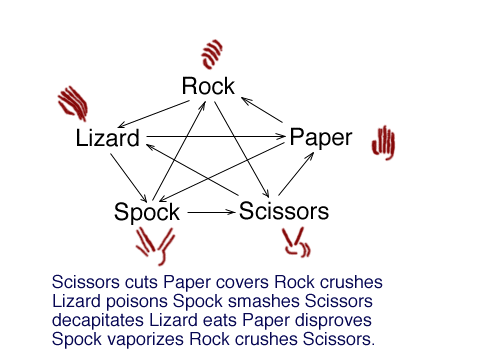
In the way of things in these modern times, five was not enough, and a good idea was run straight into the ground.
The result is RPS-25.
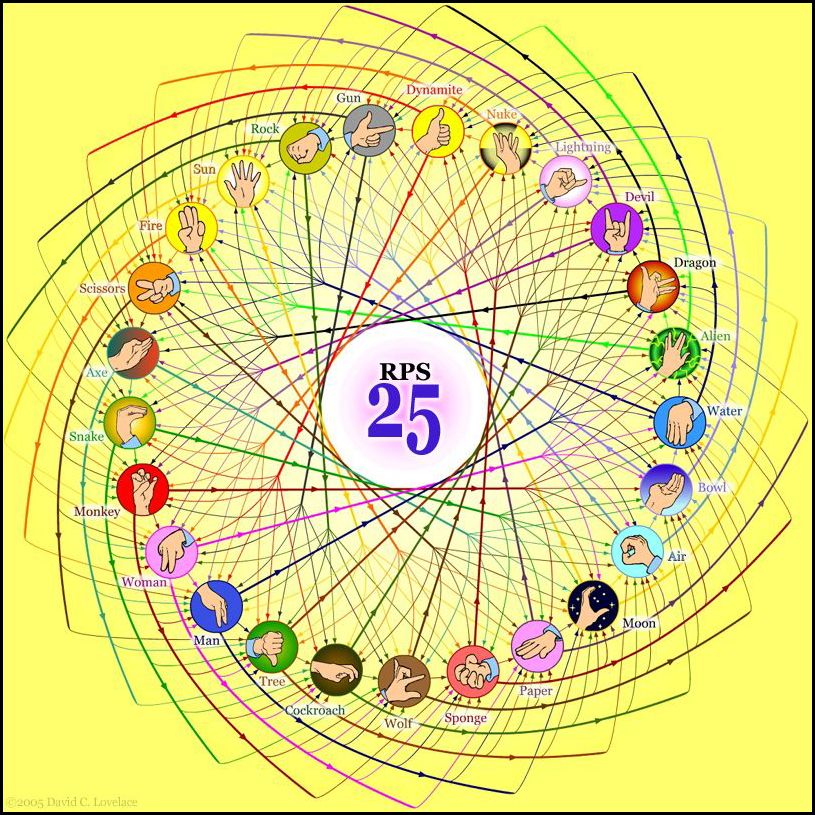
The advantage here is that ties are almost never going to happen. The disadvantage is memorizing 25 hand gestures and their 300 possible outcomes. A sample of the madness: 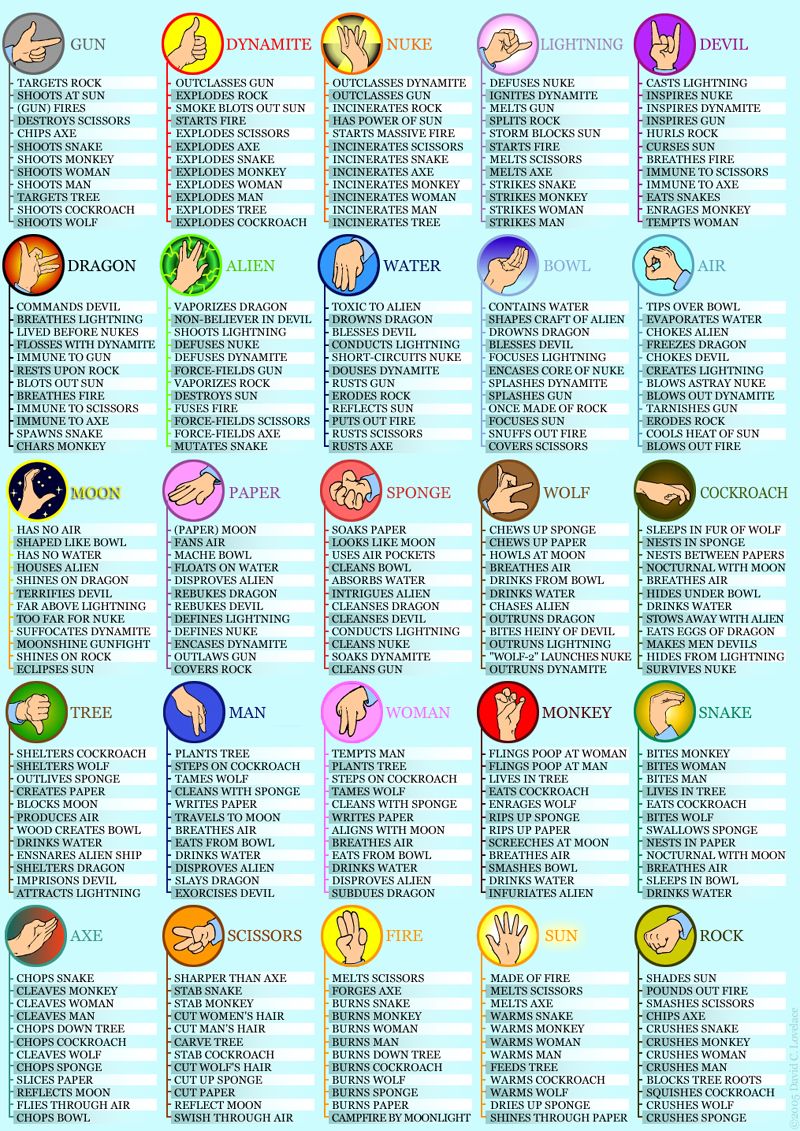
Click on the picture for all the outcomes and gestures. Or go here for a flash instantiation of the concept.
[wik] Of course, that wasn't enough. And now we have RPS-101.
 on
| § 0
on
| § 0

[ You're too late, comments are closed ]