
Buckethead's plan to save Linux

And speaking of cool technological gimcrakery we've linked in the past, it occurred to me the other day that Linux freaks are always complaining that they need to have a truly beautiful and slick user interface to have a chance to beat Windows. Most efforts along these lines have been workmanlike at best, and nothing compared to the almost godlike levels of slick that regularly come from Cupertino. Even Vista has Linux beat solid at least in this department. If someone put bumptop on top of a well packaged Linux distro that made minimal demands on the user for installation (and, more to the point, included codecs so that user could actually watch movies and listen to music without breaking the law. ESR has a screed on this issue, and how Linux could actually win the OS wars as computers switch to 64bit architectures. Interesting read.)
You'll remember bumptop - we linked it here, and here's a pic:
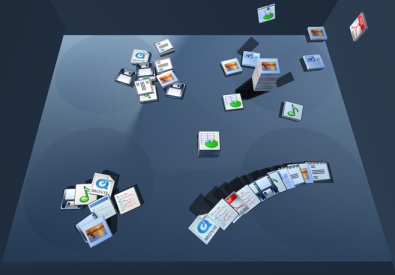
Combine the intuitiveness of that interface with the solidity, security and open source goodness of Linux, and you'd have something that even Steve Jobs would envy.
 on
| § 4
on
| § 4

§ 4 Comments
[ You're too late, comments are closed ]
KDE and gnome are decent
KDE and gnome are decent enough, true, but this would give a Linux distro a significant "our interface is even slicker" not just, "we're pretty much as good."
You're right, certainly, about the usability issue. I use Linux on occasion - at the moment, I don't have one - but I like to play. What it boils down to is not whether I can figure out how to do something, but whether it's worth my time to do so. My time is valuable, and wasting several hours figuring out (say) how to print something is a deep negative on the cost benefit ratio.
ESR is on the right track - and I think that someone with the proper motivation and right mindset could come up with something very close to a plug and play distro. Add in media like he talks about, and bumptop like I suggested, and you'd have something that is at least potentially a Vista killer.
I think ESR's document covers
I think ESR's document covers the issue pretty thoroughly, but I will say that linux emphatically does not need "a truly beautiful and slick user interface to have a chance to beat Windows." They already have a beautiful and slick interface. Several, in fact (KDE and GNOME are pretty decent looking, imho)
What is really needed is not beauty or a paradigm shifting interface (like the one you mention, which is admittedly pretty cool), but a _useable_ interface. Take a look at another ESR rant where he attempts to print something through a linux network:
http://catb.org/~esr/writings/cups-horror.html
Amazing. It took even a linux geek hours and hours to do something it would take minutes to do in windows. The problem? The slick interface doesn't actually allow the user to do everything they need to do. To fix the problem, he had to go gallavanting around in the morass of config text files. Usability is key, and linux has emphatically poor usability... at least, when it comes to converting Windows users.
That's what linux needs to fix. A typical user should be able to figure out how to do stuff in the gui. I know linux users love the command line, but it's baffling to a windows convert, and you need to consider that not everyone is going to want to figure out all the intricacies of the various apps they're using. ESR's document that you link to is very encouraging in that he seems to have the correct attitude about this. It's not that people are stupid - many of the people who give up on linux are very smart people who simply don't have the time to figure out that you have to simply recompile the application from the source code to fix such and such issue.
ESR obviously knows this, and all the other issues, pretty well. It should be interesting to see how linux progresses in the next two years.
Meh. I'm not entirely sure
Meh. I'm not entirely sure why this type of GUI is much different from my father-in-law's XP desktop, with about half a billion shortcuts, folders, and documents sitting in it with little rhyme or reason. I've gotten allergic to that way of doing things, as it makes it even harder to find things than does the usual "my documents" (or \\foo\home) filetree. All that pretty clutter!
The new hotness, the way I see it, doesn't involve enslickening the user's desktop experience, but making SEARCH and INDEXING better so that users can call up whatever the heck they want with a simple contextual search, rather than having to mouse down through six or seven directory layers to find the document.
BTW, one of the best productivity tools I ever came across was a simple .bat file a friend of mine wrote, that starts all the dozen or so apps and server sessions I use all the time, plus my everyday spreadsheets and documents, and whatever special projects I have going on at any given time. One click does it all - sooo lazy!! My desktop is reserved for brand-new projects only, before they get moved to where they will eventually live.
And I will say this about Linux: my last install, onto a several year old Dell, went like a dream. That was nice. And being able to yum down Firefox and other applications and have them just install themselves was *really* nice. But it took me and a Linux geek a good couple of hours to get PHP and Apache configured on this same machine. And forget playing mp3's or Quicktime without some major digging and reading of MAN pages. As the article linked said, Linux has been 1 year away from primetime for a decade or so, and it seems that it is still the case.
Linux is neato, and it's really fun for me to geek around with it in my spare time. But OpenOffice's spreadsheet program is merely OK, and I shudder at what would happen if I was to, say, put a Linux install on my mom's new machine.
For my part, it seems to me that Linux is a neat tool to drop into a VM environment so I can do PHP web development in a sandbox. But I'm gonna need Windows there for my spreadsheets, music, and dubiously legal ISOs of popular movies.
Johno - I agree with
Johno - I agree with everything you said. I organize my work in exactly the same way. I use google desktop to make access to all my schtuff easy and quick.
Linux is neato, but marginalized for most of the reasons you mention - and the rest are in ESR's screed. But I think that ESR is also right in saying that making some changes could make Linux a viable option for the masses. If the distro was clean installing, had support for media and had sufficiently slick interface, then its advantages in other areas could make it pay off.
Something like bumptop could take care of the "sufficiently slick desktop" part of that equation. But lack of media support will kill linux's chances. Grandma won't use Linux if she can't listen to her Shins MP3s.