Our Big Gay World

Things of interest or disgust from around our sad, gay, sad world.

Balkanada Addendum

As I was daydreaming during my second eight hour meeting this morning, it occurred to me that there is at least one other factor that would be significant in any breakup and possible assimilation of Canadian territory. I'm not sure of the specifics, but it is my understanding that Canada, while fully independent in terms of conducting its affairs both foriegn and domestic, it is still technically part of the British Empire. The Queen is still, after all, on the front of their monopoly money. I wonder what, if anything, Great Britain would have to say about the U.S. gobbling up several ex-Canadian provinces.

Posted by Buckethead Buckethead on   |   § 0

Balkanada

The whole Canada thing has gotten me thinking. While support for independence in Quebec seems be holding steady, or even declining, the potential for a breakup of Canada is still real, if somewhat remote. But what would actually happen if Canada did break up?

The first puzzle is what the remainder of Canada would do in the event of a decisive vote for sovereignty in Quebec. There seems to have been some preparation for this eventuality, and I doubt many in British Canada would really object much to the idea of Quebec going its own way. The situation would be nothing like that of the southern states seceding in 1861 – there would certainly be no civil war to force Quebec to remain part of Canada. The likely result, at least in the near term, would be an amicable divorce, in its nature very like the split between the Czech Republic and Slovakia.

The Quebecois and the rest of the Canadians would divvy up the marital assets – military bases, government facilities, and the like. They would agree to things like free movement of citizens, trade reciprocity, and access to the St. Lawrence seaway for the western parts of Canada. The opinion of the United States would have to be considered – especially in regard to that last item, seeing as how such a large portion of US trade uses the St. Lawrence seaway as well – it is the only access to the sea for the entire US Great Lakes region, including Chicago, Detroit and Cleveland. But so long as this was guaranteed, I don't think the US would really twitch at the idea of the Quebeckers going their own way.

The repercussions of an independent Quebec might move well beyond their own independence. I can imagine that once the idea of Canada is broken, others who might not have considered secession might find it, well, thinkable. The obvious candidates in this case would be Alberta, Saskatchewan and British Columbia. We are told that Canadians in the west have long felt shafted by the elites in the east, whose policies have either taken, or threatened to take, the wealth of the west to be given to the economically disadvantaged in Quebec and the Maritimes, whose economies are not as vibrant, or as well blessed with natural resources.

Alberta, especially – the Texas of the north – might be the first to follow Quebec into secession. There have been movements for secession there in the past, though not particularly large or successful. Unlike Quebec, however, with Alberta and the plains provinces, the probability of one or more of these newly independent nations turning around and petitioning the US for statehood would be significant. And that would raise big questions in the US, which has not admitted a new state to the Union in almost a half century, and the only real parallels would be with Texas and California, more than a hundred and fifty years in the past. More on that in a minute.

Meanwhile, assume that the unraveling of Canada continues, and gathers momentum. Quebec started the ball rolling, and Alberta gives it a good kick soon after. In quick succession, Saskatchewan and British Columbia also declare independence. The Central government in Ottawa has lost its biggest problem, which is nice. But it has also lost two of its most prosperous provinces, which means that it will be far less able to make transfer payments to the economically stagnant Maritime Provinces. Further, it is now geographically separate from them, with Quebec awkwardly positioned betwixt the two parts of the rump Canada. What will the Maritimes think at this point? Continuing support from Ottawa might seem to be less and less assured. Perhaps they, too, would consider independence, followed by a petition for statehood.

The advantages for certain provinces in statehood are in some cases fairly clear. As Bob and Doug McKenzie put it in the Daily Hoser:

Top Ten Affects if Canada and the United States merged into one nation:

  1. We'd be a kick ass nation with some kick ass beer!
  2. The Blue Jays would finally belong in the American League
  3. Red white and blue flag shaped like a maple leaf
  4. All politicians would henceforth be known as Hosers!
  5. One word: Americanada
  6. New rodeo attraction: bear back riding.
  7. Change of spelling from "about" to "aboot"
  8. Quebec forced to take Detroit if it wants to cecede.
  9. Condos line Hudson Bay
  10. The Mackenzie brothers can join Sonny Bono in Congress!!!

Beyond those benefits, the western provinces have, arguably, more in common with American citizens just across the border than they do with Canadians in Ontario. Likewise, the population of the Maritimes has a lot of affinity for New England. Being a part of America means getting all the benefits of being American. (And, of course, the downsides.) They would be able to participate directly in the formation of American policy with representatives in Washington. They would benefit from social programs that for all the whining, are not that different from those in pre-balkanized Canada – and that would be an important point for the Maritime Provinces.

In short – being part of Canada might seem a bad deal in the middle of a collapse, but going it entirely alone might seem a bit risky, hence the flip to America.

But how would the Americans react to all this?

If one Canadian province petitioned for statehood, the argument might be different than if many did. Just think about the various considerations and calculations that will be taking place in the minds of congressman, senators, state leaders and pundits:

Partisan types will be wondering how the citizens of a new state will vote. Most of the provinces under consideration would be, by American standards, very low in population. New Brunswick, Newfoundland and Labrador, and Prince Edward Island are all sub-South Dakota in size. PEI is tiny – actually only a fourth the population of our current least populous state, Wyoming. Nova Scotia is about a million people, which puts it in the range of a Rhode Island. Saskatchewan and Manitoba likewise. Alberta, at over three million, is equivalent to Connecticut. BC is the largest at over four million, equivalent to South Carolina. The smallest provinces would only have a single Congressman. Those with a million people would get two. Alberta would get as many as five, BC perhaps six. The overall effect would be small. But in the Senate, things would be different, as each of these new states would get the same two as everyone else.

And who would get those congressmen and senators, and who would benefit in the electoral college? The plains provinces are almost entirely conservative. Alberta is entirely conservative. It can be assumed that most of those votes would go to the Republicans. The Maritimes vote predominantly Liberal and NDP, and it can be assumed that most of those votes would go to the Democrats. That's three red states and four blue states – if each province comes in as its own state. British Columbia would be a battleground state. In the last election, it voted in 17 conservatives, and 19 from the libs and the NDP. But the peculiarities of the Canadian election system mean that as far as percentages go, it's not so close: 55% Libs and NDP, 37% Conservative.

If all the provinces came in, partisan bickering could probably be overcome since over the spread of all of these provinces; it's more or less a wash right-left wise. But if only Alberta, Saskatchewan and Manitoba wanted to join, the Democrats would howl at the near certain addition of six Republican senators. Small states (and their representatives) would likewise howl at the further dilution of their already small influence in the Senate.

The influence of these new states on Presidential elections would also be debated. Our electoral college gives a lot of influence to small states in the race for the Presidency. And if Prince Edward Island became a state, 137,000 people would wield three electoral votes, a 1:46,000 ratio compared to 1:616,000 ratio for Californians. Again, the relative balance of conservatives and liberals across all the provinces would likely reduce most complaints – something like the way free and slave states were admitted to the Union before the Civil War.

What other issues would there be? The advantages to the US of having access to Alberta's oil reserves would be clear, though environmentalists might oppose admission on those grounds. (Or support it, so they could influence it.) Expansion would likely be viewed as a good thing in principle by most Americans, especially as Canadians are for the most part very like us. Integration of ex-Canadian military forces into the American armed services would likely not be anywhere near as big a problem as it was for the Germans absorbing the East Germans. The cultural affinities of Canadians to America would likely lead to a smooth process overall. The great latitude the Constitution provides to the states in how they order their business would certainly help as well.

A little research on the web revealed the basic process of borg-like assimilation of new territories:

  1. A territory petitions Congress.
  2. The dependent area drafts a constitution with a republican form of government.
  3. Congress must approve statehood by a simple majority.
  4. The President must sign the bill.

It doesn't matter if the territory was already US territory or an independent nation as was California and Texas. So long as the state government is republican in nature, the details don't seem to matter much.

If Quebec left and the rest of Canada decided that they could still be Canada without them, this would all be moot. I think the key would be Alberta. If even one more province decided to give the stinkfinger to Ottawa, it would start a domino effect leading to the United States absorbing most of Canada outside Ontario. The only province that seems to have a reasonable shot at making it on its own as an independent nation is British Columbia. The rest are too poor, or too landlocked to be completely viable states, hence the anschluss with the U.S.

[wik] Posts like this are what happens when I leave my book at the office before getting on the Metro for the ride home.

Posted by Buckethead Buckethead on   |   § 5

O Canada!

I officially declare this Canada day on the Ministry. In the spirit of this official celebration of the lives, achievements and peculiarities of our neighbors to the north, herewith, some linkage:

  • Canada now has a conservative government. Right wing wacko, neocon and Albertan Steve Harper is now the Grand Poohbah of Canuckistan. This is great news on several levels. First, a wacky neocon is control of another real country. Second, that country is Canada, which needs a dose of wacky neocon adventurism to overcome its recent reputation as a effeminized moral weaklings. Third, the leader of a real country is named "Steve." That great name has had a checkered history when its been the moniker for a head of state. King Stephen of England managed to plunge the country into bloody civil war in only a few months. And that's pretty much the beginning and the end of the story of Steves in power. I think one US President's middle name was Stephen, but I can't verify that.
  • Austin Bay has a fine essay on the decline of the once mighty (pound for pound) Canadian military.
  • Mark Steyn on the Election in Canada and its result. Has anyone really noticed that Mark Steyn is the living embodiment of the idea of the Anglosphere?
  • Reuters, somewhat predictably, predicts that the new conservative leader will have a tough row to hoe.
  • Beer!
  • Pardon my English has noted that Michael Moore's Jesusland map needs updating.
  • A couple more thoughts on the end of Canada.
  • A couple more thoughts on Canada's gun problem, or rather problem with the lack of guns.
  • Some insightful commentary on what it all means, Canada-wise.
  • For those who aren't ready to believe that Canada is, in fact, an independent nation despite several attempted invasions - here's the classic Onion parody, "Perky "Canada" Has Own Government, Laws" - you have to scroll down a bit, it's the fourth item. For some unknown reason, I can't find it on the Onion site.
  • And lastly, CANADIAN WORLD DOMINATION!

image

[wik] Our resident Canadian, Ross, is cordially invited to comment on the momentous events underway in his frozen homeland.

[alsø wik] Murdoc has a round-up of blog commentary, of which my favorites are Joe Katzman at WoC (no surprise) and this seemingly counterintuitive bit from Frank Warner that makes more sense if you think about it for a second. Murdoc also dared to use the "H" word.

[alsø alsø wik] I should also mention that the Austin Bay piece, well, I stole that from Blackfive.

[wi nøt trei a høliday in Sweden this yër?] Joe also links to this nifty graphic.

Posted by Buckethead Buckethead on   |   § 3

Cruel and Perfidious Canucks

In reference to Bram's comment on my previous post, Upheaval in the Great White North regarding the Liberal efforts to disarm Canadians leading to a less than interesting Canadian Civil War:

It's being reported that despite the lack of guns in the hands of honest Canadian citizens, the ability of Canadians to commit violence and rapine on their compatriots has not lessened. In fact, it has increased. Canada's rate of violent crime is now twice that of the United States - 963 per 100,000 compared to the States' peacable 475. Sexual assault is also twice the US level. Overall crime rates are half again that of the US. Looking on the sunny side, if you are injured in the course of a violent assault (a likely outcome, all things considered) you won't have to pay for treatment! Isn't that great? Of course, you may have to wait awhile...

Posted by Buckethead Buckethead on   |   § 2

Upheaval in the Great White North

After over a decade in power, it seems as if Canada's liberal government is heading toward defeat. Trailing by a substantial margin behind Harper's conservatives, Martin's liberals are unlikely to retain control. Who exactly will have control remains to be seen, as the same polls indicate that it is uncertain whether the conservatives will actually attain a majority.

Columnist Mark Steyn has this appreciation of the situation:

By my math, the Tories are currently about 25 seats short of a majority, and the race does seem to be tightening as "undecideds" come home to their kleptocrat nanny. The Liberal vote seems to be holding up in the Maritimes and possibly in BC as well. The scarification strategy works - though, unlike 2004, it won't work well enough. And, as I wrote below, in Quebec antipathy to the Martinite Grits is so strong you can only scare folks from the Tories to the Bloc and vice-versa. Furthermore, while the bleeding of the Liberal vote to the Tories can be staunched, the desertion by a proportion of the left to the NDP looks less responsive to the scary stuff. So, even if everything else turned out swell, I reckon the Liberals are still looking at a significant loss of seats. If they were by some chance to wind up as the biggest single party, the Governor-General would invite Mr Martin to form his second (and even smaller) minority government.

Bloc Quebecois will get all of its votes from Quebec. The conservatives are stong in the west, and the liberal base is Ontario. However, the loberal vote will be split between the Liberal party and the NDP, which means that the Tories will have the most votes in Ontario. The Maritimes will likely be split evenly.

So what does it all mean? First, the likelihood of Martin keeping his job is slim. The conservatives will likely have to form a minority government, but even a "weak minority government unable to operate without the support of secessionist obstructionists" is better (in my opinion) than a scandal ridden administration that is reflexively anti-American. I'm sure Ross is less happy, but hey, we can always invade.

I'm curious as to where the Canadian sucessionist movement is. They appear to be at least for the moment happy with playing kingmaker in Canadian politics - but regional parties are typically the bane of democratic soceities. Either they will decide on their own to go back to trying to pull out of Canada, or the rest of the nation will get sufficiently pissed as to invite them to leave. The apparently permanent split of the Canadian left seems to leave the door open for continued growth of the Conservatives - something that will likely be fueled by the increasing oil wealth of the west. From what I have read, that part of British Canada that isn't Ontario has often been frustrated by the self-centeredness of the center.

The dark and disaster-hungry part of my soul really wants to see Canada break up. Naturally, I am aware that political instability is not a good thing, and having it on our northern border is even less a good thing. We're already reverse hemorrhaging on the south - an influx of Canadian political refugees is not something we should be asking for.

Nevertheless, just think of the spectacle - Quebec votes for independence, which would force the rest of Canada to contemplate the existential question of what is Canada, exactly, and do we need Quebec in it. Deciding that it does could lead to conflict. Deciding it doesn't could lead to rapid devolution on the model of Yugoslavia. Once the first one goes, there is far less justification for insisting that other parts remain part of the metropole. A rapidly balkanizing Canada would, at least, give Canadians the satisfaction that the Americans would finely being paying attention to them, but the end result would be hard to predict.

Some have speculated that parts of Canada would petition for statehood, Alberta being the most frequently mentioned. Quebec would certainly attempt to pursue an independent course – though problems with an Anglophone minority could prove troublesome. Other parts might decide to follow Quebec's example – British Columbia could go that way. Canada's maritime provinces would be poor candidates for independence, as they are very dependent on transfer payments from the Federal government for their economic livelihood. Ontario's ability to maintain those payments would be minimized at best with the loss of Alberta and the west – perhaps the Maritimes would shop around for a new federal government to subsidize them.

And beyond the secession of provinces from the Federal government, parts of provinces could retro-secede, leading to a patchwork of small independent states, a rump of British Canada with outposts across the northern tier of America, an angry and economically isolated Quebec, and new American states.

So long as no one gets killed, it would be fascinating to watch. And I'm curious to see how we'd design a flag with 57 stars.

Posted by Buckethead Buckethead on   |   § 3

All About The Benjamins

Today would be the 300th birfday of America's greatest founding father, natural philospher, aphorist, and pussy-hound, Benjamin Franklin.

Click the link for a list of festivities nationwide. Tonight I will be attending a lecture by a local (Boston-area) historian on the continuing influence of Franklin's inventions and ideas. There will also be wine and cheese; the Johno is most pleased.

Best of all, if you are so inclined you may hoist a Poor Richard's Ale in honor of the man himself. Moreover, you may also brew some yourself- a PDF recipe is contained in the foregoing link. As the man said, "beer is proof that God loves us and wants us to be happy."

Posted by Johno Johno on   |   § 0

Got Freedom?

Have a hankering to know the level of freedom in your neck of the woods? Just look at this nifty web map thingy from Freedom House and divine the answer instantly.

It occurred to me and a coworker that it would be an amusing tshirt exercise to combine the slogan of the great state of New Hampshire with the languages of the bottom ranks of Freedom House's annual survey. Arabic accounts for a full third of the nations, though Chinese wins on numbers. Korean, of course, wins on pure mean. You could put a nice big American flag on the back.

I think I shall have to exercise my mad photoshop skills. Any readers willing to translate the phrase "Live Free or Die!" into Arabic, Korean, Chinese, Russian, Spanish, French, Burmese, Lao, Vietnamese, Uzbek and Turkman, please contact me.

Posted by Buckethead Buckethead on   |   § 2

"Vigorous and Tolerant" And we'll screw anything that moves

The Canadian High Court has declared that group sex clubs are kosher in the Great White North.

"Consensual conduct behind code-locked doors can hardly be supposed to jeopardize a society as vigorous and tolerant as Canadian society," said the opinion of the seven-to-two majority, written by Chief Justice Beverley McLachlin.

I guess you'd have to be both if you're a swingin' canuck.

Posted by Buckethead Buckethead on   |   § 1

Sources? We don't need no stinking sources

Yesterday, I posted a link to an article on WorldNetDaily regarding violence on the US Mexican border. Knowing that this particular news source is sometimes a little, shall we say, overeager; I included the word "apparently" in my link, not having had the time to research more thoroughly. Despite my caution, Phil jumped all over me. This morning, government work having slown down for the day off that has nothing to do with Christmas, I decided to check it all out.

It turns out that the story has some fairly solid basis in fact. The key incident is this – a dump truck laden with marijuana got stuck in the Rio Grande between Mexico and Texas. Border Patrol agents began unloading the truck until "men who looked like Mexican troops yanked the truck into Mexico, according to authorities."

The Austin-American Statesman relates:

Hudspeth County Chief Deputy Mike Doyal told the El Paso Times: "Everyone had the presence of mind not to cause an international incident or start shooting."

Thursday evening, Border Patrol agents tried to stop the dump truck on Interstate 10, sheriff's officials said. The truck fled to Mexico in the Neely's Crossing area.

The truck got stuck in the riverbed, and the driver took off running. Doyal said the driver returned with armed men, including men who arrived in official-looking vehicles with overhead lights and what appeared to be Mexican soldiers in uniform and with military-style rifles.
The standoff ended when the "soldiers" used a bulldozer to pull the dump truck into Mexico, sheriff's department officials said.

Officials with the Mexican army, used in anti-narcotics operations, could not be reached for comment.

The Border Patrol, however, disputes parts of that story. The El Paso Times reported that

Border Patrol officials now dispute the allegation by officials with the Hudspeth County Sheriff's Department that the men on the Mexican side of the Rio Grande were the Mexican military.

"We have no evidence of that. We don't believe it was true," Paul Beeson, deputy chief patrol agent in El Paso, said of the incident.

Border Patrol officials noted that the Mexican military uses G3 rifles, and not AK-47s, which were allegedly used by the men in the standoff.

Beeson said Border Patrol agents started to unload the drugs when the driver returned with smugglers who were dressed in camouflage fatigues and who carried AK-47s.

Sheriff's deputies, who were called for back-up, saw the smugglers, 15 to 20 of them, Sheriff Arvin West said. Some of them hooked the truck to a bulldozer and towed it out of the river, while others stood watch holding the weapons, but not pointing them.

"They appeared to have a military style to them -- their way of standing. It was military-style people," West said. But he added, "I don't know that they were (the military)."

West admitted that everything the men had, from the fatigues, to the red dashboard light in their vehicles, to their weapons, are readily available to people outside the military.

So, at the very least, we have "military looking people" confronting Border Patrol Agents and local law enforcement. Clearly, even if these "military looking people" were not actually members of the Mexican army; they outgunned the U.S. Law Enforcement presence on the border and no one did anything to stop the drug smugglers, either from a desire to avoid an international incident or a simple common sense desire not to get involved in a gunfight with heavily armed bad people.

And there certainly are a lot of heavily armed bad people on the border, and those bad people are growing increasingly willing to use those weapons on Border Patrol agents attempting to protect the border. The San Antonio Express-News offers some information on the drug smugglers:

Paramilitary enforcers for Mexican drug cartels are responsible for a wave of violence in Nuevo Laredo that poses a serious threat for residents on both sides of the Southwest border, U.S. law enforcement officials told a House committee Thursday.

Assassinations, kidnappings and daylight shootouts between military-trained gangs place citizens at risk along the border where violence has soared past historical norms, officials said.

"These paramilitary groups work for the cartels as enforcers and are a serious threat to public safety on both sides of the border," said Chris Swecker, the FBI assistant director for the criminal investigative division.

…The root of the escalating violence is the use of trained paramilitary enforcers known as Los Zetas by the Gulf Cartel, which is still supervised by kingpin Osiel Cardenas Guillen, despite his 2003 arrest, Reid said.

Los Zetas is comprised of former members of Mexico's special forces, many of them military deserters hired by the Gulf Cartel, according to the FBI.

While not as bad as actual Mexican army forces attacking U.S. Border Patrol agents, Mexican Special Forces-staffed and -trained paramilitary enforcers attacking U.S. Border Patrol agents is still pretty damned bad. And given the level of corruption and intimidation in and on the Mexican authorities - both civilian and military – the idea is not all that far fetched.

And the incident with the dump truck is not an isolated one. Back in the El Paso Times we learn that

Men in military gear protecting drug shipments are not an uncommon sight on the border, officials with the Texas Border Sheriffs Coalition said.

Earlier this year, investigators doing surveillance in Zapata County in South Texas spotted 25 armed people in dark fatigues carrying duffel bags, said Zapata County Sheriff Sigifredo Gonzalez Jr., the coalition's chairman.

"The way they were dressed, they appeared to be military- oriented. Clean-cut. Some type of military organization," Gonzalez said.

The backdrop for all this is the fact that assaults on Border Patrol agents doubled in fiscal year 2005. According to the Arizona Republic,

Nationwide, the number of assaults nearly doubled, with attacks on agents based in Arizona making up more than half the incidents.

From Oct. 1, 2004, to Sept. 30, the Border Patrol registered 687 assaults on its agents, up from 349 during the same period along the Southwest and Canadian borders. All but one of the attacks occurred on the Southwest border, officials said. In Tucson and Yuma, there were 365 assaults during the past fiscal year, up from 179 the year before.

…Federal law enforcement officials told Congress last week that drug cartels from Mexico have gotten much more aggressive in smuggling drugs and people across the border, hiring local gangs on both sides of the international line and arming members with assault rifles, grenades and other weapons.

…Agents say they frequently are subjected to grapefruit-size rocks being thrown at their trucks from the Mexican side of the border.

Trucks carrying drugs or migrants have tried to ram Border Patrol vehicles when the agents attempt to stop the vehicles.

The Indianapolis Star adds,

Shootings are becoming more frequent as well. In the Tucson and Yuma sectors in fiscal year 2005, there were 45 shootings, up from 15 in 2004. Two agents from Nogales were hit in an ambush as they tracked drug smugglers through the desert on June 30 in one of the year's most serious assaults. Both are recovering. Neither is back on duty.

This should be worrying to anyone. The Border Patrol is unable to patrol the border. Local law enforcement can't fill the gap. Hundreds of thousands of people cross the border without our say-so every year. And when the border patrol does attempt to intervene, the response is ever more often a violent one, and the border patrol agents are outgunned.

As I've said many times before, it really doesn't matter what you feel about immigration. Whether you favor lots of immigrants or none, illegal immigration is, well, illegal, and should be stopped. And further, having a complete lack of control over the border is a serious problem in an era where terrorists would like to kill large numbers of Americans.

The Dallas Morning News has a fascinating article on the issue. Of all the articles I've linked, read all of this one. The authors interviewed Val Verde County Sheriff D'Wayne Jernigan, who has dealt with smugglers and drug gangs both as sheriff and customs agent.

But in the last year, the risks of drug-fueled terrorism have raised the stakes to scary levels. Rifles and handguns have been replaced by rocket-propelled grenades, or RPGs, and high-caliber machine guns.

"Now the bad guys have more sophisticated training and better equipment," Sheriff Jernigan said. "They're better armed and willing to shoot."

One of the reasons they're more willing to shoot is explained by Jernigan's deputy:

"To make matters worse, a few months ago we picked up information that a new order went out from the Zetas that no more drug loads would be lost," he said. "It used to be that losing a load now and then was a cost of doing business. Now the Zetas are telling their people they can't give up a load. They're to fight the cops. ...

"We're caught in the middle until somebody wins," Chief Deputy Simons said. "It's not just drug smuggling anymore. You have to think of it as narco-terrorism."

To get an idea of the scale of the mismatch, there's this:

For the border sheriffs, it is, at best, an uneven battle.

Sheriff Jernigan has 13 deputies to patrol a county of 3,100 square miles – roughly three-fourths the size of New Jersey. Most of the county's 45,000 residents live in Del Rio. The rest are scattered across isolated ranches and small communities, connected to state highways via gravel ranch roads or private twisting dirt roads. The deputies also patrol roughly 90 miles of river frontage, including thick stands of carrizo (cane) and limestone cliffs.

"What we need is money to put more boots on the ground and give these guys better training and equipment," Sheriff Jernigan said.

"But this isn't just our fight. ... If border law enforcement doesn't work, than the rest of the country is going to lose."

To be sure, there are also the Border Patrol agents, but at 12,000 – many of whom are bureaucrats and not actually on the border – that's not really that many. The smugglers have the advantage of tactical surprise, as they can decide when and where they cross. They also can concentrate their forces to gain the advantage locally, even when it would be impossible for them to take on all the opposing U.S. forces. For a border as long, and as uninhabited, as this one, we certainly need more agents, and a more aggressive plan.

As for aggressiveness, the Homeland Security Department made a small step and addressed one of the border sheriff's biggest complaints when they ended the controversial "catch and release" policy for illegal immigrants from nations other than Mexico – the "OTMs." OTMs were released with a "notice to appear," pending deportation proceedings. Sheriff Jernigan said,

"The OTMs were coming through in droves from all over the world. They'd come up to us, asking where to find a Border Patrol agent. We'd see them later, waiting to hitch a ride along Highway 90. And no one had any idea of where they were going or what they might do once they got there."

And, it's not just drugs:

In Vega Verde, a neighborhood along the river west of Del Rio that borders a major smuggling route,thieves come across the river, hit the homes there and get back to Mexico before deputies can arrive.

"They're taking guns, jewelry, air conditioners, anything they can get on a raft and get across," Deputy Faz said. "Landowners are frustrated. And my concern is that people will start taking the law in their own hands. What's going to happen if residents take up their hunting rifles against some Zetas bringing a load of dope across?"

Recently, deputies frustrated with the inaction of Mexican authorities staged an impromptu raid, taking boats across the river and seizing stolen property.

"The funny thing is, with all this activity on the river, the Border Patrol never showed up," Deputy Jose Luis Blancarte said. "We're bringing back TVs and air conditioners and nobody saw it? We don't have to worry about terrorists sneaking suitcase nukes across the border. They could be bringing whole bombs, and no one would know."

The border sheriffs say their main concern is the safety of their residents. "We don't want to be immigration officers," Sheriff Jernigan said. "We just want to make sure our counties are safe. To do that we need help, and that help has to come from the federal government.

"My nightmare is that it will take another 9-11 attack to wake up this country about the vulnerability of the border," he said. "And some border sheriff is going to have to say it came through his county."

Posted by Buckethead Buckethead on   |   § 2

The Great Wall of Arizona

The US House of Representatives voted to construct a wall along the US-Mexican border. The usual suspects will decry this as racist, or suspect, or even just unfriendly toward our prosperous and friendly neighbors to the south. I don't think this is necessarily the case. I don't have a problem with individual Mexicans. I don't have a problem with Mexicans - even in large numbers - moving northwards in an orderly and legal fashion.

I do, however, have a problem with most of the Mexican nation shouting, "Hey! Look! Terrorists!" and sneaking over the border en masse while we're looking the other way. Despite the predictions of many dreamy-eyed one-world-staters, the importance of the nation-state has not withered away. And one of the essentials of national soveriegnty is control over the borders. If we can't keep the damn furriners out with the existing border, than by god we should build a better one.

Sadly, it looks like the planned wall won't really be a wall, exactly, but rather a security fence with cameras. In other words, looking north from the otherside of the border will, in essence, be much like looking in at any standard issue industrial facility. Which, in essence, is the whole relationship Mexico has with the US anyway. So no worries!

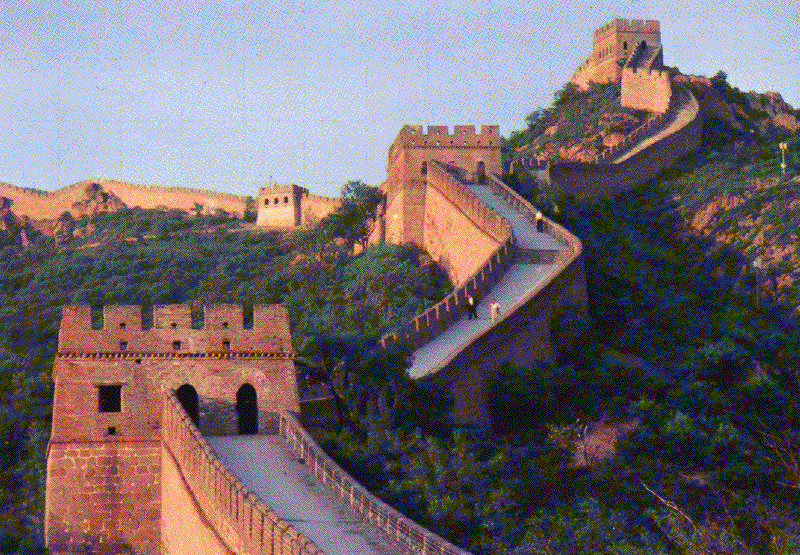
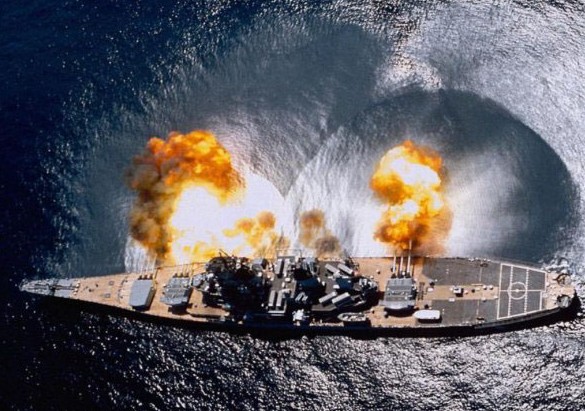
What we should build, just because we can and because it would make a much better statement is a combination of this:

Great Wall of Arizona

And this:

Battleship Guns

That would just be fun.

[wik] Bram adds: We’re going to need some cheap Mexican labor to build a wall that big! Good thing there is plenty available.

Posted by Buckethead Buckethead on   |   § 7

We were somewhere outside Tashkent, on the edge of the desert, when the drugs began to take hold.

Keith at Sortapundit is gearing up to do the very dumbest fun thing I've ever heard of: drive the Mongol Rally. Participants must first donate a bunch of money to Send a Cow, a charity that, erm, Sends Cows to needy African families, and then drive from the west coast of Europe to Ulaan Bataar in Eastern Mongolia in a car with a total engine displacement of less than 1000ccs or less. Which is tiny, especially for the mountains and deserts of central Asia while pursued by enraged highwaymen in CIA surplus white SUVs waving AK-47s.

So, he's got the tin cup out and is rattling it around and why not head over there, read up on the stupid hijinks this moron Brit is cooking up, and kick in a fivespot or so to help him cover the costs. And maybe buy him a helmet.

[wik] Buckethead adds: I have been offered a place in the boot of their car. I have to supply my own beer, though. I don't think they realize that the combined weight of a moderately large Buckethead and his beer supply would have a deleterious effect on a 1000cc engine's ability to accelerate on anything but a downhill pitch.

Posted by Johno Johno on   |   § 0

All Of Kazakstan Hates You

Just how offensive do you have to be before a nation tries to sue you?

I've often wondered about that myself, but my talents run more toward vile ad hominem attacks than sweeping assassination of an entire people's character. But now Kazakhstan - the country, Kazakhstan, home to the feared and noble Cossacks, some of the haughtiest and fiercest warriors on earth - is trying to sue English comedian Sacha Baron Cohen for his portrayal of Borat, a faux-Kazahstani who describes his people as ignorant drunks and horsehumpers.

Which is awesome.

Posted by Johno Johno on   |   § 3

A warrant of death political

The troubles in France seem not to be entirely fading away, and President Chirac has taken action to deal with the crisis. His diagnosis? "Profound National Malaise."

I have two words for the French people: Jimmy Carter.

However, unlike America in the seventies, they do not have as we did, waiting in the wings, the Godlike eminence of Ronald Reagan. They have Le Pen.

Posted by Buckethead Buckethead on   |   § 3

Strangers on a train

Perfidious crony NDR has it all over many of the rest of us in one regard. Not only has he traveled to Europe - to France - in the very recent past, but his doctoral dissertation is on the vexed questions of identity and assimilation in the Alsace region. He relates a long and very interesting story about a conversation on a train with a French Muslim about the unique, and to an American, incomprehensible, problems facing French citizens who nevertheless are on the outside looking in.

As I equated things that made sense to me about integration and advancement, I hit a nerve. "More education!?" he said. I wasn't sure what had given him a shock. "Why should I have more education? I move on to the next level, studying more, because the degrees I have earned don't help me to get a job. I look forward only to more education." He had no faith that an employer would give him the chance to practice what he studied (he tried hard to find a job) so he continued to study.

This chance meeting was not unique. I've had it many times in France and Germany: a conversation with an enthusiastic Muslim or African who is surprised that someone will pay attention. Listening to them, I find that they are enthusiastic about their European homeland (adopted or natal.) They are culturally aware, exhibiting (what I consider) good social practices for their milieu. Yet they remain outsiders. I have also asked Frenchmen and Germans about Muslims and Africans: "Why are people who seem assimilated not accepted?" The question can turn a conversation on its end, turning transnational discourse into national defense.

The explanations that I hear through gritted teeth are nothing but cliches. "Immigrants" (which describes even the second generation born in country) are not assimilated. They retain backward traditions. They come just to earn money and send it home. They get brides from the mother country, locking them away and not doing anything to assimilate them. They don't learn the language, so they become rabble-rousers rather than hard workers. They are a problem for society.

The litany of complaints are familiar to me: Frenchmen used them to discredit the protests of Alsatians in the 1920s. They were used to discredit regionalist movements in Brittany and Provence. They were used to discredit traditional Catholics. They belong to a discourse of nationality and nationalization that shifts attention from discourse between national identity and ethnicity to the "other." Indeed, the most understanding Frenchmen said that it was not up to them to understand Alsatians, only for Alsatians to change. Race deepens the problem.

At least in Germany Muslims and Africans know that they are not accepted. The Turks, generations after being invited to work in the factories, are still not citizens, and they are subjected to an arduous process of naturalization. And there is an ongoing, albeit uncomfortable, discourse about how Germans view race. But the French constitution, which calls anyone born in the territory a citizen, obscures the problems of acceptance. Being taken seriously as a Frenchmen require more than a passport.

A very interesting and a fairly off-the-wall take on an issue that 'mericans are fond of pontificating on but that we - let's face it - know crap about.

Posted by Johno Johno on   |   § 0

Just as I expected

French right-winger (and as you all should know by now, a right winger in France is signifcantly different from one here) and Presidential hopeful M. Le Pen is making the most of the recent unrest by youths in France. Of course, Le Pen is more than willing to use the words "civil war" and "moslem" than most of the press.

Here's what ol' Jean-Marie had to say:

Le Pen claimed Wednesday his National Front party has been "submerged" with prospective members and supportive e-mail since rioting erupted in heavily immigrant communities near Paris.

In an interview with The Associated Press, Le Pen described the recent violence as "just the start" of conflicts caused by "massive immigration from countries of the Third World that is threatening not just France but the whole continent."

Le Pen said people with immigrant backgrounds who commit crimes should be stripped of their French nationality and sent "back to their country of origin."

Reminded that the vast majority of youths taking part in the arson and rioting are French, born in France to immigrant parents, he said: "What does that mean? Are they French because they have a French identity card?"

French nationality should be given only to those who ask for it and "who are worthy of it," he said. "Those who got nationality automatically, who don't consider themselves French and who even say publicly that they consider France their enemy should not be treated as French."

Le Pen said he is convinced that what he described as a surge in support for his "zero immigration" platform would translate into votes at the ballot box for his National Front party.

If this sort of thing goes on even intermittently over the next couple years, the 2007 election in France could be very, very interesting.

Posted by Buckethead Buckethead on   |   § 1

Splendid Multilateralism

While smoking and reading Niall Ferguson's excellent book, Colossus, the Price of America's Empire, I ran across this excellent paragraph. Ferguson is discussing unilateralism and multilateralism (which he defines as "a vague phrase usually intended to refer to the United Nations, but sometimes in reality flattering a few nations opposed to American policy):

Yet this is in many ways a false dichotomy. The invasion of Iraq in 2003 was not without a legitimate basis in international law and was supported in various ways by around forty other states. No country was so opposed to the regime change that it was willing to fight against it, other than with that least expensive and effective of weapons, rhetoric. On the other side, the French government can hardly be protrayed as an exemplar of "multilateral" virtue, any more than the United Nations Security Council can be regarded as the sole fount of legitimacy in international relations. The crisis in Iraq arose from deep ambiguities in the way the UN - and especially the Security Council - behaved in the thirteen years prior to 2003. These were the years when, with the cold war over, a "new world order" was supposed to emerge, in which the UN, supported by the United States, would play a crucial role. Those who today exalt the United Nations and excoriate the United States have selective memories. For the cardinal sins of omission on the part of the former far outweigh the venal sins of commission on the part of the latter.

Later, in discussing the makeup of the Security Council, he says:

The UNSC, rather like the regular conferences of the foriegn ministers of the great powers during the nineteenth century - is a convenience, a clearinghouse for the interests of some (though not all) of the great powers of today. When it does legitimize American policy, it is positively useful. When it does not, on the other hand, it is no more than an irritant. And perhaps by providing a stage upon which former empires can indulge their own sense of self-importance, it renders them less powerful than they might otherwise be - precisely because their presence is a subtle irritant to the ascendant economic powers of the present that are, for purely historical reasons, not permanent council members. Today the other four permanent members of the UNSC have economies with a combined gross domestic product of $4.5 trillion. This is slightly less than half of the GDP of the United States. It is also less than three-quarters fo the combined GDP of the three largest nonmembers of the Security Council: Japan, Germany and India.

I am not yet finished with the book, but it is clear that Ferguson believes that there is an American empire, that it is not necessarily a bad thing, and that he seriously doubts that America has either the will or persistance or mindset to truly make a good showing of it.

I have been well pleased with several of Ferguson's other works, including Empire: The Rise and Demise of the British World Order and the Lessons for Global Power, Virtual History: Alternatives and Counterfactuals and various op-eds over the last few years. This one is turnign out to be no exception.

Posted by Buckethead Buckethead on   |   § 0

So how about them French?

What war on terror?

I don't know about you, but I'm feeling just a little bit of schadenfreude right now. Twelve days and counting, and now it's spread to over 300 cities, and beyond France's borders. If this goes on, it could have even larger effects than 9/11 did here in the states. There are five million muslims in France. France will have to act very deftly - on the one hand, they can't afford to piss off all the muslims. On the other hand, they can't afford to be perceived as capitulating or appeasing the muslims - it would both incite them, and the 20% of the electorate that voted for le Pen in the last election.

Maybe inviting all of those Algerians in, and then pushing them off into ghettoes wasn't really the best idea after all.

[wik] Useful link round-up at the Blogs of War, and especially clever commentary here, here and here.

[alsø wik] Oh, and here, where I got most of the links above. Hit Drudge or google news for the updates, obviously. I'm going to take a break from other things and look at Strategypage.

Posted by Buckethead Buckethead on   |   § 3

Liberal Calvinball

Holy crap. I swear I never thought I would be saying something like this right out loud (I might have to turn in my fellow traveler card to the Vast Left Wing Conspiracy), but some things just aren't right. One is the current initiative in my fair Commonwealth, known unfairly by its detractors as Taxachusetts, to let the children of illegal immigrants attend state colleges at in-state resident tuition levels.

State Attorney General (and likely Democratic candidate for Governator) Tom Reilly is pushing this plan as part of his campaign bid. And now our Lieutenant Governer, Republican Kerry Healy, is getting crap for saying something about it.

Bullshit. Bullshit. Bullshit. Not in a million years. That's my tax money. That I pay because I live here legally.

Now, I'm not a close-the-borders kind of guy. Immigration is what made this country great (that plus strategic genocide, but I'm not, really not in favor of repeating that part of our history), and I like it a lot when the best and brightest - or the most desperate and resourceful - from around the world come to our shores in search of a piece o' whatever makes them happy. And maybe our immigration policies need a bunch of work to make it easier for people to be documented and cleared to enter, and maybe the slugs at the Department of Homeland Security who are responsible for visas and such could stop trying to make life as hard as possible for all supplicants at their grubby Formica altars. I agree. We need to get on that.

But in the meantime, we need to do something about the people here illegally. Yes, I know our economy could grind to a halt if we sent everyone home en masse. But guess what? The answer to that conundrum is not to decide the rules are meaningless. By "do something," I mean 'figuring out how to more efficiently police our borders,' 'how to more efficiently screen guest workers such as seasonal produce pickers,' 'how to streamline the visa process,' and so on. "Something" is not giving away tuition breaks to the chidren of illegals. Do that, and the difference between legal and illegal immigration becomes less and less meaningful. If you get a drivers' license (such as California proposes) and in-state tuition, why ever go to the goons at DHS to plead your case?

I get where the impulse comes from. The kids, it's likely, aren't generally here of their own volition; they haven't broken immigration laws independently of the authority of their parents. This is America, after all, and people deserve a shot. If they're bright, we can use them. Now that they're here, sure, it would be nice if they got smart and educated, and stayed in the Bay State as hardworking, aboveboard and upright legal aliens. That's a nice idea.

But until the day they get their visa or their green card, it's also bullshit.

Posted by Johno Johno on   |   § 2