Our Big Gay World

Things of interest or disgust from around our sad, gay, sad world.

"YANKEE GO HOME!!" "Wait, where are you going...?"

The Financial Times is reporting on expected American troop withdrawals from Europe. Washington is planning to cut the European presence by one-third, or about 30,000 people, the bulk of them from der Vaterland.

Earlier reportage predicted a redeployment eastward, building huge new facilities in Poland and other Warsaw Pact survivor states. The plan now seems to be to establish a series of small, spartan bases there, but with a tiny permanent presence and designed to expand rapidly if necessary.

The funny thing is that no one at all will be happy with this decision. The obvious casualties of a dramatic troop withdrawal from Germany would be the local economies associated with providing goods and services to soldiers. But it's not just bars and bordellos that would feel the pinch: every restaurant, cab driver and liquor store within 5 kilometers of an American kaserne is going to get hurt. Some businesses never recovered after the drawdowns in the '90s.

So small local merchants will be unhappy at a reduction in the American presence. But the Green/Commie/Left/Pacifists will be overjoyed, right? Wrong. Euro-hippies will exult at first without GIs running about, sweeping away their women or causing the odd fracas. They will soon find, however, that without soldiers to beat up the Poizei will be able to focus their considerable ass-kicking energies back onto the frenzied Left.

What to do with those 30,000 withdrawn soldiers is a question mark for the time being. But ultimately the United States cannot make strategic decisions like where to station an Army division based on the needs of foreign whores and barkeeps. The US need only consider the needs of good ol' American whores and barkeeps.

Posted by GeekLethal GeekLethal on   |   § 0

Rwanda

Tacitus is writing about his trip to Rwanda last year and in the process reenforcing my belief that, if there is a God, he's a real son of a bitch.

Posted by Johno Johno on   |   § 1

The Horror of North Korea's Gulag

Loyal reader #0009 Mapgirl has pointed us at a Guardian article on the horrors contained within the borders of North Korea:

Over the past year harrowing first-hand testimonies from North Korean defectors have detailed execution and torture, and now chilling evidence has emerged that the walls of Camp 22 hide an even more evil secret: gas chambers where horrific chemical experiments are conducted on human beings.

Witnesses have described watching entire families being put in glass chambers and gassed. They are left to an agonizing death while scientists take notes. The allegations offer the most shocking glimpse so far of Kim Jong-il's North Korean regime.

Kwon Hyuk, who has changed his name, was the former military attaché at the North Korean Embassy in Beijing. He was also the chief of management at Camp 22. In the BBC's This World documentary, to be broadcast tonight, Hyuk claims he now wants the world to know what is happening.

'I witnessed a whole family being tested on suffocating gas and dying in the gas chamber,' he said. 'The parents, son and a daughter. The parents were vomiting and dying, but till the very last moment they tried to save kids by doing mouth-to-mouth breathing.'

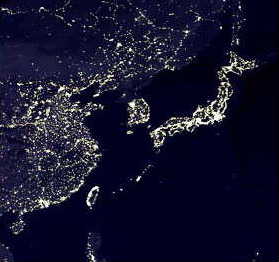
There can be little argument that the nightmare masquerading as a sovereign government in North Korea is the most hellish, brutal and perverse on Earth. The obscenely surreal rhetoric that issues forth from Pyongyang only gives us the tiniest glimpse into what life is like in that benighted country. This picture is from a composite satellite image of the earth at night: 

image

You can see where light and prosperity end at the northern border of South Korea. Political, moral and literal darkness. The North Koreans are devoting much of their energy to the acquisition of nuclear weapons and delivery systems for same. They already have missiles capable of hitting Japan, and soon they may have missiles that could deliver a nuclear warhead to the west coast of the United States. (No thanks to Pakistan) The consensus is that North Korea may already have two or more bombs.

That nuclear capability makes the problem of North Korea much more complicated than that we faced in Iraq or Afghanistan, or than we might face in Syria, Iran or Saudi Arabia. As well, even though in a conventional fight the North is no match for the South, let alone the US and the South together - a surprise attack combined with the use of nuclear or chemical weapons could wreak enormous destruction before the eventual defeat of the North. Seoul, the capitol of South Korea, is within artillery range of the North.

Perhaps the best hope we have is that the system will collapse under the weight of its own delusions and there will be a peaceful anschluss with the south. American strategy has been to angle for the isolation of the North, possibly in the hopes of accelerating this process. But there are several complicating factors even with this slim hope. First, the government in the North is by any metric we could use completely insane. Desperation on top of insanity might provoke an attack if the regime and its Dear Leader felt there was nothing to lose. Second, China's strategic considerations make all outcomes doubtful. China's desire to be a regional hegemon and not have a close US ally on their border will be a big factor however it plays out - in the event of a Northern collapse and especially if there is fighting. Third, the completely understandable (meaning four, for those who followed the Winds of Change debate) reluctance of the South Koreans to do anything to provoke the raving lunatics next door.

North Korea is an integral part of the world market in WMD, and American stands to suffer should these weapons get into the hands of some well heeled 'splodeydopes in the Middle East. The brutality of the regime, and the suffering of the North Koreans should put Kim on everyone's better dead list. That doesn't stop Jimmy Carter from hanging out with the Dear Leader, of course. They all have free health care, you know. It's hard to see what anyone can do to solve the problem without massive 'collateral damage' - to the South, to Japan, or even to the US. Yet to leave it alone is unacceptable for both moral and national security reasons. I think the only practical course is to wait - but it is a galling choice.

Posted by Buckethead Buckethead on   |   § 3

So it was about the oil...

ABC is reporting on the list of people and organizations who supported Saddam Hussein's regime and were given oil contracts as a result. All of the contracts were under the UN administered Oil for Food program, and were awarded between 1997 and the start of the war. The list was discovered in the files of the Iraqi Oil Ministry.

Investigators say none of the people involved would have actually taken possession of oil, but rather just the right to buy the oil at a discounted price, which could be resold to a legitimate broker or oil company, at an average profit of about 50 cents a barrel. ...

According to the document, France was the second-largest beneficiary, with tens of millions of barrels awarded to Patrick Maugein, a close political associate and financial backer of French President Jacques Chirac.

Maugein, individually and through companies connected to him, received contracts for some 36 million barrels. Chirac's office said it was unaware of Maugein's deals, which Maugein told ABCNEWS are perfectly legal.

The single biggest set of contracts were given to the Russian government and Russian political figures, more than 1.3 billion barrels in all — including 92 million barrels to individual officials in the office of President Vladimir Putin.

George Galloway, British MP and vocal critic of the war, was on the list for 19 million barrels, though he denies any involvement. Most disturbing to me was the presence on the list of the Russian Orthodox Church. I wonder what defense they are offering.

I don't think anyone should be surprised about the French involvement.

Posted by Buckethead Buckethead on   |   § 0

Well Damn!

It comes to our ears that Bush is moving away from his spendthrift ways and is coming close to a total freeze on discretionary spending in the next budget. Bush will propose an increase of less than 1% for all federal programs save those for homeland security and defense. Fiscal conservatives have been savaging the president for "spending like a drunken sailor" and apparently this move is at least in some part a reaction to that criticism.

But the president will propose increasing governmentwide homeland security funding by 9.7 percent in the fiscal 2005 budget, and the military budget is expected to increase by a small amount.

"This is going to be an austere budget," White House spokesman Trent Duffy said of the budget that Mr. Bush will send to Congress on Feb. 2. The less-than-1 percent growth will be the smallest since Mr. Bush took office in 2001 — and the lowest since his father, President Bush, proposed his fiscal 1993 budget.

Conservatives are happy with the proposal, though some are dubious, myself included. Brian Riedl, a budget analyst at the Heritage Foundation, said the proposal is "definitely a good start."

"The key question is whether the White House will back up this proposal with a veto threat, because last year the president proposed a 4 percent increase and, with the passage of the omnibus spending bill, he's about to sign a 9 percent increase," he said.

If - if - the president actually follows through with this, and puts the arm on congress and even threatens a veto (he has yet to veto a bill) then this will be a very good thing. Deficits, all things being equal, are not a good thing. However, there are reasons to run them, and war and recessions being some of them. So I am not opposed - in principle - to deficits. However, the spending surge under this Republican president has been disturbing to say the least. Most of the spending increases have not been for the military or for homeland security but rather for social and other programs.

These increases, which Bush either proposed himself or did nothing to hinder combined with the recession stricken economy and the tax cuts to bring about our current deficit situation. But the light at the end of the tunnel is that the tax cuts did their work as a stimulus to the economy, which is now looks to be in the early phases of another ten year boom. If the president restrains spending, the increase in revenue through from the growth in the economy should level out the deficits as it did back in the mid nineties. But spending has to be restrained - because its for damn sure that the government can outspend the economy, and will if not watched carefully.

Hat tip to Pejman for the link.

Posted by Buckethead Buckethead on   |   § 0

Apples and Oranges

Godless Capitalist slams the Canadian medical system again. That's just too many times today for me to stay quiet.

Dear Godless: Please familiarize yourself a little further with the Canadian health care system. A key statistic is per-capita spending which is around C$3200, or about US$2440. That's for universal health care, year 2000-2001.

In that same year the US health care system spent around $4600. At that figure around 84% of the population was covered (16% had no insurance). Medical insurance rates here have increased tremendously since then (I know; my company has been paying them).

The assertion that a private system _must_ be more efficient is simply erroneous. Each has its strengths and weaknesses.

A 2003 study of costs indicated the following (http://query.nytimes.com/gst/fullpage.html?res=9A01E2DE1F30F932A1575BC0A9659C8B63):

"BOSTON, Aug. 20 -- A comparison of health care costs has found that 31 cents of every dollar spent on health care in the United States pays administrative costs, nearly double the rate in Canada.
Researchers who prepared the comparison said today that the United States wasted more money on health bureaucracy than it would cost to provide health care to the tens of millions of the uninsured. Americans spend $752 more per person per year than Canadians in administrative costs, investigators from Harvard and the Canadian Institute for Health Information found.
Published: 08 - 21 - 2003 , Late Edition - Final , Section A , Column 6 , Page 23"

Here's the point -- you simply cannot compare the two. They're apples and oranges. The Canadian system has very tight control on costs and yes, this leads to shortages at times. When the pain gets great enough, the population speaks and the purse strings come open.

Note that there are no significant differences between the US and Canada in any health metrics such as length of life and so forth. We're all basically equal.

Canada _could_ elect to dramatically increase its spending on health, by say 20% or 30%. This would still keep its total costs far below those of the US, per capita, but would substantially increase quality of care, and on the average could probably exceed levels of service in the US. Certainly, some might make the argument that there is a moral purpose to doing this.

Note that with health costs contained and handled by the government, Canadian businesses are free to concentrate on what they _should_ be concentrating on: Being efficient providers of services and goods. They don't have to babysit their employees and be "big brother" like US companies are _compelled_ to do.

There are no controls on medical spending in the US. The current system is utterly broken and spiralling out of control. I believe that there are private solutions that can work.

Walmart can help. Walmart can demand of its insurance providers that they agree to insure _anyone_ wherever Walmart has a store. Walmart doesn't pay the tab, of course -- the person getting the insurance does. But that individual is getting Walmart's negotiating power. And I don't mind seeing Walmart take a cut of that money.

Relatively inexpensive catastrophic coverage insurance is one possible solution...

Posted by Ross Ross on   |   § 0

Clinton in Qatar

By way of Kathy K over at On the Third Hand, we have this rather surprising
article from Ralph Peters in the Post. Peters is not known for his loving feelings about Clinton, or his administration. But read the article... it's interesting, and has some important things to say about relations between the middle east and the U.S.

On another note, we have this from the Middle East Quarterly: an analysis of the failure of the Oslo accords, and what lessons can be drawn from it.

Staying with the Israeli theme, we come to this thought provoking gem from Tech Central Station, one of the most awkwardly named good websites around. The demographic trends mentioned in that article are one of the biggest problems facing the state of Israel right now - and for a long time to come.

Posted by Buckethead Buckethead on   |   § 0

Being Female in the New Iraq

Riverbend has some critical reading on the subject...what, exactly, does our New Iraq have in store for her?

Let's keep in mind that she's already lost her job because of fundamentalism. What freedom is she going to lose next?

It is not "OK" for the US to allow the religious nutjobs over there to set up any kind of stupid Sharia law system. It is utterly unacceptable to have these alternate, binding courts. Sure, apparently you can use this secondary court system only if there's agreement. Exactly how does that happen? There are all kinds of intimidation that can be brought to bear.

Irshad Manji's recent "The Trouble with Islam" delineates the treatment of Muslim women with distressing detail. Riverbend is becoming a casualty. What good have we done if we simply exchange one oppressor (Hussesin) for another (the anonymous mullah).

Posted by Ross Ross on   |   § 5

I know martial arts. May I kick your ass?

By way of TL Hines, Writer, we hear of a practical joke of quite monstrous proportions. Yahoo Entertainment News reports that a disgruntled Japanese Tourism Official, known only as M.L. Tanaka has painstakingly created a faux Japanese-English phrase book that gives dangerously incorrect English translations of common phrases.

Among the nearly 2300 incidents reported to the Japanese Embassy:

  • A 29-year-old Tokyo man visiting San Francisco for the first time meant to ask a female store clerk, "May I please have film for my camera?" But what he actually said was, "Would you place your copious breasts in my mouth?" He was slapped in the face, then got tossed out by the manager.
  • Four family members from Osaka were thrilled see their favorite American singer coming out of a ritzy store in Beverly Hills. While waving frantically, they shouted out what they believed to be, "We love you so much." Unfortunately, what they really said was, "We're here to take your head." The four were arrested and detained for six hours by police.
  • A 45-year-old tourist from Okinawa looking for the legendary Apollo Theater in Harlem thought he was asking a group of young men, "I am lost. Which way is uptown?" In reality, he said, "I know martial arts. May I kick your ass?" He was chased five blocks before being rescued by police.

Five blocks. In Harlem.

"The man who compiled this dictionary clearly went out of his way to wreak havoc," says New York hotel concierge Jacqueline Porseman, who arranges tours for many VIP guests from Japan. No kidding. Be kind to the next Japanese tourist who respectfully asks to kick your ass, for he knows not what he does.

Posted by Buckethead Buckethead on   |   § 1

Not a bad idea

Steve, over at Begging to Differ, reports on a pretty good idea: Creating an Iraqi Oil Trust and giving shares in the trust to all Iraqi citizens. This would resemble the Alaskan Oil Trust, where all state oil revenues are pooled, and then dividends paid to Alaska residents. The difference here would be that the shares could be bought and sold, so that Iraqis would in effect have ownership of the oil, and would have more freedom do decide what to do with their shares - sell them, keep them, whatever.

This is a good idea on several levels. One, it gives the Iraqi people on an individual level, a stake in the country's wealth and future. Two, it gives them a clear title on a source of wealth that they can use as they see fit. Three, it would remove or at least mitigate one of the major sources of corruption in resource rich third world ountries - government control of vast wealth. I approve heartily, and this could be something that materially assists the formation of a civil and democratic soceity in Iraq.

Also on that estimable webpage, is a post by Greg linking to and commenting on a list of the fifty most underrated recent movies. This is an interesting list, and as I informed Greg, I have seen 36 of them, and actually own 15 of those. The remaining 14 will give me a goal, now that I can no longer easily go over to the multiplex thanks to the arrival of Sir John-the-can't-be-quiet-in-a-movie-theater. I have seen one, one movie in the last eight months. I used to see at least one a fortnight. Go over and see my additions to the list.

Posted by Buckethead Buckethead on   |   § 4

Allies of convenience

Buckethead and I have spent time before lamenting the US's policy of getting into bed with dictators during the Cold War. Saddam Hussein was one of those. Aziz Poonawalla has a killer post up to that effect which goes into some detail about the level of support the US lent Hussein during the Iran-Iraq War. Hint: the words "anthrax" and "Rumsfeld" turn up. Not to get all tinfoil-hatty on the topic, but this has turned into a rather embarrassing, inconvenient, expensive, and generally lamentable situation thirty years down the line.

As one of Aziz' commenters says, "Catching evil dictators is a great thing, but it would be better if we did not have a policy of working with evil dictators when it seems in Washington's best interests." Right on. Although it's one thing to sit here in my swivel chair and condemn Reagan-era foreign policy for cozening up to known monsters and another to have to decide between backing the Shah and backing Hussein, I think the flaws in the US's policy of making allies of convenience are all too clear, and the long-term costs are far too high.

[wik] Please note that Michael Moore is quoted in the AP post linked. Guess what? He's an irritating f*ck, but so is Newt Gingrich and last week he said something totally on the money. So, again, can it with the America-hating stuff.

Posted by Johno Johno on   |   § 0

I'm on a roll

So two weeks ago I attended the live broadcast of "Hardball" with Howard Dean.

This last Tuesday, I was one of only 800 people to attend a talk by Wen Jiabao, Premier of China. ("How was it, Johno?" "How do you think? I attended a once-in-a-lifetime talk by a leader of the unfree world, and he took audience questions. It was awesome.")

This coming Monday, I'm going to be at "Hardball" once again, this time with Joe Leiberman.

This weekend, I'm going to try to get Goodwife Johno down to Foxwoods for a few hands of blackjack. If my luck's hot, I really oughtta do all I can to cash in. It's the American way!

But seriously... on Tuesday, I attended a speech by the Prime Minister of China. He spoke for about an hour on the topic of "coming together". Never in my lifetime did I foresee a day when a leader of China, in the interest of polite innocuous diplomacy, would openly advocate the democratization of Chinese politics and the marketization of China's economy. Although most of what he said was simple diplomatic boilerplate and therefore only mildly interesting, he spent a lot of time talking about trade, Taiwan (semicircumspectly), and the problems facing China as she tries to deal with SARS, AIDS, industralization, education, and the adequate distribution of goods and services to the entire population. Not mentioned: Tibet, except by a protester who was promptly and gently removed.

Posted by Johno Johno on   |   § 0

Shiny Red Button Worship

I bow down to all you badass motherf@#$@rs. The kick'em in the teeth crowd; the take-no-shit crowd; the make-me-a-sandwich boys. You own the playground. You can tape signs on the backs of the nerds.

Then you grow up. You work in a gas station. And the nerd working in corporate fires your ass.

Den Beste gives us a marvelous example of true extremism -- the casual contemplation of nuclear genocide to rid ourselves of a tiny, nasty minority within a population with which we are currently somewhat adversarial. I find his words to be a smooth, oily kind of evil. This rush to judgement, rush to the end-game...it's an unnecessary exercise of brinksmanship and absolutism.

Is this the point at which I need to reassert myself as a card-carrying citizen of whatever democracy? Say a few things to earn respect? Boo-ya. Capitalism kicks ass. Taxes suck! I support the troops! I like pancakes and Samurai Jack. That's the limit of rote platitudes I can muster, in this moment.

I have said repeatedly that what the Arabs need to fear the most is that we begin to think about them the way they (or their extremes) think about us. But what do they really think about us? Would you kill Savas, the generous and kind Arab who showed me Istanbul? Because when you guys talk about your armies and your shiny red buttons, and how very much you'd like to push them, but only if somebody absolutely makes you do it.

Exactly how close do you all think we are, to the brink? Are we one step removed from annihilation?

We've been there for forty years, and the extremists had nothing to do with it. We put ourselves there. We built the technology; we built it, and now they've come, in the night. But we can't put the jack back in the box. It doesn't work that way.

There are two essential positions vis-a-vis the terrorists/extremists in this world. You can either do something to get'em to love us, or you can try to get'em to fear us.

Den Beste and rest of the button pushers sure do definitely want them to fear us. Never mind the cost of such an action to our souls, the very heart of what makes our countries fundamentally better. We try to do the right thing.

Is there not a 40 year object lesson in Israel right now that teaches us about this particular endgame? It leads nowhere. If we are unwilling to engage a final (read: death to them all) solution, a population cannot be suppressed through fear and violence. It only incites more violence and hatred. Like a bully in a playground, the blows rain down on someone who can't fight back, won't fight back. And then a gun shows up in the hands of the victim, and someone dies, and then the cycle starts again...the history of the world is written in these small cycles, and expanded to the larger canvas of civilizations.

I refuse to accept the playground. There are other ways. We can grow up, grow out of this. Hatred can be eased, when we recognize it on both sides for what it is.

Those in the center must find the strength to reject attempts at domination by the extremists.

This has been a circuitous route to "Idiotarianism"...but here's the point: You cannot eliminate terrorism through force. If you think it can be done through force, you are an idiot. Thousands of years of human history tell us, with exacting clarity that in any population there are misfits, there are malcontents, and there are those who are insane. The only defense we have against these sad souls is a population that doesn't want them around. People are the early warning system.

If America had ten Timothy McVeighs, and they went to Moscow, they rented ten white vans, bought twenty tons of fertilizer, and blew holes in buildings, killing a few thousand Russians, we'd have a number of people in this country who'd say "good riddance". A Russian Den Beste might push his button at that point, which would be idiotic.

Technology is dangerous. I get that, deeply and fundamentally. It places more and more power into the hands of fewer and fewer people, as every year goes by. There is no way to stop it. Suitcase nukes, an aerosol of death, radioactive dust...and in the future, we may have nuclear-powered nanites carrying tiny bladders of vile poison deep into the heart of the enemy, whoever that is.

When the next destructive wonder comes along, will you play the same risk analysis game? Will you decide that the newest technology wonder is too dangerous for others to have, and that it requires a pre-emptive strike? If we don't push our button, maybe we won't get the chance...and God won't give us 50 points at the Pearly Gates for having "smited enemies when we had the damn chance."

Holy Christ, I'm one of the pansy peaceniks, or something. I mean, why would God have given the US an Army if he didn't intend for it to be used?

Commenter Ben informs us: So the left will become more frustrated, radicalized, and dangerous. You shoot mad dogs. You may not like it, but you really have no choice. Either shoot the mad dogs, or let them destroy you and your family, your friends, and your nation.

With that paragraph I think we've arrived at the reason why "Idiotarian" bothers me so much. It's a big, obvious hook on which the narrow-minded, vicious hard right can hang anything or anyone they don't understand or don't like. It's a parrot-talk word. It cheapens the intellectual underpinnings of the true conservative and re-renders genuine argument into lead-based pablum. It's a single-color paintbrush in a multi-color world.

Right now there are tens of thousands of relatives of thousands of newly dead Iraqis who have developed a permanent hatred of the US. A significant chunk of that emotion is generated by the right-wing rhetorical chaining of 9/11 to Iraq; the perception is that they're being killed in retribution for something that they didn't do. I can't think of a better way to piss people off than that.

I know how the average American would react if he was convicted of something he didn't do. He'd scream bloody murder, vow revenge, and find a way to get back at whoever put him there. Why expect people in other countries to be any different?

Maybe they're on 3/5 of a person, per person, over there. Maybe it's less.

Yes, the rambling needs to stop. Here's one last bit of nasty perspective:

Den Beste says that "what we're trying to do in Iraq seems to be the only way to keep the body count in this war from making WWII look small". Let's go horrible, terrible-case and assume a nuke in terrorist hands...a crude suitcase model will do.

Deaths in Hiroshima: 65,000 in the first four months. That's about what would happen in a modern city, too, with a nuke of comparable size, within a factor of two or three.

Deaths in World War II: Around 50 MILLION.

Why don't we lay off on the comparisons between Al Qaeda and WWII, ok? It's BS. The only thing that could possibly generate truly high and horrific deaths are biologicals, which are going to be substantially easier to work with in the future than nukes. It's probably a bad time to "accidentally" kill an Arab microbiologist's son.

Al Qaeda are criminals. You don't nuke a neighborhood because it produces criminals. You don't walk into the neighborhood and shoot randomly, unless you don't think humans live in the neighborhood. Don't be suprised if the feeling is mutual, then..

This would be a great time for Buckethead to get a word in edgewise, and demonstrate to me just how far out of my tree I have managed to get myself.

Posted by Ross Ross on   |   § 3

Peace Can Be Bought

Just like so many other things. Here is my new crazy idea. The primary Palestinian objection to The Fence is the economic implications thereof: They're dependent on Israel for their economy. Of course, a pretty good chunk of Israel is dependent on cheap Palestinian labor too, but that's life. There are land issues (farmers' farms being split up), but let's set those issues aside as solvable and part of the "where is the fence" problem, rather than the "should there be a fence problem".

If the US and certain other countries (like Europe) were to agree to set up factories and so forth in the new Palestine, this could jumpstart a new economy. First, it's a cheap way to buy peace. Second, it gives Palestinians jobs; a pretty good chunk of the political resistance is due to the desperation and free time created by a destroyed economy.

It might just be the cheapest way to solve much of the problem. At the end of the day, you'd have two states, relative peace, and a decent Palestinian economic infrastructure. You'd also have the US sitting as the agency that made it happen.

So I wonder...what would it cost to do something like this? Life and materials are cheap in the West Bank...what kinds of industries could be created, with international support?

And Then?

I sure do think simple sometimes. Too simple... :)

Posted by Ross Ross on   |   § 3

"In My Country, Women Come Second"... "And Sometimes Not At All!"

It seems the proposed Constitution of Afghanistan it does not live up to expectations. Our expectations that is, as liberators who respect the liberty of women and the right of free political organization.

On Reason's weblog, Julian Sanchez links to this piece by someone who has actually read the proposed Constitution, and Tim Cavanaugh adds his thoughts.

And please excuse my Austin Powers reference. It's Friday.

[wik] Edited Nov 14, 2 PM.

Posted by Johno Johno on   |   § 0

China's dirty secret

Kudos and all for China for getting a space program together, yeah ok, and I've congratulated them elsewhere for leaping forward to 1958.

But for all the spacefaring feats that nation may achieve, there's still mindbendingly awful systemic problems in China, like this one. China has a horrid recent history of interior management-- stealing cookware to make home steel smelters, encouraging schoolchildren to kill their teachers, starving thousands if not millions in the name of so-called progress, etc., etc., and that legacy seriously undermines any claims to outer-space glory. Worse, the nation's leaders seem not to have learned much from their past failures.

In the mid 1990's the communist party authorities in Henan encouraged poor rural farmers to sell their blood.

Mobile collection units toured rural villages. Millions of villagers took up the call. But the blood collectors ignored even the most basic standards of hygiene. Dirty equipment was used over and over. Donor blood was mixed together, the plasma removed, and then what remained pumped back into the donors blood streams.

HIV spread out of control through the whole blood collection system.

No-one for sure how many people were infected, at least 500,000, maybe more. . . . .

Having infected so many of its own people, China's communist rulers are now doing everything they can to stop the outside world from finding out.

Posted by Johno Johno on   |   § 0

On Reconstruction

The Economist has an article (graciously reprinted online) on the reconstruction of Iraq.

They see the glass as half full-- many utilities have been restored to prewar levels, oil is flowing-- which is valid. But I don't think that's too great. While I get that it will take time, "prewar levels" just aren't that great a benchmark. We can be doing better.

The entire article is worth a read, and the most interesting bit is at the end. It suggests that big oil companies aren't biting at Iraqi oil contracts, because such interests "tend nowadays to look at the lifetime capacity of a field, not at the chance of a quick profit. 'You're talking about a horizon of 10-12 years, minimum,' says a European businessman searching for deals. Despite the high technical calibre of Iraq's oil ministry, outsiders are not yet confident that long-term contracts will be watertight."

So, even if it was all about the oil (and yes, let's not kid ourselves that the economics of oil aren't a big piece of the Whole General Sort Of Mish-Mash), it's not really about the oil now, for better or worse. Ironic.

Of course, until sabotage is minimized, infrastructure upgraded, pipelines re-established, and stable operations established, investing in Iraqi oil is a fool's game suitable only for sinking giant sums of US government money. That's ironic too, and unfortunate.

Posted by Johno Johno on   |   § 3

Johno's Roundup of Significant Things

In this issue:
The CPI Follows the Money Trail To Nowhere
Stone Cold Thuggin'
Afghanistan's Steps Toward Constitution
Happy Kitten Sunshine Story Time

Read on, below the fold!
The Money Trail To Nowhere

The Center for Public Integrity has released "Windfalls of War," their report on the correlation between cronyism and contracts in Iraq. You know, the Halliburton thing. Daniel Drezner riddles the report with too many holes to fly. Drezner's central rebuttal is that by asserting a statistical correlation between campaign contributions and size of Iraqi reconstruction contracts, the CPI put themselves in the position of arguing from no evidence.

Drezner's argument is pretty persuasive, though some commenters disagree. What is not said, though, is that the CPI chose a piss-poor way of measuring cronyism. All the CPI report's research shows is that campaign contributions played little role in determining who won contracts to rebuild Iraq and Afghanistan.

Drezner himself makes the salient point in a footnote: " the primary thrust of Windfalls of War is that the process is riddled with malfeasance rather than disorganization. The notion that there was a conscious effort to reward Bush cronies with lucrative government contracts would require a lot more centralized coordination than the CPI report uncovers."

As Godwin's law runs, "never chalk up to malice what may be attributed to stupidity." The more likely scenario as regards reconstruction contracts is this: there are maybe ten construction companies in the US large enough to undertake the rebuilding of Iraq, and fewer than that of companies who specialize in oil infrastructure (Halliburton among them). In the evident administrative chaos that surrounded the Administration's run-up to the aftermath, Occam's Razor suggests that Cheney, Condi, etc. said "Hey, I know a guy...." and the calls went out.

If they're serious, the CPI needs to do a much more detailed investigation into whether cronyism played a role here, because by using the numbers they did, they demonstrate a fundamental lack of understanding of the nature of the beast.

Personally, I find it hard to believe that cronyism played no role in getting Halliburton, Bechtel, etc their phat contracts, but CPI sure haven't found any smoking gun yet.

Stone Cold Thuggin'

David Brooks has an op-ed piece in the New York Times today which argues that the "opposition" we're fighting in the Sunni Triangle are the remnants of Saddam Hussein's thug brigades for which the delicious money/power teat has dried up. He doesn't actually use the phrase, "delicious money/power teat"-- that's my innovation-- but that's the gist of it. He argues that making progress in the next few months is crucial, so that by the time Iraqi police, mayors, and so on are ready to take over they just have to mop up instead of fight a well organized crime syndicate.

It would indeed be grand if the Iraqis would hunt the killers. They know the territory. They can get the intelligence sources.

But the administration would be making a mistake if it sent the signal to the American people that the hard work from here on out would be done by the Iraqis themselves. After all, is it realistic to think barely trained policemen can, over the next six months, deliver blows against bands of experienced mass murderers? Is it realistic to think that a local Iraqi mayor will take on the terrorists and so risk his own death, when the most powerful army in the history of the earth is camped just nearby?

Cori Dauber, guest-posting at the Volokh Conspiracy, links to Brooks' piece commenting

It is also important to keep reminding ourselves that for many Iraqis the pain of the old regime is still front and center, which puts comparisons between the situation before and after the war in a slightly different light. How is the situation in Iraq today? Too often when that question is asked we forget to begin the answer with, "well, the torture chambers are closed and there are no new mass graves."

Damn right. And that's the legacy that our agents in Iraq need to be very, very careful not to resemble in any way even by accident. This is part of that "hearts and minds" campaign that we have been posting about in this very venue, and I say again I think it's the most important fight of all in the greater war.

Afghanistan's Steps Toward Constitution

The Afghani draft Constitution was unveiled this week. It features a unitary government led by a President, makes no mention of the Shari'a laws, codifies Islam as the religion of Afghanistan, and makes provisions for the speedy replacement of a deceased President in order to prevent coups.

This is great news. While it's true that you rarely get more than one shot at a Constitution, what I've seen seems encouraging.

That being said, the problems that plague Afghanistan are deep and cultural. Violence is a way of life there. The Atlantic Monthly carried a story last year that underscored how deeply the language, ways, and ethos of violent reprisal suffuse the entire culture, affecting even aimable relations against neighbors. Paraphrasing a bit from the article, I remember one woman in the mountains who told the writer that she was in the market for a rocket launcher because her neighbor up the mountain-- with whom she had no particular quarrel-- had one too.

In a country that has never really known stability in the sense we understand it, fostering goodwill and cooperation for a new Constitutional government will be a huge challenge, especially with the Taliban still mounting attacks.

Happy Kitten Sunshine Story Time

Look at the kitties! Look at them!

image

image

And that's it for today. Have a cromulent day.

Posted by Johno Johno on   |   § 0