An Orbit of Eternal Grace

Science, mad or otherwise. Rockets and space travel, and maybe we can get off this sordid rock.

War in Space, Part Two

Part one can be found here, and here is part three. Here can be found a battle in space. 

Gravity Gauge

When we think about battles in space, it is useful to draw some parallels to earthly naval warfare. Just as there is a distinction between blue water and brown water navies, there will be a similar divide between warships designed to fight within the gravity well of a planet, and those intended to fight in the depths of interplanetary space. Warships designed to operate in close proximity to bases, and to deal with the rigors of maneuver in a steep gravity well will be very different from those required to make long journeys in flat space between the planets. We can think of the former as river gunboats, the latter as battleships. 

Gunboats operating in orbital space around, say, Earth will have powerful, high thrust engines and limited facilities for life support. They will be based in orbital forts, or perhaps launched atop disposable launch vehicles like the Gemini or Apollo rockets of the sixties. The life of the crews of these warships will be more like that of an Air Force fighter pilot than that of a submariner - which I think will be the closest analog for long duration deep space warships.

Gunboats, operating in the constrained space around a planet, will engage at shorter distances than their deep space cousins. In most respects, their armament and sensors will be very like that of a modern jet fighter. In fact, they will probably look something like a modern fighter - as being able to enter the atmosphere (at least the upper reaches of it) will be a very useful thing. Aero-braking, skip-jumping along the top of the atmosphere, and similar tactics will all save fuel while increasing the range and maneuverability of the ship. And being able to land on Earth will be a happy alternative to dying in space in the event of damage to the ship.

Looking beyond the descendants of a marriage between the space shuttle and an F-15, other types of orbital gunboat can be imagined. Light sail ships, boosted by ground or space based lasers might also be developed. Heavier warships, analogous to coast guard cutters might linger in orbit for weeks at a time, before returning to base. If scramjets are ever perfected, then warships operating at the interface between space and the atmosphere might become common. All of these types would have some capacity to attack targets on the ground, and in fact some might be designed around that mission. Erwin Sanger, an Austrian designer in the forties, imagined a rocket-powered bomber that would skip along the top of the atmosphere.

In combat within the gravity well of a large planet, altitude will be the most important tactical consideration. Like the wind gauge for sail-powered warships, gravity gauge will be the dominant factor. Having the advantage of position will be crucial, in that a position higher up the gravity well translates to more options for maneuver. Also, shooting up the gravity well is inherently harder than shooting down. The first pilots of these warships will have to learn the somewhat paradoxical logic of orbital mechanics - slowing down speeds you up, and vice versa. For pilots used to the straightforward maneuvers within an atmosphere will have to adapt quickly.

Deep Space Design Tradeoffs

Deep space will offer vastly different challenges to warship designers. All of the propulsion systems that might be available in the near future have serious limitations. Two tradeoffs will determine the design of all warships. The first is mass/acceleration; the second is power/stealth. I noted in the first part the tradeoffs required by stealth. Most of the tradeoffs for mass and acceleration will push ship design in the same direction.

The major propulsion systems that could be constructed with current or very near future technology are chemical rockets, nuclear fission rockets, nuclear pulse drives, ion drives and solar sails. The first three are high thrust, short duration drives; while the last two are low thrust, long duration. With the exception of nuclear pulse, which I will discuss separately, all of these systems impose the same limitation on warship design: every ounce of mass will reduce the total acceleration the warship is capable of. Space types refer to this as delta-v, or change in velocity. It is a measure of the total change in velocity (speed plus direction) that the ship is capable of with a given drive and fuel supply. It doesn't matter whether your ship accelerates really fast and then coasts, or if it makes a long slow burn, since delta-v measures the total change. This makes it a useful comparison between ships even of vastly different design.

(While solar sails will have effectively infinite delta-v, because they use the solar wind for propulsion, solar sails will not be well suited for combat since the sails are so visible and so fragile. Warships will be confined to the other drives.)

Ship designers will always be striving to make the ship lighter. This will allow engines of a given capacity to achieve a higher delta-v. However, there are things that a warship must have in order to be effective. Weapons, armor, sensors and stealthing; crew, and food, water and life support for voyages lasting months or more; a storm cellar to protect the crew from solar flares; fuel or reaction mass; these are all things you will need to bring along. Rockets and ion drives are low energy, and this balance will place a premium on low mass weapons, small crews (and thus lessened life support requirements) and little or no armor.

Weapons that require vast power plants will be right out. (Both for mass and heat/stealth loss reasons.) Weapons that are themselves heavy will be right out. Missiles will not be very useful in long-range engagements, due to the fact that a rocket capable of propelling a warhead to a target tens of thousands of miles away in time to affect a battle will be almost as large as a small space ship. This would seem to put a premium on beam weapons. However, as we discussed in the previous part, and as Clueless mentioned, power plants capable of powering lasers, masers, and particle beam weapons will be heavy and produce lots of heat.

So, it may very well be that early spaceships will be armed with rapid-fire cannon and machine-guns. With some effort, a high velocity, rapid-fire cannon could be developed for use in spaceships. Rate of fire would be important, as I discussed in the first part. The more rounds put in the general vicinity of the target will increase the chance of a hit. One of the most promising technologies is the Metalstorm system invented by the Australian O'Dwyer. This system stacks bullets in the barrel, and fires them electronically. By bundling several barrels together, it can achieve rates of fire approaching millions of rounds per minute. Gunners on warships would fire hundreds of rounds at a time, laying patterns that would (hopefully) intersect the course of the target. Variations might include sub-munitions, target seeking or sensor rounds, and explosive rounds. After firing all its rounds, individual Metalstorm units could be discarded, increasing available delta-v. Rapid-fire, self contained, requiring effectively no external power, and disposable after use - Metalstorm cannon seem an ideal fit for spaceships.

As technology advances, smaller and more efficient power plants will allow warships to move toward beam weapons that will be more accurate than the cannon described above. Unless radically better drives are developed, missiles will remain the weapons of orbital gunboats, and not deep space navies. The mass penalty for missiles with adequate range will simply be too great. Warships of these types will be armed with cannon; and, if they can be developed, standoff x-ray lasers.

Deep space warships built around rockets or ion drives will tend toward small. Small is better for mass and stealth both. In all likelihood, they will be narrow, to provide a smaller radar and IR signature for enemies to detect. (That is, as long as the ship is pointing in the right direction.) They will be covered with stealth materials, and the rear of the ship will have complicated and fragile fractal heat radiators as well as the drive exhaust. Weapons will be concealed beneath the stealth covering. Life for the crew will be hard, living in cramped spaces for months at a time. I imagine it will be rather like a submarine.

Orion Drive The exception to much of the mass considerations discussed above is the nuclear pulse, or Orion drive. This concept involves building a very large ship with a heavy base plate attached to the back of the ship by some very serious shock absorbers. Then, you light off a small nuke behind the ship. Repeat as necessary. This is an over-the-top propulsion scheme. With this, you could accelerate very large masses very quickly. Ships using an Orion drive would simply have to be big just to make the acceleration survivable. Since you need a big ship; adding armor, huge power plants, or anything else you want is not such a big deal. An Orion powered warship would be a huge hulking brute. It would not be subtle, and stealth would be a lost cause.

No other type of spaceship (based on current technology) could match the Orion for speed and payload. It will be in a class by itself until and unless someone invents fusion or antimatter drives. Meanwhile, the inherent limitations of the other propulsion types will limit the kinds of warships that can be built around them. (As will the existence of Orion powered warships.) And given the requirement for (large numbers of) nuclear devices for propulsion in an Orion, and the stupendous expense of putting that much mass in orbit will probably mean that only governments will ever have them.

Life for a crewman on an Orion warship will be easy, by comparison. The generous payloads of an Orion will make for more comfortable quarters, and better life support. Large amounts of armor will likely contribute to the peace of mind of the crew as well. Rotating crew quarters providing artificial gravity might even be possible. The speed of Orion will also mean shorter journeys - weeks instead of months between planets.

In the next part, we'll look at strategic considerations, and how these ships might be employed.

Posted by Buckethead Buckethead on   |   § 17

War in Space. Part One

Steven den Beste has written a two part (so far) article on the possible outlines of combat in space. As is typical for the master of the USS Clueless, it is long and examines the topic in a thorough and logical manner. However, I find that his thinking diverges significantly from my own thoughts on the matter.

The first essay is a compressed history of naval combat here on Earth. The second part begins the discussion of what might happen in space. Clueless makes two central assumptions: 1) Stealth will be difficult if not impossible to achieve; and 2) that nuclear weapons will not be used. I'll talk about the second one first.

[wik] Here are parts two and three, and here is a description of a possible battle in space

Fire Control Solution Most of the interaction between technology and tactics centers on what might be termed a fire control solution. Another way to look at it is this: You want to kill one guy on a hill, in plain sight, three miles away. Shooting at him with a rifle will only bring him down by chance - rifles are not accurate at those ranges. You have three choices.

  1. Get more guys with rifles, and deluge that hilltop with bullets. Each bullet, considered individually, is inaccurate. But one of them will hit. An example of this is the Napoleonic era and earlier: firearms then were inaccurate in the extreme. Therefore, troops were massed in lines, to increase the volume of fire and achieve a satisfactory number of hits. The trade off was that to get the volume of fire you wanted; you bunched your troops up and exposed them to the return fire of the enemy. So long as your enemy had the same type of weapons, this was acceptable.
  2. Run back to the lab, and invent a more accurate rifle, and drop him with a head shot. This happened in land warfare by the time of the American Civil War. Rifle accuracy increased, increasing the danger in exposing all your troops to enemy fire. Most generals were very slow to realize this, and some didn't even into the First World War.
  3. Run back to the lab, and invent a more effective bullet. This has two potential paths: self-guiding, but otherwise more or less conventional bullets; or explosive bullets that lessen the need for accurate placement. An analogy for this is the ICBMs of the opposing superpowers in the Cold War. American missiles were equipped with ever more accurate guidance systems, allowing them to be placed directly on target. Soviet missiles never achieved that level of accuracy, but carried large warheads that made misses into hits.

How does this apply to space warfare? In space, there is no cover to hide behind and no foxholes to dig. If you are in plain sight (more on that later) you can, theoretically, be hit. However, space is very, very big. How do you hit and disable or destroy an enemy who is a quarter million miles away, and moving an order of magnitude faster than a bullet? You will have to use one of the methods outlined above, and that will shape battle tactics more than any other factor, save one: stealth.

Nuclear Weapons in Space To go back to our earlier discussion of the death of the man on the hilltop, one way to ensure his demise was to use a bullet that rendered accuracy less important. What weapon that we now possess is better at this than a nuke? In the end, I don't think nuclear weapons will be avoided in space warfare - there utility will be too tempting to military planners. Considering the general hugeness of space, and the possibility that combat will take place over light seconds of distance, targeting becomes a real problem. When you look at the sun (well, glance. Didn't your mother tell you not to stare at the sun?) you are seeing where it was over eight minutes ago. When you look at the moon, you are seeing where it was, one and a half seconds ago. The moon is a big target, and not moving very fast in relation to the earth. But a small spaceship, actively trying to jink and maneuver to avoid your righteous anger, is going to be a tough shot when even information conveyed at the speed of light is seconds out of date.

Nukes will surmount this problem to a large extent, by the stupendous explosions they create. It reduces the targeting problem by increasing the size of the kill zone. In the end, and because of the lack of bunnies and whales in space, nukes will definitely be used. (Use near the atmosphere of Earth might still be avoided, though.)

Stand-Off Weapons A further use of nukes is in disposable X-Ray lasers. Imagine a small nuke. Put a cylinder of carefully designed rods around the nuke. Light off the nuke. What happens - hopefully - is that the nuclear explosion bombards the rods with highly energetic gamma rays. In the instant before being destroyed by the explosion, the gamma rays cause the spontaneous emission of X-ray photons in the lasing rods, creating several X-ray laser beams. Instead of an expanding sphere of radioactive death, you get a several lances of highly-focused X-ray death. Initial research for these weapons was done back in the eighties for SDI. While those tests were inconclusive, something like this should be possible. A weapon of this nature would be rather amazingly powerful, and could be fired without giving away the precise location of the launching warship. (And, of course, it would function as a sensor drone until detonated.) Even if the X-ray lasers turn out to be impossible - stand-off weapons will likely form a large part of space tactics. There will be a spectrum of autonomous weapon systems, starting with pure missiles, shading into sensor drone/missiles, and into autonomous weapons platforms analogous to the X-45 we described here. The boundaries between the different types will be vague, and many types will be developed. But I don't think that any crewed warship in a deep space battle will be without robotic surrogates. (Actually, I don't think it will be long before that is true here on Earth.)

Other Weapons Clueless' other comments on possible space weapons are well founded and sensible. I especially liked his thoughts on the use of cannon in space, especially in light of the need to avoid heat - no large power plant would be necessary to fire a cannon. These are the weapons, along with nukes, that we will use to beat on each other as we take our squabbles into space.

Utility of Stealth Technology Reconsidered Steven dismisses stealth technology, and invokes the Second Law of Thermodynamics to defend his assumption. However, there are several factors that I think he is missing. First, all space ships will need to radiate heat, making it possible for enemy sensors to detect them. However, the Second Law does not require my spaceship to radiate heat toward the enemy. If I am not mistaken, it should be possible to direct the radiation of heat toward a sector of the sky not infested by enemy sensors, thus reducing your IR signature. Also, much ingenuity could be invested in coatings, surfaces, insulators, heat exchangers and the like to pull heat from the surface of the ship, and place it elsewhere, out of the direct view of the enemy. And again, space is very, very big. To detect a ship that is trying to be cool, from tens, hundreds of thousands, or even millions of miles away, would require very sensitive IR gear indeed. I imagine that in some respects, fleet movements will be like modern submarine deployments, with heat replacing sound as the deadly giveaway. Non-essential power systems will be turned off until needed. And ships will be cold. They will coast like derelicts until battle is met.

Likewise, active sensor systems like radar will be used only sparingly. Lighting up a radar system powerful enough to detect stealthed objects at thousands of mile distances (remember the inverse-square law) will be like lighting up an enormous "shoot me" beacon. Conventional stealth technology does not render the airplanes invisible to radar. In effect, it makes them smaller - and thus harder to detect. The same technologies (and their descendants) will still be used to render ships harder to detect.

Despite the troubling limitations of active sensors, there is hope. One possible work-around is the use of sensor drones. These would be deployed well in advance of battle, to allow maximum drift from the mother ship. The take from a sensor drone would be piped to the warship by tight beam laser communications to minimize the chance of detection. These could use active sensors without endangering a crewed warship. Also, data from passive sensors on a number of drones could be combined with that of the mother ship to form a much more powerful virtual sensor. Interferometry has been used for decades here on earth by astronomers, and there is no reason to suppose it won't be used in space combat. (I would imagine that each sensor drone will also be a missile. There is no reason not to combine them. Not all missile/drones will have the complete sensor suite, but if you're going to be talking to your missiles to guide them to target, you might as well benefit, intelligence-wise, while it's still around.)

All ships will have their passive sensors working nonstop, trying to detect a warm blob, or a whisper of radio, or the occultation of a star. A warship's powerful radar systems will only be engaged rarely, and only after the commander is certain that his location is already known. It is always possible to achieve strategic surprise - even when the enemy knows where you are. Tactical surprise requires more, or at least different, levels of cunning. With almost dormant, heavily stealthed ships, you could get fairly close to the enemy without detection. Of course, fairly close in space combat will likely end up being the distance from the earth to the moon.

In a little bit, I'll continue with some thoughts on how the stuff I just talked about relates to space strategery and tactics.

Posted by Buckethead Buckethead on   |   § 40

And that, my liege, is how we know the world to be banana-shaped

Via Marginal Revolution I find this very puzzling article from the New Scientist which contains speculative evidence that the universe is shaped something like a funnel or straight horn.

They are not sure yet whether this is just a statistical anomaly, but I'll be waiting to hear.

This is nutty. Not only would this imply that the universe is bounded, but moreover at some points it would have finite volume. And then, of course, there's the question of dimensions... Oooh I'm all a-twitter!

At some point, faith, science, and gibberish are indistinguishable.

Posted by Johno Johno on   |   § 0

Earn Big Money, Win Fabulous Prizes

The Instapundit has a good article up at TCS, looking at the reasons why the X-Prize is getting results.

The money quote is from X-Prize founder Peter Diamandis:

The results of this competition have been miraculous. For the promise of $10 million, over $50 million has been spent in research, development and testing. And where we might normally have expected one or two paper designs resulting from a typical government procurement, we're seeing dozens of real vehicles being built and tested. This is Darwinian evolution applied to spaceships. Rather than paper competition with selection boards, the winner will be determined by ignition of engines and the flight of humans into space. Best of all, we don't pay a single dollar till the result is achieved.

Faster, please.

[wik] The title of this post has been changed. I completely forgot, and did not notice until just now, that I had never changed the boring auto-generated title to one of my trademark half clever personalized titles. It will never happen again.

Posted by Buckethead Buckethead on   |   § 0

Red Mars

No not that red. Commie red. Siberian Light links to a slew of articles about Russian space plans. It is, after all, Cosmonaut day in the motherland.

Among the articles he links, we see that a Russian company is claiming that it will put six cosmonauts on Mars by 2009. (2011 according to this AP story.) The articles are sadly lacking in details, but they say that they can do it for $3.5 billion. That would be a significant savings over the proposed NASA plan (anywhere from $30 billion to $1 trillion, depending on who you listen to.) The Russian space officials have declared this nonsense, and based on what I know of the current state of Russian technology and industry, I'd have to agree. They couldn't get to the moon in '69, so I don't see how they could get to Mars in five years now, especially given the economic problems they face.

A researcher at the Central Research Institute for Machine-Building, Russia's premier authority on space equipment design, said it would carry out the project with funding promised by Aerospace Systems, a little-known private Russian company that says it draws no resources from the state budget.

The program envisions six people traveling to Mars and exploring it for several months before returning to Earth. The expedition is designed to last three years in all, and would depend on a fully equipped spacecraft containing its own garden, medical facilities and other amenities.

Absent some idea of how they intend to do it, I will have to remain dubious. Still, more power to them! Maybe the Russkies and Chinese and Indians can force America to actually use its capabilities in a sensible and forward looking way, instead of remaining in a blinkered, stuck-in-the-sixties, bureaucratic mindset.

Posted by Buckethead Buckethead on   |   § 0

Planet-Killer Simulator

A couple weeks ago, Buckethead posted a nice piece on the Earth's latest near-miss encounter with an asteroid big enough to make forever irrelevant all concerns of who's gonna win The Apprentice.

If you're like me, you like staring into the abyss and playing around with what you find in there. So go check out this Earth Impact simulator. Plug in your desired specs (say, witnessing a 5-mile wide hunk of ice hitting the earth at a 35-degree angle at 200Km/s from fifty miles away), and it spits out a detailed analysis of the armageddon you've wrought, from how loud the blast will be at your chosen distance to the size of the fireball and deadly flying chunkage and probable damage to structures.

We're all gonna die! Sweet!

Posted by Johno Johno on   |   § 5

First Private Space Ship Gets FAA License

AP reports that the FAA has granted the first ever license to a private, manned suborbital rocket. The Federal Aviation administration granted a one-year license to Burt Rutan's Scaled Composites

"This is a big step," FAA spokesman Henry Price said.

And it is. Up til this point, no private space coprporation has ever gotten much help from the government, let alone a license for a manned spacecraft. The government has often harassed companies trying to mount private satellite launch services.

Things like this give me hope that perhaps, just maybe, it will be me rather than my grandchildren that will get an opportunity to go into space.

Posted by Buckethead Buckethead on   |   § 6

Other Earths

120 extrasolar planets have been discovered over the last decade, orbiting 105 different suns. All of the planets so far discovered are Jupiter sized or larger, due to the limitations of current astronomical instruments, and none are believed capable of supporting life. However, an Open University team has conducted a study of extrasolar planetary systems to determine whether or not earthlike planets could possible exist.

Using computer models of the known characteristics of a sample of the extrasolar systems, they have calculated the possibility of Earth-sized planets orbiting in the habitable zone - that region of a solar system that is neither too warm nor too cold to allow the existence of liquid water.

By launching 'Earths' (with masses between 0.1 and 10 times that of our Earth) into a variety of orbits in the habitable zone and following their progress with the computer model, the small planets have been found to suffer a variety of fates. In some systems the proximity of one or more Jupiter-like planets results in gravitational ejection of the 'Earth' from anywhere in the habitable zone. However, in other cases there are safe havens in parts of the habitable zone, and in the remainder the entire zone is a safe haven.

Nine of the known exoplanetary systems have been investigated in detail using this technique, enabling the team to derive the basic rules that determine the habitability of the remaining ninety or so systems.

The analysis shows that about half of the known exoplanetary systems could have an 'Earth' which is currently orbiting in at least part of the habitable zone, and which has been in this zone for at least one billion years. This period of time has been selected since it is thought to be the minimum required for life to arise and establish itself.

Furthermore, the models show that life could develop at some time in about two thirds of the systems, since the habitable zone moves outwards as the central star ages and becomes more active.

The team also examined the possibility of planet-sized moons of large gas giant planets might also exist in the "Goldilocks Zone" and also be capable of supporting life. A poster setting out the possibilities will be presented during the RAS National Astronomy Meeting.

Most of the planets so far detected have been (in galactic terms) close neighbors. If half of them could harbor earth like worlds, then the possibility for life is certainly much greater than we thought only a decade ago. Which raises again the Fermi Paradox - where are they? If habitable worlds are common, why have they not developed intelligent life? And why has that life not visited Earth?

Perhaps intelligent life is far rarer than we think it should be. Or perhaps the galaxy is a more dangerous place than our imagined in Star Trek's Federation of Planets, and the really intelligent races don't go around shouting at the top of their lungs - because they know that they'll get whacked.

Posted by Buckethead Buckethead on   |   § 4

Thoughts on the Space Age and Russia

The space age began with Tsiolkovsky, a school teacher in Tsarist Russia. His theoretical work moved thinking on space flight from the realm of fantasy- Hale’s story Brick Moon, the works of Jules Verne, etc.- to rigorous mathematical theory. Tsiolkovsky analyzed the requirements of space flight in incredible detail. Before Liquid fuel rockets had even been attempted (the first successful liquid fuel rocket was flown, I believe, in 1928 by the American Robert Goddard) Tsiolkovsky determined that only this type of rocket would have the power too achieve orbital flight. He predicted that the use of staged rockets would allow sizable payloads to be placed in orbit. (He referred to them as “rocket trains.”) He predicted that eventually mankind would create orbital habitats, and that we would eventually make homes in space for millions of people. He said that "Earth is the cradle of mankind, but one can’t live in the cradle forever.”

Though Tsiolkovsky was doomed to obscurity, this visionary saw in its entirety the whole future of man in space- not merely the dream of space flight, but how it would be achieved. And he wrote the earliest of his papers before the first heavier than air flight! After the revolution, he was praised by the Soviets as a forward thinker, and a treasure of the Soviet people. But the Soviet government made no real efforts in the field of rocketry.

In the inter-war period, the only place that serious developments in rocketry were happening was Germany. The VfR, or Rocket Society, was the primary vehicle for this development. Its members included all of the most prominent rocket engineers- most of whom would later work at Peenemunde. Mention of this could be indirect, because at the same time, there was a rocket society in the Soviet Union. Small and not very rich in resources or political connections, the (I think it was the All-Russian Society for Rocketry) members of this group began to develop their own line of experimental rockets. Despite the paucity of resources, they were very successful, building bigger and more capable rockets throughout the thirties.

In terms of social context, the changes in the 1930s are very interesting as well. What had started as private volunteer organizations in the late 20s, became government and military projects over the course of the 30s. Almost the entire German VfR became part of Wehrmacht Gen. Dornberger’s Rocket program at Peenemunde. Similarly, the Soviet group came under increasing Soviet supervision. (It had always been a state sponsored group- but the higher government officials began to take a greater interest in their activities.)

The work of the soviet rocket experimenters could be compared to the more substantial developments in Germany, because the Soviets followed those developments very closely. During the period of the Nazi-Soviet non-aggression pact, Korolev visited the Germans at Peenemunde. But despite the influence of the Germans, the Soviet program always followed its own style and purpose.

With the coming of the war, the Soviet program was more or less put on hold. Korolev worked with the Tupolev design bureau for most of the war. Its head and namesake had been in the gulags until his services were desperately needed, and was still technically in prison even while designing planes for the war effort.

When the war was won, the Americans and Soviets divided the spoils of the German Rocket program. The Americans got all the high level engineers and plans, as well as about a thousand complete V2 rockets. The Soviets got all the industrial facilities, machine tools, and trained workers. These were all taken back to Russia. The German engineers became the core of the American rocket program. They designed most of the early ICBMs, and several of the civilian rockets later used in the space program (Most notably the Saturn V by Werner von Braun, still the most powerful rocket ever designed.) American born engineers worked with the Germans, and eventually replaced them, but the genesis and style of the American rocket efforts was and remained German.

The Soviets, on the other hand, examined the V2s they had captured, and incorporated some of its technology into their designs. But the thrust of their design efforts remained Soviet in characteristics. (One can see the difference in Soviet and German/American design philosophies by looking at the first ICBMs. The American effort is substantially like the V2- linear, stage upon stage design. The Soviet R7, used later to launch Gagarin, is clearly not a descendent of the V2. Its stage and a half design, with a central core surrounded by drop off stage rockets is both different from the western tradition, and a obvious descendent of the early efforts of the Soviet Rocket society.) They merely used the industrial plant and workers captured in the war to increase their production capacity.

While the Americans would do some research, and build ICBMs, American efforts in the 50s were rather lackluster. Von Braun, in particular, was frustrated at the slow pace of his adopted country. (This man, and his colleagues, had had to hide their engineering drawings from their military and Nazi party superiors because they had always drawn manned capsules on top of the rockets rather than explosive warheads. While he didn’t have to hide his desire for space in America, the US government was no more willing to fork out the cash for “Buck Rogers Stuff.”) Von Braun had done the long series of articles in Colliers, illustrated by Bonestell, explaining how man could get to Mars, before the first satellite had been launched. But no progress was made in this direction.

The Soviets meanwhile, were preparing to force the creation of the space age. Early Soviet atomic warheads were very large, and this had a direct effect on Soviet rocket development. The need for a large military rocket had resulted in the powerful R7 rocket, and it was realized that this rocket could put a satellite into orbit, and - suitably modified - could put a man in orbit.

The development of the modern space race is well documented, but some points can be made: the Soviet efforts in space completely determined the character of American achievements in Space at least through 1980. America had no real space program until after the Sputnik launch in ’57. The Vanguard failures were due to the desire for a civilian space efforts despite the fact that proven military rockets were available. Explorer, and later the Mercury program were direct responses to Russian successes.

The entire Lunar program was the result of the fact that a moon landing was the first thing that the Americans would be able to beat the Russians to. Every smaller achievement, it was felt, would be reached first by the Soviets no matter how much effort was expended. So America decided, for almost purely political reasons, to aim for the Moon. As a result, the latter half of the Mercury program, and the Ranger, Surveyor, Gemini and Apollo programs were all the result of one political decision that was made as a result of Soviet successes in Space. (And when the political reasons for the program no longer obtained, the program collapsed. Further, all competing programs, some of which had enormous potential, were sacrificed to reach the Moon. This was known as the “Slaughter of the Innocents. Two such occurrences have happened so far in American Space history - the other was during the Shuttle program.)

A second point is the culture surrounding the Soviet space program. Lives were lost due to the push for success: the stupidity and blindness of the Soviet government resulted in hundreds of casualties. The fact that Gagarin was probably not the first man in space. The fact that Korolev was not only denied permission to receive the Nobel prize twice, but even his name was kept secret from the west until after his death. (“The Chief Designer.”) The lack of modern technology forced difficult, and eventually impossible compromises. The Soviet N1 rocket, designed for moon missions, was unworkable - though its existence was kept completely secret. (The existence of the N1 even controlled the timetable for Apollo missions. When the CIA discovered the N1 on the pad, the timetable for Apollo 8 was, if I remember correctly, moved up over a month.)

The Soviet program kept moving forward on inertia after the successful American moon landing. They focused on long duration space missions, and have acquired the most extensive data on Human tolerance of micro-gravity environments. But the end of the cold war in space resulted in confusion on both sides. Neither side had a political goal, but the field was still too politicized for purely scientific goals to replace them.

Now, in at least one sense, the Russians are leading the world again. They are the first nation to move toward allowing a purely private company to lease and operate a space facility. They were the first nation to allow paying passengers to go into space. (Over NASA’s strenuous objections.) Whether this results in more private access to space or not is very uncertain, but it’s still a first. NASA’s sclerotic hold on the American space effort is in noticeable contrast. While these moves are certainly the result of the horrible financial predicament of the former Soviet space program, the fact that the Russians keep trying, no matter how difficult it is, when the vastly richer Americans do proportionally far less is interesting. (Brief sermon, couldn’t help myself.)

Russia continues to pursue its space program with all the vigor that its limited budget allows. They are designing a follow on to their venerable soyuz capsule. Hopefully, we will follow their example in privatising space travel. Of course, we have always been following their lead, so perhaps we don't really have a choice.

Posted by Buckethead Buckethead on   |   § 1

To Boldly Go Where No Artifact Has Gone Before

Writing in the New York Times Review of Pretentious Twaddle You'll Never Read And If You Say You Do, You Lie, Knowing In Your Heart You Gave Out 80 Pages From The End Of David Foster Wallace's Latest Pantload, Choosing Instead The New One From Steven King, Steven Weinberg asks the wise question, "if it costs so damn much to shoot a meatsack up there, why not just send robots to deep space instead?"

Posted by Johno Johno on   |   § 0

Seats Six Full Size Adults and Their Luggage

RKK Energiya, the Russian space company, has announced plans to design a replacement for the venerable Soyuz capsule. Given sufficient funding, the company says that it can have the new capsule flying in five years.

The new capsule, dubbed "Clipper," will have twice the passenger capacity of the old Soyuz, and weigh twice as much. Further, it will be reusable up to 25 times, a significant improvement over the single use Soyuz. While the article does not specifically mention it, I presume that since they're calling it a capsule, the vehicle will not be winged, and will hard land (slowed by parachutes) on the ground like the current model.

At least someone's thinking ahead.

Posted by Buckethead Buckethead on   |   § 5

I'm An Idea Guy

As I mentioned in the comments to this post by Buckethead, I have a solution to our asteroid near-miss problem. Collateral benefits would include a missile defense shield and an invincible interstellar American army to extend our foreign policy ideals to Tattoine and beyond.

What, you ask, could this magic solution possibly be?

One word:
image

SU - PER - MAN

Posted by Johno Johno on   |   § 2

Near Miss

A 100 foot asteroid will pass within 26,500 miles of the Earth this evening. That distance is just beyond the geosynchronous orbit occupied by communications satellites. NASA says that there is no chance the rock will hit the Earth, this the closest recorded near miss we've seen. Asteroids about this size are estimated to pass this close on average once every two years, but this is the first time we've detected one ahead of time.

We really, really need to expand the Spacewatch Project so we can get a little more warning shold a bigger asteroid come a little closer.

Posted by Buckethead Buckethead on   |   § 1

Blue Mars II

The recent announcement that NASA scientists have concluded that surface of Mars - at least where the opportunity rover is exploring - was once a wet place has space enthusiasts rather excited. For those who don't see why this is a good thing, nevermind. It's a space thing and you wouldn't understand.

Just kidding. The fact that at least one place on Mars was certifiably wet has many implications. It means that there was once another place in the solar system that was habitable. This does not by any means guarantee that there was at any point life on Mars, but by studying the geological history of Mars, we can learn things that we could never learn by studying the Earth alone. Science moves much faster when researchers have two things to compare. We will learn from Mars how life didn't evolve under conditions similar to those on Earth, and from this learn more about how it did on Earth. We can learn about climate, and how it goes wrong. (Maybe Mars was hit by global warming? The sky is falling!)

Also, the fact that there was once surface water raises the big question, "Where is it now?" If this water is bound up in the rocks, or in subsurface permafrost or ice deposits, that means that we could potentially get at it, and use it for human settlements or even for terraforming.

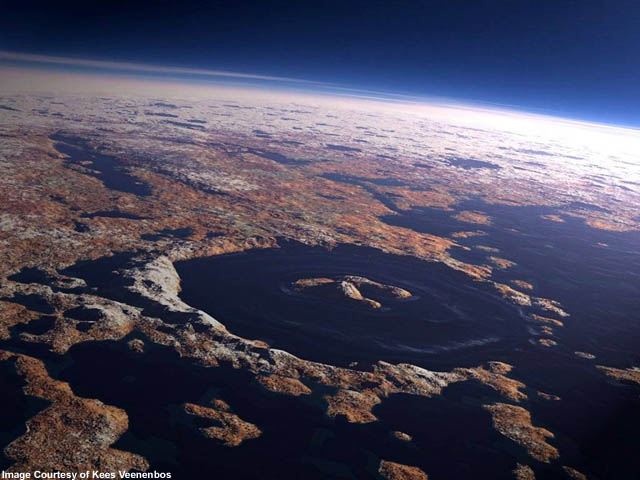
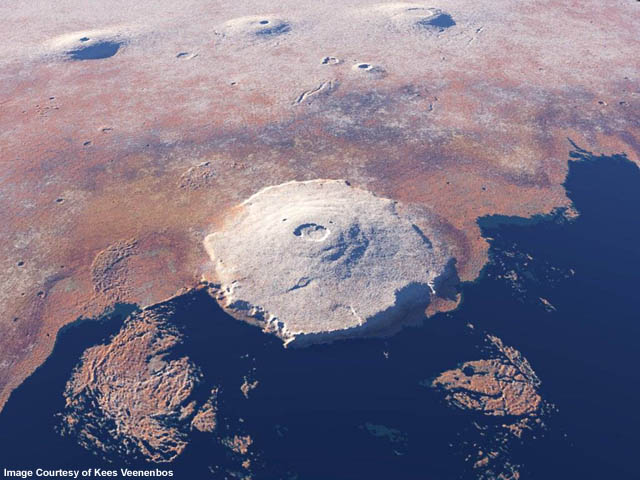
And besides, it's just plain cool to imagine what Mars might have looked like with oceans and seas. Like this:

Valles Marineris

A view down the Valles Marineris.

Or imagine sailing on these seas:

image

Or sailing up to the very base of the tallest mountain in the Solar System:

image

Posted by Buckethead Buckethead on   |   § 0

Shuttle Dead?

Murdoc has a post up on the possible fate of the Shuttle. He links to a Jeffrey Bell article that argues that after the CAIB, there is really no way that the shuttle can return to service, given the high (40%, according to Bell) likelihood that we'd lose another shuttle just doing the limited ISS-maintenance flights that are currently imagined.

The shuttle has long been everything but what NASA has claimed it to be. It is expensive, inefficient, has impossibly long turn around times, and most important, it's lethal to its crews. The fact that we will almost certainly lose Hubble due to the problems with the shuttle is an unfortunate, though predictable fact. We have not been even remotely sensible about space travel in almost a half century. (And yes, I am aware of how old the space age is.)

It's a sad fact that China and Russia - using forty year old technology - have a more robust and capable manned space flight capability than we do with our thirty year old technology. There have been no significant advances in space transportation since the shuttle flew back in '81, and that wasn't much of an advance, as Murdoc has pointed out. There are three things we need for a decent space transportation infrastructure, and we have only one of them.

We have disposable launchers that can reliably put satellites and other moderate sized, unmanned payloads into orbit, for a fairly reasonable price. The other two things are a safe and reasonably priced manned vehicle, and a heavy lift vehicle. We have known almost from the beginning of the shuttle era that despite the smoke NASA's been blowing, the shuttle is none of these things.

I simply can't believe that with all we (and the Russkies) have learned since 1961, Lockheed or Boeing could not design a simple manned capsule, even one that could do a glider reentry - in a weekend. The design studies have been done. We have better computers, materials, and everything you need to design and build space vehicles than when we did it the first time over forty years ago. A minishuttle/X24 lookalike should not take half a decade to build. And once built, there is no reason that we couldn't launch it on one of our disposable rockets.

Similarly, for a heavy lift vehicle, we already have everything we need. If you consider that the entire mass of the shuttle orbiter is in fact payload reaching orbit, why not just get rid of the orbiter and replace it with a cargo shell with shuttle main engines at the bottom? All the components have been tested, and again the design studies already completed. If we really wanted to, we could have a full-fledged, reliable, flexible and robust space transportation system in little more than a year. And we could easily save Hubble, as we could easily have saved Skylab back in '79 had we not foolishly thrown all our eggs into the shuttle basket.

And despite much thinking about it, I really have no idea why it isn't being done - aside from a few more or less paranoid conspiracy theories I'm not confortable with. It seems impossible to me that NASA could be so completely lacking even the dimmest vision of how we can get into space, especially as all the pieces are right out in full view.

More and more, I think the only answer is an end to civilian government sponsored spaceflight. Let the military develop what they need - they have a far better track record than NASA. And let private industry meet all the other needs. If we are moderately careful about how we do it, we could have an amazing change in space travel in a very short time. To be sure, government provides money that has given us what we have so far, but I think the stultifying effects of bureaucracy and central planning has done far more harm than good. Imagine what kind of computers we'd have now if NASA had been designing them.

Posted by Buckethead Buckethead on   |   § 0

Double Happiness

The Chinese have announced that next time, they're going to launch two chinkonauts into orbit. [I know I said I wouldn't use that word anymore. I lied. It makes me giggle.] The next mission, sometime in 2005, is expected to last seven to ten days. The ChiComs also reaffirmed their plans to follow up their initial manned missions with the construction of an orbital base. Which they will undoubtedly use for nefarious and inscrutable purposes. Depending on when the launch actually happens, we may or may not have a manned spaceflight program of our own.

Posted by Buckethead Buckethead on   |   § 4

The Universe Is An Equation With A Remainder.

Various news services are reporting today (here's the NY Times) that a new study by cosmologists suggests the improbable: that "dark energy" really is one of the shaping forces of the Universe.

"Dark energy" has until recently been considered little more than an update of "ether" "phlogiston" or "life essence," a convenient anomaly conjured to explain why the universe's numbers don't fit our projections. Basically, it's what keeps the weak force of gravity from sucking the universe back together again. Ever since it was discovered that the universe is expanding faster and faster over time, rather than slowing under the influence of gravity, another force has been needed to explain this. Hence, dark energy. A universal fudge of sorts.

Even stranger, the strength of the dark energy seems to conform to Einstein's most famous fudge, the "cosmological constant." Later derided by him as his biggest mistake, it was Einstein's efforts to tally his theories with the work of later physicists and cosmologists. But it seems he was right.

Nutty, nutty, nutty.

This research also bolsters the arguments of string-theory advocates, whose models predict that otherwise barren stretches of space contain massive amounts of energy vibrating in eleven dimen...

Ok. Ok. Ok. I've recently been taking mostly good-natured potshots at organized religion, since I myself am not a particulary pious person. Also, God gets used as an excuse a lot. But I ask you: what is the weirder story:

Some super-being made the Universe as humanity's playground and birthright, and two thousand years ago his son got nailed to a tree for saying how good it would be to be nice to each other for a change (with apologies to Douglas Adams). Now, that super-being and his son watch us all from another dimension, and when we die our deeds will be measured against their teachings and the good apples get a gold star.

Or: The three-dimensional physical universe sprang into being randomly as a mere manifestation of a larger host of dimensions numbering eleven in total (or maybe sixteen), and through a staggeringly improbable set of coincidences, physics, chemistry and chance combined to produce a universe neither too hot nor too cold, with just the right number of unfolded dimensions, neither too big nor too small, with juuuust the right amount of energy that some of it can lump together into stars and galaxies and yappy bichon dogs. Oh, and the numbers don't add up like they should.

I guess it's all a matter of what you choose to put your faith in.

Posted by Johno Johno on   |   § 7

Water on Mars?

That's what space.com is reporting, cautiously.

Opportunity rover sent back new images from Mars showing that small spheres previously found on the surface also exist below, in a trench the rover dug. Hints of salty water were also found in the trench, but much more analysis is needed to learn the true composition.

Meanwhile Opportunity's twin rover, Spirit, is about to dig a trench of its own in order to investigate soil that sticks to its wheels, suggesting the fine-grained material might be moist.
In a press conference today, officials said the soil at both locations could contain small amounts of water mixed with salt in a brine that can exist in liquid form at very low temperatures.

The scientists stressed that only miniscule amounts of water would be needed to create the brine.

Posted by Johno Johno on   |   § 0

Space News Potpourri

Several interesting space tidbits:

  • MSNBC is reporting that the shuttle will be grounded until at least 2005. This is both bad news and a potential opportunity. First, it means that space station personnel will need to use the Russian Soyuz to get to and from the station; and there will be no manned missions to do things like save the Hubble, or for anything else. The opportunity, which will almost certainly be passed up, is for NASA to move past the shuttle entirely, and begin a crash program to develop an efficient means of manned space flight, along several tracks:

    One, a stop gap, cheap but reliable capsule to be launched atop a disposable launcher like the Atlas - along the lines of OSP ideas. Two, restart the DCX program with exactly the same management philosophy as the original program. Build early, build often is the surest way to success. This could result in a real SSTO in a few years. And three, long range research into propulsion materials, and other technologies for new launchers in the future. Shuttle technology should be immediately converted to unmanned cargo uses, along the lines of the shuttle-c or other ideas outlined here. In my dreams.

  • Also on MSNBC, this report that there's lots of debris floating around the ISS. And a good chunk of that debris might be parts of the space station. Who'd they get to build that thing anyway, Ryan homes?
  • And finally, space.com informs us that the Russians are considering building a Soyuz 2.0. The new version would have twice the passenger capacity of the current, decades old design; and the crew section would be reusable. The Russian rocket company Energiya would need to design a new launcher, as the current Soyuz rocket would be insufficient to put the twice as heavy capsule into orbit. But hey, at least somebody's thinking ahead.

Posted by Buckethead Buckethead on   |   § 0